

Wearable Sensor-Based Human Activity Recognition with Transformer Model
Open accessPublished version of a preprint
The DOI matches its Crossref record; 44 of the 44 references it cites were found in a registry or an index.
Abstract
Computing devices that can recognize various human activities or movements can be used to assist people in healthcare, sports, or human-robot interaction. Readily available data for this purpose can be obtained from the accelerometer and the gyroscope built into everyday smartphones. Effective classification of real-time activity data is, therefore, actively pursued using various machine learning methods. In this study, the transformer model, a deep learning neural network model developed primarily for the natural language processing and vision tasks, was adapted for a time-series analysis of motion signals. The self-attention mechanism inherent in the transformer, which expresses individual dependencies between signal values within a time series, can match the performance of state-of-the-art convolutional neural networks with long short-term memory. The performance of the proposed adapted transformer method was tested on the largest available public dataset of smartphone motion sensor data covering a wide range of activities, and obtained an average identification accuracy of 99.2% as compared with 89.67% achieved on the same data by a conventional machine learning method. The results suggest the expected future relevance of the transformer model for human activity recognition.
Overview
The claims and statistics of this paper haven’t been checked yet.
Free: it reads the open-access text and checks the first 5 claims that cite a source we can check. Create a free account to check every claim.
Integrity signals
Registry
Cites
Statistics
Figures


Verification
Claims the paper makes
The claims and statistics of this paper haven’t been checked yet.
Free: it reads the open-access text and checks the first 5 claims that cite a source we can check. Create a free account to check every claim.
Claims other papers make about this one
Each is checked against this paper’s own text: does it say what the citing paper says it does?
The source backs part of the claim, not all of it — or backs it for a different population, condition or comparison.
In the citing paper
“This parallel design minimizes redundancy and improves efficiency relative to the sequential attention in [24] or the resource-intensive Transformer-based attention in [23].”
From Adaptive temporal attention mechanism and hybrid deep CNN model for wearable sensor-based human activity recognition (2025) · cites this paper as [23]
Experimental — accuracy not yet measuredThe source backs part of the claim, not all of it — or backs it for a different population, condition or comparison.
In the citing paper
“Previous studies, including [10, 18, 23, 24], have amalgamated convolutional neural networks (CNN), recurrent neural networks (RNN), and attention mechanisms;”
From Adaptive temporal attention mechanism and hybrid deep CNN model for wearable sensor-based human activity recognition (2025) · cites this paper as [23]
Experimental — accuracy not yet measuredIn the citing paper
“Moreover, replacing LSTM with BiGRU and using an optimized attention mechanism reduces computational cost, making CNNd-TAm more efficient than Transformer-based [23] and hierarchical models [19], and suitable for deployment on resource-constrained wearable devices without compromising accuracy.”
From Adaptive temporal attention mechanism and hybrid deep CNN model for wearable sensor-based human activity recognition (2025) · cites this paper as [23]
Self-check
Percentages, sums and reported differences re-computed from the paper’s own numbers.
The self-check needs the paper’s full text.
Citations
Cites
Vaswani, A., Shazeer, N., Parmar, N., Uszkoreit, J., Jones, L., Gomez, A. N., Kaiser, L., & Polosukhin, I. (2017) · arXiv · doi:10.48550/arxiv.1706.03762 · Cited by 120,404 · cited 6×
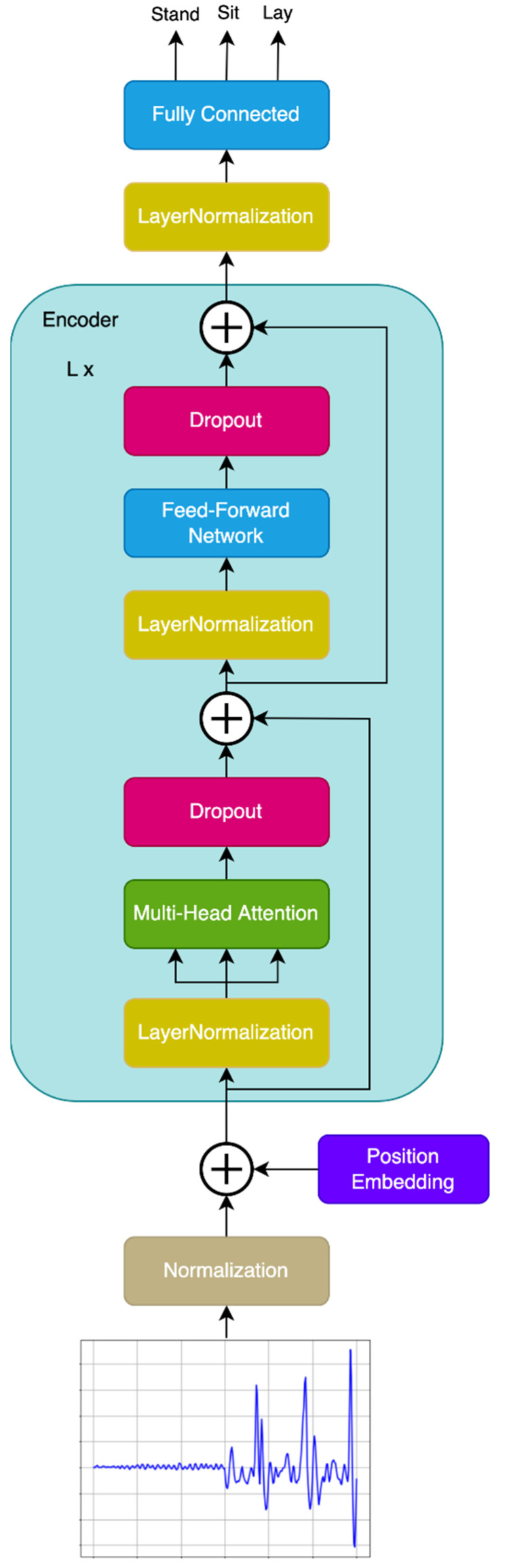
“The entry determining the position of the features within the series is also added to the network input, because the transformer does not know the order of the features, for example, within the processed sentence [34]:”
BackgroundMethodResultInfluentialExploiting Generative AI to Scale up Intelligent Tutoring Systems
Jakubův, J., Chvalovský, K., Goertzel, Z., Kaliszyk, C., Olšák, M., Piotrowski, B., Schulz, S., Suda, M., & Urban, J. (2023) · DROPS (Schloss Dagstuhl – Leibniz Center for Informatics) · doi:10.4230/lipics.itp.2023.19 · Cited by 76,658
Introducing a New Benchmarked Dataset for Activity Monitoring
Reiss, A., & Stricker, D. (2012) · 2012 16th International Symposium on Wearable Computers · doi:10.1109/iswc.2012.13 · Cited by 1,456
BEiT: BERT Pre-Training of Image Transformers
Bao, H., Dong, L., Piao, S., & Wei, F. (2021) · arXiv · doi:10.48550/arxiv.2106.08254 · Cited by 1,392
Doherty, A., Jackson, D., Hammerla, N., Plötz, T., Olivier, P., Granat, M. H., White, T., van Hees, V. T., Trenell, M. I., Owen, C. G., et al. (2017) · PLOS ONE · doi:10.1371/journal.pone.0169649 · Cited by 1,250 · cited 2×
“The dataset selected for testing is the largest currently available for smartphone motion sensor data, covering a wide range of activities [33,36–40].”
MethodMultiscale Convolutional Neural Networks for Fault Diagnosis of Wind Turbine Gearbox
Jiang, G., He, H., Yan, J., & Xie, P. (2019) · IEEE Transactions on Industrial Electronics · doi:10.1109/tie.2018.2844805 · Cited by 892 · cited 1×
“Several types of deep neural networks are typically used for time series classification of sensor signals, such as convolutional neural networks [14–16], fully convolutional neural networks [17], multiscale convolutional neural networks [18], time-LeNet [19], stacked denoising autoencoder [20], deep belief neural netw…”
MethodTransition-Aware Human Activity Recognition Using Smartphones
Reyes-Ortiz, J.-L., Oneto, L., Samà, A., Parra, X., & Anguita, D. (2016) · Neurocomputing · doi:10.1016/j.neucom.2015.07.085 · Cited by 740
Failure diagnosis using deep belief learning based health state classification
Tamilselvan, P., & Wang, P. (2013) · Reliability Engineering & System Safety · doi:10.1016/j.ress.2013.02.022 · Cited by 630 · cited 1×
“…fully convolutional neural networks [17], multiscale convolutional neural networks [18], time-LeNet [19], stacked denoising autoencoder [20], deep belief neural networks [21], Long Short-Term Memory (LSTM) deep recurrent neural network [22], echo state networks [23], or inception-ResNet [24].”
BackgroundDeep Learning in Human Activity Recognition with Wearable Sensors: A Review on Advances
Zhang, S., Li, Y., Zhang, S., Shahabi, F., Xia, S., Deng, Y., & Alshurafa, N. (2022) · Sensors · doi:10.3390/s22041476 · Cited by 625
mHealthDroid: A Novel Framework for Agile Development of Mobile Health Applications
Banos, O., Garcia, R., Holgado-Terriza, J. A., Damas, M., Pomares, H., Rojas, I., Saez, A., & Villalonga, C. (2014) · Lecture Notes in Computer Science · doi:10.1007/978-3-319-13105-4_14 · Cited by 583 · cited 3×
“The The random forest method prediction accuracy on this dataset [36] was slightly lower than deep learning methods achieved on other datasets. random forest method prediction accuracy on this dataset [36] was slightly lower than deep learning methods achieved on other datasets.”
Method
Research works printed but not linked: 1
- Dosovitskiy A. Beyer L. Kolesnikov A. Weissenborn D. Zhai X. Unterthiner T. Dehghani M. Minderer M. Heigold G. Gelly S. An image is worth 16x16 words: Transformers for image recognition at scale arXiv 2020 2010.11929
Cited by
Items 201–269 of 269
MOMOWO: Women Designers, Craftswomen, Architects and Engineers between 1918 and 1945
Groot, M., Seražin, H., Franchini, C., & Garda, E. M. (2017) · Womenʼs creativity · doi:10.3986/wocrea/1/momowo1 · Cited by 6
Tang, Y., Feng, X., Peng, L., Li, K., & Wen, L. (2023) · Advances in transdisciplinary engineering · doi:10.3233/atde230199
Human Activity Recognition for Packing Processes using CNN-biLSTM
Angulo, A., Beltrán, J., & Castro, L. A. (2023) · ACM International Joint Conference on Pervasive and Ubiquitous Computing (UbiComp) · doi:10.1145/3594739.3610735
“This mechanism is crucial for the trans-former model, where each attention head in multiple attention heads can look for a different relevance definition or correlation [8], the attention layer consists of 20 heads with dimension 64, the nowcast is added to the input of the next layer to aid…”
Multi-Phase Neural Networks with Ensemble Learning Model to Monitor Human Health ActivitiesPreprint
Dhar, J., Rana, K., Goyal, P., Alavi, A., Rana, R. K., Vo, Q. B., Mishra, S., & Mistry, S. (2023) · SSRN Electronic Journal · doi:10.2139/ssrn.4594345
Identification of the Advanced Data Exfiltration by Human Activity Recognition using Transformer
Martins, J. D. C., Castro, G. A., Souza, L. R., Weigang, L., & Costa, P. (2023) · Annual Conference of the IEEE Industrial Electronics Society (IECON) · doi:10.1109/iecon51785.2023.10312631
“Among the main researches on the application of Trans-former to classify human activities, in the context of this work, the following researchers stand out: [28] [29] [30] [31], however only two works addressed UCI-HAR dataset, [28] and [31].”
BackgroundMethodDemo Abstract: Lightweight Attention Network for Time Series Classification on Edge
Mukhopadhyay, S., Dey, S., Pal, A., & Ashwin, S. S. (2023) · ACM Conference on Embedded Networked Sensor Systems (SenSys) · doi:10.1145/3625687.3628393
“Furthermore, Time Series Transformers have been implemented in fewer applications, one of the notable ones being Human Activity Recognition [2].”
A Transformer-Based Approach to Human Posture Classification with 3D Skeleton Data
Ekemeyong, E., Zielinska, T. T., & Dutta, V. (2024) · International Workshop on Robot Motion and Control · doi:10.1109/romoco60539.2024.10604368
Janardhan, M., Neelima, A., Siri, D., Sathish Kumar, R., Balakrishna, N., Sreenivasa, N., Singasani, T. R., & Vatambeti, R. (2024) · International Research Journal of Multidisciplinary Technovation · doi:10.54392/irjmt2461 · Cited by 2
Optimising Deep Learning for Wearable Sensor-Based Fall Detection
Zhou, H., Nguyen, D., & Le‐Khac, N. (2024) · Lecture notes in networks and systems · doi:10.1007/978-3-031-74127-2_14
Bai, Y., Guan, X., Wang, Z., Zhang, R., Cheng, S., & Li, H. B. (2024) · Preprints.org · doi:10.1101/2024.12.01.626260
Footstep Localization on Badminton Court with Vibration Signals: A Pilot Study
Yang, T., Wang, W., Yan, W., & Peng, Y. (2025) · Electronics · doi:10.3390/electronics14020289
“In recent years, wearable sensor-based human activity recognition gained traction in sports sciences [12–16].”
Data Efficient Transformers for Wearable Sensor Analysis in Centralized and Federated Environments
McQuire, J., Watson, P., Wright, N., Hiden, H., & Catt, M. (2024) · IEEE International Conference on Big Data (BigData) · doi:10.1109/bigdata62323.2024.10825888
Wu, Q., Shen, J., Fan, F., Gu, Y., & Chen, Y. (2024) · IEEE Smart World Congress (SWC) · doi:10.1109/swc62898.2024.00106
“IMUs are commonly used, with studies employing feature engineering [1] and deep learning [2], [3] approaches on datasets like Opportunity [4], UTD-MHAD [5], and KU-HAR [6].”
Xiao, S., Cai, L., & Tang, C. (2025) · doi:10.36227/techrxiv.175022099.92157295/v1
GS-Transformer: A Lightweight Transformer Model for Real-Time HAR on Edge Devices
Jeong, H., Kim, T.-G., Shin, K., & Baek, Y. (2024) · IEEE Consumer Life Tech (ICLT) · doi:10.1109/iclt63507.2024.11038541
Liu, Z. (2025) · Applied and Computational Engineering · doi:10.54254/2755-2721/2025.mh24964
Tensor-Based Hidden Semi-Markov Model for CPSS User Activity Analysis and Services
Lu, Z., Yang, L. T., Azman, A., Zhou, F., Zhang, S., & Fu, X. (2025) · IEEE Transactions on Services Computing · doi:10.1109/tsc.2025.3618011 · Cited by 1
“…Adam as the optimizer, and the Multinomial Log Loss as the loss function, which are the most commonly used components in LSTM. (cid:2) Transformer [48] is a powerful deep learning architecture that excels at capturing long-range dependencies and contextual relationships, making it highly…”
Multi-Head Attention-Based 1DCNN-LSTM Networks for Human Activity Recognition
Long, L., & Jin, L. (2025) · Chinese Control Conference (CCC) · doi:10.23919/ccc64809.2025.11178726
Real-Time Human Activity Recognition Using the H2O AutoML Framework and Imbalance Handling
Gammoudi, E., Fakhry, C. E., Madkour, F., Aly, S., & Elghamrawy, S. M. (2025) · International Telecommunications Conference (ITC-Egypt) · doi:10.1109/itc-egypt66095.2025.11186554
“Lupta´kova´ et al. [3] investigated transformer models for wearable sensor-based HAR.”
Nguyen, T. D., Nguyen, H. D., Tan, T. C., Nguyen, L. A., & Truong, X. T. (2025) · Lecture notes in networks and systems · doi:10.1007/978-981-95-1746-6_66
Baskaran, P., Liu, X., Li, S., & Iba, S. (2025) · IEEE/RSJ International Conference on Intelligent Robots and Systems (IROS) · doi:10.1109/iros60139.2025.11247376 · Cited by 4
RF-ShopViT: Non-Line-of-Sight Shopping Behavior Recognition Using COTS RFID and Vision Transformer
Zhang, X., Zhang, Y., Yue, C., & Jiang, Y. (2025) · IEEE Internet of Things Journal · doi:10.1109/jiot.2025.3638708
“At present, significant progress has been made in action and behavior recognition through various approaches based on computer vision [23], wearable devices [24], and radio frequency signals [25].”
Bidirectional Transformer for Contactless Human Behavior Sensing
Zhu, Y., Liang, J., Zhang, M., & Liao, S. (2025) · IEEE World Forum on Internet of Things (WF-IoT) · doi:10.1109/wf-iot64238.2025.11270696
“The Transformer model is renowned for its ability to comprehensively capture global features in long sequential data [13], [14].”
Automated assessment of open-ended computer science questions using large language models
Ölvecký, M., Beňo, M., & Díaz, P. (2025) · International Conference on Emerging eLearning Technologies and Applications (ICETA) · doi:10.1109/iceta67772.2025.11280262
“This efficiency makes SBERT ideal for real-time educational applications, such as classifying, clustering, or retrieving student responses in automated assessment pipelines [24].”
Mahalakshmi, S., & Nagarajan, V. (2025) · International Conference on Communication, Computer, and Information Technology (IC3IT) · doi:10.1109/ic3it66137.2025.11341216 · Cited by 1
AFTR-HAR-Net: Adaptive Fusion and Temporal Reasoning Network for Robust Human Activity Recognition
Prakash, D., Joy, A. T., Bandaru, S., R, B. R. B., & Subramaniam, S. (2025) · International Conference on Mobile Networks and Wireless Communications (ICMNWC) · doi:10.1109/icmnwc66779.2025.11354371
“Iveta Dirgová Luptáková et al. [15] demonstrated Transformer Model for Wearable Sensor-Based Human Activity Recognition.”
Zuchna, N., Resch, B., & Odenwald, S. (2026) · Advances in Science, Technology & Innovation/Advances in science, technology & innovation · doi:10.1007/978-3-032-03488-5_19
Predicción de enfermedades mediante transformadores para conjuntos de datos de expresión génica
Mercy, I., & Chidambaram, M. (2025) · Revista Colombiana de Ciencias Químico Farmacéuticas · doi:10.15446/rcciquifa.v54n3.118814
Recurrent Neural Network on Human Activity Recognition Based on Latent State Space
Wu, J., & Chen, B.-Q. (2025) · IEEE International Conference on Computer and Communications (ICCC) · doi:10.1109/iccc68654.2025.11438161
Zhang, T., Yi, C.-Z., Song, Y.-H., Wei, B.-C., & Chen, Z.-B. (2026) · IEEE Sensors Journal · doi:10.1109/jsen.2026.3680607
“Early systems typically relied on handcrafted statistical or frequency-domain features and shallow classifiers [e.g., support vector machine (SVM), K-NN, and random forest (RF)] [19], [20].”
Jana, A., Adhikari, P., De, S., Bhattacharjee, S., & Singh, P. K. (2026) · Communications in computer and information science · doi:10.1007/978-3-032-17181-8_14 · Cited by 1
STORM: Hardware-Aware Tiny Transformer Co-Design for Low-Power Inertial Human Activity Recognition
Varaldi, A., Genta, C., Manzone, A., & Vacca, M. (2026) · Electronics · doi:10.3390/electronics15091924
Autonomous Human Movement Analyzer System
Mashukov, I., Chen, P., & Ding, W. (2026) · International Conference on Machine Learning and Autonomous Systems (ICMLAS) · doi:10.1109/icmlas67792.2026.11483903
“[15], [21]–[23].”
Leveraging the Sequence of Activities to Enhance Sensor-Based Human Activity RecognitionPreprint
Baraka, A. M., & Noor, M. H. M. (2026) · Research Square · doi:10.21203/rs.3.rs-9515041/v1
Neurorehabilitation and AI-Driven Cognitive Therapy
Mavai, A. S., Mishra, D. K., & Sharma, A. (2026) · Cognitive systems monographs · doi:10.1007/978-3-032-18782-6_8
Research of human motion classification algorithm with adaptive weight adjustment module
Wei, J., Qu, C., Zhou, Y., Li, F., & Qu, S. (2026) · Journal of the Brazilian Society of Mechanical Sciences and Engineering · doi:10.1007/s40430-026-06432-4
Transformer-Based Human Activity Recognition with Wearable Sensors
Fan, C., Shi, L., He, S., Liu, S., & Li, J. (2026) · Communications in computer and information science · doi:10.1007/978-981-95-9615-7_24
Optimizing Human Activity Recognition Via Transformer Encoders Using Mobile Sensor Streams
Samin, Fahim, A. M., Mim, D. A., Anim, S. M., Mirdha, M. F., & Roy, A. (2026) · IEEE International Conference on Quantum Photonics, Artificial Intelligence & Networking (QPAIN) · doi:10.1109/qpain69676.2026.11545674
“Similarly, Dirgov´a Lupt´akov´a et al. [15] evaluated Transformer models for activity recognition and reported competitive performance compared to CNN and LSTM baselines.”
Wu, Q., Chu, S., Li, K., & Wang, L. (2026) · Applied Sciences · doi:10.3390/app16126037
Attention-Guided Multi-Modal Sensor Fusion with Transformer Learning for Human Activity Recognition
S.Vinayagan, Bharath Kumara, J., Priyanka, M. S., Ram, V. S., & Kalaivani, A. (2026) · International Conference on Intelligent Systems and Computational Networks (ICISCN) · doi:10.1109/iciscn67954.2026.11566204
“Iveta Dirgová Luptáková et al. [15] demonstrated Transformer Model for Wearable Sensor-Based Human Activity Recognition.”
EgoInertia-MI: A Multimodal Egocentric Vision and IMU Benchmark for Motor Impairment Assessment
Alhamdoosh, F., Pala, P., Mohamed, A., & Arvind, D. (2026) · Lecture notes in computer science · doi:10.1007/978-3-032-39379-1_13
Madhan, S., & Rajakumari, S. B. (2026) · International Conference on Electrical and Electronics for Sustainable Innovations (ICEESI) · doi:10.1109/iceesi68020.2026.11583589
“Types of Classifiers Advantage Disadvantage [1] Linear Classifiers [11] The processing of datasets is fast and it is computationally efficient.”
Mekruksavanich, S., & Jitpattanakul, A. (2026) · Procedia Computer Science · doi:10.1016/j.procs.2026.05.091
CW-PITN: Cross-Attention Fusion of WiFi and Wearable Signals for Rehabilitation Action Recognition
Zha, W., Gu, F., & Wu, J. (2026) · Lecture notes in computer science · doi:10.1007/978-981-92-3400-4_43
A Lightweight Hybrid Neural Network for Multimodal Human Activity Recognition
Kumar, S. S., Vemulapalli, V., Pravallika, S., Raju, B. N. V. N., Krishna, B. L. V. S. R., & Vikruthi, S. (2026) · International Conference on Innovations in Cybersecurity and Data Science (ICICDS) · doi:10.1109/icicds70526.2026.11604632
“Researchers have successfully adapted Transformers which use self-attention mechanisms for natural language processing to develop powerful methods for wearable sensor-based human activity recognition which enable efficient sequence modeling through parallel processing [8].”
GADF-enhanced global–local feature network for wearable sensor-based cow behavior recognition
Wang, C. (2026) · Frontiers in Veterinary Science · doi:10.3389/fvets.2026.1872214
Efficient and Adaptive Human Activity Recognition via LLM Backbones
Bredikhin, A., Lalanda, P., & Vega, G. (2026) · IEEE International Conference on Smart Computing · doi:10.1109/smartcomp69968.2026.00022
Unsupervised Sensor-Based Human Activity Recognition via Contrastive Learning of Representation
Wang, K., Li, Z., Zhang, L., Gao, Q., & Wang, Z. (2026) · IEEE Internet of Things Journal · doi:10.1109/jiot.2026.3719110
“For example, Lupt´akov´a et al. [35] and Xiao et al. [36] employed self-attention mechanisms to model long-range temporal dependencies in multivariate sensor streams, showcasing the potential of attention-based models in this domain.”
Shen, Z., Gao, B., & Shi, M. (2026) · World Congress on Medical Physics and Biomedical Engineering, September 7 - 12, 2009, Munich, Germany · doi:10.1007/978-3-032-20291-8_18
Sindhu, S., Srividhya, S., Rajaram, V., & Suresh, K. (2026) · International Journal of Online and Biomedical Engineering (iJOE) · doi:10.3991/ijoe.v22i08.62334
157Chapter 12 Wearable Sensor Technologies for Chronic Pain Management
Barisal, S. K., Sudharsan, M., & Karunakaran, M. (2026) · De Gruyter eBooks · doi:10.1515/9783112237083-012
Wu, B. (2026) · IEEE Internet of Things Journal · doi:10.1109/jiot.2026.3725660
“Self-attention and trans-former models extend this idea to longer-range dependencies in wearable streams [19], [20].”
Mekruksavanich, S., & Jitpattanakul, A. (2026) · Computers · doi:10.3390/computers15090595
“Four of them are representative deep learning architectures for time-series HAR: TCN [7], DeepConvLSTM [6], InceptionTime [8], and a Transformer-based encoder [9].”
Mekruksavanich, S., Phaphan, W., & Jitpattanakul, A. (2026) · International Conference on Big Data Analytics and Practices (IBDAP) · doi:10.1109/ibdap69915.2026.11677994
“Transformers have also reached the wearable time-series domain: Dirgov´a Lupt´akov´a et al. [31] attained 99.2% accuracy on a large motion dataset with a self-attention transformer, and CSNet [32], [33] fused convolutional inductive biases with global attention to outperform both pure CNN and…”
InfluentialZhou, Q., Zhang, Y., Imani, F., & Tang, J. (2026) · Journal of Manufacturing Systems · doi:10.1016/j.jmsy.2026.09.002
Heterogeneous Feature Encoding and Multi-Scale Temporal Fusion for Air Target Intent Recognition
Song, Q., Wu, X., Lang, H., Chen, L., Ma, J., & Li, H. (2026) · Aerospace · doi:10.3390/aerospace13090823
Mekruksavanich, S., Phaphan, W., & Jitpattanakul, A. (2026) · International Conference on Big Data Analytics and Practices (IBDAP) · doi:10.1109/ibdap69915.2026.11677760
“Transformers were also adopted directly for inertial recognition [4], for wearable sensor data [25], and with convolutional feature extraction plus relative position embedding [26].”
ActNet: focus-aware multi-scale CNN for human activity recognition from images
Kılıç, Ş. (2026) · PeerJ Computer Science · doi:10.7717/peerj-cs.3990
Gu, Z., Yang, R., Shi, Y., Dai, D., Li, C., Huang, B., Jiao, K., Tao, Y., Wen, Y., Zhong, Y., et al. (2026) · Sensors · doi:10.3390/s26185838
What is Attention Mechanism? A Comprehensive Survey of Attention Methods and Transformer Models
Shiri, F. M., Memar, F., & Parhizgar, M. (2026) · Machine Learning · doi:10.1007/s10994-026-07131-w
Xie, D., Yan, P., Li, Y., Wang, Q., & Liu, J. (2026) · Sensors · doi:10.3390/s26185879
“[17] introduced attention mechanisms into SHAR to capture inter-signal dependencies within time-series data.”
Zhou, L., & Wang, P. (2026) · Systems and Soft Computing · doi:10.1016/j.sasc.2026.200641
Activity recognition via Riemannian optimization and multimodal Transformers
Soleimani, F., Khodabandelou, G., Chibani, A., & Amirat, Y. (2026) · Machine Learning with Applications · doi:10.1016/j.mlwa.2026.101021
Pan, Y., Zhao, Z., & Xu, Y. (2026) · Sensors · doi:10.3390/s26196139
“Transformer-based models further improve global sequence modeling through attention, but the quadratic cost of self-attention and its weaker built-in bias for adjacent time samples can be unattractive for mobile inference [10,11].”
Open-ended Human Activity Understanding via LLM-assisted Motion Decomposition and Semantic Fusion
Wei, Q., Hu, K., Huang, J., Guo, C. C., Gao, Y., & Dong, W. (2026) · Proceedings of the ACM on Interactive Mobile Wearable and Ubiquitous Technologies · doi:10.1145/3831643 · Cited by 2
AutoResearcHAR: A Multi-Agent Framework for Dataset Adaptive IMU Based Human Activity Recognition
Ray, L. S. S., Rey, V. F., Bian, S., Suh, S., Lukowicz, P., & Zhou, B. (2026) · ACM International Symposium on Wearable Computers (ISWC) · doi:10.1145/3830727.3834823
Isa, W. H. M., Salbani, M. F., Abdullah, M. A., Razman, M. A. M., Khairuddin, I. M., Yahya, N. M., Nasir, A. F. A., Musa, R. M., & Majeed, A. P. P. A. (2026) · IEEE Access · doi:10.1109/access.2026.3739227
“Related wearable human-activity-recognition studies also indicate that attention mechanisms, transfer learning, and multi-sensor fusion can improve robustness when signals are noisy, heterogeneous, or collected from multiple body locations [22], [23], [24], [25], [26].”
Ena, A., Olmedo, J. J. S., Mazzà, C., Belachew, S. M., & Reyes, Ó. (2026) · Sensors · doi:10.3390/s26206582
“However, their applications have primarily focused on activity recognition [56], gait identity recognition [58], and the detection of clinical events such as Freezing of Gait [59], rather than on the localization of individual gait events.”
Metadata
- Authors
- Dirgová Luptáková, I., Kubovčík, M., & Pospíchal, J.
- Affiliations
- Department of Applied Informatics, Faculty of Natural Sciences, University of Ss. Cyril and Methodius, J. Herdu 2, 917 01 Trnava, Slovakia
- University of Ss. Cyril and Methodius in Trnava (SK)
- Venue
- Sensors
- Publisher
- MDPI AG
- Published
- 2022-03-01
- Volume
- 22
- Issue
- 5
- Pages
- 1911
- ISSN
- 1424-8220 (ISSN-L)
- PMC
- PMC8914677
- OpenAlex
- W4214843096
- Cited by
- 270
- References
- 42
- Citations by year
- 2026: 60 · 2025: 54 · 2024: 64 · 2023: 47 · 2022: 16
- FWCI
- 14.80
- Type
- journal article
- Language
- en
- Open access
- gold
- doi.org
- Licence
- Locations
- Sensors (publishedVersion, cc-by)
- Preprints.org (acceptedVersion, cc-by)
- PubMed Central (publishedVersion, cc-by)
- PubMed (publishedVersion)
- DOAJ (DOAJ: Directory of Open Access Journals) (submittedVersion, cc-by-sa)
- Funders
- Slovak Research and Development Agency (APVV-17-0116)
- Cultural and Educational Grant Agency MŠVVaŠ SR (KEGA 012UCM-4/2021)
- Topics
- Physical Sciences › Computer Science › Computer Vision and Pattern Recognition › Context-Aware Activity Recognition Systems
- Physical Sciences › Computer Science › Signal Processing › Time Series Analysis and Forecasting
- Physical Sciences › Engineering › Biomedical Engineering › Gait Recognition and Analysis
- Keywords
- human activity recognition, wearable sensors, smartphone motion sensors, accelerometer, gyroscope, transformer models, self-attention, time series classification, motion signals
- MeSH terms
- Machine Learning, Wearable Electronic Devices, Algorithms, Humans, Human Activities, Neural Networks, Computer
About these checks
Registry, retraction, Cites and statistics results are computed, not judged, with one exception: a printed reference that no index lists is read once by a model before it counts as a citation error. Claims are extracted by a model and kept only when their quote appears verbatim in the text; each cited source is then checked, with a model’s help, for whether it says what the claim relies on. Those verdicts can be wrong — read the claim’s quote and the cited source before relying on one.
Statistics and arithmetic are recomputed, not judged.
Confidence bands are shown only for fields calibrated on our annotated test set. None is calibrated yet, so no band is shown.
What counts as a claim ›How we measure confidence ›How we check this ›
Are you an author, or do you see a problem with this page? Request a review
Data sources
Bibliographic data: Semantic Scholar, OpenAlex, Crossref.
Contains information from the Semantic Scholar Academic Graph Datasets, made available under the ODC Attribution License (ODC-BY 1.0).
Semantic Scholar’s data is described in: Kinney, R., et al. (2023). The Semantic Scholar Open Data Platform. arXiv:2301.10140.
