

Towards a Practical Implementation of a Single-Beam All-Optical Non-Zero-Field Magnetic Sensor for Magnetoencephalographic Complexes
Open accessThe DOI matches its Crossref record; 43 of the 43 references it cites were found in a registry or an index.
Abstract
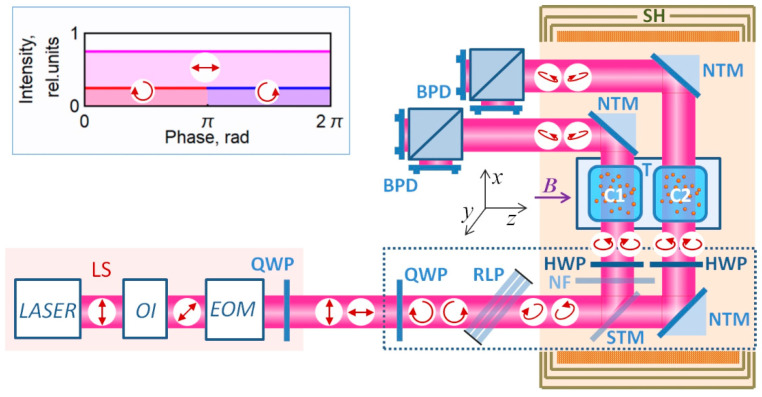
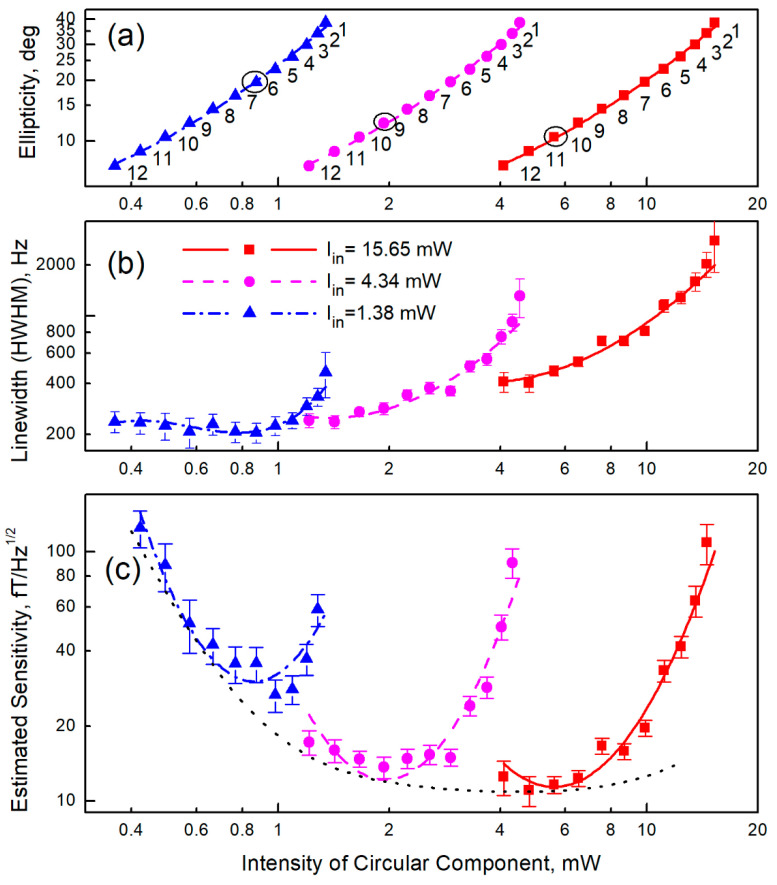
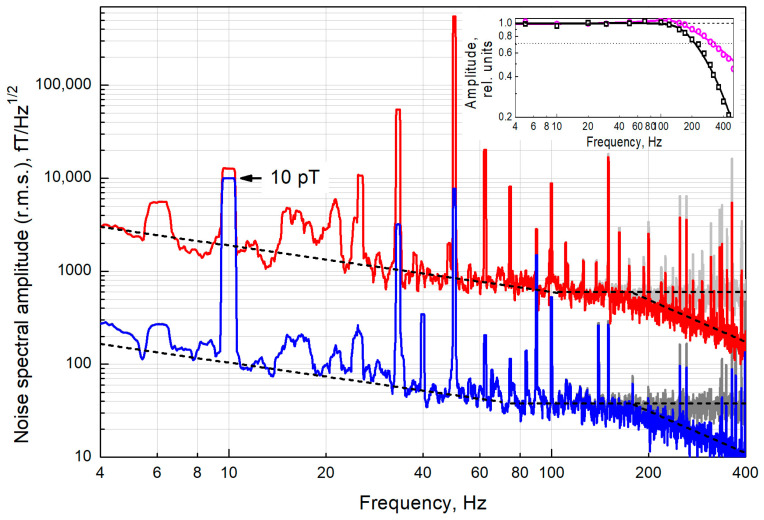
We present a single-beam all-optical two-channel magnetic sensor scheme developed for biological applications such as non-zero-field magnetoencephalography and magnetocardiography. The pumping, excitation and detection of magnetic resonance in two cells are performed using a single laser beam with time-modulated linear polarization: the linear polarization of the beam switches to orthogonal every half-cycle of the Larmor frequency. Light with such characteristics can be transmitted over a single-mode polarization-maintaining fiber without any loss in the quality of the polarization characteristics. We also present an algorithm for calculating optical elements in a sensor scheme, the results of measuring the parametric dependences of magnetic resonance in cells, and the results of direct testing of a sensor in a magnetic shield. We demonstrate sensitivity at the level of 20 fT/√Hz in one sensor channel in the frequency range of 80-200 Hz.
Overview
The claims and statistics of this paper haven’t been checked yet.
Free: it reads the open-access text and checks the first 5 claims that cite a source we can check. Create a free account to check every claim.
Integrity signals
Registry
Cites
Statistics
Figures
Verification
Claims the paper makes
The claims and statistics of this paper haven’t been checked yet.
Free: it reads the open-access text and checks the first 5 claims that cite a source we can check. Create a free account to check every claim.
Claims other papers make about this one
Each is checked against this paper’s own text: does it say what the citing paper says it does?
The source backs part of the claim, not all of it — or backs it for a different population, condition or comparison.
In the citing paper
“Both technologies have also proven sufficiently sensitive for unshielded MEG and brain source localization using an array of scalar OPMs in the presence of a large background field (280–284).”
From Clinical magnetocardiography: the unshielded bet—past, present, and future (2023) · cites this paper as [284]
Experimental — accuracy not yet measuredThe check wasn’t confident either way, so it gives no verdict — never disputed.
In the citing paper
“Indeed, a large body of literature has provided evidence that MCG enhances the non-invasive diagnostic and prognostic capability in numerous clinical fields, such as but not limited to the earlier detection of (sometimes electrically silent) myocardial ischemia (59, 88, 90, 323, 319), the preventive arrhythmogenic risk assessment in adults (53, 225, 325–322) as well as in fetuses (83, 323, 324),”
From Clinical magnetocardiography: the unshielded bet—past, present, and future (2023) · cites this paper as [319]
Experimental — accuracy not yet measured
Self-check
Percentages, sums and reported differences re-computed from the paper’s own numbers.
The self-check needs the paper’s full text.
Citations
Cites
Hämäläinen, M., Hari, R., Ilmoniemi, R. J., Knuutila, J., & Lounasmaa, O. V. (1993) · Reviews of Modern Physics · doi:10.1103/revmodphys.65.413 · Cited by 4,684 · cited 12×
“The obvious solution is to use a separate EOM in each sensor, which can significantly increase the cost of a multichannel MEG complex.”
BackgroundInfluentialBudker, D., & Romalis, M. (2007) · Nature Physics · doi:10.1038/nphys566 · Cited by 1,916
A subfemtotesla multichannel atomic magnetometer
Kominis, I. K., Kornack, T. W., Allred, J. C., & Romalis, M. V. (2003) · Nature · doi:10.1038/nature01484 · Cited by 1,631
Moving magnetoencephalography towards real-world applications with a wearable system
Boto, E., Holmes, N., Leggett, J., Roberts, G., Shah, V., Meyer, S. S., Muñoz, L. D., Mullinger, K. J., Tierney, T. M., Bestmann, S., et al. (2018) · Nature · doi:10.1038/nature26147 · Cited by 1,377
Resonant nonlinear magneto-optical effects in atoms
Budker, D., Gawlik, W., Kimball, D. F., Rochester, S. M., Yashchuk, V. V., & Weis, A. (2002) · Reviews of Modern Physics · doi:10.1103/revmodphys.74.1153 · Cited by 809 · cited 1×
“Finally, we detect MR at the transition F = I + 1/2, mF = F↔ F – 1 of the ground state by rotating the polarization angle of the linearly polarized (π) radiation component [35,36].”
BackgroundCohen, D. (1972) · Science · doi:10.1126/science.175.4022.664 · Cited by 785 · cited 1×
“The application of these sensors to MEG problems has shaken the long-term monopoly of superconducting SQUID (superconducting quantum interference device) systems [6,7] and made it possible to overcome their inherent limitations.”
BackgroundBoto, E., Meyer, S. S., Shah, V., Alem, O., Knappe, S., Kruger, P., Fromhold, T. M., Lim, M., Glover, P. M., Morris, P. G., et al. (2017) · NeuroImage · doi:10.1016/j.neuroimage.2017.01.034 · Cited by 471
Optically pumped magnetometers: from quantum origins to multi-channel magnetoencephalography
Tierney, T. M., Holmes, N., Mellor, S., López, J. D., Roberts, G., Hill, R. M., Boto, E., Leggett, J., Shah, V., Brookes, M. J., et al. (2019) · NeuroImage · doi:10.1016/j.neuroimage.2019.05.063 · Cited by 400
Optically Driven Spin Precession
Bell, W. E., & Bloom, A. L. (1961) · Physical Review Letters · doi:10.1103/physrevlett.6.280 · Cited by 366 · cited 1×
“Third, we use a modification of the Mx design, known as the Bell–Bloom scheme [4,32].”
MethodSensitive magnetometry based on nonlinear magneto-optical rotation
Budker, D., Kimball, D. F., Rochester, S. M., Yashchuk, V. V., & Zolotorev, M. (2000) · Physical Review A · doi:10.1103/physreva.62.043403 · Cited by 335 · cited 1×
“Finally, we detect MR at the transition F = I + 1/2, mF = F↔ F – 1 of the ground state by rotating the polarization angle of the linearly polarized (π) radiation component [35,36].”
BackgroundMeasuring MEG Closer to the Brain: Performance of on-Scalp Sensor Arrays
Iivanainen, J., Stenroos, M., & Parkkonen, L. (2017) · NeuroImage · doi:10.1016/j.neuroimage.2016.12.048 · Cited by 296
Principles of Operation of the Rubidium Vapor Magnetometer
Bloom, A. L. (1962) · Applied Optics · doi:10.1364/ao.1.000061 · Cited by 282
Portable Magnetometry for Detection of Biomagnetism in Ambient Environments
Limes, M. E., Foley, E. L., Kornack, T. W., Caliga, S., McBride, S., Braun, A., Lee, W., Lucivero, V. G., & Romalis, M. V. (2020) · Physical Review Applied · doi:10.1103/physrevapplied.14.011002 · Cited by 257
Modulation of a Light Beam by Precessing Absorbing Atoms
Dehmelt, H. G. (1957) · Physical Review · doi:10.1103/physrev.105.1924 · Cited by 227
Recording brain activities in unshielded Earth’s field with optically pumped atomic magnetometers
Zhang, R., Xiao, W., Ding, Y., Feng, Y., Peng, X., Shen, L., Sun, C., Wu, T., Wu, Y., Yang, Y., et al. (2020) · Science Advances · doi:10.1126/sciadv.aba8792 · Cited by 222
Lee, S.-K., & Romalis, M. V. (2008) · Journal of Applied Physics · doi:10.1063/1.2885711 · Cited by 170 · cited 2×
“According to [43], in our cylindrical shield, in which the radius of the inner shell made of steel is a = 17 cm, the thermal noise amplitude should be ~23 fT/ √ Hz.”
BackgroundA high-sensitivity laser-pumped Mx magnetometer
Groeger, S., Bison, G., Schenker, J.-L., Wynands, R., & Weis, A. (2006) · The European Physical Journal D · doi:10.1140/epjd/e2006-00037-y · Cited by 164
Light narrowing of rubidium magnetic-resonance lines in high-pressure optical-pumping cells
Appelt, S., Ben-Amar Baranga, A., Young, A. R., & Happer, W. (1999) · Physical Review A · doi:10.1103/physreva.59.2078 · Cited by 142 · cited 1×
“William Happer called this state “end-state” or “stretched”, and showed [33] that the spin-exchange rate in this state can decrease significantly.”
BackgroundSensitive magnetometry in challenging environments
Fu, K. C., Iwata, G. Z., Wickenbrock, A., & Budker, D. (2020) · AVS Quantum Science · doi:10.1116/5.0025186 · Cited by 132
Light-narrowed optically pumped Mx magnetometer with a miniaturized Cs cell
Scholtes, T., Schultze, V., IJsselsteijn, R. P. J., Woetzel, S., & Meyer, H. ‐. (2011) · Physical Review A · doi:10.1103/physreva.84.043416 · Cited by 127
Nonlinear Magneto-optical Rotation via Alignment-to-Orientation Conversion
Budker, D., Kimball, D. F. J., Rochester, S., & Yashchuk, V. V. (2000) · Physical Review Letters · doi:10.1103/physrevlett.85.2088 · Cited by 120
A 90-Channel Triaxial Magnetoencephalography System Using Optically Pumped Magnetometers
Rea, M., Boto, E., Holmes, N., Hill, R., Osborne, J., Rhodes, N., Leggett, J., Rier, L., Bowtell, R., Shah, V., et al. (2022) · Annals of the New York Academy of Sciences · doi:10.1111/nyas.14890 · Cited by 102
Potential of on‐scalp MEG: Robust detection of human visual gamma‐band responses
Iivanainen, J., Zetter, R., & Parkkonen, L. (2020) · Human Brain Mapping · doi:10.1002/hbm.24795 · Cited by 99
Atomic magnetic resonance induced by amplitude-, frequency-, or polarization-modulated light
Grujić, Z. D., & Weis, A. (2013) · Physical Review A · doi:10.1103/physreva.88.012508 · Cited by 90 · cited 1×
“Third, we use a modification of the Mx design, known as the Bell–Bloom scheme [4,32].”
MethodNardelli, N. V., Perry, A. R., Krzyzewski, S. P., & Knappe, S. A. (2020) · EPJ Quantum Technology · doi:10.1140/epjqt/s40507-020-00086-4 · Cited by 85
An Optically Pumped Magnetometer Working in the Light-Shift Dispersed Mz Mode
Schultze, V., Schillig, B., IJsselsteijn, R. P. J., Scholtes, T., Woetzel, S., & Stolz, R. (2017) · Sensors · doi:10.3390/s17030561 · Cited by 76
Transforming and comparing data between standard SQUID and OPM-MEG systems
Marhl, U., Jodko-Władzińska, A., Brühl, R., Sander, T. H., & Jazbinšek, V. (2022) · PLoS ONE · doi:10.1371/journal.pone.0262669 · Cited by 70 · cited 1×
“The application of these sensors to MEG problems has shaken the long-term monopoly of superconducting SQUID (superconducting quantum interference device) systems [6,7] and made it possible to overcome their inherent limitations.”
BackgroundFemtotesla Nearly-Quantum-Noise-Limited Pulsed Gradiometer at Earth-Scale Fields
Lucivero, V. G., Lee, W., Limes, M. E., Foley, E. L., Kornack, T. W., & Romalis, M. V. (2022) · Physical Review Applied · doi:10.1103/physrevapplied.18.l021001 · Cited by 61
Single-Beam All-Optical Nonzero-Field Magnetometric Sensor for Magnetoencephalography Applications
Petrenko, M. V., Pazgalev, A. S., & Vershovskii, A. K. (2021) · Physical Review Applied · doi:10.1103/physrevapplied.15.064072 · Cited by 40 · cited 9×
“sensor is built in accordance with the principles we outlined earlier in [25,26]; it meets the MEG requirements for all the main parameters, namely, for sensitivity, speed and ability to function without creating RF interference to adjacent sensors.”
BackgroundMethodSelf-citationPerry, A. R., Bulatowicz, M. D., Larsen, M., Walker, T. G., & Wyllie, R. (2020) · Optics Express · doi:10.1364/oe.408486 · Cited by 39
A study of scalar optically-pumped magnetometers for use in magnetoencephalography without shielding
Clancy, R. J., Gerginov, V., Alem, O., Becker, S., & Knappe, S. (2021) · Physics in Medicine & Biology · doi:10.1088/1361-6560/ac18fb · Cited by 37 · cited 1×
“The possibilities and prospects for the use of scalar non-zero-field optical magnetometers (the class to which the sensor presented in this work belongs) were studied in [20] and partially in [23].”
BackgroundLight Scattering Reviews 4: Single Light Scattering and Radiative Transfer
Kokhanovsky, A. A. (2009) · Springer eBooks · doi:10.1007/978-3-540-74276-0 · Cited by 32
Guo, Y., Wan, S., Sun, X., & Qin, J. (2019) · Applied Optics · doi:10.1364/ao.58.000734 · Cited by 29
Towards the Non-Zero Field Cesium Magnetic Sensor Array for Magnetoencephalography
Petrenko, M. V., Dmitriev, S. P., Pazgalev, A. S., Ossadtchi, A. E., & Vershovskii, A. K. (2021) · IEEE Sensors Journal · doi:10.1109/jsen.2021.3089455 · Cited by 26
Self-citationПопов, Е. Н., Bobrikova, V. A., Voskoboinikov, S. P., Баранцев, К. А., Ustinov, S. M., Litvinov, A. N., Vershovskii, A. K., Dmitriev, S. P., Kartoshkin, V. A., Pazgalev, A. S., et al. (2018) · Journal of Experimental and Theoretical Physics Letters · doi:10.1134/s0021364018200122 · Cited by 25 · cited 4×
“Second, we use combined (hyperfine + Zeeman) pumping, first proposed in [30] and theoretically justified in [31].”
BackgroundMethodSelf-citationOptically Pumped Magnetometers for Biomagnetic Measurements
Romalis, M. V. (2022) · Springer eBooks · doi:10.1007/978-3-031-05363-4_1 · Cited by 19
Polarization-maintaining fibers
Kaminow, I. P. (1984) · Flow Turbulence and Combustion · doi:10.1007/bf00382456 · Cited by 18
All-Optical Magnetometric Sensor for Magnetoencephalography and Ultralow Field Tomography
Vershovskii, A. K., Pazgalev, A. S., & Petrenko, M. V. (2020) · Technical Physics Letters · doi:10.1134/s1063785020090126 · Cited by 12 · cited 1×
“Indeed, as the pump intensity increases, the broadening of the magnetic resonance is preceded by its narrowing [34], which makes it possible to bring the sensitivity of the nonzero field sensor closer to that of the SERF sensor to some extent.”
BackgroundSelf-citationLiang, A., Wu, H., Ma, Y., Liang, X., Jia, Y., Gao, Y., Ning, X., & Fang, J. (2021) · IEEE Access · doi:10.1109/access.2021.3063054 · Cited by 12 · cited 12×
“The obvious solution is to use a separate EOM in each sensor, which can significantly increase the cost of a multichannel MEG complex.”
BackgroundInfluentialMethods of Parametric Resonance Excitation in the Scheme of an Optical Magnetometric Sensor
Vershovskii, A. K., & Petrenko, M. V. (2021) · Technical Physics · doi:10.1134/s106378422105025x · Cited by 8 · cited 4×
“The influence of the od lation shape in the standard two-beam Bell–Bloom scheme was studied in [40], and it was shown that although rectangular modulation leads to a slight broadening of the MR signal, it nevertheless allows values close to the ultimate sensitivity to be reached; however, the assumption that this is a…”
BackgroundMethodSelf-citationPetrenko, M. V., Pazgalev, A. S., & Vershovskii, A. K. (2021) · IEEE Magnetics Letters · doi:10.1109/lmag.2021.3132851 · Cited by 2 · cited 1×
“sensor is built in accordance with the principles we outlined earlier in [25,26]; it meets the MEG requirements for all the main parameters, namely, for sensitivity, speed and ability to function without creating RF interference to adjacent sensors.”
MethodSelf-citationFiber-Coupled OPM in Purely Coil-Shielded Environment
Wu, T., Peng, X., Chen, J., & Guo, H. M. (2022) · Springer eBooks · doi:10.1007/978-3-031-05363-4_9 · Cited by 2
Optical Magnetometric Sensor for Magnetoencephalographic Complexes
Vershovskii, A. K., & Petrenko, M. V. (2023) · Technical Physics Letters · doi:10.1134/s1063785023900601 · Cited by 2
Self-citation
Research works printed but not linked: 1
- Born M. Wolf E. Principles of Optics: Electromagnetic Theory of Propagation, Interference and Diffraction of Light Elsevier Amsterdam, The Netherlands 2013
Cited by
Clinical magnetocardiography: the unshielded bet—past, present, and future
Brisinda, D., Fenici, P., & Fenici, R. (2023) · Frontiers in Cardiovascular Medicine · doi:10.3389/fcvm.2023.1232882 · Cited by 80
All-Optical Nonzero-Field Vector Magnetic Sensor for Magnetoencephalography
Petrenko, M. V., Pazgalev, A. S., & Vershovskii, A. K. (2023) · Physical Review Applied · doi:10.1103/physrevapplied.20.024001 · Cited by 15
“6 pT/Hz 1/2 [37] (which is about five times the noise of the transverse field components), a direct measurement of the real signal-tonoise ratio and the real scalar sensitivity of the sensor is possible only in the gradiometric scheme [37,38].”
BackgroundSelf-citationFenici, R., Picerni, M., Fenici, P., & Brisinda, D. (2026) · Sensors · doi:10.3390/s26041369 · Cited by 6
“These and other innovative OPM sensors have already been successfully applied to unshielded magnetoencephalographic recordings [74–78].”
Mamatov, A., Sotvoldiyev, X., Talipov, M., Shaumarov, S., Gafarbayli, K., & Bekmirzaev, D. (2026) · Vibroengineering PROCEDIA · doi:10.21595/vp.2026.26360 · Cited by 3
“Low-cost MEMS accelerometers have made it feasible to instrument large numbers of structures [5, 6, 15].”
Mastropietro, A., Rivolta, M. W., & Scano, A. (2023) · Sensors · doi:10.3390/s23167063
“The paper “Towards a Practical Implementation of a Single-Beam All-Optical NonZero-Field Magnetic Sensor for Magnetoencephalographic Complexes” [11] introduces a single-beam all-optical two-channel magnetic sensor scheme developed for non-zerofield magnetoencephalography and magnetocardiography applications.”
Background
Metadata
- Authors
- Petrenko, M., & Vershovskii, A.
- Affiliations
- Russian Academy of Sciences (RU)
- Corresponding author
- Vershovskii, Anton
- Venue
- Sensors
- Publisher
- MDPI AG
- Published
- 2022-12-15
- Volume
- 22
- Issue
- 24
- Pages
- 9862
- ISSN
- 1424-8220 (ISSN-L)
- PMC
- PMC9784752
- OpenAlex
- W4311791465
- Cited by
- 6
- References
- 43
- Citations by year
- 2026: 3 · 2023: 3
- FWCI
- 0.31
- Type
- journal article
- Language
- en
- Open access
- gold
- doi.org
- Licence
- Locations
- Sensors (publishedVersion, cc-by)
- PubMed Central (publishedVersion, cc-by)
- PubMed (publishedVersion)
- DOAJ (DOAJ: Directory of Open Access Journals) (submittedVersion, cc-by-sa)
- Funders
- Russian Foundation for Basic Research (19-29-10004)
- Topics
- Physical Sciences › Physics and Astronomy › Atomic and Molecular Physics, and Optics › Atomic and Subatomic Physics Research
- Physical Sciences › Engineering › Electrical and Electronic Engineering › Magnetic Field Sensors Techniques
- Physical Sciences › Chemistry › Spectroscopy › Electron Spin Resonance Studies
- Keywords
- magnetocardiography, polarization-maintaining fiber, optically detected magnetic resonance, sensor sensitivity
- MeSH terms
- Light, Magnetics, Magnetoencephalography, Magnetocardiography, Optical Devices
About these checks
Registry, retraction, Cites and statistics results are computed, not judged, with one exception: a printed reference that no index lists is read once by a model before it counts as a citation error. Claims are extracted by a model and kept only when their quote appears verbatim in the text; each cited source is then checked, with a model’s help, for whether it says what the claim relies on. Those verdicts can be wrong — read the claim’s quote and the cited source before relying on one.
Statistics and arithmetic are recomputed, not judged.
Confidence bands are shown only for fields calibrated on our annotated test set. None is calibrated yet, so no band is shown.
What counts as a claim ›How we measure confidence ›How we check this ›
Are you an author, or do you see a problem with this page? Request a review
Data sources
Bibliographic data: Semantic Scholar, OpenAlex, Crossref.
Contains information from the Semantic Scholar Academic Graph Datasets, made available under the ODC Attribution License (ODC-BY 1.0).
Semantic Scholar’s data is described in: Kinney, R., et al. (2023). The Semantic Scholar Open Data Platform. arXiv:2301.10140.
