

The DOI matches its Crossref record; 44 of the 44 references it cites were found in a registry or an index; 2 of the 6 sources its claims cite were checked for support.
A High-Precision Vehicle Detection and Tracking Method Based on the Attention Mechanism
Open accessAbstract
Vehicle detection and tracking technology plays an important role in intelligent transportation management and control systems. This paper proposes a novel vehicle detection and tracking method for small target vehicles to achieve high detection and tracking accuracy based on the attention mechanism. We first develop a new vehicle detection model (YOLOv5-NAM) by adding the normalization-based attention module (NAM) to the classical YOLOv5s model. By exploiting the YOLOv5-NAM model as the vehicle detector, we then propose a real-time small target vehicle tracking method (JDE-YN), where the feature extraction process is embedded in the prediction head for joint training. Finally, we present extensive experimental results to verify our method on the UA-DETRAC dataset and to demonstrate that the method can effectively detect small target vehicles in real time. It is shown that compared with the original YOLOv5s model, the mAP value of the YOLOv5-NAM vehicle detection model is improved by 1.6%, while the MOTA value of the JDE-YN method improved by 0.9% compared with the original JDE method.
Overview
CoChat Summary
## TL;DR
This paper proposes a vehicle detection-and-tracking pipeline for small targets by adding a normalization-based attention module to YOLOv5s and combining it with a joint detection/tracking method. On UA-DETRAC, the authors report that detection mAP improves by 1.6%, tracking MOTA improves by 0.9%, and vehicle identity switches drop by 15%.
## Key findings
- The proposed YOLOv5-NAM detector improves mAP over YOLOv5s by 1.6% overall on UA-DETRAC; the paper also reports 1.4% improvement from NAM alone and 0.2% more from SD-NMS.
- For single-class detection on UA-DETRAC, the paper reports AP gains of 0.3% for cars, 2.7% for buses, 3.6% for other vehicles, while vans slightly decreased; with both NAM and SD-NMS, overall mAP improved by 1.6%.
- The proposed JDE-YN tracking method improves MOTA by 0.9% compared with the original JDE method, and the paper says vehicle identity switching times decrease by 15%.
- The paper reports the model after adding NAM increases network layers from 213 to 219 and model size from 13.7 M to 13.9 M, while FPS decreases by 0.4; replacing NMS with SD-NMS lowers FPS by 3 for YOLOv5s and 2.8 for YOLOv5-NAM.
## Methods
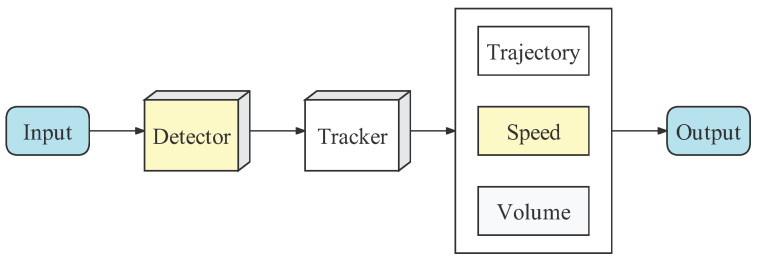
- The paper uses a detection + tracking system model: YOLOv5-based vehicle detector plus a tracker built around Kalman filter state estimation and data association.
- For detection, it modifies YOLOv5s by adding the NAM attention module to the Neck, uses CIoU_Loss instead of GIoU_Loss, and proposes Soft-DIoU NMS (SD-NMS).
- For tracking, it proposes JDE-YN, embedding appearance feature extraction into the detection head and using a cascade matching algorithm based on direction correction.
- Experiments are run on UA-DETRAC; the paper states it selects 16,542 train images / 102,562 labels and 11,235 test images / 86,559 labels for detection experiments, and for tracking uses 60 video sequences for training and 40 for testing.
## Limitations
- The paper states the dataset is challenging because UA-DETRAC includes multiple weather conditions and vehicles of different scales, which keeps MOTA and MOTP low (between 0.3 and 0.4).
- It explicitly notes a tradeoff: the proposed method improves accuracy but can reduce speed, e.g. FPS drops when adding NAM or SD-NMS. This is stated in the paper.
- Evident from the text: the reported improvements are demonstrated mainly on UA-DETRAC, with a secondary COCO2017 retraining check; broader generalization beyond these datasets is not established in the provided text.
Model-written summary. Check it against the paper before relying on it.
Integrity signals
Registry
Cites
Statistics
Figures




Verification
Claims the paper makes
2 Valid · 2 Not valid · 4 Not checked · 45 Own results and interpretations
Every source the paper cites for this claim was checked and supports it.
In the paper
“the NAM attention module chooses the weight of the image channel and spatial information as a measure of image characteristics of significance, through a normalized scaling factor to represent the importance of the weight, and suppress the unimportant channel information and pixel information in the image.”
§ A High-Precision Vehicle Detection and Tracking Method Based on the Attention Mechanism > 3. Vehicle Detection and Tracking Method > 3.1. The YOLOv5-NAM Vehicle Detection Model
What the sources say
- Supportedcites [39] Liu, Y., Shao, Z., Teng, Y., and Hoffmann, N. (2021). NAM: Normalization-based Attention Module. arXiv. source
The Introduction (p. 1) says NAM aims to suppress insignificant channels or pixels. The Methodology (p. 2) describes normalization-based scaling factors that measure the importance of channels and pixels, supporting the cited sentence's explanation. (LLM, conf=0.93)
plainstates a cause- Asserted: passes — The authors put it forward as true.
- Checkable: passes — It can be checked against evidence.
- Load-bearing: passes — The paper’s conclusions depend on it.
- Based: passes — The paper gives a reason why it holds.
- Supported
Every source the paper cites for this claim was checked and supports it.
In the paper
“As an extension of the CBAM attention module, NAM is a lightweight and efficient new attention module achieved by redesigning the channel and spatial attention submodule based on normalization technology [39].”
§ A High-Precision Vehicle Detection and Tracking Method Based on the Attention Mechanism > 3. Vehicle Detection and Tracking Method > 3.1. The YOLOv5-NAM Vehicle Detection Model
What the sources say
- Supportedcites [39] Liu, Y., Shao, Z., Teng, Y., and Hoffmann, N. (2021). NAM: Normalization-based Attention Module. arXiv. source
The Methodology (p. 2) calls NAM an efficient, lightweight attention mechanism that adopts CBAM’s module integration and redesigns its channel and spatial attention submodules using normalization scaling factors. The Introduction (p. 1) explains that this approach avoids adding fully connected and convolutional layers. (LLM, conf=0.95)
plain- Asserted: passes — The authors put it forward as true.
- Checkable: passes — It can be checked against evidence.
- Load-bearing: passes — The paper’s conclusions depend on it.
- Based: passes — The paper gives a reason why it holds.
- Supported
A result the paper states — it cites no source for it, so there is none to check. The quote shows it is in the paper.
In the paper
“The inter-class similarity and the intra-class difference between the vehicles will lead to the failure of vehicle data association and also vehicle identity switching when the vehicles occlude each other during the driving process.”
§ A High-Precision Vehicle Detection and Tracking Method Based on the Attention Mechanism > 3. Vehicle Detection and Tracking Method > 3.5. The Cascade Matching Algorithm Based on Direction Correction
plainstates a cause- Asserted: passes — The authors put it forward as true.
- Checkable: passes — It can be checked against evidence.
- Load-bearing: passes — The paper’s conclusions depend on it.
- Based: passes — The paper gives a reason why it holds.
A result the paper states — it cites no source for it, so there is none to check. The quote shows it is in the paper.
In the paper
“our proposed method obtained the identity of the switching times at least”
§ A High-Precision Vehicle Detection and Tracking Method Based on the Attention Mechanism > 4. Detection and Tracking Experience Results > 4.3. Tracking Results on UA-DETRAC
plain- Asserted: passes — The authors put it forward as true.
- Checkable: passes — It can be checked against evidence.
- Load-bearing: passes — The paper’s conclusions depend on it.
- Based: passes — The paper gives a reason why it holds.
A result the paper reports from its own data — it cites no other source for it, so there is none to check. The quote shows it is in the paper.
In the paper
“When we use the CIoU_Loss to replace the GIoU_Loss, the YOLOv5s and YOlOv5-NAM models’ mAP values increase by 0.2% and 0.3%, respectively.”
§ A High-Precision Vehicle Detection and Tracking Method Based on the Attention Mechanism > 4. Detection and Tracking Experience Results > 4.1. Detection Results on UA-DETRAC
plainstates a cause- Asserted: passes — The authors put it forward as true.
- Checkable: passes — It can be checked against evidence.
- Load-bearing: unclear — It is unclear whether the paper’s conclusions depend on it.
- Based: passes — The paper gives a reason why it holds.
19 more claims
Create a free account to see all 53 claims and to verify the 1 reference still open.
- It may state two separate claims as one. 22
- The quote only partly states this claim. 1
- Probably not a substantial claim. 8
Self-check
Percentages, sums and reported differences re-computed from the paper’s own numbers.
Each contradiction between two passages listed here was confirmed by an independent check.
Rated minor: it would not touch a result — a value no result rests on, a p-value that stays on the same side of the significance level, or a conflict that is clerical, resolved elsewhere in the paper, or outside its own findings.
In the paper
§ A High-Precision Vehicle Detection and Tracking Method Based on the Attention Mechanism > Abstract
“It is shown that compared with the original YOLOv5s model, the mAP value of the YOLOv5-NAM vehicle detection model is improved by 1.6%,”
§ A High-Precision Vehicle Detection and Tracking Method Based on the Attention Mechanism > 4. Detection and Tracking Experience Results > 4.1. Detection Results on UA-DETRAC
“According to the Table, after adding the NAM attention mechanism into the original YOLOv5s model, the overall mAP value of the model increases by 1.4%.”
Citations
Cites
Faster R-CNN: Towards Real-Time Object Detection with Region Proposal Networks
Ren, S., He, K., Girshick, R., & Sun, J. (2017) · IEEE Transactions on Pattern Analysis and Machine Intelligence · doi:10.1109/tpami.2016.2577031 · Cited by 73,472 · cited 4×
“Twostage vehicle detection methods such as Cascade R-CNN [22], Faster R-CNN [23], Mask RCNN [24], R-FCN [25], and SPP-Net [26] first extract the candidate regions of the vehicle in the image and then send them into the CNN model for feature extraction and classification.”
MethodInfluentialYou Only Look Once: Unified, Real-Time Object Detection
Redmon, J., Divvala, S., Girshick, R., & Farhadi, A. (2016) · 2016 IEEE Conference on Computer Vision and Pattern Recognition (CVPR) · doi:10.1109/cvpr.2016.91 · Cited by 53,803 · cited 3×
“Based on the initial version of YOLO in [20], several algorithms including YOLOv2 [27], YOLOv3 [28], YOLOv4 [29], and YOLOv5 [30] were continuously developed to further improve the classification accuracy.”
MethodA New Approach to Linear Filtering and Prediction Problems
Kalman, R. E. (1960) · Journal of Basic Engineering · doi:10.1115/1.3662552 · Cited by 31,751
(2016) · Cited by 31,590
He, K., Gkioxari, G., Dollar, P., & Girshick, R. (2017) · 2017 IEEE International Conference on Computer Vision (ICCV) · doi:10.1109/iccv.2017.322 · Cited by 29,137
SSD: Single Shot MultiBox Detector
Liu, W., Anguelov, D., Erhan, D., Szegedy, C., Reed, S., Fu, C.-Y., & Berg, A. C. (2016) · Lecture Notes in Computer Science · doi:10.1007/978-3-319-46448-0_2 · Cited by 22,128 · cited 3×
“From Table 5, the AP value of our proposed method is higher than some classical object detection algorithms such as Faster R-CNN, SSD, and YOLOv3, and slightly lower than the RetainNet and CenterNet algorithms.”
MethodInfluentialYOLO9000: Better, Faster, Stronger
Redmon, J., & Farhadi, A. (2017) · 2017 IEEE Conference on Computer Vision and Pattern Recognition (CVPR) · doi:10.1109/cvpr.2017.690 · Cited by 19,892 · cited 1×
“Based on the initial version of YOLO in [20], several algorithms including YOLOv2 [27], YOLOv3 [28], YOLOv4 [29], and YOLOv5 [30] were continuously developed to further improve the classification accuracy.”
MethodYOLOv3: An Incremental Improvement
Redmon, J., & Farhadi, A. (2018) · arXiv · doi:10.48550/arxiv.1804.02767 · Cited by 17,141
Spatial Pyramid Pooling in Deep Convolutional Networks for Visual Recognition
He, K., Zhang, X., Ren, S., & Sun, J. (2015) · IEEE Transactions on Pattern Analysis and Machine Intelligence · doi:10.1109/tpami.2015.2389824 · Cited by 11,971
YOLOv4: Optimal Speed and Accuracy of Object Detection
Bochkovskiy, A., Wang, C.-Y., & Liao, H.-Y. M. (2020) · arXiv · doi:10.48550/arxiv.2004.10934 · Cited by 10,307
Cited by
Bakırcı, M. (2024) · Applied Soft Computing · doi:10.1016/j.asoc.2024.112015 · Cited by 170
Bakırcı, M. (2024) · Digital Signal Processing · doi:10.1016/j.dsp.2024.104594 · Cited by 113
Jain, D. K., Zhao, X., Gan, C., Shukla, P. K., Jain, A., & Sharma, S. (2024) · Information Fusion · doi:10.1016/j.inffus.2024.102429 · Cited by 49
Multi-Object Vehicle Detection and Tracking Algorithm Based on Improved YOLOv8 and ByteTrack
You, L., Chen, Y., Xiao, C., Sun, C., & Li, R. (2024) · Electronics · doi:10.3390/electronics13153033 · Cited by 42
Semantic Segmentation and YOLO Detector over Aerial Vehicle Images
Qureshi, A. M. (2024) · Computers, materials & continua/Computers, materials & continua (Print) · doi:10.32604/cmc.2024.052582 · Cited by 65
HVD-Net: A Hybrid Vehicle Detection Network for Vision-Based Vehicle Tracking and Speed Estimation
Ashraf, M. H., Jabeen, F., Alghamdi, H., Zia, M. S., & Almutairi, M. S. (2023) · Journal of King Saud University - Computer and Information Sciences · doi:10.1016/j.jksuci.2023.101657 · Cited by 39
Realtime Vehicle Tracking Method Based on YOLOv5 + DeepSORT
Lin, L., He, H., Xu, Z., & Wu, D. (2023) · Computational Intelligence and Neuroscience · doi:10.1155/2023/7974201 · Cited by 18
“[35] proposed a novel vehicle detection and tracking method for small target vehicles to achieve high detection and tracking accuracy based on the attention mechanism.”
MethodLGA-YOLO for Vehicle Detection in Remote Sensing Images
Zhang, Y., Wang, W., Ye, M., Yan, J., & Yang, R. (2025) · IEEE Journal of Selected Topics in Applied Earth Observations and Remote Sensing · doi:10.1109/jstars.2025.3535090 · Cited by 25
Survey on Image-Based Vehicle Detection Methods
Adam, M. A. A., & Tapamo, J. (2025) · World Electric Vehicle Journal · doi:10.3390/wevj16060303 · Cited by 18
MFF-YOLO: An Accurate Model for Detecting Tunnel Defects Based on Multi-Scale Feature Fusion
Жу, А., Wang, B., Xie, J., & Ma, C. (2023) · Sensors · doi:10.3390/s23146490 · Cited by 17
“Common approaches include cascade structures [36–38], pyramid networks [39–42] and attention mechanisms [43–45].”
Wang, H., Chaw, J. K., Goh, S. K., Shi, L., Tin, T. T., Huang, N., & Gan, H. (2024) · IEEE Access · doi:10.1109/access.2024.3442484 · Cited by 12
Vehicle identification and analysis based on lightweight YOLOv5 on edge computing platform
Hong, T., Ma, Y., & Jiang, H. (2024) · Measurement Science and Technology · doi:10.1088/1361-6501/ad9bd4 · Cited by 10
Andika, J. L., Khairuddin, A. S. M., Ramiah, H., & Kanesan, J. (2024) · Journal of Real-Time Image Processing · doi:10.1007/s11554-024-01457-1 · Cited by 10
“Consequently, the lightweight YOLO models require less memory and computing resources, making them more feasible to be implemented in low-cost embedded devices [9–14].”
Comparative analysis of machine learning techniques for enhanced vehicle tracking and analysis
Rani, S., & Dalal, S. (2024) · Transportation Engineering · doi:10.1016/j.treng.2024.100271 · Cited by 10
Gao, S., Liang, H., Hu, D., Hu, X., Lin, E., & Huang, H. (2024) · Remote Sensing · doi:10.3390/rs16224141 · Cited by 10
Farag, W., & Fayed, M. (2025) · Journal of Control and Decision · doi:10.1080/23307706.2025.2469893 · Cited by 12
A Survey of Human Intelligence Augmented Artificial Intelligence: An Autonomous Driving Perspective
Li, S., Yuan, K., Tang, Z., Zhang, Y., Ji, P., Ge, Q., Du, S., Huang, Y., & Chen, H. (2025) · Automotive Innovation · doi:10.1007/s42154-025-00361-z · Cited by 13
“In the domain of AD, attention mechanisms significantly enhance driving perception [117–120] and emphasize key features during network training, thereby accelerating the development of robust and effective driving policies [121, 122].”
Flood scenarios vehicle detection algorithm based on improved YOLOv9
Sun, J., Xu, C., Zhang, C., et al. (2025) · Multimedia Systems · doi:10.1007/s00530-024-01661-w · Cited by 8
“However, a careful [42] 51.6% 185 3.5 Dong et al. [43] 61.5% 175 13.5 YOLOv5-NAM [44] 50.8% 54 120 SDF-YOLO 71.6% 40 233 Fig.”
InfluentialSmoke Detection of Marine Engine Room Based on a Machine Vision Model (CWC-Yolov5s)
Zou, Y., Zhang, J., Du, T., et al. (2023) · Journal of Marine Science and Engineering · doi:10.3390/jmse11081564 · Cited by 8
“With the continuous development of machine vision, current smoke detection methods based on deep learning can be ro ghly divided into two categories: one is the multi-stage target detection model based on regional suggestion represented by R-CNN [26].”
MethodInfluentialRaza, N., Habib, M. A., Imran, H. M., Qayum, M. A., Perveen, S., Jabbar, S., Sarwar, S., & Ahmad, M. (2025) · IEEE Access · doi:10.1109/access.2025.3588376 · Cited by 9
“The YOLO-V5s model is modified by utilizing the Normalized Attention Module (NAM) to enhance the vehicle detection accuracy of small targets [48].”
HeMoDU: High-Efficiency Multi-Object Detection Algorithm for Unmanned Aerial Vehicles on Urban Roads
Shi, H., Wang, N., Xu, X., Qian, Y., Zeng, L., & Zhu, Y. (2024) · Sensors · doi:10.3390/s24134045 · Cited by 7
“We compare HeMoDU with YOLOv3 [19], YOLOv4 [20], Li et al. [35], DFE-Net [36], EM-YOLO [37], YOLOv8s [34], and EdgeYOLO [38] on the Visdrone2019 dataset and with YOLOv5s, YOLOv5-NAM [39], Peng et al. [40], and YOLOv8s on the UA-DETRAC dataset.”
MethodAn Automated System for Wrong-Way Vehicle Detection using YOLO and DeepSORT
Mahi, A. B. S., Eshita, F. S., & Helaly, T. (2023) · International Conference on Sustainable Technologies for Industry 5.0 (STI) · doi:10.1109/sti59863.2023.10465068 · Cited by 6
“The study in [4] introduced a new model YOLOv5-Nam by adding normalization based attention module with YOLO5s.”
MethodEnhanced real-time road-vehicles’ detection and tracking for driving assistance
Farag, W., & Nadeem, M. (2024) · International Journal of Knowledge-based and Intelligent Engineering Systems · doi:10.3233/kes-230062 · Cited by 7
“Further recent work employs the CNN network to extract vehicle attributes [18], as they show ro-busteness and appropriate for a wide range of difficult circumstances [19].”
Near Miss Detection Using Distancing Monitoring and Distance-Based Proximal Indicators
Lim, L. M., Yang, L., Zhu, W. T., et al. (2025) · IEEE Access · doi:10.1109/access.2025.3548108 · Cited by 5
“Features from multiple images of different scales are extracted by the backbone network [38].”
Vehicle Target Detection Using the Improved YOLOv5s Algorithm
Dong, Z. (2024) · Electronics · doi:10.3390/electronics13234672 · Cited by 5
“In 2023, Jiandong Wang et al. [2] proposed a high-precision vehicle detection and tracking method based on the attention mechanism.”
Ekhlakov, R. S., & Andriyanov, N. A. (2024) · Mathematics · doi:10.3390/math12040555 · Cited by 8
Rani, S. S., Mudigonda, A., Hemanth, S. V., et al. (2024) · doi:10.1109/aiiot58432.2024.10574705 · Cited by 5
“By leveraging the YOLOv5-NAM model as a vehicle detector, present a real-time small target vehicle tracking technique (JDE-YN) that combines the feature extraction process into the prediction head for collaborative training [11].”
MethodCai, H., Lin, H., & Liu, D. (2024) · Multimedia Systems · doi:10.1007/s00530-024-01407-8 · Cited by 6
“…the challenge of vehicle appearance similarity, most works improve the tracking performance by enhancing the detector’s ability to detect vehicles [15, 16], and some works abandon the appearance information and use the motion information combined with graph networks to solve the problems of…”
Enhancing YOLOv5 for Autonomous Driving: Efficient Attention-Based Object Detection on Edge Devices
Adam, M. A. A., & Tapamo, J. (2025) · Journal of Imaging · doi:10.3390/jimaging11080263 · Cited by 11
“Likewise, YOLOv5-NAM [32] integrates a Normalization-based Attention Module (NAM), improving small object detection and increasing mAP by 1.6% over the baseline while preserving real-time performance.”
InfluentialBerwo, M. A., Fang, Y., Sarwar, N., Mahmood, J., Aljohani, M., & Elhosseini, M. A. (2024) · Multimedia Tools and Applications · doi:10.1007/s11042-024-19145-4 · Cited by 6
Vehicle Detector Based on Improved YOLOv5 Architecture for Traffic Management and Control Systems
Nguyen, D.-L., Vo, X.-T., Priadana, A., et al. (2023) · Proceedings of the Annual Conference of the IEEE Industrial Electronics Society · doi:10.1109/iecon51785.2023.10311764 · Cited by 4
“For mAP@0.5, the performance of the proposed network is superior to the networks in [2] (6.6 % ↑ to 7.8% ↑ ) and two retrained YOLOv5 networks (YOLOv5n (6.0% ↑ ), YOLOv5s (3.6% ↑ ), YOLOv5l (0.8% ↑ )) and is comparable to the other retrained YOLOv5 networks (YOLOv5m (2.5% ↓ ), YOLOv5x (1.7% ↓ )).”
BackgroundMethodResultInfluentialComparative Study of Vehicle Tracking Techniques
Kaushik, P., Kumar, L., Narayan, R., et al. (2024) · doi:10.1109/aece62803.2024.10911208 · Cited by 3
“tracking system enhanced by an attention mechanism, which heightens the precision of object recognition in real-time traffic conditions [15].”
Rajkumar, S., Hariharan, A., Girish, S., et al. (2023) · SN Computer Science · doi:10.1007/s42979-023-01832-y · Cited by 3
“YOLO [30] version 3 and single shot detector algorithm train a given video dataset and detect vehicles.”
BackgroundMethodCT Image Detection of Pulmonary Tuberculosis Based on the Improved Strategy YOLOv5
Liu, J., Xie, H., Lu, M., et al. (2023) · International Journal of Swarm Intelligence Research · doi:10.4018/ijsir.329217 · Cited by 3
“In this study, the authors intend to innovatively develop an automatic detection network based on the YOLOv5 algorithm with NAM (Wang et al., 2023), SCYLLA-IoU (SIoU) loss function (Zheng, J. et al., 2022), and data augmentation, which the authors call the improved strategy YOLOv5, to quickly identify and classify les…”
MethodInfluentialLiu, Y., Cui, D., & Peng, W. (2023) · Journal of Vibroengineering · doi:10.21595/jve.2023.23441 · Cited by 3
“Wang et al. proposed a novel vehicle detection and tracking method for small target vehicles to achieve high detection and tracking accuracy based on the attention mechanism [19].”
MethodAutomatic Detection of Electric Motorcycle Based on Improved YOLOv5s Network
He, Y. (2024) · Journal of Electrical and Computer Engineering · doi:10.1155/2024/4889707 · Cited by 3
A Lightweight Direction-Aware Network for Vehicle Detection
Yang, L., Hou, Y., Zhang, H., & Zhang, C. (2025) · IEEE Access · doi:10.1109/access.2025.3539692 · Cited by 3
“To enhance model performance, some research [7], [8] introduces new feature fusion layers and attention mechanisms to improve detection precision and the capability to capture smaller target vehicles.”
Wrong Way Vehicle Detection in Single and Double Lane
Bharadwaj, R., Billade, A., Chenna, S., et al. (2023) · International Journal on Recent and Innovation Trends in Computing and Communication · doi:10.17762/ijritcc.v11i6s.6953 · Cited by 2
Ankireddy, P., S., S. G., & Reddy, V. L. (2024) · Journal of Advanced Research in Applied Sciences and Engineering Technology · doi:10.37934/araset.40.2.221241 · Cited by 3
Enhancing YOLOv5 for Autonomous Driving: Efficient Attention-Based Object Detection on Edge DevicesPreprint
Adam, M. A. A., & Tapamo, J. (2025) · Preprints.org · doi:10.20944/preprints202506.2076.v1 · Cited by 2
Sankaranarayanan, M. (2024) · International Conference on Traffic and Logistic Engineering (ICTLE) · doi:10.1109/ictle62418.2024.10703910 · Cited by 1
Ge, X., Chen, Z., Zhou, F., Sun, B., Chen, S., Gao, G., & Wang, R. (2025) · Proceedings of the Institution of Mechanical Engineers Part D Journal of Automobile Engineering · doi:10.1177/09544070251348698 · Cited by 3
“Wang et al., 42 improved YOLOv5 # s NMS mechanism but sacrificed speed without surpassing our accuracy.”
A Hybrid Framework for Kinematic Vehicle Prediction: YOLOv11 with Unscented Kalman Filter
Pahal, S., & Nandal, P. (2025) · SAE International Journal of Connected and Automated Vehicles · doi:10.4271/12-09-02-0013 · Cited by 1
Madhukaro, E. A. J. R. (2023) · International Journal on Recent and Innovation Trends in Computing and Communication · doi:10.17762/ijritcc.v11i10.8620 · Cited by 1
Leveraging Deep Learning for Improving Real Time Stolen Vehicle Tracking in Smart Cities
Sivasubramanian, K., Devi, V. B. S., Bala Murugan, M. S., & Rajagopal, M. K. (2023) · International Conference on Information Technology: IoT and Smart City (ICIT) · doi:10.1145/3638985.3639026 · Cited by 1
“Wang J et al. [25] proposed an attention-based method which used YOLOV5-NAM vehicle detector model and a tracking method JDE-YN using the UA-DETRAC dataset.”
MethodMonica, K. M., Al‐Farouni, M., Madhura, G. K., et al. (2024) · doi:10.1109/icdsis61070.2024.10594411 · Cited by 1
CBE-Net: A dedicated target detection algorithm for small vehicle
Sun, Z. (2024) · International Symposium on Control Engineering and Robotics (ISCER) · doi:10.1145/3679409.3679458 · Cited by 1
Light Weighted YOLO Vehicle Tracker for Toll Gate Using Centroid Algorithm
Singh, P. P., Prasad, S., Kalita, G., et al. (2025) · Lecture notes in electrical engineering · doi:10.1007/978-981-97-3090-2_16 · Cited by 1
A Computer Vision Approach to Ambulance Classification in the Philippines using YOLOv5 Small
Tomas, J. P. Q., Feria, S. V. P. C., Franco, J. R. A., et al. (2024) · International Conference on Machine Learning and Soft Computing (ICMLSC) · doi:10.1145/3647750.3647777
Research on object detection algorithm based on convolutional neural network
Gao, X., Luo, T., Wang, R., & Lang, C. (2024) · International Conference on Remote Sensing, Mapping, and Image Processing (RSMIP) · doi:10.1117/12.3029832
Research on Vehicle Detection Method Based on Improved YOLOv5s
Ma, L., Zhong, R., Shi, X., et al. (2024) · International Conference on Artificial Intelligence and Automation Control (AIAC) · doi:10.1109/aiac63745.2024.10899519
“YOLOv5s incorporates three types of loss functions [9-10] , they are presented in Figure 1.”
Krishna Mohan, A., Reddy, P. V. N., & Prasad, K. S. (2025) · EAI Endorsed Transactions on Internet of Things · doi:10.4108/eetiot.8231
“The paper [30] used, a Normalization-based Attention Module (YOLOv5-NAM) integrated into the YOLOv5 model for vehicle detection and tracking method for small target vehicles, and a real-time tracking approach (JDE-YN) that embeds feature extraction in the prediction head.”
Research on Vehicle Target Feature Information Fusion Evaluation Technology
Liu, Z., Sun, H., Wang, X., et al. (2025) · Communications in computer and information science · doi:10.1007/978-981-96-6462-7_4
CBAM-YOLOv8n and ViT-DeepSORT for UAV Vehicle Tracking
Joshi, A., & Sanyal, B. (2025) · Lecture notes in networks and systems · doi:10.1007/978-3-031-95017-9_16 · Cited by 1
Dual-Branch Vehicle Detection Model with Global-Local Feature Fusion
Baoli, W., Siwan, Z., Zhang, J., & Pengfei, G. (2025) · International Journal of Intelligent Transportation Systems Research · doi:10.1007/s13177-025-00544-2
“Wang et al. [ 15 ] introduced a normalization-based attention module into the YOLOv5s model, propos - ing the YOLOv5-NAM model, which enhances the model’s feature representation capabilities.”
RoadTrack: Real-Time Distant Parking Detection via Visual Geometric Projection and Speed Estimation
Yi, K., Luo, L., Xie, C., Zhu, Y., & Tian, Y. (2026) · Signal Image and Video Processing · doi:10.1007/s11760-026-05148-1
“Singh et al. proposed a vehicle detection and small object detection method based on an improved YOLOv5 algorithm [2–4].”
A deep learning-based approach for detecting anomalous behavior in safety-critical spaces
Anees, A., Jalal, S. A., Hadi, H. J., et al. (2026) · Frontiers in Artificial Intelligence · doi:10.3389/frai.2026.1702756
Yu, Y., Lu, H., Qi, X., et al. (2026) · IEEE Internet of Things Journal · doi:10.1109/jiot.2026.3685509
Environment perception for intelligent vehicles: A review
Qin, J., Pan, M., Zhang, Z., Huang, F., Li, M., & Guan, W. (2026) · Journal of Traffic and Transportation Engineering (English Edition) · doi:10.1016/j.jtte.2025.07.004 · Cited by 1
Self-citationAI-Assisted Early Detection of Dyslexia Disorder in Handwriting Analysis
Kumar, R., Khatter, H., Shrivastava, A. K., et al. (2026) · Lecture notes in networks and systems · doi:10.1007/978-3-032-25949-3_29
Saturation-Aware Structural Optimization for Edge Vehicle Detection
Yu, Y., Zhang, W., Wu, X., et al. (2026) · International Conference on Computer Supported Cooperative Work in Design (CSCWD) · doi:10.1109/cscwd68734.2026.11582318
Metadata
- Authors
- Wang, J., Dong, Y., Zhao, S., & Zhang, Z.
- Affiliations
- Xidian University (CN)
- Corresponding author
- Zhao, Shuangrui
- Venue
- Sensors
- Publisher
- MDPI AG
- Published
- 2023-01-08
- Volume
- 23
- Issue
- 2
- Pages
- 724
- ISSN
- 1424-8220 (ISSN-L)
- PMC
- PMC9863854
- OpenAlex
- W4313894539
- Cited by
- 60
- References
- 44
- Citations by year
- 2026: 6 · 2025: 16 · 2024: 26 · 2023: 12
- FWCI
- 5.42
- Type
- journal article
- Language
- en
- Open access
- gold
- doi.org
- Licence
- Locations
- Sensors (publishedVersion, cc-by)
- PubMed Central (publishedVersion, cc-by)
- PubMed (publishedVersion)
- DOAJ (DOAJ: Directory of Open Access Journals) (submittedVersion, cc-by-sa)
- Funders
- National Key R/D Program of China (2018YFE0207600, 61972308, 2019JC-17)
- Natural Science Foundation of China (NSFC) (2018YFE0207600, 61972308, 2019JC-17)
- Natural Science Basic Research Program of Shaanxi (2018YFE0207600, 61972308, 2019JC-17)
- Topics
- Physical Sciences › Computer Science › Computer Vision and Pattern Recognition › Video Surveillance and Tracking Methods
- Physical Sciences › Computer Science › Computer Vision and Pattern Recognition › Advanced Neural Network Applications
- Physical Sciences › Engineering › Automotive Engineering › Autonomous Vehicle Technology and Safety
- Keywords
- vehicle detection, vehicle tracking, small object detection, attention mechanism, YOLOv5, real-time tracking, intelligent transportation management, UA-DETRAC
- MeSH terms
- Intelligence, Technology, Transportation
About these checks
Registry, retraction, Cites and statistics results are computed, not judged, with one exception: a printed reference that no index lists is read once by a model before it counts as a citation error. Claims are extracted by a model and kept only when their quote appears verbatim in the text; each cited source is then checked, with a model’s help, for whether it says what the claim relies on. Those verdicts can be wrong — read the claim’s quote and the cited source before relying on one.
A language model drew the claims from the paper on 2026-10-10, under version 3 of the claim definition (model deepseek-v4.1-flash, prompt extract-v3).
A second model labelled each claim on 2026-10-10 (model jev-1.13-20260917, definition revision gold-guideline-v0.2).
Cited sources are checked with a language model’s help (gpt-6-sol).
Statistics and arithmetic are recomputed, not judged.
Confidence bands are shown only for fields calibrated on our annotated test set. None is calibrated yet, so no band is shown.
What counts as a claim ›How we measure confidence ›How we check this ›
Are you an author, or do you see a problem with this page? Request a review
Data sources
Bibliographic data: Semantic Scholar, OpenAlex, Crossref.
Contains information from the Semantic Scholar Academic Graph Datasets, made available under the ODC Attribution License (ODC-BY 1.0).
Semantic Scholar’s data is described in: Kinney, R., et al. (2023). The Semantic Scholar Open Data Platform. arXiv:2301.10140.
