

A Review of Embedded Machine Learning Based on Hardware, Application, and Sensing Scheme
Open accessThe DOI matches its Crossref record; 181 of the 189 references it cites were found in a registry or an index; 2 of the 59 sources its claims cite were checked for support.
Abstract
Machine learning is an expanding field with an ever-increasing role in everyday life, with its utility in the industrial, agricultural, and medical sectors being undeniable. Recently, this utility has come in the form of machine learning implementation on embedded system devices. While there have been steady advances in the performance, memory, and power consumption of embedded devices, most machine learning algorithms still have a very high power consumption and computational demand, making the implementation of embedded machine learning somewhat difficult. However, different devices can be implemented for different applications based on their overall processing power and performance. This paper presents an overview of several different implementations of machine learning on embedded systems divided by their specific device, application, specific machine learning algorithm, and sensors. We will mainly focus on NVIDIA Jetson and Raspberry Pi devices with a few different less utilized embedded computers, as well as which of these devices were more commonly used for specific applications in different fields. We will also briefly analyze the specific ML models most commonly implemented on the devices and the specific sensors that were used to gather input from the field. All of the papers included in this review were selected using Google Scholar and published papers in the IEEExplore database. The selection criterion for these papers was the usage of embedded computing systems in either a theoretical study or practical implementation of machine learning models. The papers needed to have provided either one or, preferably, all of the following results in their studies-the overall accuracy of the models on the system, the overall power consumption of the embedded machine learning system, and the inference time of their models on the embedded system. Embedded machine learning is experiencing an explosion in both scale and scope, both due to advances in system performance and machine learning models, as well as greater affordability and accessibility of both. Improvements are noted in quality, power usage, and effectiveness.
Overview
CoChat Summary
TL;DR
This review surveys embedded machine learning implementations across hardware platforms, applications, and sensing schemes, focusing mainly on NVIDIA Jetson and Raspberry Pi devices with several less-used boards. It compiles reported accuracy, inference speed, and power consumption to compare which embedded systems suit which applications.
Key findings
- The review centers on NVIDIA Jetson and Raspberry Pi, with other boards including Google Coral, ASUS Tinker, ODROID-XU4, and Banana Pi; reported hardware examples include Jetson Nano at 5–10 W and USD 300–500, Coral Dev Board at 6–10 W and USD 130, Raspberry Pi 3 Model B at 1.5 W and about USD 40, Raspberry Pi 4 Model B at 4 W and USD 40–80, and Jetson AGX Xavier at 30 W and about USD 4000.
- Applications are grouped into autonomous driving, security and safety, healthcare, drones, and agriculture; priorities differ, with autonomous driving emphasizing performance speed, drones emphasizing accuracy, and agriculture emphasizing detection accuracy and energy consumption over speed.
- Sensors covered include RGB, infrared/thermal, depth, 360-degree cameras, radar, LiDAR, microphones, body motion sensors, electrocardiograms, and electroencephalograms; most reviewed papers used some form of computer vision.
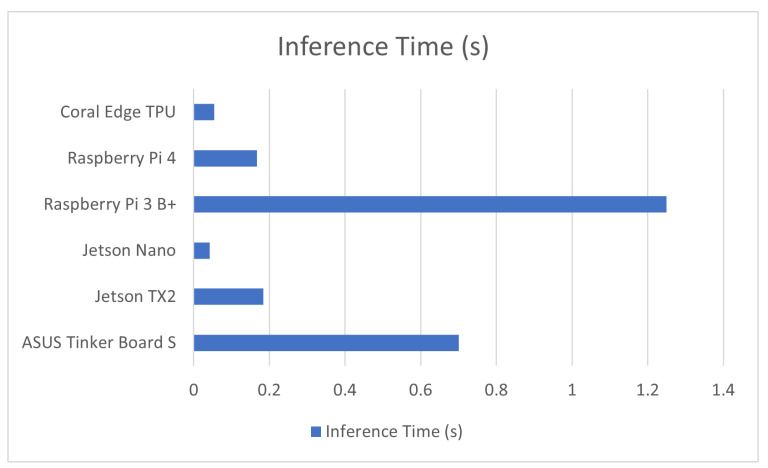
- The review compares systems by performance and cost, using the mean of all final results to assess overall performance, with results presented in Tables 2–13 and Figures 2–11.
Methods
- Review/compilation of referenced research papers; sources were selected using Google Scholar and published papers in the IEEE Xplore database, with inclusion requiring use of embedded computing systems in a theoretical study or practical implementation of machine learning models.
- Included papers needed to report one or preferably all of: model accuracy on the system, overall power consumption of the embedded machine learning system, and inference time on the embedded system.
- Sources were divided by device, application, and sensing scheme; systems were compared by performance and cost, with performance assessed differently depending on the task and the mean of final results used for overall performance.
Limitations
- The paper states that not all sources made active use of a sensor, with some mainly exploring theoretical implementation; non-vision-related applications had insufficient numbers for a proper basis-by-basis comparison and were displayed in Table 10.
- The paper states that most embedded machine learning optimization papers did not have sensing schemes, and most benchmark/review papers in that category also did not include sensing schemes.
- Evident from the text: the performance analysis method differed from source to source and depended heavily on the specific application and sensory system, limiting direct comparison across studies.
Model-written summary. Check it against the paper before relying on it.
Integrity signals
Registry
Cites
Statistics
Figures


Verification
Claims the paper makes
1 Valid · 12 Not valid · 30 Not checked · 34 Own results and interpretations
A result the paper states — it cites no source for it, so there is none to check. The quote shows it is in the paper.
In the paper
“Since the embedded systems studied in this research all made use of wired communication for their sensing systems, we focus only on analog communication.”
§ A Review of Embedded Machine Learning Based on Hardware, Application, and Sensing Scheme > 5. Sensors
plain- Asserted: passes — The authors put it forward as true.
- Checkable: passes — It can be checked against evidence.
- Load-bearing: passes — The paper’s conclusions depend on it.
- Based: passes — The paper gives a reason why it holds.
A result the paper states — it cites no source for it, so there is none to check. The quote shows it is in the paper.
In the paper
“Much like the different embedded computing systems that were used for machine learning implementation, many different sensors were used in each of our review sources depending on the application of the research.”
§ A Review of Embedded Machine Learning Based on Hardware, Application, and Sensing Scheme > 5. Sensors > 5.2. Specific Sensors
plainstates an association- Asserted: passes — The authors put it forward as true.
- Checkable: passes — It can be checked against evidence.
- Load-bearing: unclear — It is unclear whether the paper’s conclusions depend on it.
- Based: passes — The paper gives a reason why it holds.
None of the sources cited for this claim have been checked yet.
In the paper
“Most of the papers reviewed in this work utilized some form of computer vision, mainly in areas such as obstacle detection for autonomous vehicles (such as speed bumps) [11] or safety and security measures (such as violent assault identification) [12].”
§ A Review of Embedded Machine Learning Based on Hardware, Application, and Sensing Scheme > 1. Introduction
What the sources say
- Not checked — no full text of the sourcecites [11] Dewangan, 2021, Deep Learning-Based Speed Bump Detection Model for Intelligent Vehicle System Using Raspberry Pi, IEEE Sens. J. source
- Not checked yetcites [12] Vieira, 2022, Low-Cost CNN for Automatic Violence Recognition on Embedded System, IEEE Access source
Checked before — its earlier verdict is held back until a new check runs.
plain- Asserted: passes — The authors put it forward as true.
- Checkable: passes — It can be checked against evidence.
- Load-bearing: unclear — It is unclear whether the paper’s conclusions depend on it.
- Based: passes — The paper gives a reason why it holds.
A result the paper states — it cites no source for it, so there is none to check. The quote shows it is in the paper.
In the paper
“Amongst those that did implement their systems in some capacity, many implemented some form of object detection, image recognition, image segmentation, and other forms of computer vision, making extensive use of different integrated and separate image and video cameras.”
§ A Review of Embedded Machine Learning Based on Hardware, Application, and Sensing Scheme > 5. Sensors > 5.2. Specific Sensors
plain- Asserted: passes — The authors put it forward as true.
- Checkable: passes — It can be checked against evidence.
- Load-bearing: unclear — It is unclear whether the paper’s conclusions depend on it.
- Based: passes — The paper gives a reason why it holds.
None of the sources cited for this claim have been checked yet.
In the paper
“All of the embedded computer devices presented in this review contain both a CPU and GPU unit, with the CPUs being various ARM Cortex multicore processors [24,25,26,27,28,29,30,31,32,33,34].”
§ A Review of Embedded Machine Learning Based on Hardware, Application, and Sensing Scheme > 3. Hardware > 3.2. Processor Units
What the sources say
- Not checked yetcites [24] Nvidia Corporation (2019). Jetson Nano Developer Kit, Nvidia Corporation.
- Not checked yetcites [25] Nvidia Corporation (2016). Jetson TX1 Developer Kit, Nvidia Corporation.
- Not checked yetcites [26] Nvidia Corporation (2019). Jetson TX2 Developer Kit, Nvidia Corporation.
- Not checked yetcites [27] Nvidia Corporation (2019). Jetson AGX Xavier Developer Kit, Nvidia Corporation.
- Not checked yetcites [28] Nvidia Corporation (2020). Jetson Xavier NX Developer Kit, Nvidia Corporation.
- Not checked yetcites [29] Coral.ai (2022, May 29). Get Started with the Dev Board. Available online: https://coral.ai/docs/dev-board/get-started.
- Not checked yetcites [30] Raspberry Pi Foundation (2016). Raspberry Pi 3 Model B, Raspberry Pi Foundation.
- Not checked yetcites [31] Raspberry Pi Foundation (2019). Raspberry Pi 4 Model B, Raspberry Pi Foundation.
- Not matchedcites [32] Hardkernel Co. (2015). ODROID XU4, Hardkernel Co.
Couldn’t be matched to a paper in Crossref, so it can’t be checked.
- Not matchedcites [33] SinoVoip Co., Ltd. Banana PI M2, SinoVoip Co., Ltd.
Couldn’t be matched to a paper in Crossref, so it can’t be checked.
plain- Asserted: passes — The authors put it forward as true.
- Checkable: passes — It can be checked against evidence.
- Load-bearing: unclear — It is unclear whether the paper’s conclusions depend on it.
- Based: passes — The paper gives a reason why it holds.
8 more claims
Create a free account to see all 77 claims and to verify the 37 references still open.
- It may state two separate claims as one. 39
- Probably not a substantial claim. 52
Self-check
Percentages, sums and reported differences re-computed from the paper’s own numbers.
Each contradiction between two passages listed here was confirmed by an independent check.
Rated major: it would touch a result — a value a result rests on, reported and recomputed p-values on opposite sides of the significance level, two passages that conflict with no sign which is right, or a cited work retracted before this paper was published.
In the paper
§ A Review of Embedded Machine Learning Based on Hardware, Application, and Sensing Scheme > 4. Specific Systems > 4.1. Nividia Jetson
“The power consumption of the TX1 is around 15 Watts and that of the TX2 is about 25 Watts [25,26].”
§ A Review of Embedded Machine Learning Based on Hardware, Application, and Sensing Scheme > 8. Conclusions
“More recent Jetson boards such as the TX2 have a far higher performance rate compared to the TX1 while having the same power consumption levels.”
Rated minor: it would not touch a result — a value no result rests on, a p-value that stays on the same side of the significance level, or a conflict that is clerical, resolved elsewhere in the paper, or outside its own findings.
In the paper
§ A Review of Embedded Machine Learning Based on Hardware, Application, and Sensing Scheme > 4. Specific Systems > 4.4. ODROID XU4
“a 2 GB LPDDR3 memory, 2 GB eMMC5.0 LPDDR3 Flash Storage as well as a microSD slot”
§ A Review of Embedded Machine Learning Based on Hardware, Application, and Sensing Scheme > 3. Hardware > 3.4. Storage Units
“others, such as ODROID-XU4 boards, do not have their own integrated storage devices but instead have flash storage interface.”
Citations
Cites
ERFNet: Efficient Residual Factorized ConvNet for Real-Time Semantic Segmentation
Romera, E., Alvarez, J. M., Bergasa, L. M., & Arroyo, R. (2018) · IEEE Transactions on Intelligent Transportation Systems · doi:10.1109/tits.2017.2750080 · Cited by 1,484
Infrared and Visible Image Fusion via Decoupling Network
Wang, X., Guan, Z., Yu, S., Cao, J., & Li, Y. (2022) · IEEE Transactions on Instrumentation and Measurement · doi:10.1109/tim.2022.3216413 · Cited by 969
Benchmark analysis of representative deep neural network architectures
Bianco, S., Cadene, R., Celona, L., & Napoletano, P. (2018) · IEEE Access · doi:10.1109/access.2018.2877890 · Cited by 838
Wang, Z., Liu, M., Yan, W.-J., Song, H., Zhou, Z., Yuen, K.-V., Wei, Q., & Cheng, S. S. (2021) · IEEE Transactions on Instrumentation and Measurement · doi:10.1109/tim.2021.3123218 · Cited by 678
An Edge Traffic Flow Detection Scheme Based on Deep Learning in an Intelligent Transportation System
Chen, C., Liu, B., Wan, S., Qiao, P., & Pei, Q. (2021) · IEEE Transactions on Intelligent Transportation Systems · doi:10.1109/tits.2020.3025687 · Cited by 429
A Survey on LiDAR Scanning Mechanisms
Raj, T., Hashim, F. H., Huddin, A. B., Ibrahim, M. F., & Hussain, A. (2020) · Electronics · doi:10.3390/electronics9050741 · Cited by 413
weedNet: Dense Semantic Weed Classification Using Multispectral Images and MAV for Smart Farming
Sa, I., Chen, Z., Popovic, M., Khanna, R., Liebisch, F., Nieto, J., & Siegwart, R. (2018) · IEEE Robotics and Automation Letters · doi:10.1109/lra.2017.2774979 · Cited by 369
Tinier-YOLO: A Real-Time Object Detection Method for Constrained Environments
Fang, W., Wang, L., & Ren, P. (2020) · IEEE Access · doi:10.1109/access.2019.2961959 · Cited by 369
Guest Editorial Special Section for ICSMD 2021
Liu, D., & Zhang, L. (2022) · IEEE Transactions on Instrumentation and Measurement · doi:10.1109/tim.2022.3219307 · Cited by 354
Forest biomass estimation from airborne LiDAR data using machine learning approaches
Gleason, C. J., & Im, J. (2012) · Remote Sensing of Environment · doi:10.1016/j.rse.2012.07.006 · Cited by 329
Cited by
Aero-Engine Blade Defect Detection: A Systematic Review of Deep Learning Models
Abdulrahman, Y., Eltoum, M. A. M., Ayyad, A., Moyo, B., & Zweiri, Y. (2023) · IEEE Access · doi:10.1109/access.2023.3280992 · Cited by 84
Edge AI in Practice: A Survey and Deployment Framework for Neural Networks on Embedded Systems
Cordova-Cardenas, R., Amor, D., & Gutiérrez, Á. (2025) · Electronics · doi:10.3390/electronics14244877 · Cited by 93
An Underwater Object Recognition System Based on Improved YOLOv11
Cheng, S., Yan, H., Wang, Z., Liu, S., Yang, B., & Li, J. (2025) · Electronics · doi:10.3390/electronics14010201 · Cited by 42
Data Security and Privacy Concerns in Drone Operations
Sindiramutty, S. R., Jhanjhi, N. Z., Tan, C. E., Yun, K. J., Manchuri, A. R., Ashraf, H., Murugesan, R. K., Tee, W. J., & Hussain, M. (2024) · Advances in information security, privacy, and ethics book series · doi:10.4018/979-8-3693-0774-8.ch010 · Cited by 38
A Survey of Model Compression Techniques for TinyML Applications
Lamaakal, I., Yahyati, C., Ouahbi, I., Makkaoui, K. E., & Maleh, Y. (2025) · International Conference on Circuit, Systems and Communication (ICCSC) · doi:10.1109/iccsc66714.2025.11135279 · Cited by 34
Metadata
- Authors
- Biglari, A., & Tang, W.
- Affiliations
- New Mexico State University (US)
- Corresponding author
- Tang, Wei
- Venue
- Sensors
- Publisher
- MDPI AG
- Published
- 2023-02-14
- Volume
- 23
- Issue
- 4
- Pages
- 2131
- ISSN
- 1424-8220 (ISSN-L)
- PMC
- PMC9959746
- OpenAlex
- W4320730661
- Cited by
- 86
- References
- 189
- Citations by year
- 2026: 25 · 2025: 36 · 2024: 19 · 2023: 6
- FWCI
- 2.23
- Type
- journal article
- Language
- en
- Open access
- gold
- doi.org
- Licence
- Locations
- Sensors (publishedVersion, cc-by)
- PubMed Central (publishedVersion, cc-by)
- PubMed (publishedVersion)
- DOAJ (DOAJ: Directory of Open Access Journals) (submittedVersion, cc-by-sa)
- Funders
- National Science Foundation (ECCS-1652944, ECCS-2015573)
- Topics
- Physical Sciences › Computer Science › Computer Vision and Pattern Recognition › Advanced Neural Network Applications
- Physical Sciences › Computer Science › Computer Networks and Communications › IoT and Edge/Fog Computing
- Physical Sciences › Engineering › Control and Systems Engineering › Embedded Systems and FPGA Design
- Keywords
- embedded machine learning, embedded systems, NVIDIA Jetson, Raspberry Pi, power consumption, inference latency, sensor input, machine learning applications, edge computing, low-power devices
About these checks
Registry, retraction, Cites and statistics results are computed, not judged, with one exception: a printed reference that no index lists is read once by a model before it counts as a citation error. Claims are extracted by a model and kept only when their quote appears verbatim in the text; each cited source is then checked, with a model’s help, for whether it says what the claim relies on. Those verdicts can be wrong — read the claim’s quote and the cited source before relying on one.
The claim verdicts this report counts are experimental: their accuracy is not yet measured.
A language model drew the claims from the paper on 2026-10-10, under version 3 of the claim definition (model deepseek-v4.1-flash, prompt extract-v3).
A second model labelled each claim on 2026-10-10 (model jev-1.13-20260917, definition revision gold-guideline-v0.2).
Statistics and arithmetic are recomputed, not judged.
Confidence bands are shown only for fields calibrated on our annotated test set. None is calibrated yet, so no band is shown.
What counts as a claim ›How we measure confidence ›How we check this ›
Are you an author, or do you see a problem with this page? Request a review
How to cite
Cite CoChat for the checks on this page, and the paper for its own findings.
- This page
- CoChat. (2026). Citation check: A Review of Embedded Machine Learning Based on Hardware, Application, and Sensing Scheme. https://app.cochat.ai/papers/10.3390/s23042131
- The paper
- Biglari, A., & Tang, W. (2023). A Review of Embedded Machine Learning Based on Hardware, Application, and Sensing Scheme. Sensors. https://doi.org/10.3390/s23042131
Data sources
Bibliographic data: Semantic Scholar, OpenAlex, Crossref.
Contains information from the Semantic Scholar Academic Graph Datasets, made available under the ODC Attribution License (ODC-BY 1.0).
Semantic Scholar’s data is described in: Kinney, R., et al. (2023). The Semantic Scholar Open Data Platform. arXiv:2301.10140.
