

Can ChatGPT Help in Electronics Research and Development? A Case Study with Applied Sensors
Open accessThe DOI matches its Crossref record; 22 of the 23 references it cites were found in a registry or an index, and 1 are not checked yet.
Abstract
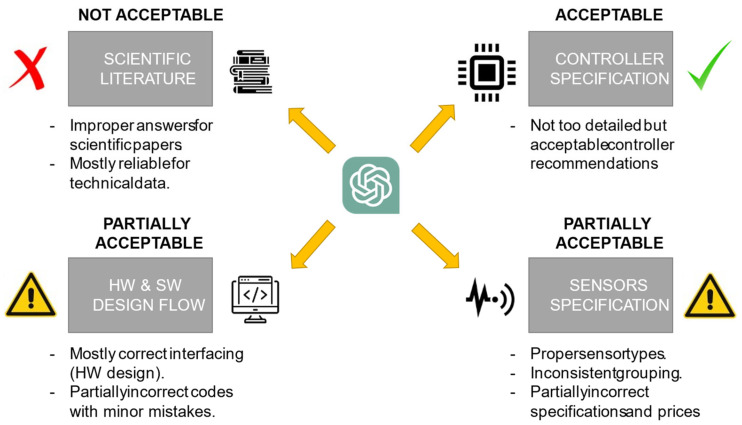
In this paper, we investigated the applicability of ChatGPT AI in electronics research and development via a case study of applied sensors in embedded electronic systems, a topic that is rarely mentioned in the recent literature, thus providing new insight for professionals and academics. The initial electronics-development tasks of a smart home project were prompted to the ChatGPT system to find out its capabilities and limitations. We wanted to obtain detailed information on the central processing controller units and the actual sensors usable for the specific project, their specifications and recommendations on the hardware and software design flow additionally. Furthermore, an extensive literature survey was requested to see if the bot could offer scientific papers covering the given topic. It was found that the ChatGPT responded with proper recommendations on controllers. However, the suggested sensor units, the hardware and software design were only partially acceptable, with occasional errors in specifications and generated code. The results of the literature survey showed that non-acceptable, fabricated citations (fake authors list, title, journal details and DOI—Digital Object identifier) were presented by the bot. The paper provides a detailed qualitative analysis, a performance analysis and critical discussion of the aforementioned aspects while providing the query set, the generated answers and codes as supplied data with the goal to give added value to electronics researchers and developers if trying to reach out for the tools in their profession.
Overview
The claims and statistics of this paper haven’t been checked yet.
Free: it reads the open-access text and checks the first 5 claims that cite a source we can check. Create a free account to check every claim.
Integrity signals
Registry
Cites
Statistics
Figures

Verification
Claims the paper makes
The claims and statistics of this paper haven’t been checked yet.
Free: it reads the open-access text and checks the first 5 claims that cite a source we can check. Create a free account to check every claim.
Claims other papers make about this one
Each is checked against this paper’s own text: does it say what the citing paper says it does?
The cited source says what the claim attributes to it.
In the citing paper
“Several authors have noted that ChatGPT tends to cite works that do not actually exist12,16–25”
From Fabrication and errors in the bibliographic citations generated by ChatGPT (2023) · cites this paper as [23]
Experimental — accuracy not yet measured
Self-check
Percentages, sums and reported differences re-computed from the paper’s own numbers.
The self-check needs the paper’s full text.
Citations
Cites
On the Dangers of Stochastic Parrots: Can Language Models Be Too Big? 🦜
Bender, E. M., Gebru, T., McMillan-Major, A., & Shmitchell, S. (2021) · Proceedings of the 2021 ACM Conference on Fairness, Accountability, and Transparency · doi:10.1145/3442188.3445922 · Cited by 6,988
Ray, P. P. (2023) · Internet of Things and Cyber-Physical Systems · doi:10.1016/j.iotcps.2023.04.003 · Cited by 2,463
What Is the Impact of ChatGPT on Education? A Rapid Review of the Literature
Lo, C. K. (2023) · Education Sciences · doi:10.3390/educsci13040410 · Cited by 2,024
ChatGPT - Reshaping medical education and clinical management
Khan, R. A., Jawaid, M., Khan, A. R., & Sajjad, M. (2023) · Pakistan Journal of Medical Sciences · doi:10.12669/pjms.39.2.7653 · Cited by 628
Generating scholarly content with ChatGPT: Ethical challenges for medical publishing
Liebrenz, M., Schleifer, R., Buadze, A., Bhugra, D., & Smith, A. (2023) · The Lancet Digital Health · doi:10.1016/s2589-7500(23)00019-5 · Cited by 594
ChatGPT for (Finance) research: The Bananarama Conjecture
Dowling, M., & Lucey, B. (2023) · Finance Research Letters · doi:10.1016/j.frl.2023.103662 · Cited by 591
ChatGPT for Robotics: Design Principles and Model Abilities
Vemprala, S. H., Bonatti, R., Bucker, A., & Kapoor, A. (2024) · IEEE Access · doi:10.1109/access.2024.3387941 · Cited by 570 · cited 1×
“showed a possible application mindset for robotics, where ChatGPT partially substitutes the engineer in the loop and where eventually a user can use the LLM as a tool to connect to further robots solving tasks [20].”
MethodUse chat gpt to solve programming bugs
Surameery, N. M. S., & Shakor, M. Y. (2023) · International Journal of Information technology and Computer Engineering · doi:10.55529/ijitc.31.17.22 · Cited by 382 · cited 1×
“Surameery and Shakor highlighted bug-fixing capabilities of the tool and suggested ChatGPT as a part of a more comprehensive debugging toolkit, not only as a sole solution used by developers [18].”
MethodChatGPT: Evolution or revolution?
Gordijn, B., & Have, H. T. (2023) · Medicine, Health Care and Philosophy · doi:10.1007/s11019-023-10136-0 · Cited by 317
Risks and Benefits of Large Language Models for the Environment
Rillig, M. C., Ågerstrand, M., Bi, M., Gould, K. A., & Sauerland, U. (2023) · Environmental Science & Technology · doi:10.1021/acs.est.3c01106 · Cited by 270
Cited by
Fabrication and errors in the bibliographic citations generated by ChatGPT
Walters, W. H., & Wilder, E. I. (2023) · Scientific Reports · doi:10.1038/s41598-023-41032-5 · Cited by 499
Khan, N., Khan, Z., Koubaa, A., Khan, M. K., & Salleh, R. B. (2024) · Connection Science · doi:10.1080/09540091.2024.2353630 · Cited by 97
ChatGPT versus Bard: A comparative study
Ahmed, I., Kajol, M. A., Hasan, U., Datta, P. P., Roy, A., & Reza, M. R. (2024) · Engineering Reports · doi:10.1002/eng2.12890 · Cited by 68
Exploring Qualitative Research Using LLMsPreprint
Bano, M., Zowghi, D., & Whittle, J. (2023) · arXiv (Cornell University) · doi:10.48550/arxiv.2306.13298 · Cited by 57
AI-Powered Innovations in High-Tech Research and Development: From Theory to Practice
Madanchian, M., & Taherdoost, H. (2024) · Computers, materials & continua/Computers, materials & continua (Print) · doi:10.32604/cmc.2024.057094 · Cited by 53
Evaluating human resources management literacy: A performance analysis of ChatGPT and bard
Raman, R., Venugopalan, M., & Kamal, A. (2024) · Heliyon · doi:10.1016/j.heliyon.2024.e27026 · Cited by 48
ChatGPT vs. Bard: A Comparative StudyPreprint
Ahmed, I., Kajol, M. A., Hasan, U., & Datta, P. P. (2023) · doi:10.36227/techrxiv.23536290 · Cited by 48
AI and Human Reasoning: Qualitative Research in the Age of Large Language Models
Bano, M., Zowghi, D., & Whittle, J. (2024) · AI Ethics Journal · doi:10.47289/aiej20240122 · Cited by 35
Chen, Y., Zhang, S., Han, T., Du, Y., Zhang, W., & Li, J. (2024) · ISPRS Journal of Photogrammetry and Remote Sensing · doi:10.1016/j.isprsjprs.2024.04.024 · Cited by 32
Alhusban, M. I., Khatatbeh, I. N., & Alshurafat, H. (2025) · Competitiveness Review An International Business Journal incorporating Journal of Global Competitiveness · doi:10.1108/cr-06-2024-0121 · Cited by 32
A Future of Smarter Digital Health Empowered by Generative Pretrained Transformer
Miao, H., Li, C., & Wang, J. (2023) · Journal of Medical Internet Research · doi:10.2196/49963 · Cited by 27
Review of Qualitative Research in the Era of Generative Artificial IntelligencePreprint
Acheampong, K. O., & Nyaaba, M. (2024) · SSRN Electronic Journal · doi:10.2139/ssrn.4686920 · Cited by 27
Eldem, A., & Eldem, H. (2026) · Scientific Reports · doi:10.1038/s41598-026-35003-9 · Cited by 20
Rane, N. L., Choudhary, S., & Rane, J. (2024) · SSRN Electronic Journal · doi:10.2139/ssrn.4681733 · Cited by 20
Vindigni, G. (2024) · European Journal of Contemporary Education and E-Learning · doi:10.59324/ejceel.2024.2(4).10 · Cited by 17
The citation catastrophe: Propagation of AI-generated counterfeit citations in scholarship
Camp, N. T., Bengtson, J. A., & Sandstrom, J. C. (2025) · The Journal of Academic Librarianship · doi:10.1016/j.acalib.2025.103065 · Cited by 12
ChatGPT vsPreprint
Ahmed, I., Kajol, M. A., Hasan, U., & Datta, P. P. (2023) · doi:10.36227/techrxiv.23536290.v1 · Cited by 9
Fuente-Ballesteros, A., & Zeidler, V. Z. (2026) · Analytical Chemistry · doi:10.1021/acs.analchem.6c00352 · Cited by 6
ChatGPT vsPreprint
Ahmed, I., Kajol, M. A., Hasan, U., & Datta, P. P. (2023) · doi:10.36227/techrxiv.23536290.v2 · Cited by 6
Somasundaram, S. K., Sridevi, S., Murugappan, M., & VinothKumar, B. (2024) · Springer eBooks · doi:10.1007/978-3-031-59967-5_9 · Cited by 5
Comparing large language model artificial intelligence tools in aid of electrical engineering
Tafferner, Z., & Géczy, A. (2024) · IEEE International Symposium for Design and Technology in Electronic Packaging (SIITME) · doi:10.1109/siitme63973.2024.10814860 · Cited by 5
Self-citationLLM-Based Code Development Model with Active Prompt Adjustment and On-Device ValidationPreprint
Su, H. (2025) · doi:10.36227/techrxiv.173804108.86605562/v1 · Cited by 5
Rane, N. L., Choudhary, S., & Rane, J. (2024) · SSRN Electronic Journal · doi:10.2139/ssrn.4681735 · Cited by 4
Gunda, P., & Rao, K. T. (2024) · International Conference on Sustainable Expert Systems (ICSES) · doi:10.1109/icses63445.2024.10763266 · Cited by 3
Enhancing Vocational Students’ Programming Skills with ChatGPT- Supported Cooperative Learning
Thongsai, K., Hutamarn, S., Howimanporn, S., Tonggoed, T., & Chookaew, S. (2025) · Lecture notes in educational technology · doi:10.1007/978-981-96-8931-6_30 · Cited by 2
Camarda, D., & Patano, M. (2024) · REAL CORP Repository · doi:10.48494/realcorp2024.1119 · Cited by 2
Chattronics : utilizando GPTs para auxílio a projeto de sistemas de aquisição de sinais
Brown, J. P. D. (2024) · Lume (Universidade Federal do Rio Grande do Sul) · Cited by 2
Géczy, A., Bojta, P., Straubinger, D., Illés, B., & Harsányi, G. (2025) · Elsevier eBooks · doi:10.1016/b978-0-443-24790-3.00003-x · Cited by 1
Self-citationRIBEIRO, W. S., OLIVEIRA, L. D., REGO, V. F. B., & STEFFEN, G. D. M. (2024) · Anais ... Encontro Nacional de Engenharia de Produção/Anais do Encontro Nacional de Engenharia de Produção · doi:10.14488/enegep2024_tn_egs_422_2072_47899 · Cited by 1
Using ChatGPT to write program-space optimized source-code
Busu, I., Enescu, A.-M., Enescu, H.-R., & Bîră, C. (2024) · Advanced Topics on Measurement and Simulation (ATOMS) · doi:10.1109/atoms60779.2024.10921548 · Cited by 1
Generative artificial intelligence for education: The present and the future
Reynaud, T. V. (2024) · Repositório do ISCTE-IUL · Cited by 1
Real vs. Artificial Scenario-Building in Planning: Some GPT-Based Experimental Notes
Melone, M. R. S., & Camarda, D. (2024) · Lecture notes in computer science · doi:10.1007/978-3-031-71315-6_2
Chattronics: using GPTs to assist in the design of data acquisition systemsPreprint
Brown, J. P. D., & Weber, T. O. (2024) · arXiv (Cornell University) · doi:10.48550/arxiv.2409.15183
AI-assisted authoring in the Software Engineering domain : an empirical study on using ChatGPT
Walter, M. (2024) · OPUS Publication Server of the University of Stuttgart (University of Stuttgart) · doi:10.18419/opus-14483
Olaosun, R., Unver, E., & Binder, J. R. (2024) · Huddersfield Research Portal (University of Huddersfield)
Artificial intelligence for distributed power system management
Pribylskii, I. V., & Armeev, D. A. (2026) · iPolytech Journal · doi:10.21285/1814-3520-2026-1-113-124
Surveying GenAI-based Automation in Printed Circuit Board Design and TestPreprint
Srinivasan, S., Turnbull, B., & Pearce, H. A. (2026) · arXiv (Cornell University) · doi:10.48550/arxiv.2606.17074
Large Language Model-Based Approaches in Electronic Design: A Brief Review
Kovács, L., Tafferner, Z., & Géczy, A. (2026) · International Spring Seminar on Electronics Technology · doi:10.1109/isse70010.2026.11600945
Self-citationDiaz, M. S. T., Facundo, J. F. L., & Pascuas-Rengifo, Y. S. (2026) · trilogía Ciencia Tecnología Sociedad · doi:10.22430/21457778.3906
Shin, W. S. (2025) · International journal of systematic innovation
Projektowanie belki wspornikowej z wykorzystaniem sztucznej inteligencji
Lacki, P., & Derlatka, A. (2026) · Inżynier Budownictwa · doi:10.68502/ib.2026.05.15
Искусственный интеллект в задачах управления энергосистемой с малой распределённой генерацией
Викторович, П. И., & Владимирович, А. Д. (2026) · iPolytech Journal
Metadata
- Authors
- Tafferner, Z., Balázs, B., Krammer, O., & Géczy, A.
- Affiliations
- Budapest University of Technology and Economics (HU)
- Corresponding author
- Géczy, Attila
- Venue
- Sensors
- Publisher
- MDPI AG
- Published
- 2023-05-18
- Volume
- 23
- Issue
- 10
- Pages
- 4879
- ISSN
- 1424-8220 (ISSN-L)
- PMC
- PMC10221460
- OpenAlex
- W4377138257
- Cited by
- 31
- References
- 21
- Citations by year
- 2026: 6 · 2025: 4 · 2024: 15 · 2023: 6
- FWCI
- 2.92
- Type
- journal article
- Language
- en
- Open access
- gold
- doi.org
- Licence
- Locations
- Sensors (publishedVersion, cc-by)
- PubMed Central (publishedVersion, cc-by)
- PubMed (publishedVersion)
- DOAJ (DOAJ: Directory of Open Access Journals) (submittedVersion, cc-by-sa)
- Topics
- Physical Sciences › Computer Science › Artificial Intelligence › Artificial Intelligence Applications
- Social Sciences › Education › Artificial Intelligence in Education
- Health Sciences › Medicine › Health Informatics › Artificial Intelligence in Healthcare and Education
- Keywords
- ChatGPT, large language models, embedded systems, home automation, microcontroller selection, sensor selection, hardware and software design, literature searching, AI-generated code
About these checks
Registry, retraction, Cites and statistics results are computed, not judged, with one exception: a printed reference that no index lists is read once by a model before it counts as a citation error. Claims are extracted by a model and kept only when their quote appears verbatim in the text; each cited source is then checked, with a model’s help, for whether it says what the claim relies on. Those verdicts can be wrong — read the claim’s quote and the cited source before relying on one.
Statistics and arithmetic are recomputed, not judged.
Confidence bands are shown only for fields calibrated on our annotated test set. None is calibrated yet, so no band is shown.
What counts as a claim ›How we measure confidence ›How we check this ›
Are you an author, or do you see a problem with this page? Request a review
Data sources
Bibliographic data: Semantic Scholar, OpenAlex, Crossref.
Contains information from the Semantic Scholar Academic Graph Datasets, made available under the ODC Attribution License (ODC-BY 1.0).
Semantic Scholar’s data is described in: Kinney, R., et al. (2023). The Semantic Scholar Open Data Platform. arXiv:2301.10140.
