

The DOI matches its Crossref record; 50 of the 50 references it cites were found in a registry or an index; none of the 42 sources its claims cite is checked for support yet.
A DDoS Detection Method Based on Feature Engineering and Machine Learning in Software-Defined Networks
Open accessAbstract
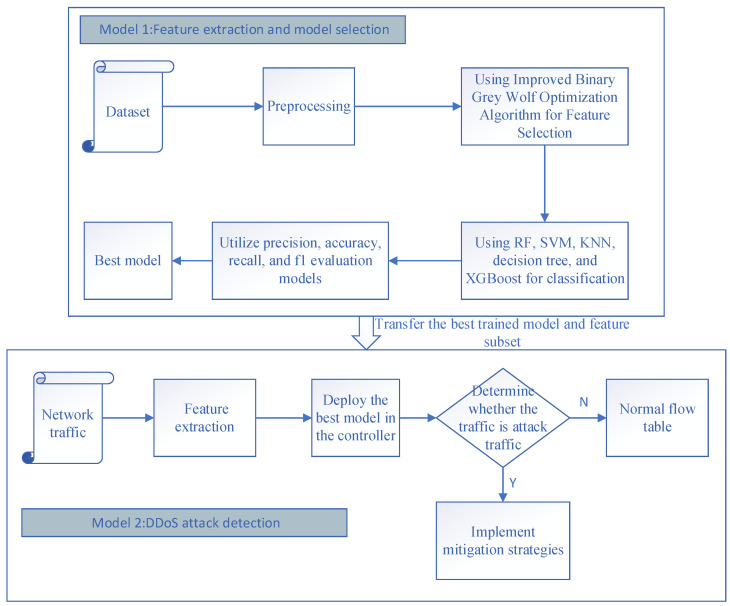
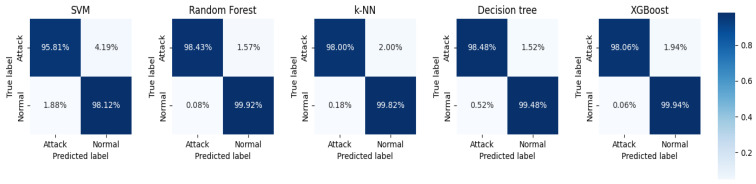
Distributed denial-of-service (DDoS) attacks pose a significant cybersecurity threat to software-defined networks (SDNs). This paper proposes a feature-engineering- and machine-learning-based approach to detect DDoS attacks in SDNs. First, the CSE-CIC-IDS2018 dataset was cleaned and normalized, and the optimal feature subset was found using an improved binary grey wolf optimization algorithm. Next, the optimal feature subset was trained and tested in Random Forest (RF), Support Vector Machine (SVM), K-Nearest Neighbor (k-NN), Decision Tree, and XGBoost machine learning algorithms, from which the best classifier was selected for DDoS attack detection and deployed in the SDN controller. The results show that RF performs best when compared across several performance metrics (e.g., accuracy, precision, recall, F1 and AUC values). We also explore the comparison between different models and algorithms. The results show that our proposed method performed the best and can effectively detect and identify DDoS attacks in SDNs, providing a new idea and solution for the security of SDNs.
Overview
CoChat Summary
TL;DR
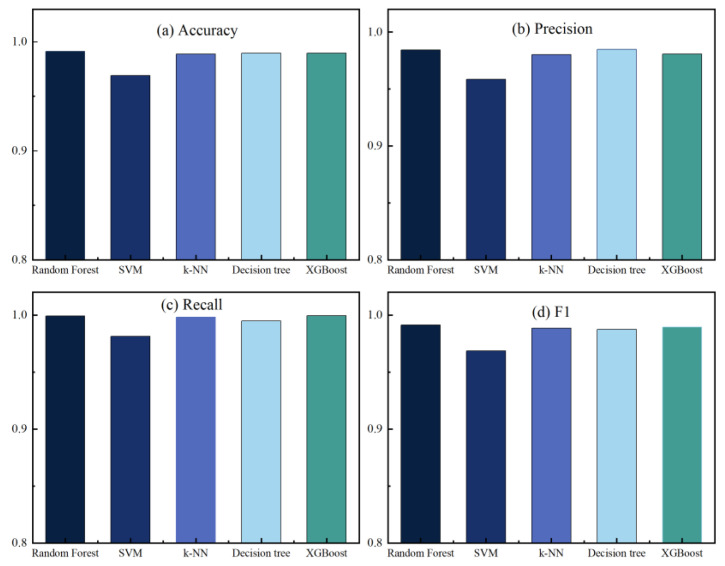
This paper proposes an SDN DDoS detection method that combines improved binary grey wolf optimization feature selection with machine learning, selecting 26 of 79 CSE-CIC-IDS2018 features and deploying the best classifier in the SDN controller. Random Forest performed best overall, achieving accuracy 0.9913, precision 0.9843, recall 0.9992, and F1 0.9913 after feature extraction.
Key findings
- Feature selection reduced the dataset from 79 to 26 features; after feature extraction, all classifiers improved in all metrics, with Decision Tree improving most by 0.0341, followed by RF by 0.0278, and SVM least by 0.0202.
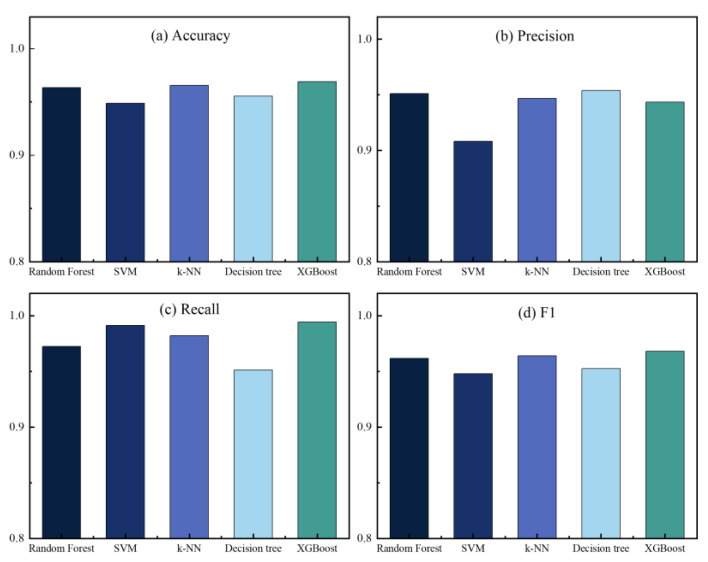
- On the original dataset, XGBoost had the best accuracy at 0.969. After feature extraction, the conclusion reports RF as best under accuracy, precision, recall, and F1 with 0.9913, 0.9843, 0.9992, and 0.9913, respectively; earlier text notes RF accuracy was slightly lower than Decision Tree but all other metrics were better.
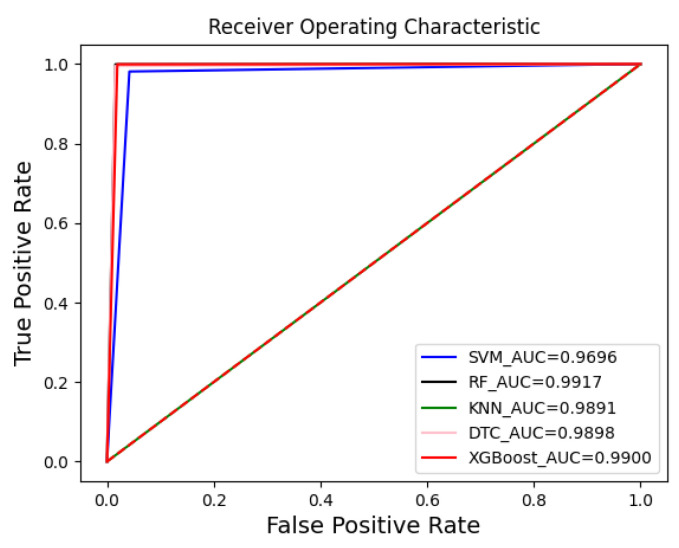
- AUC-ROC values were SVM 0.9696, RF 0.9917, k-NN 0.9891, DTC 0.9898, and XGBoost 0.99, leading the authors to consider RF the best performer.
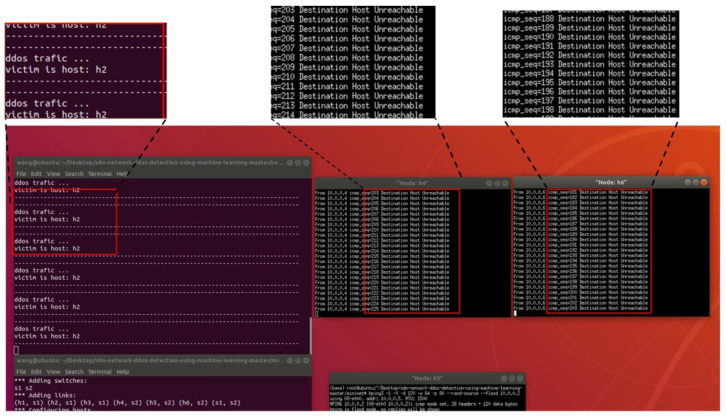
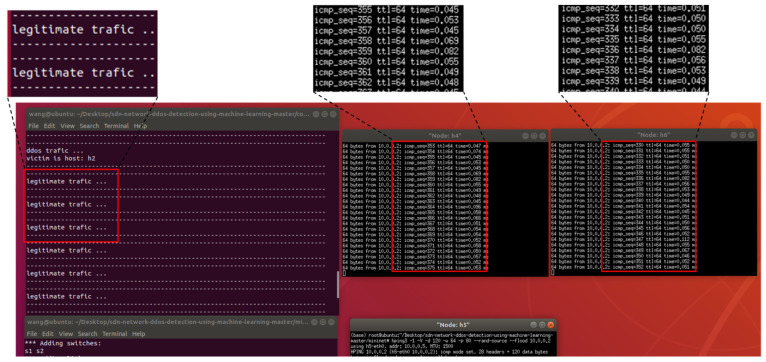
- In the SDN test, an hping3 flooding attack from h5 to h2 disrupted h4 and h6; after mitigation (dropping packets corresponding to a specific input port), h4 and h6 could send data to h2 normally.
Methods
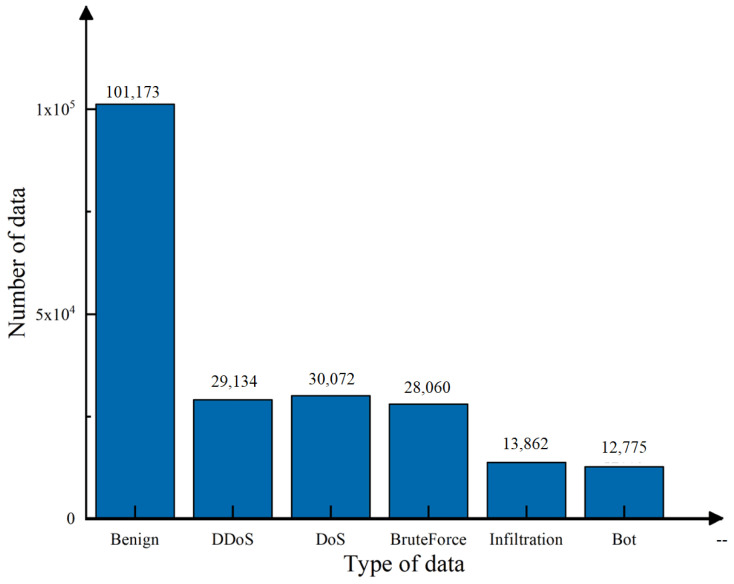
- Data: CSE-CIC-IDS2018 was cleaned by dropping NaN, empty, or infinite values, reducing samples from 215,761 to 215,076 (685 removed); MinMax scaling mapped features to [0,1]; an average of 210,000 samples was selected, including DDoS, DoS, Brute Force, Infiltration, and Bot attack types.
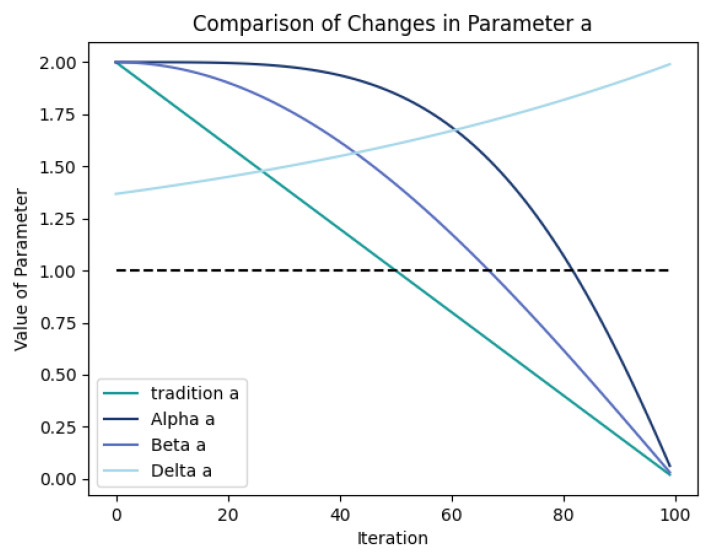
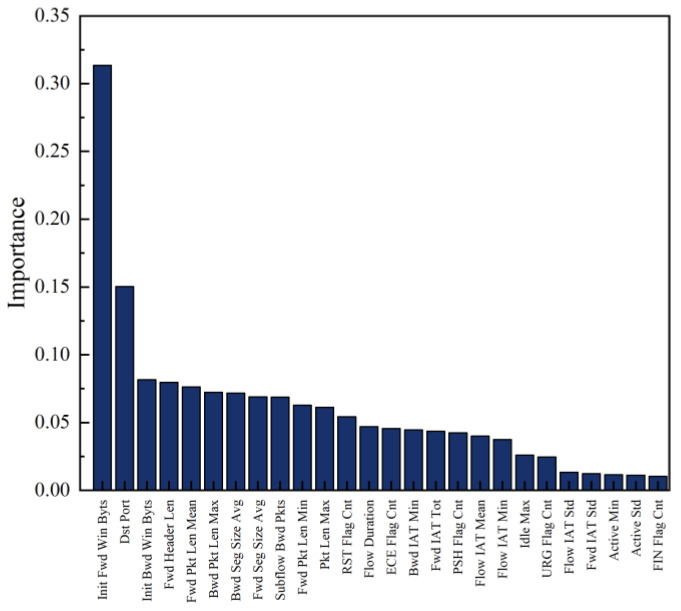
- Feature selection: an improved binary grey wolf optimization algorithm used Tent chaotic mapping initialization, nonlinear cosine search parameters, and weighted position updating; it selected 26 features from 79, with fitness based on feature count and k-NN classification error rate.
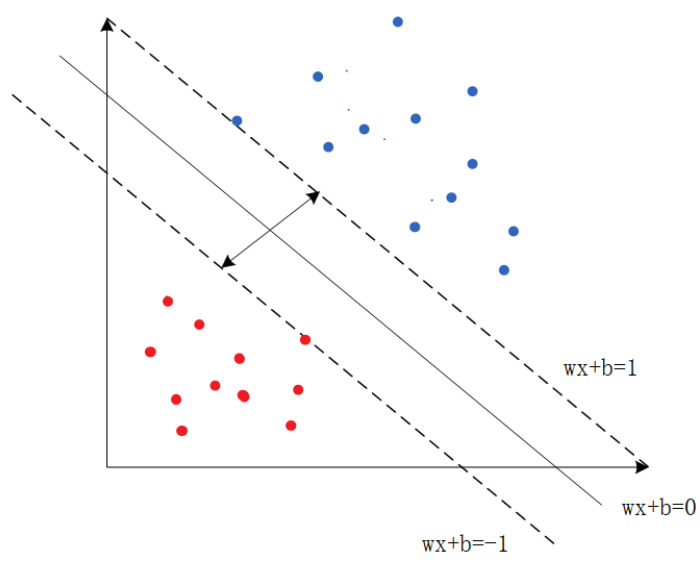
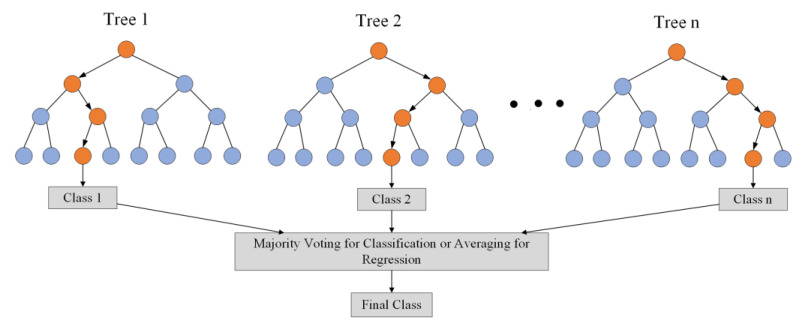
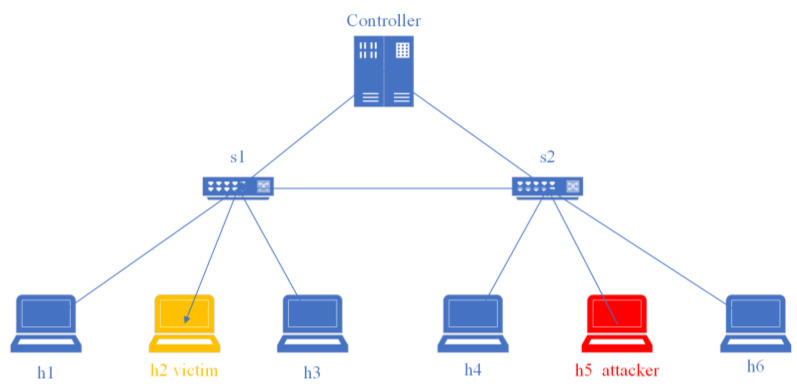
- Classifiers and evaluation: SVM, RF, Decision Tree, XGBoost, and k-NN were trained and tested with default parameters and 10-fold cross-validation using accuracy, precision, recall, F1, and ROC/AUC; the best classifier was deployed in a Ryu controller, with experiments on Ubuntu 18.04, 16 GB RAM, AMD Ryzen 7 5800 H at 3.20 GHz, Mininet, and a topology of one controller, two switches, and six hosts.
Limitations
- Stated: comparison with similar works is difficult because they use different datasets and models; the cited works did not show DDoS attack detection performance on SDNs and did not develop mitigation strategies.
- Stated future work implies current limitations: the authors plan to use advanced feature engineering and deep learning, research mitigation of adversarial attacks for robustness and adaptability, and integrate the method with other network security technologies.
- Evident from the text: evaluation uses one dataset (CSE-CIC-IDS2018) and a small Mininet topology (one controller, two switches, six hosts); classifiers used default parameters, and adversarial robustness is not tested in the current work.
Model-written summary. Check it against the paper before relying on it.
Integrity signals
Registry
Cites
Statistics
Figures
Verification
Claims the paper makes
0 Valid · 1 Not valid · 20 Not checked · 33 Own results and interpretations
A result the paper reports from its own data — it cites no other source for it, so there is none to check. The quote shows it is in the paper.
In the paper
“the algorithm’s selection process also identified the importance of each selected feature, which is illustrated in Figure 6.”
§ A DDoS Detection Method Based on Feature Engineering and Machine Learning in Software-Defined Networks > 4. Methodology > 4.1. Data Preprocessing and Feature Extraction
plainstates a cause- Asserted: passes — The authors put it forward as true.
- Checkable: passes — It can be checked against evidence.
- Load-bearing: unclear — It is unclear whether the paper’s conclusions depend on it.
- Based: passes — The paper gives a reason why it holds.
A result the paper reports from its own data — it cites no other source for it, so there is none to check. The quote shows it is in the paper.
In the paper
“From the data analysis, we can see that the XGBoost algorithm had the best performance on the original dataset with an accuracy of 0.969.”
- Also stated in: § 6. Conclusions and Future Work · plain
“The results showed that the highest accuracy of XGBoost was 0.969 on the original dataset”
§ A DDoS Detection Method Based on Feature Engineering and Machine Learning in Software-Defined Networks > 5. Experiments and Analysis of Results > 5.3. Analysis of Results
plain- Asserted: passes — The authors put it forward as true.
- Checkable: passes — It can be checked against evidence.
- Load-bearing: unclear — It is unclear whether the paper’s conclusions depend on it.
- Based: passes — The paper gives a reason why it holds.
- Rests on 2 assumptions not shown here.
- Also stated in: § 6. Conclusions and Future Work · plain
A result the paper reports from its own data — it cites no other source for it, so there is none to check. The quote shows it is in the paper.
In the paper
“The results show that RF performs best when compared across several performance metrics (e.g., accuracy, precision, recall, F1 and AUC values).”
§ A DDoS Detection Method Based on Feature Engineering and Machine Learning in Software-Defined Networks > Abstract
plain- Asserted: passes — The authors put it forward as true.
- Checkable: passes — It can be checked against evidence.
- Load-bearing: passes — The paper’s conclusions depend on it.
- Based: passes — The paper gives a reason why it holds.
A result the paper reports from its own data — it cites no other source for it, so there is none to check. The quote shows it is in the paper.
In the paper
“In total, 26 features were selected from the original dataset of 79 features using the algorithm mentioned above.”
§ A DDoS Detection Method Based on Feature Engineering and Machine Learning in Software-Defined Networks > 4. Methodology > 4.1. Data Preprocessing and Feature Extraction
plainstates a cause- Asserted: passes — The authors put it forward as true.
- Checkable: passes — It can be checked against evidence.
- Load-bearing: passes — The paper’s conclusions depend on it.
- Based: passes — The paper gives a reason why it holds.
A result the paper states — it cites no source for it, so there is none to check. The quote shows it is in the paper.
In the paper
“Due to this dataset’s significant data volume imbalance, we selected an average of 210,000 sample data, including DDoS, DoS, Brute Force, Infiltration, and Bot attack types”
§ A DDoS Detection Method Based on Feature Engineering and Machine Learning in Software-Defined Networks > 4. Methodology > 4.1. Data Preprocessing and Feature Extraction
plainn = 210,000- Asserted: passes — The authors put it forward as true.
- Checkable: passes — It can be checked against evidence.
- Load-bearing: passes — The paper’s conclusions depend on it.
- Based: passes — The paper gives a reason why it holds.
12 more claims
Create a free account to see all 54 claims and to verify the 42 references still open.
- Probably not a substantial claim. 22
- It may state two separate claims as one. 25
- The quote only partly states this claim. 2
Self-check
Percentages, sums and reported differences re-computed from the paper’s own numbers.
Each contradiction between two passages listed here was confirmed by an independent check.
Rated major: it would touch a result — a value a result rests on, reported and recomputed p-values on opposite sides of the significance level, two passages that conflict with no sign which is right, or a cited work retracted before this paper was published.
In the paper
§ A DDoS Detection Method Based on Feature Engineering and Machine Learning in Software-Defined Networks > 5. Experiments and Analysis of Results > 5.3. Analysis of Results
“the accuracy, which was slightly lower than that of the Decision Tree algorithm”
§ A DDoS Detection Method Based on Feature Engineering and Machine Learning in Software-Defined Networks > 6. Conclusions and Future Work
“the RF classifier performed best under accuracy, precision, recall, and f1_score metrics with 0.9913, 0.9843, 0.9992, and 0.9913, respectively.”
Citations
Cites
Mirjalili, S., Mirjalili, S. M., & Lewis, A. (2014) · Advances in Engineering Software · doi:10.1016/j.advengsoft.2013.12.007 · Cited by 19,343
Machine learning and deep learning
Janiesch, C., Zschech, P., & Heinrich, K. (2021) · Electronic Markets · doi:10.1007/s12525-021-00475-2 · Cited by 2,959
Binary grey wolf optimization approaches for feature selection
Emary, E., Zawbaa, H. M., & Hassanien, A. E. (2016) · Neurocomputing · doi:10.1016/j.neucom.2015.06.083 · Cited by 1,410
Binary Optimization Using Hybrid Grey Wolf Optimization for Feature Selection
Al-Tashi, Q., Abdul Kadir, S. J., Rais, H. M., Mirjalili, S., & Alhussian, H. (2019) · IEEE Access · doi:10.1109/access.2019.2906757 · Cited by 487
Mestres, A., Rodriguez-Natal, A., Carner, J., Barlet-Ros, P., Alarcón, E., Solé, M., Muntés-Mulero, V., Meyer, D., Barkai, S., Hibbett, M. J., et al. (2017) · ACM SIGCOMM Computer Communication Review · doi:10.1145/3138808.3138810 · Cited by 352
Increasing the Performance of Machine Learning-Based IDSs on an Imbalanced and Up-to-Date Dataset
Karatas, G., Demir, O., & Sahingoz, O. K. (2020) · IEEE Access · doi:10.1109/access.2020.2973219 · Cited by 293
Alzahrani, A. O., & Alenazi, M. J. F. (2021) · Future Internet · doi:10.3390/fi13050111 · Cited by 272
Polat, H., Polat, O., & Cetin, A. (2020) · Sustainability · doi:10.3390/su12031035 · Cited by 265
Automated DDOS attack detection in software defined networking
Ahuja, N., Singal, G., Mukhopadhyay, D., & Kumar, N. (2021) · Journal of Network and Computer Applications · doi:10.1016/j.jnca.2021.103108 · Cited by 234
Almomani, O. (2020) · Symmetry · doi:10.3390/sym12061046 · Cited by 231
Dong, S., & Sarem, M. (2020) · IEEE Access · doi:10.1109/access.2019.2963077 · Cited by 211
Alduailij, M., Khan, Q. W., Tahir, M., Sardaraz, M., Alduailij, M., & Malik, F. (2022) · Symmetry · doi:10.3390/sym14061095 · Cited by 207
Machine learning algorithms to detect DDoS attacks in SDN
Santos, R., Souza, D., Santo, W., Ribeiro, A., & Moreno, E. (2020) · Concurrency and Computation: Practice and Experience · doi:10.1002/cpe.5402 · Cited by 195
A novel approach to intrusion detection using SVM ensemble with feature augmentation
Gu, J., Wang, L., Wang, H., & Wang, S. (2019) · Computers & Security · doi:10.1016/j.cose.2019.05.022 · Cited by 191
A new DDoS attacks intrusion detection model based on deep learning for cybersecurity
Akgun, D., Hizal, S., & Cavusoglu, U. (2022) · Computers & Security · doi:10.1016/j.cose.2022.102748 · Cited by 189
A tree-based stacking ensemble technique with feature selection for network intrusion detection
Rashid, M., Kamruzzaman, J., Imam, T., Wibowo, S., & Gordon, S. (2022) · Applied Intelligence · doi:10.1007/s10489-021-02968-1 · Cited by 167
Machine Learning Techniques to Detect a DDoS Attack in SDN: A Systematic Review
Ali, T. E., Chong, Y.-W., & Manickam, S. (2023) · Applied Sciences · doi:10.3390/app13053183 · Cited by 164
A high-dimensional feature selection method based on modified Gray Wolf Optimization
Pan, H., Chen, S., & Xiong, H. (2023) · Applied Soft Computing · doi:10.1016/j.asoc.2023.110031 · Cited by 158
CBSO: A memetic brain storm optimization with chaotic local search
Yu, Y., Gao, S., Cheng, S., Wang, Y., Song, S., & Yuan, F. (2018) · Memetic Computing · doi:10.1007/s12293-017-0247-0 · Cited by 150
Self-citationA Machine Learning-Based Classification and Prediction Technique for DDoS Attacks
Ismail, Mohmand, M. I., Hussain, H., Khan, A. A., Ullah, U., Zakarya, M., Ahmed, A., Raza, M., Rahman, I. U., & Haleem, M. (2022) · IEEE Access · doi:10.1109/access.2022.3152577 · Cited by 141
Alhijawi, B., Almajali, S., Elgala, H., Salameh, H. B., & Ayyash, M. (2022) · Computers & Electrical Engineering · doi:10.1016/j.compeleceng.2022.107706 · Cited by 112
Wang, Z., Zeng, Y., Liu, Y., & Li, D. (2021) · IEEE Access · doi:10.1109/access.2021.3051074 · Cited by 107
Self-citationAnalysis of Machine Learning Classifiers for Early Detection of DDoS Attacks on IoT Devices
Gaur, V., & Kumar, R. (2022) · Arabian Journal for Science and Engineering · doi:10.1007/s13369-021-05947-3 · Cited by 107
Entropy and Confidence-Based Undersampling Boosting Random Forests for Imbalanced Problems
Wang, Z., Cao, C., & Zhu, Y. (2020) · IEEE Transactions on Neural Networks and Learning Systems · doi:10.1109/tnnls.2020.2964585 · Cited by 104
Aamir, M., & Zaidi, S. M. A. (2019) · International Journal of Information Security · doi:10.1007/s10207-019-00434-1 · Cited by 87
Polat, H., Türkoğlu, M., Polat, O., & Şengür, A. (2022) · Expert Systems with Applications · doi:10.1016/j.eswa.2022.116748 · Cited by 86
Alamri, H. A., & Thayananthan, V. (2020) · IEEE Access · doi:10.1109/access.2020.3033942 · Cited by 84
An Efficient IDS Framework for DDoS Attacks in SDN Environment
Varghese, J. E., & Muniyal, B. (2021) · IEEE Access · doi:10.1109/access.2021.3078065 · Cited by 81
RBF-SVM kernel-based model for detecting DDoS attacks in SDN integrated vehicular network
Anyanwu, G. O., Nwakanma, C. I., Lee, J.-M., & Kim, D.-S. (2023) · Ad Hoc Networks · doi:10.1016/j.adhoc.2022.103026 · Cited by 74
Qiong, W., Shuai, S., Ziyang, W., Qiang, F., Pingyi, F., & Cui, Z. (2023) · Chinese Journal of Electronics · doi:10.23919/cje.2022.00.093 · Cited by 74
Maheshwari, A., Mehraj, B., Khan, M. S., & Idrisi, M. S. (2022) · Microprocessors and Microsystems · doi:10.1016/j.micpro.2021.104412 · Cited by 72
A survey: Typical security issues of software-defined networking
Liu, Y., Zhao, B., Zhao, P., Fan, P., & Liu, H. (2019) · China Communications · doi:10.23919/jcc.2019.07.002 · Cited by 72
Self-citationSingh, G., & Khare, N. (2022) · International Journal of Computers and Applications · doi:10.1080/1206212x.2021.1885150 · Cited by 59
Application Layer DDoS Attack Detection Using Cuckoo Search Algorithm-Trained Radial Basis Function
Beitollahi, H., Sharif, D. M., & Fazeli, M. (2022) · IEEE Access · doi:10.1109/access.2022.3182818 · Cited by 53
DDoS attack detection using MLP and Random Forest Algorithms
Najar, A. A., & Manohar Naik, S. (2022) · International Journal of Information Technology · doi:10.1007/s41870-022-01003-x · Cited by 47
Chouhan, R. K., Atulkar, M., & Nagwani, N. K. (2022) · Applied Intelligence · doi:10.1007/s10489-022-03565-6 · Cited by 44
The detection method of low-rate DoS attack based on multi-feature fusion
Liu, L., Wang, H., Wu, Z., & Yue, M. (2020) · Digital Communications and Networks · doi:10.1016/j.dcan.2020.04.002 · Cited by 38
Distributed denial of service attack detection using autoencoder and deep neural networks
Catak, F. O., & Mustacoglu, A. F. (2019) · Journal of Intelligent & Fuzzy Systems · doi:10.3233/jifs-190159 · Cited by 37
Dora, V. R. S., & Lakshmi, V. N. (2022) · International Journal of Intelligent Robotics and Applications · doi:10.1007/s41315-022-00224-4 · Cited by 35
A novel feature-based framework enabling multi-type DDoS attacks detection
Zhou, L., Zhu, Y., Xiang, Y., & Zong, T. (2022) · World Wide Web · doi:10.1007/s11280-022-01040-3 · Cited by 29
Defensive mechanism against DDoS attack based on feature selection and multi-classifier algorithms
Mishra, A., Gupta, N., & Gupta, B. B. (2023) · Telecommunication Systems · doi:10.1007/s11235-022-00981-4 · Cited by 28
A Novel Framework for DDoS Attacks Detection Using Hybrid LSTM Techniques
Thangasamy, A., Sundan, B., & Govindaraj, L. (2023) · Computer Systems Science and Engineering · doi:10.32604/csse.2023.032078 · Cited by 27
Performance Comparison of Ryu and Floodlight Controllers in Different SDN Topologies
Chouhan, R. K., Atulkar, M., & Nagwani, N. K. (2019) · 2019 1st International Conference on Advanced Technologies in Intelligent Control, Environment, Computing & Communication Engineering (ICATIECE) · doi:10.1109/icatiece45860.2019.9063806 · Cited by 23
Intrusion Detection System for SDN-enabled IoT Networks using Machine Learning Techniques
Ashraf, J., Moustafa, N., Bukhshi, A. D., & Javed, A. (2021) · 2021 IEEE 25th International Enterprise Distributed Object Computing Workshop (EDOCW) · doi:10.1109/edocw52865.2021.00031 · Cited by 19
Mohsin, M. A., & Hamad, A. H. (2022) · Revue d'Intelligence Artificielle · doi:10.18280/ria.360207 · Cited by 17
A DDoS attack detection method based on SVM and K-nearest neighbour in SDN environment
Ma, Z., & Li, B. (2020) · International Journal of Computational Science and Engineering · doi:10.1504/ijcse.2020.111431 · Cited by 12
Feature Selection and Deep Learning Technique for Intrusion Detection System in IoT
Sharma, B., Sharma, L., & Lal, C. (2022) · Algorithms for Intelligent Systems · doi:10.1007/978-981-16-3802-2_21 · Cited by 8
Idris, S., Oyefolahan Ishaq, O., & Ndunagu Juliana, N. (2019) · 2019 2nd International Conference of the IEEE Nigeria Computer Chapter (NigeriaComputConf) · doi:10.1109/nigeriacomputconf45974.2019.8949676 · Cited by 4
An SDN-based Decision Tree Detection (DTD) Model for Detecting DDoS Attacks in Cloud Environment
J, J. P., & Sridaran, R. (2022) · International Journal of Advanced Computer Science and Applications · doi:10.14569/ijacsa.2022.0130708 · Cited by 3
Computational CBGSA – SVM Model for Network Based Intrusion Detection System
Manghnani, T., & Thirumaran, T. (2019) · Communications in Computer and Information Science · doi:10.1007/978-981-15-0871-4_14 · Cited by 2
Cited by
Advancing cybersecurity: a comprehensive review of AI-driven detection techniques
Salem, A. H., Azzam, S. M., Emam, O. E., & Abohany, A. A. (2024) · Journal of Big Data · doi:10.1186/s40537-024-00957-y · Cited by 282
Cyber-Secure SDN: A CNN-Based Approach for Efficient Detection and Mitigation of DDoS attacks
Najar, A. A., & Naik, S. M. (2024) · Computers & Security · doi:10.1016/j.cose.2024.103716 · Cited by 141
Musa, N. S., Mirza, N. M., Rafique, S. H., Abdallah, A. M., & Thangavel, M. (2024) · IEEE Access · doi:10.1109/access.2024.3360868 · Cited by 108
Cyber Attack Prediction: From Traditional Machine Learning to Generative Artificial Intelligence
Ankalaki, S., Atmakuri, A. R., Pallavi, M., Hukkeri, G. S., Jan, T., & Naik, G. R. (2025) · IEEE Access · doi:10.1109/access.2025.3547433 · Cited by 93
A DDoS attack detection method based on IQR and DFFCNN in SDN
Yue, M., Yan, H., Han, R., & Wu, Z. (2025) · Journal of Network and Computer Applications · doi:10.1016/j.jnca.2025.104203 · Cited by 55
Metadata
- Authors
- Liu, Z., Wang, Y., Feng, F., Liu, Y., Li, Z., & Shan, Y.
- Affiliations
- Hebei University (CN)
- Corresponding author
- Liu, Yifan
- Venue
- Sensors
- Publisher
- MDPI AG
- Published
- 2023-07-05
- Volume
- 23
- Issue
- 13
- Pages
- 6176
- ISSN
- 1424-8220 (ISSN-L)
- PMC
- PMC10346601
- OpenAlex
- W4383346073
- Cited by
- 119
- References
- 50
- Citations by year
- 2026: 43 · 2025: 38 · 2024: 34 · 2023: 4
- FWCI
- 9.74
- Type
- journal article
- Language
- en
- Open access
- gold
- doi.org
- Licence
- Locations
- Sensors (publishedVersion, cc-by)
- PubMed Central (publishedVersion, cc-by)
- PubMed (publishedVersion)
- DOAJ (DOAJ: Directory of Open Access Journals) (submittedVersion, cc-by-sa)
- Funders
- National Natural Science Foundation of Hebei Province, China (F2019201427, 2017A20004)
- Fund for Integration of Cloud Computing and Big Data, Innovation of Science and Education (FII) of Ministry of Education of China (F2019201427, 2017A20004)
- Topics
- Physical Sciences › Computer Science › Computer Networks and Communications › Network Security and Intrusion Detection
- Physical Sciences › Computer Science › Computer Networks and Communications › Software-Defined Networks and 5G
- Physical Sciences › Computer Science › Hardware and Architecture › Network Packet Processing and Optimization
- Keywords
- DDoS attack detection, software-defined networking, feature selection, grey wolf optimizer, random forest, XGBoost, support vector machine, k-nearest neighbors, decision tree, SDN controller security, network intrusion detection
- MeSH terms
- Machine Learning, Algorithms, Software, Cluster Analysis, Benchmarking
About these checks
Registry, retraction, Cites and statistics results are computed, not judged, with one exception: a printed reference that no index lists is read once by a model before it counts as a citation error. Claims are extracted by a model and kept only when their quote appears verbatim in the text; each cited source is then checked, with a model’s help, for whether it says what the claim relies on. Those verdicts can be wrong — read the claim’s quote and the cited source before relying on one.
A language model drew the claims from the paper on 2026-11-16, under version 3 of the claim definition (model deepseek-v4.1-flash, prompt extract-v3).
A second model labelled each claim on 2026-11-16 (model jev-1.13-20260917, definition revision gold-guideline-v0.2).
Statistics and arithmetic are recomputed, not judged.
Confidence bands are shown only for fields calibrated on our annotated test set. None is calibrated yet, so no band is shown.
What counts as a claim ›How we measure confidence ›How we check this ›
Are you an author, or do you see a problem with this page? Request a review
Data sources
Bibliographic data: Semantic Scholar, OpenAlex, Crossref.
Contains information from the Semantic Scholar Academic Graph Datasets, made available under the ODC Attribution License (ODC-BY 1.0).
Semantic Scholar’s data is described in: Kinney, R., et al. (2023). The Semantic Scholar Open Data Platform. arXiv:2301.10140.
