

Spacecraft Homography Pose Estimation with Single-Stage Deep Convolutional Neural Network
Open accessThe DOI matches its Crossref record; 41 of the 41 references it cites were found in a registry or an index.
Abstract
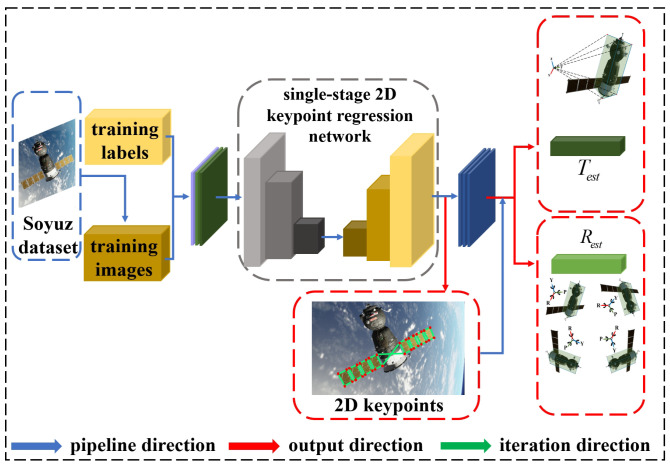
Spacecraft pose estimation using computer vision has garnered increasing attention in research areas such as automation system theory, control theory, sensors and instruments, robot technology, and automation software. Confronted with the extreme environment of space, existing spacecraft pose estimation methods are predominantly multi-stage networks with complex operations. In this study, we propose an approach for spacecraft homography pose estimation with a single-stage deep convolutional neural network for the first time. We formulated a homomorphic geometric constraint equation for spacecraft with planar features. Additionally, we employed a single-stage 2D keypoint regression network to obtain homography 2D keypoint coordinates for spacecraft. After decomposition to obtain the rough spacecraft pose based on the homography matrix constructed according to the geometric constraint equation, a loss function based on pixel errors was employed to refine the spacecraft pose. We conducted extensive experiments using widely used spacecraft pose estimation datasets and compared our method with state-of-the-art techniques in the field to demonstrate its effectiveness.
Overview
The claims and statistics of this paper haven’t been checked yet.
Free: it reads the open-access text and checks the first 5 claims that cite a source we can check. Create a free account to check every claim.
Integrity signals
Registry
Cites
Statistics
Figures


Verification
Claims the paper makes
The claims and statistics of this paper haven’t been checked yet.
Free: it reads the open-access text and checks the first 5 claims that cite a source we can check. Create a free account to check every claim.
Claims other papers make about this one
Each is checked against this paper’s own text: does it say what the citing paper says it does?
The source backs part of the claim, not all of it — or backs it for a different population, condition or comparison.
In the citing paper
“Consequently, many researchers [8,9,11,14-16] have adopted approaches that combine keypoints detection with existing Perspective-n-Point (PnP) pose estimation solvers.”
From Pose Estimation for Cross-Domain Non-Cooperative Spacecraft Based on Spatial-Aware Keypoints Regression (2024) · cites this paper as [9]
Experimental — accuracy not yet measured
Self-check
Percentages, sums and reported differences re-computed from the paper’s own numbers.
The self-check needs the paper’s full text.
Citations
Cites
Distinctive Image Features from Scale-Invariant Keypoints
Lowe, D. G. (2004) · International Journal of Computer Vision · doi:10.1023/b:visi.0000029664.99615.94 · Cited by 55,589 · cited 1×
“Examples of such feature extraction methods include SIFT [5], FAST [6], SURF [7], ORB [8], FPFH [9], etc.”
MethodMicrosoft COCO: Common Objects in Context
Lin, T.-Y., Maire, M., Belongie, S., Hays, J., Perona, P., Ramanan, D., Dollár, P., & Zitnick, C. L. (2014) · Lecture Notes in Computer Science · doi:10.1007/978-3-319-10602-1_48 · Cited by 45,460
SURF: Speeded Up Robust Features
Bay, H., Tuytelaars, T., & Van Gool, L. (2006) · Lecture Notes in Computer Science · doi:10.1007/11744023_32 · Cited by 14,955 · cited 1×
“Examples of such feature extraction methods include SIFT [5], FAST [6], SURF [7], ORB [8], FPFH [9], etc.”
MethodYOLOv7: Trainable Bag-of-Freebies Sets New State-of-the-Art for Real-Time Object Detectors
Wang, C.-Y., Bochkovskiy, A., & Liao, H.-Y. M. (2023) · 2023 IEEE/CVF Conference on Computer Vision and Pattern Recognition (CVPR) · doi:10.1109/cvpr52729.2023.00721 · Cited by 13,198
ORB: An efficient alternative to SIFT or SURF
Rublee, E., Rabaud, V., Konolige, K., & Bradski, G. (2011) · 2011 International Conference on Computer Vision · doi:10.1109/iccv.2011.6126544 · Cited by 11,037 · cited 1×
“Examples of such feature extraction methods include SIFT [5], FAST [6], SURF [7], ORB [8], FPFH [9], etc.”
MethodPath Aggregation Network for Instance Segmentation
Liu, S., Qi, L., Qin, H., Shi, J., & Jia, J. (2018) · 2018 IEEE/CVF Conference on Computer Vision and Pattern Recognition · doi:10.1109/cvpr.2018.00913 · Cited by 10,011
Deep High-Resolution Representation Learning for Human Pose Estimation
Sun, K., Xiao, B., Liu, D., & Wang, J. (2019) · 2019 IEEE/CVF Conference on Computer Vision and Pattern Recognition (CVPR) · doi:10.1109/cvpr.2019.00584 · Cited by 5,984
Distance-IoU Loss: Faster and Better Learning for Bounding Box Regression
Zheng, Z., Wang, P., Liu, W., Li, J., Ye, R., & Ren, D. (2020) · Proceedings of the AAAI Conference on Artificial Intelligence · doi:10.1609/aaai.v34i07.6999 · Cited by 5,288
CSPNet: A New Backbone that can Enhance Learning Capability of CNN
Wang, C.-Y., Mark Liao, H.-Y., Wu, Y.-H., Chen, P.-Y., Hsieh, J.-W., & Yeh, I.-H. (2020) · 2020 IEEE/CVF Conference on Computer Vision and Pattern Recognition Workshops (CVPRW) · doi:10.1109/cvprw50498.2020.00203 · Cited by 5,265
Machine Learning for High-Speed Corner Detection
Rosten, E., & Drummond, T. (2006) · Lecture Notes in Computer Science · doi:10.1007/11744023_34 · Cited by 4,555 · cited 1×
“Examples of such feature extraction methods include SIFT [5], FAST [6], SURF [7], ORB [8], FPFH [9], etc.”
MethodFast Point Feature Histograms (FPFH) for 3D registration
Rusu, R. B., Blodow, N., & Beetz, M. (2009) · 2009 IEEE International Conference on Robotics and Automation · doi:10.1109/robot.2009.5152473 · Cited by 3,878 · cited 1×
“Examples of such feature extraction methods include SIFT [5], FAST [6], SURF [7], ORB [8], FPFH [9], etc.”
MethodEPnP: An Accurate O(n) Solution to the PnP Problem
Lepetit, V., Moreno-Noguer, F., & Fua, P. (2009) · International Journal of Computer Vision · doi:10.1007/s11263-008-0152-6 · Cited by 3,298
HigherHRNet: Scale-Aware Representation Learning for Bottom-Up Human Pose Estimation
Cheng, B., Xiao, B., Wang, J., Shi, H., Huang, T. S., & Zhang, L. (2020) · 2020 IEEE/CVF Conference on Computer Vision and Pattern Recognition (CVPR) · doi:10.1109/cvpr42600.2020.00543 · Cited by 1,023 · cited 1×
“The real images faithfully reproduce the Earth albedo and direct sunlight as seen in satellite imagery.”
BackgroundComplete solution classification for the perspective-three-point problem
Gao, X.-S., Hou, X.-R., Tang, J., & Cheng, H.-F. (2003) · IEEE Transactions on Pattern Analysis and Machine Intelligence · doi:10.1109/tpami.2003.1217599 · Cited by 976 · cited 1×
“The geometric constraint equations of Perspective-Three-Point can be decomposed to obtain the pose using the Wu–Ritt zero decomposition algorithm [25].”
MethodReal-Time Seamless Single Shot 6D Object Pose Prediction
Tekin, B., Sinha, S. N., & Fua, P. (2018) · 2018 IEEE/CVF Conference on Computer Vision and Pattern Recognition · doi:10.1109/cvpr.2018.00038 · Cited by 900
YOLO-Pose: Enhancing YOLO for Multi Person Pose Estimation Using Object Keypoint Similarity Loss
Maji, D., Nagori, S., Mathew, M., & Poddar, D. (2022) · 2022 IEEE/CVF Conference on Computer Vision and Pattern Recognition Workshops (CVPRW) · doi:10.1109/cvprw56347.2022.00297 · Cited by 533
A Robust O(n) Solution to the Perspective-n-Point Problem
Li, S., Xu, C., & Xie, M. (2012) · IEEE Transactions on Pattern Analysis and Machine Intelligence · doi:10.1109/tpami.2012.41 · Cited by 503 · cited 1×
“Shiqi Li et al. proposed a research approach for homography pose estimation using Perspective Similar Triangle, transforming the Perspective-Three-Point constraint equations into quartic equations [26,27].”
MethodAn analytic solution for the perspective 4-point problem
Horaud, R., Conio, B., Leboulleux, O., & Lacolle, B. (1989) · Computer Vision, Graphics, and Image Processing · doi:10.1016/0734-189x(89)90052-2 · Cited by 377
Satellite Pose Estimation Challenge: Dataset, Competition Design, and Results
Kisantal, M., Sharma, S., Park, T. H., Izzo, D., Martens, M., & D'Amico, S. (2020) · IEEE Transactions on Aerospace and Electronic Systems · doi:10.1109/taes.2020.2989063 · Cited by 304 · cited 3×
“The software uses the OpenGL-based image rendering pipeline to generate photo-realistic images of the Tango spacecraft with desired ground-truth poses [14].”
MethodInfluentialSpacecraft pose estimation dataset (speed)
Sharma, S., Park, T. H., & D'Amico, S. (2026) · Stanford Digital Repository · doi:10.25740/dz692fn7184 · Cited by 304
Deep Learning for Spacecraft Pose Estimation from Photorealistic Rendering
Proenca, P. F., & Gao, Y. (2020) · 2020 IEEE International Conference on Robotics and Automation (ICRA) · doi:10.1109/icra40945.2020.9197244 · Cited by 229 · cited 8×
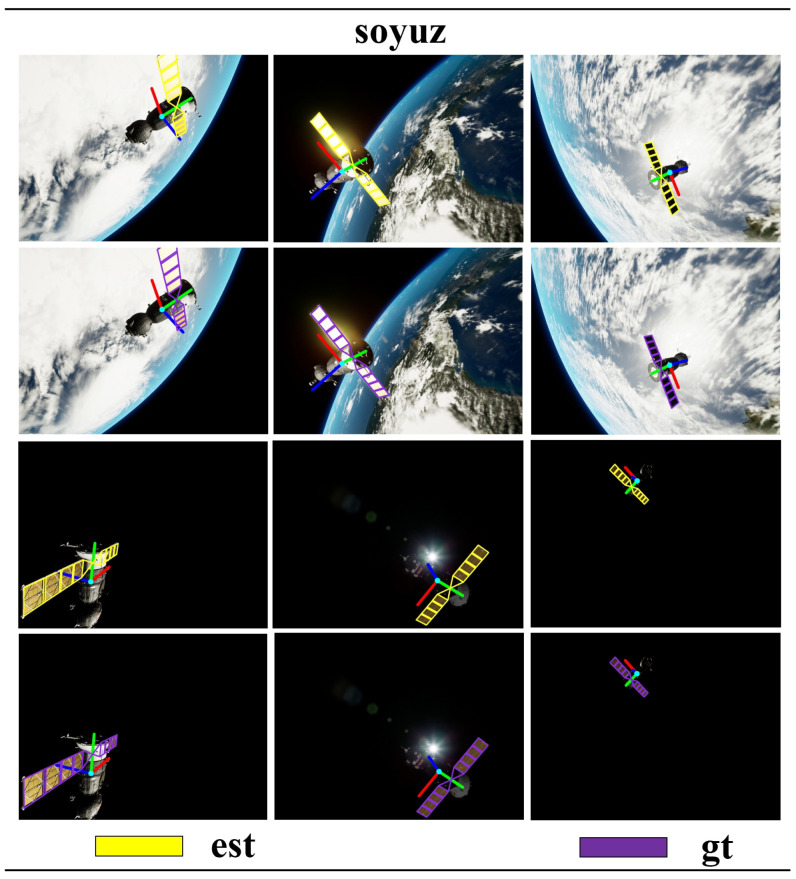
“The dataset for Soyuz is divided into two parts, Soyuz_easy and Soyuz_hard.”
BackgroundMethodInfluentialSingle-Stage 6D Object Pose Estimation
Hu, Y., Fua, P., Wang, W., & Salzmann, M. (2020) · 2020 IEEE/CVF Conference on Computer Vision and Pattern Recognition (CVPR) · doi:10.1109/cvpr42600.2020.00300 · Cited by 216 · cited 1×
“Yinlin Hu et al. introduced a grouping feature aggregation scheme that effectively addresses the corresponding clusters in object pose estimation [22].”
BackgroundSelf-citationPose estimation for non-cooperative spacecraft rendezvous using convolutional neural networks
Sharma, S., Beierle, C., & D'Amico, S. (2018) · 2018 IEEE Aerospace Conference · doi:10.1109/aero.2018.8396425 · Cited by 207
Satellite Pose Estimation with Deep Landmark Regression and Nonlinear Pose Refinement
Chen, B., Cao, J., Parra, A., & Chin, T.-J. (2019) · 2019 IEEE/CVF International Conference on Computer Vision Workshop (ICCVW) · doi:10.1109/iccvw.2019.00343 · Cited by 203 · cited 2×
“The homography matrix H has 8 degrees of freedom, hence requiring only 4 keypoints to linearly recover its vector form.”
BackgroundMethodSPEED+: Next-Generation Dataset for Spacecraft Pose Estimation across Domain Gap
Park, T. H., Martens, M., Lecuyer, G., Izzo, D., & D'Amico, S. (2022) · 2022 IEEE Aerospace Conference (AERO) · doi:10.1109/aero53065.2022.9843439 · Cited by 170 · cited 5×
“The homography matrix H has 8 degrees of freedom, hence requiring only 4 keypoints to linearly recover its vector form.”
BackgroundMethodInfluentialWide-Depth-Range 6D Object Pose Estimation in Space
Hu, Y., Speierer, S., Jakob, W., Fua, P., & Salzmann, M. (2021) · 2021 IEEE/CVF Conference on Computer Vision and Pattern Recognition (CVPR) · doi:10.1109/cvpr46437.2021.01561 · Cited by 130 · cited 1×
“Therefore, Unreal Engine 4 is utilized to render the on-orbit flights of known non-cooperative spacecraft, thereby obtaining widely used simulated datasets [15,16].”
MethodDeep learning-based spacecraft relative navigation methods: A survey
Song, J., Rondao, D., & Aouf, N. (2022) · Acta Astronautica · doi:10.1016/j.actaastro.2021.10.025 · Cited by 106 · cited 1×
“Sharma et al. introduced a spacecraft pose network (SPN) for the monocular visual pose estimation of known non-cooperative spacecraft [10–12].”
BackgroundSatellite Pose Estimation Competition 2021: Results and Analyses
Park, T. H., Märtens, M., Jawaid, M., Wang, Z., Chen, B., Chin, T.-J., Izzo, D., & D’Amico, S. (2023) · Acta Astronautica · doi:10.1016/j.actaastro.2023.01.002 · Cited by 91 · cited 1×
“In contrast, there are non-reflective parts on the surface of spatial targets, leading to missing parts of the target during the imaging process [1].”
BackgroundA Model-Based 3D Template Matching Technique for Pose Acquisition of an Uncooperative Space Object
Opromolla, R., Fasano, G., Rufino, G., & Grassi, M. (2015) · Sensors · doi:10.3390/s150306360 · Cited by 89 · cited 1×
“Under such conditions, constructing a dense and accurate spacecraft model is highly challenging, and it incurs a significant computational cost [3,4].”
BackgroundA STABLE DIRECT SOLUTION OF PERSPECTIVE-THREE-POINT PROBLEM
Li, S., & Xu, C. Y. (2011) · International Journal of Pattern Recognition and Artificial Intelligence · doi:10.1142/s0218001411008774 · Cited by 68 · cited 1×
“Shiqi Li et al. proposed a research approach for homography pose estimation using Perspective Similar Triangle, transforming the Perspective-Three-Point constraint equations into quartic equations [26,27].”
MethodTowards Robust Learning-Based Pose Estimation of Noncooperative Spacecraft
Park, T. H., Sharma, S., & D'Amico, S. (2019) · arXiv · doi:10.48550/arxiv.1909.00392 · Cited by 65 · cited 2×
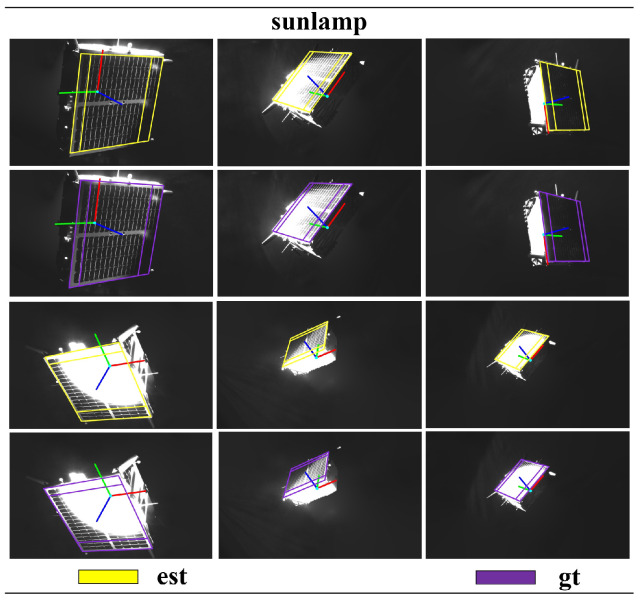
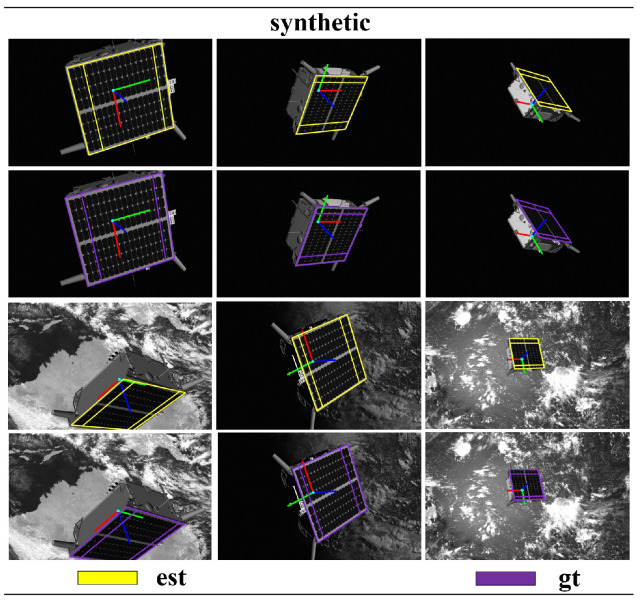
“We consider the lightbox dataset and sunlamp dataset as target dataset, while the synthetic dataset serves as the source dataset.”
MethodWang, Z., Chen, M., Guo, Y., Li, Z., & Yu, Q. (2024) · IEEE Transactions on Aerospace and Electronic Systems · doi:10.1109/taes.2023.3250385 · Cited by 64 · cited 1×
“We first calculate the position score S ( i ) t and orientation score S ( i ) q , and then add these two results together, as depicted in Equation (12). gt denotes ground truth, est denotes estimated value, and q represents the quaternion form of the rotation matrix.”
MethodPark, K., Patten, T., Prankl, J., & Vincze, M. (2019) · Proceedings - IEEE International Conference on Robotics and Automation/Proceedings · doi:10.1109/icra.2019.8794448 · Cited by 55 · cited 1×
“Under such conditions, constructing a dense and accurate spacecraft model is highly challenging, and it incurs a significant computational cost [3,4].”
BackgroundDetermining camera parameters from the perspective projection of a quadrilateral
Penna, M. A. (1991) · Pattern Recognition · doi:10.1016/0031-3203(91)90019-2 · Cited by 44 · cited 1×
“Additionally, when there are constraints in the spatial mapping where four points are coplanar but not collinear, the geometric constraint equations can be described as the projection relationship between quadrilaterals on two planes [28,29].”
BackgroundPérez-Villar, J. I. B., García‐Martín, Á., & Bescós, J. (2023) · Lecture notes in computer science · doi:10.1007/978-3-031-25056-9_3 · Cited by 36
Huang, H., Zhao, G., Gu, D., & Bo, Y. (2021) · IEEE Sensors Journal · doi:10.1109/jsen.2021.3115844 · Cited by 28 · cited 1×
“Furthermore, these three sub-networks correspondingly address orientation classification, position classification, and target detection [18].”
Background6D Object Pose Estimation from Approximate 3D Models for Orbital Robotics
Ulmer, M., Durner, M., Sundermeyer, M., Stoiber, M., & Triebel, R. (2023) · 2023 IEEE/RSJ International Conference on Intelligent Robots and Systems (IROS) · doi:10.1109/iros55552.2023.10341511 · Cited by 23 · cited 1×
“We first calculate the position score S ( i ) t and orientation score S ( i ) q , and then add these two results together, as depicted in Equation (12). gt denotes ground truth, est denotes estimated value, and q represents the quaternion form of the rotation matrix.”
MethodMFPN-6D : Real-time One-stage Pose Estimation of Objects on RGB Images
Liu, P., Zhang, Q., Zhang, J., Wang, F., & Cheng, J. S. (2021) · Proceedings - IEEE International Conference on Robotics and Automation/Proceedings · doi:10.1109/icra48506.2021.9561878 · Cited by 21 · cited 1×
“Penglei Liu et al. introduced a multi-directional feature pyramid network that can effectively tackle occlusion and texture-less issues [23].”
BackgroundEnd-to-end Monocular Pose Estimation for Uncooperative Spacecraft based on Direct Regression Network
Huang, H., Song, B., Zhao, G., & Bo, Y. (2023) · IEEE Transactions on Aerospace and Electronic Systems · doi:10.1109/taes.2023.3256971 · Cited by 20 · cited 1×
“Alternatively, two sub-networks are employed to address pose estimation, where these two sub-networks correspond to a keypoint regression network and a pose estimation network, respectively [19].”
MethodZhou, L., Liu, Z., Gan, R., Wang, H., & Ang, M. H. (2023) · IEEE/RSJ International Conference on Intelligent Robots and Systems (IROS) · doi:10.1109/iros55552.2023.10341552 · Cited by 18 · cited 1×
“In the first stage of the network, occluded target point cloud restoration is accomplished, while in the second stage the target pose is estimated through voting with the completed point cloud serving as a prior reference [20].”
BackgroundVision-Based Spacecraft Relative Pose Estimation in Variable Lighting Conditions
Kramer, E. L., Parker, W. E., & Masterson, R. A. (2022) · IEEE Aerospace Conference (AERO) · doi:10.1109/aero53065.2022.9843422 · Cited by 6 · cited 1×
“On the other hand, the high-speed motion of orbiting spacecraft introduces motion blur during the imaging process [2].”
Background
Research works printed but not linked: 1
- Sharma, S., and D’Amico, S. (2019). Pose estimation for non-cooperative rendezvous using neural networks. arXiv. · DOI · Paper page
Cited by
Bridging the Domain Gap for Flight-Ready Spaceborne Vision
Park, T. H., & D’Amico, S. (2025) · Journal of Spacecraft and Rockets · doi:10.2514/1.a36130 · Cited by 18
“The performance of SPNv3-S is also comparable to those of the post-mortem entries, surpassing FA-VAE [137] with 41.6M parameters (approximated from its DarkNet-53 backbone [138]) in both categories and Chen et al. [139], which adopts semi-supervised domain adaptation, in the lightbox category.”
InfluentialFeng, S., Dong-Yan, J., Cui, W., Wang, T., & Ma, M. (2025) · IEEE Sensors Journal · doi:10.1109/jsen.2025.3615727 · Cited by 8
Online Test-Time Adaptation for On-Orbit Noncooperative Spacecraft Pose Estimation
Feng, S., Wang, T., Guo, Y., & Qiu, J. (2025) · IEEE Transactions on Aerospace and Electronic Systems · doi:10.1109/taes.2025.3623610 · Cited by 13
Wang, Z., Liu, Y., & Zhang, E. (2024) · Aerospace · doi:10.3390/aerospace11110948 · Cited by 5
VIPE: Visible and Infrared Fused Pose Estimation Framework for Space Noncooperative Objects
Zhang, Z., Zhou, D. X., Hu, Y., Ma, W., Sun, G., & Zhang, Y. (2025) · Sensors · doi:10.3390/s25216664 · Cited by 3
“With the remarkable performance of deep learning in various computer vision tasks, deep convolutional neural networks (CNNs) have increasingly been employed for monocular image-based spacecraft pose estimation for known target [17].”
Metadata
- Authors
- Chen, S., Yang, W., Wang, W., Mai, J., Liang, J., & Zhang, X.
- Affiliations
- Sun Yat-sen University (CN)
- Corresponding author
- Zhang, Xiaohu
- Venue
- Sensors
- Publisher
- MDPI AG
- Published
- 2024-03-12
- Volume
- 24
- Issue
- 6
- Pages
- 1828
- ISSN
- 1424-8220 (ISSN-L)
- PMC
- PMC10974870
- OpenAlex
- W4392752914
- Cited by
- 12
- References
- 39
- Citations by year
- 2026: 4 · 2025: 7 · 2024: 1
- FWCI
- 2.06
- Type
- journal article
- Language
- en
- Open access
- gold
- doi.org
- Licence
- Locations
- Sensors (publishedVersion, cc-by)
- PubMed Central (publishedVersion, cc-by)
- PubMed (publishedVersion)
- DOAJ (DOAJ: Directory of Open Access Journals) (submittedVersion)
- Funders
- Sun Yat-sen University
- Topics
- Physical Sciences › Engineering › Aerospace Engineering › Space Satellite Systems and Control
- Physical Sciences › Computer Science › Computer Vision and Pattern Recognition › Advanced Neural Network Applications
- Physical Sciences › Engineering › Aerospace Engineering › Spacecraft Dynamics and Control
- Keywords
- spacecraft pose estimation, homography, planar features
About these checks
Registry, retraction, Cites and statistics results are computed, not judged, with one exception: a printed reference that no index lists is read once by a model before it counts as a citation error. Claims are extracted by a model and kept only when their quote appears verbatim in the text; each cited source is then checked, with a model’s help, for whether it says what the claim relies on. Those verdicts can be wrong — read the claim’s quote and the cited source before relying on one.
Statistics and arithmetic are recomputed, not judged.
Confidence bands are shown only for fields calibrated on our annotated test set. None is calibrated yet, so no band is shown.
What counts as a claim ›How we measure confidence ›How we check this ›
Are you an author, or do you see a problem with this page? Request a review
Data sources
Bibliographic data: Semantic Scholar, OpenAlex, Crossref.
Contains information from the Semantic Scholar Academic Graph Datasets, made available under the ODC Attribution License (ODC-BY 1.0).
Semantic Scholar’s data is described in: Kinney, R., et al. (2023). The Semantic Scholar Open Data Platform. arXiv:2301.10140.
