

The DOI matches its Crossref record; 101 of the 101 references it cites were found in a registry or an index; 2 of the 47 sources its claims cite were checked for support.
Encrypted Network Traffic Analysis and Classification Utilizing Machine Learning
Open accessAbstract
Encryption is a fundamental security measure to safeguard data during transmission to ensure confidentiality while at the same time posing a great challenge for traditional packet and traffic inspection. In response to the proliferation of diverse network traffic patterns from Internet-of-Things devices, websites, and mobile applications, understanding and classifying encrypted traffic are crucial for network administrators, cybersecurity professionals, and policy enforcement entities. This paper presents a comprehensive survey of recent advancements in machine-learning-driven encrypted traffic analysis and classification. The primary goals of our survey are two-fold: First, we present the overall procedure and provide a detailed explanation of utilizing machine learning in analyzing and classifying encrypted network traffic. Second, we review state-of-the-art techniques and methodologies in traffic analysis. Our aim is to provide insights into current practices and future directions in encrypted traffic analysis and classification, especially machine-learning-based analysis.
Overview
CoChat Summary
## TL;DR
This paper is a survey of machine-learning-based encrypted network traffic analysis and classification, with emphasis on IoT devices, mobile devices/apps, and websites. It summarizes common workflows, strategies, and open problems, and argues that encrypted traffic can still be analyzed using features such as packet size, timing, direction, and statistical patterns.
## Key findings
- The survey focuses on three major encrypted-traffic application areas: the Internet of Things, mobile devices and applications, and web applications/website fingerprinting.
- It states that encrypted traffic can still be classified without decryption by using features such as packet size, inter-arrival times, packet direction, protocol headers, and statistical properties of encrypted payloads.
- For website fingerprinting, the paper notes that attacks can identify visited webpages from observed packet sequences, and that researchers use distance metrics such as unique packet-length frequencies and Levenshtein-distance variants.
- In its conclusions, the paper says classification methods support tasks such as IoT device fingerprinting and OS identification, web fingerprinting for privacy-leak/malicious-activity detection, and mobile-app traffic analysis for QoE measurement and anomaly detection.
## Methods
- The paper is a comprehensive survey of prior studies on encrypted traffic analysis and classification; it does not report a new experimental dataset or model of its own.
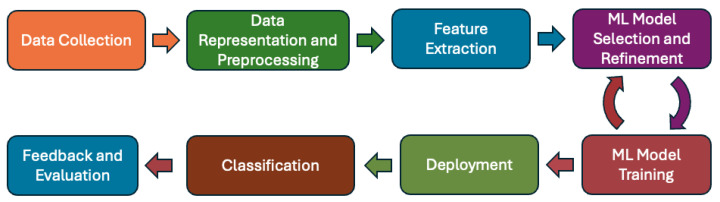
- It organizes the literature around a procedure for machine-learning-based traffic classification: data collection, preprocessing, feature extraction, model selection/refinement, model training, deployment, and feedback/evaluation.
- It synthesizes prior work on classical machine learning, deep learning, anomaly detection, feature extraction, dimensionality reduction, and deployment settings for encrypted traffic classifiers.
## Limitations
- The paper states that network dynamics such as asymmetric routing, NATing, and tunneling can affect classifier performance, and that features must be chosen to avoid being influenced by these functions.
- It states that the “curse of dimensionality,” computational overhead, memory limits, and processing time are major constraints, especially for real-time applications such as intrusion detection.
- It also notes limitations in the broader field: many public datasets lack reliable labels, real-world deployment is hindered by traffic velocity and large-scale data, and models often require continual retraining for new or unfamiliar traffic.
Model-written summary. Check it against the paper before relying on it.
Integrity signals
Registry
Cites
Statistics
Figures
Verification
Claims the paper makes
0 Valid · 2 Not valid · 30 Not checked · 22 Own results and interpretations
In the paper
“Consequently, when apps deviate from IANA rules by utilizing dynamic ports or encryption protocols like Peer to Peer (P2P) protocol, the methods used to identify traffic and applications based on ports become ineffective [19].”
§ Encrypted Network Traffic Analysis and Classification Utilizing Machine Learning > 2. Related Work
What the sources say
- Not checked — no full text of the sourcecites [19] Alrabaee, S., Al-Kfairy, M., and Barka, E. (2022, January 28–31). Efforts and suggestions for improving cybersecurity education. Proceedings of the 2022 IEEE Global Engineering Education Conference (EDUCON), Tunis, Tunisia. source
plainstates a cause- Asserted: passes — The authors put it forward as true.
- Checkable: passes — It can be checked against evidence.
- Load-bearing: passes — The paper’s conclusions depend on it.
- Based: passes — The paper gives a reason why it holds.
In the paper
“Machine learning has emerged as a potent solution, capable of extracting valuable insights from encrypted traffic analysis without accessing content [4].”
§ Encrypted Network Traffic Analysis and Classification Utilizing Machine Learning > 1. Introduction
What the sources say
- Not checked — no full text of the sourcecites [4] Atitallah, 2020, Leveraging deep learning and IoT big data analytics to support the smart cities development: Review and future directions, Comput. Sci. Rev. source
plainstates a cause- Asserted: passes — The authors put it forward as true.
- Checkable: passes — It can be checked against evidence.
- Load-bearing: passes — The paper’s conclusions depend on it.
- Based: passes — The paper gives a reason why it holds.
A conclusion the paper draws from its own results — it cites no other source for it, so there is none to check. The quote shows it is in the paper.
In the paper
“The encrypted traffic exhibits diverse data distribution characteristics, even when employing the same encryption algorithm, owing to variations in the distribution and utilization of the original traffic.”
§ Encrypted Network Traffic Analysis and Classification Utilizing Machine Learning > 2. Related Work
plainstates a cause- Asserted: passes — The authors put it forward as true.
- Checkable: passes — It can be checked against evidence.
- Load-bearing: passes — The paper’s conclusions depend on it.
- Based: unclear — It is unclear why the paper says it holds.
In the paper
“Networking dynamics: network services such as asymmetric routing, NATing, and tunneling have an impact on the performance of traffic classifiers.”
§ Encrypted Network Traffic Analysis and Classification Utilizing Machine Learning > 7. Limitations
What the sources say
- Not checked — no full text of the sourcecites [92] Moustafa, N., and Slay, J. (2015, January 10–12). UNSW-NB15: A comprehensive data set for network intrusion detection systems (UNSW-NB15 network data set). Proceedings of the 2015 Military Communications and Information Systems Conference (MilCIS), Canberra, Australia. source
plainstates a cause- Asserted: passes — The authors put it forward as true.
- Checkable: passes — It can be checked against evidence.
- Load-bearing: unclear — It is unclear whether the paper’s conclusions depend on it.
- Based: passes — The paper gives a reason why it holds.
A claim is checked only against the cited paper’s full text, never its abstract, and none is available for its sources.
In the paper
“Therefore, the majority of research is centered on the binary categorization of encrypted traffic, namely the task of distinguishing harmful traffic from valid traffic [20,21].”
§ Encrypted Network Traffic Analysis and Classification Utilizing Machine Learning > 2. Related Work
What the sources say
- Not checked — no full text of the sourcecites [20] Azab, 2020, Packing resistant solution to group malware binaries, Int. J. Secur. Netw. source
- Not checked — no full text of the sourcecites [21] Alrabaee, 2022, A stratified approach to function fingerprinting in program binaries using diverse features, Expert Syst. Appl. source
plain- Asserted: passes — The authors put it forward as true.
- Checkable: passes — It can be checked against evidence.
- Load-bearing: unclear — It is unclear whether the paper’s conclusions depend on it.
- Based: passes — The paper gives a reason why it holds.
11 more claims
Create a free account to see all 54 claims and to verify the 11 references still open.
- It may state two separate claims as one. 17
- Probably not a substantial claim. 32
Citations
Cites
Deep Residual Learning for Image Recognition
He, K., Zhang, X., Ren, S., & Sun, J. (2016) · 2016 IEEE Conference on Computer Vision and Pattern Recognition (CVPR) · doi:10.1109/cvpr.2016.90 · Cited by 235,474 · cited 1×
“Different layers of the OSI architecture utilize deep packet inspection in various network components [81–84].”
BackgroundImageNet classification with deep convolutional neural networks
Krizhevsky, A., Sutskever, I., & Hinton, G. E. (2017) · Communications of the ACM · doi:10.1145/3065386 · Cited by 112,155
Xception: Deep Learning with Depthwise Separable Convolutions
Chollet, F. (2017) · 2017 IEEE Conference on Computer Vision and Pattern Recognition (CVPR) · doi:10.1109/cvpr.2017.195 · Cited by 20,380 · cited 1×
“During the step of selecting a classification approach, there are various ways available, including machine-learning technologies, statistical methods (such as heuristics), and graphical technique methods (such as motifs and graphlets) [37].”
MethodLabaca-Castro, R. (2023) · Machine Learning under Malware Attack · doi:10.1007/978-3-658-40442-0_9 · Cited by 19,272
Fast algorithms for mining association rules
Agrawal, R., & Srikant, R. (1998) · Cited by 11,307
Mining frequent patterns without candidate generation
Han, J., Pei, J., & Yin, Y. (2000) · ACM SIGMOD Record · doi:10.1145/335191.335372 · Cited by 6,402
Mining association rules between sets of items in large databases
Agrawal, R., Imieliński, T., & Swami, A. (1993) · ACM SIGMOD Record · doi:10.1145/170036.170072 · Cited by 4,551
Moustafa, N., & Slay, J. (2015) · 2015 Military Communications and Information Systems Conference (MilCIS) · doi:10.1109/milcis.2015.7348942 · Cited by 4,033 · cited 1×
“The features must be selected in a manner that ensures they are not influenced by any of these network functions [92].”
BackgroundA Survey of Data Mining and Machine Learning Methods for Cyber Security Intrusion Detection
Buczak, A. L., & Guven, E. (2016) · IEEE Communications Surveys & Tutorials · doi:10.1109/comst.2015.2494502 · Cited by 3,332
Estimating Continuous Distributions in Bayesian Classifiers
John, G. H., & Langley, P. (2013) · arXiv (Cornell University) · doi:10.48550/arxiv.1302.4964 · Cited by 2,885 · cited 1×
“Several studies have suggested several techniques for determining the application linked to a traffic flow [87–91].”
Background
Research works printed but not linked: 2
- Semenov, V.V., Lebedev, I.S., Sukhoparov, M.E., and Salakhutdinova, K.I. (2019). Internet of Things, Smart Spaces, and Next Generation Networks and Systems, Springer.
- Quinlan, J.R. (1992). Machine Learning, Morgan Kaufmann.
Cited by
El-Hajj, M. I. (2025) · Network · doi:10.3390/network5010001 · Cited by 96
“By using AI to analyze real-time network traffic patterns, encryption can be more intelligent, automatically adjusting to the nature of the communication being transmitted, whether it is video, voice, or data [107].”
Anomaly detection in encrypted network traffic using self-supervised learning
Sattar, S., Khan, S., Khan, M. I., Аkhmediyarova, A., Mamyrbayev, O. J., Kassymova, D., Оралбекова, Д., & Alimkulova, J. (2025) · Scientific Reports · doi:10.1038/s41598-025-08568-0 · Cited by 34
Fine-Grained Encrypted Traffic Classification Using Dual Embedding and Graph Neural Networks
Liu, Z., Wei, Q., Song, Q., & Duan, C. (2025) · Electronics · doi:10.3390/electronics14040778 · Cited by 20
Enhancing encrypted HTTPS traffic classification based on stacked deep ensembles models
Elshewey, A. M., & Osman, A. M. (2025) · Scientific Reports · doi:10.1038/s41598-025-21261-6 · Cited by 18
Zhang, X.-Y., Hu, M.-D., Maimaitijiang, D., Wang, T., & Wang, L. (2025) · World Journal of Gastroenterology · doi:10.3748/wjg.v31.i39.110971 · Cited by 10
Metadata
- Authors
- Alwhbi, I. A., Zou, C. C., & Alharbi, R. N.
- Affiliations
- University of Central Florida (US)
- Corresponding author
- Zou, Cliff C.
- Venue
- Sensors
- Publisher
- MDPI AG
- Published
- 2024-05-29
- Volume
- 24
- Issue
- 11
- Pages
- 3509
- ISSN
- 1424-8220 (ISSN-L)
- PMC
- PMC11175201
- OpenAlex
- W4399181772
- Cited by
- 81
- References
- 97
- Citations by year
- 2026: 39 · 2025: 40 · 2024: 2
- FWCI
- 2.77
- Type
- journal article
- Language
- en
- Open access
- gold
- doi.org
- Licence
- Locations
- Sensors (publishedVersion, cc-by)
- PubMed Central (publishedVersion, cc-by)
- PubMed (publishedVersion)
- DOAJ (DOAJ: Directory of Open Access Journals) (submittedVersion)
- Funders
- National Science Foundation (DGE-2325452)
- Topics
- Physical Sciences › Computer Science › Artificial Intelligence › Internet Traffic Analysis and Secure E-voting
- Physical Sciences › Computer Science › Computer Networks and Communications › Network Security and Intrusion Detection
- Physical Sciences › Computer Science › Computer Vision and Pattern Recognition › Image and Video Quality Assessment
- Keywords
- encrypted traffic analysis, encrypted traffic classification, network traffic classification, Internet of Things traffic, traffic inspection, network security
About these checks
Registry, retraction, Cites and statistics results are computed, not judged, with one exception: a printed reference that no index lists is read once by a model before it counts as a citation error. Claims are extracted by a model and kept only when their quote appears verbatim in the text; each cited source is then checked, with a model’s help, for whether it says what the claim relies on. Those verdicts can be wrong — read the claim’s quote and the cited source before relying on one.
The claim verdicts this report counts are experimental: their accuracy is not yet measured.
A language model drew the claims from the paper on 2026-10-10, under version 3 of the claim definition (model deepseek-v4.1-flash, prompt extract-v3).
A second model labelled each claim on 2026-10-10 (model jev-1.13-20260917, definition revision gold-guideline-v0.2).
Statistics and arithmetic are recomputed, not judged.
Confidence bands are shown only for fields calibrated on our annotated test set. None is calibrated yet, so no band is shown.
What counts as a claim ›How we measure confidence ›How we check this ›
Are you an author, or do you see a problem with this page? Request a review
How to cite
Cite CoChat for the checks on this page, and the paper for its own findings.
- This page
- CoChat. (2026). Citation check: Encrypted Network Traffic Analysis and Classification Utilizing Machine Learning. https://app.cochat.ai/papers/10.3390/s24113509
- The paper
- Alwhbi, I. A., Zou, C. C., & Alharbi, R. N. (2024). Encrypted Network Traffic Analysis and Classification Utilizing Machine Learning. Sensors. https://doi.org/10.3390/s24113509
Data sources
Bibliographic data: Semantic Scholar, OpenAlex, Crossref.
Contains information from the Semantic Scholar Academic Graph Datasets, made available under the ODC Attribution License (ODC-BY 1.0).
Semantic Scholar’s data is described in: Kinney, R., et al. (2023). The Semantic Scholar Open Data Platform. arXiv:2301.10140.
