

The DOI matches its Crossref record; 45 of the 45 references it cites were found in a registry or an index; 7 of the 59 sources its claims cite were checked for support.
Towards User-Generalizable Wearable-Sensor-Based Human Activity Recognition: A Multi-Task Contrastive Learning Approach
Open accessAbstract
Human Activity Recognition (HAR) using wearable sensors has shown great potential for personalized health management and ubiquitous computing. However, existing deep learning-based HAR models often suffer from poor user-level generalization, which limits their deployment in real-world scenarios. In this work, we propose a novel multi-task contrastive learning framework that jointly optimizes activity classification and supervised contrastive objectives to enhance generalization across unseen users. By leveraging both activity and user labels to construct semantically meaningful contrastive pairs, our method improves representation learning while maintaining user-agnostic inference at test time. We evaluate the proposed framework on three public HAR datasets using cross-user splits, achieving comparable results to both supervised and self-supervised baselines. Extensive ablation studies further confirm the effectiveness of our design choices, including multi-task training and the integration of user-aware contrastive supervision. These results highlight the potential of our approach for building more generalizable and scalable HAR systems.
Overview
CoChat Summary
TL;DR
The paper proposes MultiSupConHAR, a single-stage multi-task framework that jointly optimizes activity classification and supervised contrastive learning using both activity and user labels to improve cross-user generalization in wearable-sensor HAR. It reports competitive or best macro-F1 on MobiAct and USC-HAD, with slightly lower performance than some supervised baselines on UCI-HAR.
Key findings
- MultiSupConHAR achieved macro-F1 of 85.93% ± 1.23% on MobiAct and 76.84% ± 1.09% on USC-HAD, ranking first on those datasets, and 91.07% ± 2.09% on UCI-HAR, ranking second behind supervised CSSHAR (93.73% ± 1.02%) and CTBL (92.72% ± 1.48%).
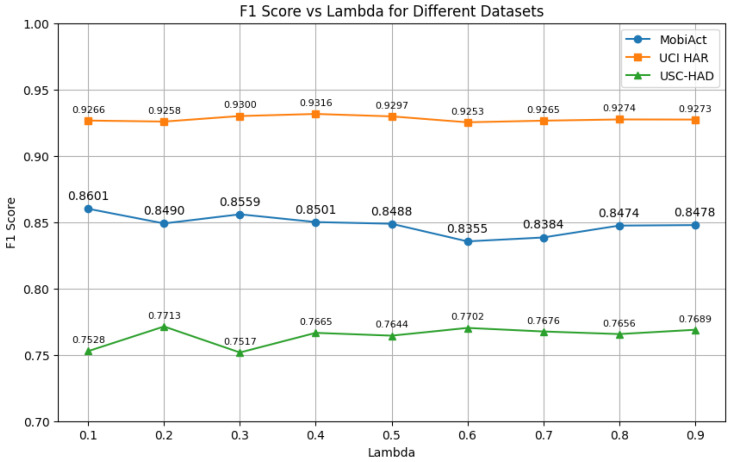
- In ablation under LOSO, the proposed multi-task model reached 86.01% on MobiAct, 93.16% on UCI-HAR, and 77.13% on USC-HAD, improving over supervised-only by 10.88%, 3.45%, and 5.78%, and over two-stage SupCon-only by 3.20%, 0.94%, and 9.99%, respectively.
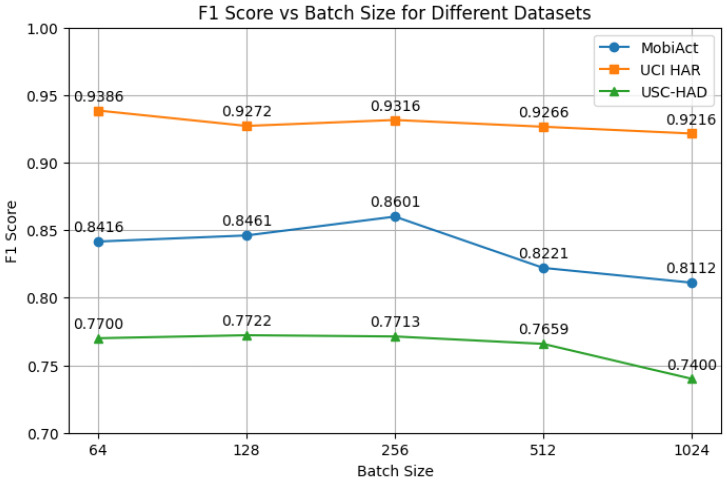
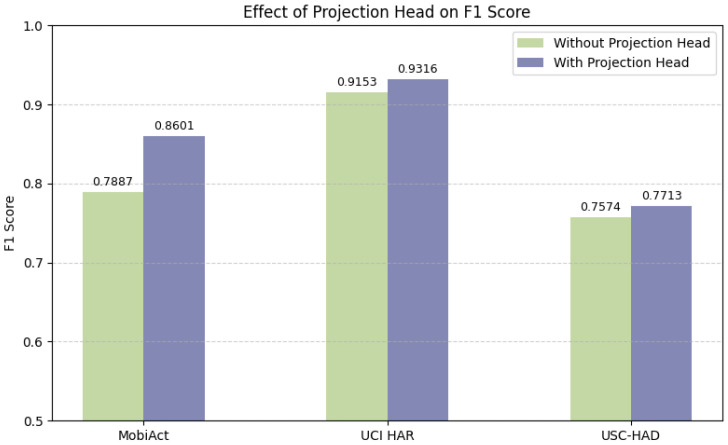
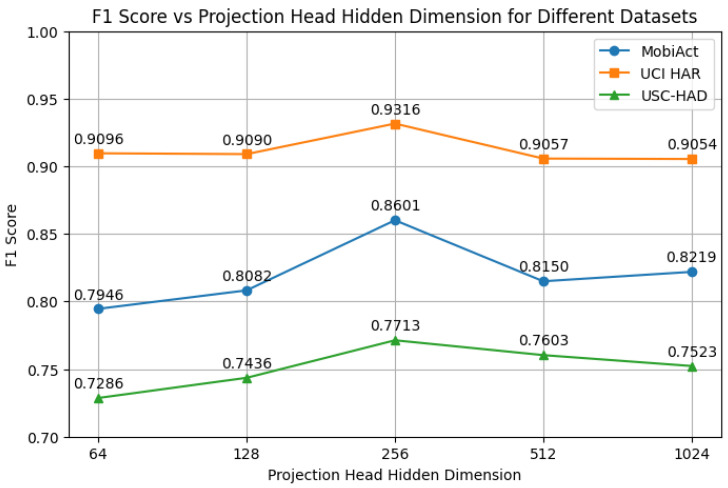
- Adding a projection head improved MobiAct F1 from 78.87% to 86.01%; batch size 256 and projection hidden dimension 256 performed best across datasets.
- The optimal contrastive loss weight λ varied by dataset: 0.1 for MobiAct, 0.2 for USC-HAD, and 0.4 for UCI-HAR; λ below 0.5 generally performed better.
Methods
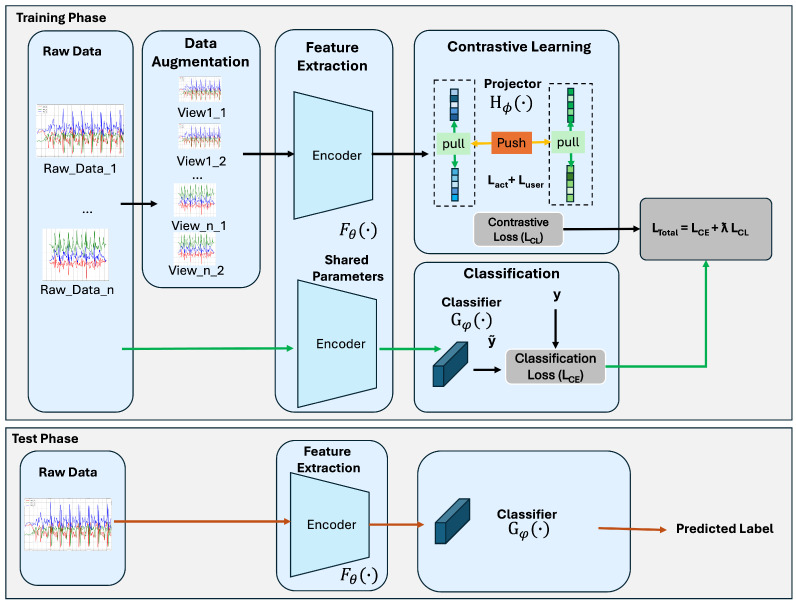
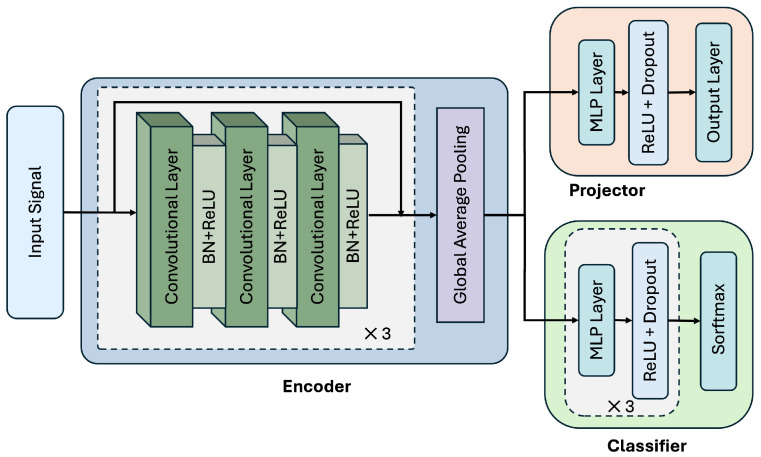
- The framework uses a shared lightweight ResNet encoder with three stacked residual blocks, a classification head for cross-entropy activity classification, and a projection head used only during training for supervised contrastive loss.
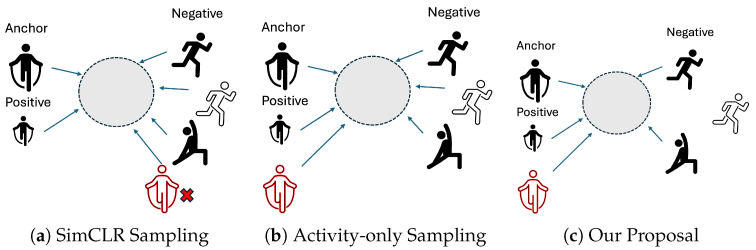
- Positive pairs are samples with the same activity label across different users; negative pairs are samples with different activity labels from the same user. The total loss is \(L_{total}=L_{CE}+\lambda L_{CL}\), optimized in a single-stage multi-task setup.
- Experiments used three public datasets: MobiAct (66 participants; 11 ADLs used), UCI HAR (30 participants; 6 ADLs), and USC-HAD (14 participants; 12 ADLs). Data were downsampled to 50 Hz, split into 1 s windows with 50% overlap, and evaluated with user-disjoint 60/20/20 train/validation/test splits over three independent runs using macro-F1.
Limitations
- The paper states that the framework relies on fully labeled data for both activity and user identities, and suggests semi-supervised, self-supervised, pseudo-labeling, or weak-supervision extensions to reduce annotation requirements.
- The paper states that validation was limited to public datasets and that in-the-wild deployment and long-term evaluation are needed to test robustness to sensor placement and user lifestyle variation.
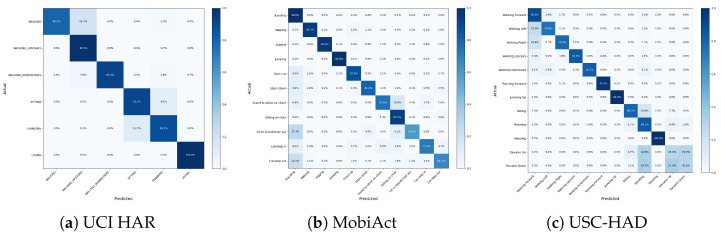
- The paper states that the framework mainly targets cross-user generalization; broader cross-domain and cross-device transferability would require complementary strategies such as domain adaptation, meta-learning, or adversarial data generation. Evident from the results: UCI-HAR performance was below supervised CSSHAR and CTBL, and confusion remained for transitional or low-motion activities such as sitting/standing and elevator/standing.
Model-written summary. Check it against the paper before relying on it.
Integrity signals
Registry
Cites
Statistics
Figures

Verification
Claims the paper makes
4 Valid · 0 Not valid · 23 Not checked · 92 Own results and interpretations
The cited sources support only part of this claim — read each source’s verdict below.
In the paper
“Prior works have explored personalized HAR frameworks [11,12,13,14,15,16], typically adopting a two-stage approach: pre-training on a general dataset followed by fine-tuning on data from the target user.”
§ Towards User-Generalizable Wearable-Sensor-Based Human Activity Recognition: A Multi-Task Contrastive Learning Approach > 1. Introduction
What the sources say
- Not checked yetcites [11] Hong, 2024, CrossHAR: Generalizing Cross-Dataset Human Activity Recognition via Hierarchical Self-Supervised Pretraining, Proc. ACM Interact. Mob. Wearable Ubiquitous Technol. source
- Not checked yetcites [12] Bianchi, 2019, IoT Wearable Sensor and Deep Learning: An Integrated Approach for Personalized Human Activity Recognition in a Smart Home Environment, IEEE Internet Things J. source
- Not checked yetcites [13] Saha, 2025, Personalized Human Activity Recognition: Real-Time On-Device Training and Inference, IEEE Consum. Electron. Mag. source
- Not checked yetcites [14] Kang, P., Moosmann, J., Liu, M., Zhou, B., Magno, M., Lukowicz, P., and Bian, S. (2025). Bridging Generalization and Personalization in Wearable Human Activity Recognition via On-Device Few-Shot Learning. arXiv, Available online: https://arxiv.org/abs/2508.15413.
- Partly supportedcites [15] Fu, Z., He, X., Wang, E., Huo, J., Huang, J., and Wu, D. (2021). Personalized Human Activity Recognition Based on Integrated Wearable Sensor and Transfer Learning. Sensors, 21. sourceExperimental — accuracy not yet measured
Our copy supports the two-stage skeleton: the Introduction defines 'the generalized data set as the source domain and the new users' data sets as the target domain', and Section 3/1 describe knowledge learned from the labeled source domain being transferred and the source-trained classifier adapting to the target user's data. However, the paper's realization is unsupervised domain adaptation (IPL-JPDA over an unlabeled target domain, using pseudo-labels and joint-probability alignment), not a 'fine-tuning' stage on labeled target-user data — no passage in our copy uses fine-tuning or pre-training of a network. The paper also does not state that personalized HAR frameworks 'typically' follow this pattern; it argues only that the ideal personalized HAR system is achievable via transfer learning/domain adaptation. (LLM, conf=0.70)
- Not checked yetcites [16] Yu, 2023, FedHAR: Semi-Supervised Online Learning for Personalized Federated Human Activity Recognition, IEEE Trans. Mob. Comput. source
plain- Asserted: passes — The authors put it forward as true.
- Checkable: passes — It can be checked against evidence.
- Load-bearing: passes — The paper’s conclusions depend on it.
- Based: passes — The paper gives a reason why it holds.
None of the sources cited for this claim have been checked yet.
In the paper
“While effective, these methods suffer from two major limitations: (1) collecting data from each new user increases deployment costs, and (2) the two-stage training pipeline adds complexity and computational overhead.”
§ Towards User-Generalizable Wearable-Sensor-Based Human Activity Recognition: A Multi-Task Contrastive Learning Approach > 1. Introduction
What the sources say
- Not checked yetcites [11] Hong, 2024, CrossHAR: Generalizing Cross-Dataset Human Activity Recognition via Hierarchical Self-Supervised Pretraining, Proc. ACM Interact. Mob. Wearable Ubiquitous Technol. source
- Not checked yetcites [12] Bianchi, 2019, IoT Wearable Sensor and Deep Learning: An Integrated Approach for Personalized Human Activity Recognition in a Smart Home Environment, IEEE Internet Things J. source
- Not checked yetcites [13] Saha, 2025, Personalized Human Activity Recognition: Real-Time On-Device Training and Inference, IEEE Consum. Electron. Mag. source
- Not checked yetcites [14] Kang, P., Moosmann, J., Liu, M., Zhou, B., Magno, M., Lukowicz, P., and Bian, S. (2025). Bridging Generalization and Personalization in Wearable Human Activity Recognition via On-Device Few-Shot Learning. arXiv, Available online: https://arxiv.org/abs/2508.15413.
- Could not verifycites [15] Fu, Z., He, X., Wang, E., Huo, J., Huang, J., and Wu, D. (2021). Personalized Human Activity Recognition Based on Integrated Wearable Sensor and Transfer Learning. Sensors, 21. sourceExperimental — accuracy not yet measured
The Introduction (page not provided) says collecting labeled data and training user-specific HAR models is time-consuming and expensive, which supports the sentence’s first limitation. But the claim under review is the second limitation: searches for a two-stage pipeline, computational overhead, and training complexity found no passage attributing added complexity or overhead to such a pipeline. (LLM, conf=0.72)
- Not checked yetcites [16] Yu, 2023, FedHAR: Semi-Supervised Online Learning for Personalized Federated Human Activity Recognition, IEEE Trans. Mob. Comput. source
plainstates a cause- Asserted: passes — The authors put it forward as true.
- Checkable: passes — It can be checked against evidence.
- Load-bearing: passes — The paper’s conclusions depend on it.
- Based: passes — The paper gives a reason why it holds.
The cited sources support only part of this claim — read each source’s verdict below.
In the paper
“Both methods were designed to leverage unlabeled data by pre-training on unannotated signals and subsequently fine-tuning on labeled data.”
§ Towards User-Generalizable Wearable-Sensor-Based Human Activity Recognition: A Multi-Task Contrastive Learning Approach > 5. Discussion > 5.1. Main Results and Comparisons
What the sources say
- Partly supportedcites [30] Haresamudram, 2021, Contrastive Predictive Coding for Human Activity Recognition, Proc. ACM Interact. Mob. Wearable Ubiquitous Technol. sourceExperimental — accuracy not yet measured
Section 5.2 (p. 10) says CPC is pre-trained on unlabeled data, then a classifier is trained on labeled samples while the learned weights remain frozen. The paper supports the claim for CPC, but the passages found do not address ClusterCLHAR, so they cannot establish that both methods use this design. (LLM, conf=0.88)
- Partly supportedcites [35] Wang, 2023, Negative Selection by Clustering for Contrastive Learning in Human Activity Recognition, IEEE Internet Things J. sourceExperimental — accuracy not yet measured
The self-supervised and semi-supervised experimental protocols describe ClusterCLHAR pretraining on unlabeled data, followed by downstream evaluation with labeled data, including fine-tuning. The passages do not establish the same design for CPC (searched for “CPC” and its pretraining procedure), so the claim about both methods is only partially supported. (LLM, conf=0.85)
plainstates a cause- Asserted: passes — The authors put it forward as true.
- Checkable: passes — It can be checked against evidence.
- Load-bearing: passes — The paper’s conclusions depend on it.
- Based: passes — The paper gives a reason why it holds.
- Partly supported
The cited sources support only part of this claim — read each source’s verdict below.
In the paper
“Within this formulation, our multi-task supervised contrastive framework provides a unified optimization process in which the classification and contrastive objectives jointly guide the encoder to capture activity semantics while suppressing user-specific variations [37].”
§ Towards User-Generalizable Wearable-Sensor-Based Human Activity Recognition: A Multi-Task Contrastive Learning Approach > 3. Methodology > 3.1. Problem Setup
What the sources say
- Partly supportedcites [37] Caruana, 1997, Multitask Learning, Mach. Learn. sourceExperimental — accuracy not yet measured
The Abstract says related tasks are learned in parallel through a shared representation, and §3.2 says their error gradients combine at the hidden layer. That supports the general idea of joint training shaping a representation, but the paper does not address supervised contrastive objectives, activity semantics, or suppression of user-specific variation. (LLM, conf=0.88)
plainstates a cause- Asserted: passes — The authors put it forward as true.
- Checkable: passes — It can be checked against evidence.
- Load-bearing: passes — The paper’s conclusions depend on it.
- Based: passes — The paper gives a reason why it holds.
- Rests on an assumption not shown here.
- Partly supported
A result the paper reports from its own data — it cites no other source for it, so there is none to check. The quote shows it is in the paper.
In the paper
“The results, shown in Figure 5, indicate that moderate batch sizes generally lead to better performance across all datasets.”
§ Towards User-Generalizable Wearable-Sensor-Based Human Activity Recognition: A Multi-Task Contrastive Learning Approach > 4. Experiments > 4.4. Ablation Study
hedgedstates a cause- Asserted: passes — The authors put it forward as true.
- Checkable: passes — It can be checked against evidence.
- Load-bearing: unclear — It is unclear whether the paper’s conclusions depend on it.
- Based: passes — The paper gives a reason why it holds.
61 more claims
Create a free account to see all 119 claims and to verify the 52 references still open.
- It may state two separate claims as one. 45
- The quote only partly states this claim. 1
- Probably not a substantial claim. 17
Self-check
Percentages, sums and reported differences re-computed from the paper’s own numbers.
Each contradiction between two passages listed here was confirmed by an independent check.
Rated minor: it would not touch a result — a value no result rests on, a p-value that stays on the same side of the significance level, or a conflict that is clerical, resolved elsewhere in the paper, or outside its own findings.
In the paper
§ Towards User-Generalizable Wearable-Sensor-Based Human Activity Recognition: A Multi-Task Contrastive Learning Approach > 4. Experiments > 4.3. Main Results
“Supervised Baselines: Traditional HAR models trained in a fully supervised manner, leveraging various backbone architectures such as the hybrid CNN-Transformer-BiLSTM (CTBL) [27], and the convolutional autoencoder (CAE) [28], DeepConvLSTM [29], CNN-Transformer (Sup. CSSHAR) [34].”
§ Towards User-Generalizable Wearable-Sensor-Based Human Activity Recognition: A Multi-Task Contrastive Learning Approach > 4. Experiments > 4.3. Main Results
“contrastive self-supervised methods such as CSSHAR, Multi-task SSL, CPC, CAE, and ClusterCLHAR”
Rated minor: it would not touch a result — a value no result rests on, a p-value that stays on the same side of the significance level, or a conflict that is clerical, resolved elsewhere in the paper, or outside its own findings.
In the paper
§ Towards User-Generalizable Wearable-Sensor-Based Human Activity Recognition: A Multi-Task Contrastive Learning Approach > 3. Methodology > 3.2. Multi-Task Contrastive Learning Framework
“-Positive pairs: samples with the same activity label across different users.”
§ Towards User-Generalizable Wearable-Sensor-Based Human Activity Recognition: A Multi-Task Contrastive Learning Approach > 4. Experiments > 4.4. Ablation Study
“SupCon (Act + User, Two-stage): A stricter version of SupCon, in which both activity and user labels must match to form positive and negative pairs (Figure 3c).”
Rated minor: it would not touch a result — a value no result rests on, a p-value that stays on the same side of the significance level, or a conflict that is clerical, resolved elsewhere in the paper, or outside its own findings.
In the paper
§ Towards User-Generalizable Wearable-Sensor-Based Human Activity Recognition: A Multi-Task Contrastive Learning Approach > 4. Experiments > 4.3. Main Results
“and ranks second on UCI-HAR (91.07% ± 2.09%)”
§ Towards User-Generalizable Wearable-Sensor-Based Human Activity Recognition: A Multi-Task Contrastive Learning Approach > 4. Experiments > 4.3. Main Results
“slightly behind supervised CSSHAR (93.73% ± 1.02%), which employs a CNN-Transformer backbone, and CTBL (92.72% ± 1.48%)”
Citations
Cites
Decoupled Weight Decay Regularization
Loshchilov, I., & Hutter, F. (2017) · arXiv · doi:10.48550/arxiv.1711.05101 · Cited by 12,522
Caruana, R. (1997) · Machine Learning · doi:10.1023/a:1007379606734 · Cited by 6,636 · cited 1×
“Within this formulation, our multi-task supervised contrastive framework provides a unified optimization process in which the classification and contrastive objectives jointly guide the encoder to capture activity semantics while suppressing user-specific variations [37].”
Activity Recognition from User-Annotated Acceleration Data
Bao, L., & Intille, S. S. (2004) · Lecture Notes in Computer Science · doi:10.1007/978-3-540-24646-6_1 · Cited by 3,147
Activity recognition using cell phone accelerometers
Kwapisz, J. R., Weiss, G. M., & Moore, S. A. (2011) · ACM SIGKDD Explorations Newsletter · doi:10.1145/1964897.1964918 · Cited by 2,912 · cited 1×
“For example, Bao and Intille [20] and Ravi et al. [21] deployed multi-sensor systems to collect data from subjects performing everyday tasks, while Kwapisz et al. [22] validated activity recognition using smartphone accelerometers in unconstrained settings.”
Deep Convolutional and LSTM Recurrent Neural Networks for Multimodal Wearable Activity Recognition
Ordóñez, F., & Roggen, D. (2016) · Sensors · doi:10.3390/s16010115 · Cited by 2,761 · cited 1×
“…multiple learning paradigms: • Supervised Baselines: Traditional HAR models trained in a fully supervised manner, leveraging various backbone architectures such as the hybrid CNN-Transformer-BiLSTM (CTBL) [27], and the convolutional autoencoder (CAE) [28], DeepConvL-STM [29], CNN-Transformer (Sup.”
Time series classification from scratch with deep neural networks: A strong baseline
Wang, Z., Yan, W., & Oates, T. (2017) · 2017 International Joint Conference on Neural Networks (IJCNN) · doi:10.1109/ijcnn.2017.7966039 · Cited by 2,299
Sensor-Based Activity Recognition
Chen, L., Hoey, J., Nugent, C. D., Cook, D. J., & Yu, Z. (2012) · IEEE Transactions on Systems, Man, and Cybernetics, Part C (Applications and Reviews) · doi:10.1109/tsmcc.2012.2198883 · Cited by 1,074
Human Action Recognition From Various Data Modalities: A Review
Sun, Z., Ke, Q., Rahmani, H., Bennamoun, M., Wang, G., & Liu, J. (2022) · IEEE Transactions on Pattern Analysis and Machine Intelligence · doi:10.1109/tpami.2022.3183112 · Cited by 601
USC-HAD: a daily activity dataset for ubiquitous activity recognition using wearable sensors
Zhang, M., & Sawchuk, A. A. (2012) · Proceedings of the 2012 ACM Conference on Ubiquitous Computing · doi:10.1145/2370216.2370438 · Cited by 554
Bianchi, V., Bassoli, M., Lombardo, G., Fornacciari, P., Mordonini, M., & De Munari, I. (2019) · IEEE Internet of Things Journal · doi:10.1109/jiot.2019.2920283 · Cited by 466 · cited 1×
“Distributed online learning [12] has shown promise for personalized adaptation in streaming IoT scenarios.”
Research works printed but not linked: 5
- Ravi, N., Dandekar, N., Mysore, P., and Littman, M. (2005, January 9–13). Activity Recognition from Accelerometer Data. Proceedings of the Seventeenth Conference on Innovative Applications of Artificial Intelligence, Pittsburgh, PA, USA.
- Guo, P., and Nakayama, M. (March, January 27). Transformer-Based Human Activity Recognition Using Wearable Sensors for Health Monitoring. Proceedings of the 9th International Conference on Biomedical Engineering and Applications (ICBEA), Seoul, Republic of Korea.
- Chen, T., Kornblith, S., Norouzi, M., and Hinton, G. (2020, January 13–18). A Simple Framework for Contrastive Learning of Visual Representations. Proceedings of the 37th International Conference on Machine Learning (ICML), Virtual Event.
- Khosla, P., Teterwak, P., Wang, C., Sarna, A., Tian, Y., Isola, P., Maschinot, A., Liu, C., and Krishnan, D. (2020, January 6–12). Supervised Contrastive Learning. Proceedings of the 34th International Conference on Neural Information Processing Systems (NeurIPS), Vancouver, BC, Canada.
- Anguita, D., Ghio, A., Oneto, L., Parra, X., and Reyes-Ortiz, J.L. (2013, January 24–26). A Public Domain Dataset for Human Activity Recognition Using Smartphones. Proceedings of the European Symposium on Artificial Neural Networks (ESANN), Bruges, Belgium.
Cited by
Biosensors for detecting communicable and non-communicable diseases: A critical review
Mashayekh, N., & Khaledi, E. M. (2026) · Sensing and Bio-Sensing Research · doi:10.1016/j.sbsr.2026.100986 · Cited by 5
MODEL$\mathrm{X}_{c}$: A Novel Data-Efficient Personalization for Fall Detection
Yasmin, A., Mahmud, T., Alamgeer, S., Islam, T. Z., & Ngu, A. H. H. (2026) · IEEE International Conference on Digital Health (ICDH) · doi:10.1109/icdh72779.2026.00038 · Cited by 1
Adaptive Gated Multimodal Fusion for Robust and Generalized Human Activity Recognition
Gautam, S., & Shrivastava, A. (2026) · Journal of Trends in Computer Science and Smart Technology · doi:10.36548/jtcsst.2026.2.007
Liu, X., & Wang, G. (2026) · Mathematics · doi:10.3390/math14111932
Tong, Z., Abuhaija, B., & Gao, Z. (2026) · Multidimensional Signal Processing Workshop · doi:10.1109/ivmsp68335.2026.11618781
Metadata
- Authors
- Guo, P., & Nakayama, M.
- Affiliations
- The University of Tokyo (JP)
- Corresponding author
- Nakayama, Masaya
- Venue
- Sensors
- Publisher
- MDPI AG
- Published
- 2025-11-15
- Volume
- 25
- Issue
- 22
- Pages
- 6988
- ISSN
- 1424-8220 (ISSN-L)
- PMC
- PMC12656164
- OpenAlex
- W4416392909
- Cited by
- 6
- References
- 36
- Citations by year
- 2026: 6
- FWCI
- 2.11
- Type
- journal article
- Language
- en
- Open access
- gold
- doi.org
- Licence
- Locations
- Sensors (publishedVersion, cc-by)
- PubMed (publishedVersion)
- DOAJ (DOAJ: Directory of Open Access Journals) (submittedVersion, cc-by-sa)
- Topics
- Physical Sciences › Computer Science › Computer Vision and Pattern Recognition › Context-Aware Activity Recognition Systems
- Physical Sciences › Computer Science › Artificial Intelligence › Domain Adaptation and Few-Shot Learning
- Physical Sciences › Engineering › Biomedical Engineering › Gait Recognition and Analysis
- Keywords
- human activity recognition, wearable sensors, cross-user generalization, contrastive learning, multi-task learning, supervised contrastive learning, representation learning
- MeSH terms
- Machine Learning, Wearable Electronic Devices, Deep Learning, Algorithms, Humans, Human Activities
About these checks
Registry, retraction, Cites and statistics results are computed, not judged, with one exception: a printed reference that no index lists is read once by a model before it counts as a citation error. Claims are extracted by a model and kept only when their quote appears verbatim in the text; each cited source is then checked, with a model’s help, for whether it says what the claim relies on. Those verdicts can be wrong — read the claim’s quote and the cited source before relying on one.
The claim verdicts this report counts are experimental: their accuracy is not yet measured.
A language model drew the claims from the paper on 2026-09-29, under version 3 of the claim definition (model deepseek-v4.1-flash, prompt extract-v3).
A second model labelled each claim on 2026-09-29 (model jev-1.13-20260917, definition revision gold-guideline-v0.2).
Cited sources are checked with a language model’s help (qwen3.8-omni-flash and gpt-6-sol).
Statistics and arithmetic are recomputed, not judged.
Confidence bands are shown only for fields calibrated on our annotated test set. None is calibrated yet, so no band is shown.
What counts as a claim ›How we measure confidence ›How we check this ›
Are you an author, or do you see a problem with this page? Request a review
How to cite
Cite CoChat for the checks on this page, and the paper for its own findings.
- This page
- CoChat. (2026). Citation check: Towards User-Generalizable Wearable-Sensor-Based Human Activity Recognition: A Multi-Task Contrastive Learning Approach. https://app.cochat.ai/papers/10.3390/s25226988
- The paper
- Guo, P., & Nakayama, M. (2025). Towards User-Generalizable Wearable-Sensor-Based Human Activity Recognition: A Multi-Task Contrastive Learning Approach. Sensors. https://doi.org/10.3390/s25226988
Data sources
Bibliographic data: Semantic Scholar, OpenAlex, Crossref.
Contains information from the Semantic Scholar Academic Graph Datasets, made available under the ODC Attribution License (ODC-BY 1.0).
Semantic Scholar’s data is described in: Kinney, R., et al. (2023). The Semantic Scholar Open Data Platform. arXiv:2301.10140.
