

Velocity-based resistance training on 1-rm, jump and sprint performance: a systematic review of clinical trials.
Open accessThe DOI matches its Crossref record; 77 of the 79 references it cites were found in a registry or an index.
Abstract
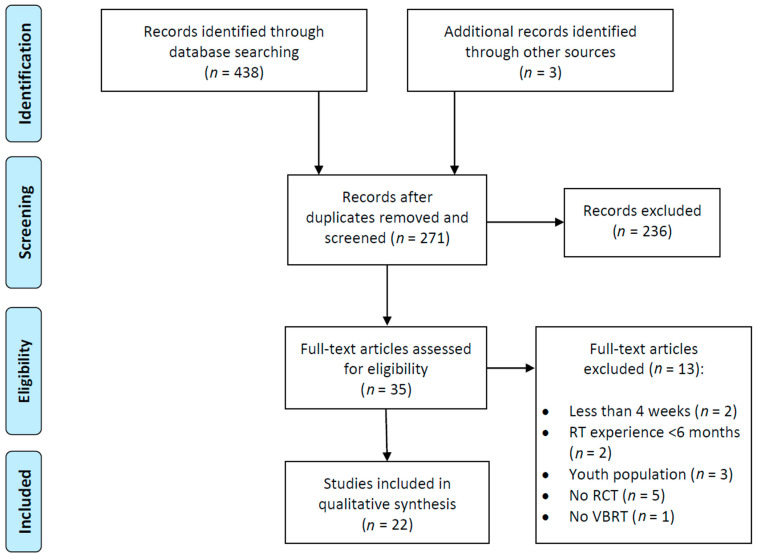
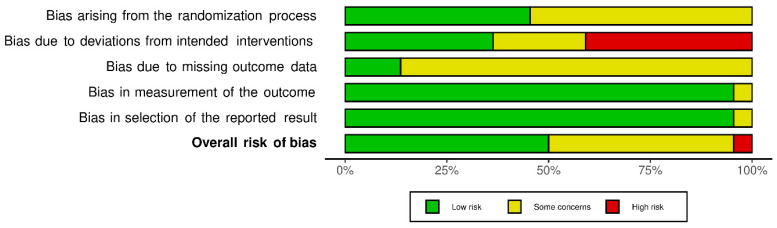
Weight resistance training (RT) has been shown to positively influence physical performance. Within the last two decades, a methodology based on monitoring RT through movement velocity (also called velocity-based resistance training, VBRT) has emerged. The aim of this PRISMA-based systematic review was to evaluate the effect of VBRT programs on variables related to muscle strength (one-repetition maximum, 1-RM), and high-speed actions (vertical jump, and sprint performance) in trained subjects. The search for published articles was performed in PubMed/MEDLINE, SPORT Discus/EBSCO, OVID, Web of Science, Scopus, and EMBASE databases using Boolean algorithms independently. A total of 22 studies met the inclusion criteria of this systematic review (a low-to-moderate overall risk of bias of the analyzed studies was detected). VBRT is an effective method to improve 1-RM, vertical jump and sprint. According to the results of the analyzed studies, it is not necessary to reach high muscle failure in order to achieve the best training results. These findings reinforce the fact that it is possible to optimize exercise adaptations with less fatigue. Future studies should corroborate these findings in female population.
Overview
The claims and statistics of this paper haven’t been checked yet.
Free: it reads the open-access text and checks the first 5 claims that cite a source we can check. Create a free account to check every claim.
Integrity signals
Registry
Cites
Statistics
Figures
Verification
Claims the paper makes
The claims and statistics of this paper haven’t been checked yet.
Free: it reads the open-access text and checks the first 5 claims that cite a source we can check. Create a free account to check every claim.
Claims other papers make about this one
Each is checked against this paper’s own text: does it say what the citing paper says it does?
The cited source says what the claim attributes to it.
In the citing paper
“Compared with CTRL, strength was impacted by engaging in standard RT (17,24,29–56), circuit RT (57–59), elastic band RT (60–62), home-based RT (63,64), and velocity-based RT (65,66).”
The cited source says what the claim attributes to it.
In the citing paper
“In comparisons between distinct RTx, jumping performance was positively affected by velocity-based RT versus standard RT (65), but jumping performance was not affected by set structure (108,109).”
The cited source says what the claim attributes to it.
In the citing paper
“In comparisons between distinct RTx, running performance was positively affected only by velocity-based RT versus standard RT (65).”
Self-check
Percentages, sums and reported differences re-computed from the paper’s own numbers.
The self-check needs the paper’s full text.
Citations
Cites
The PRISMA 2020 statement: An updated guideline for reporting systematic reviews
Page, M. J., McKenzie, J. E., Bossuyt, P. M., Boutron, I., Hoffmann, T. C., Mulrow, C. D., Shamseer, L., Tetzlaff, J. M., Akl, E. A., Brennan, S. E., et al. (2021) · BMJ · doi:10.1136/bmj.n71 · Cited by 108,283
RoB 2: a revised tool for assessing risk of bias in randomised trials
Sterne, J. A. C., Savović, J., Page, M. J., Elbers, R. G., Blencowe, N. S., Boutron, I., Cates, C. J., Cheng, H.-Y., Corbett, M. S., Eldridge, S. M., et al. (2019) · BMJ · doi:10.1136/bmj.l4898 · Cited by 34,787 · cited 1×
“0 [50] including: selection bias, performance bias, detection bias, attrition bias, outcome reporting bias, and any other bias.”
BackgroundThe PRISMA 2020 Statement: An Updated Guideline for Reporting Systematic Reviews
Page, M. J., McKenzie, J. E., Bossuyt, P. M., Boutron, I., Hoffmann, T. C., Mulrow, C. D., Shamseer, L., Tetzlaff, J. M., Akl, E. A., Brennan, S. E., et al. (2021) · International Journal of Surgery · doi:10.1016/j.ijsu.2021.105906 · Cited by 11,748
The PRISMA 2020 statement: an updated guideline for reporting systematic reviews
Page, M. J., McKenzie, J., Bossuyt, P., Boutron, I., Hoffmann, T., mulrow, C., Shamseer, L., Tetzlaff, J., Akl, E., Brennan, S. E., et al. (2020) · doi:10.31222/osf.io/v7gm2_v1 · Cited by 8,090
McGuinness, L. A., & Higgins, J. P. T. (2021) · Research Synthesis Methods · doi:10.1002/jrsm.1411 · Cited by 5,579 · cited 1×
“Figures to represent the results of the risk of bias assessment were developed using the package Risk-of-bias Visualization (robvis) [51].”
MethodFundamentals of Resistance Training: Progression and Exercise Prescription
KRAEMER, W. J., & RATAMESS, N. A. (2004) · Medicine & Science in Sports & Exercise · doi:10.1249/01.mss.0000121945.36635.61 · Cited by 2,722 · cited 2×
“On the other hand, volume is prescribed in terms of sets and repetitions per set [12].”
BackgroundMethodEriksen, M. B., & Frandsen, T. F. (2018) · Journal of the Medical Library Association · doi:10.5195/jmla.2018.345 · Cited by 1,216
Velocity Loss as an Indicator of Neuromuscular Fatigue during Resistance Training
SÁNCHEZ-MEDINA, L., & GONZÁLEZ-BADILLO, J. J. (2011) · Medicine & Science in Sports & Exercise · doi:10.1249/mss.0b013e318213f880 · Cited by 852 · cited 3×
“In addition, it has been observed that, for the same relative load, the magnitude of VL incurred in the set determine the degree of fatigue [27,28].”
BackgroundMethodMovement Velocity as a Measure of Loading Intensity in Resistance Training
González-Badillo, J. J., & Sánchez-Medina, L. (2010) · International Journal of Sports Medicine · doi:10.1055/s-0030-1248333 · Cited by 788 · cited 3×
“Thus, it is possible to estimate the 1% RM that is being used as soon as the first repetition with any given absolute load is performed [14].”
BackgroundMethodThe Role of Resistance Exercise Intensity on Muscle Fibre Adaptations
Fry, A. C. (2004) · Sports Medicine · doi:10.2165/00007256-200434100-00004 · Cited by 626 · cited 1×
“Traditionally, relative load during RT has been configured using the percentage of one-repetition maximum (1-RM) or the maximum number of repetitions complete against an absolute load (X-RM) [11,12].”
Method
Cited by
Strength training in elderly: An useful tool against sarcopenia
Cannataro, R., Cione, E., Bonilla, D. A., Cerullo, G., Angelini, F., & D’Antona, G. (2022) · Frontiers in Sports and Active Living · doi:10.3389/fspor.2022.950949 · Cited by 89
“It is worth mentioning that velocity-based resistance training is a methodology based on monitoring and dosing the training load by measuring movement velocity (Baena-Marín et al., 2022).”
MethodSelf-citationCURRIER, B. S., D’SOUZA, A. C., SINGH, M. A. F., LOWISZ, C. V., RAWSON, E. S., SCHOENFELD, B. J., SMITH-RYAN, A. E., STEEN, J. P., THOMAS, G. A., TRIPLETT, N. T., et al. (2026) · Medicine & Science in Sports & Exercise · doi:10.1249/mss.0000000000003897 · Cited by 105
Held, S., Speer, K., Rappelt, L., Wicker, P. V., & Donath, L. (2022) · Frontiers in Physiology · doi:10.3389/fphys.2022.926972 · Cited by 65
Pastor, A. S., García-Sánchez, C., Nieto, M. M., & de la Rubia, A. (2023) · International Journal of Environmental Research and Public Health · doi:10.3390/ijerph20064833 · Cited by 63
Petro, J. L., Ferrari, G., Cardozo, L. A., Vargas-Molina, S., Carbone, L., Kreider, R. B., & Bonilla, D. A. (2024) · Sports Health A Multidisciplinary Approach · doi:10.1177/19417381241260412 · Cited by 28
Self-citationRojas-Jaramillo, A., León-Sánchez, G., Calvo-Lluch, Á., González‐Badillo, J. J., & Rodríguez‐Rosell, D. (2024) · Sports · doi:10.3390/sports12020043 · Cited by 25
“%) induces less fatigue accumulation [18,19] and produces similar or even greater gains in strength, running speed, and jumping ability compared to a high magnitude of %VL in the set (>20%VL), regardless of the relative load used [5,10–12 , 19– 21].”
BackgroundMethodResultInfluentialSelf-citationPerception of Velocity during Free-Weight Exercises: Difference between Back Squat and Bench Press
Romagnoli, R., & Piacentini, M. F. (2022) · Journal of Functional Morphology and Kinesiology · doi:10.3390/jfmk7020034 · Cited by 13
Impact of the deep squat on articular knee joint structures, friend or enemy? A scoping review
Rojas-Jaramillo, A., Cuervo, D., Quintero, J. D., Ascuntar-Viteri, J. D., Acosta-Arroyave, N., Ribas‐Serna, J., González‐Badillo, J. J., & Rodríguez‐Rosell, D. (2024) · Frontiers in Sports and Active Living · doi:10.3389/fspor.2024.1477796 · Cited by 11
Self-citationGarcía-Sillero, M., Chulvi‐Medrano, I., Maroto‐Izquierdo, S., Bonilla, D. A., Vargas-Molina, S., & Benítez‐Porres, J. (2022) · Journal of Clinical Medicine · doi:10.3390/jcm11175220 · Cited by 9
Self-citationLu, T., Peng, W., Yi, M., Chen, N., Han, Y., Huang, J., & Chen, J. (2025) · Applied Sciences · doi:10.3390/app15052434 · Cited by 10
“The 6-week resistance training intervention was conducted from April to June 2024, with sessions scheduled every Monday and Thursday (15:00–17:00 h) using a progressive linear periodization structure [22].”
InfluentialKülkamp, W., Bishop, C. J., Kons, R. L., Antunes, L., do Carmo, E. C., Kunzler, D. D. C. H., & Pupo, J. D. (2023) · Measurement in Physical Education and Exercise Science · doi:10.1080/1091367x.2023.2207570 · Cited by 10
“Velocity-based training (VBT) has often been described as a practical and accurate method for prescribing and monitoring strength training in real time (Baena-Marín et al., 2022; Weakley et al., 2021a, 2021b; Külkamp et al., 2021a; Włodarczyk et al., 2021).”
BackgroundMethodSekulović, V., Stojanović, T. J., Andrić, N., Elizondo-Donado, A., Martin, D., Mikić, M. J., & Stojanović, M. D. M. (2024) · Applied Sciences · doi:10.3390/app14209192 · Cited by 7
Aydemir, B., Aydoğan, M. T., Boz, E., Kul, M., Kırkbir, F., & Özkara, A. B. (2025) · Sensors · doi:10.3390/s25175580 · Cited by 7
“For reliability assessment, the intraclass correlation coefficient (ICC) was calculated using a Two-Way Mixed Effects model (ICC [3,k]).”
Wang, Y. W. Y., Qiu, J., Dai, D., Li, Q., Wang, X., & Luo, Q. (2026) · BMC Sports Science Medicine and Rehabilitation · doi:10.1186/s13102-025-01504-9 · Cited by 6
“The eccentric phase of SSC, where the muscle length-ens, and the concentric phase, where the muscle short-ens, are both more effective when high-speed training is integrated, facilitating faster force development and improving reactive strength [44, 49].”
Bartolomei, S., Beato, M., & Coratella, G. (2025) · Journal of Functional Morphology and Kinesiology · doi:10.3390/jfmk10020145 · Cited by 5
“The literature has plenty of studies that investigated the effects of VBT, and different meta-analyses established its effectiveness for improving muscle strength and power [44–46], as well as jumping and sprinting ability [45,47].”
Paulsen, G., Myrholt, R. B., Mentzoni, F., & Solberg, P. A. (2025) · PeerJ · doi:10.7717/peerj.19797 · Cited by 3
Vojinovic, A., Janicijevic, D. N., Petrovic, M. R., García‐Ramos, A., Simić, M., & Suzović, D. (2023) · Kinesiology · doi:10.26582/k.55.1.3 · Cited by 5
Peña, J. C., Sánchez-Güette, L., Lombo, C., Pinto, E., Collazos, C. A., Riveros, B. E. T., Bonilla, D. A., Cardozo, L. A., & Téllez, L. A. (2025) · Sports · doi:10.3390/sports13050153 · Cited by 3
Self-citationFrom Monitoring to Prediction: Velocity-Based Strength Training in Female Floorball Athletes
Achermann, B. B., Regazzi, N., Heynen, R., Lüdin, D., Suter, J., Drewek, A., & Lorenzetti, S. (2025) · Sports · doi:10.3390/sports13060175 · Cited by 5
“While VBT has demonstrated benefits in improving maximal strength, jump performance, and sprint speed [13,14], much of this research has predominantly focused on males.”
Vargas-Molina, S., Rojas-Jaramillo, A., Chulvi‐Medrano, I., Carbone, L., Ramirez-Salgado, U., Bonilla, D. A., & García-Sillero, M. (2023) · Retos · doi:10.47197/retos.v49.98861 · Cited by 3
“In recent years, measuring the velocity of the first repetition has emerged as a precise method to determine the training intensity since the percentage of 1-RM can vary from day to day (Baena-Marin et al., 2022).”
Self-citationMeireles, A., Nunes, R. D. A. M., da Silva, G. C. P. S. M., Silva, Y. R., Sodré, R. D. S., Lopes, G. C., da Silva, J. D., & Vale, R. G. D. S. (2025) · International Journal of Sports Science & Coaching · doi:10.1177/17479541251400753 · Cited by 1
“4,5 Conversely, different RT methods, such as weightlifting, eccentric training, and ballistic training, can also in fl uence the magnitude of training adaptations and have been used as strategies to promote the development of muscular strength and power output.”
Judge, L. W., & García-Carrillo, E. (2026) · Sports · doi:10.3390/sports14050181 · Cited by 1
“Higher concentric velocities during ballistic resistance exercises have been closely linked to improved power output and competitive performance [8], supporting the use of velocity metrics as both a monitoring and autoregulatory tool.”
VanZant, R., Erickson, J., Dewar, M., Williams, D., & Schmidt, M. D. (2023) · Journal for the Measurement of Physical Behaviour · doi:10.1123/jmpb.2023-0006 · Cited by 1
Effekte von geschwindigkeitsbasiertem Krafttraining auf Sprung-, Sprint- und Kraftleistungen
Held, S., Rappelt, L., Wiedenmann, T., Speer, K., & Donath, L. (2023) · Sportphysio · doi:10.1055/a-2095-9207
Nieto-Acevedo, R. (2024) · UPM Digital Archive (Technical University of Madrid) · doi:10.20868/upm.thesis.81737
Tobón, L. E. I., Velásquez, C. A. A., Uribe, M. O., Restrepo, J. C. V., Uribe, A. C., Aguirre, J. A. S., & Gil, J. C. E. (2024) · Sportis Scientific Journal of School Sport Physical Education and Psychomotricity · doi:10.17979/sportis.2024.10.3.10752
Velocity-Based Training in Soccer: A Brief Narrative Review with Practical Recommendations
Rojas-Jaramillo, A., Kreider, R. B., Petro, J. L., Bonilla, D. A., González‐Badillo, J. J., & Rodríguez‐Rosell, D. (2025) · Journal of Functional Morphology and Kinesiology · doi:10.3390/jfmk10020106 · Cited by 3
“…and volume during resistance training), numerous studies were conducted comparing different volumes [21], relative loads [22,23], and loading parameters, improving the understanding of sport-specific adaptations and identifying the minimum effective dose required to achieve optimal benefits [21].”
InfluentialSelf-citationEffect of two training modalities on sprint performance in young American football players
Prioul, V., SLAWINSKI, J. S., Guersent, S., Lopes, P., & Leprêtre, P. (2025) · Frontiers in Sports and Active Living · doi:10.3389/fspor.2025.1554055
Shi, Y., Peng, W., Qu, W., Luo, Y., Li, D., Xue, W., Chen, T., & Jian, S. (2025) · Journal of Human Kinetics · doi:10.5114/jhk/207300 · Cited by 1
“Compared to PBRT, VBRT resulted in significantly greater improvements in sprint speed among university badminton players, which is consistent with previous esearch (Baena-Marín et al., 2022).”
InfluentialLoaiza-Betancur, A. F., González-González, C., Díaz-Franco, A., Castaño-Soto, J., Alzate-Toro, A., Areiza-Usuga, E., Zuluaga-M, D. A., Trujillo, J. O. J., Echavarría-Rodríguez, A. M., Díaz-López, V. A., et al. (2026) · PLoS ONE · doi:10.1371/journal.pone.0342992 · Cited by 1
“[27–32 ,34 ,36,41 ],”
InfluentialBarbell Velocity in Strength Training – A Literature Review
Zielińska-Stubińska, W., & Szyszka, P. (2026) · Polish Journal of Sport and Tourism · doi:10.2478/pjst-2026-0007
“Findings suggest that velocity-based training is at least as effective as traditional methods for developing strength and power, and often confers additional benefits related to fatigue management and improvements in explosive performance [5, 10, 13, 51].”
Murugan, S., Rajkumar, N. C. J., Mizushima, J., Rana, P., S., A., Thekkan, N., & Sanjaykumar, S. (2026) · Health sport rehabilitation · doi:10.58962/hsr.1394
“Previous studies have reported that velocity-based resistance training improves muscular power, sprint performance, and movement velocity more effectively than traditional resistance training [7-9].”
Zhang, J., Zhang, S., 崔, 燕., Huang, Y., Dan, Y., Wu, X., Ye, X., Zeng, H., Wu, B., & Yin, M. (2026) · Frontiers in Physiology · doi:10.3389/fphys.2026.1893020
Murase, N., Nishikawa, K., Suzuki, Y., & Sakurai, S. (2026) · Human Movement · doi:10.5114/hm/236117
“Furthermore, a systematic review has summarised the effects of VBT on one-repetition maximum strength, vertical jump performance, and sprint performance [7].”
Metadata
- Authors
- Baena-Marín, M., Rojas-Jaramillo, A., González-Santamaría, J., Rodríguez-Rosell, D., Petro, J. L., Kreider, R. B., & Bonilla, D. A.
- Affiliations
- Universidad Tecnológica de Pereira (CO)
- Universidad de Antioquia (CO)
- Physical Performance & Sports Research Center, Universidad Pablo de Olavide, 41013 Seville, Spain
- Universidad de Córdoba (CO)
- Texas A&M University (US)
- University of the Basque Country (ES)
- Corresponding author
- Bonilla, Diego A.
- ORCID
- Venue
- Sports
- Publisher
- MDPI AG
- Published
- 2022-01-04
- Volume
- 10
- Issue
- 1
- Pages
- 8
- ISSN
- 2075-4663 (ISSN-L)
- PMC
- PMC8822898
- OpenAlex
- W4205672490
- Semantic Scholar
- 46bb7b795e36d8b150a993e46dae834301b3e438
- Cited by
- 35
- References
- 79
- Citations by year
- 2026: 7 · 2025: 10 · 2024: 7 · 2023: 7 · 2022: 4
- FWCI
- 1.54
- Type
- journal article
- Language
- en
- Open access
- gold
- doi.org
- Licence
- Locations
- Sports (publishedVersion, cc-by)
- PubMed Central (publishedVersion, cc-by)
- PubMed (publishedVersion)
- RIO (Universidad Pablo de Olavide) (submittedVersion, cc-by)
- DOAJ (DOAJ: Directory of Open Access Journals) (submittedVersion, cc-by-sa)
- Topics
- Health Sciences › Medicine › Orthopedics and Sports Medicine › Sports Performance and Training
- Health Sciences › Medicine › Physiology (medical) › Cardiovascular and exercise physiology
- Health Sciences › Health Professions › Physical Therapy, Sports Therapy and Rehabilitation › Physical Education and Training Studies
- Keywords
- movement speed, one-repetition maximum, vertical jump, sprint performance, muscle strength, trained athletes, training load monitoring, muscle failure
About these checks
Registry, retraction, Cites and statistics results are computed, not judged, with one exception: a printed reference that no index lists is read once by a model before it counts as a citation error. Claims are extracted by a model and kept only when their quote appears verbatim in the text; each cited source is then checked, with a model’s help, for whether it says what the claim relies on. Those verdicts can be wrong — read the claim’s quote and the cited source before relying on one.
Statistics and arithmetic are recomputed, not judged.
Confidence bands are shown only for fields calibrated on our annotated test set. None is calibrated yet, so no band is shown.
What counts as a claim ›How we measure confidence ›How we check this ›
Are you an author, or do you see a problem with this page? Request a review
Data sources
Bibliographic data: Semantic Scholar, OpenAlex, Crossref.
Contains information from the Semantic Scholar Academic Graph Datasets, made available under the ODC Attribution License (ODC-BY 1.0).
Semantic Scholar’s data is described in: Kinney, R., et al. (2023). The Semantic Scholar Open Data Platform. arXiv:2301.10140.
