

A Comparison of Leg Muscle Oxygenation, Cardiorespiratory Responses, and Blood Lactate between Walking and Running at the Same Speed
Open accessThe DOI matches its Crossref record; 21 of the 23 references it cites were found in a registry or an index; 6 of the 28 sources its claims cite were checked for support.
Abstract
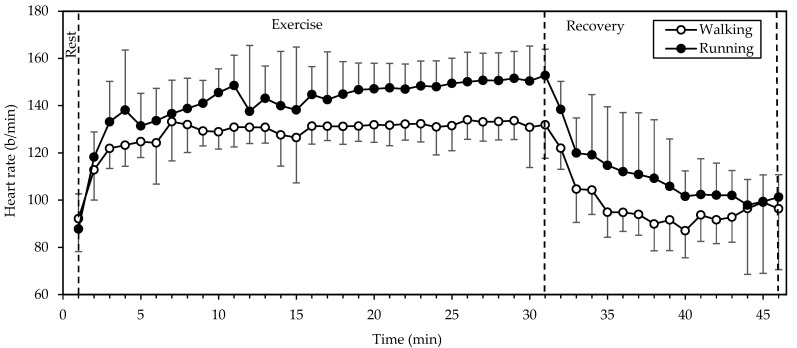
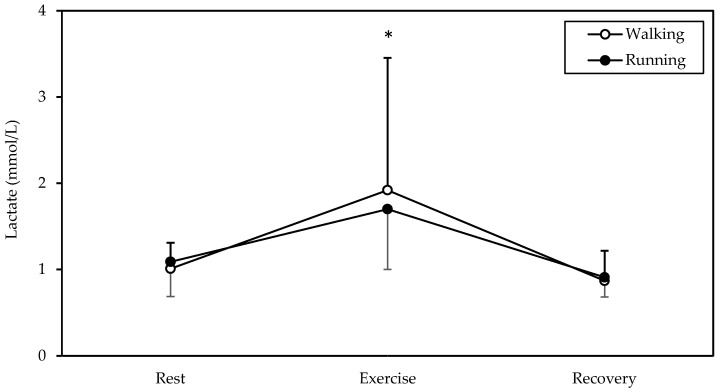
It is not known whether different gait modes, or movement patterns, at the same speed elicit differences in muscle oxygen oxygenation, expressed as muscle oxygen saturation (SmO2). Thus, the aim of this study was to compare the oxygenation of two leg muscles (vastus lateralis and gastrocnemius medialis), as well as the heart rate, respiratory gases, and blood lactate between two gait modes (walking and running) of the same speed and duration. Ten men walked and ran for 30 min each at 7 km/h in a random, counterbalanced order. SmO2, heart rate, and respiratory gases were monitored continuously. Blood lactate was measured at rest, at the end of each exercise, and after 15 min of recovery. Data were analyzed by two-way (gait mode × time) or three-way (gait mode × muscle × time) ANOVA, as applicable. Heart rate and oxygen consumption were higher when running compared to walking. SmO2 was lower during exercise compared to rest and recovery, in gastrocnemius medialis compared to vastus lateralis, and in running compared to walking. Blood lactate increased during exercise but did not differ between gait modes. In conclusion, running caused higher deoxygenation in leg muscles (accompanied by higher whole-body oxygen uptake and heart rate) than walking at the same speed (one that was comfortable for both gait modes), thus pointing to a higher internal load despite equal external load. Thus, preferring running over walking at the same speed causes higher local muscle deoxygenation, which may be beneficial in inducing favorable training adaptations.
Overview
CoChat Summary
TL;DR
In 10 young healthy men, running versus walking at the same speed (7 km/h) for 30 min produced higher heart rate, whole-body oxygen uptake, energy expenditure, and leg muscle deoxygenation, while blood lactate and RER did not differ between gait modes. The authors conclude that running at the same speed imposes a higher internal load despite equal external load, which may favor training adaptations.
Key findings
- Running increased heart rate by 12 ± 10% versus walking; walking was performed at 68 ± 5% of predicted HRmax and running at 75 ± 7% of HRmax.
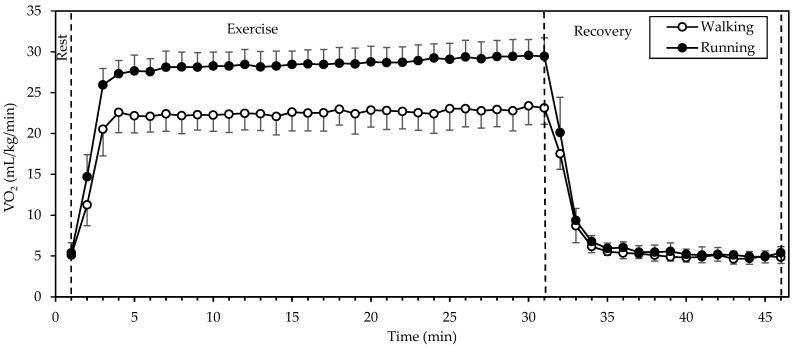
- V̇O2 was higher during running by 27 ± 10% (22.6 ± 2.1 vs. 28.6 ± 1.8 mL/kg/min during stable exercise), and energy expenditure was higher by 27 ± 11% (6.9 ± 0.7 vs. 8.7 ± 0.5 kcal/kg/h).
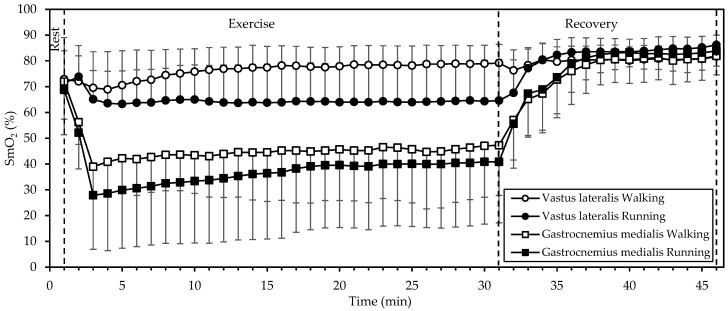
- SmO2 was lower during running than walking (p = 0.045, η2 = 0.374), averaging 64% vs. 76% in vastus lateralis and 37% vs. 45% in gastrocnemius medialis; SmO2 was also lower in gastrocnemius medialis than vastus lateralis and lower during exercise than rest/recovery.
- Blood lactate increased during exercise (averaging 1.8 mmol/L) compared with rest and recovery (both p < 0.05) but did not differ between gait modes; average RER did not differ between walking and running (0.881 ± 0.028, p = 0.783).
Methods
- Ten young, healthy males aged 21–26 years completed 30 min of walking and 30 min of running at 7 km/h on a treadmill in random, counterbalanced order, with a 15 min interval between tests.
- SmO2 and total hemoglobin were monitored continuously with Moxy devices on the vastus lateralis and gastrocnemius medialis; heart rate and respiratory gases were monitored continuously, and blood lactate was measured at rest, at the end of each exercise, and after 15 min of recovery.
- Data were analyzed by two-way (gait mode × time) or three-way (gait mode × muscle × time) ANOVA, with paired t tests for average RER and energy expenditure; significance was set at p = 0.05, and partial η2 was used for effect sizes. An interim power analysis yielded a required sample size of 7 for power 0.8 and 9 for power 0.95.
Limitations
- The paper states that findings are delimited by inclusion of male, healthy, fit, and normal-weight participants and cannot be generalized to females, patients with chronic diseases, unfit individuals, or overweight/obese persons.
- The paper also notes that female participants could not be included in sufficient numbers mainly because subcutaneous fat thickness at the vastus lateralis and/or gastrocnemius medialis exceeded the 12 mm limit for valid SmO2 recordings in most female volunteers.
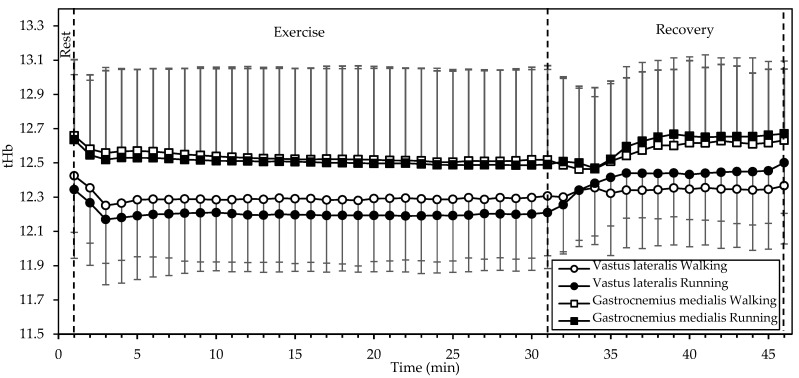
- Evident from the text: the sample was small (n = 10), only one speed (7 km/h) was tested, and no warm-up was included; order effects were found for RER and vastus lateralis tHb (both p < 0.001), with RER higher in the first gait mode (0.90 ± 0.03 vs. 0.86 ± 0.03) and tHb lower in the first gait mode (12.03 ± 0.42 vs. 12.13 ± 0.40).
Model-written summary. Check it against the paper before relying on it.
Integrity signals
Registry
Cites
Statistics
Figures
Verification
Claims the paper makes
6 Valid · 1 Not valid · 13 Not checked · 50 Own results and interpretations
The cited sources support only part of this claim — read each source’s verdict below.
In the paper
“a prospective study with 47,453 participants demonstrated greater weight loss from running than walking the same distance daily [16].”
§ A Comparison of Leg Muscle Oxygenation, Cardiorespiratory Responses, and Blood Lactate between Walking and Running at the Same Speed > 4. Discussion
What the sources say
- Partly supportedcites [16] Williams P.T. Greater Weight Loss from Running than Walking during a 6.2-Yr Prospective Follow-Up Med. Sci. Sports Exerc. 2013 45 706 713 10.1249/MSS.0b013e31827b0d0a 23190592 PMC4067491 sourceExperimental — accuracy not yet measured
The Abstract Methods report 15,237 walkers and 32,216 runners, totaling 47,453, surveyed 6.2 years apart. The Abstract Results find a stronger association between changes in running and BMI than between changes in walking and BMI in men and heavier women. The comparison is per change in energy expenditure, not between people running and walking the same distance daily; the observational study also does not establish that running caused greater weight loss. (LLM, conf=0.89)
boostedstates a causen = 47,453- Asserted: passes — The authors put it forward as true.
- Checkable: passes — It can be checked against evidence.
- Load-bearing: unclear — It is unclear whether the paper’s conclusions depend on it.
- Based: passes — The paper gives a reason why it holds.
- Partly supported
The cited sources support only part of this claim — read each source’s verdict below.
In the paper
“between walking and running at a comfortable speed for both gait modes, which, according to the aforementioned [5,6] and other studies (e.g., Ref. [10]), is around 7 km/h.”
§ A Comparison of Leg Muscle Oxygenation, Cardiorespiratory Responses, and Blood Lactate between Walking and Running at the Same Speed > 1. Introduction
What the sources say
- Not checked — no full text of the sourcecites [5] Hiroyuki H. Hamaoka T. Sako T. Nishio S. Ryotaro K. Murakami M. Katsumura T. Oxygenation in Vastus Lateralis and Lateral Head of Gastrocnemius during Treadmill Walking and Running in Humans Eur. J. Appl. Physiol. 2002 87 343 349 10.1007/s00421-002-0644-y 12172872 source
- Not checked — no full text of the sourcecites [6] Lee S.M.C. Clarke M.S.F. O’Connor D.P. Stroud L. Ellerby G.E.C. Soller B.R. Near Infrared Spectroscopy-Derived Interstitial Hydrogen Ion Concentration and Tissue Oxygen Saturation during Ambulation Eur. J. Appl. Physiol. 2011 111 1705 1714 10.1007/s00421-010-1797-8 21212975 source
- Partly supportedcites [10] Neptune R.R. Sasaki K. Ankle Plantar Flexor Force Production Is an Important Determinant of the Preferred Walk-to-Run Transition Speed J. Exp. Biol. 2005 208 799 808 10.1242/jeb.01435 15755878 sourceExperimental — accuracy not yet measured
The Abstract places the preferred walk-to-run transition near 2 m/s, and the Experimental analysis reports a group average of 1.96 m/s—about 7 km/h. Neither passage establishes that this speed is comfortable for both walking and running. (LLM, conf=0.87)
plain- Asserted: passes — The authors put it forward as true.
- Checkable: passes — It can be checked against evidence.
- Load-bearing: passes — The paper’s conclusions depend on it.
- Based: passes — The paper gives a reason why it holds.
A result the paper reports from its own data — it cites no other source for it, so there is none to check. The quote shows it is in the paper.
In the paper
“During exercise, SmO2 remained relatively stable in the VL.”
§ A Comparison of Leg Muscle Oxygenation, Cardiorespiratory Responses, and Blood Lactate between Walking and Running at the Same Speed > 3. Results > 3.4. Muscle Oxygenation
plain- Asserted: passes — The authors put it forward as true.
- Checkable: passes — It can be checked against evidence.
- Load-bearing: unclear — It is unclear whether the paper’s conclusions depend on it.
- Based: passes — The paper gives a reason why it holds.
A result the paper reports from its own data — it cites no other source for it, so there is none to check. The quote shows it is in the paper.
In the paper
“and was 0.881 ± 0.028.”
§ A Comparison of Leg Muscle Oxygenation, Cardiorespiratory Responses, and Blood Lactate between Walking and Running at the Same Speed > 3. Results > 3.3. Respiratory Parameters and Energy Expenditure
plain- Asserted: passes — The authors put it forward as true.
- Checkable: passes — It can be checked against evidence.
- Load-bearing: unclear — It is unclear whether the paper’s conclusions depend on it.
- Based: passes — The paper gives a reason why it holds.
A result the paper reports from its own data — it cites no other source for it, so there is none to check. The quote shows it is in the paper.
In the paper
“V˙O2 during running was higher by 27 ± 10%, as compared to walking.”
§ A Comparison of Leg Muscle Oxygenation, Cardiorespiratory Responses, and Blood Lactate between Walking and Running at the Same Speed > 3. Results > 3.3. Respiratory Parameters and Energy Expenditure
plain- Asserted: passes — The authors put it forward as true.
- Checkable: passes — It can be checked against evidence.
- Load-bearing: passes — The paper’s conclusions depend on it.
- Based: passes — The paper gives a reason why it holds.
33 more claims
Create a free account to see all 70 claims and to verify the 1 reference still open.
- It may state two separate claims as one. 23
- Probably not a substantial claim. 13
Citations
Cites
Data on the distribution of fibre types in thirty-six human muscles
Johnson, M. A., Polgar, J., Weightman, D., & Appleton, D. (1973) · Journal of the Neurological Sciences · doi:10.1016/0022-510x(73)90023-3 · Cited by 2,200 · cited 1×
“Johnson et al., [20] in an autopsy study, found that the GM had more type I fibers (50.8”
BackgroundInfluentialMotor Patterns in Human Walking and Running
Cappellini, G., Ivanenko, Y. P., Poppele, R. E., & Lacquaniti, F. (2006) · Journal of Neurophysiology · doi:10.1152/jn.00081.2006 · Cited by 798 · cited 2×
“Additionally, biomechanical differences [8,17], and differences in the timing of muscle activation between gait types [9] may play a role.”
BackgroundResultMargaria, R., Cerretelli, P., Aghemo, P., & Sassi, G. (1963) · Journal of Applied Physiology · doi:10.1152/jappl.1963.18.2.367 · Cited by 666
Longitudinal Modeling of the Relationship between Age and Maximal Heart Rate
GELLISH, R. L., GOSLIN, B. R., OLSON, R. E., McDONALD, A., RUSSI, G. D., & MOUDGIL, V. K. (2007) · Medicine & Science in Sports & Exercise · doi:10.1097/mss.0b013e31803349c6 · Cited by 660 · cited 1×
“Walking was performed at 68 ± 5% of the predicted maximal HR (HRmax), that is, 207 − 0.7 × age [13], while running was performed at 75 ± 7% of HRmax.”
MethodInfluentialMuscle Fibre Type Populations of Human Leg Muscles
Edgerton, V. R., Smith, J. L., & Simpson, D. R. (1975) · The Histochemical Journal · doi:10.1007/bf01003594 · Cited by 494 · cited 1×
“Similarly, Edgerton et al. [21] found that the GM and VL contained about 50% and 32% slow twitch fibers, respectively.”
MethodExternal, Internal and Total Work in Human Locomotion
Willems, P. A., Cavagna, G. A., & Heglund, N. C. (1995) · Journal of Experimental Biology · doi:10.1242/jeb.198.2.379 · Cited by 405
Exercise in the management of obesity
Petridou, A., Siopi, A., & Mougios, V. (2019) · Metabolism · doi:10.1016/j.metabol.2018.10.009 · Cited by 317 · cited 1×
“Thus, preferring running over walking at the same speed may be useful in weight management, as increased energy expenditure is the primary way in which exercise fights obesity [15].”
BackgroundSelf-citationMuscle Oximetry in Sports Science: A Systematic Review
Perrey, S., & Ferrari, M. (2018) · Sports Medicine · doi:10.1007/s40279-017-0820-1 · Cited by 220 · cited 1×
“SmO 2 is being increasingly measured in exercise as a non-invasive index of muscle metabolism thanks to the development of small wearable devices that use near-infrared spectroscopy to distinguish between oxygenated and deoxygenated heme [1].”
BackgroundNeptune, R. R., & Sasaki, K. (2005) · Journal of Experimental Biology · doi:10.1242/jeb.01435 · Cited by 195 · cited 1×
“[10]), is around 7 km/h.”
Differences in muscle function during walking and running at the same speed
Sasaki, K., & Neptune, R. R. (2006) · Journal of Biomechanics · doi:10.1016/j.jbiomech.2005.06.019 · Cited by 194
Cited by
Sex-Based Differences at Ventilatory Thresholds in Trained Runners
Rodríguez‐Barbero, S., Alda-Blanco, A., Salinero, J. J., & González‐Mohíno, F. (2025) · Applied Sciences · doi:10.3390/app15168843 · Cited by 3
Suicmez, S., Yazıcı, G., Altıparmak, T., Cagatay, C., Çağlayan, H. Z. B., & Nazlıel, B. (2025) · Topics in Stroke Rehabilitation · doi:10.1080/10749357.2025.2538520 · Cited by 1
A comparative study of lactate threshold testing outcomes: walking vs. running
Larssen, T., GLESAAEN, O. J., Bruusgaard, J. C., Strand, M. F., Kalhovde, J. M., Tønnessen, E., & Haugen, T. A. (2025) · The Journal of Sports Medicine and Physical Fitness · doi:10.23736/s0022-4707.25.17054-0
Lee, H., & Yang, D. (2026) · Archives of Orthopedic and Sports Physical Therapy · doi:10.24332/aospt.2026.22.1.06
Ionescu, G., Piele, D., Geambesa, M., Rusu, M. R., Rusu, L., Marin, M., & Buciu, G. (2026) · Research Square · doi:10.21203/rs.3.rs-10779556/v1
Yang, D.-J., Lee, H.-S., & Jung, H.-S. (2026) · Hong Kong Physiotherapy Journal · doi:10.1142/s101370252750003x
Metadata
- Authors
- Stathopoulos, A., Petridou, A., Kantouris, N., & Mougios, V.
- Affiliations
- Aristotle University of Thessaloniki (GR)
- Corresponding author
- Petridou, Anatoli
- Venue
- Sports
- Publisher
- MDPI AG
- Published
- 2024-02-01
- Volume
- 12
- Issue
- 2
- Pages
- 48
- ISSN
- 2075-4663 (ISSN-L)
- PMC
- PMC10893470
- OpenAlex
- W4391449822
- Semantic Scholar
- 6f1e8629330b0b25256aa36cda197d518214b77e
- Cited by
- 10
- References
- 23
- Citations by year
- 2026: 7 · 2025: 3
- FWCI
- 2.00
- Type
- journal article
- Language
- en
- Open access
- gold
- doi.org
- Licence
- Locations
- Sports (publishedVersion, cc-by)
- Research Square (submittedVersion, cc-by)
- PubMed Central (publishedVersion, cc-by)
- PubMed (publishedVersion)
- DOAJ (DOAJ: Directory of Open Access Journals) (submittedVersion, cc-by-sa)
- Funders
- Aristotle University of Thessaloniki
- Topics
- Health Sciences › Medicine › Physiology (medical) › Cardiovascular and exercise physiology
- Health Sciences › Medicine › Orthopedics and Sports Medicine › Sports Performance and Training
- Health Sciences › Medicine › Physiology (medical) › Exercise and Physiological Responses
- Keywords
- walking, running, muscle oxygenation, muscle oxygen saturation, vastus lateralis, medial gastrocnemius, blood lactate, heart rate, oxygen consumption, cardiorespiratory responses, internal load, exercise speed, recovery
About these checks
Registry, retraction, Cites and statistics results are computed, not judged, with one exception: a printed reference that no index lists is read once by a model before it counts as a citation error. Claims are extracted by a model and kept only when their quote appears verbatim in the text; each cited source is then checked, with a model’s help, for whether it says what the claim relies on. Those verdicts can be wrong — read the claim’s quote and the cited source before relying on one.
The claim verdicts this report counts are experimental: their accuracy is not yet measured.
A language model drew the claims from the paper on 2026-10-13, under version 3 of the claim definition (model deepseek-v4.1-flash, prompt extract-v3).
A second model labelled each claim on 2026-10-13 (model jev-1.13-20260917, definition revision gold-guideline-v0.2).
Cited sources are checked with a language model’s help (gpt-6-sol).
Statistics and arithmetic are recomputed, not judged.
Confidence bands are shown only for fields calibrated on our annotated test set. None is calibrated yet, so no band is shown.
What counts as a claim ›How we measure confidence ›How we check this ›
Are you an author, or do you see a problem with this page? Request a review
Data sources
Bibliographic data: Semantic Scholar, OpenAlex, Crossref.
Contains information from the Semantic Scholar Academic Graph Datasets, made available under the ODC Attribution License (ODC-BY 1.0).
Semantic Scholar’s data is described in: Kinney, R., et al. (2023). The Semantic Scholar Open Data Platform. arXiv:2301.10140.
