

The DOI matches its Crossref record; 46 of the 46 references it cites were found in a registry or an index.
LSTM-Based Model Predictive Control for Optimal Temperature Set-Point Planning
Open accessAbstract
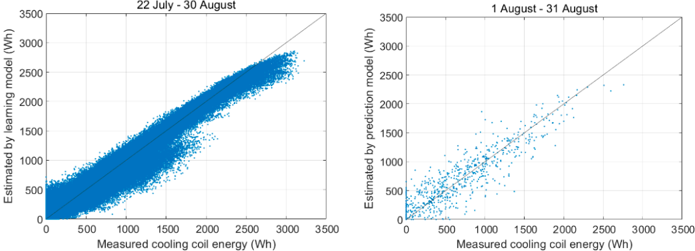
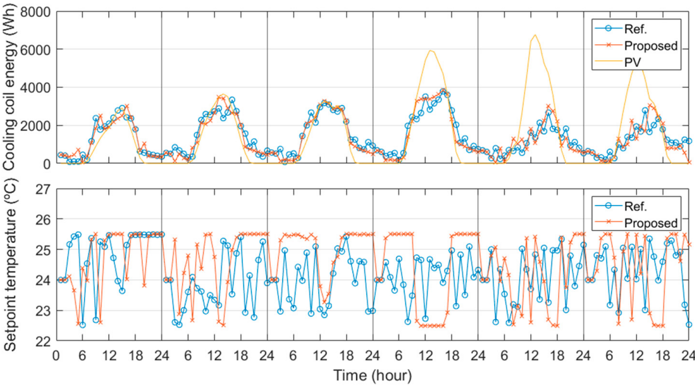
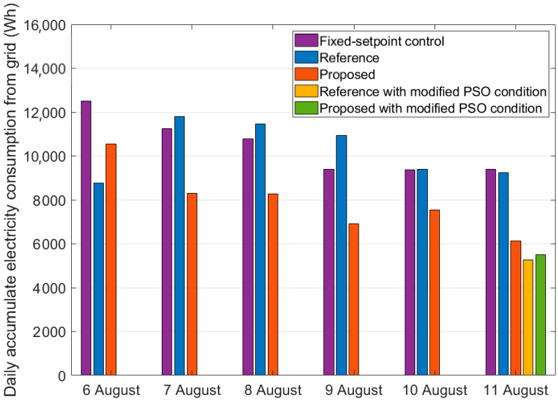
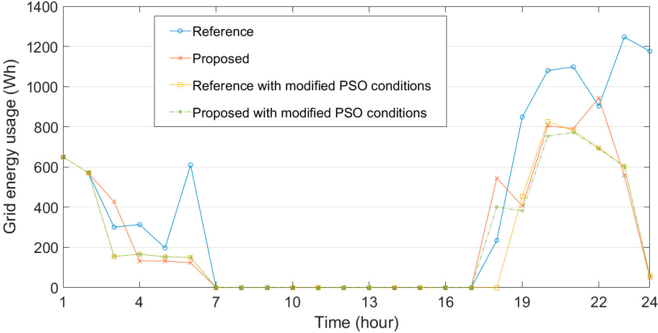
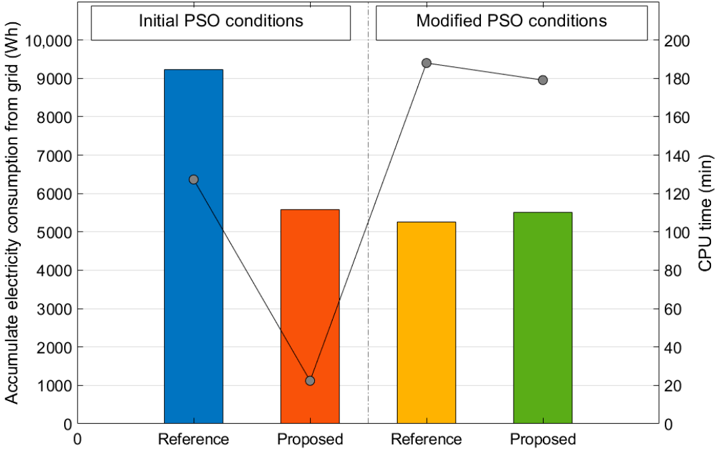
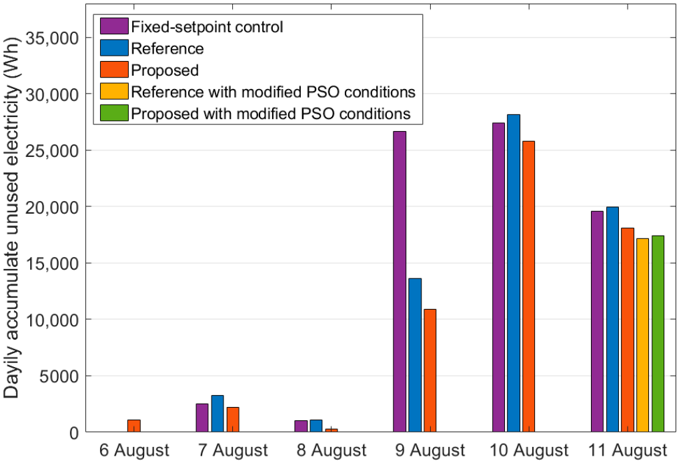
The growing interest in saving building energy has increasingly motivated studies on model predictive control (MPC), where system operation proceeds according to a planned operation strategy. Data-driven models that perform learning using past operation data of buildings are favorable for MPC applications owing to their fast computation speed. However, it is difficult to apply MPC to buildings with insufficient operation data, as the prediction accuracy varies depending on the data used for learning. To address this, we propose a method that involves generating data through a detailed building energy model and utilizing a long short-term memory (LSTM) network that performs learning using the data as an MPC model. The model was verified through a comparison with the reference model using the same optimization algorithm. In the MPC of the objective function, which is to reduce electrical energy expenditure by optimizing the indoor temperature of the target building, approximately 35% grid energy consumption was reduced compared to a reference case, by increasing self-consumption of photovoltaic (PV) energy and avoiding PV curtailment. Further, the required computation time was reduced to approximately 30%, even including the data generation time for daily learning, thereby confirming the feasibility of the MPC model that employs LSTM.
Overview
The claims and statistics of this paper haven’t been checked yet.
Free: it reads the open-access text and checks the first 5 claims that cite a source we can check. Create a free account to check every claim.
Integrity signals
Registry
Cites
Statistics
Figures

Verification
Claims the paper makes
The claims and statistics of this paper haven’t been checked yet.
Free: it reads the open-access text and checks the first 5 claims that cite a source we can check. Create a free account to check every claim.
Claims other papers make about this one
Each is checked against this paper’s own text: does it say what the citing paper says it does?
The source backs part of the claim, not all of it — or backs it for a different population, condition or comparison.
In the citing paper
“Studies have shown that MPC can reduce building energy consumption by 15~40% [11,12].”
From Research on Energy-Saving Optimization of Mushroom Growing Control Room Based on Neural Network Model Predictive Control (2025) · cites this paper as [11]
Experimental — accuracy not yet measuredThe source backs part of the claim, not all of it — or backs it for a different population, condition or comparison.
In the citing paper
“Model predictive control (MPC) is widely used in the field of commercial building energy efficiency due to its advantages of good control effect, strong robustness, and fast response speed [2][3][4].”
From Energy-Saving Control Method for Factory Mushroom Room Air Conditioning Based on MPC (2023) · cites this paper as [3]
Experimental — accuracy not yet measuredThe cited source says what the claim attributes to it.
In the citing paper
“Jeon proposed a building energy model based on long short-term memory (LSTM).Compared with the reference model, the proposed model can reduce the daily average power grid energy consumption by about 30% most of the time [3].”
From Energy-Saving Control Method for Factory Mushroom Room Air Conditioning Based on MPC (2023) · cites this paper as [3]
Self-check
Percentages, sums and reported differences re-computed from the paper’s own numbers.
The self-check needs the paper’s full text.
Citations
Cites
Hochreiter, S., & Schmidhuber, J. (1997) · Neural Computation · doi:10.1162/neco.1997.9.8.1735 · Cited by 102,318 · cited 1×
“Among them, long short-term memory (LSTM) models based on recurrent neural networks are known to be favorable for learning data with time-series characteristics or sequences [34,35].”
BackgroundAdam: A Method for Stochastic Optimization
Kingma, D. P., & Ba, J. (2014) · arXiv · doi:10.48550/arxiv.1412.6980 · Cited by 98,946 · cited 1×
“The set values of the parameters were determined based on the values recommended by MATLAB and previous studies [39,40].”
MethodKennedy, J., & Eberhart, R. (2002) · Proceedings of ICNN'95 - International Conference on Neural Networks · doi:10.1109/icnn.1995.488968 · Cited by 58,192
Particle swarm optimization: An overview
Poli, R., Kennedy, J., & Blackwell, T. (2007) · Swarm Intelligence · doi:10.1007/s11721-007-0002-0 · Cited by 21,101
Bidirectional recurrent neural networks
Schuster, M., & Paliwal, K. K. (1997) · IEEE Transactions on Signal Processing · doi:10.1109/78.650093 · Cited by 10,172 · cited 1×
“Among them, long short-term memory (LSTM) models based on recurrent neural networks are known to be favorable for learning data with time-series characteristics or sequences [34,35].”
BackgroundElectricity price forecasting: A review of the state-of-the-art with a look into the future
Weron, R. (2014) · International Journal of Forecasting · doi:10.1016/j.ijforecast.2014.08.008 · Cited by 1,646 · cited 1×
“Weron [25] compared and analyzed building energy demand prediction models based on various methodologies and reported that data-driven models yielded the best prediction performance in the test environment.”
ResultPredicting residential energy consumption using CNN-LSTM neural networks
Kim, T.-Y., & Cho, S.-B. (2019) · Energy · doi:10.1016/j.energy.2019.05.230 · Cited by 1,469
Theory and applications of HVAC control systems – A review of model predictive control (MPC)
Afram, A., & Janabi-Sharifi, F. (2014) · Building and Environment · doi:10.1016/j.buildenv.2013.11.016 · Cited by 1,310
A Comprehensive Survey on Particle Swarm Optimization Algorithm and Its Applications
Zhang, Y., Wang, S., & Ji, G. (2015) · Mathematical Problems in Engineering · doi:10.1155/2015/931256 · Cited by 1,146 · cited 1×
“[43], PSO is one of the most commonly used optimization algorithms.”
MethodTwo-Dimensional Boron Monolayer Sheets
Wu, X., Dai, J., Zhao, Y., Zhuo, Z., Yang, J., & Zeng, X. C. (2012) · ACS Nano · doi:10.1021/nn302696v · Cited by 890 · cited 1×
“It has been widely applied in numerous areas, owing to its simple algorithm and short computation time [44,45].”
Background
Cited by
Zarzycki, K., & Ławryńczuk, M. (2021) · Sensors · doi:10.3390/s21165625 · Cited by 155
“Examples are: a benchmark process [38], a pH reactor [39], a reverse osmosis plant [40], temperature control [41] or an autonomous mobility-on-demand system [42].”
BackgroundAdvanced predictive control for GRU and LSTM networks
Zarzycki, K., & Ławryńczuk, M. (2022) · Information Sciences · doi:10.1016/j.ins.2022.10.078 · Cited by 150
LSTM and GRU type recurrent neural networks in model predictive control: A Review
Ławryńczuk, M., & Zarzycki, K. (2025) · Neurocomputing · doi:10.1016/j.neucom.2025.129712 · Cited by 176
Mahanty, B. (2023) · Biotechnology and Bioengineering · doi:10.1002/bit.28503 · Cited by 76
Model Predictive Control when utilizing LSTM as dynamic models
Jung, M., Mendes, P. R. D. C., Önnheim, M., & Gustavsson, E. (2023) · Engineering Applications of Artificial Intelligence · doi:10.1016/j.engappai.2023.106226 · Cited by 78
Metadata
- Authors
- Jeon, B.-K., & Kim, E.-J.
- Affiliations
- Inha University (KR)
- Corresponding author
- Kim, Eui-Jong
- Venue
- Sustainability
- Publisher
- MDPI AG
- Published
- 2021-01-17
- Volume
- 13
- Issue
- 2
- Pages
- 894
- ISSN
- 2071-1050 (ISSN-L)
- OpenAlex
- W3122065728
- Cited by
- 55
- References
- 46
- Citations by year
- 2026: 10 · 2025: 12 · 2024: 8 · 2023: 11 · 2022: 11 · 2021: 3
- FWCI
- 3.78
- Type
- journal article
- Language
- en
- Open access
- gold
- doi.org
- Licence
- Locations
- Sustainability (publishedVersion, cc-by)
- RePEc: Research Papers in Economics (submittedVersion)
- DOAJ (DOAJ: Directory of Open Access Journals) (submittedVersion, cc-by-sa)
- Funders
- Korea Institute of Energy Technology Evaluation and Planning (2019271010015D)
- Topics
- Physical Sciences › Engineering › Building and Construction › Building Energy and Comfort Optimization
- Physical Sciences › Engineering › Control and Systems Engineering › Advanced Control Systems Optimization
- Physical Sciences › Engineering › Electrical and Electronic Engineering › Integrated Energy Systems Optimization
- Keywords
- model predictive control, long short-term memory networks, building energy management, photovoltaic self-consumption, photovoltaic curtailment, building energy simulation, indoor temperature control
About these checks
Registry, retraction, Cites and statistics results are computed, not judged, with one exception: a printed reference that no index lists is read once by a model before it counts as a citation error. Claims are extracted by a model and kept only when their quote appears verbatim in the text; each cited source is then checked, with a model’s help, for whether it says what the claim relies on. Those verdicts can be wrong — read the claim’s quote and the cited source before relying on one.
Statistics and arithmetic are recomputed, not judged.
Confidence bands are shown only for fields calibrated on our annotated test set. None is calibrated yet, so no band is shown.
What counts as a claim ›How we measure confidence ›How we check this ›
Are you an author, or do you see a problem with this page? Request a review
How to cite
Cite CoChat for the checks on this page, and the paper for its own findings.
- This page
- CoChat. (2026). Citation check: LSTM-Based Model Predictive Control for Optimal Temperature Set-Point Planning. https://app.cochat.ai/papers/10.3390/su13020894
- The paper
- Jeon, B.-K., & Kim, E.-J. (2021). LSTM-Based Model Predictive Control for Optimal Temperature Set-Point Planning. Sustainability. https://doi.org/10.3390/su13020894
Data sources
Bibliographic data: Semantic Scholar, OpenAlex, Crossref.
Contains information from the Semantic Scholar Academic Graph Datasets, made available under the ODC Attribution License (ODC-BY 1.0).
Semantic Scholar’s data is described in: Kinney, R., et al. (2023). The Semantic Scholar Open Data Platform. arXiv:2301.10140.
