

LSTM-Based Model Predictive Control for Optimal Temperature Set-Point Planning
Open accessThe DOI matches its Crossref record; 46 of the 46 references it cites were found in a registry or an index.
Abstract
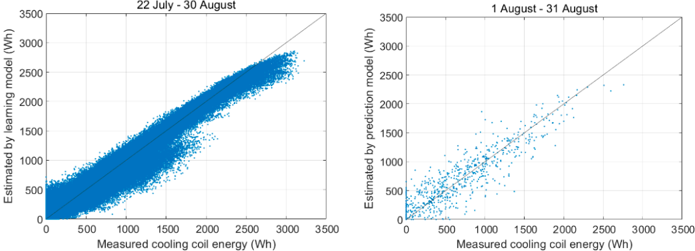
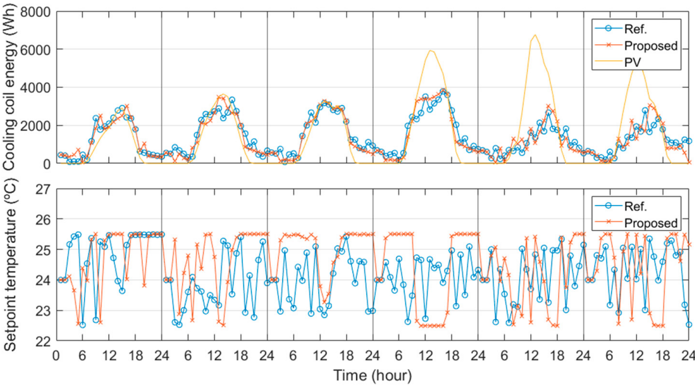
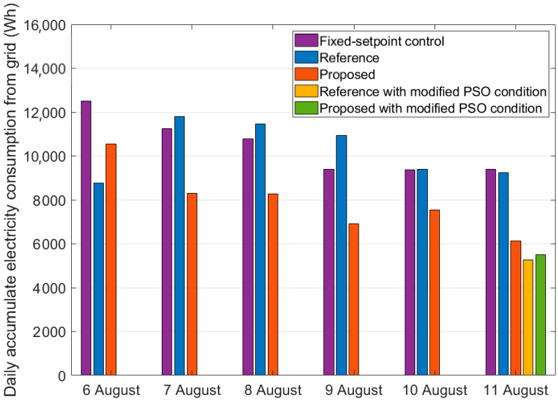
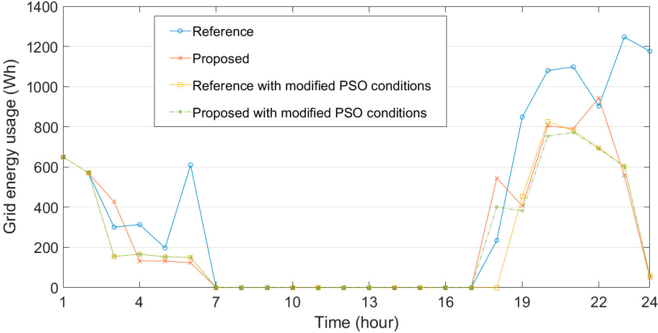
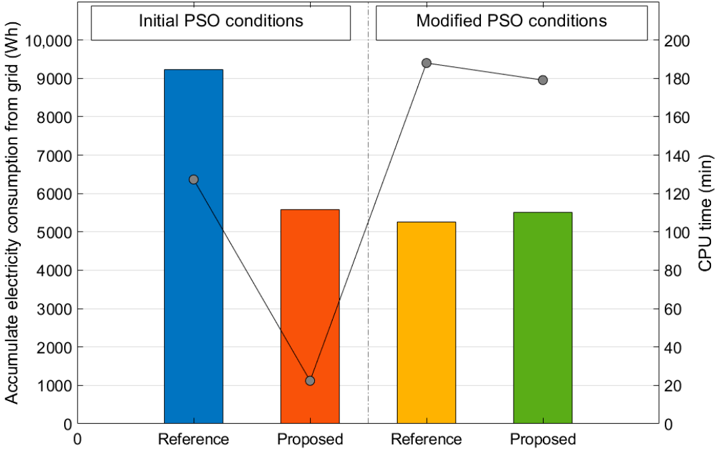
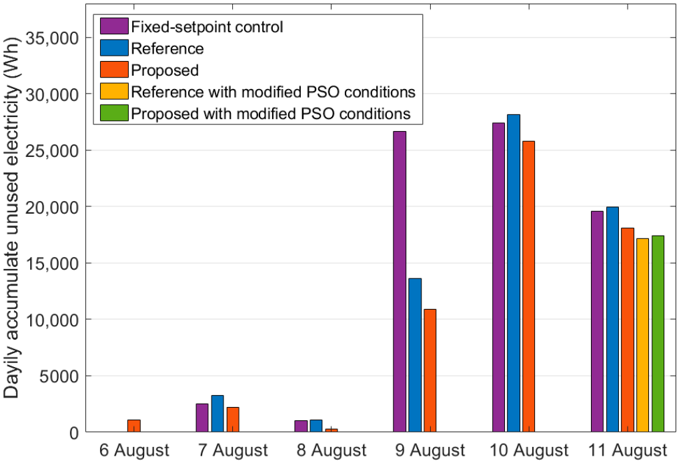
The growing interest in saving building energy has increasingly motivated studies on model predictive control (MPC), where system operation proceeds according to a planned operation strategy. Data-driven models that perform learning using past operation data of buildings are favorable for MPC applications owing to their fast computation speed. However, it is difficult to apply MPC to buildings with insufficient operation data, as the prediction accuracy varies depending on the data used for learning. To address this, we propose a method that involves generating data through a detailed building energy model and utilizing a long short-term memory (LSTM) network that performs learning using the data as an MPC model. The model was verified through a comparison with the reference model using the same optimization algorithm. In the MPC of the objective function, which is to reduce electrical energy expenditure by optimizing the indoor temperature of the target building, approximately 35% grid energy consumption was reduced compared to a reference case, by increasing self-consumption of photovoltaic (PV) energy and avoiding PV curtailment. Further, the required computation time was reduced to approximately 30%, even including the data generation time for daily learning, thereby confirming the feasibility of the MPC model that employs LSTM.
Overview
The claims and statistics of this paper haven’t been checked yet.
Free: it reads the open-access text and checks the first 5 claims that cite a source we can check. Create a free account to check every claim.
Integrity signals
Registry
Cites
Statistics
Figures

Verification
Claims the paper makes
The claims and statistics of this paper haven’t been checked yet.
Free: it reads the open-access text and checks the first 5 claims that cite a source we can check. Create a free account to check every claim.
Claims other papers make about this one
Each is checked against this paper’s own text: does it say what the citing paper says it does?
The source backs part of the claim, not all of it — or backs it for a different population, condition or comparison.
In the citing paper
“Studies have shown that MPC can reduce building energy consumption by 15~40% [11,12].”
From Research on Energy-Saving Optimization of Mushroom Growing Control Room Based on Neural Network Model Predictive Control (2025) · cites this paper as [11]
Experimental — accuracy not yet measuredThe source backs part of the claim, not all of it — or backs it for a different population, condition or comparison.
In the citing paper
“Model predictive control (MPC) is widely used in the field of commercial building energy efficiency due to its advantages of good control effect, strong robustness, and fast response speed [2][3][4].”
From Energy-Saving Control Method for Factory Mushroom Room Air Conditioning Based on MPC (2023) · cites this paper as [3]
Experimental — accuracy not yet measuredThe cited source says what the claim attributes to it.
In the citing paper
“Jeon proposed a building energy model based on long short-term memory (LSTM).Compared with the reference model, the proposed model can reduce the daily average power grid energy consumption by about 30% most of the time [3].”
From Energy-Saving Control Method for Factory Mushroom Room Air Conditioning Based on MPC (2023) · cites this paper as [3]
Self-check
Percentages, sums and reported differences re-computed from the paper’s own numbers.
The self-check needs the paper’s full text.
Citations
Cites
Hochreiter, S., & Schmidhuber, J. (1997) · Neural Computation · doi:10.1162/neco.1997.9.8.1735 · Cited by 102,318 · cited 1×
“Among them, long short-term memory (LSTM) models based on recurrent neural networks are known to be favorable for learning data with time-series characteristics or sequences [34,35].”
BackgroundAdam: A Method for Stochastic Optimization
Kingma, D. P., & Ba, J. (2014) · arXiv · doi:10.48550/arxiv.1412.6980 · Cited by 98,946 · cited 1×
“The set values of the parameters were determined based on the values recommended by MATLAB and previous studies [39,40].”
MethodKennedy, J., & Eberhart, R. (2002) · Proceedings of ICNN'95 - International Conference on Neural Networks · doi:10.1109/icnn.1995.488968 · Cited by 58,192
Particle swarm optimization: An overview
Poli, R., Kennedy, J., & Blackwell, T. (2007) · Swarm Intelligence · doi:10.1007/s11721-007-0002-0 · Cited by 21,101
Bidirectional recurrent neural networks
Schuster, M., & Paliwal, K. K. (1997) · IEEE Transactions on Signal Processing · doi:10.1109/78.650093 · Cited by 10,172 · cited 1×
“Among them, long short-term memory (LSTM) models based on recurrent neural networks are known to be favorable for learning data with time-series characteristics or sequences [34,35].”
BackgroundElectricity price forecasting: A review of the state-of-the-art with a look into the future
Weron, R. (2014) · International Journal of Forecasting · doi:10.1016/j.ijforecast.2014.08.008 · Cited by 1,646 · cited 1×
“Weron [25] compared and analyzed building energy demand prediction models based on various methodologies and reported that data-driven models yielded the best prediction performance in the test environment.”
ResultPredicting residential energy consumption using CNN-LSTM neural networks
Kim, T.-Y., & Cho, S.-B. (2019) · Energy · doi:10.1016/j.energy.2019.05.230 · Cited by 1,469
Theory and applications of HVAC control systems – A review of model predictive control (MPC)
Afram, A., & Janabi-Sharifi, F. (2014) · Building and Environment · doi:10.1016/j.buildenv.2013.11.016 · Cited by 1,310
A Comprehensive Survey on Particle Swarm Optimization Algorithm and Its Applications
Zhang, Y., Wang, S., & Ji, G. (2015) · Mathematical Problems in Engineering · doi:10.1155/2015/931256 · Cited by 1,146 · cited 1×
“[43], PSO is one of the most commonly used optimization algorithms.”
MethodTwo-Dimensional Boron Monolayer Sheets
Wu, X., Dai, J., Zhao, Y., Zhuo, Z., Yang, J., & Zeng, X. C. (2012) · ACS Nano · doi:10.1021/nn302696v · Cited by 890 · cited 1×
“It has been widely applied in numerous areas, owing to its simple algorithm and short computation time [44,45].”
Background
Cited by
Zarzycki, K., & Ławryńczuk, M. (2021) · Sensors · doi:10.3390/s21165625 · Cited by 155
“Examples are: a benchmark process [38], a pH reactor [39], a reverse osmosis plant [40], temperature control [41] or an autonomous mobility-on-demand system [42].”
BackgroundAdvanced predictive control for GRU and LSTM networks
Zarzycki, K., & Ławryńczuk, M. (2022) · Information Sciences · doi:10.1016/j.ins.2022.10.078 · Cited by 150
LSTM and GRU type recurrent neural networks in model predictive control: A Review
Ławryńczuk, M., & Zarzycki, K. (2025) · Neurocomputing · doi:10.1016/j.neucom.2025.129712 · Cited by 176
Mahanty, B. (2023) · Biotechnology and Bioengineering · doi:10.1002/bit.28503 · Cited by 80
Model Predictive Control when utilizing LSTM as dynamic models
Jung, M., Mendes, P. R. D. C., Önnheim, M., & Gustavsson, E. (2023) · Engineering Applications of Artificial Intelligence · doi:10.1016/j.engappai.2023.106226 · Cited by 78
Vivian, J., Prataviera, E., Gastaldello, N., & Zarrella, A. (2024) · Journal of Building Engineering · doi:10.1016/j.jobe.2024.108583 · Cited by 65
Schwedersky, B. B., & Flesch, R. C. C. (2022) · Engineering Applications of Artificial Intelligence · doi:10.1016/j.engappai.2022.105247 · Cited by 44
Shah, P., Choi, H., & Kwon, J. S. (2023) · Processes · doi:10.3390/pr11030809 · Cited by 43
A predictive control approach for thermal energy management in buildings
Berouine, A., Ouladsine, R., Bakhouya, M., & Essaaidi, M. (2022) · Energy Reports · doi:10.1016/j.egyr.2022.07.037 · Cited by 41
Prediction of air pollutant concentrations based on the long short-term memory neural network
Wu, Z., Tian, Y., Li, M., Wang, B., Quan, Y., & Liu, J. (2024) · Journal of Hazardous Materials · doi:10.1016/j.jhazmat.2023.133099 · Cited by 35
Fast machine learning for building management systems
Mshragi, M., & Petri, I. (2025) · Artificial Intelligence Review · doi:10.1007/s10462-025-11226-6 · Cited by 32
“A variety of studies (Tukymbekov et al. 2021 ; Jeon and Kim 2021 ; Jang et al. 2022 ; Karijadi and Chou 2022 ; Durand et al. 2022 ; Wang et al. 2020 ; Luo and Oyedele 2021 ; Hu et al. 2023 ; Matsu - kawa et al. 2019 ; Zhu et al. 2022 ) further attest to the versatility of LSTM networks-from…”
Gordon, D. C., Norouzi, A., Winkler, A., McNally, J., Nuss, E., Abel, D., Shahbakhti, M., Andert, J., & Koch, C. R. (2022) · Energies · doi:10.3390/en15249335 · Cited by 23
Computationally Efficient Nonlinear Model Predictive Control Using the L1 Cost-Function
Ławryńczuk, M., & Nebeluk, R. (2021) · Sensors · doi:10.3390/s21175835 · Cited by 20
Nonlinear MPC based on elastic autoregressive fuzzy neural network with roasting process application
Liang, H., Yang, C., Li, Y., Sun, B., & Feng, Z. (2023) · Expert Systems with Applications · doi:10.1016/j.eswa.2023.120012 · Cited by 19
White-Model Predictive Control for Balancing Energy Savings and Thermal Comfort
Jeon, B.-K., & Kim, E.-J. (2022) · Energies · doi:10.3390/en15072345 · Cited by 19
Self-citationGordon, D. C., Winkler, A., Bedei, J., Schaber, P., Pischinger, S., Andert, J., & Koch, C. R. (2024) · Proceedings of the ... American Control Conference/Proceedings of the American Control Conference · doi:10.23919/acc60939.2024.10644830 · Cited by 18
“However, traditionally the integration of an LSTM model into a nonlinear Model Predictive Controller (NMPC) has been focused on slow-response applications such as temperature set-point planning for buildings [19].”
BackgroundInvestigation on pre-cooling potential of UFAD via model-based predictive control
Joe, J. (2022) · Energy and Buildings · doi:10.1016/j.enbuild.2022.111898 · Cited by 18
Bayesian LSTM framework for the surrogate modeling of process engineering systems
Mora‐Mariano, D., & Flores‐Tlacuahuac, A. (2023) · Computers & Chemical Engineering · doi:10.1016/j.compchemeng.2023.108553 · Cited by 18
Forgery Cyber-Attack Supported by LSTM Neural Network: An Experimental Case Study
Zarzycki, K., Chaber, P., Cabaj, K., Ławryńczuk, M., Marusak, P. M., Nebeluk, R., Plamowski, S., & Wojtulewicz, A. (2023) · Sensors · doi:10.3390/s23156778 · Cited by 19
“LSTM models can also be successfully implemented in a model predictive control algorithm [35,53,54].”
MethodData-Driven LSTM Model and Predictive Control for Vehicle Lateral Motion
Kim, K. H., Jeong, C., Kim, J., Lee, S., & Kang, C. M. (2024) · Journal of Electrical Engineering and Technology · doi:10.1007/s42835-024-01982-w · Cited by 14
Krayem, H., Younes, J., Ghali, K., Jradi, M., & Ghaddar, N. (2025) · Energy Conversion and Management · doi:10.1016/j.enconman.2025.120880 · Cited by 11
Jia, Y., Li, L., & Gao, L. (2025) · Poultry Science · doi:10.1016/j.psj.2025.104771 · Cited by 10
“Regarding temperature prediction methods, Si et al. (2021), He et al. (2023), Deng et al. (2022), Jeon et al. (2021) used techniques such as CNN, LSTM, GRU, and ATTENTION for indoor temperature prediction.”
Talib, A., Park, S., Im, P., & Joe, J. (2025) · Engineering Applications of Artificial Intelligence · doi:10.1016/j.engappai.2025.110831 · Cited by 10
Energy-Saving Control Method for Factory Mushroom Room Air Conditioning Based on MPC
Wang, M., Zheng, W., Zhao, C., Chen, Y., Chen, C., & Zhang, X. (2023) · Energies · doi:10.3390/en16227623 · Cited by 8
Enhancing University Building Energy Flexibility Performance Using Reinforcement Learning Control
Friansa, K., Pradipta, J., Nanda, R. M., Haq, I. N., Mangkuto, R. A., Iskandar, R. F., Wasesa, M., & Leksono, E. (2024) · IEEE Access · doi:10.1109/access.2024.3512543 · Cited by 8
de Vries, S., Laan, C. M., Bons, P. C., & Heller, R. (2024) · Journal of Building Performance Simulation · doi:10.1080/19401493.2024.2371918 · Cited by 7
“LSTM models were also used to predict cooling energy consumption (Ellis and Chinde 2020; Jeon and Kim 2021) and indoor temperatures under cooling operation (Ellis and Chinde 2020).”
Reservoir computing for system identification and model predictive control
Williams, J. P., Kutz, J. N., & Manohar, K. (2026) · Neural Networks · doi:10.1016/j.neunet.2026.109031 · Cited by 7
Learning-Based Model Predictive Control with Application in Robotic Trajectory Tracking
Zhu, H., Liu, M., & Yu, D. (2023) · IEEE Conference on Decision and Control (CDC) · doi:10.1109/cdc49753.2023.10384110 · Cited by 5
“For example, a LSTM-based MPC controller is designed to optimize the energy consumption of a building in [18].”
BackgroundLSTM-based control of cellulose degree of polymerization in a batch pulp digester
Shah, P., Choi, H., & Kwon, J. S. (2023) · Proceedings of the ... American Control Conference/Proceedings of the American Control Conference · doi:10.23919/acc55779.2023.10156480 · Cited by 5
“Once the training is complete, an LSTM-based model predictive controller (MPC) is designed that is computationally fast and accounts for process constraints [22]–[25].”
MethodSevim, D., Pilatin, M. Y., Ekinci, S., & Akin, E. (2026) · Applied Sciences · doi:10.3390/app16083938 · Cited by 4
Electricity demand flexibility estimation in warehouses using machine learning
Javan, F. D., Avendano, I. A. C., Kaboli, A., Najafi, B., Moazami, A., Perotti, S., & Rinaldi, F. (2024) · Elsevier eBooks · doi:10.1016/b978-0-443-21524-7.00006-2 · Cited by 5
Fast Nonlinear Model Predictive Control Using LSTM Networks: A Model Linearisation Approach
Zarzycki, K., & Ławryńczuk, M. (2022) · Mediterranean Conference on Control and Automation (MED) · doi:10.1109/med54222.2022.9837211 · Cited by 4
Data Enhanced Model Predictive Control of a Coupled Tank System
Scheurenberg, D., Schmerling, K., & Abel, D. (2022) · IEEE/ASME International Conference on Advanced Intelligent Mechatronics · doi:10.1109/aim52237.2022.9863287 · Cited by 4
Explainable artificial intelligence for deep learning-based model predictive controllers
Utama, C., Karg, B., Meske, C., & Lucia, S. (2022) · International Conference on System Theory, Control and Computing (ICSTCC) · doi:10.1109/icstcc55426.2022.9931794 · Cited by 4
“These deep learning-based model predictive controllers (NN-MPCs) have been shown to perform well in various applications, such as minimizing building energy consumption [4], [5], optimizing the output of a concentrated solar power plant [3] and controlling chemical processes [6].”
BackgroundSong, Y., Zheng, W., Guo, G., Wang, M., Luo, C., Chen, C., & Li, Z. (2025) · Energies · doi:10.3390/en18205550 · Cited by 3
Bonci, A., Longarini, L., Longhi, S., Pompei, G., & Prist, M. (2025) · Procedia Computer Science · doi:10.1016/j.procs.2025.01.297 · Cited by 3
Intelligent Model Predictive Control for Boiler Temperature
Tavoosi, J. (2021) · Automatic Control and Computer Sciences · doi:10.3103/s014641162109008x · Cited by 3
“In [9], a good combination of model predictive control method and LSTM neural network has been used to reduce the energy consumption of the building.”
MethodRNN learning controller trained by ADRC
Zhao, Y., Wang, M., Huang, Y., Li, L., & Xie, Y. (2022) · Chinese Control Conference (CCC) · doi:10.23919/ccc55666.2022.9902318 · Cited by 3
Praczyk, T., & Szymkowiak, M. (2024) · Scientific Reports · doi:10.1038/s41598-024-63419-8 · Cited by 2
Çakiroğlu, A., Bayrak, G., & Nurel, A. (2023) · International Congress on Human-Computer Interaction, Optimization and Robotic Applications (ICHORA) · doi:10.1109/hora58378.2023.10156695 · Cited by 2
“In a study aimed at optimizing indoor temperature for energy-saving purposes in building energy, the LSTM algorithm also yielded successful results [17].”
ResultEfficient Data-Driven Model Predictive Control for Demand Response of Commercial Buildings
Paré, M.-C., Dermardiros, V., & Lesage‐Landry, A. (2025) · Annual Conference of the IEEE Industrial Electronics Society (IECON) · doi:10.1109/iecon58223.2025.11221949 · Cited by 2
“We use an LSTM RNN. LSTM have been widely applied to building modelling because of their high accuracy [28].”
Optimization method for energy consumption prediction of campus buildings based on Bayesian theory
Zhao, C. G. (2025) · Journal of Computational Methods in Sciences and Engineering · doi:10.1177/14727978251321733 · Cited by 1
“11 – 13 The in fl uencing factors and mechanisms of users ’ comprehensive EC behavior were studied, with a focus on exploring their internal correlations.”
Model Predictive Sliding Mode Control with Neural Network for UAVs
Jang, S.-H., & Leeghim, H. (2022) · Lecture notes in electrical engineering · doi:10.1007/978-981-19-2635-8_60
Praczyk, T., & Szymkowiak, M. (2024) · SSRN Electronic Journal · doi:10.2139/ssrn.4715288
Application of LSTM model for forecasting production orders
Vereš, P., & Baráth, Z. (2024) · Advanced Logistic Systems - Theory and Practice · doi:10.32971/als.2024.042
An LSTM Based Temperature Control
Antony, J., & Nirdoshi, R. (2025) · Lecture notes in electrical engineering · doi:10.1007/978-3-031-84331-0_87
Data-Driven Predictive Control with Adaptive LSTM Model Update for Continuous Stirred-Tank Reactors
Zhang, Q., Wang, Z., Duan, K., & Liu, P. (2025) · International Conference on Artificial Intelligence, Internet of Things and Cloud Computing Technology (AIoTC) · doi:10.1109/aiotc66747.2025.11198637
“However, existing works still have limitations[4]: (1) LSTM training requires large amounts of labeled data, and online learning may suffer from catastrophic forgetting; (2) the real-time performance of LSTM-MPC is constrained by the computational burden of neural network inference and optimization…”
LSTM-MPC control of thermal management system for high-power fiber-coupled diode lasers
Yan, K., Fang, J., Chen, X., Zhang, C., & Wang, T. (2025) · Measurement Science and Technology · doi:10.1088/1361-6501/ae3099
“Based on the above input − output configuration, the LSTM-related parameters are set and trained to obtain the optimal parameter combination [29].”
Alışveriş merkezindeki dükkânların enerji tüketimininmakine öğrenmesiyle tahmini - Vaka çalışması
Ahbab, N. (2023) · Istanbul Technical University Academic Open Archive (Istanbul Technical University)
A Novel Data-Driven Algorithm for Prediction Horizon Estimation in Model Predictive Control
Jorgovanović, B., Jorgovanović, N., Stanišić, D., & Mejić, L. (2026) · Sensors · doi:10.3390/s26134214
Praczyk, T., Pietrukaniec, L., Wrzesień, M., Szymkowiak, M., & Stalica, J. (2026) · Sensors · doi:10.3390/s26144564
Energy-efficient LSTM-based predictive control for nonlinear systems
Taouil, H., & Zribi, A. (2026) · Transactions of the Institute of Measurement and Control · doi:10.1177/01423312261467462
Akkaya, M., & AKKAYA, S. (2026) · Sustainable Energy Technologies and Assessments · doi:10.1016/j.seta.2026.105225
Hassani, A. A., Bajit, A., Benzzine, H., Bouali, K., Hachmi, R. E., Sahl, S., Melhaoui, M., Srifi, N., & Bouayadi, R. E. (2026) · Lecture notes in networks and systems · doi:10.1007/978-3-032-23716-3_38
Thakur, V., Roy, V. K., Mittal, A., & Goyal, N. (2026) · De Gruyter eBooks · doi:10.1515/9783112211991-005
Operational Optimization of an Airport Terminal Chilled-Water Storage System Based on LSTM-MPC
Liu, Y., Zhou, Z., He, B., Shi, J., & Ruan, Y. (2026) · International Conference on Artificial Intelligence Technologies and Applications (ICAITA) · doi:10.1109/icaita71179.2026.11737094
“Long short-term memory (LSTM) networks are well suited to representing temporal dependencies in cooling-load sequences and can therefore serve as the forecasting component of MPC[4].”
Talib, A., Choi, K., & Joe, J. (2026) · Architectural research · doi:10.1007/s44515-026-00031-z
“In MPC applications, these models are typically combined with nonlinear optimization tech - niques, such as fmincon, genetic algorithms, or particle swarm optimization, stochastic gradient descent, to iden - tify the control inputs (Reynolds et al. 2018 ; Jeon and Kim 2021 ; Hu et al. 2025).”
Metadata
- Authors
- Jeon, B.-K., & Kim, E.-J.
- Affiliations
- Inha University (KR)
- Corresponding author
- Kim, Eui-Jong
- Venue
- Sustainability
- Publisher
- MDPI AG
- Published
- 2021-01-17
- Volume
- 13
- Issue
- 2
- Pages
- 894
- ISSN
- 2071-1050 (ISSN-L)
- OpenAlex
- W3122065728
- Cited by
- 55
- References
- 46
- Citations by year
- 2026: 10 · 2025: 12 · 2024: 8 · 2023: 11 · 2022: 11 · 2021: 3
- FWCI
- 3.78
- Type
- journal article
- Language
- en
- Open access
- gold
- doi.org
- Licence
- Locations
- Sustainability (publishedVersion, cc-by)
- RePEc: Research Papers in Economics (submittedVersion)
- DOAJ (DOAJ: Directory of Open Access Journals) (submittedVersion, cc-by-sa)
- Funders
- Korea Institute of Energy Technology Evaluation and Planning (2019271010015D)
- Topics
- Physical Sciences › Engineering › Building and Construction › Building Energy and Comfort Optimization
- Physical Sciences › Engineering › Control and Systems Engineering › Advanced Control Systems Optimization
- Physical Sciences › Engineering › Electrical and Electronic Engineering › Integrated Energy Systems Optimization
- Keywords
- model predictive control, long short-term memory networks, building energy management, photovoltaic self-consumption, photovoltaic curtailment, building energy simulation, indoor temperature control
About these checks
Registry, retraction, Cites and statistics results are computed, not judged, with one exception: a printed reference that no index lists is read once by a model before it counts as a citation error. Claims are extracted by a model and kept only when their quote appears verbatim in the text; each cited source is then checked, with a model’s help, for whether it says what the claim relies on. Those verdicts can be wrong — read the claim’s quote and the cited source before relying on one.
Statistics and arithmetic are recomputed, not judged.
Confidence bands are shown only for fields calibrated on our annotated test set. None is calibrated yet, so no band is shown.
What counts as a claim ›How we measure confidence ›How we check this ›
Are you an author, or do you see a problem with this page? Request a review
Data sources
Bibliographic data: Semantic Scholar, OpenAlex, Crossref.
Contains information from the Semantic Scholar Academic Graph Datasets, made available under the ODC Attribution License (ODC-BY 1.0).
Semantic Scholar’s data is described in: Kinney, R., et al. (2023). The Semantic Scholar Open Data Platform. arXiv:2301.10140.
