

Teachers’ Perception towards the Use of Quizizz in the Teaching and Learning of English: A Systematic Review
Open accessThe DOI matches its Crossref record; 55 of the 61 references it cites were found in a registry or an index.
Abstract
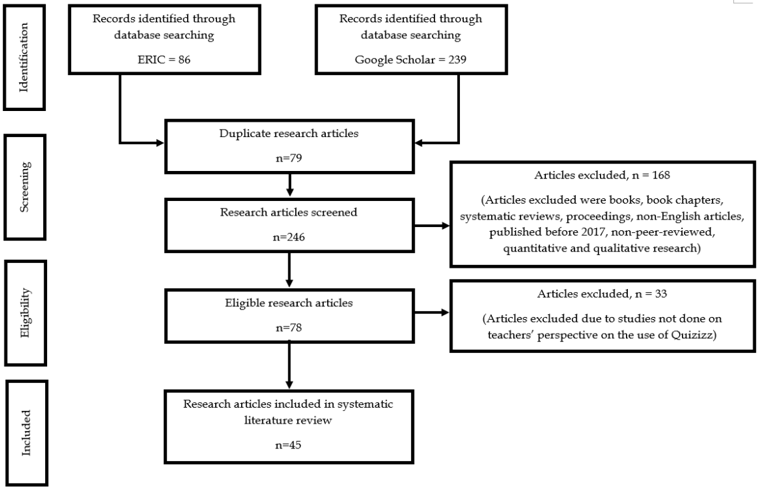
The teaching and learning of English as a second language have always been emphasized by the Ministry of Education (MOE). In the Malaysia Education Blueprint (2013–2025), among the many goals is to produce learners who can comprehend the language for various purposes, including for information and enjoyment. Over the years, the teaching and learning of English have changed from conventional chalk-and-talk methods to modern methods that involve various platforms such as Quizizz, which is free and easy to use. This systematic literature review focuses on teachers’ perception on the use of Quizizz in the teaching and learning of English. Using the Preferred Reporting Items for Systematic Review and Meta-Analyses (PRISMA) review methodology, a total of 45 articles related to the use of Quizizz in the English language classroom were identified from the ERIC and Google Scholar databases. Based on the articles from the year 2017 to 2021, the results show that the mixed-method research design was most used to gather teachers’ perspectives on the use of Quizizz in the teaching and learning of English. Overall, the results of this study show that Quizizz is accepted positively among teachers due to its effectiveness, feasibility, ease of use, and motivating nature for learners. As a suggestion for future research, more focus can be put on investigating the effectiveness of Quizizz from the perspective of parents and issues related to the implementation of gamified learning, such as Internet connection and device availability.
Overview
The claims and statistics of this paper haven’t been checked yet.
Free: it reads the open-access text and checks the first 5 claims that cite a source we can check. Create a free account to check every claim.
Integrity signals
Registry
Cites
Statistics
Figures
Verification
Claims the paper makes
The claims and statistics of this paper haven’t been checked yet.
Free: it reads the open-access text and checks the first 5 claims that cite a source we can check. Create a free account to check every claim.
Self-check
Percentages, sums and reported differences re-computed from the paper’s own numbers.
The self-check needs the paper’s full text.
Citations
Cites
Gamification in Science Education. A Systematic Review of the Literature
Kalogiannakis, M., Papadakis, S., & Zourmpakis, A.-I. (2021) · Education Sciences · doi:10.3390/educsci11010022 · Cited by 637 · cited 2×
“learning process, students only need a game code from their teachers in order to access a game that can be played in real-time mode or student-paced mode [26,41].”
BackgroundAlqahtani, A. Y., & Rajkhan, A. A. (2020) · Education Sciences · doi:10.3390/educsci10090216 · Cited by 615 · cited 1×
“Learners are also motivated to learn when they use Quizizz because they are learning in a fun, comfortable, and conducive environment with a little bit of friendly competition [35,38,47,57,58].”
BackgroundBetween Level Up and Game Over: A Systematic Literature Review of Gamification in Education
Manzano-León, A., Camacho-Lazarraga, P., Guerrero, M. A., Guerrero-Puerta, L., Aguilar-Parra, J. M., Trigueros, R., & Alias, A. (2021) · Sustainability · doi:10.3390/su13042247 · Cited by 512 · cited 2×
“Learners are also motivated to learn when they use Quizizz because they are learning in a fun, comfortable, and conducive environment with a little bit of friendly competition [35,38,47,57,58].”
BackgroundEffectiveness of gamification in the engagement of students
da Rocha Seixas, L., Gomes, A. S., & de Melo Filho, I. J. (2016) · Computers in Human Behavior · doi:10.1016/j.chb.2015.11.021 · Cited by 382 · cited 2×
“[25], it was found that 87% of the teachers who were the research participants agreed that their learners showed positive progress in their level of proficiency after using Quizizz in the classroom.”
BackgroundThe Role of Serious Games, Gamification and Industry 4.0 Tools in the Education 4.0 Paradigm
Almeida, F., & Simoes, J. (2019) · Contemporary Educational Technology · doi:10.30935/cet.554469 · Cited by 300 · cited 1×
“learning process, students only need a game code from their teachers in order to access a game that can be played in real-time mode or student-paced mode [26,41].”
BackgroundCOVID-19 Emergency eLearning and Beyond: Experiences and Perspectives of University Educators
Müller, A. M., Goh, C., Lim, L. Z., & Gao, X. (2021) · Education Sciences · doi:10.3390/educsci11010019 · Cited by 240
Bereczki, E. O., & Kárpáti, A. (2021) · Thinking Skills and Creativity · doi:10.1016/j.tsc.2021.100791 · Cited by 236 · cited 3×
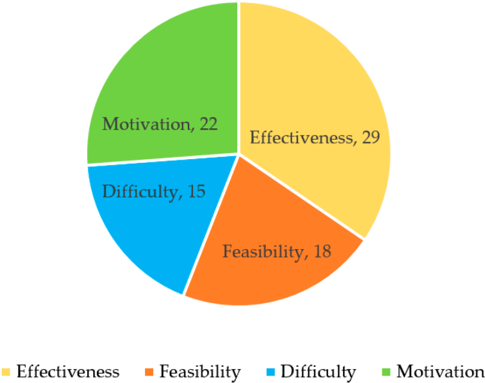
“Authors Perspective Effectiveness Feasibility Difficulty Motivation [14] ✓ ✓ ✓ [15] ✓ ✓ [53] ✓ [16] ✓ ✓ [43] ✓ ✓ [17] ✓ ✓ ✓ [44] ✓ ✓ [54] ✓ [18] ✓ [19] ✓ ✓ ✓ [55] ✓ [20] ✓ ✓ [21] ✓ [49] ✓ ✓ [22] ✓ ✓ [23] ✓ ✓ [45] ✓ ✓ .”
BackgroundFactors influencing EFL students’ motivation in online learning: A qualitative case study
Meşe, E., & Sevilen, Ç. (2021) · Journal of Educational Technology and Online Learning · doi:10.31681/jetol.817680 · Cited by 198
Gamified flipped EFL classroom for primary education: student and teacher perceptions
Zou, D. (2020) · Journal of Computers in Education · doi:10.1007/s40692-020-00153-w · Cited by 194 · cited 1×
“With this, Quizizz eventually helps improve learners’ performance in the language due to their eagerness to be actively involved in the learning process [27,28,30].”
BackgroundExploring a Gamified Learning Tool in the ESL Classroom: The Case of Quizizz
Yunus, C. C. A., & Hua, T. K. (2021) · Journal of Education and e-Learning Research · doi:10.20448/journal.509.2021.81.103.108 · Cited by 182 · cited 2×
“Authors Perspective Effectiveness Feasibility Difficulty Motivation [14] ✓ ✓ ✓ [15] ✓ ✓ [53] ✓ [16] ✓ ✓ [43] ✓ ✓ [17] ✓ ✓ ✓ [44] ✓ ✓ [54] ✓ [18] ✓ [19] ✓ ✓ ✓ [55] ✓ [20] ✓ ✓ [21] ✓ [49] ✓ ✓ [22] ✓ ✓ [23] ✓ ✓ [45] ✓ ✓ .”
Result
Research works printed but not linked: 7
- Ahmad, J.; Mahmud, N.; Jabbar, A.; Ikbal, M. Opportunities and challenges in the use of information and communication technology: Study for "Teaching From Home" for pandemic COVID-19. Int. J. Sci. Technol. Res. 2020, 9, 294-299.
- Onal, N.T. Investigation of technology integration knowledge of teachers: A case study. Int. J. Curric. Instr. 2021, 13, 773-793.
- Degirmenci, R. The use of Quizizz in language learning and teaching from the teachers' and students' perspectives: A literature review. Lang. Educ. Technol. 2021, 1, 1-11.
- Junior, J.B. Assessment for learning with mobile apps: Exploring the potential of Quizizz in the educational context. Int. J. Dev. Res. 2020, 10, 33366-33371.
- Moakofhi, M.; Leteane, O.; Phiri, T.; Pholele, T.; Sebalatlheng, P. Challenges of introducing e-learning at Botswana University of Agriculture and Natural Resources: Lecturers' perspective. Int. J. Educ. Dev. Using Inf. Commun. Technol. 2017, 13, 4-20.
- Weng, X.; Jong, M.; Chiu, T. Implementation challenges of STEM Education: From teachers' perspective. Asia-Pac. Comput. Educ. 2020, 1, 1-4.
- Huong, T.L. Enhancing student motivation in foreign language learning with computer-based concept mapping: An evidence from Vietnam. Int. J. Educ. Sci. Lang. Arts 2020, 1, 1-12.
Cited by
The Pedagogical Use of Gamification in English Vocabulary Training and Learning in Higher Education
Panmei, B., & Waluyo, B. (2022) · Education Sciences · doi:10.3390/educsci13010024 · Cited by 170
“The number of studies investigating the integration of other gamification apps into vocabulary learning outside the classroom is still scarce [23,24].”
BackgroundRamalingam, S., Yunus, M. M., & Hashim, H. B. (2022) · Sustainability · doi:10.3390/su14138051 · Cited by 163
“A number of authors have discussed this in their articles [26,27,56,57,61,62,65,67,68].”
BackgroundSelf-citationRafiq, K. R. M., Hashim, H. B., & Yunus, M. M. (2021) · Sustainability · doi:10.3390/su13179768 · Cited by 103
“Despite the growing trends of research in ESP, systematic reviews are more towards the ESL [12–14], EFL [15–17], and ELT fields [18], thereby leaving a gap.”
Self-citationInayati, N., & Waloyo, A. A. (2022) · Journal on English as a Foreign Language · doi:10.23971/jefl.v12i2.3546 · Cited by 78
“One factor that contributes to increased engagement is the userfriendly interface, which makes it easy to operate (Lim & Yunus, 2021).”
BackgroundPelatihan Pengembangan Soal HOTS dengan Memanfaatkan Quizizz untuk Guru Sekolah Dasar Pedesaan
Rulyansah, A. (2022) · Indonesia Berdaya · doi:10.47679/ib.2022195 · Cited by 53
Metadata
- Authors
- Lim, T. M., & Yunus, M. M.
- Affiliations
- National University of Malaysia (MY)
- Corresponding author
- Lim, Thomas Mason
- Venue
- Sustainability
- Publisher
- MDPI AG
- Published
- 2021-06-05
- Volume
- 13
- Issue
- 11
- Pages
- 6436
- ISSN
- 2071-1050 (ISSN-L)
- OpenAlex
- W3171915126
- Cited by
- 117
- References
- 61
- Citations by year
- 2026: 12 · 2025: 11 · 2024: 17 · 2023: 45 · 2022: 28 · 2021: 4
- FWCI
- 5.10
- Type
- journal article
- Language
- en
- Open access
- gold
- doi.org
- Licence
- Locations
- Sustainability (publishedVersion, cc-by)
- RePEc: Research Papers in Economics (submittedVersion)
- DOAJ (DOAJ: Directory of Open Access Journals) (submittedVersion, cc-by-sa)
- Greater South Information System
- Funders
- Universiti Kebangsaan Malaysia (GG-2020-024)
- Topics
- Social Sciences › Psychology › Developmental and Educational Psychology › Educational Games and Gamification
- Social Sciences › Education › English Language Learning and Teaching
- Social Sciences › Education › Technology-Enhanced Education Studies
- Keywords
- Quizizz, teacher perceptions, English as a second language, gamified learning, gamification, online quizzes, English language teaching, student motivation, Malaysia Education Blueprint
About these checks
Registry, retraction, Cites and statistics results are computed, not judged, with one exception: a printed reference that no index lists is read once by a model before it counts as a citation error. Claims are extracted by a model and kept only when their quote appears verbatim in the text; each cited source is then checked, with a model’s help, for whether it says what the claim relies on. Those verdicts can be wrong — read the claim’s quote and the cited source before relying on one.
Statistics and arithmetic are recomputed, not judged.
Confidence bands are shown only for fields calibrated on our annotated test set. None is calibrated yet, so no band is shown.
What counts as a claim ›How we measure confidence ›How we check this ›
Are you an author, or do you see a problem with this page? Request a review
How to cite
Cite CoChat for the checks on this page, and the paper for its own findings.
- This page
- CoChat. (2026). Citation check: Teachers’ Perception towards the Use of Quizizz in the Teaching and Learning of English: A Systematic Review. https://app.cochat.ai/papers/10.3390/su13116436
- The paper
- Lim, T. M., & Yunus, M. M. (2021). Teachers’ Perception towards the Use of Quizizz in the Teaching and Learning of English: A Systematic Review. Sustainability. https://doi.org/10.3390/su13116436
Data sources
Bibliographic data: Semantic Scholar, OpenAlex, Crossref.
Contains information from the Semantic Scholar Academic Graph Datasets, made available under the ODC Attribution License (ODC-BY 1.0).
Semantic Scholar’s data is described in: Kinney, R., et al. (2023). The Semantic Scholar Open Data Platform. arXiv:2301.10140.
