

Green Branding in the Digital Era: The Role of Influencer Credibility and Greenwashing in Shaping Brand Authenticity, Trust and Purchase Intentions
Open accessThe DOI matches its Crossref record; 59 of the 59 references it cites were found in a registry or an index.
Abstract
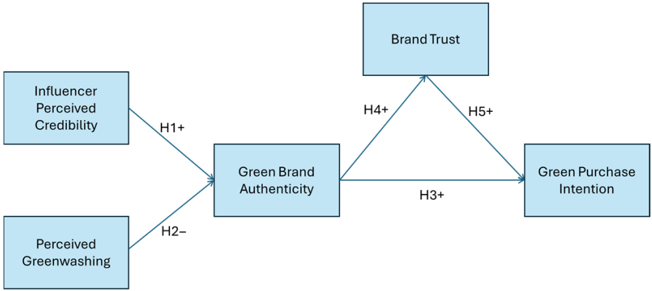
This study examines digital sustainability signals and the psychological mechanisms (authenticity and trust) that relate to consumers’ sustainable food purchase intentions. While the attitude–behavior gap remains a persistent challenge in sustainability research, our study focuses on upstream factors that may help explain why intentions vary in strength. Drawing on signaling theory, this research develops and tests a framework that combines positive signals (e.g., influencer credibility) and negative signals (e.g., perceived greenwashing) to investigate the impact on green brand authenticity, brand trust, and purchase intention. Data were gathered from a survey of 324 adult social media users who follow influencers with a focus on sustainability and have recent experience buying eco-labeled food products. Using PLS-SEM, results indicate that influencer credibility has a significant and positive effect on perceptions of green brand authenticity, whereas the influence of greenwashing has a significant and negative effect. Authenticity shows a strong prediction of brand trust, and this in turn predicts green purchase intentions with trust mediating the authenticity–intention relationship to some degree. The results indicate authenticity as a key mechanism by which digital signals affect sustainable consumption. The research provides practical insights for food brands seeking to strengthen the psychological conditions that support sustainable consumption intentions.
Overview
The claims and statistics of this paper haven’t been checked yet.
Free: it reads the open-access text and checks the first 5 claims that cite a source we can check. Create a free account to check every claim.
Integrity signals
Registry
Cites
Statistics
Figures
Verification
Claims the paper makes
The claims and statistics of this paper haven’t been checked yet.
Free: it reads the open-access text and checks the first 5 claims that cite a source we can check. Create a free account to check every claim.
Claims other papers make about this one
Each is checked against this paper’s own text: does it say what the citing paper says it does?
The cited source says what the claim attributes to it.
In the citing paper
“In the realm of social media influencers, Poulis et al. [48] ascertain that influencer credibility enhances green brand authenticity, whereas perceived greenwashing diminishes it; authenticity serves as a predictor of trust, which in turn predicts purchase intention with partial mediation.”
From Substantiated vs. Vague Circular Economy Claims in Fashion Brands: Claim Support Credibility, Authenticity, and Trust in Greece vs. the UK (2026) · cites this paper as [48]
The cited source says what the claim attributes to it.
In the citing paper
“This is in line with research that shows that authenticity is a key factor in building trust and purchase intentions [47,48] and that negative reactions often happen in stages rather than just stopping people from doing something [45,87].”
From Substantiated vs. Vague Circular Economy Claims in Fashion Brands: Claim Support Credibility, Authenticity, and Trust in Greece vs. the UK (2026) · cites this paper as [48]
The cited source says what the claim attributes to it.
In the citing paper
“This aligns with the communication objectives of the study and the compelling evidence that sustainability intentions are proximal to authenticity and trust [47,48].”
From Substantiated vs. Vague Circular Economy Claims in Fashion Brands: Claim Support Credibility, Authenticity, and Trust in Greece vs. the UK (2026) · cites this paper as [48]
Self-check
Percentages, sums and reported differences re-computed from the paper’s own numbers.
The self-check needs the paper’s full text.
Citations
Cites
A new criterion for assessing discriminant validity in variance-based structural equation modeling
Henseler, J., Ringle, C. M., & Sarstedt, M. (2015) · Journal of the Academy of Marketing Science · doi:10.1007/s11747-014-0403-8 · Cited by 38,459
When to Use and How to Report the Results of PLS-SEM
Hair, J. F., Risher, J. J., Sarstedt, M., & Ringle, C. M. (2019) · European Business Review · doi:10.1108/ebr-11-2018-0203 · Cited by 27,541
Spence, M. (1973) · The Quarterly Journal of Economics · doi:10.2307/1882010 · Cited by 19,518
Predictive model assessment in PLS-SEM: guidelines for using PLSpredict
Shmueli, G., Sarstedt, M., Hair, J. F., Cheah, J.-H., Ting, H., Vaithilingam, S., & Ringle, C. M. (2019) · European Journal of Marketing · doi:10.1108/ejm-02-2019-0189 · Cited by 4,618
Ohanian, R. (1990) · Journal of Advertising · doi:10.1080/00913367.1990.10673191 · Cited by 4,043
Delmas, M. A., & Burbano, V. C. (2011) · California Management Review · doi:10.1525/cmr.2011.54.1.64 · Cited by 3,441
Lou, C., & Yuan, S. (2019) · Journal of Interactive Advertising · doi:10.1080/15252019.2018.1533501 · Cited by 2,795
Sokolova, K., & Kefi, H. (2020) · Journal of Retailing and Consumer Services · doi:10.1016/j.jretconser.2019.01.011 · Cited by 1,650
Factors affecting green purchase behaviour and future research directions
Joshi, Y., & Rahman, Z. (2015) · International Strategic Management Review · doi:10.1016/j.ism.2015.04.001 · Cited by 1,518
Authenticity under threat: When social media influencers need to go beyond self-presentation
Audrezet, A., de Kerviler, G., & Guidry Moulard, J. (2020) · Journal of Business Research · doi:10.1016/j.jbusres.2018.07.008 · Cited by 1,452
Research works printed but not linked: 2
- 15. Connelly, B.L.; Certo, S.T.; Ireland, R.D.; Reutzel, C.R. Signaling Theory: A Review and Assessment. J. Manag. 2011, 37, 39-67. [CrossRef]
- 32. Nyilasy, G.; Gangadharbatla, H.; Paladino, A. Greenwashing: A Consumer Perspective. Econ. Sociol. 2012, 5, 116.
Cited by
Pigola, A., Bevan-Dye, A. L., de Moraes, G. H. S. M., & Synodinos, C. (2026) · Services Marketing Quarterly · doi:10.1080/15332969.2026.2667809 · Cited by 7
Tarnanidis, T. K., Manda, V. K., & Sousa, B. (2026) · Sustainability · doi:10.3390/su18031319 · Cited by 2
Dong, M., & Zhang, H. (2026) · Sustainability · doi:10.3390/su18083811 · Cited by 3
The Greenwashing Paradox: Signal Degradation and the Rise of Heuristic Substitution
Nagy-Kercsó, K., Kovacs, S., Zha, L., & Kontor, E. (2026) · Administrative Sciences · doi:10.3390/admsci16050223 · Cited by 2
“Consequently, rather than reducing information asymmetry, the abundance of green signals paradoxically increases consumer skepticism, diminishes the value of legitimate costly signals, and leads to a generalized perception of greenwashing (Tu et al., 2024; Poulis et al., 2026; Gupta & Singh, 2024).”
TRENDS ON TECHNOLOGY-BASED MEDIA BRANDING IN THE COMMUNICATION DISCIPLINE: A BIBLIOMETRIC ANALYSIS
Sukmojati, E., Jati, T. W. U., Lejap, P. I. J., Sakinah, N., Bifary, I. A., Zulfian, F. A., Paujiah, P., & Dennopa, N. (2026) · F1000Research · doi:10.12688/f1000research.179409.1 · Cited by 1
Mehmood, K., Sabir, M. R., Almahraj, Y. A., & Ashraf, R. U. (2026) · Corporate Social Responsibility and Environmental Management · doi:10.1002/csr.70759 · Cited by 2
Suh, S. Y. (2026) · Journal of theoretical and applied electronic commerce research · doi:10.3390/jtaer21090295 · Cited by 1
Balaskas, S., Yfantidou, I., & Skandali, D. (2026) · Sustainability · doi:10.3390/su18062869
Alnasser, A. N., & Noureldin, A. A. (2026) · Preprints.org · doi:10.20944/preprints202603.0195.v1
Alnasser, A. N., & Noureldin, A. A. (2026) · Preprints.org · doi:10.20944/preprints202603.0370.v1
Consumer Behaviour Across Cultures and Markets
Nikołajuk, S., Meclik, J., Nowosada, E. M., Konieczny, M. T., Pereira, A., & Carvalho, H. M. (2026) · IGI Global eBooks · doi:10.4018/979-8-2600-2188-0.ch006
Recognizing genuine green brands through AI visual cues
Liu, J., & Guo, R. (2026) · Journal of Marketing Communications · doi:10.1080/13527266.2026.2693503
Sharma, D. N., & Nalige, M. C. (2026) · International Journal of Novel Research and Development · doi:10.56975/ijnrd.v11i5.324770 · Cited by 1
Examining the Impact of Sustainable Branding on Consumer Behaviour through Digital Platforms
Datta, S., & Bhattacharya, M. (2026) · Indian Journal of Mass Communication and Journalism · doi:10.54105/ijmcj.d1172.05040626
Wang, J., Jiang, N., Li, H., & Jia, S. (2026) · Frontiers in Sustainable Food Systems · doi:10.3389/fsufs.2026.1829877
Sustaining Recent Growth in Sustainability’s Impact and Quality
Lyon, S. W. (2026) · Sustainability · doi:10.3390/su18157533
Rahman, S. F., Thasin, R., Bhuiyan, N., Asif, M. M. R., & Hossen, M. B. (2026) · International Journal of Research and Innovation in Social Science · doi:10.47772/ijriss.2026.100700205
Siahaan, F. S., & Priscillia, A. S. (2026) · Journal of Consumer Sciences · doi:10.29244/jcs.11.2.322-346
Aykut, O. H. (2026) · Uluslararası İktisadi ve İdari İncelemeler Dergisi · doi:10.18092/ulikidince.1942639
Alnasser, A. N., & Noureldin, A. A. (2026) · Frontiers in Communication · doi:10.3389/fcomm.2026.1849855
Стратегічні підходи до розбудови автентичності та сталості бренду в епоху ШІ
Брагінець, Д. (2026) · Electronic Kyiv-Mohyla Academy Institutional Repository (National University of Kyiv-Mohyla Academy)
Amutha, V., Victoria, D. G. M., Reni, G., & vani, S. K. (2026) · doi:10.65647/msp/132/2026
MARKA OTANTİKLİĞİ LİTERATÜRÜNÜN GELİŞİMİNE YÖNELİK BİBLİYOMETRİK BİR ANALİZ
Üçsu, B. K. (2026) · İktisat İşletme ve Uluslararası İlişkiler Dergisi · doi:10.58654/jebi.1946258
Impact of Green Brand Colour Cues on Consumer Perceived Authenticity and Purchase Intent
-, R. G. P., Mishra, S., Pada, A., Patel, M., & Mishra, N. (2026) · International Conference on NextGen Data Science and Analytics (ICNDSA) · doi:10.1109/icndsa68777.2026.11652137
“Similarly, also [29] described that green trust is a significant mediator between the branding cues and purchase intention with emphasis on the authenticity as an important intervening variable.”
Napitupulu, R. L., Gaffar, V., Monoarfa, H., & Herawaty, M. T. (2026) · Research Square · doi:10.21203/rs.3.rs-10033159/v1
Ju, Z., Wang, Z., Chen, X., & Shen, S. (2026) · World Electric Vehicle Journal · doi:10.3390/wevj17090471
“It enables consumers to treat innovation and smart-cockpit features as authentic rather than promotional [14,18].”
Eldabet, M. M., Eldabet, A., Aboul-Dahab, S. A.-E. M. M., & El-Tahan, E. A.-K. S. (2026) · International Journal of ADVANCED AND APPLIED SCIENCES · doi:10.21833/ijaas.2026.07.024
Digital Media Influence and Consumer Trust in Sustainable Consumption Decision-Making
Vasilevska, D., Ozola, I., Libkovska, U., & Kreslins, K. (2026) · WSEAS TRANSACTIONS ON BUSINESS AND ECONOMICS · doi:10.37394/23207.2026.23.124
OKACHA, S. (2026) · International Journal of Economics and Management Sciences · Cited by 1
Maučec, M. (2026) · University of Maribor digital library (University of Maribor)
Palla, P. J., Palla, E., & Drossos, D. A. (2026) · Frontiers in Communication · doi:10.3389/fcomm.2026.1904390
Sustainability as a driver of customer choice: evidence from SMEs in Oman
Al-Jahwari, N. S., Bathmanathan, V., & Abubakar, A. (2026) · Strategy and Leadership · doi:10.1108/sl-05-2026-0243
Xu, Y., Du, J., & Wattoo, M. U. (2026) · Acta Psychologica · doi:10.1016/j.actpsy.2026.107923
Honest brand messaging during crises: communication principles from retail marketing practitioners
Pozzo, G. D., Sit, J., & Cicekli, I. (2026) · Cogent Business & Management · doi:10.1080/23311975.2026.2747479
Rimbawan, A., Utami, N. K. Y., Setiyarti, T., Pertiwi, I., Sumariani, N. K. N., Dewi, N. M. E. N., Pratama, I. G. Y., Dharmawan, P. A. P., Sari, N. N. B. R., & Sari, K. I. P. (2026) · Jurnal PkM (Pengabdian kepada Masyarakat) · doi:10.30998/jurnalpkm.v9i3.5090
Marumbwa, J., Mabuyana, B., Chabata, T., & Muresherwa, G. (2026) · Administrative Sciences · doi:10.3390/admsci16110531
Strategic Drama Marketing and Consumer Reactions in Digital Commerce: Evidence from Thailand
Limna, P., Tansakul, P., Khaniyao, K., Shaengchart, Y., & Saejuen, T. (2026) · Societies · doi:10.3390/soc16110382
Pichayakul, P., & Boonyasana, P. (2026) · Services Marketing Quarterly · doi:10.1080/15332969.2026.2746023
Metadata
- Authors
- Poulis, A., Theodoridis, P., & Zacharatos, T.
- Affiliations
- University of West Attica (GR)
- Hellenic Open University (GR)
- Corresponding author
- Poulis, Athanasios
- Venue
- Sustainability
- Publisher
- MDPI AG
- Published
- 2026-01-02
- Volume
- 18
- Issue
- 1
- Pages
- 451
- ISSN
- 2071-1050 (ISSN-L)
- OpenAlex
- W7117991875
- Cited by
- 23
- References
- 59
- Citations by year
- 2026: 23
- FWCI
- 210.58
- Type
- journal article
- Language
- en
- Open access
- gold
- doi.org
- Licence
- Locations
- Sustainability (publishedVersion, cc-by)
- Funders
- University of West Attica
- Topics
- Social Sciences › Business, Management and Accounting › Marketing › Environmental Sustainability in Business
- Social Sciences › Business, Management and Accounting › Marketing › Consumer Behavior in Brand Consumption and Identification
- Social Sciences › Business, Management and Accounting › Marketing › Digital Marketing and Social Media
- Keywords
- green branding, greenwashing, influencer credibility, brand authenticity, brand trust, purchase intention, sustainable food consumption, signaling theory, social media influencers, attitude-behavior gap
About these checks
Registry, retraction, Cites and statistics results are computed, not judged, with one exception: a printed reference that no index lists is read once by a model before it counts as a citation error. Claims are extracted by a model and kept only when their quote appears verbatim in the text; each cited source is then checked, with a model’s help, for whether it says what the claim relies on. Those verdicts can be wrong — read the claim’s quote and the cited source before relying on one.
Statistics and arithmetic are recomputed, not judged.
Confidence bands are shown only for fields calibrated on our annotated test set. None is calibrated yet, so no band is shown.
What counts as a claim ›How we measure confidence ›How we check this ›
Are you an author, or do you see a problem with this page? Request a review
Data sources
Bibliographic data: Semantic Scholar, OpenAlex, Crossref.
Contains information from the Semantic Scholar Academic Graph Datasets, made available under the ODC Attribution License (ODC-BY 1.0).
Semantic Scholar’s data is described in: Kinney, R., et al. (2023). The Semantic Scholar Open Data Platform. arXiv:2301.10140.
