

The Influence of Environmental Friendliness on Green Trust: The Mediation Effects of Green Satisfaction and Green Perceived Quality
Open accessThe DOI matches its Crossref record; 51 of the 51 references it cites were found in a registry or an index.
Abstract
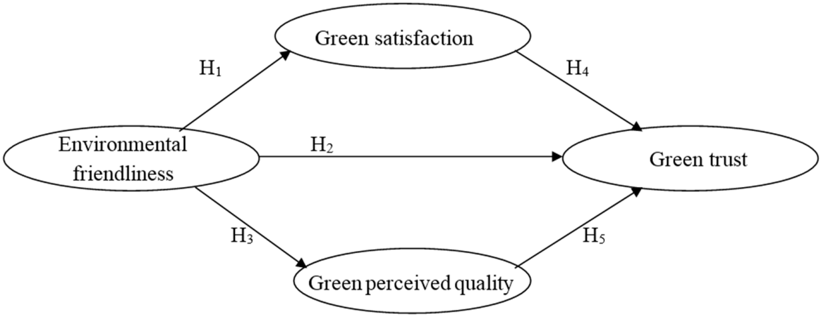
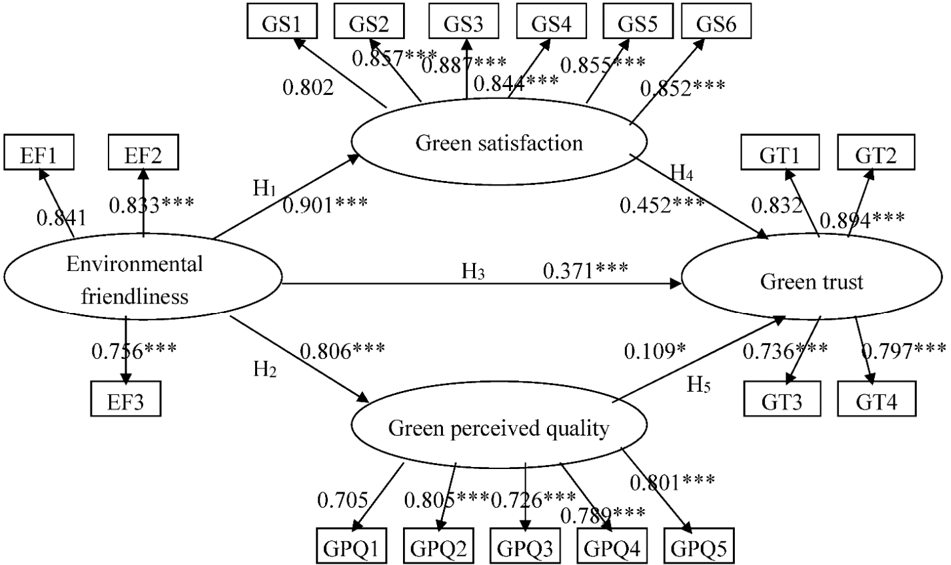
As global green trends became more prevalent, green marketing also developed into an important issue. Although prior literature explored the main factors affecting green trust, it was inconclusive as to how environmental friendliness could affect the green trust in green marketing. This study aims to focus on the positive influence of environmental friendliness on green trust, and explore the mediation effects of green satisfaction and green perceived quality. This study undertakes an empirical study by means of questionnaire survey. The respondents are consumers who have experience purchasing green products. This study applies structural equation modeling (SEM) to test the hypotheses. The findings of this study indicate that (1) environmental friendliness has a significant positive impact on green satisfaction, green perceived quality, and green trust; (2) both green satisfaction and green perceived quality positively affect green trust; and (3) green satisfaction and green perceived quality partially mediate the positive relationship between environmental friendliness and green trust.
Overview
The claims and statistics of this paper haven’t been checked yet.
Free: it reads the open-access text and checks the first 5 claims that cite a source we can check. Create a free account to check every claim.
Integrity signals
Registry
Cites
Statistics
Figures
Verification
Claims the paper makes
The claims and statistics of this paper haven’t been checked yet.
Free: it reads the open-access text and checks the first 5 claims that cite a source we can check. Create a free account to check every claim.
Claims other papers make about this one
Each is checked against this paper’s own text: does it say what the citing paper says it does?
The source backs part of the claim, not all of it — or backs it for a different population, condition or comparison.
In the citing paper
“Previous research on circular consumption shows that perceived uncertainty about circular offerings influences purchase intentions in addition to pro-environmental motivation [21-23].”
From Substantiated vs. Vague Circular Economy Claims in Fashion Brands: Claim Support Credibility, Authenticity, and Trust in Greece vs. the UK (2026) · cites this paper as [21]
Experimental — accuracy not yet measuredThe source backs part of the claim, not all of it — or backs it for a different population, condition or comparison.
In the citing paper
“A growing stream highlights authenticitythe perception that the creator is sincere and value-consistent-as the catalyst that turns attention into verifiable green action via trust (Bastounis et al., 2021;Chen et al., 2015).”
From Cross-national evidence on influencer-driven green choice: a moderated-mediation model of authenticity, parasocial ties, and greenwashing exposure (2026) · cites this paper as Chen et al., 2015
Experimental — accuracy not yet measuredThe source backs part of the claim, not all of it — or backs it for a different population, condition or comparison.
In the citing paper
“At the same time, consumer skepticism is heightened by greenwashing-overstated or fabricated environmental claims-creating a climate where repeated exposure to misleading claims depresses responsiveness, even to well-intended messages (Bastounis et al., 2021;Chen et al., 2015).”
From Cross-national evidence on influencer-driven green choice: a moderated-mediation model of authenticity, parasocial ties, and greenwashing exposure (2026) · cites this paper as Chen et al., 2015
Experimental — accuracy not yet measuredThe check wasn’t confident either way, so it gives no verdict — never disputed.
In the citing paper
“AUTH can build trust by lowering inferences of opportunism and increasing perceived truthfulness; PSR can build trust by lowering perceived risk through relational closeness.”
From Cross-national evidence on influencer-driven green choice: a moderated-mediation model of authenticity, parasocial ties, and greenwashing exposure (2026) · cites this paper as Chen et al., 2015
Experimental — accuracy not yet measured
Self-check
Percentages, sums and reported differences re-computed from the paper’s own numbers.
The self-check needs the paper’s full text.
Citations
Cites
Evaluating Structural Equation Models with Unobservable Variables and Measurement Error
Fornell, C., & Larcker, D. F. (1981) · Journal of Marketing Research · doi:10.2307/3151312 · Cited by 109,314 · cited 3×
“Average variation extraction (AVE) calculates how well observed questionnaire items of a construct explain the average variation of the construct [53].”
BackgroundInfluentialEvaluating structural equation models with unobservable variables and measurement error
Fornell, C., & Larcker, D. F. (1981) · Journal of Marketing Research · doi:10.1177/002224378101800104 · Cited by 109,190
Herne, H., Cooley, W. W., & Lohnes, P. R. (1973) · Journal of the Royal Statistical Society. Series A (General) · doi:10.2307/2344428 · Cited by 35,697
On the Evaluation of Structural Equation Models
Bagozzi, R. P., & Yi, Y. (1988) · Journal of the Academy of Marketing Science · doi:10.1007/bf02723327 · Cited by 26,163
Significance tests and goodness of fit in the analysis of covariance structures.
Bentler, P. M., & Bonett, D. G. (1980) · Psychological Bulletin · doi:10.1037//0033-2909.88.3.588 · Cited by 19,023 · cited 1×
“9 [55]”
Consumer Perceptions of Price, Quality, and Value: A Means-End Model and Synthesis of Evidence
Zeithaml, V. A. (1988) · Journal of Marketing · doi:10.1177/002224298805200302 · Cited by 18,292 · cited 3×
“Perceived quality is defined as “the overall assessment of product or service excellence or superiority by the user” [42].”
BackgroundInfluentialAaker, D. A. (1995) · Cited by 8,243
Chaudhuri, A., & Holbrook, M. B. (2001) · Journal of Marketing · doi:10.1509/jmkg.65.2.81.18255 · Cited by 6,674 · cited 1×
“Furthermore, brand trust appears to serve as a key factor of brand commitment and brand loyalty [47].”
BackgroundMarketing management: analysis. planning. implementation and control
Kotler, P. (2000) · Cited by 6,639
The Different Roles of Satisfaction, Trust, and Commitment in Customer Relationships
Garbarino, E., & Johnson, M. S. (1999) · Journal of Marketing · doi:10.1177/002224299906300205 · Cited by 4,899 · cited 2×
“Customer perceived quality and satisfaction are reflected in customer trust and loyalty [4].”
Background
Research works printed but not linked: 5
- 1. Yang, C.; Wang, Y.; Fong, L.; Hsieh, S. A study of the hospitality personal cognizance, attitude and behavior toward practice of green productivity. J. Tour. Stud. 2007 , 13 , 165-192.
- 10. Kontogianni, E.; Kouthouris, C. Investigating environmentally friendly behavior among users and visitors of a Greek ski resort. Trends Sport Sci. 2014 , 21 , 101-110.
- 39. Oliver, R.L. Satisfaction: A Behavioral Perspective on the Customer ; McGraw Hill: New York, NY, USA, 1997.
- 40. Chen, C.-N.; Lin, S.-Y.; Ting, S.-C. The Relationships of Trust, Commitment, and the Related Factors: An Empirical Study of the Franchise Systems. Taiwan Acad. Manag. J. 2005 , 5 , 209-229.
- 50. Lin, L.-Y.; Wang, J.-F.; Huang, L.-M. The Impacts of Service Quality, Promotion Strategy, Perceived Value and Customer Trust on Customer Satisfaction: An Example of the Taxpayers of Taipei Country Tax Bureau. Mark. Rev./Xing Xiao Ping Lun 2011 , 8 , 433-452.
Cited by
Items 201–229 of 229
ปจจยทมอทธพลตอการรบรดานการยอมรบสำหรบเทคโนโลยรถยนตไฟฟาในประเทศไทย
พันธุ์พิศุทธิ์ชัย, ว., & วรพิเชฐ, ธ. (2023) · วารสารวิชาการการตลาดและการจัดการ มหาวิทยาลัยเทคโนโลยีราชมงคลธัญบุรี · doi:10.60101/mmr.2023.267076
Jelita, A. P., & Roostika, R. (2024) · Al-Kharaj Jurnal Ekonomi Keuangan & Bisnis Syariah · doi:10.47467/alkharaj.v6i6.2332
Green behaviors towards intention to participate in river cleaning initiatives
Shamsudin, S., Amir, A. A., & Husin, N. A. (2024) · Malaysian Journal of Society and Space · doi:10.17576/geo-2024-2003-01
The Influence Of Green Marketing and Green Brand Image nn Green Satisfaction Starbucks Yogyakarta
Pranata, Y., & Ekasasi, S. R. (2022) · Cakrawangsa Bisnis Jurnal Ilmiah Mahasiswa · doi:10.35917/cb.v3i1.304
Pfiffelmann, J., Untilov, O., Thøgersen, J. B., Gengenbach, A., & Mionetto, C. (2025) · Recherche et Applications en Marketing (French Edition) · doi:10.1177/07673701241307479
Sustainability as a Determinant Factor in the Purchasing Decision
Popa, A., Barbu, C. A., & Ionașcu, A. E. (2025) · Ovidius University Annals Economic Sciences Series · doi:10.61801/ouaess.2024.2.56 · Cited by 1
Era of Management: Adapting Strategies for a Changing Environment
Kaur, P., & Inamdar, S. (2025) · doi:10.70593/978-93-49910-89-8 · Cited by 1
Irfan, M. (2023) · Indonesian Journal of Economics Business Accounting and Management (IJEBAM) · doi:10.63901/ijebam.v1i3.16 · Cited by 1
Shamsudin, S., Amir, A. A., Ali, W. M. S. W. M., & Husin, N. A. (2025) · SSRN Electronic Journal · doi:10.2139/ssrn.5271135
Zalzalah, G. G., Pradana, A., & Pratita, M. P. (2025) · UPY Business and Management Journal (UMBJ) · doi:10.31316/ubmj.v4i2.7918 · Cited by 2
Yılmaz, E. Ü., TULUK, T., & Bozbay, Z. (2025) · SSRN Electronic Journal · doi:10.2139/ssrn.5376261
Dzulqarnain, M. U., & Ramdhan, M. R. (2025) · International Journal of Asian Business and Management · doi:10.55927/ijabm.v4i4.457
“According to Chen et al. (2015), green perceived value, green trust, and green satisfaction significantly contribute to consumer purchase intention.”
Pengaruh Produk Hijau Terhadap Keputusan Terhadap Makanan Di Kota Ambon
Pelupessy, M. M., Tehuayo, E., & Mangguali, R. (2025) · Bongaya Journal for Research in Management (BJRM) · doi:10.37888/bjrm.v9i1.875
Role of blockchain technology in green banking
Išoraitė, M., & Dubauskas, G. (2025) · Journal of Entrepreneurship and Sustainability Issues · doi:10.9770/s5967972526
Anggraeni, A. N., & Sabandi, M. (2025) · RIGGS Journal of Artificial Intelligence and Digital Business · doi:10.31004/riggs.v4i3.2598
SÜRDÜRÜLEBİLİR REKLAMCILIĞIN ÇIKMAZI: GREENWASHİNG VE TÜKETİCİ GÜVENİNİN DÖNÜŞÜMÜ
Merdin, M. (2025) · The Journal of Social Sciences · doi:10.29228/sobider.87870
Hiep Bao, C. H. U., & Huynh, T. M. (2026) · Veredas do Direito Direito Ambiental e Desenvolvimento Sustentável · doi:10.18623/rvd.v23.n1.4088
“In some previous studies, the research has focused on green customer behavior through purchasing intention (Kong et al., 2014) and green trust (Konuk et al., 2015; Chen & Chang, 2012; Chen et al., 2015; Wang et al., 2019).”
Green Branding: Exploration of Factors Impacting Consumer Selection of Green Hotels
Gulati, G., Joshi, M. C., & Kumar, A. (2026) · World sustainability series · doi:10.1007/978-3-032-10212-6_12
Master Program of Management, U. M. A., Sugito, S., Lubis, A., Master Program of Management, U. M. A., Muliono, R., Informatics Engineering Study Program, U. M. A., Effendi, I., Master Program of Management, U. M. A., & Rosalina, D. (2026) · International Journal of ADVANCED AND APPLIED SCIENCES · doi:10.21833/ijaas.2026.02.001
Ethical Sustainability Marketing and Its Impact on Consumer Trust: From Greenwashing to Green Trust
Uikey, S. (2026) · IGI Global eBooks · doi:10.4018/979-8-3373-9680-4.ch008
Abu-Alhaija, A. S., & Alsawaha, A. (2026) · International Journal of Management and Sustainability · doi:10.18488/11.v15i1.4812
“Additionally, brand advocacy is more common among customers who trust a company's environmental claims (Chen et al., 2015).”
Deepti, K. S., & Patnaik, R. P. K. (2026) · International Research Journal of Multidisciplinary Scope · doi:10.47857/irjms.2026.v07i02.09135
“…were used to understand the demographics of the respondents and their perceptions regarding eco labels and awareness campaigns (27), the equates are presented respectively from Equations [8, 9]: Where: X i = individual data points n = total number of observations Standard Deviation (SD): Where:”
Unpacking Green Quality: A Structural Model Analysis of Eco-Awareness and Trust
Brahmbhatt, M. (2026) · Milky Way Scientific Journal · doi:10.65021/mwsj.v2.i1.31
Sayyad, F. (2026) · International Journal of Advanced Academic Studies · doi:10.33545/27068919.2026.v8.i6a.2042
Borges, A. P., Yozcu, Ö. K., Vieira, E., Rodrigues, M., & Franco, M. (2026) · Social Responsibility Journal · doi:10.1108/srj-10-2025-1119
Shakeel, M. I., & Naz, S. (2026) · Journal of Business Insight and Innovation · doi:10.63544/jbii.v5i9.219
“According to (Chen, Lin, & Weng, 2015), as green attributes are often difficult to verify before purchase, trust mitigate uncertainty and encourages consumers to rely on sustainability claims Empirical researches confirms the positive impact of green trust on GPI (Ahmad & Zhang, 2020; Jaiswal et…”
The Indonesian beauty economy: study of local skincare consumers
Alrizqi, D. G., Ridwan, N. H., Sari, P. N., Yani, N. L. S., & Nugraha, P. A. D. (2026) · SN Business & Economics · doi:10.1007/s43546-026-01452-7
“In contrast, when consumers evaluate more subjective and ambiguity-prone signals, such as product quality and green claims, brand trust may become more rel - evant because it helps consumers reduce uncertainty and validate their interpretation of product performance and environmental credibility (Y.-S. Chen 2010; Liao…”
InfluentialSustainable Consumption and Digital Media in Türkiye: Mediating Role of Ecological Literacy
Çağlar, E., & Çıngı, M. (2026) · International E-Journal of Advances in Social Sciences · doi:10.59534/jcss.1930079
Trinisa, N., Fiona, F., & Eka, S. (2026) · Jambura Economic Education Journal · doi:10.37479/jeej.v8i4.40210
Metadata
- Authors
- Chen, Y.-S., Lin, C.-Y., & Weng, C.-S.
- Affiliations
- National Taipei University (TW)
- Taipei Medical University (TW)
- Corresponding author
- Chen, Yu-Shan
- ORCID
- Chen, Yu-Shan
- Venue
- Sustainability
- Publisher
- MDPI AG
- Published
- 2015-07-29
- Volume
- 7
- Issue
- 8
- Pages
- 10135-10152
- ISSN
- 2071-1050 (ISSN-L)
- OpenAlex
- W1600908323
- Cited by
- 207
- References
- 51
- Citations by year
- 2026: 12 · 2025: 24 · 2024: 35 · 2023: 36 · 2022: 35 · 2021: 21 · 2020: 20 · 2019: 10 · 2018: 8 · 2017: 1 · 2016: 3 · 2015: 2
- FWCI
- 11.59
- Type
- journal article
- Language
- en
- Open access
- gold
- dx.doi.org
- Licence
- Locations
- Sustainability (publishedVersion, cc-by)
- RePEc: Research Papers in Economics (submittedVersion)
- DOAJ (DOAJ: Directory of Open Access Journals) (submittedVersion, cc-by-sa)
- Funders
- National Science Council
- Topics
- Social Sciences › Business, Management and Accounting › Marketing › Environmental Sustainability in Business
- Social Sciences › Business, Management and Accounting › Strategy and Management › Sustainable Supply Chain Management
- Social Sciences › Business, Management and Accounting › Marketing › Customer Service Quality and Loyalty
- Keywords
- environmental compatibility, green trust, green satisfaction, green perceived quality, green marketing, green products, consumer trust, mediating effect, sustainable consumption
About these checks
Registry, retraction, Cites and statistics results are computed, not judged, with one exception: a printed reference that no index lists is read once by a model before it counts as a citation error. Claims are extracted by a model and kept only when their quote appears verbatim in the text; each cited source is then checked, with a model’s help, for whether it says what the claim relies on. Those verdicts can be wrong — read the claim’s quote and the cited source before relying on one.
Statistics and arithmetic are recomputed, not judged.
Confidence bands are shown only for fields calibrated on our annotated test set. None is calibrated yet, so no band is shown.
What counts as a claim ›How we measure confidence ›How we check this ›
Are you an author, or do you see a problem with this page? Request a review
Data sources
Bibliographic data: Semantic Scholar, OpenAlex, Crossref.
Contains information from the Semantic Scholar Academic Graph Datasets, made available under the ODC Attribution License (ODC-BY 1.0).
Semantic Scholar’s data is described in: Kinney, R., et al. (2023). The Semantic Scholar Open Data Platform. arXiv:2301.10140.
