

The Influence of Environmental Friendliness on Green Trust: The Mediation Effects of Green Satisfaction and Green Perceived Quality
Open accessThe DOI matches its Crossref record; 51 of the 51 references it cites were found in a registry or an index.
Abstract
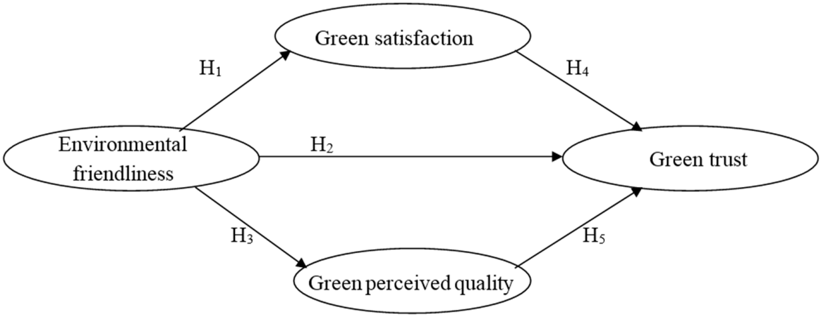
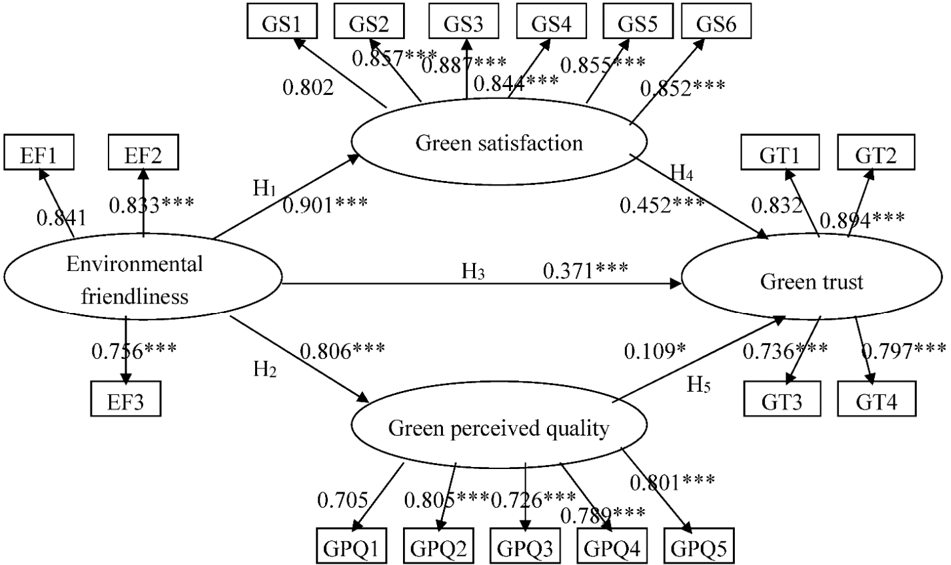
As global green trends became more prevalent, green marketing also developed into an important issue. Although prior literature explored the main factors affecting green trust, it was inconclusive as to how environmental friendliness could affect the green trust in green marketing. This study aims to focus on the positive influence of environmental friendliness on green trust, and explore the mediation effects of green satisfaction and green perceived quality. This study undertakes an empirical study by means of questionnaire survey. The respondents are consumers who have experience purchasing green products. This study applies structural equation modeling (SEM) to test the hypotheses. The findings of this study indicate that (1) environmental friendliness has a significant positive impact on green satisfaction, green perceived quality, and green trust; (2) both green satisfaction and green perceived quality positively affect green trust; and (3) green satisfaction and green perceived quality partially mediate the positive relationship between environmental friendliness and green trust.
Overview
The claims and statistics of this paper haven’t been checked yet.
Free: it reads the open-access text and checks the first 5 claims that cite a source we can check. Create a free account to check every claim.
Integrity signals
Registry
Cites
Statistics
Figures
Verification
Claims the paper makes
The claims and statistics of this paper haven’t been checked yet.
Free: it reads the open-access text and checks the first 5 claims that cite a source we can check. Create a free account to check every claim.
Claims other papers make about this one
Each is checked against this paper’s own text: does it say what the citing paper says it does?
The source backs part of the claim, not all of it — or backs it for a different population, condition or comparison.
In the citing paper
“Previous research on circular consumption shows that perceived uncertainty about circular offerings influences purchase intentions in addition to pro-environmental motivation [21-23].”
From Substantiated vs. Vague Circular Economy Claims in Fashion Brands: Claim Support Credibility, Authenticity, and Trust in Greece vs. the UK (2026) · cites this paper as [21]
Experimental — accuracy not yet measuredThe source backs part of the claim, not all of it — or backs it for a different population, condition or comparison.
In the citing paper
“A growing stream highlights authenticitythe perception that the creator is sincere and value-consistent-as the catalyst that turns attention into verifiable green action via trust (Bastounis et al., 2021;Chen et al., 2015).”
From Cross-national evidence on influencer-driven green choice: a moderated-mediation model of authenticity, parasocial ties, and greenwashing exposure (2026) · cites this paper as Chen et al., 2015
Experimental — accuracy not yet measuredThe source backs part of the claim, not all of it — or backs it for a different population, condition or comparison.
In the citing paper
“At the same time, consumer skepticism is heightened by greenwashing-overstated or fabricated environmental claims-creating a climate where repeated exposure to misleading claims depresses responsiveness, even to well-intended messages (Bastounis et al., 2021;Chen et al., 2015).”
From Cross-national evidence on influencer-driven green choice: a moderated-mediation model of authenticity, parasocial ties, and greenwashing exposure (2026) · cites this paper as Chen et al., 2015
Experimental — accuracy not yet measuredThe check wasn’t confident either way, so it gives no verdict — never disputed.
In the citing paper
“AUTH can build trust by lowering inferences of opportunism and increasing perceived truthfulness; PSR can build trust by lowering perceived risk through relational closeness.”
From Cross-national evidence on influencer-driven green choice: a moderated-mediation model of authenticity, parasocial ties, and greenwashing exposure (2026) · cites this paper as Chen et al., 2015
Experimental — accuracy not yet measured
Self-check
Percentages, sums and reported differences re-computed from the paper’s own numbers.
The self-check needs the paper’s full text.
Citations
Cites
Evaluating Structural Equation Models with Unobservable Variables and Measurement Error
Fornell, C., & Larcker, D. F. (1981) · Journal of Marketing Research · doi:10.2307/3151312 · Cited by 109,314 · cited 3×
“Average variation extraction (AVE) calculates how well observed questionnaire items of a construct explain the average variation of the construct [53].”
BackgroundInfluentialEvaluating structural equation models with unobservable variables and measurement error
Fornell, C., & Larcker, D. F. (1981) · Journal of Marketing Research · doi:10.1177/002224378101800104 · Cited by 109,190
Herne, H., Cooley, W. W., & Lohnes, P. R. (1973) · Journal of the Royal Statistical Society. Series A (General) · doi:10.2307/2344428 · Cited by 35,697
On the Evaluation of Structural Equation Models
Bagozzi, R. P., & Yi, Y. (1988) · Journal of the Academy of Marketing Science · doi:10.1007/bf02723327 · Cited by 26,163
Significance tests and goodness of fit in the analysis of covariance structures.
Bentler, P. M., & Bonett, D. G. (1980) · Psychological Bulletin · doi:10.1037//0033-2909.88.3.588 · Cited by 19,023 · cited 1×
“9 [55]”
Consumer Perceptions of Price, Quality, and Value: A Means-End Model and Synthesis of Evidence
Zeithaml, V. A. (1988) · Journal of Marketing · doi:10.1177/002224298805200302 · Cited by 18,292 · cited 3×
“Perceived quality is defined as “the overall assessment of product or service excellence or superiority by the user” [42].”
BackgroundInfluentialAaker, D. A. (1995) · Cited by 8,243
Chaudhuri, A., & Holbrook, M. B. (2001) · Journal of Marketing · doi:10.1509/jmkg.65.2.81.18255 · Cited by 6,674 · cited 1×
“Furthermore, brand trust appears to serve as a key factor of brand commitment and brand loyalty [47].”
BackgroundMarketing management: analysis. planning. implementation and control
Kotler, P. (2000) · Cited by 6,639
The Different Roles of Satisfaction, Trust, and Commitment in Customer Relationships
Garbarino, E., & Johnson, M. S. (1999) · Journal of Marketing · doi:10.1177/002224299906300205 · Cited by 4,899 · cited 2×
“Customer perceived quality and satisfaction are reflected in customer trust and loyalty [4].”
Background
Research works printed but not linked: 5
- 1. Yang, C.; Wang, Y.; Fong, L.; Hsieh, S. A study of the hospitality personal cognizance, attitude and behavior toward practice of green productivity. J. Tour. Stud. 2007 , 13 , 165-192.
- 10. Kontogianni, E.; Kouthouris, C. Investigating environmentally friendly behavior among users and visitors of a Greek ski resort. Trends Sport Sci. 2014 , 21 , 101-110.
- 39. Oliver, R.L. Satisfaction: A Behavioral Perspective on the Customer ; McGraw Hill: New York, NY, USA, 1997.
- 40. Chen, C.-N.; Lin, S.-Y.; Ting, S.-C. The Relationships of Trust, Commitment, and the Related Factors: An Empirical Study of the Franchise Systems. Taiwan Acad. Manag. J. 2005 , 5 , 209-229.
- 50. Lin, L.-Y.; Wang, J.-F.; Huang, L.-M. The Impacts of Service Quality, Promotion Strategy, Perceived Value and Customer Trust on Customer Satisfaction: An Example of the Taxpayers of Taipei Country Tax Bureau. Mark. Rev./Xing Xiao Ping Lun 2011 , 8 , 433-452.
Cited by
Maichum, K., Parichatnon, S., & Peng, K.-C. (2016) · Sustainability · doi:10.3390/su8101077 · Cited by 728
“To test the internal consistency of the indicators of each studied construct, the most common method is to calculate the coefficient alpha of a given construct [117,118].”
MethodWillingness to pay more for green products: A critical challenge for Gen Z
Gomes, S., Lopes, J. M., & Nogueira, S. (2023) · Journal of Cleaner Production · doi:10.1016/j.jclepro.2023.136092 · Cited by 369
Jamil, K., Dunnan, L., Gul, R. F., Shehzad, M. U., Gillani, S. H. M., & Awan, F. H. (2022) · Frontiers in Psychology · doi:10.3389/fpsyg.2021.808525 · Cited by 260
Ansu‐Mensah, P. (2021) · Future Business Journal · doi:10.1186/s43093-021-00094-5 · Cited by 297
“Green perceived quality (GPQ) denotes how the quality or reliability of a green product is impacted by the consumer’s comprehensive decision [17, 81].”
BackgroundChen, Y.-S., Lin, Y.-H., Lin, C.-Y., & Chang, C.-W. (2015) · Sustainability · doi:10.3390/su71115674 · Cited by 176
“Countries in the world are committing to create a new international climate agreement recently, so firms must collect timely green knowledge and information that are critical for their business operations [6].”
BackgroundSelf-citationOgiemwonyi, O. (2021) · Environmental and Sustainability Indicators · doi:10.1016/j.indic.2021.100164 · Cited by 216
Chen, Y., Chang, T., Li, H., & Chen, Y.-R. (2020) · International Journal of Environmental Research and Public Health · doi:10.3390/ijerph17114089 · Cited by 232
“Since more and more consumers are willing to give priority to greenness [13], by developing positive emotional responses as the basis for green brand influence, brand differentiation and generating green purchase intentions are crucial to green brand strategy.”
BackgroundSelf-citationChen, Y., Chang, T., Lin, C., Lai, P.-Y., & Wang, K.-H. (2016) · Sustainability · doi:10.3390/su8100966 · Cited by 192
“Nowadays, because green products are generally acceptable [4,5], and green management can be profitable, companies pay more attention to green product development and production [2,6,7].”
BackgroundSelf-citationKahraman, A., & Kazançoğlu, İ. (2019) · Business Strategy and the Environment · doi:10.1002/bse.2312 · Cited by 145
Chang, T., Chen, F.-F., Luan, H.-D., & Chen, Y. (2019) · Sustainability · doi:10.3390/su11030617 · Cited by 186
Self-citationYeğin, T., & Ikram, M. (2022) · Sustainability · doi:10.3390/su141912091 · Cited by 203
“[143] found in their research that being environmentally friendly will increase individuals’ GT.”
BackgroundPredicting Purchase Intention of Electric Vehicles in Hong Kong
Ng, M., Law, M., & Zhang, S. (2018) · Australasian Marketing Journal (AMJ) · doi:10.1016/j.ausmj.2018.05.015 · Cited by 162
Consumer Behaviour towards Organic Products: The Moderating Role of Environmental Concern
Cachero‐Martínez, S. (2020) · Journal of risk and financial management · doi:10.3390/jrfm13120330 · Cited by 148
“There is empirical evidence that positively relates the degree of respect for the environment associated with a product with consumer satisfaction (Chen et al. 2015).”
BackgroundDeterminants of Pro-Environmental Behaviour in the Workplace
Foster, B., Muhammad, Z., Yusliza, M. Y., Faezah, J. N., Johansyah, M. D., Yong, J. Y., Haque, A. U., Saputra, J., Ramayah, T., & Fawehinmi, O. O. (2022) · Sustainability · doi:10.3390/su14084420 · Cited by 131
“Green Self-Efficacy Green self-efficacy was measured with six items adapted from the study by Chen, Lin, and Weng [89], which were rated on a five-point scale ranging from one (“strongly disagree”) to five (“strongly agree”).”
MethodLopes, J. M., Gomes, S., & Trancoso, T. (2024) · Sustainability Accounting Management and Policy Journal · doi:10.1108/sampj-07-2023-0492 · Cited by 149
Sun, H., Samad, S., Rehman, S. U., & Usman, M. (2022) · British Food Journal · doi:10.1108/bfj-09-2021-1002 · Cited by 110
Asif, M. H., Tan, Z., Ahmad, B., Irfan, M. F., Razzaq, A., & Ameer, W. (2022) · Environmental Science and Pollution Research · doi:10.1007/s11356-022-24286-w · Cited by 103
Abdou, A. H., Hassan, T. H., Salem, A. E., Albakhit, A. I., Almakhayitah, M. Y., & Salama, W. (2022) · Sustainability · doi:10.3390/su141912791 · Cited by 102
“Numerous scholars emphasized that GS positively affects green brand equity [22], green loyalty [21,77], green WoM [78], green trust [66], and green purchase intention [80,81].”
BackgroundSung, P. L., Hsiao, T. Y., Huang, L., & Morrison, A. M. (2021) · Corporate Social Responsibility and Environmental Management · doi:10.1002/csr.2131 · Cited by 92
“Green trust is a belief that the other party is reliable, dependable and committed to its environmental promises (Chen et al., 2015); it is defined as a “willingness to depend on a product, service, or brand based on a belief or expectation resulting from its credibility, benevolence, and…”
BackgroundHashish, M. E.-S., Abdou, A. H., Mohamed, S. A. K., Elenain, A. S. A., & Salama, W. (2022) · International Journal of Environmental Research and Public Health · doi:10.3390/ijerph192316195 · Cited by 110
“[65] concluded that GT is significantly associated with GPQ (β = 0.”
BackgroundWu, H., Cheng, C., Chen, Y.-C., & Hong, W. (2018) · International Journal of Contemporary Hospitality Management · doi:10.1108/ijchm-10-2016-0596 · Cited by 105
Self-citationFactors influencing Generation Z’s intention to purchase sustainable clothing products in Vietnam
Ngo, T. T. A., Vo, C. N. A., Tran, N. L., Nguyen, K. V., Tran, T. D., & Trinh, Y. N. (2024) · PLoS ONE · doi:10.1371/journal.pone.0315502 · Cited by 93
“Additionally, research by Chen et al. [82] highlights the statistically significant and positive relationship between environmental attitude, product attitude, and perceptions of green product quality.”
Li, H., Haq, I. U., Nadeem, H., Albasher, G. I., Alqatani, W., Nawaz, A., & Hameed, J. (2020) · International Journal of Early Childhood Special Education · doi:10.24205/03276716.2020.1079 · Cited by 91
Investigating factors that influence the purchase behaviour of green cosmetic products
Dlamini, S., & Mahowa, V. (2024) · Cleaner and Responsible Consumption · doi:10.1016/j.clrc.2024.100190 · Cited by 91
Pichierri, M., & Pino, G. (2023) · Psychology and Marketing · doi:10.1002/mar.21858 · Cited by 83
Determinants of green behavior (Revisited): A comparative study
Ogiemwonyi, O. (2024) · Resources Conservation & Recycling Advances · doi:10.1016/j.rcradv.2024.200214 · Cited by 96
Issock, P. B. I., Roberts-Lombard, M., & Mpinganjira, M. (2020) · Journal of Social Marketing · doi:10.1108/jsocm-05-2019-0071 · Cited by 81
A rising trend in eco-friendly products: A health-conscious approach to green buying
Cam, L. N. T. (2023) · Heliyon · doi:10.1016/j.heliyon.2023.e19845 · Cited by 74
“The interdependence of green perceived value and green trust in the study of Chen, Lin, & Weng showed that the trust between customers and providers could be improved through the quality and value of products/services which are perceived/provided [38].”
BackgroundIssock, P. B. I., Mpinganjira, M., & Roberts-Lombard, M. (2018) · Journal of Cleaner Production · doi:10.1016/j.jclepro.2018.08.299 · Cited by 69
Özgül, B., & Zehir, C. (2022) · Journal of Business and Industrial Marketing · doi:10.1108/jbim-01-2022-0043 · Cited by 81
Loyalty in Heritage Tourism: The Case of Córdoba and Its Four World Heritage Sites
del Río, J. A. J., Rojas, R., Vergara-Romero, A., & Millán, M. G. D. (2020) · International Journal of Environmental Research and Public Health · doi:10.3390/ijerph17238950 · Cited by 76
Cai, G., Hong, Y. A., Xu, L., Gao, W., Wang, K., & Chi, X. (2020) · Sustainability · doi:10.3390/su13010145 · Cited by 72
“[8] found that satisfaction has positive correlations with green buildings’ indoor environmental quality and green perceived quality.”
BackgroundOchoa-Rico, M.-S., Vergara-Romero, A., Subia, J. F. R., & del Río, J. A. J. (2022) · PLoS ONE · doi:10.1371/journal.pone.0263331 · Cited by 78
Ratan, R., Earle, K., Rosenthal, S., Chen, V. H. H., Gambino, A., Goggin, G. M., Stevens, H., Li, B. J., & Lee, K. M. (2021) · Computers in Human Behavior Reports · doi:10.1016/j.chbr.2021.100076 · Cited by 57
Bamidele, R. O., Öztüren, A., Haktanir, M., & Ogunmokun, O. A. (2023) · Sustainability · doi:10.3390/su15032475 · Cited by 57
Zhang, B. S., Ali, K., & Kanesan, T. (2022) · Frontiers in Psychology · doi:10.3389/fpsyg.2022.1080414 · Cited by 61
“It refers to compare different systems using objective measures of usability/systems characteristics (Venkatesh and Davis, 1996). They further argued that the higher the OU, the system is easier to use. Venkatesh (2000) argued that anchors and adjustments were the determinants of PEU, where PE and OU fall under the ad…”
BackgroundBraik, A., Saleh, Y., & Jaaron, A. (2023) · Journal of Foodservice Business Research · doi:10.1080/15378020.2023.2205337 · Cited by 40
“It is as posited by Chen et al. (2015), the adoption of green promotion is likely to provide an organization a competitive edge over its competitors through responding to its customers’ demands and plays a critical role in improving environmental products and services on offer.”
Green competitiveness: the evolution of concept formation
Chygryn, O. Y., Росохата, А., Rybina, O., & Stoyanets, N. (2021) · E3S Web of Conferences · doi:10.1051/e3sconf/202123400004 · Cited by 46
What does it matter for trust of green consumers? An application to German electricity market
Mezger, A., Cabanelas, P., Cabiddu, F., & Rüdiger, K. (2019) · Journal of Cleaner Production · doi:10.1016/j.jclepro.2019.118484 · Cited by 50
Sustainable development and consumption: The role of trust for switching towards green energy
Mezger, A., Cabanelas, P., Miguéns, M. J. L., Cabiddu, F., & Rüdiger, K. (2020) · Business Strategy and the Environment · doi:10.1002/bse.2599 · Cited by 51
Factors affecting millennials’ green purchase behavior: Evidence from Saudi Arabia
Mabkhot, H. (2024) · Heliyon · doi:10.1016/j.heliyon.2024.e25639 · Cited by 66
“This finding may challenge the notion that building trust in eco-friendly products is a major driving force behind millennials ’ environmentally conscious actions [73].”
BackgroundWhat drives green experiential loyalty towards green restaurants?
Wu, H., Cheng, C., & Ai, C.-H. (2019) · Tourism Review · doi:10.1108/tr-02-2019-0079 · Cited by 53
Sounds of Green: How Brand Name Sounds Metaphorically Convey Environmental Friendliness
Joshi, P., & Kronrod, A. (2019) · Journal of Advertising · doi:10.1080/00913367.2019.1696720 · Cited by 51
“…product preference, perceived environmental friendliness of the product was measured on a four-item, 7-point scale adapted and reverse-coded from Chen, Lin, and Weng (2015) and from Stokes and Turri (2015): “The product is environmentally friendly”; “The product can reduce environmental impact,…”
MethodWang, J., & Li, A. (2022) · Sustainability · doi:10.3390/su142013248 · Cited by 62
“[33] use environmental image, environmental function, environmental statement, and product performance, as the measures of green trust as a core indicator.”
BackgroundAdhitiya, L., & Astuti, R. D. (2019) · IPTEK Journal of Proceedings Series · doi:10.12962/j23546026.y2019i5.6299 · Cited by 54
“For sustainable earth development, we must try to change the habits of traditional production and consumption [4].”
BackgroundKim, H., & Lee, C. W. (2018) · Sustainability · doi:10.3390/su10072271 · Cited by 62
“This study was conducted to investigate the effects of SSCM on customers’ attitudes, and it has been studied that eco-friendl charact ristics of products have a positive effect on customer’s trust [54,77].”
BackgroundChairy, C., & Alam, M. E. N. (2019) · Jurnal Manajemen · doi:10.32832/jm-uika.v10i2.2431 · Cited by 60
Fatima, N., Li, Y., Li, X., Abbas, W., Jabeen, G., Zahra, T., Işık, C., Ahmed, N., Ahmad, M., & Yasir, A. (2022) · Frontiers in Energy Research · doi:10.3389/fenrg.2022.830286 · Cited by 42
“On the contrary, a positive effect of environmentally friendly nature, greenness, and the perceived quality of innovative technologies on consumer trust and adoption process of those technologies (Chen et al., 2015; Ahmad et al., 2019).”
BackgroundRetractedJamil, K., Dunnan, L., Awan, F. H., Jabeen, G., Gul, R. F., Idrees, M., & Mingguang, L. (2022) · Frontiers in Energy Research · doi:10.3389/fenrg.2022.863127 · Cited by 41
RetractedGuo, S., Lu, C., Li, H., & Ning, Z. (2021) · Frontiers in Psychology · doi:10.3389/fpsyg.2021.711854 · Cited by 49
Ezeh, P. C., & Dube, K. (2025) · Discover Sustainability · doi:10.1007/s43621-025-01159-z · Cited by 42
Ahmad, S., Chaveesuk, S., & Chaiyasoonthorn, W. (2024) · International Journal of Sustainable Energy · doi:10.1080/14786451.2024.2387908 · Cited by 43
“Trust, in the context of environmental sustainability, is the act of relying on a product, service, or brand due to the belief or expectation derived from its credibility, benevolence, and capacity regarding its environmental performance (Chen 2013; Chen, Lin, and Weng 2015).”
Systematic Literature Review of Information Security Compliance Behaviour Theories
Kuppusamy, P., Samy, G. N., Maarop, N. B., Magalingam, P., Kamaruddin, N. B., Shanmugam, B., & Perumal, S. (2020) · Journal of Physics Conference Series · doi:10.1088/1742-6596/1551/1/012005 · Cited by 44
Ogiemwonyi, O., & Harun, A. (2020) · Israel Journal of Ecology and Evolution · doi:10.1163/22244662-bja10010 · Cited by 39
Green Marketing: An Introduction
Mukonza, C., Hinson, R. E., Adeola, O., Adisa, I., Mogaji, E., & Kırgız, A. C. (2021) · Palgrave studies of marketing in emerging economies · doi:10.1007/978-3-030-74065-8_1 · Cited by 37
Lopes, J. M., Silva, L. F., Massano‐Cardoso, I., & Galhardo, A. B. (2024) · Administrative Sciences · doi:10.3390/admsci14110293 · Cited by 41
Mawardi, M., Iqbal, M., Astuti, E., Alfisyahr, R., & Mappatompo, A. (2024) · Cogent Business & Management · doi:10.1080/23311975.2024.2318806 · Cited by 34
“…avenues for future research aimed at bridging this divide and understanding the complexities of green consumerism (amoako et al., 2020; chen, 2013; chen et al., 2015); and, 4. exploration of push-factors in green marketing: Delving into the mechanisms through which businesses influence consumer…”
Roy, S. K. (2023) · Heliyon · doi:10.1016/j.heliyon.2023.e20630 · Cited by 44
“Goodwill, on the other hand, refers to consideration for the purposes and well-being of both sides in the achievement of a shared interest [85].”
BackgroundThe linkage between green banking practices and green loyalty: A customer perspective
Pawar, D. S., & Munuswamy, J. (2022) · Banks and Bank Systems · doi:10.21511/bbs.17(3).2022.17 · Cited by 29
“Hence, institutions enhance their green trust by improving the green satisfaction and green perceived quality among the bank’s green products and services (Chen et al., 2015).”
Putra, A. H. P. K., Mariam, S., Tafsir, M., & Rosanti, N. (2024) · International Review of Management and Marketing · doi:10.32479/irmm.16224 · Cited by 47
Thakur, M., Madhu, & Kumar, R. (2023) · International Social Science Journal · doi:10.1111/issj.12412 · Cited by 33
Ali, A. (2025) · Journal of Intellectual Capital · doi:10.1108/jic-03-2024-0080 · Cited by 31
Corporate governance for sustainability: Connecting environmental, social and economic goals
Bhat, B. A., Makkar, M. K., & Gupta, N. (2023) · Sustainable Development · doi:10.1002/sd.2779 · Cited by 32
Wang, T., & Tian, M. (2023) · Frontiers in Psychology · doi:10.3389/fpsyg.2022.1099897 · Cited by 36
“As consumers trust increases, anxiety and uncertainty are reduced, and the integrity of the brand or company is strengthened (Chen et al., 2015).”
BackgroundGreen supply chain: the impact of environmental knowledge on green purchasing intention
Elbarky, S. S., El-Gamal, S. Y., Hamdi, R., & Barakat, M. R. (2023) · Supply Chain Forum an International Journal · doi:10.1080/16258312.2022.2164164 · Cited by 41
Examining Green Hotel Patronage Intention from the Perspective of Behavioural Reasoning Theory
Tan, L. L., Aziz, N. A., & Ngah, A. H. (2021) · International Journal of Business and Society · doi:10.33736/ijbs.3766.2021 · Cited by 28
“Altruism is applied in many prior studies to explore behaviours related to recycling, energy saving and environmental protection (Chen et al., 2015).”
BackgroundThai, K. P., & NGUYEN, Q. H. (2022) · GeoJournal of Tourism and Geosites · doi:10.30892/gtg.40133-829 · Cited by 32
CONSUMERS’ PERCEPTION OF SUSTAINABLE PACKAGING IN THE FOOD INDUSTRY
Anquez, E., Raab, K., Cechella, F. S., & Wagner, R. (2022) · Revista Direitos Culturais · doi:10.20912/rdc.v17i41.728 · Cited by 11
“…(2016), perceived expensiveness with two items adapted from Monnot et al. (2015), perceived environmental friendliness with three items adapted from Chen et al. (2015), perceived convenience with two items adapted from Steenis et al. (2018), and purchase intention with three items adapted from…”
Background(2023) · Quality - Access to Success · doi:10.47750/qas/25.198.40 · Cited by 22
Jiang, Y., Long, H., Tang, Y.-T., & Deng, W. (2024) · Habitat International · doi:10.1016/j.habitatint.2024.103237 · Cited by 25
Wiranto, A., & Adialita, T. (2020) · Jurnal Administrasi Bisnis · doi:10.26593/jab.v16i2.4261.174-184 · Cited by 24
Siitonen, P., Honkapuro, S., Annala, S., & Wolff, A. (2024) · International Journal of Sustainable Energy · doi:10.1080/14786451.2024.2350756 · Cited by 24
“Wider benefits like societal and environmental impacts are also often taken into consideration by customers (Huijts, Molin, and Steg 2012; Siegrist 1999) and have been shown to influence on customer attitudes and purchase intentions (Chen, Lin, and Weng 2015; Claudy, Peterson, and O’Driscoll 2013).”
Rahma, B., Kramberger, T., Barakat, M. R., & Ali, A. H. (2024) · Business Process Management Journal · doi:10.1108/bpmj-03-2024-0182 · Cited by 23
Sustainability and Brand Equity: The Moderating Role of Brand Color and Brand Gender
Sun, M.-J., & Kim, J. (2023) · Sustainability · doi:10.3390/su15118908 · Cited by 31
“These initiatives enhance Netflix’s perceived quality, thereby positively influencing brand equity [48].”
BackgroundShao, J., Yi, F., & Liu, Z. (2024) · Sustainability · doi:10.3390/su162410960 · Cited by 31
Helping Mother Earth: young children's responses to sustainability labels on food packaging
de Brabandere, M., Hudders, L., & de Sompel, D. V. (2022) · Journal of Marketing Management · doi:10.1080/0267257x.2022.2042362 · Cited by 22
“The environmental friendliness scale used in the questionnaire has been adapted from the environmental friendliness scale of Chen et al. (2015): ‘You believe that this product is environmentally friendly?’.”
BackgroundMethodInfluentialAdoption intentions of home-refill delivery service for fast-moving consumer goods
Yu, V. F., Aloina, G., & Eccarius, T. (2023) · Transportation Research Part E Logistics and Transportation Review · doi:10.1016/j.tre.2023.103041 · Cited by 24
Lee, J.-C., Li, T., & Zhang, L. (2025) · Humanities and Social Sciences Communications · doi:10.1057/s41599-025-04856-2 · Cited by 27
“This fi nding is consistent with a prior study that explores green purchase intention (Chairy and Alam 2019; Chen et al. 2015).”
Let’s go green: achieving consumer-related performance outcomes in banks
Aslam, W., & Jawaid, S. T. (2023) · International Journal of Ethics and Systems · doi:10.1108/ijoes-01-2023-0019 · Cited by 20
Huang, Y. A., & Chiu, W. (2024) · International Journal of Sports Marketing and Sponsorship · doi:10.1108/ijsms-12-2023-0250 · Cited by 19
Customer Behavior of Green Advertising: Confirmatory Factor Analysis
Alamsyah, D. P., Othman, N. A., Aryanto, R., Mulyani, M., & Udjaja, Y. (2021) · Advances in Science Technology and Engineering Systems Journal · doi:10.25046/aj060192 · Cited by 17
“In the end, the concept of green advertising needs to meet three main criteria, namely explicit or implicit about the correlation between products and environment [12], promoting a green lifestyle with or without products [38], and it explains company image that cares to environment [20].”
BackgroundShan, J., & Xu, H. (2025) · Journal of Product & Brand Management · doi:10.1108/jpbm-05-2024-5151 · Cited by 25
Wiastuti, R. D., Liawatimena, L., & Masatip, A. (2022) · International Journal of Sustainable Development and Planning · doi:10.18280/ijsdp.170817 · Cited by 16
Astini, R. (2017) · Jurnal Manajemen · doi:10.24912/jm.v20i1.63 · Cited by 16
Marcelino, D. (2020) · Jurnal Sekretaris & Administrasi Bisnis (JSAB) · doi:10.31104/jsab.v4i1.152 · Cited by 16
Mada, A. L., Hidayanti, I., & Yusuf, I. S. H. (2021) · INOBIS Jurnal Inovasi Bisnis dan Manajemen Indonesia · doi:10.31842/jurnalinobis.v4i3.187 · Cited by 16
“Persepsi kualitas adalah penilaian keunggulan dan kelebihan keseluruhan dari suatu produk atau pelayanan oleh pengguna (Chen et al., 2015).”
BackgroundWidhiarini, N. M. A. N., Pradiani, T., & Fathorrahman (2023) · International Journal of Social Science and Business · doi:10.23887/ijssb.v7i2.53309 · Cited by 27
Buying Behavior Of Organic Vegetables Product: The Effects Of Perceptions Of Quality And Risk
Alamsyah, D. P., & Angliawati, R. Y. (2015) · International journal of scientific and technology research · Cited by 18
Lorgnier, N. G. A., Su, C., & O’Rourke, S. M. (2022) · Service Business · doi:10.1007/s11628-021-00474-5 · Cited by 17
Li, W., Waris, I., Sun, C., Hameed, I., Bhutto, M. Y., & Ali, R. (2022) · Frontiers in Psychology · doi:10.3389/fpsyg.2022.970444 · Cited by 21
Widyastuti, S. H. (2019) · JRB-Jurnal Riset Bisnis · doi:10.35592/jrb.v2i2.401 · Cited by 36
Switching to Biobased Products – The Brand Owner Perspective
Gaffey, J., McMahon, H. P., Marsh, E., & Vos, J. (2021) · Industrial Biotechnology · doi:10.1089/ind.2021.29246.jga · Cited by 14
Chen, J. (2023) · Sustainability · doi:10.3390/su151713121 · Cited by 20
Sustainable wardrobe: recycled clothing towards sustainability and eco-friendliness
Mukthar, K. P. J., Nagadeepa, C., Selvaratnam, D. P., Pushpa, A., & Shukla, N. (2024) · Discover Sustainability · doi:10.1007/s43621-024-00358-4 · Cited by 30
Carbajal-Rubio, L. A., García-Salirrosas, E. E., Villar-Guevara, M., Escobar-Farfán, M., & Millones-Liza, D. Y. (2024) · Sage Open · doi:10.1177/21582440241292136 · Cited by 12
“Perception quality refers to consumers’ quality assessment based on their approach to environmental issues and commitment to sustainable practices (Y.-S. Chen et al., 2015; Ng et al., 2014).”
Silva, N. D. S., Gomes, S., Arruda, E., & Galina, S. (2025) · Corporate Social Responsibility and Environmental Management · doi:10.1002/csr.70080 · Cited by 12
Linking Consumption Values to Green Purchase Intention: Evidence from Emerging Economies
Aly, A. S., & Al-Salfiti, A. (2025) · Sustainability · doi:10.3390/su172210109 · Cited by 17
How the environmental friendliness of food delivery packages shapes sustainable customer behavior
Liu, T., & Ahn, J. (2025) · Social Responsibility Journal · doi:10.1108/srj-01-2024-0031 · Cited by 16
The strategy of eco-friendly products with green consumer behavior: Development of green trust model
Alamsyah, D. P., Aryanto, R., Indriana, I., Widjaja, V. F., & Rohaeni, H. (2021) · IOP Conference Series Earth and Environmental Science · doi:10.1088/1755-1315/824/1/012044 · Cited by 12
“3 accordance with consumer expectations [12].”
BackgroundInfluentialLiang, S., Zhang, M., Chu, Y., & He, L. (2022) · Sustainability · doi:10.3390/su141610291 · Cited by 17
“, exaggerate the environmental functionality of green products) to mislead consumers, which has become a barrier to attracting consumers, how to improve consumers’ green trust has become an important problem [16,45].”
Background
Metadata
- Authors
- Chen, Y.-S., Lin, C.-Y., & Weng, C.-S.
- Affiliations
- National Taipei University (TW)
- Taipei Medical University (TW)
- Corresponding author
- Chen, Yu-Shan
- ORCID
- Chen, Yu-Shan
- Venue
- Sustainability
- Publisher
- MDPI AG
- Published
- 2015-07-29
- Volume
- 7
- Issue
- 8
- Pages
- 10135-10152
- ISSN
- 2071-1050 (ISSN-L)
- OpenAlex
- W1600908323
- Cited by
- 207
- References
- 51
- Citations by year
- 2026: 12 · 2025: 24 · 2024: 35 · 2023: 36 · 2022: 35 · 2021: 21 · 2020: 20 · 2019: 10 · 2018: 8 · 2017: 1 · 2016: 3 · 2015: 2
- FWCI
- 11.59
- Type
- journal article
- Language
- en
- Open access
- gold
- dx.doi.org
- Licence
- Locations
- Sustainability (publishedVersion, cc-by)
- RePEc: Research Papers in Economics (submittedVersion)
- DOAJ (DOAJ: Directory of Open Access Journals) (submittedVersion, cc-by-sa)
- Funders
- National Science Council
- Topics
- Social Sciences › Business, Management and Accounting › Marketing › Environmental Sustainability in Business
- Social Sciences › Business, Management and Accounting › Strategy and Management › Sustainable Supply Chain Management
- Social Sciences › Business, Management and Accounting › Marketing › Customer Service Quality and Loyalty
- Keywords
- environmental compatibility, green trust, green satisfaction, green perceived quality, green marketing, green products, consumer trust, mediating effect, sustainable consumption
About these checks
Registry, retraction, Cites and statistics results are computed, not judged, with one exception: a printed reference that no index lists is read once by a model before it counts as a citation error. Claims are extracted by a model and kept only when their quote appears verbatim in the text; each cited source is then checked, with a model’s help, for whether it says what the claim relies on. Those verdicts can be wrong — read the claim’s quote and the cited source before relying on one.
Statistics and arithmetic are recomputed, not judged.
Confidence bands are shown only for fields calibrated on our annotated test set. None is calibrated yet, so no band is shown.
What counts as a claim ›How we measure confidence ›How we check this ›
Are you an author, or do you see a problem with this page? Request a review
Data sources
Bibliographic data: Semantic Scholar, OpenAlex, Crossref.
Contains information from the Semantic Scholar Academic Graph Datasets, made available under the ODC Attribution License (ODC-BY 1.0).
Semantic Scholar’s data is described in: Kinney, R., et al. (2023). The Semantic Scholar Open Data Platform. arXiv:2301.10140.
