

How Does the Urban Environment Affect Health and Well-Being? A Systematic Review
Open accessThe DOI matches its Crossref record; 69 of the 70 references it cites were found in a registry or an index.
Abstract
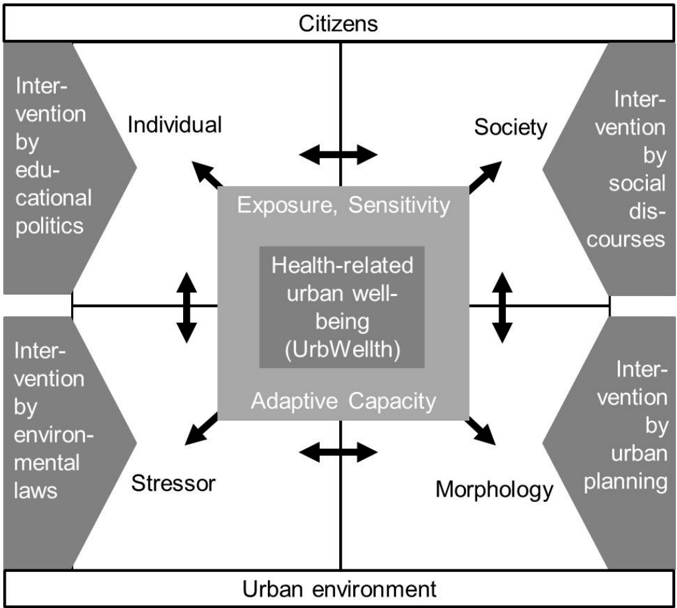
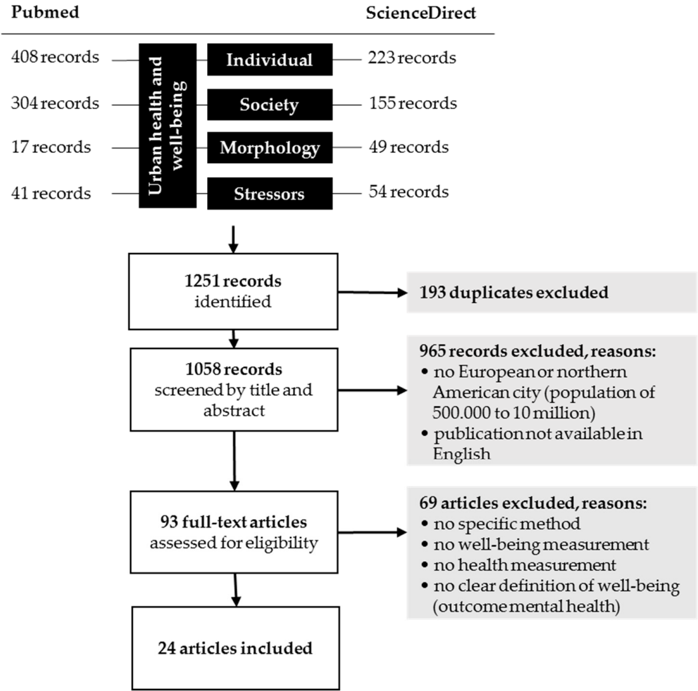
In times of rapid urbanization, health and well-being of citizens is increasingly recognized as a challenge. A remarkable amount of research on relations between urban environments and health or well-being has been conducted. To get an insight about the existing measurements on both health combined with well-being, a systematic literature search was conducted using the databases PubMed and ScienceDirect including references until July 2017. To classify the references a conceptual model describing interrelationships between factors that may be associated with health-related urban well-being was used. The keywords “urban”, “well-being”, and “health” were applied together with factors described in the model. Twenty-four articles met the inclusion criteria. Of these, most studies focused on associations between urban green, health and well-being showing the great importance of green space usage in urban settings to promote better health and well-being. Health was mostly assessed by the General Health Questionnaire (GHQ-12); to measure well-being, the Warwick-Edinburgh Mental Well-Being Scale (WEMWBS) was mostly used. There are still only a few studies investigating the great complexity of urban health and well-being. More specifically, there is a lack in interdisciplinary approaches that highlight the complexity of urban structures and dynamics and their possible influence on urban health and well-being.
Overview
The claims and statistics of this paper haven’t been checked yet.
Free: it reads the open-access text and checks the first 5 claims that cite a source we can check. Create a free account to check every claim.
Integrity signals
Registry
Cites
Statistics
Figures
Verification
Claims the paper makes
The claims and statistics of this paper haven’t been checked yet.
Free: it reads the open-access text and checks the first 5 claims that cite a source we can check. Create a free account to check every claim.
Claims other papers make about this one
Each is checked against this paper’s own text: does it say what the citing paper says it does?
The source backs part of the claim, not all of it — or backs it for a different population, condition or comparison.
In the citing paper
“Urbanisation is a risk factor for poorer mental health (Krefis et al., 2018).”
From Exploring the role of exposure to green and blue spaces in preventing anxiety and depression among young people aged 14–24 years living in urban settings: A systematic review and conceptual framework (2022) · cites this paper as Krefis et al., 2018
Experimental — accuracy not yet measured
Self-check
Percentages, sums and reported differences re-computed from the paper’s own numbers.
The self-check needs the paper’s full text.
Citations
Cites
Promoting ecosystem and human health in urban areas using Green Infrastructure: A literature review
Tzoulas, K., Korpela, K., Venn, S., Yli-Pelkonen, V., Kaźmierczak, A., Niemela, J., & James, P. (2007) · Landscape and Urban Planning · doi:10.1016/j.landurbplan.2007.02.001 · Cited by 2,810
Fine Particulate Air Pollution and Hospital Admission for Cardiovascular and Respiratory Diseases
Dominici, F., Peng, R. D., Bell, M. L., Pham, L., McDermott, A., Zeger, S. L., & Samet, J. M. (2006) · JAMA · doi:10.1001/jama.295.10.1127 · Cited by 2,634 · cited 1×
“5 or PM10) air pollutants has been associated with several health outcomes such as heart failure [64] or chronic respiratory diseases [19].”
BackgroundThat ‘Internet of Things’ Thing
Ashton, K. J. (1999) · Medical Entomology and Zoology · Cited by 2,555
The challenge of defining wellbeing
Dodge, R., Daly, A., Huyton, J., & Sanders, L. (2012) · International Journal of Wellbeing · doi:10.5502/ijw.v2i3.4 · Cited by 2,166 · cited 2×
“The definition for well-being is still challenging, whereby the terms “happiness”, “life satisfaction” or “quality of life” are often used in the same context [11,13].”
BackgroundA Life Course Approach to Chronic Disease Epidemiology
(2004) · doi:10.1093/acprof:oso/9780198578154.001.0001 · Cited by 1,984
Built Environment Correlates of Walking: A Review
SAELENS, B. E., & HANDY, S. L. (2008) · Medicine & Science in Sports & Exercise · doi:10.1249/mss.0b013e31817c67a4 · Cited by 1,912
Ravens-Sieberer, U., & Bullinger, M. (1998) · Quality of Life Research · doi:10.1023/a:1008853819715 · Cited by 1,096 · cited 1×
“The Kid-KINDL questionnaire [56] was used to measure health-related quality of life via self-report.”
MethodWould You Be Happier Living in a Greener Urban Area? A Fixed-Effects Analysis of Panel Data
White, M. P., Alcock, I., Wheeler, B. W., & Depledge, M. H. (2013) · Psychological Science · doi:10.1177/0956797612464659 · Cited by 906 · cited 5×
“By using panel data (1991 to 2008) from the British Household Panel Survey from over 10,000 individuals living in England, White et al. (2013) investigated potential relations between urban green space and well-being (indexed by ratings of life satisfaction) and between urban green space and mental distress (indexed b…”
BackgroundMethodResultInfluentialShaping cities for health: complexity and the planning of urban environments in the 21st century
Rydin, Y., Bleahu, A., Davies, M., Dávila, J. D., Friel, S., De Grandis, G., Groce, N., Hallal, P. C., Hamilton, I., Howden-Chapman, P., et al. (2012) · The Lancet · doi:10.1016/s0140-6736(12)60435-8 · Cited by 839 · cited 1×
“Furthermore, the International Council for Science (ICSU) with their “Science plan on Health and Wellbeing in the Changing Urban Environment” [8,9] focus on this issue and underline the importance for “shaping cities for health” [4].”
BackgroundHealth and climate related ecosystem services provided by street trees in the urban environment
Salmond, J. A., Tadaki, M., Vardoulakis, S., Arbuthnott, K., Coutts, A., Demuzere, M., Dirks, K. N., Heaviside, C., Lim, S., Macintyre, H., et al. (2016) · Environmental Health · doi:10.1186/s12940-016-0103-6 · Cited by 596
Research works printed but not linked: 3
- 1. United Nations, Department of Economic and Social Affairs, Population Division. World Urbanization Prospects: The 2014 Revision, CD-ROM Edition ; United Nations, Department of Economic and Social Affairs, Population Division: New York, NY, USA, 2014.
- 2. Burdett, R.; Taylor, M.; Kaasa, A. Cities, Health and Well-Being: Conference newspaper. In Proceedings of the Hong Kong Urban Age Conference, Hong Kong, China, 16-17 November 2011; pp. 3-44.
- 6. Taylor, M. Cities, health and well-being: Report on a conference organised by LSE Cities at the London School of Economics and Political Science and the Alfred Herrhausen Society, in partnership with the University of Hong Kong. In Proceedings of the Urban Age Conference, Hong Kong, China, 16-17 November 2011; pp. 1-10.
Cited by
Items 101–173 of 173
van Renswouw, L., van Hamersveld, Y., Huibers, H., Vos, S. B., & Lallemand, C. (2022) · CHI Conference Extended Abstracts on Human Factors in Computing Systems (CHI EA) · doi:10.1145/3491101.3519765 · Cited by 6
“Through their design, urban environments can contribute signifcantly to stimulate people to be more active [15, 26].”
BackgroundUrban Wellbeing in the Contemporary City
Biloria, N. M., Reddy, P., Fatimah, Y. A., & Mehta, D. (2019) · S.M.A.R.T. environments · doi:10.1007/978-3-030-12180-8_16 · Cited by 6
Bray, I., Reece, R., Sinnett, D., Martin, F., & Hayward, R. C. (2021) · Research Square · doi:10.21203/rs.3.rs-255123/v1 · Cited by 4
Sarkar, A., & Pujara, T. (2025) · Cities & Health · doi:10.1080/23748834.2025.2457847 · Cited by 5
“In the face of rapid urbanization, the health and well-being of citizens are progressively being recognized as major challenges that require urgent attention (Krefis et al .”
Anwar, R., Elkhateeb, S., Afifi, S. M. Z., & Bayoumi, K. (2025) · Architecture · doi:10.3390/architecture5030076 · Cited by 4
Denkovski, V., & Gavrilov, G. (2022) · EAI Endorsed Transactions on Pervasive Health and Technology · doi:10.4108/eetpht.v8i31.1129 · Cited by 3
“urban residence, indicating to the raised risk concerns on their health in regards to the great number of populations present in urban areas [29, 30, 31].”
BackgroundSaadi, D., Tirosh, E., & Schnell, I. (2021) · The Science of The Total Environment · doi:10.1016/j.scitotenv.2020.144474 · Cited by 3
Corona und die veränderte Wahrnehmung der Stadt
Oßenbrügge, J. (2021) · Springer eBooks · doi:10.1007/978-3-662-63509-4_9 · Cited by 3
Self-citationWhere We Rate: The Impact of Urban Characteristics on Digital Reviews and Ratings
Öztürk, Ö., Hacar, M. A., Gülgen, F., & Pappalardo, L. (2025) · Applied Sciences · doi:10.3390/app15020931 · Cited by 3
Jia, J., Zlatanova, S., Hawken, S., & Zhang, K. (2020) · ISPRS annals of the photogrammetry, remote sensing and spatial information sciences · doi:10.5194/isprs-annals-vi-4-w2-2020-79-2020 · Cited by 5
“With the rapid and highdensity urbanization, protecting human wellbeing has become a huge challenge (Krefis et al., 2018, Thangavel, 2017).”
BackgroundAndrees, V., der Kellen, R. B., Augustin, M., Gallinat, J., Harth, V., Hoven, H., Kühn, S., Lautenbach, A., Magnussen, C., Mohr, N., et al. (2024) · PLoS ONE · doi:10.1371/journal.pone.0301475 · Cited by 2
“They may alter environmental conditions [41, 42] such as air quality, noise, access to healthcare and crime rates.”
BackgroundSelf-citationWang, F., & Liu, M. (2025) · Scientific Reports · doi:10.1038/s41598-025-04468-5 · Cited by 2
The emergence of a modern paradigm for urban health
Grant, M., de Leeuw, E., Caiaffa, W. T., Boufford, J. I., Dora, C. F. C., & Parnell, S. M. (2024) · F1000Research · doi:10.12688/f1000research.154294.1 · Cited by 10
“We have also added a useful conclusion from Krefis, et al, (2018) that there is a lack of interdisciplinary approaches that highlight the complexity of urban structures and dynamics and their possible influence on urban health and well-being.”
Afamefuna, K., Schweiker, M., & Harmsen, J. (2026) · European Review of Applied Psychology · doi:10.1016/j.erap.2025.101140 · Cited by 4
Mensi, L., Grotto, G., & Buja, A. (2026) · Journal of Public Health · doi:10.1007/s10389-026-02699-y · Cited by 2
Smart, L. N., Amaratunga, D., & Haigh, R. (2020) · Springer eBooks · doi:10.1007/978-3-030-44381-8_2 · Cited by 2
Arisha, A. R. (2024) · Advances in Science, Technology & Innovation/Advances in science, technology & innovation · doi:10.1007/978-3-031-54911-3_14 · Cited by 2
Promoting user well-being in central business district: the role of sustainable open spaces
Hussein, S., Aziz, S., & Nasreldin, R. (2024) · Renewable Energy and Sustainable Development · doi:10.21622/resd.2024.10.1.827 · Cited by 2
Loving and Healing a Hurt City: Planning a Green Monterrey Metropolitan Area
Roggema, R., Cisneros, I. I. R., López, R. J., Leal, P. R., Suarez, M. R., & Díaz, M. O. (2025) · Land · doi:10.3390/land14010164 · Cited by 2
Neighbourhood Social Sustainability, Urban Renewal, and Health Inequalities: A Viewpoint
Macassa, G. (2022) · International Journal of Urban Planning and Smart Cities · doi:10.4018/ijupsc.301552 · Cited by 4
Agbabiaka, H. I., Yusuf, F. I., Yussuf, S. O., & Ukpong, E. (2024) · Journal of Facilities Management · doi:10.1108/jfm-11-2021-0142 · Cited by 1
Roy, S., Majumder, S., Bose, A., Kayal, P., & Chowdhury, I. R. (2024) · Climate change management · doi:10.1007/978-3-031-58261-5_30 · Cited by 1
Collage urbanism: Creating sustainable cities through equitable urban resources for good health
Choudhury, D. (2024) · Developments in environmental science · doi:10.1016/b978-0-443-21948-1.00028-5 · Cited by 2
Functional brain imaging and population-level visits to urban spaces
Kaur, A., Rodrigues, A. L., Hoogstraten, S., Blanco-Mora, D. A., Miranda, B., Morgado, P., & Meshi, D. (2024) · Nature Cities · doi:10.1038/s44284-024-00158-x · Cited by 1
A-T-G Louvers: a novel geometry and material driven spatial syntax for flexible structures
Tabari, M. H. S., Khojastehmehr, F., & Filz, G. H. (2025) · Architecture Structures and Construction · doi:10.1007/s44150-025-00150-6 · Cited by 1
“The majority of recent research pertains to the challenges involved in establishing socially sustainable urban areas, towns, and communities [113–115], specifically focusing on the development of socially sustainable cities.”
Spurrier, P., Knibbs, L. D., Mazumdar, S., Lazarevic, N., & Lal, A. (2025) · Environmental Research · doi:10.1016/j.envres.2025.122450 · Cited by 3
Genealogy of the Concept of Healthy Housing
Dehrashid, P. A., Ahmad, P., Mansourian, H., & Khavarian-Garmsir, A. R. (2025) · Climate change management · doi:10.1007/978-3-031-99132-5_9 · Cited by 3
Preventing Frailty Through Healthy Environments: The Slovenian Systemic Pre-Frailty Project
Jutraž, A., Pirnat, N., & Gabrovec, B. (2025) · Buildings · doi:10.3390/buildings15173182 · Cited by 1
Health Funding for Parks and Greenspace: An Innovative Community Investment Strategy
Takenaka, B. P., Seerha, H., Frumkin, H., & Tandon, P. S. (2025) · INQUIRY The Journal of Health Care Organization Provision and Financing · doi:10.1177/00469580251404376 · Cited by 3
Aesthetic components of urban environments and their relation to wellbeing: a scoping review
Chana, K., Dehove, M., Mikuni, J., Specker, E., Knoll, A. L., Barrière, T., Trupp, M. D., Pelowski, M. J., Oberzaucher, E., & Leder, H. (2026) · Cities & Health · doi:10.1080/23748834.2025.2569732 · Cited by 1
“2018, Krefis et al .”
Tanimanidis, I., & Papaspyropoulos, K. G. (2026) · Urban Science · doi:10.3390/urbansci10020098 · Cited by 1
“Urban green contributes to environmental quality, climate regulation, biodiversity conservation, and social well-being, while also providing recreational and cultural benefits to urban residents [11].”
Crenshaw, A., Wang, Y., Leão, A. L. F., Kepper, M. M., Gierbolini-Rivera, R. D., & Reis, R. S. (2025) · Cities & Health · doi:10.1080/23748834.2025.2526875 · Cited by 2
“Urban communities face unique challenges that significantly impact the well-being, health, and overall quality of life of their residents (Krefis et al .”
Feller, R. L., Narraway, C., Burslem, D. F. R. P., Colucci‐Gray, L., van Noordwijk, C., & van der Wal, R. (2026) · PLoS ONE · doi:10.1371/journal.pone.0289446 · Cited by 1
“As cities become increasingly densely populated and built-up, such knowledge is important for informing the development of urban green space policies and conservation programmes to prioritise and ensure effective use of small green spaces for mental well-being [10,11].”
Gal, N., Wang, A. L. M., Franco, A., Chaix, B., & Birenboim, A. (2026) · Social Science & Medicine · doi:10.1016/j.socscimed.2026.119337 · Cited by 3
Mourits, K., Knoops, I., van der Velden, K., & Molleman, G. R. M. (2022) · Cities & Health · doi:10.1080/23748834.2022.2103390 · Cited by 1
“2015, Krefis et al .”
Kuttler, W., Halbig, G., & Oßenbrügge, J. (2023) · Springer eBooks · doi:10.1007/978-3-662-66696-8_21 · Cited by 1
Self-citationLiu, Y., Me, R. C., & Yusoff, I. S. M. (2024) · Springer series in design and innovation · doi:10.1007/978-3-031-60863-6_29 · Cited by 3
Investigating Relationship Between Built Environment and Health: International Best Practices
Stagno, E. (2020) · Smart innovation, systems and technologies · doi:10.1007/978-3-030-48279-4_27 · Cited by 1
Economic prospects for using the excursion potential of urban environments (case of Rostov-on-Don)
Zainullina, T., Kedrova, I., Karich, L., & Tikidzhyyan, R. (2021) · E3S Web of Conferences · doi:10.1051/e3sconf/202127309024 · Cited by 1
DISCOV: Stimulating Physical Activity Through an Explorative Interactive Walking Experience
van Renswouw, L., Verhoef, J., Vos, S. B., & Lallemand, C. (2022) · [ ] With Design: Reinventing Design Modes · doi:10.1007/978-981-19-4472-7_194 · Cited by 1
A Starting Mark of Health Promotion in Jakarta: Voicing the Community’s Perspective
Sokang, Y. A. (2020) · Research Publications (Maastricht University) · doi:10.26481/dis.20200528as · Cited by 1
Debray, H., Kraff, N. J., Zhu, X. X., & Taubenböck, H. (2022) · SSRN Electronic Journal · doi:10.2139/ssrn.3999214 · Cited by 1
Functional brain imaging predicts population-level visits to urban spacesPreprint
Kaur, A., Rodrigues, A. L., Hoogstraten, S., Blanco-Mora, D. A., Miranda, B., Morgado, P., & Meshi, D. (2024) · bioRxiv (Cold Spring Harbor Laboratory) · doi:10.1101/2024.02.16.580650 · Cited by 1
Healthy Places to Play, Learn, and Develop
Boynton‐Jarrett, R. (2019) · Oxford University Press eBooks · doi:10.1093/oso/9780190915858.003.0012 · Cited by 1
Urban resilience to environmental stressors via EO-based smart solutions
Gerasopoulos, E., Athanasopoulou, E., Speyer, O., Bailey, J., Kocman, D., & Karl, M. (2021) · IEEE International Geoscience and Remote Sensing Symposium (IGARSS) · doi:10.1109/igarss47720.2021.9554066
“The environmental pressures defined above constitute significant challenges for the urban physical and mental health, well-being and socio-environmental justice [5, 10, 8].”
BackgroundMtapuri, O. (2022) · Springer eBooks · doi:10.1007/978-981-19-5856-4_1
Hossein, M. (2023) · Eötvös Loránd Tudományegyetem · doi:10.15476/elte.2023.055
Aesthetic Elements of Urban Environments and their relation to Wellbeing: A scoping review.Preprint
Chana, K., Dehove, M., Mikuni, J., Specker, E., Knoll, A. L., Barrière, T., Trupp, M. D., Pelowski, M. J., Oberzaucher, E., & Leder, H. (2024) · OSF Preprints (OSF Preprints) · doi:10.31219/osf.io/nxvtq
ALBUQUERQUE, C. F. H., & Santiago, Z. M. P. (2024) · doi:10.5151/eneac2024-828612
Cities, Health, and Well-Being
Ibarluzea, J. M., Etxarri, A. A., Palacios, P. P. F. D. L., Araolaza-Arrieta, M., Kayı, İ., & Sakarya, S. (2024) · Applied innovation and technology management · doi:10.1007/978-3-031-75649-8_12
TÜRKİYE’NİN KALKINMA PLANLARINDA HALK SAĞLIĞI VE KENTSEL SAĞLIĞIN ELE ALINIŞI
Ala, E., & Aydın, N. (2025) · Uluslararası İktisadi ve İdari İncelemeler Dergisi · doi:10.18092/ulikidince.1513219
Nedeljko, M., Perović, B. T., Flatt, J. D., & Kaučič, B. M. (2025) · Kontakt · doi:10.32725/kont.2025.008
The Arab Noise Pollution and Soundscape Project (ANSP): Preliminary Results and Future Directions
Bouzir, T. A. K., Berkouk, D., Kafyah, W. Z. M., & Aljadaani, A. (2025) · Proceedings in Technology Transfer · doi:10.1007/978-981-97-8588-9_51
A Correlational Study of Physical Environment and Happiness
Aşılıoğlu, F., Çay, R. D., & Şermet, R. (2025) · Chinese Journal of Urban and Environmental Studies · doi:10.1142/s2345748125500083
The Landscape Assessment Scale: A New Tool to Evaluate Environmental Qualities
Marocco, S., Vitale, V., Grossi, E., Talamo, A., & Presaghi, F. (2025) · Sustainability · doi:10.3390/su17177785 · Cited by 1
Roelandt, J., Czymoniewicz‐Klippel, M. T., Simons, M., & de Vet, E. (2025) · Health & Place · doi:10.1016/j.healthplace.2025.103566 · Cited by 1
Healing the city: a diagnostic approach to decoding stress in urban public spaces
Haug, N., Taubenböck, H., Zeile, P., & Neppl, M. (2025) · Cities & Health · doi:10.1080/23748834.2025.2571264
“As a result, these spaces can be more frequently experienced as stressful environments and often lack the qualities that contribute to attractiveness and a human-centred quality of life (Moore 1997, Krefis et al .”
Boso, À., Oltra, C., Martilli, A., Baltazar, S., Ventura, S., Cruces, Á., & Hofflinger, À. (2025) · Social Science Information · doi:10.1177/05390184251396007
“…and daily neighborhood activities, which has been linked to a spectrum of adverse health outcomes including cardiovascular disease, sleep disturbances, and cognitive impairment manifesting as concentration disorders (Jariwala et al., 2017; Krefis et al., 2018; Stansfeld and Matheson, 2003).”
Pagani, L. S. (2025) · Euro-Mediterranean Journal for Environmental Integration · doi:10.1007/s41207-025-00996-8 · Cited by 1
“Green spaces not only improve psychological health but also foster community engagement in environmental stewardship (Krefis et al. 2018).”
INTEGRATION OF MENTAL ILLNESSES WITH URBAN LIFE: A THEMATIC LITERATURE ANALYSIS (2003-2024)
Akbeniz, A. (2025) · Sabuncuoglu Serefeddin Health Sciences · doi:10.55895/sshs.1739423
Measuring Student Wellbeing in Vietnam: Development and Validation of the CSEP ScalePreprint
Khuc, T. N., Nguyen, M., & Nguyen, M. A. (2025) · Research Square · doi:10.21203/rs.3.rs-7280664/v1
AI for urban well-being: using NLP to assess user sentiment in Dubai’s historic spaces
Hossain, S., Nielsen, Y., Seth, H., Alwsh, Z. A., & Elshabshiri, A. (2026) · Smart and Sustainable Built Environment · doi:10.1108/sasbe-10-2025-0650
Datta, S., Mukherjee, T., & Ganguly, A. (2026) · The urban book series · doi:10.1007/978-3-032-17895-4_11
How to improve collaboration across government departments to achieve healthy urban environments
McClatchey, R., Newman, J., Ayres, S., Bates, G., Charlesworth-May, A., & Aldridge, S. (2026) · Contemporary Social Science · doi:10.1080/21582041.2026.2662221 · Cited by 1
Saari, S. (2026) · Scandinavian Journal of Hospitality and Tourism · doi:10.1080/15022250.2026.2670261
“While public health, urban planning, and environmental psychology have explored links between urban environments and well-being (Krefis et al., 2018), tourism research has yet to fully integrate these insights (Chang et al., 2022; Lee et al., 2020).”
Environmental determinants of health in Europe: a multi-factor approach
Vidal-Pando, Á., Echavarren, J. M., & del Rosal, R. S. (2026) · Frontiers in Environmental Science · doi:10.3389/fenvs.2026.1827257
Edge-XReal: distributed Holistic Scene Understanding for edge XR devices
Fiten, G., Winant, S., Chatterjee, J., & Vega, M. T. (2026) · Multimedia Systems · doi:10.21203/rs.3.rs-9745238/v1
A framework to quantify managed retreat outcomes for households and communities
Lauer, H., Jamshed, A., Feldmeyer, D., Mach, K. J., Chaves, C. M. C., & Birkmann, J. (2026) · Climate Risk Management · doi:10.1016/j.crm.2026.100890
Malvezzi, R. (2026) · Urban Science · doi:10.3390/urbansci10100576
The Influence of Urban Environment on Sentiments: A Systematic ReviewPreprint
Betco, I., Ribeiro, A. I., Viana, C. M., & Rocha, J. (2026) · Research Square · doi:10.21203/rs.3.rs-11281653/v1
Gong, C., Wu, Z., & Hu, C. (2026) · Frontiers of Architectural Research · doi:10.1016/j.foar.2026.08.013
Arbel, Y., Rachevski, I., Kerner, A., & Kerner, M. (2026) · Frontiers in Epidemiology · doi:10.3389/fepid.2026.1848489
Metadata
- Authors
- Krefis, A., Augustin, M., Schlünzen, K., Oßenbrügge, J., & Augustin, J.
- Affiliations
- University Medical Center Hamburg-Eppendorf (DE)
- Universität Hamburg (DE)
- Corresponding author
- Krefis, Anne
- Venue
- Urban Science
- Publisher
- MDPI AG
- Published
- 2018-03-02
- Volume
- 2
- Issue
- 1
- Pages
- 21
- ISSN
- 2413-8851 (ISSN-L)
- OpenAlex
- W2790917658
- Cited by
- 173
- References
- 70
- Citations by year
- 2026: 18 · 2025: 28 · 2024: 27 · 2023: 22 · 2022: 27 · 2021: 17 · 2020: 21 · 2019: 11 · 2018: 2
- FWCI
- 1.35
- Type
- journal article
- Language
- en
- Open access
- gold
- doi.org
- Licence
- Locations
- Urban Science (publishedVersion, cc-by)
- Topics
- Social Sciences › Urban Studies › Urban Green Space and Health
- Social Sciences › Transportation › Urban Transport and Accessibility
- Social Sciences › Health › Health disparities and outcomes
- Keywords
- urban health, well-being, urban environment, urban green space, green space use, urbanization, psychological well-being, health measurement, General Health Questionnaire, Warwick-Edinburgh Mental Well-being Scale
About these checks
Registry, retraction, Cites and statistics results are computed, not judged, with one exception: a printed reference that no index lists is read once by a model before it counts as a citation error. Claims are extracted by a model and kept only when their quote appears verbatim in the text; each cited source is then checked, with a model’s help, for whether it says what the claim relies on. Those verdicts can be wrong — read the claim’s quote and the cited source before relying on one.
Statistics and arithmetic are recomputed, not judged.
Confidence bands are shown only for fields calibrated on our annotated test set. None is calibrated yet, so no band is shown.
What counts as a claim ›How we measure confidence ›How we check this ›
Are you an author, or do you see a problem with this page? Request a review
Data sources
Bibliographic data: Semantic Scholar, OpenAlex, Crossref.
Contains information from the Semantic Scholar Academic Graph Datasets, made available under the ODC Attribution License (ODC-BY 1.0).
Semantic Scholar’s data is described in: Kinney, R., et al. (2023). The Semantic Scholar Open Data Platform. arXiv:2301.10140.
