

How Does the Urban Environment Affect Health and Well-Being? A Systematic Review
Open accessThe DOI matches its Crossref record; 69 of the 70 references it cites were found in a registry or an index.
Abstract
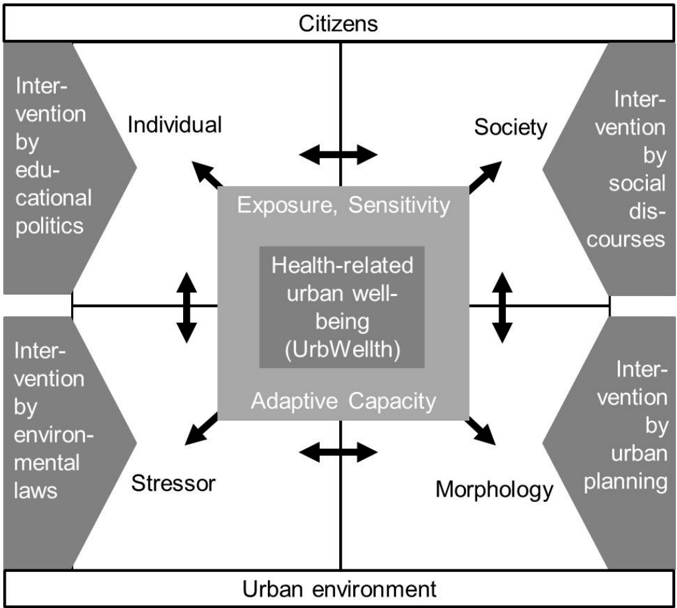
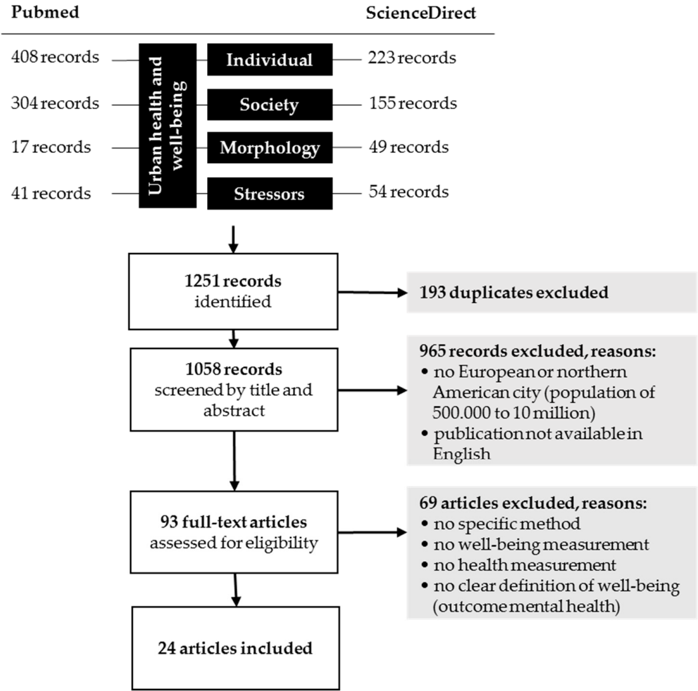
In times of rapid urbanization, health and well-being of citizens is increasingly recognized as a challenge. A remarkable amount of research on relations between urban environments and health or well-being has been conducted. To get an insight about the existing measurements on both health combined with well-being, a systematic literature search was conducted using the databases PubMed and ScienceDirect including references until July 2017. To classify the references a conceptual model describing interrelationships between factors that may be associated with health-related urban well-being was used. The keywords “urban”, “well-being”, and “health” were applied together with factors described in the model. Twenty-four articles met the inclusion criteria. Of these, most studies focused on associations between urban green, health and well-being showing the great importance of green space usage in urban settings to promote better health and well-being. Health was mostly assessed by the General Health Questionnaire (GHQ-12); to measure well-being, the Warwick-Edinburgh Mental Well-Being Scale (WEMWBS) was mostly used. There are still only a few studies investigating the great complexity of urban health and well-being. More specifically, there is a lack in interdisciplinary approaches that highlight the complexity of urban structures and dynamics and their possible influence on urban health and well-being.
Overview
The claims and statistics of this paper haven’t been checked yet.
Free: it reads the open-access text and checks the first 5 claims that cite a source we can check. Create a free account to check every claim.
Integrity signals
Registry
Cites
Statistics
Figures
Verification
Claims the paper makes
The claims and statistics of this paper haven’t been checked yet.
Free: it reads the open-access text and checks the first 5 claims that cite a source we can check. Create a free account to check every claim.
Claims other papers make about this one
Each is checked against this paper’s own text: does it say what the citing paper says it does?
The source backs part of the claim, not all of it — or backs it for a different population, condition or comparison.
In the citing paper
“Urbanisation is a risk factor for poorer mental health (Krefis et al., 2018).”
From Exploring the role of exposure to green and blue spaces in preventing anxiety and depression among young people aged 14–24 years living in urban settings: A systematic review and conceptual framework (2022) · cites this paper as Krefis et al., 2018
Experimental — accuracy not yet measured
Self-check
Percentages, sums and reported differences re-computed from the paper’s own numbers.
The self-check needs the paper’s full text.
Citations
Cites
Promoting ecosystem and human health in urban areas using Green Infrastructure: A literature review
Tzoulas, K., Korpela, K., Venn, S., Yli-Pelkonen, V., Kaźmierczak, A., Niemela, J., & James, P. (2007) · Landscape and Urban Planning · doi:10.1016/j.landurbplan.2007.02.001 · Cited by 2,810
Fine Particulate Air Pollution and Hospital Admission for Cardiovascular and Respiratory Diseases
Dominici, F., Peng, R. D., Bell, M. L., Pham, L., McDermott, A., Zeger, S. L., & Samet, J. M. (2006) · JAMA · doi:10.1001/jama.295.10.1127 · Cited by 2,634 · cited 1×
“5 or PM10) air pollutants has been associated with several health outcomes such as heart failure [64] or chronic respiratory diseases [19].”
BackgroundThat ‘Internet of Things’ Thing
Ashton, K. J. (1999) · Medical Entomology and Zoology · Cited by 2,555
The challenge of defining wellbeing
Dodge, R., Daly, A., Huyton, J., & Sanders, L. (2012) · International Journal of Wellbeing · doi:10.5502/ijw.v2i3.4 · Cited by 2,166 · cited 2×
“The definition for well-being is still challenging, whereby the terms “happiness”, “life satisfaction” or “quality of life” are often used in the same context [11,13].”
BackgroundA Life Course Approach to Chronic Disease Epidemiology
(2004) · doi:10.1093/acprof:oso/9780198578154.001.0001 · Cited by 1,984
Built Environment Correlates of Walking: A Review
SAELENS, B. E., & HANDY, S. L. (2008) · Medicine & Science in Sports & Exercise · doi:10.1249/mss.0b013e31817c67a4 · Cited by 1,912
Ravens-Sieberer, U., & Bullinger, M. (1998) · Quality of Life Research · doi:10.1023/a:1008853819715 · Cited by 1,096 · cited 1×
“The Kid-KINDL questionnaire [56] was used to measure health-related quality of life via self-report.”
MethodWould You Be Happier Living in a Greener Urban Area? A Fixed-Effects Analysis of Panel Data
White, M. P., Alcock, I., Wheeler, B. W., & Depledge, M. H. (2013) · Psychological Science · doi:10.1177/0956797612464659 · Cited by 906 · cited 5×
“By using panel data (1991 to 2008) from the British Household Panel Survey from over 10,000 individuals living in England, White et al. (2013) investigated potential relations between urban green space and well-being (indexed by ratings of life satisfaction) and between urban green space and mental distress (indexed b…”
BackgroundMethodResultInfluentialShaping cities for health: complexity and the planning of urban environments in the 21st century
Rydin, Y., Bleahu, A., Davies, M., Dávila, J. D., Friel, S., De Grandis, G., Groce, N., Hallal, P. C., Hamilton, I., Howden-Chapman, P., et al. (2012) · The Lancet · doi:10.1016/s0140-6736(12)60435-8 · Cited by 839 · cited 1×
“Furthermore, the International Council for Science (ICSU) with their “Science plan on Health and Wellbeing in the Changing Urban Environment” [8,9] focus on this issue and underline the importance for “shaping cities for health” [4].”
BackgroundHealth and climate related ecosystem services provided by street trees in the urban environment
Salmond, J. A., Tadaki, M., Vardoulakis, S., Arbuthnott, K., Coutts, A., Demuzere, M., Dirks, K. N., Heaviside, C., Lim, S., Macintyre, H., et al. (2016) · Environmental Health · doi:10.1186/s12940-016-0103-6 · Cited by 596
Research works printed but not linked: 3
- 1. United Nations, Department of Economic and Social Affairs, Population Division. World Urbanization Prospects: The 2014 Revision, CD-ROM Edition ; United Nations, Department of Economic and Social Affairs, Population Division: New York, NY, USA, 2014.
- 2. Burdett, R.; Taylor, M.; Kaasa, A. Cities, Health and Well-Being: Conference newspaper. In Proceedings of the Hong Kong Urban Age Conference, Hong Kong, China, 16-17 November 2011; pp. 3-44.
- 6. Taylor, M. Cities, health and well-being: Report on a conference organised by LSE Cities at the London School of Economics and Political Science and the Alfred Herrhausen Society, in partnership with the University of Hong Kong. In Proceedings of the Urban Age Conference, Hong Kong, China, 16-17 November 2011; pp. 1-10.
Cited by
Rigolon, A., Browning, M. H. E. M., McAnirlin, O., & Yoon, H. (. (2021) · International Journal of Environmental Research and Public Health · doi:10.3390/ijerph18052563 · Cited by 557
Bray, I., Reece, R., Sinnett, D., Martin, F., & Hayward, R. (2022) · Environmental Research · doi:10.1016/j.envres.2022.114081 · Cited by 124
Navarrete-Hernández, P., & Laffan, K. M. (2019) · Landscape and Urban Planning · doi:10.1016/j.landurbplan.2019.103618 · Cited by 149
Nature-based activities improve the well-being of older adults
Sia, A., Tam, W., Fogel, A. M., Kua, E. H., Khoo, K., & Ho, R. (2020) · Scientific Reports · doi:10.1038/s41598-020-74828-w · Cited by 136
Bioconversion of organic waste by insects – A comprehensive review
Siddiqui, S. A., Harahap, I. A., Osei‐Owusu, J., Saikia, T., Wu, Y. S., Fernando, I., Perestrelo, R., & Câmara, J. S. (2024) · Process Safety and Environmental Protection · doi:10.1016/j.psep.2024.04.122 · Cited by 190
Trade-offs among urban sustainability, pollution and livability in European cities
Martínez-Bravo, M. D. M., Martínez‐del‐Río, J., & Antolín‐López, R. (2019) · Journal of Cleaner Production · doi:10.1016/j.jclepro.2019.03.110 · Cited by 104
Assessing Social Sustainability for Achieving Sustainable Architecture
Lami, I. M., & Mecca, B. (2020) · Sustainability · doi:10.3390/su13010142 · Cited by 87
The role of the physical environment in adolescent mental health
Mueller, M. A. E., Flouri, E., & Kokosi, T. (2019) · Health & Place · doi:10.1016/j.healthplace.2019.102153 · Cited by 96
Is urban living good for mental health?
Lečić‐Toševski, D. (2019) · Current Opinion in Psychiatry · doi:10.1097/yco.0000000000000489 · Cited by 93
Systems approaches for localising the SDGs: co-production of place-based case studies
Tan, D. T., Siri, J. G., Gong, Y., Ong, B., Lim, S. C., MacGillivray, B. H., & Marsden, T. (2019) · Globalization and Health · doi:10.1186/s12992-019-0527-1 · Cited by 85
Happiness in urban green spaces: A systematic literature review
Syamili, M. S., Takala, T., Korrensalo, A., & Tuittila, E. (2023) · Urban forestry & urban greening · doi:10.1016/j.ufug.2023.128042 · Cited by 98
Sundling, C., & Jakobsson, M. (2023) · Sustainability · doi:10.3390/su151410817 · Cited by 70
Wearable Sensors for Human Environmental Exposure in Urban Settings
Helbig, C., Ueberham, M., Becker, A. M., Marquart, H., & Schlink, U. (2021) · Current Pollution Reports · doi:10.1007/s40726-021-00186-4 · Cited by 69
Insights into human-wildlife interactions in cities from bird sightings recorded online
Lopez, B. E., Minor, E. S., & Crooks, A. T. (2020) · Landscape and Urban Planning · doi:10.1016/j.landurbplan.2019.103742 · Cited by 75
Cyclists’ Multiple Environmental Urban Exposures—Comparing Subjective and Objective Measurements
Ueberham, M., Schlink, U., Dijst, M., & Weiland, U. (2019) · Sustainability · doi:10.3390/su11051412 · Cited by 55
Reece, R., Bray, I., Sinnett, D., Hayward, R., & Martin, F. (2021) · Journal of Public Mental Health · doi:10.1108/jpmh-02-2021-0030 · Cited by 50
“Living in an urban environment is a risk factor for poorer mental health (Ventriglio et al., 2021; Lecic-Tosevski, 2019; Krefis et al., 2018).”
BackgroundChi, Y., & Mak, H. W. L. (2021) · Sustainability · doi:10.3390/su13168781 · Cited by 61
Sadeghi, A. R., Ebadi, M., Shams, F., & Jangjoo, S. (2022) · Scientific Reports · doi:10.1038/s41598-022-25414-9 · Cited by 57
A design-support framework to assess urban green spaces for human wellbeing
Jing, J., Zlatanova, S., Liu, H., Aleksandrov, M., & Zhang, K. (2023) · Sustainable Cities and Society · doi:10.1016/j.scs.2023.104779 · Cited by 51
Czekajlo, A., Coops, N. C., Wulder, M. A., Hermosilla, T., Lu, Y., White, J. C., & van den Bosch, M. A. (2020) · International Journal of Applied Earth Observation and Geoinformation · doi:10.1016/j.jag.2020.102210 · Cited by 52
Urban landscape and climate affect residents’ sentiments based on big data
He, H., Sun, R., Li, J., & Li, W. (2023) · Applied Geography · doi:10.1016/j.apgeog.2023.102902 · Cited by 41
Baumgartner, J., Brauer, M. D., & Ezzati, M. (2020) · BMC Medicine · doi:10.1186/s12916-020-1499-y · Cited by 43
Mahmoud, N. S. A., Samanoudy, G. E., & Jung, C. (2022) · Ain Shams Engineering Journal · doi:10.1016/j.asej.2022.101810 · Cited by 45
Aleksejeva, J., Voulgaris, G., & Gasparatos, A. (2022) · Urban forestry & urban greening · doi:10.1016/j.ufug.2022.127632 · Cited by 44
Huebner, G. M., Oreszczyn, T., Direk, K., & Hamilton, I. (2022) · Journal of Environmental Psychology · doi:10.1016/j.jenvp.2022.101763 · Cited by 37
Earth observation: An integral part of a smart and sustainable city
Gerasopoulos, E., Bailey, J., Athanasopoulou, E., Speyer, O., Kocman, D., Raudner, A., Tsouni, A., Kontoes, C., Johansson, C., Georgiadis, C., et al. (2022) · Environmental Science & Policy · doi:10.1016/j.envsci.2022.02.033 · Cited by 31
Le, Q. H., Kwon, N., Nguyen, T. H., Kim, B., & Ahn, Y. (2024) · Building and Environment · doi:10.1016/j.buildenv.2024.112054 · Cited by 35
Christoforou, R., Lange, S., & Schweiker, M. (2024) · Journal of Building Engineering · doi:10.1016/j.jobe.2024.108560 · Cited by 38
Public health benefits from urban horticulture in the global north: A scoping review and framework
Cruz-Piedrahita, C., Howe, C., & de Nazelle, A. J. (2020) · Global Transitions · doi:10.1016/j.glt.2020.10.001 · Cited by 29
Four urban health paradigms: The search for coherence
Kim, J., de Leeuw, E., Harris‐Roxas, B., & Sainsbury, P. (2022) · Cities · doi:10.1016/j.cities.2022.103806 · Cited by 27
Visiting nature is associated with lower socioeconomic inequalities in well-being in Wales
Garrett, J. K., Rowney, F. M., White, M. P., Lovell, R., Fry, R. J., Akbari, A., Geary, R. S., Lyons, R. A., Mizen, A., Nieuwenhuijsen, M. J., et al. (2023) · Scientific Reports · doi:10.1038/s41598-023-35427-7 · Cited by 40
Debray, H., Kraff, N. J., Zhu, X. X., & Taubenböck, H. (2023) · Landscape and Urban Planning · doi:10.1016/j.landurbplan.2023.104711 · Cited by 34
McCormack, G. R., Frehlich, L., Blackstaffe, A., Turin, T. C., & Doyle–Baker, P. K. (2020) · International Journal of Environmental Research and Public Health · doi:10.3390/ijerph17041131 · Cited by 31
Nissen, S., Prendergast, K. B., Aoyagi, M., Burningham, K., Hasan, M. M., Hayward, B., Jackson, T. P., Jha, V., Mattar, H., Schudel, I., et al. (2020) · Sustainable Earth Reviews · doi:10.1186/s42055-020-00039-w · Cited by 38
“The quality of urban environments have a profound effect on young people’s wellbeing [15], life opportunities [16] and agency [17].”
BackgroundThe green divide: A spatial analysis of segregation-based environmental inequality in Vienna
Neier, T. (2023) · Ecological Economics · doi:10.1016/j.ecolecon.2023.107949 · Cited by 30
Environmental economic geography and environmental inequality: challenges and new research prospects
Braun, B., Oßenbrügge, J., & Schulz, C. (2018) · ZFW – Advances in Economic Geography · doi:10.1515/zfw-2018-0001 · Cited by 33
“The second example is based on own research in Hamburg which aims at a better understanding of the relations between stressors in its reproducible and quantitative characteristics on the one hand and its perceived and qualitative characteristics on the other (Krefis et al. 2018).”
BackgroundSelf-citationThe Interplay Between the Built Environment, Health, and Well-Being—A Scoping Review
Andalib, E., Salaj, A. T., Steinert, M., Johansen, A., Aalto, P., & Lohne, J. (2024) · Urban Science · doi:10.3390/urbansci8040184 · Cited by 36
Ling, T.-Y. J., Hung, W.-K., Lin, C.-T., & Lu, M. (2020) · Sustainability · doi:10.3390/su122310020 · Cited by 31
Creating active urban environments: insights from expert interviews
van Renswouw, L., Lallemand, C., van Wesemael, P. J. V., & Vos, S. B. (2022) · Cities & Health · doi:10.1080/23748834.2022.2132585 · Cited by 42
Geary, R. S., Thompson, D. A., Garrett, J. K., Mizen, A., Rowney, F. M., Song, J., White, M. P., Lovell, R., Watkins, A. J., Lyons, R. A., et al. (2023) · Public Health Research · doi:10.3310/lqpt9410 · Cited by 48
Analyzing the Impact of Green Roof Functions on the Citizens' Mental Health in Metropolitan Cities
Rezaei, M., Emmanuel, N., Kim, J., & Kim, D. H. (2021) · Iranian Journal of Public Health · doi:10.18502/ijph.v50i5.6107 · Cited by 22
“For instance, urbanization caused a lack of green spaces and consequently decreased citizens' health (physical and mental) living with high levels of environmental stress and tension (3, 4).”
BackgroundStructural deviations drive an uncanny valley of physical places
Diel, A., & Lewis, M. B. (2022) · Journal of Environmental Psychology · doi:10.1016/j.jenvp.2022.101844 · Cited by 36
Orii, L., Alonso, L., & Larson, K. (2020) · Sustainability · doi:10.3390/su12229458 · Cited by 29
“Mental Health, which is oftentimes subjectively evaluated through social survey data and self-reported scores [22,25,35], can be measured through the amount of exposure to nature, mental health support, opportunities for interaction, and perception of safety.”
InfluentialChang, H., Huang, J., Yao, W., Zhao, W., & Li, L. (2022) · Transport Policy · doi:10.1016/j.tranpol.2022.03.011 · Cited by 21
Cortesi, A., Vardopoulos, I., & Salvati, L. (2022) · Urban Science · doi:10.3390/urbansci6040069 · Cited by 24
Employing citizen science to enhance active and healthy ageing in urban environments
Wood, G., Pykett, J., Banchoff, A., King, A. C., & Stathi, A. (2022) · Health & Place · doi:10.1016/j.healthplace.2022.102954 · Cited by 22
Factors affecting the development of a healthy city in Suburban areas, Thailand
Iamtrakul, P., & Chayphong, S. (2023) · Journal of Urban Management · doi:10.1016/j.jum.2023.04.002 · Cited by 30
Dorji, T., Morrison‐Saunders, A., & Blake, D. (2023) · Environmental Management · doi:10.1007/s00267-023-01833-w · Cited by 33
“…reviews on wellbeing and climate change have focused on wellbeing, health, and climate change (Chersich et al. 2018; Aldridge and McChesney 2018; Krefis et al. 2018; Moore et al. 2018; Oh et al. 2017), wellbeing and climate change mitigation (Creutzig et al. 2021; Lamb and Steinberger 2017a),…”
BackgroundLing, T.-Y. J. (2021) · Environment Development and Sustainability · doi:10.1007/s10668-020-01197-9 · Cited by 20
Spatial Equity of Public Parks: A Case Study of Kabul City, Afghanistan
Mushkani, R. A., & Ono, H. (2021) · Sustainability · doi:10.3390/su13031516 · Cited by 22
The simple urban radiation model for estimating mean radiant temperature in idealised street canyons
Fischereit, J. (2020) · Urban Climate · doi:10.1016/j.uclim.2020.100694 · Cited by 18
Placemaking and infrastructure through the lens of levelling up for health equity: A scoping review
Couper, I., Jaques, K., Reid, A., & Harris, P. J. (2023) · Health & Place · doi:10.1016/j.healthplace.2023.102975 · Cited by 19
Densification versus urban sprawl. Modeling the impact of two urban growth scenarios on air quality
Valencia, V. H., Levin, G., & Ketzel, M. (2023) · Atmospheric Environment · doi:10.1016/j.atmosenv.2023.119963 · Cited by 17
Santi, G., Leporelli, E., & Sivo, M. D. (2019) · Sustainability · doi:10.3390/su11061585 · Cited by 18
Deep Learning to Unveil Correlations between Urban Landscape and Population Health
Pala, D., Caldarone, A. A., Franzini, M., Malovini, A. L., Larizza, C., Casella, V. M., & Bellazzi, R. (2020) · Sensors · doi:10.3390/s20072105 · Cited by 23
An analytical framework for assessing heat vulnerability in urban thermal environmental planning
Kim, Y., & Kim, Y. (2024) · Urban Climate · doi:10.1016/j.uclim.2024.102145 · Cited by 20
Psycho-behavioral responses to urban scenes: An exploration through eye-tracking
Tavakoli, A., Douglas, I. P., Noh, H. Y., Hwang, J., & Billington, S. L. (2024) · Cities · doi:10.1016/j.cities.2024.105568 · Cited by 20
Navarrete-Hernández, P., & Zegras, P. C. (2023) · Transportation Research Part A Policy and Practice · doi:10.1016/j.tra.2023.103670 · Cited by 34
Baruwa, O. J., Gbadebo, B. M., Adeleye, O. J., Tabana, H., & Fagbamigbe, A. F. (2023) · BMC Women s Health · doi:10.1186/s12905-023-02813-2 · Cited by 18
“Specifically, we considered independent variables for which there is empirical evidence supporting their relationship with overweight and obesity [7, 12, 35, 36].”
BackgroundResultInfluentialPettersen, G. R., Nordbø, E. C. A., Ese, J., & Ihlebæk, C. (2023) · Wellbeing Space and Society · doi:10.1016/j.wss.2023.100133 · Cited by 23
van Renswouw, L., Vos, S. B., van Wesemael, P. J. V., & Lallemand, C. (2021) · Designing Interactive Systems Conference · doi:10.1145/3461778.3462137 · Cited by 19
“Design of ‘activating’ urban environments can be an effective trigger to subconsciously nudge people into moving [34]][23].”
BackgroundPool, U., Kenyon, A., Froggett, L., & Dooris, M. (2023) · International Journal of Environmental Research and Public Health · doi:10.3390/ijerph20146355 · Cited by 18
Objective well-being level (OWL) composite indicator for sustainable and resilient cities
Sebestyén, V., Trájer, A. J., Domokos, E., Torma, A., & Abonyi, J. (2024) · Ecological Indicators · doi:10.1016/j.ecolind.2023.111460 · Cited by 17
Shoaib, A., Nadeem, K., Islam, H. S., & Saleemi, A. H. (2021) · GeoJournal · doi:10.1007/s10708-021-10545-9 · Cited by 16
“This rapid growth impacts sustainable development and reduces green space areas for residents in cities on varying levels and intensities (Jim et al., 2018; Krefis et al., 2018).”
BackgroundInfluence of Wind Buffers on the Aero-Thermal Performance of Skygardens
Mohammadi, M., Tien, P. W., & Calautit, J. K. (2020) · Fluids · doi:10.3390/fluids5030160 · Cited by 13
Hanf, F. S., Ament, F., Boettcher, M., Burgemeister, F., Gaslikova, L., Hoffmann, P., Knieling, J., Matthias, V., Meier, L., Pein, J. U., et al. (2025) · International Journal of Urban Sustainable Development · doi:10.1080/19463138.2025.2474399 · Cited by 20
“Urban health involves both objec-tive (physical health) as well as subjective (mental health) dimensions (Krefis et al. 2018).”
Self-citationNenadović, A., & Milošević, J. (2022) · Sustainability · doi:10.3390/su14042133 · Cited by 13
Water sources for street trees in mesic urban environments
Smith, I. A., Templer, P. H., & Hutyra, L. R. (2023) · The Science of The Total Environment · doi:10.1016/j.scitotenv.2023.168411 · Cited by 11
Pleshkanovska, А. (2020) · Bulletin of Geography Socio-economic series · doi:10.2478/bog-2020-0019 · Cited by 11
Re-Imaging the Future in Urban Studies and Built Environment Discourse: A Neurourbanism Perspective
Ndaguba, E. A., Cilliers, E. J., Mbanga, S., Brown, K. A., & Ghosh, S. (2022) · Buildings · doi:10.3390/buildings12122056 · Cited by 18
Teng, M., Suo, J., Zhong, H., Kou, N., Song, B., & Li, G. (2023) · Psychology Research and Behavior Management · doi:10.2147/prbm.s401082 · Cited by 10
Ngom, R. V., Chouto, S., Doua, S. A., Garabed, R. B., Pagnah, A. Z., & Gonné, B. (2019) · International Journal of Health Geographics · doi:10.1186/s12942-019-0186-8 · Cited by 10
Vaz, C. T., Andrade, A. C. D. S., Silva, U. M., Rodríguez, D., Wang, X., Moore, K., Friche, A. A. D. L., Roux, A. V. D., & Caiaffa, W. T. (2020) · International Journal of Environmental Research and Public Health · doi:10.3390/ijerph17238956 · Cited by 9
Jóźwik, R., & Jóźwik, A. (2021) · Sustainability · doi:10.3390/su14010086 · Cited by 11
The Social Equity Of Public Green Open Space Accessibility: The Case Of South Tangerang, Indonesia
Kurniawan, H., & Roychansyah, M. S. (2023) · GEOGRAPHY ENVIRONMENT SUSTAINABILITY · doi:10.24057/2071-9388-2022-124 · Cited by 14
Fan, P., Chen, J., & Sarker, T. (2022) · Sustainability · doi:10.3390/su14042342 · Cited by 9
A cross-sectional analysis of gender and psychological well-being among older Taiwanese adults
Fergus, D. N., Chen, Y., Chuang, Y., Sandra, A., & Chuang, K. (2024) · Frontiers in Psychology · doi:10.3389/fpsyg.2024.1392007 · Cited by 9
“On the other hand, cities also provide opportunities for social interactions and participation in social activities which can improve well-being (Krefis et al., 2018).”
BackgroundInfluentialSirin, D., Hoffmann, P., & Scheffran, J. (2024) · Sustainable Cities and Society · doi:10.1016/j.scs.2024.106069 · Cited by 11
Brightness Motivates Healthy Behaviors: The Role of Self-Accountability
Chan, E. Y. (2021) · Environment and Behavior · doi:10.1177/00139165211026609 · Cited by 9
“Previous work has found that environmental forces such as urbanization (Krefis et al., 2018) and access to green spaces (Tamosiunas et al., 2014) play a role in physical health.”
BackgroundMoore, H. E., Siriwardena, A. N., Gussy, M. G., Hill, B., Tanser, F. C., & Spaight, R. (2022) · American Journal of Men s Health · doi:10.1177/15579883221082428 · Cited by 8
“These factors might include features of environmental landscapes, such as access to health-promoting services and spaces (Krefis et al., 2018), like general practitioners and green spaces that are known to promote wellbeing (Hartig et al.”
BackgroundZhou, X., Ao, R., Zhu, Y., Chen, J., Xue, S., & Aihemaitijiang, Y. (2023) · PLoS ONE · doi:10.1371/journal.pone.0289754 · Cited by 8
“[34] pointed out that urban settlements are associated with physical (objective health status), psychological (personal health status) and healthy emotional (emotional well-being) aspects of individuals.”
BackgroundDesigning (with) AI for Wellbeing
Dritsa, D., van Renswouw, L., Colombo, S., Väänänen, K., Bogers, S., Martinez, A., Holbrook, J., & Brombacher, A. (2024) · CHI Conference Extended Abstracts on Human Factors in Computing Systems (CHI EA) · doi:10.1145/3613905.3636282 · Cited by 13
“…wellbeing signifies a positive, optimistic, and holistic approach to health, going beyond the absence of illness and aiming to optimize quality of life by proactively addressing health-related issues, promoting positive behaviors, and focusing on prevention rather than treat-ment [7, 21, 54].”
Suaib (2024) · International Journal of Religion · doi:10.61707/8d422b64 · Cited by 10
“When all these factors are linked in the context of urban community quality of life, the dynamics of the urban environment can influence individuals' psychological well-being (Krefis et al., 2018).”
BackgroundJana, A., Sarkar, A., & Bardhan, R. (2022) · Area Development and Policy · doi:10.1080/23792949.2022.2043171 · Cited by 7
“Health and individual well-being are deeply influenced by structural design and spatial and community planning (Song et al., 2021) and the way they shape access to open green spaces, vegetation environments, neighbourhood density and housing quality (Krefis et al., 2018; Zuniga-Teran et al., 2016).”
BackgroundResidential greenspace and COVID-19 morbidity and mortality: A nationwide cohort study in Denmark
Zhang, J., Lim, Y.-H., Chen, J., Hyman, S., Cole‐Hunter, T., Tuffier, S., Napolitano, G. M., Bergmann, M. L., Mortensen, L. H., Brandt, J. G., et al. (2024) · Environment International · doi:10.1016/j.envint.2024.109173 · Cited by 6
Damen, I., Brankaert, R., Xue, M., Chen, X., Grave, A., & Vos, S. B. (2019) · CHI Conference Extended Abstracts on Human Factors in Computing Systems (CHI EA) · doi:10.1145/3290607.3299051 · Cited by 6
“Krefis’ recent systematic review on the effects of the urban environment on health and well-being shows a lack of interdisciplinary research approaches that convey the complexity of urban structures and health and well-being [12].”
BackgroundWan, J., Zhao, Y., Chen, Y., Wang, Y., Su, Y., Song, X., Zhang, S., Zhang, C., Zhu, W., & Yang, J. (2022) · International Journal of Environmental Research and Public Health · doi:10.3390/ijerph19084501 · Cited by 8
Al-Obaidi, T., Prior, J., & McIntyre, E. (2022) · Sustainability · doi:10.3390/su142315536 · Cited by 6
Jiang, H., Chen, M., Meng, X., Qiao, H., Lang, D., & Zhang, Z. (2025) · Remote Sensing of Environment · doi:10.1016/j.rse.2025.115050 · Cited by 10
Suárez, N. R. E., Desrosiers, F., Prokop, L. J., Dupéré, S., & Diallo, T. (2024) · BMJ Open · doi:10.1136/bmjopen-2023-078396 · Cited by 10
Lin, T., Cai, J., Geng, H., Zheng, Y., Zeng, Z., & Zheng, Y. (2024) · Nature-Based Solutions · doi:10.1016/j.nbsj.2024.100122 · Cited by 11
Social Support and Social Participation among Urban Community in Malaysia
Ahmad, J., Ahmad, A. R., Malek, J. A., & Ahmad, N. A. I. L. (2018) · International Journal of Academic Research in Business and Social Sciences · doi:10.6007/ijarbss/v8-i6/4246 · Cited by 5
Choongo, P., Eijdenberg, E. L., Lungu, J., Chabala, M., Taylor, T. K., & Masurel, E. (2020) · Elsevier eBooks · doi:10.1016/b978-0-12-817465-4.00010-8 · Cited by 5
The Impact of Urban art on Wellbeing: A Laboratory Study
Dehove, M., Mikuni, J., Podolin-Danner, N., Leder, H., & Oberzaucher, E. (2024) · Empirical Studies of the Arts · doi:10.1177/02762374241298878 · Cited by 6
“Engaging with urban green spaces positively in fl uences environmental, social, physical, and subjective wellbeing (see the reviews: Jabbar et al., 2022; Kre fi s et al., 2018; Mensah et al., 2016; Papastergiou et al., 2023; Reyes-Riveros et al., 2021).”
Sargolini, M., Sopina, A., Polci, V., Mariani, D., Paolini, C., & Mariani, M. (2025) · Sustainability · doi:10.3390/su172210014 · Cited by 9
Douglas, J. W. A., Willcock, S., Kibowski, F., Marshall, T. P., & Jones, L. (2026) · Ecosystems and People · doi:10.1080/26395916.2026.2624444 · Cited by 9
Voting-Based Intervention Planning Using AI-Generated Images
Kavouras, I., Rallis, I., Sardis, E., Doulamis, A. D., & Doulamis, N. D. (2025) · IEEE Computer Graphics and Applications · doi:10.1109/mcg.2025.3553620 · Cited by 6
NATURE-DEFICIT DISORDER IN MODERN CITIES
NIKKHOU, A. S. M., & Tezer, A. (2020) · WIT transactions on ecology and the environment · doi:10.2495/sdp200331 · Cited by 4
Votsi, N.-E., Papangelis, G., Varotsos, K. V., Athanasopoulou, E., Koutsantoni, P., Karali, A., Karagianis, D., Sismanidis, P., Kiranoudis, C. T., Keramitsoglou, I., et al. (2025) · Euro-Mediterranean Journal for Environmental Integration · doi:10.1007/s41207-025-00746-w · Cited by 5
“The poor air quality in cities has resulted in air pollution being an important environmental stressor (Krefis et al. 2018).”
The happiness of Chinese cities
Qian, H., Guo, Q., Zhou, S., & Su, Y. (2021) · Journal of Urban Affairs · doi:10.1080/07352166.2021.1962721 · Cited by 5
Metadata
- Authors
- Krefis, A., Augustin, M., Schlünzen, K., Oßenbrügge, J., & Augustin, J.
- Affiliations
- University Medical Center Hamburg-Eppendorf (DE)
- Universität Hamburg (DE)
- Corresponding author
- Krefis, Anne
- Venue
- Urban Science
- Publisher
- MDPI AG
- Published
- 2018-03-02
- Volume
- 2
- Issue
- 1
- Pages
- 21
- ISSN
- 2413-8851 (ISSN-L)
- OpenAlex
- W2790917658
- Cited by
- 173
- References
- 70
- Citations by year
- 2026: 18 · 2025: 28 · 2024: 27 · 2023: 22 · 2022: 27 · 2021: 17 · 2020: 21 · 2019: 11 · 2018: 2
- FWCI
- 1.35
- Type
- journal article
- Language
- en
- Open access
- gold
- doi.org
- Licence
- Locations
- Urban Science (publishedVersion, cc-by)
- Topics
- Social Sciences › Urban Studies › Urban Green Space and Health
- Social Sciences › Transportation › Urban Transport and Accessibility
- Social Sciences › Health › Health disparities and outcomes
- Keywords
- urban health, well-being, urban environment, urban green space, green space use, urbanization, psychological well-being, health measurement, General Health Questionnaire, Warwick-Edinburgh Mental Well-being Scale
About these checks
Registry, retraction, Cites and statistics results are computed, not judged, with one exception: a printed reference that no index lists is read once by a model before it counts as a citation error. Claims are extracted by a model and kept only when their quote appears verbatim in the text; each cited source is then checked, with a model’s help, for whether it says what the claim relies on. Those verdicts can be wrong — read the claim’s quote and the cited source before relying on one.
Statistics and arithmetic are recomputed, not judged.
Confidence bands are shown only for fields calibrated on our annotated test set. None is calibrated yet, so no band is shown.
What counts as a claim ›How we measure confidence ›How we check this ›
Are you an author, or do you see a problem with this page? Request a review
Data sources
Bibliographic data: Semantic Scholar, OpenAlex, Crossref.
Contains information from the Semantic Scholar Academic Graph Datasets, made available under the ODC Attribution License (ODC-BY 1.0).
Semantic Scholar’s data is described in: Kinney, R., et al. (2023). The Semantic Scholar Open Data Platform. arXiv:2301.10140.
