

Using Google Trends to Predict COVID-19 Vaccinations and Monitor Search Behaviours about Vaccines: A Retrospective Analysis of Italian Data
Open accessThe DOI matches its Crossref record; 33 of the 33 references it cites were found in a registry or an index.
Abstract
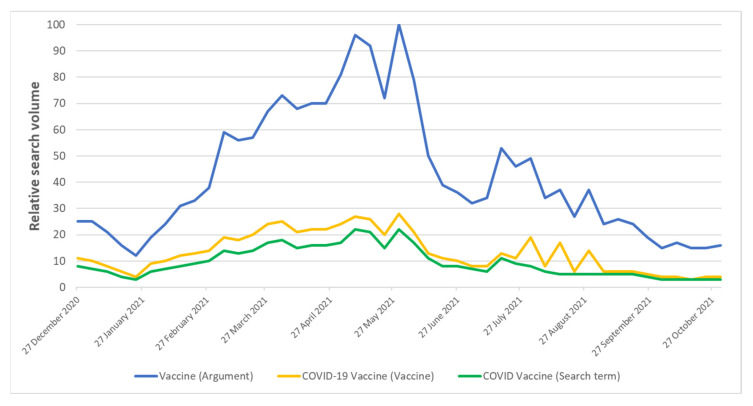
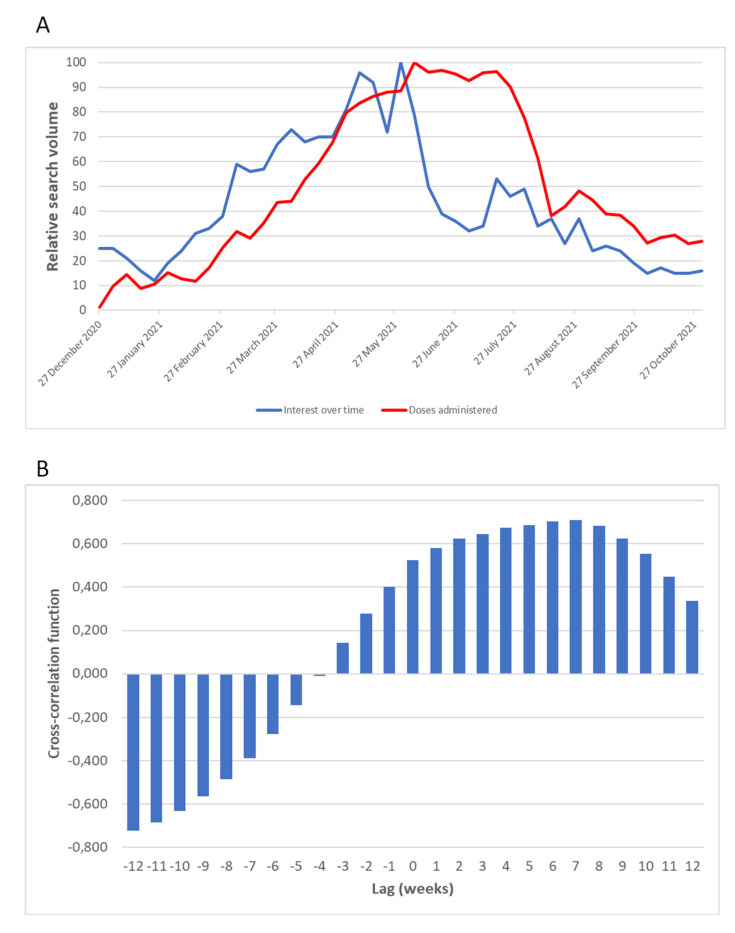
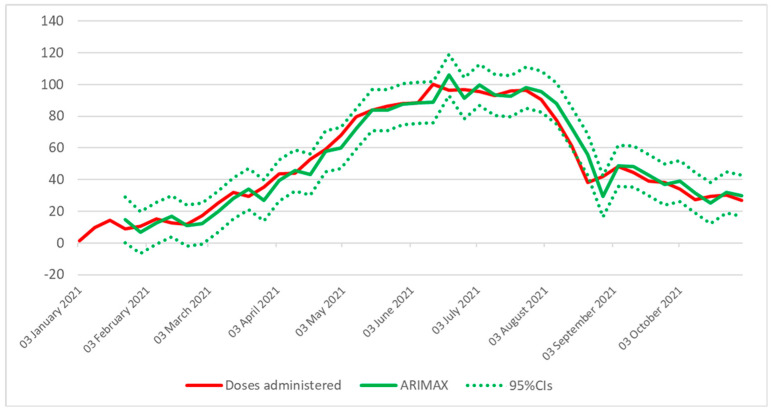
Google Trends data are an efficient source for analysing internet search behaviour and providing valuable insights into community dynamics and health-related problems. In this article, we aimed to evaluate if Google Trends data could help monitor the COVID-19 vaccination trend over time and if the introduction of COVID-19 vaccines modified the interest of pregnant women in vaccination. Data related to Google internet searches and the number of vaccine doses administered in Italy were used. We found moderate to strong correlations between search volumes of vaccine-related terms and the number of vaccines administered. In particular, a model based on Google Trends with a 3-week lag showed the best performance in fitting the number of COVID-19 vaccinations over time. We also observed that the introduction of COVID-19 vaccines affected the search interest for the argument “vaccination in pregnancy” both quantitatively and qualitatively. There was a significant increase in the search interest after the launch of the COVID-19 vaccination campaign in Italy. Qualitative analysis suggested that this increase was probably due to concerns about COVID-19 vaccines. Thus, our study suggests the benefits of using Google Trends data to predict the number of COVID-19 vaccine doses administered, and to monitor feelings about vaccination.
Overview
The claims and statistics of this paper haven’t been checked yet.
Free: it reads the open-access text and checks the first 5 claims that cite a source we can check. Create a free account to check every claim.
Integrity signals
Registry
Cites
Statistics
Figures
Verification
Claims the paper makes
The claims and statistics of this paper haven’t been checked yet.
Free: it reads the open-access text and checks the first 5 claims that cite a source we can check. Create a free account to check every claim.
Claims other papers make about this one
Each is checked against this paper’s own text: does it say what the citing paper says it does?
The cited source says what the claim attributes to it.
In the citing paper
“Google Trends is a valuable tool for investigating the level of interest of the general public in a specific topic.”
From Public and Research Interest in Telemedicine From 2017 to 2022: Infodemiology Study of Google Trends Data and Bibliometric Analysis of Scientific Literature (2024) · cites this paper as [29]
Self-check
Percentages, sums and reported differences re-computed from the paper’s own numbers.
The self-check needs the paper’s full text.
Citations
Cites
Benchimol, E. I., Smeeth, L., Guttmann, A., Harron, K., Moher, D., Petersen, I., Sørensen, H. T., von Elm, E., Langan, S. M., & RECORD Working Committee (2015) · PLOS Medicine · doi:10.1371/journal.pmed.1001885 · Cited by 5,749 · cited 1×
“This study was conducted in accordance with the REporting of studies Conducted using Observational Routinely-collected health Data (RECORD) statement [18] and checklist (Supplementary Table S1).”
MethodWu, J. T., Leung, K., & Leung, G. M. (2020) · The Lancet · doi:10.1016/s0140-6736(20)30260-9 · Cited by 4,389
Detecting influenza epidemics using search engine query data
Ginsberg, J., Mohebbi, M. H., Patel, R. S., Brammer, L., Smolinski, M. S., & Brilliant, L. (2009) · Nature · doi:10.1038/nature07634 · Cited by 4,295
Modelling the COVID-19 epidemic and implementation of population-wide interventions in Italy
Giordano, G., Blanchini, F., Bruno, R., Colaneri, P., Di Filippo, A., Di Matteo, A., & Colaneri, M. (2020) · Nature Medicine · doi:10.1038/s41591-020-0883-7 · Cited by 1,740
Spread and dynamics of the COVID-19 epidemic in Italy: Effects of emergency containment measures
Gatto, M., Bertuzzo, E., Mari, L., Miccoli, S., Carraro, L., Casagrandi, R., & Rinaldo, A. (2020) · Proceedings of the National Academy of Sciences · doi:10.1073/pnas.2004978117 · Cited by 1,051
Kucharski, A. J., Klepac, P., Conlan, A. J. K., Kissler, S. M., Tang, M. L., Fry, H., Gog, J. R., Edmunds, W. J., Emery, J. C., Medley, G., et al. (2020) · The Lancet Infectious Diseases · doi:10.1016/s1473-3099(20)30457-6 · Cited by 900
Digital disease detection - harnessing the Web for public health surveillance
Brownstein, J. S., Freifeld, C. C., & Madoff, L. C. (2009) · New England Journal of Medicine · doi:10.1056/nejmp0900702 · Cited by 819
Infodemiology and Infoveillance
Eysenbach, G. (2011) · American Journal of Preventive Medicine · doi:10.1016/j.amepre.2011.02.006 · Cited by 414
Cascini, F., Pantovic, A., Al-Ajlouni, Y., Failla, G., & Ricciardi, W. (2021) · EClinicalMedicine · doi:10.1016/j.eclinm.2021.101113 · Cited by 396 · cited 1×
“This has resulted in high levels of vaccine hesitancy, especially among more deprived communities and ethnic minority groups [31,32].”
BackgroundMavragani, A., Ochoa, G., & Tsagarakis, K. P. (2018) · Journal of Medical Internet Research · doi:10.2196/jmir.9366 · Cited by 390
Research works printed but not linked: 1
- Box G. Time Series Analysis: Forecasting and Control; Palgrave Macmillan, London, UK, 2015
Cited by
How Wearable Sensors Can Support the Research on Foetal and Pregnancy Outcomes: A Scoping Review
Maugeri, A., Barchitta, M., & Agodi, A. (2023) · Journal of Personalized Medicine · doi:10.3390/jpm13020218 · Cited by 51
Self-citationBrabandere, L. D., Hendrickx, G., Poels, K., Daelemans, W. M. P., Damme, P. V., & Maertens, K. (2023) · BMJ Open · doi:10.1136/bmjopen-2022-066367 · Cited by 38
Spatiotemporal evolution of online attention to vaccines since 2011: An empirical study in China
Hu, F., Qiu, L., Xia, W., Liu, C.-F., Xi, X., Zhao, S., Yu, J., Wei, S., Hu, X., Su, N., et al. (2022) · Frontiers in Public Health · doi:10.3389/fpubh.2022.949482 · Cited by 28
Maugeri, A., Barchitta, M., Basile, G., & Agodi, A. (2024) · Journal of Medical Internet Research · doi:10.2196/50088 · Cited by 20
Self-citationSasse, K., Mahabir, R., Gkountouna, O., Crooks, A. T., & Croitoru, A. (2024) · PLoS ONE · doi:10.1371/journal.pone.0301488 · Cited by 16
Maugeri, A., Barchitta, M., Basile, G., & Agodi, A. (2022) · Antibiotics · doi:10.3390/antibiotics11030379 · Cited by 13
Self-citationSung, H., Dabrundashvili, N., & Baek, S. (2023) · Sustainable Cities and Society · doi:10.1016/j.scs.2023.104842 · Cited by 13
Is googling risky? A study on risk perception and experiences of adverse consequences in web search
Häußler, H., Schultheiß, S., & Lewandowski, D. (2023) · Journal of the Association for Information Science and Technology · doi:10.1002/asi.24802 · Cited by 9
“For example, a person could be exposed to incorrect search results and base relevant decisions on erroneous information, potentially severely threatening their health and well-being (Lin et al., 2020; Maugeri et al., 2022).”
BackgroundSigalo, N., Awasthi, N., Abrar, S. M., & Frías-Martínez, V. (2023) · JMIR Infodemiology · doi:10.2196/43703 · Cited by 8
Maugeri, A., Barchitta, M., Perticone, V., & Agodi, A. (2023) · International Journal of Environmental Research and Public Health · doi:10.3390/ijerph20031976 · Cited by 8
Self-citationGoogle Trends applications for COVID-19 pandemic: A bibliometric analysis
Li, H., Zhang, N., Ma, X., Wang, Y., Yang, F., Wang, W., Huang, Y., Xie, Y., & Du, Y. (2025) · Digital Health · doi:10.1177/20552076241310055 · Cited by 7
Mehra, M., Brody, P. A., Kollapaneni, S. S., Sakhalkar, O. V., & Rahimi, S. Y. (2023) · Cureus · doi:10.7759/cureus.45984 · Cited by 7
“Furthermore, current and future applications include the ability to predict patient decisions and trends, which can be utilized to make decisions that affect public health [6].”
BackgroundCho, J., Kwon, S., Lee, J.-S., Lee, J., Lee, J.-H., Chae, Y., & Lee, E. (2024) · BMC Public Health · doi:10.1186/s12889-024-20973-0 · Cited by 6
“Maugery et al. [38] suggested that Google Trends provides insights into fears and concerns regarding vaccination.”
15 years of research on Google Trends: A bibliometric review and future research directionsPreprint
Madsen, D. Ø., Silva, E. S., & Sohail, S. S. (2023) · Research Square · doi:10.21203/rs.3.rs-2826296/v1 · Cited by 5
Gentile, L., Bertuccio, P., Ancona, A., Cucchi, A., Dallagiacoma, G., Godoy, M. A., Signorelli, C., & Odone, A. (2023) · Acta bio-medica dell'Ateneo parmense/Acta biomedica · doi:10.23750/abm.v94is3.14558 · Cited by 4
Rovetta, A. (2023) · Healthcare Analytics · doi:10.1016/j.health.2023.100272 · Cited by 3
Zhang, Y., Guo, X., & Su, Y. (2024) · PLoS ONE · doi:10.1371/journal.pone.0312488 · Cited by 3
Maugeri, A., Barchitta, M., Zaffar, S. M., & Agodi, A. (2025) · International Journal of Environmental Research and Public Health · doi:10.3390/ijerph22060941 · Cited by 2
Self-citationLin, T.-W., Tsai, T.-H., Tsai, C.-L., & Chang, P.-C. (2025) · Cornea Open · doi:10.1097/coa.0000000000000066 · Cited by 1
Kłak, A., Furmańczyk, K., Nowicka, P., Mańczak, M., Barańska, A., Religioni, U., Siekierska, A., Ambroziak, M., & Chłopek, M. (2022) · International Journal of Environmental Research and Public Health · doi:10.3390/ijerph192013275 · Cited by 1
Assessing the Public’s Interest in Orofacial Pain Specialists: A Google Trends Analysis
Botros, J., & Padilla, M. (2023) · Journal of Oral Medicine and Pain · doi:10.14476/jomp.2023.48.4.137 · Cited by 1
Liu, Y., Ran, L., Wang, Y., & Xia, Y. (2025) · BMC Public Health · doi:10.1186/s12889-025-21740-5 · Cited by 1
Azmoude, E., Larki, M., Marvi, N., & Roudsari, R. L. (2023) · Current Women s Health Reviews · doi:10.2174/1573404820666230504102912
Hsu, P.-S., Huang, C.-C., Sung, W.-Y., Tsai, H.-Y., Wu, Z.-X., Lin, T.-Y., Lin, K.-P., & Liu, G.-S. (2023) · Journal of Intelligent & Fuzzy Systems · doi:10.3233/jifs-231165
“Maugeri et al. [4] found a strong correlation between keywords in Google trends in the Italian region and the actual number of COVID-19 vaccinations.”
Uso de Google Trends como herramienta infodemiológica en el campo de la Salud Laboral
Llinares, R. P., & Sánchez-Tormo, J. (2023) · Medicina y Seguridad del Trabajo · doi:10.4321/s0465-546x2023000100001
Asian pharmaceutical and medical device industry innovation - perspectives up to 2050
(2023) · Frontiers research topics · doi:10.3389/978-2-8325-3809-8
Russell, D. M., & An, L. C. (2024) · doi:10.2196/preprints.56154
Epidemic Prediction and Analysis of Novel Coronavirus Pneumonia COVID-19
Jing, H., Ali, Q., Wang, F., Zhang, L., & Xu, H. (2024) · International Symposium on Artificial Intelligence for Medicine Sciences (ISAIMS) · doi:10.1145/3706890.3706941
Guo, X., Zhang, Y., Koura, Y. H., & Wang, N. (2025) · Online Information Review · doi:10.1108/oir-11-2024-0721
Liang, Z., Liang, G., Kuang, Y., & Li, Z. (2025) · Cureus · doi:10.7759/cureus.93193
“Based on the Italian government GitHub database, an ARIMA model was used to predict vaccination, with an MAE of 7.35 [17].”
InfluentialUSING SOCIAL MEDIA AS A DATA SOURCE IN PUBLIC HEALTH RESEARCH
Sigalo, N. (2022) · University Libraries (University of Maryland) · doi:10.13016/dspace/942b-bafv
Afeku-Amenyo, H., Knoble, C., & Lal, P. (2026) · Sustainable Futures · doi:10.1016/j.sftr.2025.101573
Pavia, G., Quirino, A., Marascio, N., Licata, F., Matera, G., Bianco, A., & Gennaro, G. D. (2026) · Vaccine · doi:10.1016/j.vaccine.2026.129058
Metadata
- Authors
- Maugeri, A., Barchitta, M., & Agodi, A.
- Affiliations
- University of Catania (IT)
- Corresponding author
- Agodi, Antonella
- Venue
- Vaccines
- Publisher
- MDPI AG
- Published
- 2022-01-14
- Volume
- 10
- Issue
- 1
- Pages
- 119
- ISSN
- 2076-393X (ISSN-L)
- PMC
- PMC8778420
- OpenAlex
- W4205688775
- Cited by
- 30
- References
- 29
- Citations by year
- 2026: 1 · 2025: 7 · 2024: 6 · 2023: 13 · 2022: 3
- FWCI
- 5.23
- Type
- journal article
- Language
- en
- Open access
- gold
- doi.org
- Licence
- Locations
- Vaccines (publishedVersion, cc-by)
- PubMed Central (publishedVersion, cc-by)
- PubMed (publishedVersion)
- DOAJ (DOAJ: Directory of Open Access Journals) (submittedVersion, cc-by-sa)
- Topics
- Health Sciences › Medicine › Epidemiology › Data-Driven Disease Surveillance
- Social Sciences › Health › Vaccine Coverage and Hesitancy
- Life Sciences › Pharmacology, Toxicology and Pharmaceutics › Toxicology › Pharmacovigilance and Adverse Drug Reactions
- Keywords
- Google Trends, COVID-19 vaccination, pregnant women, maternal immunization, vaccine hesitancy, search interest
About these checks
Registry, retraction, Cites and statistics results are computed, not judged, with one exception: a printed reference that no index lists is read once by a model before it counts as a citation error. Claims are extracted by a model and kept only when their quote appears verbatim in the text; each cited source is then checked, with a model’s help, for whether it says what the claim relies on. Those verdicts can be wrong — read the claim’s quote and the cited source before relying on one.
Statistics and arithmetic are recomputed, not judged.
Confidence bands are shown only for fields calibrated on our annotated test set. None is calibrated yet, so no band is shown.
What counts as a claim ›How we measure confidence ›How we check this ›
Are you an author, or do you see a problem with this page? Request a review
Data sources
Bibliographic data: Semantic Scholar, OpenAlex, Crossref.
Contains information from the Semantic Scholar Academic Graph Datasets, made available under the ODC Attribution License (ODC-BY 1.0).
Semantic Scholar’s data is described in: Kinney, R., et al. (2023). The Semantic Scholar Open Data Platform. arXiv:2301.10140.
