

Worldwide Child Routine Vaccination Hesitancy Rate among Parents of Children Aged 0–6 Years: A Systematic Review and Meta-Analysis of Cross-Sectional Studies
Open accessThe DOI matches its Crossref record; 50 of the 51 references it cites were found in a registry or an index, and 1 are not checked yet.
Abstract
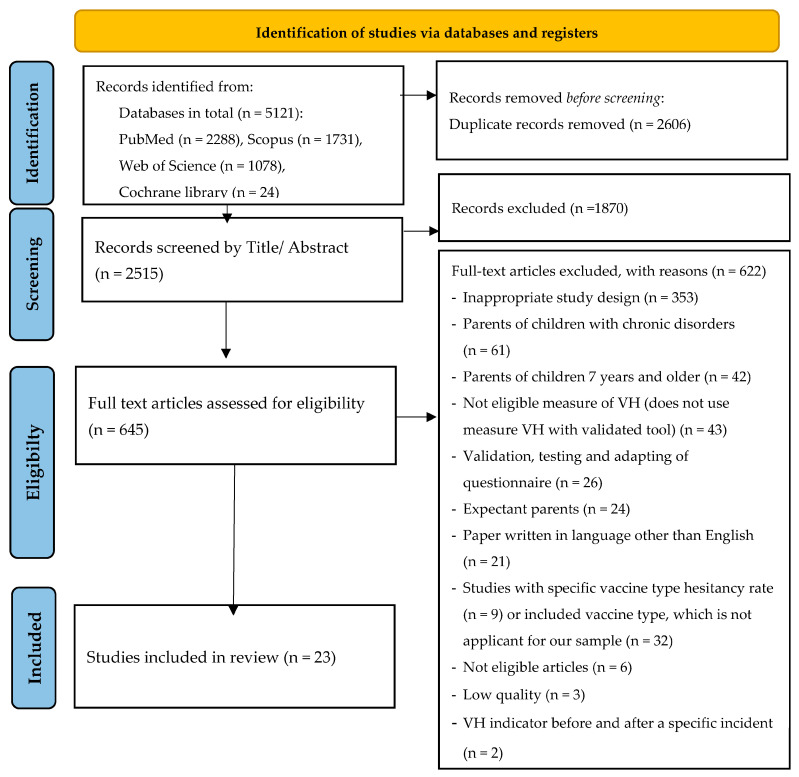
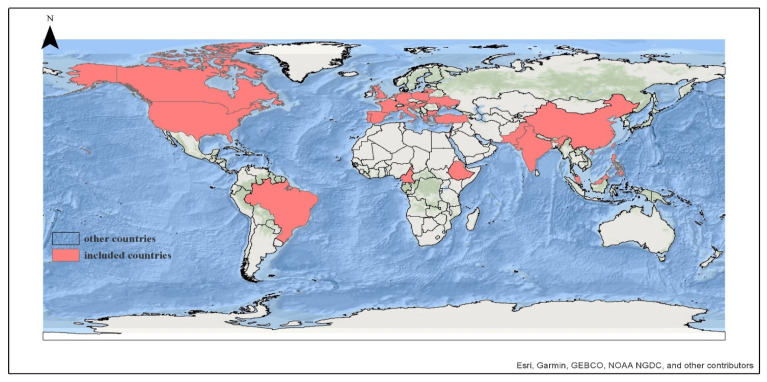
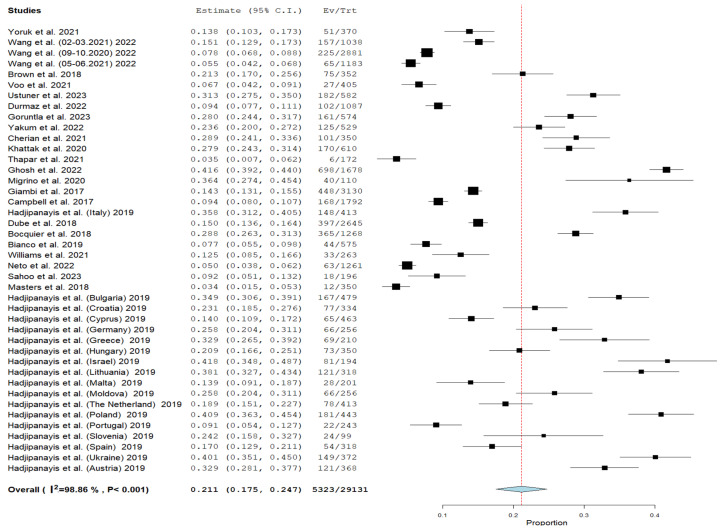
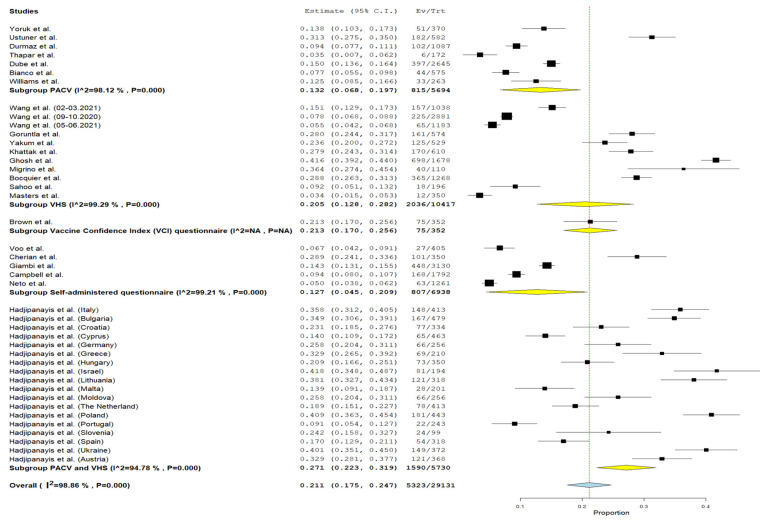
Routine vaccine hesitancy is a major global health challenge observed in over 190 countries worldwide. This meta-analysis aims to determine the worldwide prevalence of routine vaccination hesitancy among parents of children aged 0–6. An extensive search was conducted in four scientific databases: PubMed, Scopus, Web of Science, and the Cochrane Library. Studies were included if they reported hesitancy related to WHO-recommended routine immunizations for children under 7 years of age. A single-arm meta-analysis was performed using the OpenMeta[Analyst] software. An initial search retrieved 5121 articles, of which only 23 publications, involving 29,131 parents, guardians, and caregivers from over 30 countries met the inclusion criteria and quality assessment. The cumulative prevalence of parental vaccine hesitancy was found to be 21.1% (95% CI = 17.5–24.7%, I2 = 98.86%, p < 0.001). When stratifying the prevalence of vaccine hesitancy per WHO region, significant variations were observed, ranging from 13.3% (95% CI = 6.7–19.9%, I2 = 97.72%, p < 0.001) in the Region of the Americas to 27.9% (95% CI = 24.3–31.4%) in the Eastern Mediterranean region. The study findings highlight the need for healthcare providers and governments to develop and improve comprehensive programs with communication strategies to reduce parental vaccine hesitancy.
Overview
The claims and statistics of this paper haven’t been checked yet.
Free: it reads the open-access text and checks the first 5 claims that cite a source we can check. Create a free account to check every claim.
Integrity signals
Registry
Cites
Statistics
Figures
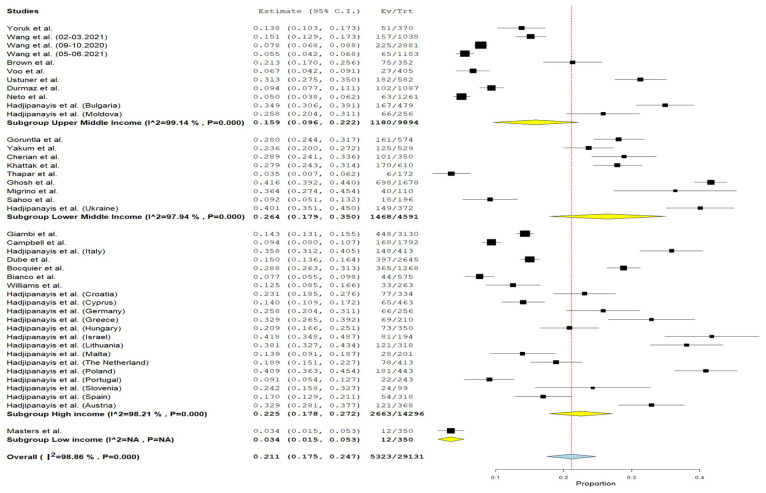
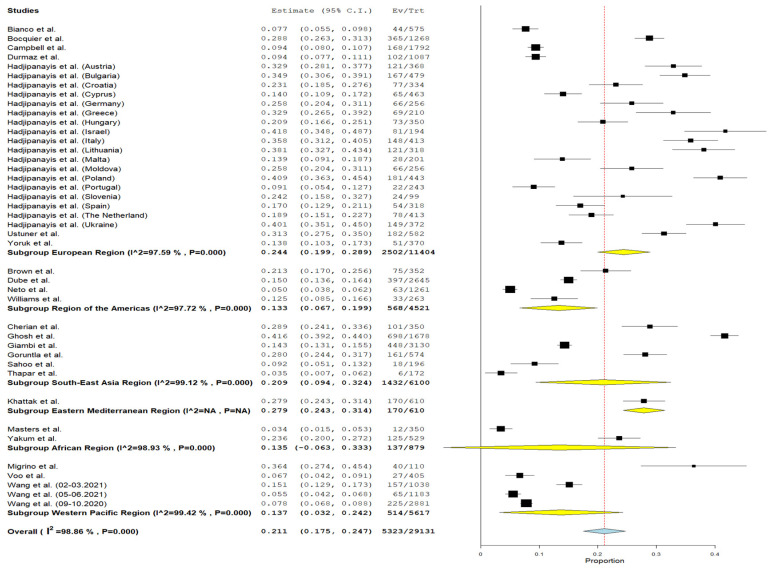
Verification
Claims the paper makes
The claims and statistics of this paper haven’t been checked yet.
Free: it reads the open-access text and checks the first 5 claims that cite a source we can check. Create a free account to check every claim.
Self-check
Percentages, sums and reported differences re-computed from the paper’s own numbers.
The self-check needs the paper’s full text.
Citations
Cites
Vaccine hesitancy: Definition, scope and determinants
MacDonald, N. E. (2015) · Vaccine · doi:10.1016/j.vaccine.2015.04.036 · Cited by 5,573 · cited 1×
“This phenomenon, defined as the reluctance to promptly accept or refuse vaccination despite the widespread availability of vaccination services, poses a threat to global public health [6].”
Backgroundde Figueiredo, A., Simas, C., Karafillakis, E., Paterson, P., & Larson, H. J. (2020) · The Lancet · doi:10.1016/s0140-6736(20)31558-0 · Cited by 1,143 · cited 1×
“In a comprehensive retrospective study of 149 countries that analyzed global trends in vaccine confidence and included data from 284,381 individuals, it was found that confidence in the importance of vaccines exhibited the strongest univariate association with vaccination coverage [13].”
BackgroundCOVID-19 vaccine acceptance and hesitancy in low- and middle-income countries
(2021) · doi:10.1038/s41591-021-01454-y · Cited by 1,105 · cited 1×
“However, the presence of these factors, in varying proportions, may be individual for each country or society [53,54].”
BackgroundStrategies for addressing vaccine hesitancy–A systematic review
Jarrett, C., Wilson, R., O’Leary, M., Eckersberger, E., & Larson, H. J. (2015) · Vaccine · doi:10.1016/j.vaccine.2015.04.040 · Cited by 1,066 · cited 1×
“Interventions based on vaccination reminders are also employed to combat vaccine hesitancy [58,59].”
BackgroundVaccine hesitancy, vaccine refusal and the anti-vaccine movement: influence, impact and implications
Dubé, E., Vivion, M., & MacDonald, N. E. (2015) · Expert Review of Vaccines · doi:10.1586/14760584.2015.964212 · Cited by 986 · cited 1×
“This highlights the importance of analyzing and monitoring the level of indecisiveness among parents, especially among parents of preschool-aged children [20,21].”
BackgroundPhadke, V. K., Bednarczyk, R. A., Salmon, D. A., & Omer, S. B. (2016) · JAMA · doi:10.1001/jama.2016.1353 · Cited by 674
Mapping vaccine hesitancy-country-specific characteristics of a global phenomenon
Dubé, E., Gagnon, D., Nickels, E., Jeram, S., & Schuster, M. (2014) · Vaccine · doi:10.1016/j.vaccine.2014.09.039 · Cited by 544
Lane, S., MacDonald, N. E., Marti, M., & Dumolard, L. (2018) · Vaccine · doi:10.1016/j.vaccine.2018.03.063 · Cited by 530
Opel, D. J., Mangione-Smith, R., Taylor, J. A., Korfiatis, C., Wiese, C., Catz, S., & Martin, D. P. (2011) · Human Vaccines · doi:10.4161/hv.7.4.14120 · Cited by 432 · cited 1×
“Numerous research studies have aimed to identify parental hesitancy toward childhood vaccination [14–19].”
A systematic review of interventions for reducing parental vaccine refusal and vaccine hesitancy
Sadaf, A., Richards, J. L., Glanz, J., Salmon, D. A., & Omer, S. B. (2013) · Vaccine · doi:10.1016/j.vaccine.2013.07.013 · Cited by 392
Voo, J. Y. H., Lean, Q. Y., Ming, L. C., Md. Hanafiah, N. H., Al-Worafi, Y. M., & Ibrahim, B. (2021) · Vaccines · doi:10.3390/vaccines9111348 · Cited by 380 · cited 1×
“Self-administered questionnaires were applied in Brazil [46], England [47], India [48], Italy [49], and Malaysia [50], involving 6938 parents/caregivers.”
Parental vaccine hesitancy in Italy – Results from a national survey
Giambi, C., Fabiani, M., D'Ancona, F., Ferrara, L., Fiacchini, D., Gallo, T., Martinelli, D., Pascucci, M. G., Prato, R., Filia, A., et al. (2018) · Vaccine · doi:10.1016/j.vaccine.2017.12.074 · Cited by 283 · cited 1×
“Self-administered questionnaires were applied in Brazil [46], England [47], India [48], Italy [49], and Malaysia [50], involving 6938 parents/caregivers.”
Face to face interventions for informing or educating parents about early childhood vaccination
Kaufman, J., Synnot, A., Ryan, R., Hill, S., Horey, D., Willis, N., Lin, V., & Robinson, P. (2013) · Cochrane Database of Systematic Reviews · doi:10.1002/14651858.cd010038.pub2 · Cited by 255 · cited 1×
“Interventions based on vaccination reminders are also employed to combat vaccine hesitancy [58,59].”
BackgroundFace-to-face interventions for informing or educating parents about early childhood vaccination
Kaufman, J., Ryan, R., Walsh, L., Horey, D., Leask, J., Robinson, P., & Hill, S. (2018) · Cochrane Database of Systematic Reviews · doi:10.1002/14651858.cd010038.pub3 · Cited by 206
Parent perspectives on childhood vaccination: How to deal with vaccine hesitancy and refusal?
Bianco, A., Mascaro, V., Zucco, R., & Pavia, M. (2019) · Vaccine · doi:10.1016/j.vaccine.2018.12.062 · Cited by 195
Comparisons of Vaccine Hesitancy across Five Low- and Middle-Income Countries
Wagner, A. L., Masters, N. B., Domek, G. J., Mathew, J. L., Sun, X., Asturias, E. J., Ren, J., Huang, Z., Contreras-Roldan, I. L., Gebremeskel, B., et al. (2019) · Vaccines · doi:10.3390/vaccines7040155 · Cited by 180
Olusanya, O. A., Bednarczyk, R. A., Davis, R. L., & Shaban-Nejad, A. (2021) · Frontiers in Immunology · doi:10.3389/fimmu.2021.663074 · Cited by 176 · cited 3×
“According to the definition provided by the Strategic Advisory Group of Experts (SAGE) Working Group on Vaccine Hesitancy (VH), vaccine hesitancy (VH) refers to the delay in acceptance or refusal of vaccination despite the availability of vaccination services [1].”
BackgroundMethodDong, Y., Wang, L., Burgner, D. P., Miller, J. E., Song, Y., Ren, X., Li, Z., Xing, Y., Ma, J., Sawyer, S. M., et al. (2020) · BMJ · doi:10.1136/bmj.m1043 · Cited by 160 · cited 1×
“Public health services face numerous challenges in addressing this issue, including the impact of the COVID-19 pandemic, which has significantly affected parental confidence in vaccination [1,2].”
BackgroundVaccine confidence among parents: Large scale study in eighteen European countries
Hadjipanayis, A., Esso, D. V., del Torso, S., Dornbusch, H. J., Michailidou, K., Minicuci, N., Pancheva, R., Mujkić, A., Geitmann, K., Syridou, G., et al. (2019) · Vaccine · doi:10.1016/j.vaccine.2019.11.068 · Cited by 149 · cited 3×
“A study conducted across 18 European countries employed a survey based on two sources, PACV and WHO SAGE VHS, with the participation of 5736 parents/caregivers [45].”
MethodInfluentialVaccine confidence and hesitancy in Brazil
Brown, A. L., Sperandio, M., Turssi, C. P., Leite, R. M. D. A., Berton, V. F., Succi, R. M., Larson, H. J., & Napimoga, M. H. (2018) · Cadernos de Saúde Pública · doi:10.1590/0102-311x00011618 · Cited by 141 · cited 2×
“Out of the 32 countries examined in the study [ 29– 51”
BackgroundMethodDyda, A., King, C. L., Dey, A., Leask, J., & Dunn, A. G. (2020) · BMC Public Health · doi:10.1186/s12889-020-09327-8 · Cited by 137
Parental childhood vaccine hesitancy and predicting uptake of vaccinations: a systematic review
Obohwemu, K. O., Jong, F. C.-D., & Ling, J. (2022) · Primary Health Care Research & Development · doi:10.1017/s1463423622000512 · Cited by 115 · cited 1×
“…main determinants of VH include confidence and complacency, which encompass anxiety, a low perceived risk, a low severity of the disease, reduced confidence in the safety and effectiveness of vaccines, a lack of trust in healthcare providers and vaccination services, and fear of side effects [56].”
BackgroundDubé, È., Farrands, A., Lemaître, T., Boulianne, N., Sauvageau, C., Boucher, F. D., Tapiéro, B., Quach, C., Ouakki, M., Gosselin, V., et al. (2018) · Human Vaccines & Immunotherapeutics · doi:10.1080/21645515.2018.1509647 · Cited by 113 · cited 1×
“The PACV questionnaire was applied in seven studies, encompassing a total of 5694 parents/caregivers in the countries of Italy [29], India [30,31], the USA [32], Canada [33], and Turkey [34–36].”
MethodSiani, A. (2019) · Preventive Medicine · doi:10.1016/j.ypmed.2019.02.011 · Cited by 107
Bocquier, A., Fressard, L., Cortaredona, S., Zaytseva, A., Ward, J. K., Gautier, A., Peretti‐Watel, P., & Verger, P. (2018) · Vaccine · doi:10.1016/j.vaccine.2018.10.085 · Cited by 106
Changing attitudes to childhood immunisation in English parents
Campbell, H., Edwards, A., Letley, L. H., Bedford, H. E., Ramsay, M. E., & Yarwood, J. (2017) · Vaccine · doi:10.1016/j.vaccine.2017.03.089 · Cited by 99 · cited 1×
“Self-administered questionnaires were applied in Brazil [46], England [47], India [48], Italy [49], and Malaysia [50], involving 6938 parents/caregivers.”
Ali, F., Rehman, K., Shahzad, M. A., Arif, N., Ullah, N., Kibria, Z., Arshad, M., Afaq, S., Ibrahimzai, A. K., & Haq, Z. U. (2020) · International Journal of Infectious Diseases · doi:10.1016/j.ijid.2020.12.029 · Cited by 90 · cited 2×
“The highest number of studies utilized the WHO SAGE VHS, with eight studies involving a sample size of 10,417 parents/caregivers from Pakistan [37], India [38,39], Cameroon [40], Ethiopia [41], China [42], France [43], and the Philippines [44].”
BackgroundChoudhary, T. S., Samarasimha Reddy, N., Apte, A. A., Sinha, B., Roy, S., Nair, N. P., Sindhu, K. N., Patil, R., Upadhyay, R. P., & Chowdhury, R. (2019) · Vaccine · doi:10.1016/j.vaccine.2019.03.039 · Cited by 78
Vaccine hesitancy for childhood vaccinations in slum areas of Siliguri, India
Bhattacherjee, S., Dasgupta, P., Mukherjee, A., & Dasgupta, S. (2018) · Indian Journal of Public Health · doi:10.4103/ijph.ijph_397_17 · Cited by 74 · cited 1×
“…et al. (2022) that examined yellow fever vaccine hesitancy alongside other mandatory vaccinations [40], the study by Napolitano et al. (2018) that assessed varicella vaccine hesitancy [41], and the study by Dasgupta et al. (2018) that explored Japanese encephalitis vaccine hesitancy rates [55].”
BackgroundMigriño, J. R., Gayados, B., Birol, K. R. J., Jesus, L. D., Lopez, C. W., Mercado, W. C., Tolosa, J.-M. C., Torreda, J., & Tulagan, G. (2020) · Western Pacific surveillance response journal · doi:10.5365/wpsar.2019.10.2.006 · Cited by 59 · cited 1×
“The highest number of studies utilized the WHO SAGE VHS, with eight studies involving a sample size of 10,417 parents/caregivers from Pakistan [37], India [38,39], Cameroon [40], Ethiopia [41], China [42], France [43], and the Philippines [44].”
BackgroundMasters, N. B., Tefera, Y. A., Wagner, A. L., & Boulton, M. L. (2018) · Human Vaccines & Immunotherapeutics · doi:10.1080/21645515.2018.1480242 · Cited by 58 · cited 3×
“…et al. (2022) that examined yellow fever vaccine hesitancy alongside other mandatory vaccinations [40], the study by Napolitano et al. (2018) that assessed varicella vaccine hesitancy [41], and the study by Dasgupta et al. (2018) that explored Japanese encephalitis vaccine hesitancy rates [55].”
BackgroundThe demographics of vaccine hesitancy in Shanghai, China
Ren, J., Wagner, A. L., Zheng, A., Sun, X., Boulton, M. L., Huang, Z., & Zikmund-Fisher, B. J. (2018) · PLOS ONE · doi:10.1371/journal.pone.0209117 · Cited by 55
Durmaz, N., SUMAN, M., Ersoy, M. Ö., & Örün, E. (2022) · Vaccines · doi:10.3390/vaccines10111958 · Cited by 52 · cited 1×
“The PACV questionnaire was applied in seven studies, encompassing a total of 5694 parents/caregivers in the countries of Italy [29], India [30,31], the USA [32], Canada [33], and Turkey [34–36].”
MethodMeasles: A dangerous vaccine-preventable disease returns
Porter, A. S., & Goldfarb, J. (2019) · Cleveland Clinic Journal of Medicine · doi:10.3949/ccjm.86a.19065 · Cited by 43 · cited 1×
“Measles outbreaks occurring in various parts of the world also underscore the importance of monitoring and assessing the level of parental hesitancy regarding vaccinating children under 7 years of age [3–5].”
BackgroundFactors associated with pediatric vaccine hesitancy of parents: a cross-sectional study in Turkey
Yörük, S., & Güler, D. S. (2021) · Human Vaccines & Immunotherapeutics · doi:10.1080/21645515.2021.1953348 · Cited by 41
The relation between digital literacy, cyberchondria, and parents' attitudes to childhood vaccines
Top, F. Ü., Çevik, C., & Güneş, N. B. (2023) · Journal of Pediatric Nursing · doi:10.1016/j.pedn.2023.01.006 · Cited by 38 · cited 1×
“The PACV questionnaire was applied in seven studies, encompassing a total of 5694 parents/caregivers in the countries of Italy [29], India [30,31], the USA [32], Canada [33], and Turkey [34–36].”
MethodGhosh, A., Annigeri, S., Hemram, S. K., Dey, P. K., Mazumder, S., & Ghosh, P. (2022) · Clinical Epidemiology and Global Health · doi:10.1016/j.cegh.2022.101155 · Cited by 28 · cited 3×
“The highest number of studies utilized the WHO SAGE VHS, with eight studies involving a sample size of 10,417 parents/caregivers from Pakistan [37], India [38,39], Cameroon [40], Ethiopia [41], China [42], France [43], and the Philippines [44].”
BackgroundWang, Z. J., Chen, S., & Fang, Y. (2022) · Vaccines · doi:10.3390/vaccines10091453 · Cited by 27 · cited 1×
“The highest number of studies utilized the WHO SAGE VHS, with eight studies involving a sample size of 10,417 parents/caregivers from Pakistan [37], India [38,39], Cameroon [40], Ethiopia [41], China [42], France [43], and the Philippines [44].”
BackgroundNeto, J. O., & Olbrich, S. R. L. R. (2023) · Revista Paulista de Pediatria · doi:10.1590/1984-0462/2023/41/2022009 · Cited by 25 · cited 2×
“%) in Brazil [46] to 34.9% (95% CI = 30.6–39.1”
InfluentialChan, P. S.-F., Fang, Y., Kawuki, J., Chen, S., Liang, X., Mo, P. K. H., & Wang, Z. J. (2023) · Vaccines · doi:10.3390/vaccines11081360 · Cited by 25 · cited 1×
“This age category is the most suitable for assessing parental attitudes towards vaccination [11].”
BackgroundParental and provider vaccine hesitancy and non-timely childhood vaccination in Switzerland
Jafflin, K. G., Deml, M. J., Schwendener, C. L., Kiener, L. M., Delfino, A., Gafner, R., Schudel, S., Mäusezahl, M., Berger, C., Huber, B. M., et al. (2022) · Vaccine · doi:10.1016/j.vaccine.2022.04.044 · Cited by 24 · cited 1×
“Numerous research studies have aimed to identify parental hesitancy toward childhood vaccination [14–19].”
BackgroundParental Vaccine Hesitancy and Vaccination Disparities in a Safety-Net System
Williams, J. T. B., Rice, J. D., Lou, Y., Bayliss, E. A., Federico, S. G., Hambidge, S. J., & O’Leary, S. T. (2021) · PEDIATRICS · doi:10.1542/peds.2020-010710 · Cited by 23 · cited 1×
“The PACV questionnaire was applied in seven studies, encompassing a total of 5694 parents/caregivers in the countries of Italy [29], India [30,31], the USA [32], Canada [33], and Turkey [34–36].”
MethodYakum, M. N., Funwie, A. D., Ajong, A. B., Tsafack, M., Ze, L. E. E., & Shah, Z. (2022) · PLOS Global Public Health · doi:10.1371/journal.pgph.0001012 · Cited by 23 · cited 2×
“…of certain studies, including the one by Ngandjon et al. (2022) that examined yellow fever vaccine hesitancy alongside other mandatory vaccinations [40], the study by Napolitano et al. (2018) that assessed varicella vaccine hesitancy [41], and the study by Dasgupta et al. (2018) that explored…”
BackgroundThapar, R. (2021) · F1000Research · doi:10.12688/f1000research.28293.3 · Cited by 21 · cited 2×
“[31] to 41.6% (95% CI = 39.2–44”
MethodInfluentialSahoo, S. S., Parida, S. P., Singh, A. K., Palepu, S., Sahoo, D. P., & Bhatia, V. (2023) · Therapeutic Advances in Vaccines and Immunotherapy · doi:10.1177/25151355231152650 · Cited by 21 · cited 1×
“The PACV questionnaire was applied in seven studies, encompassing a total of 5694 parents/caregivers in the countries of Italy [29], India [30,31], the USA [32], Canada [33], and Turkey [34–36].”
MethodPrevalence and predictors of vaccine hesitancy in an urbanized agglomeration of New Delhi, India
Cherian, V., Saini, N. K., Sharma, A. K., & Philip, J. (2021) · Journal of Public Health · doi:10.1093/pubmed/fdab007 · Cited by 20 · cited 1×
“Self-administered questionnaires were applied in Brazil [46], England [47], India [48], Italy [49], and Malaysia [50], involving 6938 parents/caregivers.”
Wang, Q., Xiu, S., Yang, L., Han, Y., Cui, T., Shi, N., Liu, M., Yi, Y., Liu, C., Wang, X., et al. (2022) · JMIR Public Health and Surveillance · doi:10.2196/33235 · Cited by 20
Goruntla, N., Akanksha, K., Lalithaasudhaa, K., Pinnu, V., Jinka, D. R., Pradeepkumar, B., & Doniparthi, J. (2023) · Journal of Education and Health Promotion · doi:10.4103/jehp.jehp_687_22 · Cited by 19 · cited 2×
“The highest number of studies utilized the WHO SAGE VHS, with eight studies involving a sample size of 10,417 parents/caregivers from Pakistan [37], India [38,39], Cameroon [40], Ethiopia [41], China [42], France [43], and the Philippines [44].”
BackgroundThe impact of national income and vaccine hesitancy on country-level COVID-19 vaccine uptake
Moradpour, J., Shajarizadeh, A., Carter, J., Chit, A., & Grootendorst, P. V. (2023) · PLoS ONE · doi:10.1371/journal.pone.0293184 · Cited by 18 · cited 1×
“However, the presence of these factors, in varying proportions, may be individual for each country or society [53,54].”
BackgroundYakum, M. N., Funwie, A. D., Ajong, A. B., et al. (2022) · medRxiv · doi:10.1101/2022.02.17.22271108 · Cited by 3
Thapar, R. (2021) · F1000Research · doi:10.12688/f1000research.28293.2 · Cited by 3
Cited by
Haeuser, E., Byrne, S., Nguyen, J., Raggi, C., McLaughlin, S. A., Bisignano, C., Harris, A. A., Smith, A. E., Lindstedt, P. A., Smith, G., et al. (2025) · The Lancet · doi:10.1016/s0140-6736(25)01037-2 · Cited by 143
Cagnotta, C., Lettera, N., Cardillo, M., Pirozzi, D., Catalán-Matamoros, D., Capuano, A., & Scavone, C. (2025) · Journal of Infection and Public Health · doi:10.1016/j.jiph.2024.102648 · Cited by 51
A World without Measles and Rubella: Addressing the Challenge of Vaccine Hesitancy
Higgins, D. M., & O’Leary, S. T. (2024) · Vaccines · doi:10.3390/vaccines12060694 · Cited by 21
“Based on a recent meta-analysis with studies from over 30 different countries, the worldwide cumulative prevalence of vaccine hesitancy among parents of children aged 0–6 years old has been estimated to be ~20% [43].”
BackgroundProgress with the Second Dose Measles Vaccine Introduction and Coverage in the WHO African Region
Masresha, B., Shibeshi, M. E., Grant, G. B., Hatcher, C., & Wiysonge, C. S. (2024) · Vaccines · doi:10.3390/vaccines12091069 · Cited by 21
Szalast, K., Nowicki, G., Pietrzak, M., Mastalerz–Migas, A., Biesiada, A. M., Grochans, E., & Ślusarska, B. J. (2025) · Vaccines · doi:10.3390/vaccines13010041 · Cited by 14
Metadata
- Authors
- Abenova, M., Shaltynov, A., Jamedinova, U., & Semenova, Y.
- Affiliations
- Semey Medical University (KZ)
- Nazarbayev University (KZ)
- Corresponding author
- Semenova, Yuliya
- Venue
- Vaccines
- Publisher
- MDPI AG
- Published
- 2023-12-27
- Volume
- 12
- Issue
- 1
- Pages
- 31
- ISSN
- 2076-393X (ISSN-L)
- PMC
- PMC10819761
- OpenAlex
- W4390273032
- Cited by
- 49
- References
- 50
- Citations by year
- 2026: 21 · 2025: 20 · 2024: 8
- FWCI
- 2.45
- Type
- journal article
- Language
- en
- Open access
- gold
- doi.org
- Licence
- Locations
- Vaccines (publishedVersion, cc-by)
- PubMed Central (publishedVersion, cc-by)
- PubMed (publishedVersion)
- DOAJ (DOAJ: Directory of Open Access Journals) (submittedVersion, cc-by-sa)
- Funders
- Science Committee of the Ministry of Education and Science of the Republic of Kazakhstan (AP15473448)
- Topics
- Social Sciences › Health › Vaccine Coverage and Hesitancy
- Health Sciences › Medicine › Epidemiology › Cervical Cancer and HPV Research
- Health Sciences › Medicine › Emergency Medicine › Intramuscular injections and effects
- Keywords
- vaccine hesitancy, routine childhood immunization, parental vaccine hesitancy, WHO regions, children aged 0-6, vaccine communication strategies, global health
About these checks
Registry, retraction, Cites and statistics results are computed, not judged, with one exception: a printed reference that no index lists is read once by a model before it counts as a citation error. Claims are extracted by a model and kept only when their quote appears verbatim in the text; each cited source is then checked, with a model’s help, for whether it says what the claim relies on. Those verdicts can be wrong — read the claim’s quote and the cited source before relying on one.
Statistics and arithmetic are recomputed, not judged.
Confidence bands are shown only for fields calibrated on our annotated test set. None is calibrated yet, so no band is shown.
What counts as a claim ›How we measure confidence ›How we check this ›
Are you an author, or do you see a problem with this page? Request a review
Data sources
Bibliographic data: Semantic Scholar, OpenAlex, Crossref.
Contains information from the Semantic Scholar Academic Graph Datasets, made available under the ODC Attribution License (ODC-BY 1.0).
Semantic Scholar’s data is described in: Kinney, R., et al. (2023). The Semantic Scholar Open Data Platform. arXiv:2301.10140.
