

The DOI matches its Crossref record; 221 of the 224 references it cites were found in a registry or an index, and 3 are not checked yet.
Shooting at a Moving Target—Effectiveness and Emerging Challenges for SARS-CoV-2 Vaccine Development
Open accessAbstract
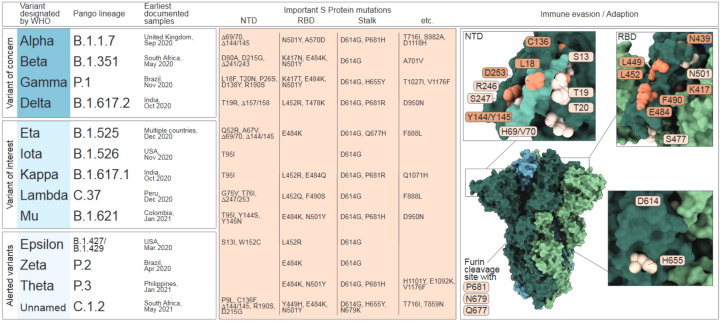
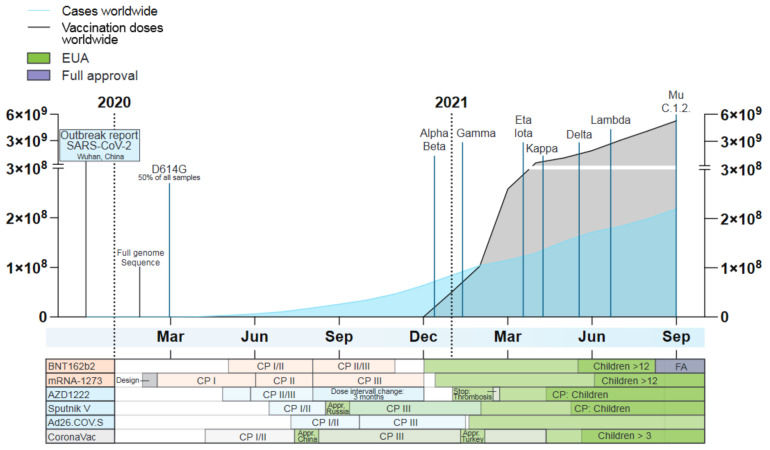
Since late 2019 the newly emerged pandemic SARS-CoV-2, the causative agent of COVID-19, has hit the world with recurring waves of infections necessitating the global implementation of non-pharmaceutical interventions, including strict social distancing rules, the wearing of masks and the isolation of infected individuals in order to restrict virus transmissions and prevent the breakdown of our healthcare systems. These measures are not only challenging on an economic level but also have a strong impact on social lifestyles. Using traditional and novel technologies, highly efficient vaccines against SARS-CoV-2 were developed and underwent rapid clinical evaluation and approval to accelerate the immunization of the world population, aiming to end the pandemic and return to normality. However, the emergence of virus variants with improved transmission, enhanced fitness and partial immune escape from the first generation of vaccines poses new challenges, which are currently being addressed by scientists and pharmaceutical companies all over the world. In this ongoing pandemic, the evaluation of SARS-CoV-2 vaccines underlies diverse unpredictable dynamics, posed by the first broad application of the mRNA vaccine technology and their compliance, the occurrence of unexpected side effects and the rapid emergence of variations in the viral antigen. However, despite these hurdles, we conclude that the available SARS-CoV-2 vaccines are very safe and efficiently protect from severe COVID-19 and are thereby the most powerful tools to prevent further harm to our healthcare systems, economics and individual lives. This review summarizes the unprecedented pathways of vaccine development and approval during the ongoing SARS-CoV-2 pandemic. We focus on the real-world effectiveness and unexpected positive and negative side effects of the available vaccines and summarize the timeline of the applied adaptations to the recommended vaccination strategies in the light of emerging virus variants. Finally, we highlight upcoming strategies to improve the next generations of SARS-CoV-2 vaccines.
Overview
The claims and statistics of this paper haven’t been checked yet.
Run the check — free, no account needed. It reads the open-access text and checks the sources it cites.
Integrity signals
Registry
Cites
Statistics
Figures
Verification
Claims the paper makes
The claims and statistics of this paper haven’t been checked yet.
Run the check — free, no account needed. It reads the open-access text and checks the sources it cites.
Claims other papers make about this one
Each is checked against this paper’s own text: does it say what the citing paper says it does?
In the citing paper
“Real-world data showed that effectiveness of mRNA-1273 against Alpha and Beta variants was 100% and 96.4%, respectively,417,418 whereas effectiveness against Delta was slightly lower (73.1%).102”
From Advances in COVID-19 mRNA vaccine development (2022) · cites this paper as [418]
Self-check
Percentages, sums and reported differences re-computed from the paper’s own numbers.
The self-check needs the paper’s full text.
Citations
Cites
A pneumonia outbreak associated with a new coronavirus of probable bat origin
Zhou, P., Yang, X.-L., Wang, X.-G., Hu, B., Zhang, L., Zhang, W., Si, H.-R., Zhu, Y., Li, B., Huang, C.-L., et al. (2020) · Nature · doi:10.1038/s41586-020-2012-7 · Cited by 21,969
Hoffmann, M., Kleine-Weber, H., Schroeder, S., Krüger, N., Herrler, T., Erichsen, S., Schiergens, T. S., Herrler, G., Wu, N.-H., Nitsche, A., et al. (2020) · Cell · doi:10.1016/j.cell.2020.02.052 · Cited by 20,286
Safety and Efficacy of the BNT162b2 mRNA Covid-19 Vaccine
Polack, F. P., Thomas, S. J., Kitchin, N., Absalon, J., Gurtman, A., Lockhart, S., Perez, J. L., Pérez Marc, G., Moreira, E. D., Zerbini, C., et al. (2020) · New England Journal of Medicine · doi:10.1056/nejmoa2034577 · Cited by 14,592 · cited 1×
“Groups below 55 years of age reported a higher frequency of intense pain, fever and fatigue upon the second dose compared to older groups [103].”
BackgroundEfficacy and Safety of the mRNA-1273 SARS-CoV-2 Vaccine
Baden, L. R., El Sahly, H. M., Essink, B., Kotloff, K., Frey, S., Novak, R., Diemert, D., Spector, S. A., Rouphael, N., Creech, C. B., et al. (2021) · New England Journal of Medicine · doi:10.1056/nejmoa2035389 · Cited by 10,119
Structure, function and antigenicity of the SARS-CoV-2 spike glycoprotein
Walls, A. C., Park, Y.-J., Tortorici, M. A., Wall, A., McGuire, A. T., & Veesler, D. (2020) · doi:10.1101/2020.02.19.956581 · Cited by 8,586
Angiotensin-converting enzyme 2 is a functional receptor for the SARS coronavirus
Li, W., Moore, M. J., Vasilieva, N., Sui, J., Wong, S. K., Berne, M. A., Somasundaran, M., Sullivan, J. L., Luzuriaga, K., Greenough, T. C., et al. (2003) · Nature · doi:10.1038/nature02145 · Cited by 5,923
Voysey, M., Clemens, S. A. C., Madhi, S. A., Weckx, L. Y., Folegatti, P. M., Aley, P. K., Angus, B., Baillie, V. L., Barnabas, S. L., Bhorat, Q. E., et al. (2021) · The Lancet · doi:10.1016/s0140-6736(20)32661-1 · Cited by 4,616
Korber, B., Fischer, W. M., Gnanakaran, S., Yoon, H., Theiler, J., Abfalterer, W., Hengartner, N., Giorgi, E. E., Bhattacharya, T., Foley, B., et al. (2020) · Cell · doi:10.1016/j.cell.2020.06.043 · Cited by 4,281
Nextstrain: real-time tracking of pathogen evolution
Hadfield, J., Megill, C., Bell, S. M., Huddleston, J., Potter, B., Callender, C., Sagulenko, P., Bedford, T., & Neher, R. A. (2018) · Bioinformatics · doi:10.1093/bioinformatics/bty407 · Cited by 3,154
GISAID: Global initiative on sharing all influenza data – from vision to reality
Shu, Y., & McCauley, J. (2017) · Eurosurveillance · doi:10.2807/1560-7917.es.2017.22.13.30494 · Cited by 3,039
Research works printed but not linked: 6
- Hoffmann, 2021, SARS-CoV-2 variants B.1.351 and B.1.1.248: Escape from therapeutic antibodies and antibodies induced by infection and vaccination, Cell, 181, 271, 10.1016/j.cell.2020.02.052 · DOI · Paper page
- Weisblum, 2020, Escape from Neutralizing Antibodies by SARS-CoV-2 Spike Protein Variants, eLife, 9, e61312, 10.7554/eLife.61312 · DOI · Paper page
- Minervina, A.A., Pogorelyy, M.V., Kirk, A.M., Allen, E.K., Allison, K.J., Lin, C.-Y., Brice, D.C., Zhu, X., Vegesana, K., and Wu, G. (2021). Convergent epitope-specific T cell responses after SARS-CoV-2 infection and vaccination. medRxiv.
- Walsh, 2020, Safety and immunogenicity of two RNA-based Covid-19 vaccine candidates, N. Engl. J. Med., 383, 2439, 10.1056/NEJMoa2027906 · DOI · Paper page
- Baker, A.T., Boyd, R.J., Sarkar, D., Vant, J., Crespo, A.T., Waraich, K., Truong, C.D., Bates, E., Wilson, E., and Chan, C.K. (2021). The Structure of ChAdOx1/AZD-1222 Reveals Interactions with CAR and PF4 with Implications for Vaccine-induced Immune Thrombotic Thrombocytopenia. bioRxiv. · DOI
- Weber, R.I., Bender, J.K., Werner, G., Noll, I., and Sin, M.A. (2021). Epidemiologisches Bulletin 25/2021, robert koch institut. RKI.
Cited by
Sorted by citations
Advances in COVID-19 mRNA vaccine development
Fang, E., Liu, X., Li, M., Zhang, Z., Song, L., Zhu, B., Wu, X., Liu, J., Zhao, D., & Li, Y. (2022) · Signal Transduction and Targeted Therapy · doi:10.1038/s41392-022-00950-y · Cited by 601
Lipid nanoparticles: Composition, formulation, and application
Xu, S., Hu, Z., Song, F., Xu, Y. G., & Han, X. (2025) · Molecular Therapy — Methods & Clinical Development · doi:10.1016/j.omtm.2025.101463 · Cited by 115
Chakraborty, C., Bhattacharya, M., & Dhama, K. (2023) · Vaccines · doi:10.3390/vaccines11030682 · Cited by 112
Omicron (B.1.1.529) variant of SARS‐CoV‐2: Concerns, challenges, and recent updates
Mohapatra, R. K., Tiwari, R., Sarangi, A. K., Islam, M. R., Chakraborty, C., & Dhama, K. (2022) · Journal of Medical Virology · doi:10.1002/jmv.27633 · Cited by 83
Development and applications of mRNA treatment based on lipid nanoparticles
Wang, Z., Ma, W., Fu, X., Qi, Y., Zhao, Y., & Zhang, S. (2023) · Biotechnology Advances · doi:10.1016/j.biotechadv.2023.108130 · Cited by 57
Metadata
- Authors
- Günl, F., Mecate-Zambrano, A., Rehländer, S., Hinse, S., Ludwig, S., & Brunotte, L.
- Affiliations
- University of Münster (DE)
- Institute of Virology (IVM), University of Münster, 48149 Münster, Germany
- Corresponding author
- Brunotte, Linda
- Venue
- Vaccines
- Publisher
- MDPI AG
- Published
- 2021-09-22
- Volume
- 9
- Issue
- 10
- Pages
- 1052
- ISSN
- 2076-393X (ISSN-L)
- PMC
- PMC8540924
- OpenAlex
- W3199631570
- Cited by
- 27
- References
- 200
- Citations by year
- 2025: 3 · 2024: 2 · 2023: 9 · 2022: 12 · 2021: 1
- FWCI
- 0.70
- Type
- journal article
- Language
- en
- Open access
- gold
- doi.org
- Licence
- Locations
- Vaccines (publishedVersion, cc-by)
- Europe PMC (PubMed Central) (publishedVersion, other-oa)
- PubMed Central (publishedVersion, cc-by)
- PubMed (publishedVersion)
- DOAJ (DOAJ: Directory of Open Access Journals) (submittedVersion, cc-by-sa)
- URN:NBN Resolver for Germany & Switzerland (German National Library) (submittedVersion, cc-by)
- Funders
- Deutsche Forschungsgemeinschaft (BR 5189/1-1)
- Clinical Research Unit (CRU342)
- Bundesministerium für Bildung und Forschung (01KI20218)
- Network University Medicine (01KX2021)
- Interdisciplinary Centre for Clinical Research (IZKF) (Bru2/015/19)
- Topics
- Health Sciences › Medicine › Infectious Diseases › SARS-CoV-2 and COVID-19 Research
- Social Sciences › Health › Vaccine Coverage and Hesitancy
- Health Sciences › Medicine › Infectious Diseases › COVID-19 Clinical Research Studies
- Keywords
- SARS-CoV-2, COVID-19 vaccines, vaccine development, mRNA vaccines, vaccine side effects, vaccine effectiveness, SARS-CoV-2 variants, immune evasion, vaccine approval, vaccination strategies, vaccine safety
About these checks
Registry, retraction, Cites and statistics results are computed, not judged, with one exception: a printed reference that no index lists is read once by a model before it counts as a citation error. Claims are extracted by a model and kept only when their quote appears verbatim in the text; each cited source is then checked, with a model’s help, for whether it says what the claim relies on. Those verdicts can be wrong — read the claim’s quote and the cited source before relying on one.
Statistics and arithmetic are recomputed, not judged.
Confidence bands are shown only for fields calibrated on our annotated test set. None is calibrated yet, so no band is shown.
What counts as a claim ›How we measure confidence ›How we check this ›
Are you an author, or do you see a problem with this page? Request a review
