

Enabling Grid Services with Bidirectional EV Chargers: A Comparative Analysis of CCS2 and CHAdeMO Response Dynamics
Open accessThe DOI matches its Crossref record; 25 of the 26 references it cites were found in a registry or an index; none of the 33 sources its claims cite is checked for support yet.
Abstract
Bidirectional electric vehicle (EV) charging represents an opportunity to leverage EVs as flexible energy assets within the power system. By enabling controlled power flow in both directions, bidirectional charging unlocks a wide range of grid services, thereby enhancing grid stability as the energy sector decarbonizes. This paper presents a comprehensive experimental evaluation of bidirectional charging systems (EVCS), focusing on response dynamics and controllability delays critical for grid services. A real ISO 15118–20–enabled EV and an EV emulator were used to conduct tests across configurations, utilizing the Watt & Well 22 kW bidirectional charging bay. The study compares CCS2 and CHAdeMO protocols under varying configuration conditions. Results show that modern chargers achieve sub-second responsiveness, with local communication delays typically below 0.4 s and ramping times around 0.5 s. However, power flow reversals introduce an additional delay of approximately 1 s. These updated controllability metrics are essential for validating bidirectional charging in time-critical applications such as primary frequency regulation. The findings highlight the influence of voltage level and modular configuration on dynamic performance, underscoring the need to integrate external control path delays for full-stack validation. This work provides a foundation for modeling and deploying bidirectional EVCS in fast-response grid services.
Overview
CoChat Summary
TL;DR
This paper experimentally characterizes the response dynamics of a Watt & Well bidirectional EVSE under ISO 15118-20/CCS2 and CHAdeMO, finding sub-second communication and ramping but an additional ~1 s delay for power flow reversals. It provides updated controllability metrics for grid services and compares modern CCS2 with CHAdeMO and prior CHAdeMO results.
Key findings
- Modern bidirectional EVCS achieved sub-second responsiveness: local communication delays were typically below 0.4 s and ramping times around 0.5 s; average response was less than 1 s when power flow direction remained unchanged, but more than 1 s when direction changed.
- Power flow reversal (PFR) introduced an additional delay of approximately 1 s; measured t_PFR ranged from 0 to 1.7 s across configurations, with CCS2 mean t_PFR = 1.118 s (CV 0.312) and CHAdeMO mean t_PFR = 0.661 s (CV 0.679).
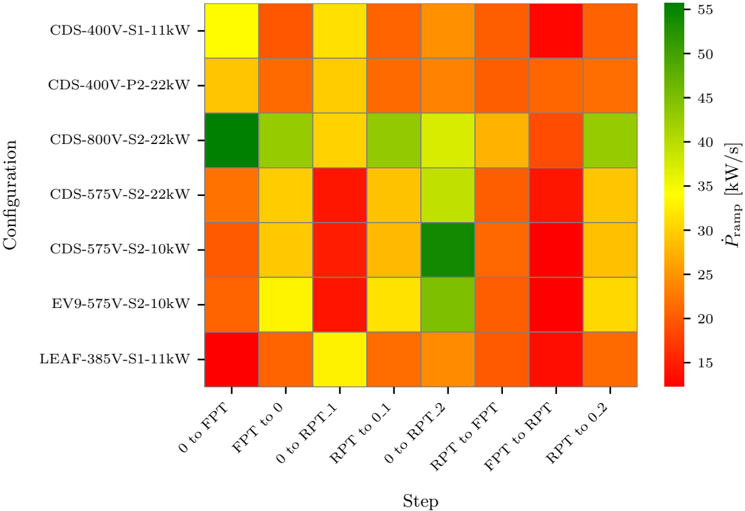
- CCS2 showed lower communication latency and faster converter ramping than CHAdeMO: t_comm = 0.188 s vs 0.314 s, and P_conv = 30.916 kW/s vs 20.036 kW/s (CCS2 about 50% better as stated). Overall transition time t_total remained similar: CCS2 1.255 s vs CHAdeMO 1.254 s.
- Voltage level and modular configuration influenced dynamics: nominal 400 V and 800 V configurations outperformed 575 V; series stacking at 800 V gave ramping rates up to 150% of a single power module and parallel stacking, while parallel stacking did not proportionally increase ramping. The paper also reports t_delay reduced from 4 s in a prior 2018 CHAdeMO study to approximately 0.4–0.5 s.
Methods
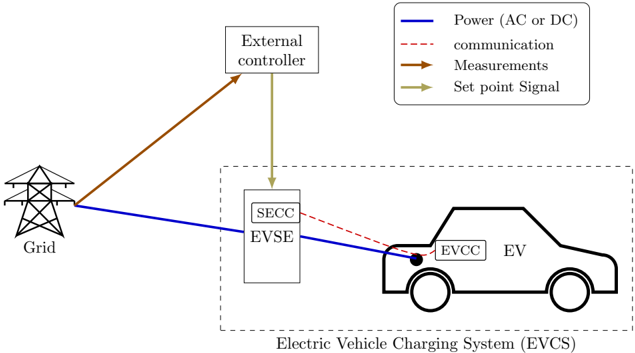
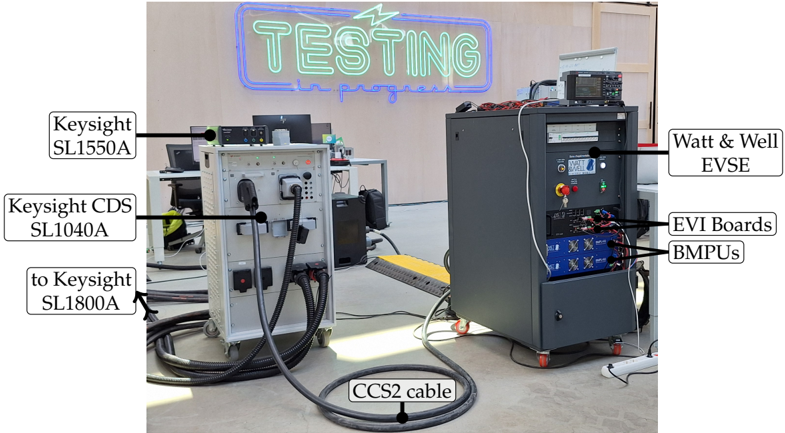
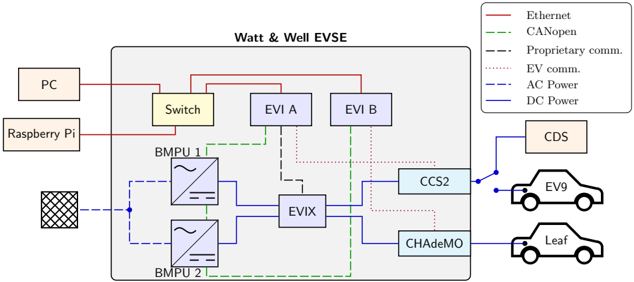
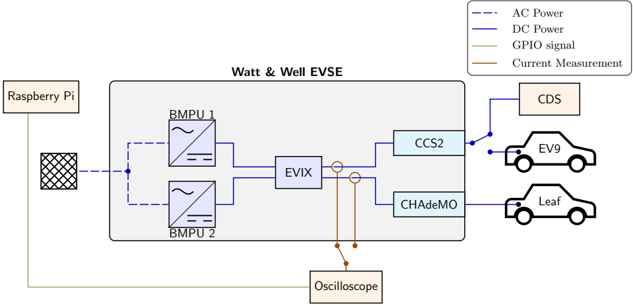
- Experimental test of a Watt & Well 22 kW bidirectional DC EVSE with two 11 kW BMPU modules, EVIX board, CCS2/CHAdeMO connectors, controlled by a Raspberry Pi and PC GUI. EV side used a Keysight CDS emulator (SL1040A with SL1550A and SL1800A) for ISO 15118-20, a pre-production KIA EV9 (CCS2, SOC = 50%, V_batt = 575 V), and a Nissan Leaf (CHAdeMO, SOC = 80%, V_batt = 385 V).
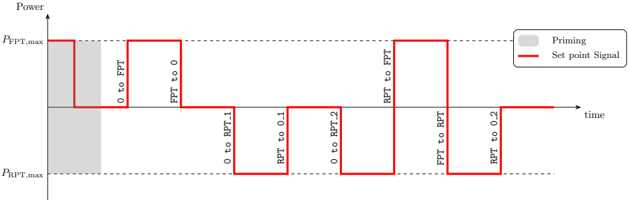
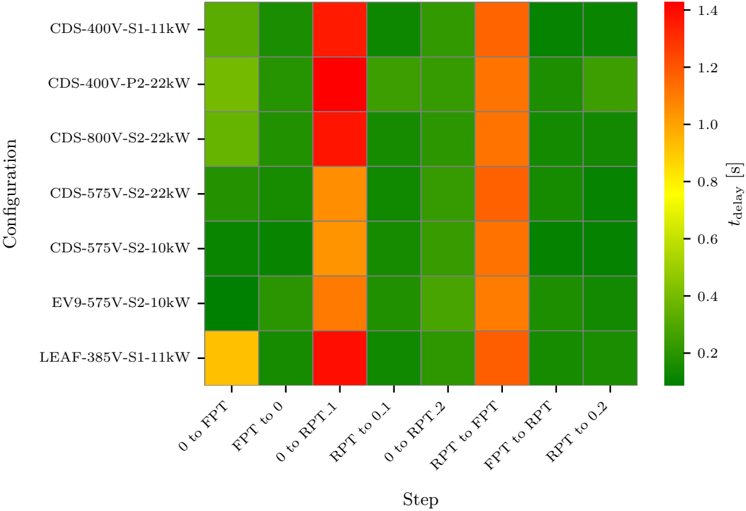
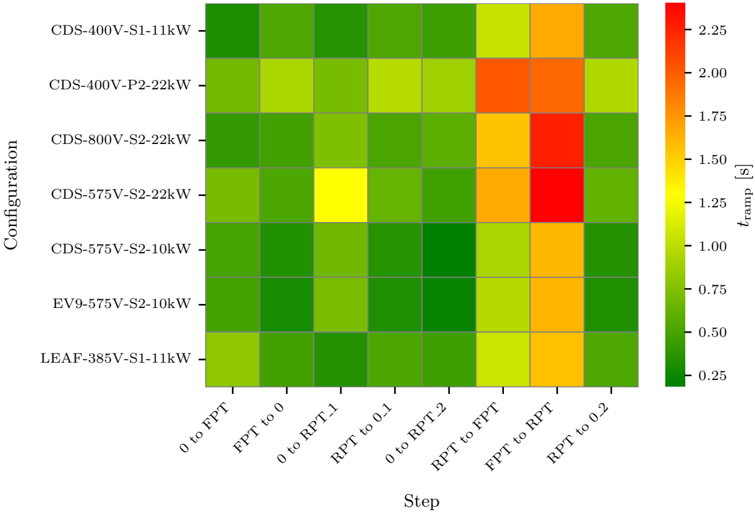
- Seven configurations (Table 3) across eight operational steps, including 0 to FPT, FPT to 0, 0 to RPT_1, RPT to 0_1, 0 to RPT_2, RPT to FPT, FPT to RPT, and RPT to 0_2; setpoints were held for 5 s, and three independent runs were performed per configuration.
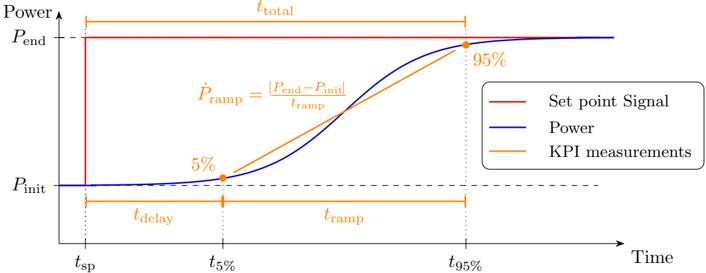
- DC current was sampled at 1 kHz with a Keysight oscilloscope, triggered by a Raspberry Pi GPIO signal after the EVI board confirmed receipt of the setpoint. KPIs included t_delay, t_ramp, t_total, and P_ramp; post-processing used t_5% and t_95%, and PFR transitions were excluded to isolate t_comm and P_conv, with t_PFR derived via equations.
Limitations
- Paper-stated: the timing reference relies on the Raspberry Pi pulling a GPIO high only after the EVI accepted the setpoint, so measured delay is a lower bound and actual communication latency can be higher. Measurements focused on the DC side; AC-side current and real-time battery voltage should also be recorded. The procedure used a limited set of step sizes and primarily full power transitions, so broader intermediate setpoints are needed. Voltage and power caps were not standardized across CCS2 and CHAdeMO comparisons, and broader validation across vehicle types and states of charge is recommended. TLS 1.3 was disabled during all CCS2 testing because the required PKI is not fully integrated, with the paper assuming negligible impact on active power transfer dynamics.
- Evident from the text: the CCS2 vs CHAdeMO comparison is confounded by different configurations, voltage levels, power caps, and sample sizes (CCS2 includes six configurations while CHAdeMO includes one), so protocol effects are not fully isolated. The study uses one EVSE model and one real EV per protocol, with three runs per configuration. PFR delays are attributed to system-level control and communication overhead rather than BMPU hardware, based on the BMPU datasheet and stacked-module behavior.
Model-written summary. Check it against the paper before relying on it.
Integrity signals
Registry
Cites
Statistics
Figures
Verification
Claims the paper makes
0 Valid · 1 Not valid · 23 Not checked · 73 Own results and interpretations
A result the paper states — it cites no source for it, so there is none to check. The quote shows it is in the paper.
In the paper
“The only notable exception is a 0.9-s ramp observed when two BMPUs operate in parallel.”
§ Enabling Grid Services with Bidirectional EV Chargers: A Comparative Analysis of CCS2 and CHAdeMO Response Dynamics > 3.2.2. Ramping
plainSingle case- Asserted: passes — The authors put it forward as true.
- Checkable: passes — It can be checked against evidence.
- Load-bearing: unclear — It is unclear whether the paper’s conclusions depend on it.
- Based: passes — The paper gives a reason why it holds.
A result the paper states — it cites no source for it, so there is none to check. The quote shows it is in the paper.
In the paper
“Transitions that ramp down to 0-whether from FPT or RPT-are consistently among the fastest across all configurations, typically completing within 0.25 to 0.53 s.”
§ Enabling Grid Services with Bidirectional EV Chargers: A Comparative Analysis of CCS2 and CHAdeMO Response Dynamics > 3.2.2. Ramping
plainstates an association- Asserted: passes — The authors put it forward as true.
- Checkable: passes — It can be checked against evidence.
- Load-bearing: unclear — It is unclear whether the paper’s conclusions depend on it.
- Based: passes — The paper gives a reason why it holds.
A result the paper reports from its own data — it cites no other source for it, so there is none to check. The quote shows it is in the paper.
In the paper
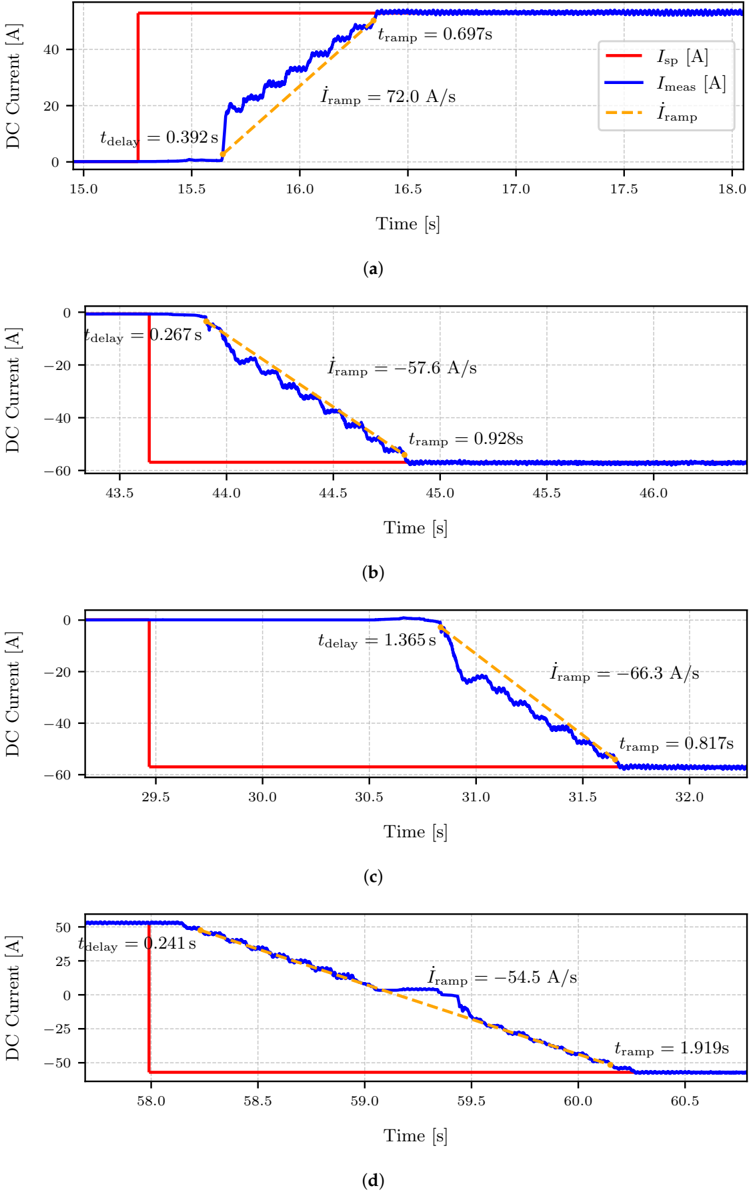
“As shown in Figure 11c, when a command for RPT follows an FPT phase, there is a substantial t delay of 1.365 s.”
§ Enabling Grid Services with Bidirectional EV Chargers: A Comparative Analysis of CCS2 and CHAdeMO Response Dynamics > 3.1. Example of Time-Series Analysis of Charging Dynamics
plainstates a causeSingle case- Asserted: passes — The authors put it forward as true.
- Checkable: passes — It can be checked against evidence.
- Load-bearing: passes — The paper’s conclusions depend on it.
- Based: passes — The paper gives a reason why it holds.
A result the paper states — it cites no source for it, so there is none to check. The quote shows it is in the paper.
In the paper
“Similarly, the ramping capability has increased even when considering the higher nominal power of the Watt & Well EVSE, indicating substantial advances in controller design and implementation.”
§ Enabling Grid Services with Bidirectional EV Chargers: A Comparative Analysis of CCS2 and CHAdeMO Response Dynamics > 4.4. Comparison with CHAdeMO
plainstates a cause- Asserted: passes — The authors put it forward as true.
- Checkable: passes — It can be checked against evidence.
- Load-bearing: passes — The paper’s conclusions depend on it.
- Based: passes — The paper gives a reason why it holds.
A result the paper reports from its own data — it cites no other source for it, so there is none to check. The quote shows it is in the paper.
In the paper
“These PFR transitions deviate significantly from ideal behavior and will be discussed separately.”
§ Enabling Grid Services with Bidirectional EV Chargers: A Comparative Analysis of CCS2 and CHAdeMO Response Dynamics > 4. Discussion
plain- Asserted: passes — The authors put it forward as true.
- Checkable: passes — It can be checked against evidence.
- Load-bearing: passes — The paper’s conclusions depend on it.
- Based: passes — The paper gives a reason why it holds.
46 more claims
Create a free account to see all 97 claims and every source verdict.
- Probably not a substantial claim. 21
- It may state two separate claims as one. 35
Self-check
Percentages, sums and reported differences re-computed from the paper’s own numbers.
Each contradiction between two passages listed here was confirmed by an independent check.
Rated minor: it would not touch a result — a value no result rests on, a p-value that stays on the same side of the significance level, or a conflict that is clerical, resolved elsewhere in the paper, or outside its own findings.
In the paper
§ Enabling Grid Services with Bidirectional EV Chargers: A Comparative Analysis of CCS2 and CHAdeMO Response Dynamics > 4.3. Power Flow Reversal Delays
“For instance, transitions from FPT to RPT appear consistently faster than other transitions.”
§ Enabling Grid Services with Bidirectional EV Chargers: A Comparative Analysis of CCS2 and CHAdeMO Response Dynamics > 5. Conclusions
“| LEAF-385V-S1-11kW | 1.064 | 0.178 | 0.741 |”
Rated minor: it would not touch a result — a value no result rests on, a p-value that stays on the same side of the significance level, or a conflict that is clerical, resolved elsewhere in the paper, or outside its own findings.
In the paper
§ Enabling Grid Services with Bidirectional EV Chargers: A Comparative Analysis of CCS2 and CHAdeMO Response Dynamics > 3. Results
“the eight different setup configurations chosen.”
§ Enabling Grid Services with Bidirectional EV Chargers: A Comparative Analysis of CCS2 and CHAdeMO Response Dynamics > 3.2.1. Communication and Control Delays
“This section compares the communication and internal control delays of the EVCS across the seven configurations and eight operational steps.”
Rated minor: it would not touch a result — a value no result rests on, a p-value that stays on the same side of the significance level, or a conflict that is clerical, resolved elsewhere in the paper, or outside its own findings.
In the paper
§ Enabling Grid Services with Bidirectional EV Chargers: A Comparative Analysis of CCS2 and CHAdeMO Response Dynamics > Data availability
“No new data were created or analyzed in this study.”
§ Enabling Grid Services with Bidirectional EV Chargers: A Comparative Analysis of CCS2 and CHAdeMO Response Dynamics > 2.2. Test Procedure
“Three independent runs were performed for each configuration, ensuring repeatability and identifying potential outliers.”
Rated minor: it would not touch a result — a value no result rests on, a p-value that stays on the same side of the significance level, or a conflict that is clerical, resolved elsewhere in the paper, or outside its own findings.
In the paper
§ Enabling Grid Services with Bidirectional EV Chargers: A Comparative Analysis of CCS2 and CHAdeMO Response Dynamics > 3.1. Example of Time-Series Analysis of Charging Dynamics
“As shown in Figure 11c, when a command for RPT follows an FPT phase, there is a substantial t delay of 1.365 s.Conversely, when the command preserves the flow direction, t delay is negligible (Figure 11b,c).”
§ Enabling Grid Services with Bidirectional EV Chargers: A Comparative Analysis of CCS2 and CHAdeMO Response Dynamics > 5. Conclusions
“(c) 0 to RPT (from a state of FPT, and thus includes a PFR).”
Rated minor: it would not touch a result — a value no result rests on, a p-value that stays on the same side of the significance level, or a conflict that is clerical, resolved elsewhere in the paper, or outside its own findings.
In the paper
§ Enabling Grid Services with Bidirectional EV Chargers: A Comparative Analysis of CCS2 and CHAdeMO Response Dynamics > 3.1. Example of Time-Series Analysis of Charging Dynamics
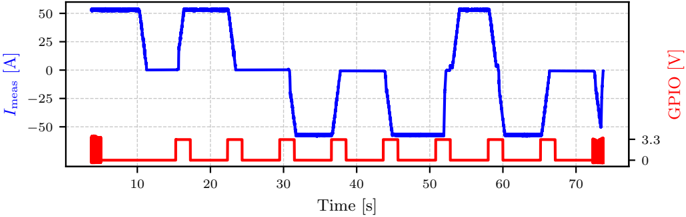
“One of the three runs with the CDS and a single BMPU at 400 V will now provide general observations on the response dynamics.Figure 10 provides an overview of the raw data from a single test run, showing the GPIO control signal indicating a change in setpoint and the corresponding measured DC current (I meas ) from the power converters.This comprehensive sequence provides context for the four specific transitions that are isolated and examined in detail in Figure 11.”
§ Enabling Grid Services with Bidirectional EV Chargers: A Comparative Analysis of CCS2 and CHAdeMO Response Dynamics > 5. Conclusions
“Focused view of step transitions showing initial delay and ramping behavior for the first run with the configuration of two BMPU in parallel configuration connected to the CDS at 400 V.”
Citations
Cites
Kempton, W., & Tomić, J. (2005) · Journal of Power Sources · doi:10.1016/j.jpowsour.2004.12.022 · Cited by 2,126
Plug-in electric vehicles in electric distribution networks: A review of smart charging approaches
García-Villalobos, J., Zamora, I., San Martín, J. I., Asensio, F. J., & Aperribay, V. (2014) · Renewable and Sustainable Energy Reviews · doi:10.1016/j.rser.2014.07.040 · Cited by 497
A Review of Power System Flexibility With High Penetration of Renewables
Mohandes, B., Moursi, M. S. E., Hatziargyriou, N., & Khatib, S. E. (2019) · IEEE Transactions on Power Systems · doi:10.1109/tpwrs.2019.2897727 · Cited by 496
Hu, J., Morais, H., Sousa, T., & Lind, M. (2016) · Renewable and Sustainable Energy Reviews · doi:10.1016/j.rser.2015.12.014 · Cited by 460
The rise of electric vehicles—2020 status and future expectations
Muratori, M., Alexander, M., Arent, D., Bazilian, M., Cazzola, P., Dede, E. M., Farrell, J., Gearhart, C., Greene, D., Jenn, A., et al. (2021) · Progress in Energy · doi:10.1088/2516-1083/abe0ad · Cited by 456
Rietmann, N., Hügler, B., & Lieven, T. (2020) · Journal of Cleaner Production · doi:10.1016/j.jclepro.2020.121038 · Cited by 402
Powell, S., Cezar, G. V., Min, L., Azevedo, I. M. L., & Rajagopal, R. (2022) · Nature Energy · doi:10.1038/s41560-022-01105-7 · Cited by 366
Bidirectional Onboard Chargers for Electric Vehicles: State-of-the-Art and Future Trends
Wouters, H., & Martinez, W. (2024) · IEEE Transactions on Power Electronics · doi:10.1109/tpel.2023.3319996 · Cited by 280
Gonzalez Venegas, F., Petit, M., & Perez, Y. (2021) · Renewable and Sustainable Energy Reviews · doi:10.1016/j.rser.2021.111060 · Cited by 244
A Comprehensive Review of Developments in Electric Vehicles Fast Charging Technology
Zentani, A., Almaktoof, A., & Kahn, M. T. (2024) · Applied Sciences · doi:10.3390/app14114728 · Cited by 148
Research works printed but not linked: 3
- Waechter, N.; Eugster, P.; Piffaretti, M.; Christensen, B. Advancing Global Interoperability for Vehicle-to-Grid (V2G) Technology: Insights from Task 53. In Proceedings of the 38th International Electric Vehicle Symposium and Exhibition, Göteborg, Sweden, 15-18 June 2025.
- European Parliment. Regulation (EU) 2023/1804 of the European Parliament and of the Council of 13 September 2023 on the Deployment of Alternative Fuels Infrastructure, and Repealing Directive 2014/94/EU. Off. J. Eur. Union 2024, 234, 1-47.
- Sevdari, K.; Knudsen, R.M.; Fabbri, G.; Pedersen, K.L.; Alami, A.; Marinelli, M. Demonstration of Bidirectional Charging Using ISO 15118-20. In Proceedings of the 38th International Electric Vehicle Symposium and Exhibition, Göteborg, Sweden, 15-18 June 2025.
Cited by
Yu, H., Wu, C., & Liu, Y. (2026) · Machines · doi:10.3390/machines14040418 · Cited by 8
Katsuba, Y., Kochegarov, M., Zalyubovsky, A., Sivov, A., & Bazhenov, A. (2026) · World Electric Vehicle Journal · doi:10.3390/wevj17040205 · Cited by 2
Štefko, R., Szomosi, V., Bobček, M., Király, J., Čonka, Z., & Chabreček, E. (2026) · Applied Sciences · doi:10.3390/app16199410
Porfirenko, V. (2025) · The National Transport University Bulletin · doi:10.33744/2308-6645-2025-2-29-82-93
IACOPINI, D. (2026) · Electronic Theses and Dissertations Repository (University of Pisa)
Metadata
- Authors
- Pedersen, K. L., Knudsen, R. M., Marinelli, M., Secchi, M., & Sevdari, K.
- Affiliations
- Technical University of Denmark (DK)
- Monta, Strandboulevarden 122, 2100 Copenhagen, Denmark
- Corresponding author
- Pedersen, Kristoffer Laust
- ORCID
- Venue
- World Electric Vehicle Journal
- Publisher
- MDPI AG
- Published
- 2025-11-20
- Volume
- 16
- Issue
- 11
- Pages
- 636
- ISSN
- 2032-6653 (ISSN-L)
- OpenAlex
- W4416409851
- Cited by
- 5
- References
- 24
- Citations by year
- 2026: 4 · 2025: 1
- FWCI
- 0.84
- Type
- journal article
- Language
- en
- Open access
- gold
- doi.org
- Licence
- Locations
- World Electric Vehicle Journal (publishedVersion, cc-by)
- Preprints.org (submittedVersion, cc-by)
- DOAJ (DOAJ: Directory of Open Access Journals) (submittedVersion)
- Zenodo (CERN European Organization for Nuclear Research) (submittedVersion, cc-by)
- Funders
- EV4EU (101056765)
- FLOW (101056730)
- Topics
- Physical Sciences › Engineering › Electrical and Electronic Engineering › Electric Vehicles and Infrastructure
- Physical Sciences › Engineering › Electrical and Electronic Engineering › Smart Grid Energy Management
- Physical Sciences › Energy › Energy Engineering and Power Technology › Power Systems and Renewable Energy
- Keywords
- bidirectional EV charging, grid services, CHAdeMO, response dynamics, primary frequency control, reverse power flow, voltage levels
About these checks
Registry, retraction, Cites and statistics results are computed, not judged, with one exception: a printed reference that no index lists is read once by a model before it counts as a citation error. Claims are extracted by a model and kept only when their quote appears verbatim in the text; each cited source is then checked, with a model’s help, for whether it says what the claim relies on. Those verdicts can be wrong — read the claim’s quote and the cited source before relying on one.
A language model drew the claims from the paper on 2026-11-25, under version 3 of the claim definition (model deepseek-v4.1-flash, prompt extract-v3).
A second model labelled each claim on 2026-11-25 (model jev-1.13-20260917, definition revision gold-guideline-v0.2).
Statistics and arithmetic are recomputed, not judged.
Confidence bands are shown only for fields calibrated on our annotated test set. None is calibrated yet, so no band is shown.
What counts as a claim ›How we measure confidence ›How we check this ›
Are you an author, or do you see a problem with this page? Request a review
Data sources
Bibliographic data: Semantic Scholar, OpenAlex, Crossref.
Contains information from the Semantic Scholar Academic Graph Datasets, made available under the ODC Attribution License (ODC-BY 1.0).
Semantic Scholar’s data is described in: Kinney, R., et al. (2023). The Semantic Scholar Open Data Platform. arXiv:2301.10140.
