

Topic Evolution of Library and Information Science Studies in the Last Twenty Years: A Co-Word Analysis
Open accessThe DOI matches its Crossref record; 46 of the 48 references it cites were found in a registry or an index.
Abstract
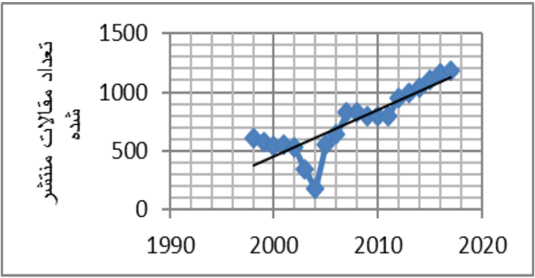
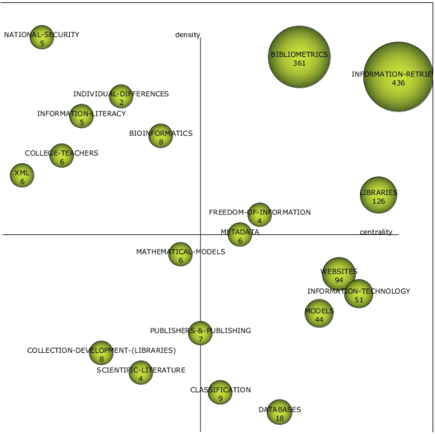
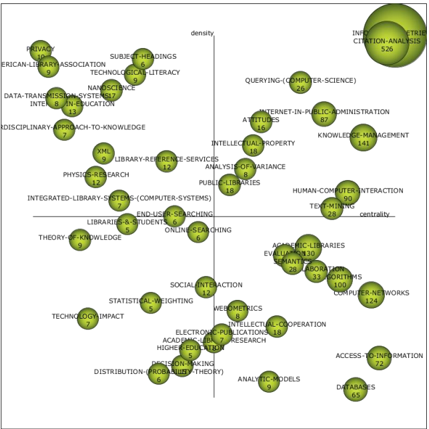
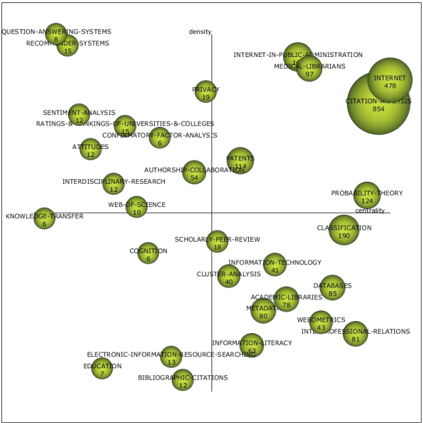
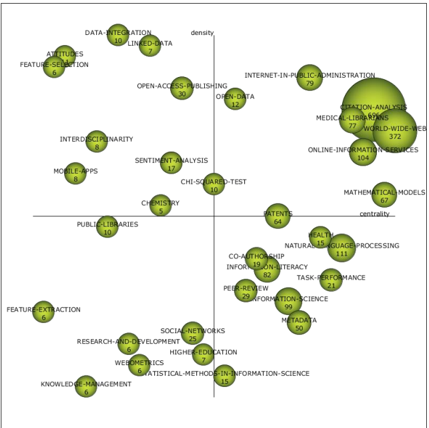
Abstract Background and Objectives: Topic evolutions of scientific and academic disciplines can be clarified by drawing scientific maps and identifies emerging or developed topics of scientific disciplines, sub-topics and the relationship between different topics of a discipline. The purpose of this study is to draw a strategic diagram to analyze the developments of the last twenty years of library and information science field. Material and Methods: This was a Scientometrics study with co-occurrence analysis of words that was conducted on ten journals with the highest impact factor in the field of library and information science. Twenty years (1998-2017) publications were extracted from LISTA database and imported into SciMAT software. After preparing the data, all publications were divided into four time periods, strategic diagrams of each period were drawn and topic clusters were analyzed. Results: The largest clusters of the first two periods were "Information Retrieval" and "Bibliometrics", which in the next period "Citation-Analysis" appeared instead of "Information Retrieval" cluster, but nevertheless the largest node of this cluster was "Information Retrieval". These clusters were the most developed topics in the field of library and information science. Conclusion: Information retrieval and bibliometrics are at the forefront of library and information science. Sentiment analysis and information literacy with a cognitive approach are emerging topics in the field. Also, studies related to information production and related indicators have led to qualitative research.
Overview
CoChat Summary
TL;DR
This scientometric co-word analysis used SciMAT strategic diagrams to map topic evolution in ten high-impact library and information science journals from 1998–2017. It reports information retrieval and bibliometrics as the field’s most developed/forefront topics, with citation analysis emerging as a major cluster and sentiment analysis/information literacy as emerging topics.
Key findings
- The largest clusters in the first two periods were “Information Retrieval” and “Bibliometrics”; in the next period, “Citation-Analysis” appeared instead of the “Information Retrieval” cluster, but the largest node of that cluster was still “Information Retrieval” (abstract).
- Information retrieval and bibliometrics are described as being at the forefront of library and information science.
- Sentiment analysis and information literacy with a cognitive approach are identified as emerging topics.
- Studies related to information production and related indicators have led to qualitative research.
Methods
- Scientometrics study using co-word analysis, conducted on ten journals with the highest impact factor in library and information science.
- Twenty years of publications (1998–2017) were extracted from the LISTA database and imported into SciMAT software.
- After data preparation, publications were divided into four time periods; strategic diagrams were drawn for each period and topic clusters were analyzed using centrality and density.
Limitations
- The paper states that the most important limitation is limiting articles to journals with a high impact factor as LIS articles.
- The paper notes that results depend on how articles are selected and on keyword-based co-word analysis limitations, such as new keywords and author keywords.
- Evident from the described design: restricting the sample to ten high-impact journals and LISTA may not represent all LIS research venues or non-indexed publications.
Model-written summary. Check it against the paper before relying on it.
Integrity signals
Registry
Cites
Statistics
Figures
Verification
Claims the paper makes
0 Valid · 0 Not valid · 0 Not checked · 11 Own results and interpretations
A result the paper reports from its own data — it cites no other source for it, so there is none to check. The quote shows it is in the paper.
In the paper
“Human Computer Interaction و Text Mining خوشه دوم ربع بودند.”
§ Topic Evolution of Library and Information Science Studies in the Last Twenty Years: A Co-Word Analysis > Additional information
plain- Asserted: passes — The authors put it forward as true.
- Checkable: passes — It can be checked against evidence.
- Load-bearing: unclear — It is unclear whether the paper’s conclusions depend on it.
- Based: passes — The paper gives a reason why it holds.
A result the paper reports from its own data — it cites no other source for it, so there is none to check. The quote shows it is in the paper.
In the paper
“The largest clusters of the first two periods were “Information Retrieval” and “Bibliometrics””
§ Topic Evolution of Library and Information Science Studies in the Last Twenty Years: A Co-Word Analysis > Abstract
plain- Asserted: passes — The authors put it forward as true.
- Checkable: passes — It can be checked against evidence.
- Load-bearing: passes — The paper’s conclusions depend on it.
- Based: passes — The paper gives a reason why it holds.
A result the paper reports from its own data — it cites no other source for it, so there is none to check. The quote shows it is in the paper.
In the paper
“قااو ی تاارین باا ارتباااط ین گااره هااا ی Citation-Analysis ، Bibliometrics و Impact Factor بود”
§ Topic Evolution of Library and Information Science Studies in the Last Twenty Years: A Co-Word Analysis > Additional information
plainstates an association- Asserted: passes — The authors put it forward as true.
- Checkable: passes — It can be checked against evidence.
- Load-bearing: unclear — It is unclear whether the paper’s conclusions depend on it.
- Based: passes — The paper gives a reason why it holds.
A result the paper reports from its own data — it cites no other source for it, so there is none to check. The quote shows it is in the paper.
In the paper
“but nevertheless the largest node of this cluster was “Information Retrieval””
§ Topic Evolution of Library and Information Science Studies in the Last Twenty Years: A Co-Word Analysis > Abstract
plain- Asserted: passes — The authors put it forward as true.
- Checkable: passes — It can be checked against evidence.
- Load-bearing: unclear — It is unclear whether the paper’s conclusions depend on it.
- Based: passes — The paper gives a reason why it holds.
A result the paper reports from its own data — it cites no other source for it, so there is none to check. The quote shows it is in the paper.
In the paper
“which in the next period “Citation-Analysis” appeared instead of “Information Retrieval” cluster”
§ Topic Evolution of Library and Information Science Studies in the Last Twenty Years: A Co-Word Analysis > Abstract
hedged- Asserted: passes — The authors put it forward as true.
- Checkable: passes — It can be checked against evidence.
- Load-bearing: unclear — It is unclear whether the paper’s conclusions depend on it.
- Based: passes — The paper gives a reason why it holds.
1 more claim
Create a free account to see all 11 claims and every source verdict.
- It may state two separate claims as one. 4
- Probably not a substantial claim. 1
Self-check
Percentages, sums and reported differences re-computed from the paper’s own numbers.
Each contradiction between two passages listed here was confirmed by an independent check.
Rated minor: it would not touch a result — a value no result rests on, a p-value that stays on the same side of the significance level, or a conflict that is clerical, resolved elsewhere in the paper, or outside its own findings.
In the paper
§ Topic Evolution of Library and Information Science Studies in the Last Twenty Years: A Co-Word Analysis > Abstract
“but nevertheless the largest node of this cluster was "Information Retrieval".”
§ Topic Evolution of Library and Information Science Studies in the Last Twenty Years: A Co-Word Analysis > Additional information
“در خوشااه ی Citation-Analysis باازرگ تاارین گااره Bibliometrics”
Rated minor: it would not touch a result — a value no result rests on, a p-value that stays on the same side of the significance level, or a conflict that is clerical, resolved elsewhere in the paper, or outside its own findings.
In the paper
§ Topic Evolution of Library and Information Science Studies in the Last Twenty Years: A Co-Word Analysis > Abstract
“which in the next period "Citation-Analysis" appeared instead of "Information Retrieval" cluster”
§ Topic Evolution of Library and Information Science Studies in the Last Twenty Years: A Co-Word Analysis > Additional information
“Citation-Analysis جاایگزین Bibliometrics”
Citations
Cites
Callon, M., Courtial, J. P., & Laville, F. (1991) · Scientometrics · doi:10.1007/bf02019280 · Cited by 2,090
From translations to problematic networks: An introduction to co-word analysis
Callon, M., Courtial, J.-P., Turner, W. A., & Bauin, S. (1983) · Social Science Information · doi:10.1177/053901883022002003 · Cited by 1,951
E-government research: Reviewing the literature, limitations, and ways forward
Yildiz, M. (2007) · Government Information Quarterly · doi:10.1016/j.giq.2007.01.002 · Cited by 1,024
Bibliometric cartography of information retrieval research by using co-word analysis
Ding, Y., Chowdhury, G. G., & Foo, S. (2001) · Information Processing & Management · doi:10.1016/s0306-4573(00)00051-0 · Cited by 882
Knowledge Discovery through Co-Word Analysis.
Qin, H. (1999) · Illinois Digital Environment for Access to Learning and Scholarship (University of Illinois at Urbana-Champaign) · Cited by 853
Critical Information Literacy: Implications for Instructional Practice
Elmborg, J. (2006) · The Journal of Academic Librarianship · doi:10.1016/j.acalib.2005.12.004 · Cited by 551
Information Literacy: Essential Skills for the Information Age
Eisenberg, M. B. (2008) · DESIDOC Journal of Library & Information Technology · doi:10.14429/djlit.28.2.166 · Cited by 505
Analyzing the Scientific Evolution of Social Work Using Science Mapping
Martínez, M. A., Cobo, M. J., Herrera, M., & Herrera-Viedma, E. (2015) · Research on Social Work Practice · doi:10.1177/1049731514522101 · Cited by 347
Chang, Y.-W., Huang, M.-H., & Lin, C.-W. (2015) · Scientometrics · doi:10.1007/s11192-015-1762-8 · Cited by 330
Ravikumar, S., Agrahari, A., & Singh, S. N. (2015) · Scientometrics · doi:10.1007/s11192-014-1402-8 · Cited by 230
Research works printed but not linked: 5
- Sharafi A, Nourmohammadi H. Determination of the Life Process of the Subjects of Masters and Doctoral Dissertations in Library and Information Science based on the Records Available in the ProQuest Database During 2006-2010. Journal of Studies in Library and Information Science. 2012; 4(10), 41-60. (Persian)
- Babalhavaeji F, Zarei A, Neshat N, Hariri N. Mapping of knowledge and information science based on main and sub-main subject categorization. Journal of Studies in Library and Information Science. 2014; 6(13), 1-24. (Persian)
- 10.22055/slis.2018.11650.(persian · doi:10.22055/slis.2018.11650.(persian
- 10.22070/rsci.2020.4724.1319.(persian · doi:10.22070/rsci.2020.4724.1319.(persian
- 10.34172/doh.2020.43.(persian · doi:10.34172/doh.2020.43.(persian
Cited by
Liao, F., Ong, J., Zhang, W., Xu, L., Pan, H., & Li, P. (2025) · Engineering Construction & Architectural Management · doi:10.1108/ecam-04-2025-0612 · Cited by 1
Metadata
- Authors
- Habibi, S., Abdollahzadeh, P., Abdekhoda, M., & Aghayari, H.
- Affiliations
- Tabriz University of Medical Sciences (IR)
- Corresponding author
- Abdollahzadeh, Parvin
- Venue
- Depiction of Health
- Publisher
- Maad Rayan Publishing Company
- Published
- 2021-03-19
- Volume
- 12
- Issue
- 1
- Pages
- 55-68
- ISSN
- 2008-9058 (ISSN-L)
- 2423-6640
- OpenAlex
- W3151202953
- Cited by
- 1
- References
- 48
- Citations by year
- 2025: 1
- FWCI
- 0.00
- Type
- journal article
- Language
- en
- Open access
- diamond
- doi.org
- Licence
- cc-by-nc
- Locations
- Depiction of Health (publishedVersion, cc-by-nc)
- E-LIS Repository (University of Naples Federico II) (submittedVersion, cc-by-nc)
- DOAJ (DOAJ: Directory of Open Access Journals) (submittedVersion)
- Topics
- Social Sciences › Library and Information Sciences › scientometrics and bibliometrics research
- Social Sciences › Library and Information Sciences › Library Science and Information
- Social Sciences › Library and Information Sciences › Information Science and Libraries
- Keywords
- library and information science, topic evolution, information retrieval, bibliometric analysis, citation analysis, sentiment analysis, information literacy, information production, research trends
About these checks
Registry, retraction, Cites and statistics results are computed, not judged, with one exception: a printed reference that no index lists is read once by a model before it counts as a citation error. Claims are extracted by a model and kept only when their quote appears verbatim in the text; each cited source is then checked, with a model’s help, for whether it says what the claim relies on. Those verdicts can be wrong — read the claim’s quote and the cited source before relying on one.
A language model drew the claims from the paper on 2026-11-23, under version 3 of the claim definition (model deepseek-v4.1-flash, prompt extract-v3).
A second model labelled each claim on 2026-11-23 (model jev-1.13-20260917, definition revision gold-guideline-v0.2).
Statistics and arithmetic are recomputed, not judged.
Confidence bands are shown only for fields calibrated on our annotated test set. None is calibrated yet, so no band is shown.
What counts as a claim ›How we measure confidence ›How we check this ›
Are you an author, or do you see a problem with this page? Request a review
Data sources
Bibliographic data: Semantic Scholar, OpenAlex, Crossref.
Contains information from the Semantic Scholar Academic Graph Datasets, made available under the ODC Attribution License (ODC-BY 1.0).
Semantic Scholar’s data is described in: Kinney, R., et al. (2023). The Semantic Scholar Open Data Platform. arXiv:2301.10140.
