

Distractors associated with reward break through the focus of attention
Open accessThe DOI matches its Crossref record; 42 of the 42 references it cites were found in a registry or an index.
Abstract
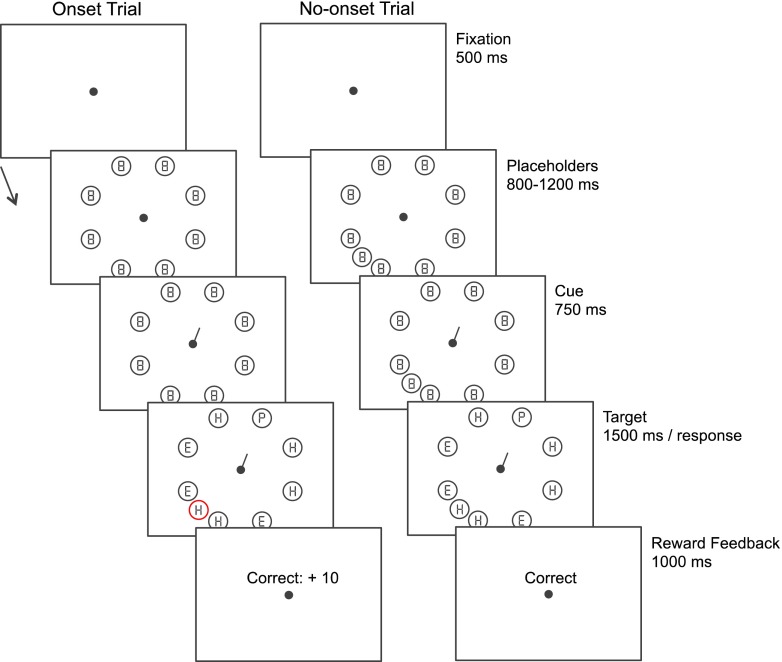
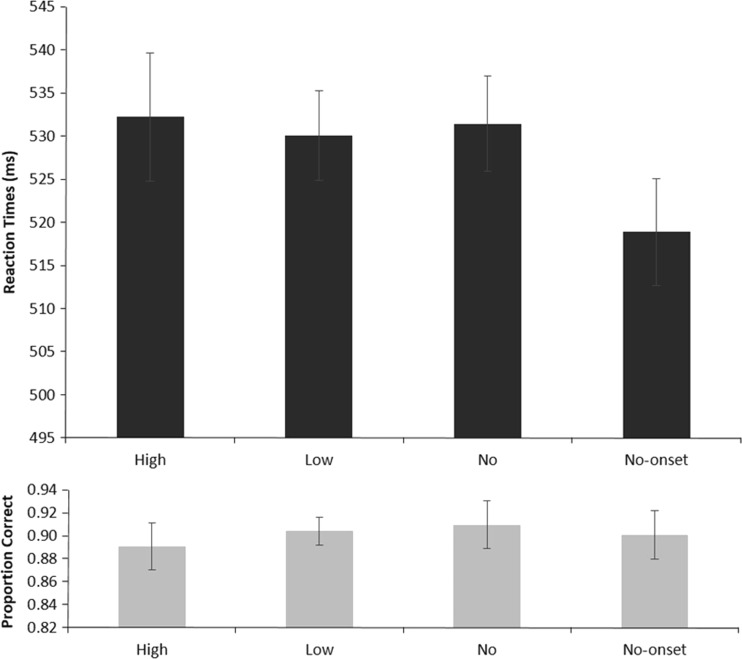
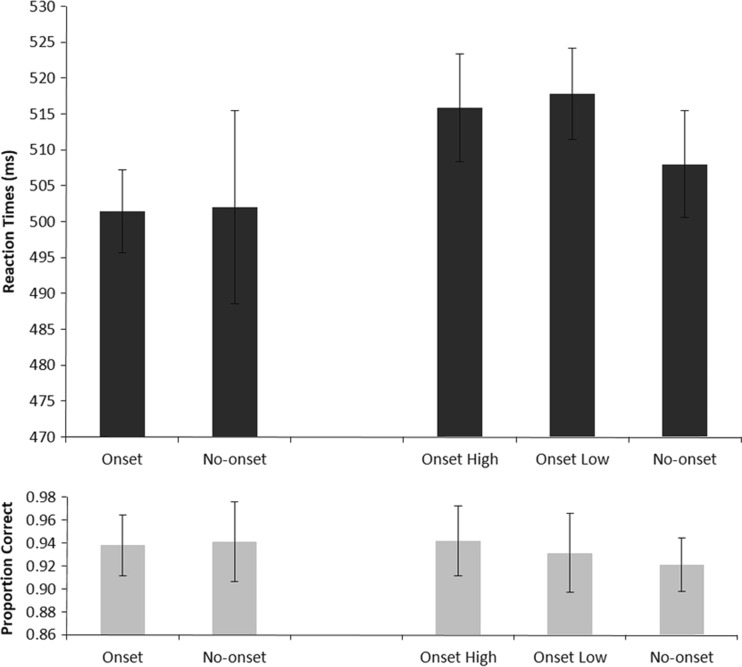
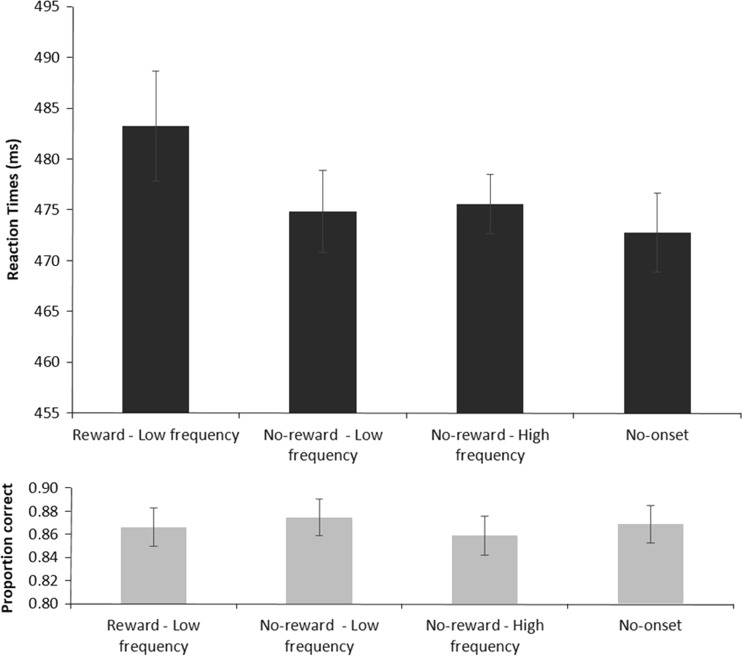
In the present study, we investigated the conditions in which rewarded distractors have the ability to capture attention, even when attention is directed toward the target location. Experiment 1 showed that when the probability of obtaining reward was high, all salient distractors captured attention, even when they were not associated with reward. This effect may have been caused by participants suboptimally using the 100%-valid endogenous location cue. Experiment 2 confirmed this result by showing that salient distractors did not capture attention in a block in which no reward was expected. In Experiment 3, the probability of the presence of a distractor was high, but it only signaled reward availability on a low number of trials. The results showed that those very infrequent distractors that signaled reward captured attention, whereas the distractors (both frequent and infrequent ones) not associated with reward were simply ignored. The latter experiment indicates that even when attention is directed to a location in space, stimuli associated with reward break through the focus of attention, but equally salient stimuli not associated with reward do not.
Overview
The claims and statistics of this paper haven’t been checked yet.
Free: it reads the open-access text and checks the first 5 claims that cite a source we can check. Create a free account to check every claim.
Integrity signals
Registry
Cites
Statistics
Figures
Verification
Claims the paper makes
The claims and statistics of this paper haven’t been checked yet.
Free: it reads the open-access text and checks the first 5 claims that cite a source we can check. Create a free account to check every claim.
Claims other papers make about this one
Each is checked against this paper’s own text: does it say what the citing paper says it does?
The cited source says what the claim attributes to it.
In the citing paper
“Munneke et al. (2016) found that abrupt onset distractors only broke through the focus of spatial attention when they were associated with reward.”
From Selection history: How reward modulates selectivity of visual attention. (2018) · cites this paper as Munneke et al., 2016
The cited source says what the claim attributes to it.
In the citing paper
“When they were not associated with reward, these distractors could simply be ignored”
From Selection history: How reward modulates selectivity of visual attention. (2018) · cites this paper as Munneke et al., 2016
The cited source says what the claim attributes to it.
In the citing paper
“recent studies showed that this is not the case for reward-signaling or previously reward-associated stimuli (e.g., MacLean, Diaz, & Giesbrecht, 2016; Munneke, Belopolsky, & Theeuwes, 2016; Munneke, Hoppenbrouwers, & Theeuwes, 2015; Wang et al., 2015).”
From Selection history: How reward modulates selectivity of visual attention. (2018) · cites this paper as Munneke, Belopolsky, & Theeuwes, 2016
Self-check
Percentages, sums and reported differences re-computed from the paper’s own numbers.
The self-check needs the paper’s full text.
Citations
Cites
Brainard, D. H. (1997) · Spatial Vision · doi:10.1163/156856897x00357 · Cited by 19,702 · cited 2×
“12 (Brainard, 1997; Pelli, 1997) for MATLAB 2014a (MathWorks, Inc.”
MethodInfluentialControl of goal-directed and stimulus-driven attention in the brain
Corbetta, M., & Shulman, G. L. (2002) · Nature Reviews Neuroscience · doi:10.1038/nrn755 · Cited by 12,881 · cited 1×
“These models of attention have been studied extensively and have long been considered the only mechanisms responsible for attentional selection (for reviews of the matter, see Corbetta & Shulman, 2002; Theeuwes, 2010; Theeuwes, Olivers, & Belopolsky, 2010).”
BackgroundThe VideoToolbox software for visual psychophysics: transforming numbers into movies
Pelli, D. G. (1997) · Spatial Vision · doi:10.1163/156856897x00366 · Cited by 11,098 · cited 1×
“All of the stimuli were created and presented using Psychophysics Toolbox 3.0.12 (Brainard, 1997; Pelli, 1997) for MATLAB 2014a (MathWorks, Inc.).”
MethodInfluentialNeural Mechanisms of Selective Visual Attention
Desimone, R., & Duncan, J. (1995) · Annual Review of Neuroscience · doi:10.1146/annurev.ne.18.030195.001205 · Cited by 8,388 · cited 1×
“This competition is resolved (biased) by attention (Desimone, 1998; Desimone & Duncan, 1995).”
BackgroundBergum, B. O., Long, J., & Baddeley, A. (1982) · The American Journal of Psychology · doi:10.2307/1422199 · Cited by 2,226
Confidence Intervals from Normalized Data: A correction to Cousineau (2005)
Morey, R. D. (2008) · Tutorials in Quantitative Methods for Psychology · doi:10.20982/tqmp.04.2.p061 · Cited by 1,997
Voluntary versus automatic control over the mind's eye
Jonides, J. (1981) · Attention and performance · Cited by 1,857
Top-down versus bottom-up attentional control: a failed theoretical dichotomy
Awh, E., Belopolsky, A. V., & Theeuwes, J. (2012) · Trends in Cognitive Sciences · doi:10.1016/j.tics.2012.06.010 · Cited by 1,557 · cited 1×
“…is that associating a stimulus with a reward boosts its representation on an attentional priority map, biasing attention toward * Jaap Munneke Jaap.Munneke@gmail.com 1 Department of Cognitive Psychology, Vrije Universiteit, Amsterdam, The Netherlands selection of this stimulus (Awh et al., 2012).”
BackgroundSelf-citationTop–down and bottom–up control of visual selection
Theeuwes, J. (2010) · Acta Psychologica · doi:10.1016/j.actpsy.2010.02.006 · Cited by 1,385 · cited 8×
“, whether a rewarded salient stimulus breaks through attentional focus, whereas an equally salient but nonrewarded stimulus does 1 Because the salient distractor in the no-reward block always had the same color, it can be argued that the lack of an effect was caused by a suppression of the distractor color, due to neg…”
BackgroundMethodResultInfluentialSelf-citationVoluntary versus automatic control over the mind's eye's movement
Jonides, J. (1981) · Attention and performance · Cited by 1,341
Cited by
Selection history: How reward modulates selectivity of visual attention.
Failing, M., & Theeuwes, J. (2018) · Psychonomic Bulletin & Review · doi:10.3758/s13423-017-1380-y · Cited by 345
“For example, Munneke et al. (2016) found that abrupt onset distractors only broke through the focus of spatial attention when they were associated with reward.”
BackgroundSelf-citationThe past, present, and future of selection history
Anderson, B. A., Kim, H., Kim, A. J., Liao, M.-R., Mrkonja, L., Clement, A., & Grégoire, L. (2021) · Neuroscience & Biobehavioral Reviews · doi:10.1016/j.neubiorev.2021.09.004 · Cited by 187
Neurobiology of value-driven attention
Anderson, B. A. (2018) · Current Opinion in Psychology · doi:10.1016/j.copsyc.2018.11.004 · Cited by 151
On the value-dependence of value-driven attentional capture
Anderson, B. A., & Halpern, M. (2017) · Attention Perception & Psychophysics · doi:10.3758/s13414-017-1289-6 · Cited by 106
“Unrewarded control condition Attentional capture by previously unrewarded target features was substantially larger in Sha and Jiang (2016) than in the present study and in several other studies using a similar paradigm (Anderson, 2017 a;”
ResultReward-driven distraction: A meta-analysis.
Rusz, D., Pelley, M. E. L., Kompier, M. A. J., Mait, L., & Bijleveld, E. (2020) · Psychological Bulletin · doi:10.1037/bul0000296 · Cited by 71
“This finding implies that reward-associated distractors are capable of penetrating strong, top-down processes, substantiating findings from previous studies (Munneke et al., 2015, 2016; L. Wang, Duan, Theeuwes, & Zhou, 2014; L. H. Wang et al., 2015).”
ResultAn adaptive view of attentional control.
Anderson, B. A. (2021) · American Psychologist · doi:10.1037/amp0000917 · Cited by 61
How Attention Changes in Response to Incentives
Sawaki, R., Luck, S. J., & Raymond, J. E. (2015) · Journal of Cognitive Neuroscience · doi:10.1162/jocn_a_00847 · Cited by 57
Weight Status and Attentional Biases Toward Foods: Impact of Implicit Olfactory Priming
Mas, M., Brindisi, M., Chabanet, C., Nicklaus, S., & Chambaron, S. (2019) · Frontiers in Psychology · doi:10.3389/fpsyg.2019.01789 · Cited by 36
Kim, H., & Anderson, B. A. (2020) · Cognition · doi:10.1016/j.cognition.2020.104554 · Cited by 36
Immunity to attentional capture at ignored locations
Ruthruff, E. D., & Gaspelin, N. (2017) · Attention Perception & Psychophysics · doi:10.3758/s13414-017-1440-4 · Cited by 33
“Munneke, Belopolsky, and Theeuwes (2016) indicated the target location using a 100 % valid line cue.”
BackgroundUncertainty modulates value-driven attentional capture
Cho, S. A., & Cho, Y. S. (2020) · Attention Perception & Psychophysics · doi:10.3758/s13414-020-02171-3 · Cited by 28
Mixed signals: The effect of conflicting reward- and goal-driven biases on selective attention
Preciado, D. F., Munneke, J., & Theeuwes, J. (2017) · Attention Perception & Psychophysics · doi:10.3758/s13414-017-1322-9 · Cited by 23
“Importantly, these valuedriven attentional effects are observed to act against endogenous attentional control determined by the goals of the observer, the specific demands of the ongoing task, or even despite the fact that in certain experimental conditions these stimuli are no longer predictive of reward (Anderson et…”
BackgroundSelf-citationImplicit food odour priming effects on reactivity and inhibitory control towards foods
Mas, M., Brindisi, M., Chabanet, C., & Chambaron, S. (2020) · PLoS ONE · doi:10.1371/journal.pone.0228830 · Cited by 23
“Those two aspects provide a solid base to establish that food stimuli are salient in the environment [12]: they are more prone to visually attract attention, and consequently, undergo quickly cognitive processing, which affects decision-making [13].”
BackgroundReward differentially interacts with physical salience in feature-based attention
Gong, M., & Liu, T. (2018) · Journal of Vision · doi:10.1167/18.11.12 · Cited by 15
Stimuli that signal the availability of reward break into attentional focus
Wang, L., Li, S., Zhou, X., & Theeuwes, J. (2018) · Vision Research · doi:10.1016/j.visres.2017.10.008 · Cited by 15
“, 2016) or an area (Munneke et al., 2016), resulting in a broadly distributed attentional window that allows capture to occur (MacLean et al.”
InfluentialSelf-citationMatias, J., Quinton, J., Colomb, M., Normand, A., Izaute, M., & Silvert, L. (2021) · Frontiers in Psychology · doi:10.3389/fpsyg.2021.688157 · Cited by 14
Selection history-driven signal suppression
Anderson, B. A., & Kim, A. J. (2020) · Visual Cognition · doi:10.1080/13506285.2020.1727599 · Cited by 10
“Third, our findings concerning the apparent absence of such signal suppression in the case of value-driven attention dovetail nicely with recent findings that value-driven attention is not subject to certain forms of suppression frequently observed for physically salient stimuli in the absence of prior reward training…”
BackgroundResultInfluentialSidnam-Mauch, E., & Monge, P. R. (2024) · CHI Conference on Human Factors in Computing Systems · doi:10.1145/3613904.3641950 · Cited by 10
Reward‐related distracters and working memory filtering
Ward, R. T., Miskovich, T. A., Stout, D. M., Bennett, K. P., Lotfi, S., & Larson, C. L. (2019) · Psychophysiology · doi:10.1111/psyp.13402 · Cited by 11
“Task‐irrel-evant reward stimuli distracters can even capture attention when one's focus is targeted elsewhere based on attentional cues (Munneke et al., 2016).”
BackgroundReward history modulates perceptual load effects
Matias, J., Quinton, J., Colomb, M., Izaute, M., & Silvert, L. (2020) · Acta Psychologica · doi:10.1016/j.actpsy.2020.103217 · Cited by 6
Value-driven effects on perceptual averaging
Munneke, J., Duymaz, İ., & Corbett, J. E. (2022) · Attention Perception & Psychophysics · doi:10.3758/s13414-022-02446-x · Cited by 6
“Given the observation that value-signaling stimuli can exert a stronger influence on attention than physical salience (i.e., bottom-up attention; Munneke et al., 2016), we further expect to find a difference between the influence of bottom-up attention as caused by the presence of a color…”
BackgroundSelf-citationInteraction of spatial attention and the associated reward value of audiovisual objects
Vakhrushev, R., & Pooresmaeili, A. (2024) · Cortex · doi:10.1016/j.cortex.2024.07.013 · Cited by 5
“However, we note that previous studies have found an effect of reward cues presented at the unattended locations even when the location of the target was known in advance and remained the same on every trial during visual search tasks (Munneke et al., 2016; Wang et al., 2014, 2018).”
Do Reward-Related Distractors Impair Cognitive Performance? Perhaps Not
Rusz, D., Bijleveld, E., & Kompier, M. A. J. (2019) · Collabra Psychology · doi:10.1525/collabra.169 · Cited by 5
Control over reward gain unlocks the reward cue motivational salience
Tommaso, M. D., & Turatto, M. (2022) · Motivation and Emotion · doi:10.1007/s11031-022-10001-2 · Cited by 3
Attentional Orienting by Non-informative Cue Is Shaped via Reinforcement Learning
Cho, S. A., & Cho, Y. S. (2020) · Frontiers in Psychology · doi:10.3389/fpsyg.2019.02884 · Cited by 3
Spatial task relevance modulates value-driven attentional capture
Ma, X., & Abrams, R. A. (2022) · Attention Perception & Psychophysics · doi:10.3758/s13414-022-02530-2 · Cited by 1
“Other studies provided clear top-down guidance of spatial attention away from the reward signaling or previously rewarded distractor to make them “task irrelevant” (MacLean et al., 2016; Munneke et al., 2015, 2016; Wang et al., 2015).”
BackgroundMethodStudies on reward-driven distraction
Rusz, D. (2019) · Radboud Repository (Radboud University)
de Dios, C. (2019) · Digital Commons - University of South Florida (University of South Florida)
Motivation and visual attention in adolescents and adults
Dodgson, D. B. (2019) · University of Birmingham Institutional Research Archive (University of Birmingham) · Cited by 1
Mas, M. (2020) · theses.fr (ABES) · doi:10.70675/2acbede7ze0d9z4b79z92d2zac21e057d5b5 · Cited by 1
Metadata
- Authors
- Munneke, J., Belopolsky, A. V., & Theeuwes, J.
- Affiliations
- Vrije Universiteit Amsterdam (NL)
- Corresponding author
- Munneke, Jaap
- Venue
- Attention, Perception, & Psychophysics
- Published
- 2016-03-01
- Volume
- 78
- Issue
- 7
- Pages
- 2213-2225
- ISSN
- 1943-3921 (ISSN-L)
- 1943-393X
- PMC
- PMC5013144
- OpenAlex
- W2292587922
- Semantic Scholar
- 708c44bc6102d2f193b4797f1cd0a8279e885e81
- Cited by
- 28
- References
- 42
- Citations by year
- 2024: 2 · 2022: 3 · 2021: 3 · 2020: 8 · 2019: 4 · 2018: 3 · 2017: 4
- FWCI
- 2.49
- Type
- journal article
- Language
- en
- Open access
- hybrid
- doi.org
- Locations
- Attention Perception & Psychophysics (publishedVersion, cc-by)
- Europe PMC (PubMed Central) (publishedVersion, cc-by)
- PubMed Central (publishedVersion, cc-by)
- PubMed (publishedVersion)
- Brunel University Research Archive (BURA) (Brunel University London) (submittedVersion)
- VU Research Portal (submittedVersion, other-oa)
- Data Archiving and Networked Services (DANS) (submittedVersion, other-oa)
- Funders
- European Research Council (ERC-2012-AdG – 323413)
- Topics
- Physical Sciences › Computer Science › Computer Vision and Pattern Recognition › Visual Attention and Saliency Detection
- Life Sciences › Neuroscience › Cognitive Neuroscience › Neural and Behavioral Psychology Studies
- Life Sciences › Neuroscience › Cognitive Neuroscience › Visual perception and processing mechanisms
- Keywords
- reward, distractor capture, attentional capture, salience, reward probability, distractor frequency, attentional focus, visual attention
- MeSH terms
- Attentional Bias, Adult, Analysis of Variance, Attention, Eye Movements, Female, Fixation, Ocular, Humans, Male, Reward
About these checks
Registry, retraction, Cites and statistics results are computed, not judged, with one exception: a printed reference that no index lists is read once by a model before it counts as a citation error. Claims are extracted by a model and kept only when their quote appears verbatim in the text; each cited source is then checked, with a model’s help, for whether it says what the claim relies on. Those verdicts can be wrong — read the claim’s quote and the cited source before relying on one.
Statistics and arithmetic are recomputed, not judged.
Confidence bands are shown only for fields calibrated on our annotated test set. None is calibrated yet, so no band is shown.
What counts as a claim ›How we measure confidence ›How we check this ›
Are you an author, or do you see a problem with this page? Request a review
Data sources
Bibliographic data: Semantic Scholar, OpenAlex, Crossref.
Contains information from the Semantic Scholar Academic Graph Datasets, made available under the ODC Attribution License (ODC-BY 1.0).
Semantic Scholar’s data is described in: Kinney, R., et al. (2023). The Semantic Scholar Open Data Platform. arXiv:2301.10140.
