

The metacognition of auditory distraction: Judgments about the effects of deviating and changing auditory distractors on cognitive performance
The DOI matches its Crossref record; 48 of the 48 references it cites were found in a registry or an index.
Abstract
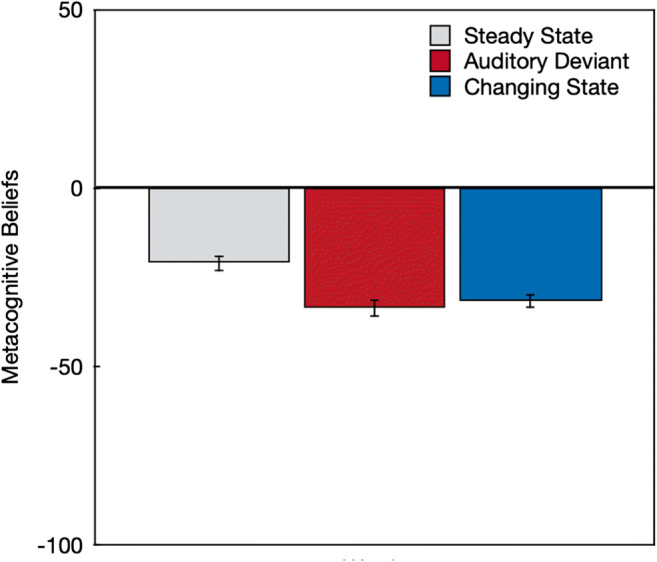
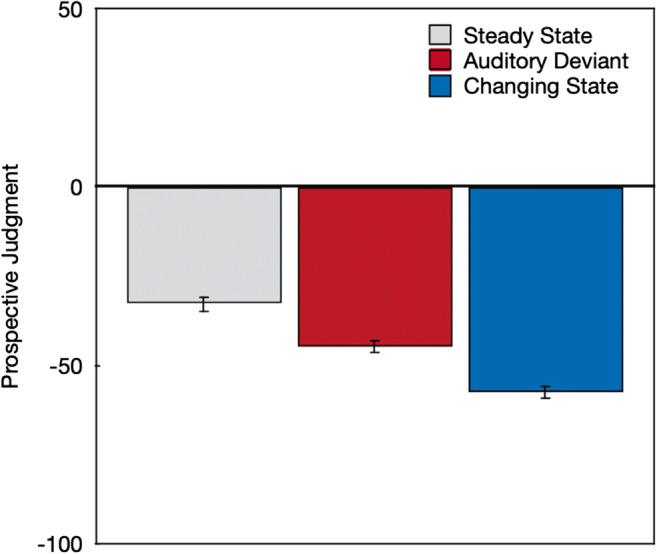
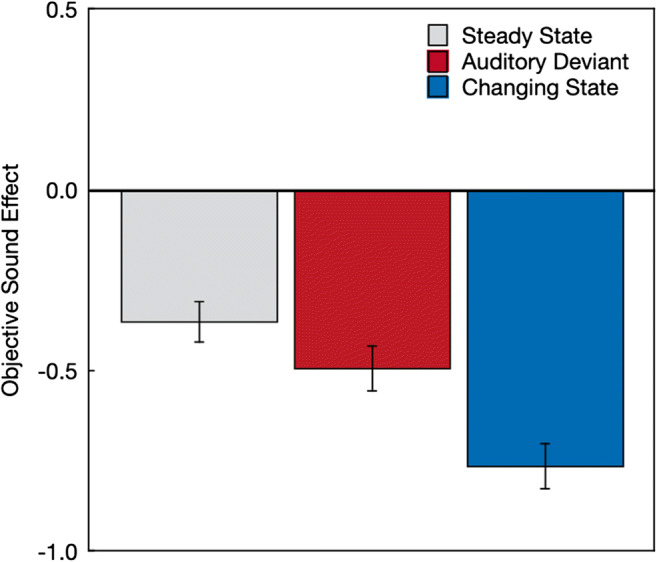
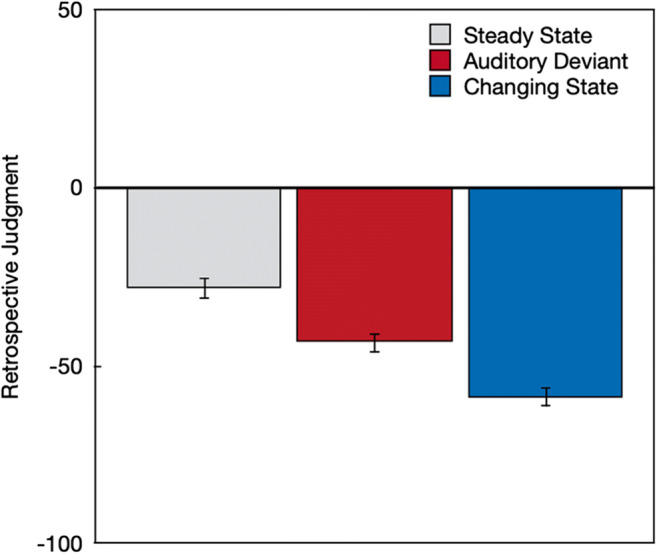
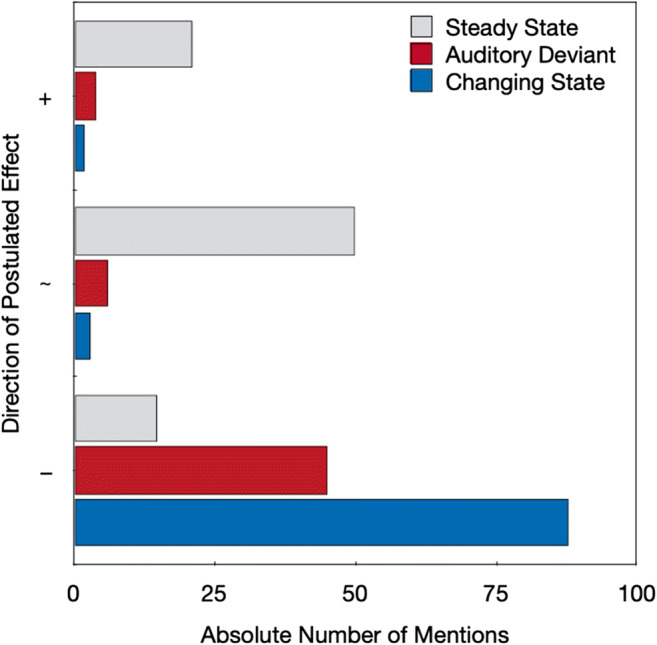
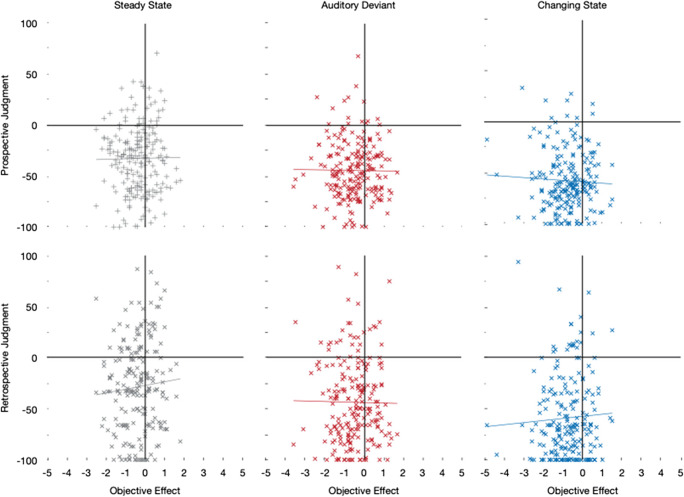
The duplex-mechanism account of auditory distraction has been extended to predict that people should have metacognitive awareness of the disruptive effect of auditory deviants on cognitive performance but little to no such awareness of the disruptive effect of changing-state relative to steady-state auditory distractors. To test this prediction, we assessed different types of metacognitive judgments about the disruptive effects of auditory-deviant, changing-state, and steady-state distractor sequences on serial recall. In a questionnaire, participants read about an irrelevant-speech experiment and were asked to provide metacognitive beliefs about how serial-recall performance would be affected by the different types of distractors. Another sample of participants heard the auditory distractors before predicting how their own serial-recall performance would suffer or benefit from the distractors. After participants had experienced the disruptive effects of the distractor sequences first hand, they were asked to make episodic retrospective judgments about how they thought the distractor sequences had affected their performance. The results consistently show that people are, on average, well aware of the greater disruptive effect of deviant and changing-state relative to steady-state distractors. Irrespective of condition, prospective and retrospective judgments of distraction were poor predictors of the individual susceptibility to distraction. These findings suggest that phenomena of auditory distraction cannot be categorized in two separate classes based on metacognitive awareness.
Overview
The claims and statistics of this paper haven’t been checked yet.
Free: it reads the open-access text and checks the first 5 claims that cite a source we can check. Create a free account to check every claim.
Integrity signals
Registry
Cites
Statistics
Figures

Verification
Claims the paper makes
The claims and statistics of this paper haven’t been checked yet.
Free: it reads the open-access text and checks the first 5 claims that cite a source we can check. Create a free account to check every claim.
Claims other papers make about this one
Each is checked against this paper’s own text: does it say what the citing paper says it does?
The cited source says what the claim attributes to it.
In the citing paper
“The direct-access account thus has some prima facie plausibility for explaining why metacognitive judgments and objective sound effects were closely aligned in the study of Bell et al.11.”
From Evidence of a metacognitive illusion in judgments about the effects of music on cognitive performance (2023) · cites this paper as [11]
The cited source says what the claim attributes to it.
In the citing paper
“In the study of Bell et al.11, both the stimulus-specific prospective as well as the global retrospective metacognitive judgments correctly captured the objective sound effects on performance.”
From Evidence of a metacognitive illusion in judgments about the effects of music on cognitive performance (2023) · cites this paper as [11]
In the citing paper
“Both the objective sound effects and the metacognitive judgments of distraction were found to become more positive as a function of repetition.”
From Evidence of a metacognitive illusion in judgments about the effects of music on cognitive performance (2023) · cites this paper as [11]
In the citing paper
“By contrast, in case of metacognitive judgments about cognitive processes such as learning or distraction, the proximal cue that is thought to underlie processing-fluency effects is the experienced ease or difficulty of processing3,5,11,17,21,50,51.”
From Evidence of a metacognitive illusion in judgments about the effects of music on cognitive performance (2023) · cites this paper as [11]
Self-check
Percentages, sums and reported differences re-computed from the paper’s own numbers.
The self-check needs the paper’s full text.
Citations
Cites
Uniting the Tribes of Fluency to Form a Metacognitive Nation
Alter, A. L., & Oppenheimer, D. M. (2009) · Personality and Social Psychology Review · doi:10.1177/1088868309341564 · Cited by 1,995
Monitoring one’s own knowledge during study: A cue-utilization approach to judgments of learning
Koriat, A. (1997) · Journal of Experimental Psychology: General · doi:10.1037/0096-3445.126.4.349 · Cited by 1,363 · cited 4×
“The degree to which the cues underlying the metacognitive judgments are reliably correlated with distraction and, thus, lead to correct judgments about distraction across different contexts is, ultimately, an empirical question (cf. Begg et al., 1989; Koriat, 1997).”
BackgroundInfluentialMANOVA method for analyzing repeated measures designs: An extensive primer.
O'Brien, R. G., & Kaiser, M. K. (1985) · Psychological Bulletin · doi:10.1037/0033-2909.97.2.316 · Cited by 1,148 · cited 1×
“A repeated-measures analysis using the MANOVA approach as suggested by O'Brien and Kaiser (1985) revealed that people’s metacognitive beliefs about the effects of distractor words on serial-recall performance varied as a function of distractor type, F(2,187) = 18.80, p .001, ηp 2 = .17.”
MethodInfluentialTwo Is Not Always Better Than One: A Critical Evaluation of Two-System Theories
Keren, G., & Schul, Y. (2009) · Perspectives on Psychological Science · doi:10.1111/j.1745-6924.2009.01164.x · Cited by 691
Benchmarks for models of short-term and working memory.
Oberauer, K., Lewandowsky, S., Awh, E., Brown, G. D. A., Conway, A., Cowan, N., Donkin, C., Farrell, S., Hitch, G. J., Hurlstone, M. J., et al. (2018) · Psychological Bulletin · doi:10.1037/bul0000153 · Cited by 447
Memory predictions are based on ease of processing
Begg, I., Duft, S., Lalonde, P., Melnick, R., & Sanvito, J. (1989) · Journal of Memory and Language · doi:10.1016/0749-596x(89)90016-8 · Cited by 322
Cowan, N. (1998) · Oxford University Press eBooks · doi:10.1093/acprof:oso/9780195119107.001.0001 · Cited by 288
Hughes, R. W., Vachon, F., & Jones, D. M. (2007) · Journal of Experimental Psychology: Learning, Memory, and Cognition · doi:10.1037/0278-7393.33.6.1050 · Cited by 225
Individual differences in susceptibility to the “irrelevant speech effect”
Ellermeier, W., & Zimmer, K. (1997) · The Journal of the Acoustical Society of America · doi:10.1121/1.419596 · Cited by 184
Hughes, R. W., Hurlstone, M. J., Marsh, J. E., Vachon, F., & Jones, D. M. (2013) · Journal of Experimental Psychology: Human Perception and Performance · doi:10.1037/a0029064 · Cited by 182
Research works printed but not linked: 3
- Cowan, N. (1999). An embedded-processes model of working memory. In A. Miyake & P. Shah (Eds.), Models of working memory: Mechanisms of active maintenance and executive control (pp. 62-101). Cambridge University Press. · DOI · Paper page
- Jacoby, L. L., Ste-Marie, D., & Toth, J. P. (1993). Redefining automaticity: unconscious influences, awareness, and control. In A. D. Baddeley & L. Weiskrantz (Eds.), Attention, selection, awareness and control. A tribute to Donald Broadbent (pp. 261-282). Oxford University Press.
- Rohrmann B Empirische Studien zur Entwicklung von Antwortskalen für die sozialwissenschaftliche Forschung [Empirical studies on the development of answer scales for social science research] Zeitschrift fur Sozialpsychologie 1978 9 3 222 245
Cited by
Bell, R., Komar, G. F., Mieth, L., & Buchner, A. (2023) · Scientific Reports · doi:10.1038/s41598-023-46169-x · Cited by 16
Self-citation
Metadata
- Authors
- Bell, R., Mieth, L., Röer, J. P., & Buchner, A.
- Venue
- Memory & Cognition
- Published
- 2021-07-13
- Volume
- 50
- Issue
- 1
- Pages
- 160-173
- ISSN
- 0090-502X
- 1532-5946
- PMC
- PMC8763777
- Cited by
- 19
- References
- 48
- Language
- en
- Licence
- creativecommons.org/licenses/by/4.0 (tdm)
- creativecommons.org/licenses/by/4.0 (vor)
- Funders
- Heinrich-Heine-Universität Düsseldorf
About these checks
Registry, retraction, Cites and statistics results are computed, not judged, with one exception: a printed reference that no index lists is read once by a model before it counts as a citation error. Claims are extracted by a model and kept only when their quote appears verbatim in the text; each cited source is then checked, with a model’s help, for whether it says what the claim relies on. Those verdicts can be wrong — read the claim’s quote and the cited source before relying on one.
Statistics and arithmetic are recomputed, not judged.
Confidence bands are shown only for fields calibrated on our annotated test set. None is calibrated yet, so no band is shown.
What counts as a claim ›How we measure confidence ›How we check this ›
Are you an author, or do you see a problem with this page? Request a review
Data sources
Bibliographic data: Semantic Scholar, OpenAlex, Crossref.
Contains information from the Semantic Scholar Academic Graph Datasets, made available under the ODC Attribution License (ODC-BY 1.0).
Semantic Scholar’s data is described in: Kinney, R., et al. (2023). The Semantic Scholar Open Data Platform. arXiv:2301.10140.
