

The metacognition of auditory distraction: Judgments about the effects of deviating and changing auditory distractors on cognitive performance
The DOI matches its Crossref record; 6 of the 6 references it cites were found in a registry or an index.
Abstract
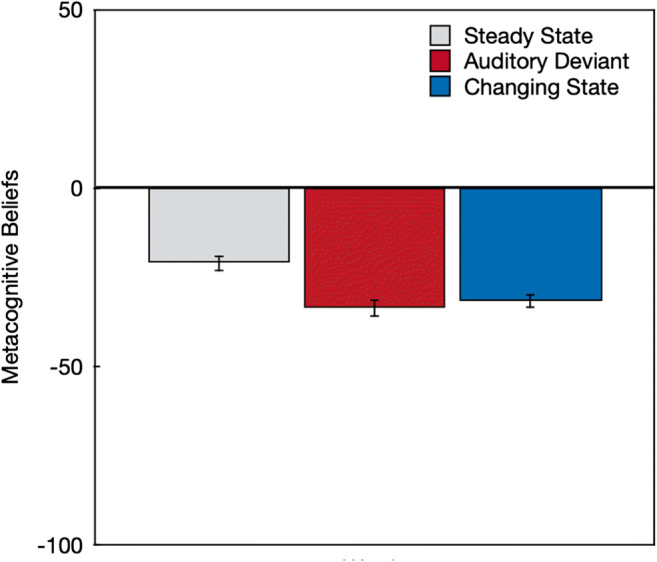
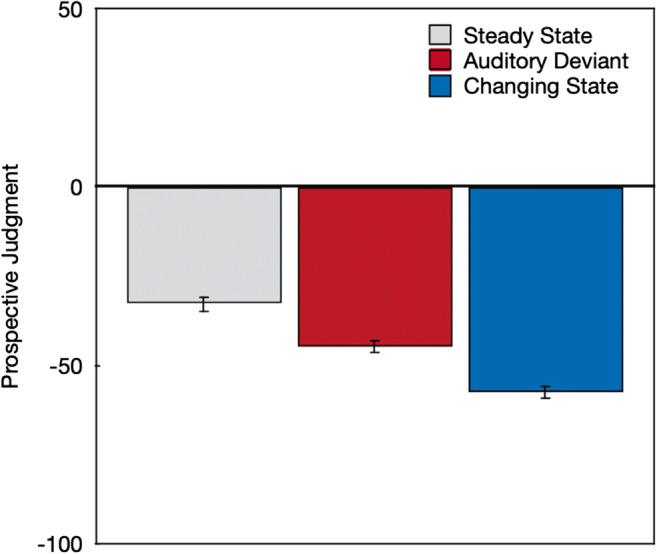
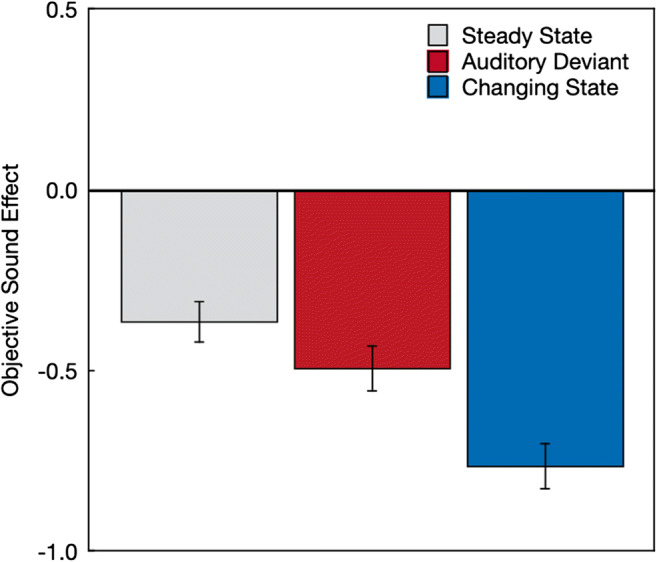
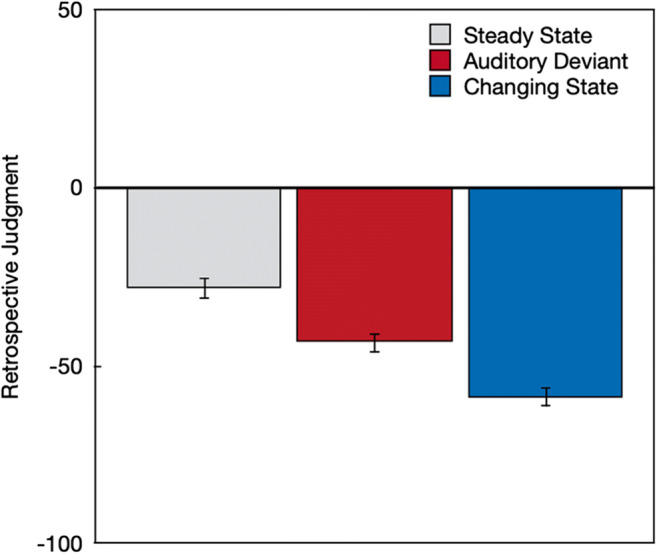
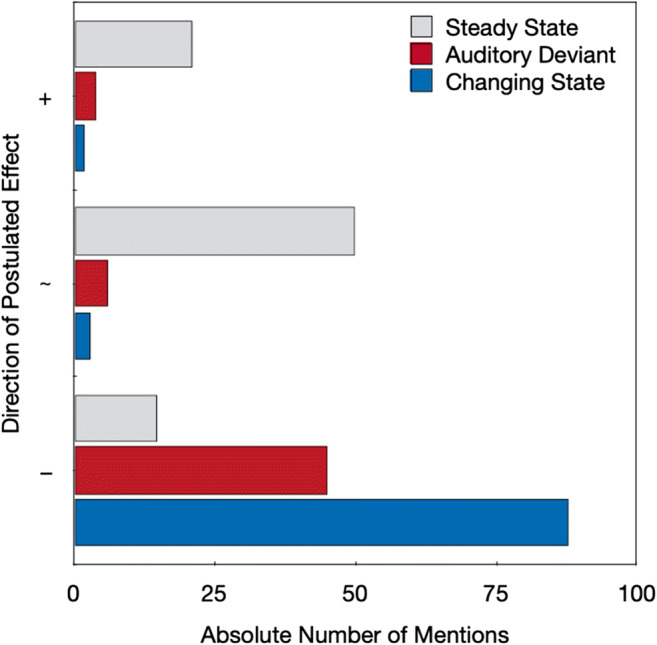
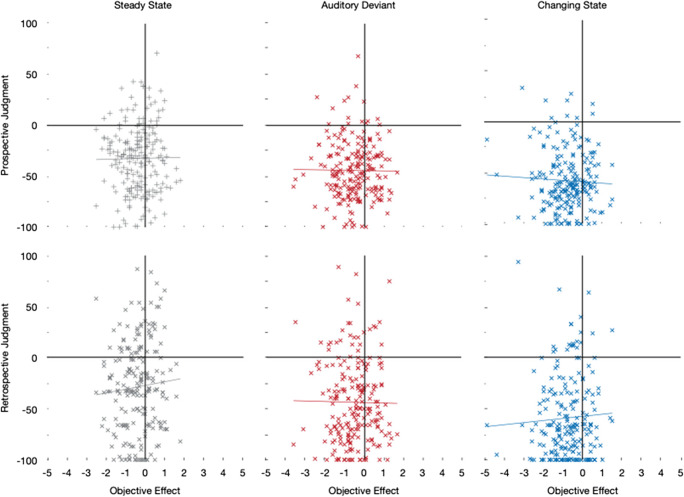
The duplex-mechanism account of auditory distraction has been extended to predict that people should have metacognitive awareness of the disruptive effect of auditory deviants on cognitive performance but little to no such awareness of the disruptive effect of changing-state relative to steady-state auditory distractors. To test this prediction, we assessed different types of metacognitive judgments about the disruptive effects of auditory-deviant, changing-state, and steady-state distractor sequences on serial recall. In a questionnaire, participants read about an irrelevant-speech experiment and were asked to provide metacognitive beliefs about how serial-recall performance would be affected by the different types of distractors. Another sample of participants heard the auditory distractors before predicting how their own serial-recall performance would suffer or benefit from the distractors. After participants had experienced the disruptive effects of the distractor sequences first hand, they were asked to make episodic retrospective judgments about how they thought the distractor sequences had affected their performance. The results consistently show that people are, on average, well aware of the greater disruptive effect of deviant and changing-state relative to steady-state distractors. Irrespective of condition, prospective and retrospective judgments of distraction were poor predictors of the individual susceptibility to distraction. These findings suggest that phenomena of auditory distraction cannot be categorized in two separate classes based on metacognitive awareness.
Overview
The claims and statistics of this paper haven’t been checked yet.
Free: it reads the open-access text and checks the first 5 claims that cite a source we can check. Create a free account to check every claim.
Integrity signals
Registry
Cites
Statistics
Figures

Verification
Claims the paper makes
The claims and statistics of this paper haven’t been checked yet.
Free: it reads the open-access text and checks the first 5 claims that cite a source we can check. Create a free account to check every claim.
Claims other papers make about this one
Each is checked against this paper’s own text: does it say what the citing paper says it does?
The cited source says what the claim attributes to it.
In the citing paper
“The direct-access account thus has some prima facie plausibility for explaining why metacognitive judgments and objective sound effects were closely aligned in the study of Bell et al.11.”
From Evidence of a metacognitive illusion in judgments about the effects of music on cognitive performance (2023) · cites this paper as [11]
The cited source says what the claim attributes to it.
In the citing paper
“In the study of Bell et al.11, both the stimulus-specific prospective as well as the global retrospective metacognitive judgments correctly captured the objective sound effects on performance.”
From Evidence of a metacognitive illusion in judgments about the effects of music on cognitive performance (2023) · cites this paper as [11]
In the citing paper
“Both the objective sound effects and the metacognitive judgments of distraction were found to become more positive as a function of repetition.”
From Evidence of a metacognitive illusion in judgments about the effects of music on cognitive performance (2023) · cites this paper as [11]
In the citing paper
“By contrast, in case of metacognitive judgments about cognitive processes such as learning or distraction, the proximal cue that is thought to underlie processing-fluency effects is the experienced ease or difficulty of processing3,5,11,17,21,50,51.”
From Evidence of a metacognitive illusion in judgments about the effects of music on cognitive performance (2023) · cites this paper as [11]
Self-check
Percentages, sums and reported differences re-computed from the paper’s own numbers.
The self-check needs the paper’s full text.
Citations
Cites
Uniting the Tribes of Fluency to Form a Metacognitive Nation
Alter, A. L., & Oppenheimer, D. M. (2009) · Personality and Social Psychology Review · doi:10.1177/1088868309341564 · Cited by 1,995
Monitoring one’s own knowledge during study: A cue-utilization approach to judgments of learning
Koriat, A. (1997) · Journal of Experimental Psychology: General · doi:10.1037/0096-3445.126.4.349 · Cited by 1,363 · cited 4×
“The degree to which the cues underlying the metacognitive judgments are reliably correlated with distraction and, thus, lead to correct judgments about distraction across different contexts is, ultimately, an empirical question (cf. Begg et al., 1989; Koriat, 1997).”
BackgroundInfluentialMANOVA method for analyzing repeated measures designs: An extensive primer.
O'Brien, R. G., & Kaiser, M. K. (1985) · Psychological Bulletin · doi:10.1037/0033-2909.97.2.316 · Cited by 1,148 · cited 1×
“A repeated-measures analysis using the MANOVA approach as suggested by O'Brien and Kaiser (1985) revealed that people’s metacognitive beliefs about the effects of distractor words on serial-recall performance varied as a function of distractor type, F(2,187) = 18.80, p .001, ηp 2 = .17.”
MethodInfluentialMemory predictions are based on ease of processing
Begg, I., Duft, S., Lalonde, P., Melnick, R., & Sanvito, J. (1989) · Journal of Memory and Language · doi:10.1016/0749-596x(89)90016-8 · Cited by 322
Individual differences in susceptibility to the “irrelevant speech effect”
Ellermeier, W., & Zimmer, K. (1997) · The Journal of the Acoustical Society of America · doi:10.1121/1.419596 · Cited by 184
Mueller, M. L., Dunlosky, J., Tauber, S. K., & Rhodes, M. G. (2014) · Journal of Memory and Language · doi:10.1016/j.jml.2013.09.007 · Cited by 174
Research works printed but not linked: 45
- Alley TR Greene ME The relative and perceived impact of irrelevant speech, vocal music and non-vocal music on working memory Current Psychology 2008 27 4 277 289 10.1007/s12144-008-9040-z · DOI
- Bell, R., Mieth, L., Buchner, A., & Röer, J. P. (in press). Monetary incentives have only limited effects on auditory distraction: Evidence for the automaticity of cross-modal attention capture. Psychological Research. 10.1007/s00426-020-01455-5 PMC8476381 33340342 · DOI
- Bell R Mieth L Röer JP Troche SJ Buchner A Preregistered replication of the auditory deviant effect: A robust benchmark finding Journal of Cognition 2019 2 1 13 10.5334/joc.64 · DOI
- Bell R Röer JP Buchner A Irrelevant speech disrupts item-context binding Experimental Psychology 2013 60 5 376 384 10.1027/1618-3169/a000212 23820947 · doi:10.1027/1618-3169/a000212
- Bell R Röer JP Lang A-G Buchner A Distraction by steady-state sounds: Evidence for a graded attentional model of auditory distraction Journal of Experimental Psychology: Human Perception and Performance 2019 45 4 500 512 10.1037/xhp0000623 30816785 · doi:10.1037/xhp0000623
- Bell R Röer JP Lang A-G Buchner A Reassessing the token set size effect on serial recall: Implications for theories of auditory distraction Journal of Experimental Psychology: Learning, Memory, and Cognition 2019 45 8 1432 1440 10.1037/xlm0000658 30265053 · doi:10.1037/xlm0000658
- Bell R Röer JP Marsh JE Storch D Buchner A The effect of cognitive control on different types of auditory distraction: A preregistered study Experimental Psychology 2017 64 359 368 10.1027/1618-3169/a000372 28662612 · DOI
- Besken M Mulligan NW Perceptual fluency, auditory generation, and metamemory: Analyzing the perceptual fluency hypothesis in the auditory modality Journal of Experimental Psychology: Learning, Memory, and Cognition 2014 40 2 429 440 10.1037/a0034407 24016138 · DOI · Paper page
- Campbell T Beaman CP Berry DC Auditory memory and the irrelevant sound effect: Further evidence for changing-state disruption Memory 2002 10 3 199 214 10.1080/09658210143000335 11958724 · DOI
- Cowan, N. (1995). Attention and memory: An integrated framework. Oxford University Press. 10.1093/acprof:oso/9780195119107.001.0001 · DOI
- Cowan, N. (1999). An embedded-processes model of working memory. In A. Miyake & P. Shah (Eds.), Models of working memory: Mechanisms of active maintenance and executive control (pp. 62-101). Cambridge University Press. · DOI · Paper page
- Ellermeier W Zimmer K The psychoacoustics of the irrelevant sound effect Acoustical Science and Technology 2014 35 1 10 16 10.1250/ast.35.10 · DOI · Paper page
- Elliott EM Hughes RW Briganti A Joseph TN Marsh JE Macken B Distraction in verbal short-term memory: Insights from developmental differences Journal of Memory and Language 2016 88 39 50 10.1016/j.jml.2015.12.008 · DOI
- Frank DJ Kuhlmann BG More than just beliefs: Experience and beliefs jointly contribute to volume effects on metacognitive judgments Journal of Experimental Psychology: Learning, Memory, and Cognition 2017 43 5 680 693 10.1037/xlm0000332 27709983 · DOI · Paper page
- Hanczakowski M Beaman CP Jones DM When distraction benefits memory through semantic similarity Journal of Memory and Language 2017 94 61 74 10.1016/j.jml.2016.11.005 · DOI
- Hanczakowski M Beaman CP Jones DM Learning through clamor: The allocation and perception of study time in noise Journal of Experimental Psychology: General 2018 147 7 1005 1022 10.1037/xge0000449 29975090 · DOI
- Hughes RW Auditory distraction: A duplex-mechanism account PsyCH 2014 3 30 41 10.1002/pchj.44 26271638 · DOI · Paper page
- Hughes RW Hurlstone MJ Marsh JE Vachon F Jones DM Cognitive control of auditory distraction: Impact of task difficulty, foreknowledge, and working memory capacity supports duplex-mechanism account Journal of Experimental Psychology: Human Perception and Performance 2013 39 2 539 553 10.1037/a0029064 22731996 · DOI · Paper page
- Hughes RW Marsh JE Dissociating two forms of auditory distraction in a novel Stroop serial recall experiment Auditory Perception & Cognition 2019 2 3 129 142 10.1080/25742442.2020.1760757 · DOI
- Hughes RW Marsh JE When is forewarned forearmed? Predicting auditory distraction in short-term memory Journal of Experimental Psychology: Learning Memory and Cognition 2020 46 3 427 442 10.1037/xlm0000736 31180705 · DOI
- Hughes RW Vachon F Jones DM Auditory attentional capture during serial recall: Violations at encoding of an algorithm-based neural model? Journal of Experimental Psychology: Learning, Memory, and Cognition 2005 31 4 736 749 10.1037/0278-7393.31.4.736 16060777 · DOI
- Hughes RW Vachon F Jones DM Disruption of short-term memory by changing and deviant sounds: Support for a duplex-mechanism account of auditory distraction Journal of Experimental Psychology: Learning, Memory, and Cognition 2007 33 6 1050 1061 10.1037/0278-7393.33.6.1050 17983312 · DOI · Paper page
- Jacoby, L. L., Ste-Marie, D., & Toth, J. P. (1993). Redefining automaticity: unconscious influences, awareness, and control. In A. D. Baddeley & L. Weiskrantz (Eds.), Attention, selection, awareness and control. A tribute to Donald Broadbent (pp. 261-282). Oxford University Press.
- Jones DM Macken WJ Murray AC Disruption of visual short-term memory by changing-state auditory stimuli: The role of segmentation Memory & Cognition 1993 21 3 318 328 10.3758/BF03208264 8316094 · DOI · Paper page
- Joseph TN Hughes RW Sörqvist P Marsh JE Differences in auditory distraction between adults and children: A duplex-mechanism approach Journal of Cognition 2018 1 13 1 11 10.5334/joc.15 PMC6634439 31517187 · DOI
- Keren G Schul Y Two is not always better than one Perspectives on Psychological Science 2009 4 6 533 550 10.1111/j.1745-6924.2009.01164.x 26161732 · DOI · Paper page
- Körner U Röer JP Buchner A Bell R Working memory capacity is equally unrelated to auditory distraction by changing-state and deviant sounds Journal of Memory and Language 2017 96 122 137 10.1016/j.jml.2017.05.005 · DOI
- Körner U Röer JP Buchner A Bell R Time of presentation affects auditory distraction: Changing-state and deviant sounds disrupt similar working memory processes Quarterly Journal of Experimental Psychology 2019 72 3 457 471 10.1177/1747021818758239 29360013 · DOI
- Maitland A Should I label all scale points or just the end points for attitudinal questions? Survey Practice 2009 2 4 1 4 10.29115/SP-2009-0014 · DOI
- Marois A Marsh JE Vachon F Is auditory distraction by changing-state and deviant sounds underpinned by the same mechanism? Evidence from pupillometry Biological Psychology 2019 141 64 74 10.1016/j.biopsycho.2019.01.002 30633950 · DOI
- Marsh, J. E., Campbell, T. A., Vachon, F., Taylor, P. J., & Hughes, R. W. (2020). How the deployment of visual attention modulates auditory distraction. Attention, Perception, & Psychophysics, 82(1). 10.3758/s13414-019-01800-w PMC6994418 31290133 · DOI
- Marsh JE Yang J Qualter P Richardson C Perham N Vachon F Hughes RW Post-categorical auditory distraction in serial short-term memory: Insights from increased task load and task type Journal of Experimental Psychology: Learning, Memory, and Cognition 2018 44 6 882 897 10.1037/xlm0000492 29389192 · DOI
- Oberauer, K., Lewandowsky, S., Awh, E., Brown, G. D. A., Conway, A. R. A., Cowan, N., Donkin, C., Farrell, S., Hitch, G. J., Hurlstone, M. J., Ma, W. J., Morey, C. C., Nee, D. E., Schweppe, J., Vergauwe, E., & Ward, G. (2018). Benchmarks for models of short term and working memory. Psychological Bulletin, 144(9), 885–958. 10.1037/bul0000153 30148379 · DOI · Paper page
- Perham N Vizard J Can preference for background music mediate the irrelevant sound effect? Applied Cognitive Psychology 2011 25 4 625 631 10.1002/acp.1731 · DOI
- Röer JP Bell R Buchner A Evidence for habituation of the irrelevant sound effect on serial recall Memory & Cognition 2014 42 4 609 621 10.3758/s13421-013-0381-y 24203781 · DOI · Paper page
- Röer JP Bell R Buchner A Specific foreknowledge reduces auditory distraction by irrelevant speech Journal of Experimental Psychology: Human Perception and Performance 2015 41 3 692 702 10.1037/xhp0000028 25621576 · DOI
- Röer JP Bell R Marsh JE Buchner A Age equivalence in auditory distraction by changing and deviant speech sounds Psychology and Aging 2015 30 4 849 855 10.1037/pag0000055 26523691 · DOI
- Röer JP Körner U Buchner A Bell R Equivalent auditory distraction in children and adults Journal of Experimental Child Psychology 2018 172 41 58 10.1016/j.jecp.2018.02.005 29574236 · DOI
- Röer JP Rummel J Bell R Buchner A Metacognition in auditory distraction: How expectations about distractibility influence the irrelevant sound effect Journal of Cognition 2017 1 1 2 10.5334/joc.3 31517180 PMC6645164 · DOI
- Rohrmann B Empirische Studien zur Entwicklung von Antwortskalen für die sozialwissenschaftliche Forschung [Empirical studies on the development of answer scales for social science research] Zeitschrift fur Sozialpsychologie 1978 9 3 222 245
- Schaper ML Kuhlmann BG Bayen UJ Metacognitive expectancy effects in source monitoring: Beliefs, in-the- moment experiences, or both? Journal of Memory and Language 2019 107 1 95 110 10.1016/j.jml.2019.03.009 · DOI
- Schlittmeier S Hellbrück J Thaden R Vorländer M The impact of background speech varying in intelligibility: Effects on cognitive performance and perceived disturbance Ergonomics 2008 51 5 719 736 10.1080/00140130701745925 18432448 · DOI
- Sörqvist P High working memory capacity attenuates the deviation effect but not the changing-state effect: Further support for the duplex-mechanism account of auditory distraction Memory & Cognition 2010 38 5 651 658 10.3758/MC.38.5.651 20551344 · DOI
- Undorf M Erdfelder E The relatedness effect on judgments of learning: A closer look at the contribution of processing fluency Memory & Cognition 2015 43 4 647 658 10.3758/s13421-014-0479-x 25388520 · DOI · Paper page
- Vachon F Labonté K Marsh JE Attentional capture by deviant sounds: A noncontingent form of auditory distraction? Journal of Experimental Psychology: Learning, Memory, and Cognition 2017 43 4 622 634 10.1037/xlm0000330 27656870 · DOI
Cited by
Bell, R., Komar, G. F., Mieth, L., & Buchner, A. (2023) · Scientific Reports · doi:10.1038/s41598-023-46169-x · Cited by 16
Self-citation
Metadata
- Authors
- Bell, R., Mieth, L., Röer, J. P., & Buchner, A.
- Venue
- Memory & Cognition
- Published
- 2021-07-13
- Volume
- 50
- Issue
- 1
- Pages
- 160-173
- ISSN
- 0090-502X
- 1532-5946
- PMC
- PMC8763777
- Cited by
- 19
- References
- 6
- Language
- en
- Licence
- creativecommons.org/licenses/by/4.0 (tdm)
- creativecommons.org/licenses/by/4.0 (vor)
- Funders
- Heinrich-Heine-Universität Düsseldorf
About these checks
Registry, retraction, Cites and statistics results are computed, not judged, with one exception: a printed reference that no index lists is read once by a model before it counts as a citation error. Claims are extracted by a model and kept only when their quote appears verbatim in the text; each cited source is then checked, with a model’s help, for whether it says what the claim relies on. Those verdicts can be wrong — read the claim’s quote and the cited source before relying on one.
Statistics and arithmetic are recomputed, not judged.
Confidence bands are shown only for fields calibrated on our annotated test set. None is calibrated yet, so no band is shown.
What counts as a claim ›How we measure confidence ›How we check this ›
Are you an author, or do you see a problem with this page? Request a review
Data sources
Bibliographic data: Semantic Scholar, OpenAlex, Crossref.
Contains information from the Semantic Scholar Academic Graph Datasets, made available under the ODC Attribution License (ODC-BY 1.0).
Semantic Scholar’s data is described in: Kinney, R., et al. (2023). The Semantic Scholar Open Data Platform. arXiv:2301.10140.
