

Statistical properties of four effect-size measures for mediation models
Open accessThe DOI matches its Crossref record; 52 of the 55 references it cites were found in a registry or an index.
Abstract
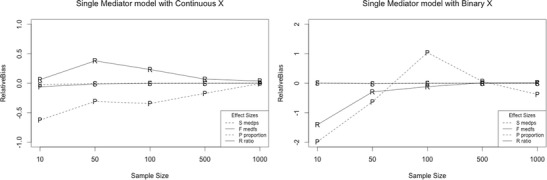
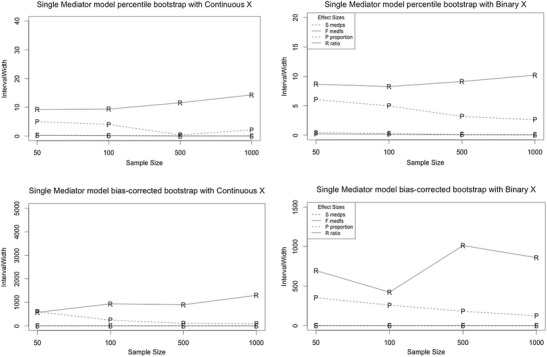
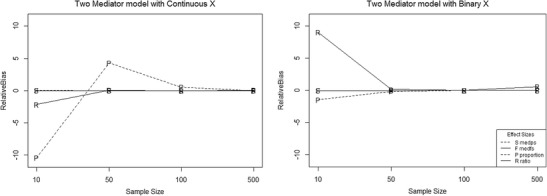
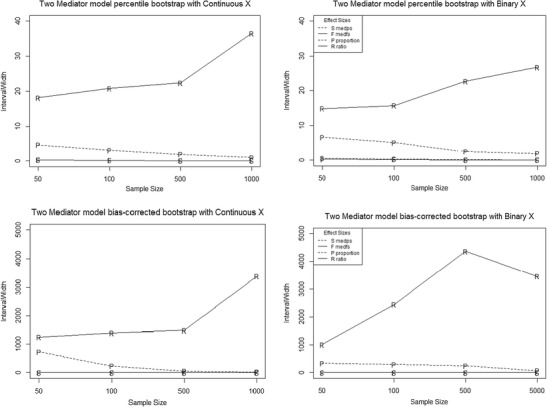
This project examined the performance of classical and Bayesian estimators of four effect size measures for the indirect effect in a single-mediator model and a two-mediator model. Compared to the proportion and ratio mediation effect sizes, standardized mediation effect-size measures were relatively unbiased and efficient in the single-mediator model and the two-mediator model. Percentile and bias-corrected bootstrap interval estimates of ab/s Y , and ab(s X )/s Y in the single-mediator model outperformed interval estimates of the proportion and ratio effect sizes in terms of power, Type I error rate, coverage, imbalance, and interval width. For the two-mediator model, standardized effect-size measures were superior to the proportion and ratio effect-size measures. Furthermore, it was found that Bayesian point and interval summaries of posterior distributions of standardized effect-size measures reduced excessive relative bias for certain parameter combinations. The standardized effect-size measures are the best effect-size measures for quantifying mediated effects.
Overview
The claims and statistics of this paper haven’t been checked yet.
Free: it reads the open-access text and checks the first 5 claims that cite a source we can check. Create a free account to check every claim.
Integrity signals
Registry
Cites
Statistics
Figures
Verification
Claims the paper makes
The claims and statistics of this paper haven’t been checked yet.
Free: it reads the open-access text and checks the first 5 claims that cite a source we can check. Create a free account to check every claim.
Claims other papers make about this one
Each is checked against this paper’s own text: does it say what the citing paper says it does?
The cited source says what the claim attributes to it.
In the citing paper
“In addition, a variety of other papers recommend means to improve mediational models, including how to calculate effect sizes (Lachowicz et al., 2018;Miočević et al., 2018) that can facilitate a move away from a focus on null effect significance testing (Götz et al., 2021) and recommendations for best practices (e.g., Fairchild & McDaniel, 2017;Jose, 2019).”
From Acceptance and Commitment Therapy Processes and Mediation: Challenges and How to Address Them (2023) · cites this paper as Miočević et al., 2018
The cited source says what the claim attributes to it.
In the citing paper
“Standardized effect sizes were reported as these may have less bias than proportion- and ratio-based methods (Miočević et al., 2018).”
From The relationship between distress tolerance and behavioral activation on anxiety and depression symptomatology in autistic youth: Leveraging self and caregiver perspectives (2024) · cites this paper as Miočević et al., 2018
Self-check
Percentages, sums and reported differences re-computed from the paper’s own numbers.
The self-check needs the paper’s full text.
Citations
Cites
Statistical power analysis for the behavioral sciences
(1990) · Computers, Environment and Urban Systems · doi:10.1016/0198-9715(90)90050-4 · Cited by 65,269
Gelman, A., Carlin, J. B., Stern, H. S., & Rubin, D. B. (2003) · doi:10.1201/9780429258480 · Cited by 27,276
Mediation in experimental and nonexperimental studies: New procedures and recommendations.
Shrout, P. E., & Bolger, N. (2002) · Psychological Methods · doi:10.1037/1082-989x.7.4.422 · Cited by 11,335 · cited 1×
“One common non-parametric alternative to normal theory is the bootstrap (Manly, 1997; MacKinnon, Lockwood, & Williams, 2004; MacKinnon, 2008; Shrout & Bolger, 2002).”
BackgroundIntroduction to Statistical Mediation Analysis
MacKinnon, D. P. (2012) · doi:10.4324/9780203809556 · Cited by 5,618 · cited 12×
“…of Psychology, Arizona State University, 950 S. McAllister Ave, Tempe, AZ 85287, USA 2 Feinberg School of Medicine, Northwestern University, Chicago, IL, USA Y ¼ i2 þ c0Xþ bMþ e2 ð2Þ M ¼ i3 þ aXþ e3 ð3Þ and estimated using only equations 2 and 3, or only equations 1 and 3 (MacKinnon, 2008).”
BackgroundMethodInfluentialSelf-citationRandomization, Bootstrap and Monte Carlo Methods in Biology
Manly, B. F. J. (2018) · Chapman & Hall/CRC eBooks · doi:10.1201/9781315273075 · Cited by 4,194
Preacher, K. J., & Kelley, K. (2011) · Psychological Methods · doi:10.1037/a0022658 · Cited by 3,060 · cited 4×
“Recently, effect-size measures have been proposed that quantify the maximum possible mediation effect that could have been achieved given the constraints of the data and the proportion of that maximum effect that was obtained in a given study (Preacher & Kelley, 2011).”
BackgroundMethodInfluentialStatistical methods in psychology journals: Guidelines and explanations.
Wilkinson, L., & Task Force on Statistical Inference (1999) · American Psychologist · doi:10.1037/0003-066x.54.8.594 · Cited by 2,791
Randomization, Bootstrap and Monte Carlo Methods in Biology.
Kemp, A. W., & Manly, B. F. J. (1997) · Biometrics · doi:10.2307/2533527 · Cited by 1,927 · cited 3×
“The upper confidence limit for the estimate is the value that exceeds a proportion φ(2z0 + z1 −α/2) in that same distribution (Manly, 1997).”
BackgroundA Simulation Study of Mediated Effect Measures
MacKinnon, D. P., Warsi, G., & Dwyer, J. H. (1995) · Multivariate Behavioral Research · doi:10.1207/s15327906mbr3001_3 · Cited by 1,719
Self-citationStice, E. (2001) · Journal of Abnormal Psychology · doi:10.1037/0021-843x.110.1.124 · Cited by 1,251 · cited 1×
“…Ilies & Judge, 2003; Ilies & Judge, 2005; Leigh, 1983; MacKinnon, Johnson, Pentz, Dwyer, Hansen, Flay, & Wang, 1991; Sharkansky, King, King, Wolfe, Erickson, & Stokes, 2000; Stice, 2001; Tein, Sandler, Ayers, & Wolchik, 2006; Wolchik, West, Westover, Sandler, Martin, Lustig, Tein, & Fisher, 1993).”
Research works printed but not linked: 4
- Hayes A Miscellaneous Topics in Mediation Analysis Mediation, Moderation, and Conditional Process Analysis 2013 New York Guilford Press 184 193
- Miočević, M., & MacKinnon, D. P. (2014). SAS® for Bayesian Mediation Analysis. In Proceedings of the SAS Global Forum 2014 Conference, Cary NC: SAS Institute Inc.
- Miočević, M., MacKinnon, D. P., & Levy, R. (2016). Comparison of Bayesian and frequentist estimates of the mediated effect. Manuscript under review.
- Taborga, M. P. (2000). Effect size in mediation models. Unpublished master’s thesis, Arizona State University, Tempe, Arizona.
Cited by
Items 101–200 of 201
Zhu, X., Squiers, L., Helmueller, L., Madson, G., Southwell, B. G., Alam, S., & Rutten, L. J. F. (2023) · Social Science & Medicine · doi:10.1016/j.socscimed.2023.116397 · Cited by 10
Sheng, Y., Ni, A., Liu, L., Gao, L., Zhang, Y., Xiao, G., & Zhu, Y. (2025) · Transportation Letters · doi:10.1080/19427867.2025.2523370 · Cited by 10
“None of the intervals contains zero, indicating that the total indirect effect is significant (Miočević et al. 2018).”
Hien, D. A., Gette, J. A., Blakey, S. M., Piccirillo, M. L., Back, S. E., Bauer, A. G., Ebrahimi, C. T., Ellis, R. A., Killeen, T. K., Lehinger, E. A., et al. (2025) · Addiction · doi:10.1111/add.70126 · Cited by 8
Criteria for selecting and reporting mediation effects sizes
Sabol, M. A., Winton, B. G., & Legate, A. E. (2025) · Organization Management Journal · doi:10.1108/omj-08-2024-2291 · Cited by 7
Ho, R., Fong, T. C. T., & Wan, A. H. Y. (2022) · Mindfulness · doi:10.1007/s12671-021-01786-3 · Cited by 13
Jin, B., & Zhang, D. (2022) · Learning and Individual Differences · doi:10.1016/j.lindif.2022.102187 · Cited by 11
Optimal Practices for Mediation Analysis in AB Single Case Experimental Designs
Miočević, M., Klaassen, F., Moeyaert, M., & Geuke, G. G. M. (2023) · The Journal of Experimental Education · doi:10.1080/00220973.2023.2243593 · Cited by 10
Self-citationEffect of Parameterization on Statistical Power and Effect Size Estimation in Latent Growth Modeling
Feingold, A. (2021) · Structural Equation Modeling A Multidisciplinary Journal · doi:10.1080/10705511.2021.1878895 · Cited by 11
The Importance of Mediation Analysis in Substance-Use Prevention
O’Rourke, H. P., & MacKinnon, D. P. (2019) · Advances in prevention science · doi:10.1007/978-3-030-00627-3_15 · Cited by 10
Self-citationGyensare, M. A., Jain, P., Asante, E. A., Adomako, S., Ofori, K. S., & Hayford, Y. (2025) · Journal of International Management · doi:10.1016/j.intman.2024.101222 · Cited by 9
Sommerfeld, E. (2022) · Psychotherapy Research · doi:10.1080/10503307.2022.2144526 · Cited by 6
Chan, R. S. W., & Poon, K. (2023) · Sex Roles · doi:10.1007/s11199-023-01410-9 · Cited by 8
“Although the serial mediation explained a low proportion of the link between ostracism and mental health (2.5%), this may be due to their strong overall relationship (Miočević et al., 2018).”
BackgroundInfluentialDelaTraba, A., Jódar, R., Cavada, C. L., & Pascual‐Leone, A. (2025) · Psychotherapy Research · doi:10.1080/10503307.2025.2460535 · Cited by 7
Quality of palliative nursing care: Meaning, death anxiety, and the mediating role of well-being
Egea, M. Z., Ursúa, M. P., Toro, L. B., & Anchía, R. J. (2022) · Palliative & Supportive Care · doi:10.1017/s1478951521001954 · Cited by 7
Sim, M., Suh, Y., & Kim, S. (2022) · 한국심리학회지: 일반 · doi:10.22257/kjp.2022.6.41.2.103 · Cited by 8
Zhu, L., Zhang, Y., Song, L., Zhou, Z., Wang, J., Wang, Y., Sang, L., Xiao, J. J., & Lian, Y. (2022) · BMC Public Health · doi:10.1186/s12889-022-14038-3 · Cited by 11
“The mediation effect was calculated by subtracting the direct effect from the total effect [39].”
MethodRelational and psychological mediators of change in low‐income couples' perceived health
Roddy, M. K., & Doss, B. D. (2020) · Personal Relationships · doi:10.1111/pere.12332 · Cited by 8
Huang, J., Liu, W., & Huang, Y. (2022) · BMC Medical Informatics and Decision Making · doi:10.1186/s12911-022-02019-w · Cited by 5
“If the value of indirect effects doesn’t contain zero in its 95% confidence interval, the indirect effect can be considered as significant [55].”
BackgroundDampness and student-reported social climate: two multilevel mediation models
Finell, E., Tolvanen, A. J., Pekkanen, J., Ståhl, T., & Luopa, P. (2021) · Environmental Health · doi:10.1186/s12940-021-00710-5 · Cited by 9
The Experience of Sex Guilt: The Roles of Parenting, Adult Attachment, and Sociosexuality
Hackathorn, J. M., & Malm, E. K. (2021) · Sexuality & Culture · doi:10.1007/s12119-021-09887-w · Cited by 8
“Although this is not unusual in complex mediation models (Miočević et al., 2018), these findings suggest that additional constructs are involved, especially as it pertains to predicting sex guilt.”
BackgroundVelten, J., Scholten, S., Brailovskaia, J., & Margraf, J. (2021) · PLoS ONE · doi:10.1371/journal.pone.0258333 · Cited by 8
“Standardized regression coefficients as well as standardized effects for indirect effects are reported [53].”
BackgroundMotive perception pathways to the release of personal information to healthcare organizations
Soellner, M., & Koenigstorfer, J. (2022) · BMC Medical Informatics and Decision Making · doi:10.1186/s12911-022-01986-4 · Cited by 6
“All direct and indirect paths were included in the model and we report fully standardized measures [76, 77] and the percentage of proportion mediated to indicate the effect size of the mediation model [78].”
MethodCohrdes, C., Meyrose, A., Ravens‐Sieberer, U., & Hölling, H. (2022) · Journal of Adult Development · doi:10.1007/s10804-022-09424-5 · Cited by 8
“1 The percentile bootstrap interval for the mediated proportion can exceed the upper limit of 1, if the mediated proportion is larger than the direct effect, thus resulting in more than 100% of the total effect (Miočević et al., 2018).”
BackgroundIacono, A., Oremus, M., Maxwell, C. J., & Tyas, S. L. (2023) · Aging Neuropsychology and Cognition · doi:10.1080/13825585.2023.2226855 · Cited by 9
“The P M is a useful and intuitive statistic (Ananth, 2019; de Heus, 2012; Miočević et al., 2018) and one of the most frequently reported methods for quantifying mediation (Miočević et al., 2018).”
BackgroundLiu, H., Yutong, H., Jiajia, S., Wenbo, L., & Pingping, Z. (2024) · Clinical Nutrition ESPEN · doi:10.1016/j.clnesp.2024.12.017 · Cited by 4
de Miquel, C., Moneta, M. V., Weber, S., Lorenz, C., Olaya, B., & Haro, J. M. (2023) · Journal of Medical Internet Research · doi:10.2196/42317 · Cited by 8
“If the indirect effects result is significant, a partially standardized indirect effect will be estimated ( ab ps ) as a measure of the size of the effect [41,42].”
Liu, F., & Chong, E. S. K. (2023) · Journal of Social and Personal Relationships · doi:10.1177/02654075231174187 · Cited by 5
“Based on the formula of the partially standardized indirect effect (ab ps = ab/s Y ; Mio ˇ cevi´c et al., 2018), the standardized indirect effect size for self-esteem and IH as mediator was .11 and .08, respectively.”
MethodJin, X., Zhu, J., Wang, N., Sun, L., Yu, J., Wang, S., & Sun, G. (2024) · Frontiers in Public Health · doi:10.3389/fpubh.2024.1339149 · Cited by 8
Kinney, A. R., Schmid, A. A., Henry, K. L., Coatsworth, J. D., & Eakman, A. M. (2019) · Journal of American College Health · doi:10.1080/07448481.2019.1656637 · Cited by 8
“We report standardized estimates of the indirect effects to evaluate effect size because it is the most appropriate measure of effect size for small samples (n< 500).(57)”
BackgroundA Confidence Interval for the Difference Between Standardized Regression Coefficients
Anderson, S. F. (2024) · Multivariate Behavioral Research · doi:10.1080/00273171.2024.2318784 · Cited by 4
“As such, methodologists continue to develop, test, and improve methods for standardized effects (e.g., Bell et al., 2017; Hedges et al., 2023; Mio � cevi � c et al., 2018; Pesigan et al., 2023).”
SAS® Macros for Computing Causal Mediated Effects in Two- and Three-Wave Longitudinal Models.
Valente, M. J., & MacKinnon, D. P. (2018) · PubMed · Cited by 5
Self-citationAntasari, I. W. (2025) · Social Sciences & Humanities Open · doi:10.1016/j.ssaho.2024.101255 · Cited by 4
Aguiar, S., Carvalho, J., Carrito, M. L., & Santos, I. M. (2023) · The Journal of Sexual Medicine · doi:10.1093/jsxmed/qdac048 · Cited by 4
Petrican, R., Fornito, A., Murgatroyd, C., Boyland, E. J., & Hardman, C. A. (2025) · Nature Communications · doi:10.1038/s41467-025-60686-5 · Cited by 7
“Bootstrapping-based 95% CIs for the indirect effects (cf. 136 ), as outputted by PROCESS, were used as effect size estimates.”
Causal mediation analysis decomposition of between-hospital variance
Chen, B., Lawson, K. A., Finelli, A., & Saarela, O. (2021) · Health Services and Outcomes Research Methodology · doi:10.1007/s10742-021-00256-6 · Cited by 6
Adams, G. C., Wrath, A. J., Mela, M., DesRoches, A., Adams, S., Andreen, A., & McKenna, A. (2023) · Behavioral Sciences & the Law · doi:10.1002/bsl.2612 · Cited by 4
Zhong, Q., & Dong, T. (2024) · Humanities and Social Sciences Communications · doi:10.1057/s41599-024-04197-6 · Cited by 5
“The construction of the mediated effects model is chie fl y informed by prior research fi ndings (Bauer et al., 2006; Fairchild and MacKinnon, 2009; Miocevic et al., 2018; Preacher and Kelley, 2011).”
Petrican, R., Chopra, S., Segal, A., Fallon, N., & Fornito, A. (2025) · Nature Mental Health · doi:10.1038/s44220-024-00352-9 · Cited by 3
“As recommended in the literature 82,203 bootstrapping-based 95% CIs for the indirect effects were used as effect size estimates.”
Lieberman, A. J., Rogers, M. L., Graham, A., & Joiner, T. E. (2021) · Journal of Affective Disorders · doi:10.1016/j.jad.2021.07.023 · Cited by 3
Edvik, A., Geisler, M., Muhonen, T., Witmer, H., & Björk, J. (2020) · Frontiers in Psychology · doi:10.3389/fpsyg.2020.00995 · Cited by 4
Work-School Conflict and Working Students - The Impact of Type of Employment on Academic Outcomes
Jardim, J.-J. (2020) · Open University of Cape Town (University of Cape Town) · Cited by 6
Tolerance of Uncontrollability and Psychopathology: The Role of Maladaptive Emotion Regulation
Şener, G., & Atalay, A. A. (2024) · Cognitive Therapy and Research · doi:10.1007/s10608-024-10543-4 · Cited by 2
“Effect sizes of models were calculated using a fully standardized effect size measure, which was shown to have low bias and high efficacy in two mediator models compared to other strategies (Miočević et al., 2018).”
Kensbock, J. M. (2024) · Journal of Business Venturing · doi:10.1016/j.jbusvent.2024.106458 · Cited by 2
Zheng, X., & Zhuang, L. (2025) · Sustainability · doi:10.3390/su17198592 · Cited by 2
Sim, M., & Kim, S. (2025) · Structural Equation Modeling A Multidisciplinary Journal · doi:10.1080/10705511.2025.2576699 · Cited by 5
“Various measures have been introduced to quantify the size of mediation effects (Lachowicz et al., 2018; MacKinnon, 2008; Mio � cevi � c et al., 2018; Preacher & Kelley, 2011), including the coefficient of determination R 2 ; which reflects the proportion of variance explained in the dependent…”
Meng, W., Zhu, Z., Wu, Z., Zhu, S., Zhang, C., Wu, C., Huo, X., Lin, H., & Zhang, G. (2025) · NeuroImage · doi:10.1016/j.neuroimage.2025.121641 · Cited by 2
Park, J., Chen, Y., Jordan, M. E., Starrett, E., & Meza‐Torres, C. (2026) · Journal of Research in Science Teaching · doi:10.1002/tea.70040 · Cited by 2
Lu, M., Ali, M., Zhang, W., & Kumar, N. (2023) · Public Management Review · doi:10.1080/14719037.2023.2283125 · Cited by 4
“To better understand the importance of emotions’ mediating effects, the proportion mediated is utilized to quantify the extent to which the exposure’s effect on the outcome is attributable to its impact on the intermediary variable (Miočević et al. 2018).”
Ofori, E., Delgado, F., James, D. L., Wilken, J. A., Hancock, L. M., Doniger, G. M., & Gudesblatt, M. (2024) · Experimental Brain Research · doi:10.1007/s00221-024-06832-9 · Cited by 4
Engelke, D. H., Pearse, N. J., Corrêa, F. M., & Skae, F. O. (2024) · Economic and business review · doi:10.15458/2335-4216.1335 · Cited by 4
Jiao, W., Xiang, Y., & Chang, A. (2022) · Nutrients · doi:10.3390/nu14214702 · Cited by 2
“The ratio of the mediation effect through dietary advice to the total effect was used to calculate the relative magnitude of the effects [37].”
MethodDatts, M., & Gerl, K. (2023) · German Politics · doi:10.1080/09644008.2023.2168649 · Cited by 4
Liu, X.-Z., Wu, J.-X., Li, B., Guo, L., & Ye, B. (2024) · South African Journal of Education · doi:10.15700/saje.v44n4a2562 · Cited by 19
“Mediating effect represents the mechanism that independent variable influences dependent variable through intermediary variable (Miočević, O’Rourke, MacKinnon & Brown, 2018).”
Yang, T., Niu, J., Chen, H., & Wei, P. (2019) · bioRxiv (Cold Spring Harbor Laboratory) · doi:10.1101/774877 · Cited by 2
“Less attention has been given to the moderate- and high-dimensional settings (Miočević et al., 2018; Preacher and Kelley, 2011), although such a measure may be especially useful in guiding further more specific pathway analyses and providing mechanistic insights.”
BackgroundSchwartzman, J. M., Antezana, L., & Conner, C. M. (2024) · Autism Research · doi:10.1002/aur.3208 · Cited by 1
“…study, T-scores from the depression and total anxiety subscales of the RCADS-P and RCADS-C were included in analyses and demonstrated acceptable and good internal consistency, respectively (Depression: caregiver α = 0.78, adolescent α = 0.82; Anxiety: care-giver α = 0.92, adolescent α = 0.96).”
InfluentialHierarchical causal variance decomposition for institution and provider comparisons in healthcare
Chen, B., McAlpine, K., Lawson, K. A., Finelli, A., & Saarela, O. (2023) · Health Services and Outcomes Research Methodology · doi:10.1007/s10742-023-00301-6 · Cited by 6
The impact of gamification approach on students’ mathematical critical thinking: A meta-analysis
Mandala, A. S., Hidayah, I. R., Hamidah, D., Pranyata, Y. I. P., & Fauziah, F. (2025) · AIP conference proceedings · doi:10.1063/5.0290421 · Cited by 1
Gu, X., & Yueqin, H. U. (2026) · Behavioral Sciences · doi:10.3390/bs16020301 · Cited by 1
“Significance of indirect effects was evalu‑ ated based on 95% Credibility Intervals (CI) not containing zero (Yuan & MacKinnon, 2009).”
InfluentialAssessing Heterogeneous Treatment Effects Using Bayesian (Non)Linear Growth Mixture Mediation Models
Zhang, Z., Kohli, N., Lock, E. F., & Rosser, B. R. S. (2026) · Journal of Educational and Behavioral Statistics · doi:10.3102/10769986261422710 · Cited by 1
Thai, H., O’Driscoll, G. A., Koestner, R., Somer, E., & Lepage, M. (2026) · Schizophrenia Bulletin · doi:10.1093/schbul/sbaf249 · Cited by 1
“43 ) is interpreted as the expected change in standard deviations in Y (QLS) via the mediator (MHRM), for a 1-unit increase in X (HCCQ).”
Feingold, A. (2022) · Structural Equation Modeling A Multidisciplinary Journal · doi:10.1080/10705511.2022.2139702 · Cited by 1
Plamondon, A., Tarabulsy, G. M., Dionne, G., Ouellet‐Morin, I., Vitaro, F., Brendgen, M. R., & Boivin, M. (2023) · Frontiers in Child and Adolescent Psychiatry · doi:10.3389/frcha.2023.1113938 · Cited by 3
“Models with the robust standard errors were used to derive model fit indices, but all parameter estimates as well as their 95% confidence intervals (95% CIs) were derived by running the models with 5,000 bootstrap samples (49).”
MethodHormann, O. (2024) · Zeitschrift für Erziehungswissenschaft · doi:10.1007/s11618-024-01247-2 · Cited by 3
Januar, M. F., Zaini, O. K., & Yudha, A. P. (2024) · Journal of Social Transformation and Regional Development · doi:10.30880/jstard.2024.06.01.004 · Cited by 4
Castro, A. S. (2018) · Digital Commons-DePaul (DePaul University)
Designing attractive stores : How the spatial layout of physical stores affects consumers’ responses
Ploydanai, K. (2019) · doi:10.18174/476192 · Cited by 2
Iacono, A. J. (2021) · UWSpace (University of Waterloo)
The Impact of Ignoring the Treatment-Mediator Interaction on Traditional Tests of Indirect Effects
Whittaker, T. A. (2019) · American Educational Research Association Annual Meeting (AERA) · doi:10.3102/1431513
Pengaruh konten buzzer terhadap keputusan pembelian melalui keterlibatan konsumen
Putri, C. A. P., Nugraha, A. K. N. A., & Purwati, Y. (2024) · Jurnal Riset Ekonomi dan Bisnis · doi:10.26623/jreb.v17i1.8885 · Cited by 8
Thạch, N. N., & Liệu, P. T. (2024) · Studies in systems, decision and control · doi:10.1007/978-3-031-59110-5_12
Pieters, R. G. M. (2024) · SSRN Electronic Journal · doi:10.2139/ssrn.5050418
cao, L., Zhang, Y., Li, C., Wang, Q., Fan, K., Wen, Y., Li, Z., & Zhang, X. (2025) · SSRN Electronic Journal · doi:10.2139/ssrn.5165842
‘Talents in Action’ are Linked to Children's Quality of Life and Their Academic SuccessPreprint
Siegmeier, V., Ballhausen, N., Spaargaren, V., Deun, K. V., & Brehmer, Y. (2025) · SSRN Electronic Journal · doi:10.2139/ssrn.5246090
It takes two to tango - how teacher-child interactions help advance children’s emotion knowledge
Hormann, O., Voltmer, K., & von Salisch, M. (2025) · Frontiers in Psychology · doi:10.3389/fpsyg.2025.1622163 · Cited by 2
“…is reported as a partially indirect effect that reflects the change in the dependent variable in terms of its standard deviations for a one-unit change in the predictor of interest, in this case, for the difference between being in the training versus control group (Miočević et al., 2018).”
A Guide to Specifying Effects in Latent Change Score Models with Moderated Mediation
O’Rourke, H. P., & Hilley, C. D. (2025) · Journal of Behavioral Data Science · doi:10.35566/jbds/orourke
“…comparing CIEs within a given study) and comparisons of CIEs across studies for mediation models in the LCS framework; it is unknown whether established effect sizes for mediation in the regression framework (Mioˇcevi´c, O’Rourke, MacKinnon, & Brown, 2018) translate to the LCS framework as well.”
Self-citationDelgadillo, J. D., Beltran‐Najera, I., Long, A. R., Haase, S. R., Vickers, J. K., Woods, S. P., Vance, D. E., & Fazeli, P. L. (2025) · Nursing Research and Reviews · doi:10.2147/nrr.s520064
Grady, S. M. (2025) · SSRN Electronic Journal · doi:10.2139/ssrn.5773025
Soellner, M., & Koenigstorfer, J. (2022) · Figshare · doi:10.6084/m9.figshare.21099111
Additional file 1 of Estimation of total mediation effect for high-dimensional omics mediators
Yang, T., Niu, J., Chen, H., & Wei, P. (2021) · Figshare · doi:10.6084/m9.figshare.16417685
Soellner, M., & Koenigstorfer, J. (2022) · Figshare · doi:10.6084/m9.figshare.21099108
Soellner, M., & Koenigstorfer, J. (2022) · Figshare · doi:10.6084/m9.figshare.21099105
Soellner, M., & Koenigstorfer, J. (2022) · Figshare · doi:10.6084/m9.figshare.21099114
Cao, L., Zhang, Y., Li, Y., Wang, Q., Fan, K., Zhang, X., Wen, Y., Li, Z., & Zhang, X. (2025) · Medicine · doi:10.1097/md.0000000000046294
“The indirect effect (mediated effect) was obtained by subtracting the direct effect from the total effect [20] (Fig.”
Effect size measures in mediation analysis: New and Old, What is Good?
Yuan, K., Wang, Y., & Liu, H. (2025) · Methods in Psychology · doi:10.1016/j.metip.2025.100224
The Psychological Costs of Tax Compliance: Insights From Indonesian SME Taxpayers
Ferry (2026) · Emerald Group Publishing Limited eBooks · doi:10.1108/s1058-749720260000032006
Mew, E. J., Lowe, S. R., Shabanova, V., Soliai-Lemusu, S., Toelupe, R. L. M., Iopu, F., Naseri, J., Loia, M., Tasele, S., Tofaeono, J. F., et al. (2026) · Social Science & Medicine · doi:10.1016/j.socscimed.2026.119173
Yang, G., He, W., Qiu, X., Shen, S., Yifei, F. E. N. G., Peng, Y., Yang, T., Wen, Z., Li, P., Luo, H., et al. (2026) · European journal of medical research · doi:10.1186/s40001-026-04312-0
Mew, E. J., Poulin, R., Shabanova, V., Gorman, H., Meadows, M.-C., Bonumwezi, J., Chung, V. D., Hennein, R., Huang, A. Y., Quach, K., et al. (2026) · Child Maltreatment · doi:10.1177/10775595261425582 · Cited by 1
Smid, S. C., & Duinhof, E. L. (2020) · OSF Preprints (OSF Preprints)
Positive Bias in Value-Based Decision Making: Neurocognitive Associations with Resilience
Rammensee, R. A., Heathcote, A., & Basten, U. (2026) · Journal of Neuroscience · doi:10.1523/jneurosci.1734-25.2026
Xu, C., Zhou, J., Yin, T., Lu, D., Ge, Y., Xia, Z., Qu, D., & Chen, Y. (2026) · Acta Psychologica · doi:10.1016/j.actpsy.2026.107048 · Cited by 1
Applying self-determination theory to workers’ motivation for self-directed learning
Hein, V., & Urban, K. (2026) · Journal of Workplace Learning · doi:10.1108/jwl-08-2025-0273 · Cited by 1
513 Statistical mediation analysis for communication science
Goodboy, A. K., & Kline, R. B. (2026) · De Gruyter eBooks · doi:10.1515/9783111203577-003
Liu, X., Zhou, Y., Li, Y., & Wang, M. (2026) · Frontiers in Public Health · doi:10.3389/fpubh.2026.1811045
“The 95% confidence interval (95% CI) for the indirect association is estimated; if this confidence interval does not include 0, it is inferred that the data are consistent with a significant statistical mediation by M between X and Y (55).”
Self-Efficacy as a Potential Mechanism of Behavior Change in Mindfulness-Based Relapse PreventionPreprint
Witkiewitz, K. A., & Moniz-Lewis, D. I. K. (2022) · OSF Preprints (OSF Preprints)
Hartmann, S. F., Borm, I., Barnow, S., Timm, C., & Pruessner, L. (2026) · Behaviour Research and Therapy · doi:10.1016/j.brat.2026.105121
Gilmore, A. H., Ryan, T., Liang, C., & Baik, C. (2026) · Studies in Higher Education · doi:10.1080/03075079.2026.2718479
Illness Uncertainty in Pediatric Irritable Bowel Syndrome: A Pilot Study
Gamwell, K. L., Robbertz, A. S., Peugh, J., Santucci, N. R., Graham, K. D., & Hommel, K. A. (2026) · Children · doi:10.3390/children13081106
Gao, H., & Zhang, M. (2026) · Frontiers in Psychology · doi:10.3389/fpsyg.2026.1961617
Metadata
- Authors
- Miočević, M., O’Rourke, H. P., MacKinnon, D. P., & Brown, H. C.
- Affiliations
- Arizona State University (US)
- Northwestern University (US)
- Corresponding author
- Miočević, Milica
- Venue
- Behavior Research Methods
- Published
- 2017-03-24
- Volume
- 50
- Issue
- 1
- Pages
- 285-301
- ISSN
- 1554-351X (ISSN-L)
- 1554-3528
- PMC
- PMC5809552
- OpenAlex
- W2601251367
- Cited by
- 200
- References
- 55
- Citations by year
- 2026: 16 · 2025: 22 · 2024: 24 · 2023: 27 · 2022: 34 · 2021: 28 · 2020: 16 · 2019: 22 · 2018: 10 · 2017: 1
- FWCI
- 9.32
- Type
- journal article
- Language
- en
- Open access
- hybrid
- doi.org
- Locations
- Behavior Research Methods (publishedVersion, cc-by)
- PubMed Central (publishedVersion, cc-by)
- PubMed (publishedVersion)
- Utrecht University Repository (Utrecht University) (submittedVersion, other-oa)
- eScholarship@McGill (McGill) (submittedVersion)
- Funders
- Utrecht University
- Topics
- Physical Sciences › Mathematics › Statistics and Probability › Advanced Causal Inference Techniques
- Social Sciences › Decision Sciences › Statistics, Probability and Uncertainty › Meta-analysis and systematic reviews
- Physical Sciences › Mathematics › Statistics and Probability › Statistical Methods and Bayesian Inference
- Keywords
- effect size measures, mediation analysis, indirect effects, bootstrap confidence intervals, Bayesian estimation, relative bias, statistical power, type I error rate
- MeSH terms
- Bayes Theorem, Computer Simulation, Humans, Models, Statistical, Bias, Negotiating, Sample Size
About these checks
Registry, retraction, Cites and statistics results are computed, not judged, with one exception: a printed reference that no index lists is read once by a model before it counts as a citation error. Claims are extracted by a model and kept only when their quote appears verbatim in the text; each cited source is then checked, with a model’s help, for whether it says what the claim relies on. Those verdicts can be wrong — read the claim’s quote and the cited source before relying on one.
Statistics and arithmetic are recomputed, not judged.
Confidence bands are shown only for fields calibrated on our annotated test set. None is calibrated yet, so no band is shown.
What counts as a claim ›How we measure confidence ›How we check this ›
Are you an author, or do you see a problem with this page? Request a review
Data sources
Bibliographic data: Semantic Scholar, OpenAlex, Crossref.
Contains information from the Semantic Scholar Academic Graph Datasets, made available under the ODC Attribution License (ODC-BY 1.0).
Semantic Scholar’s data is described in: Kinney, R., et al. (2023). The Semantic Scholar Open Data Platform. arXiv:2301.10140.
