

The DOI matches its Crossref record; 95 of the 96 references it cites were found in a registry or an index.
Automating creativity assessment with SemDis: An open platform for computing semantic distance
Open accessAbstract
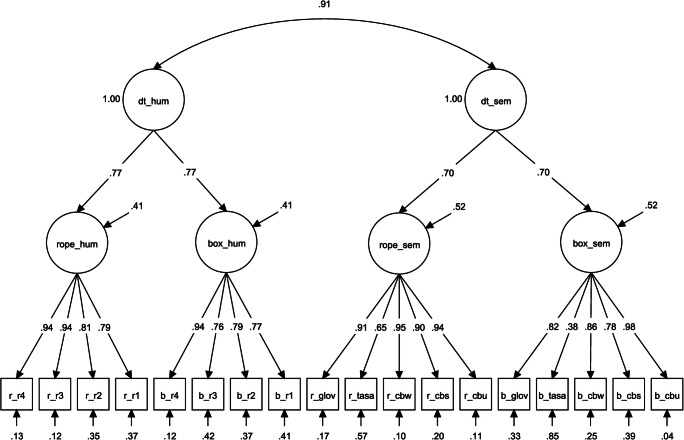
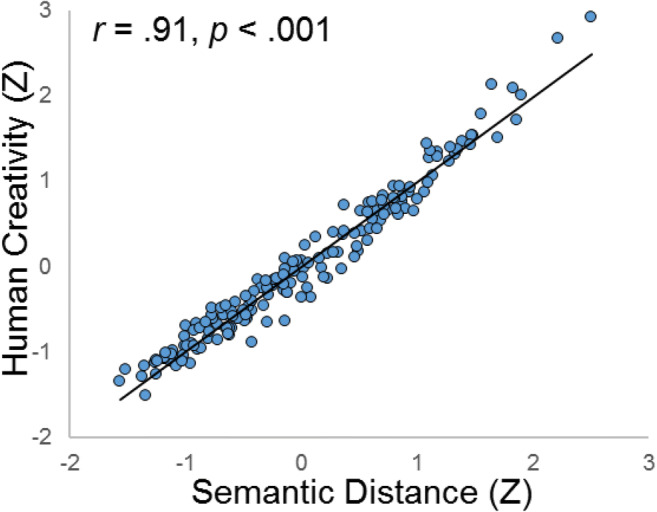
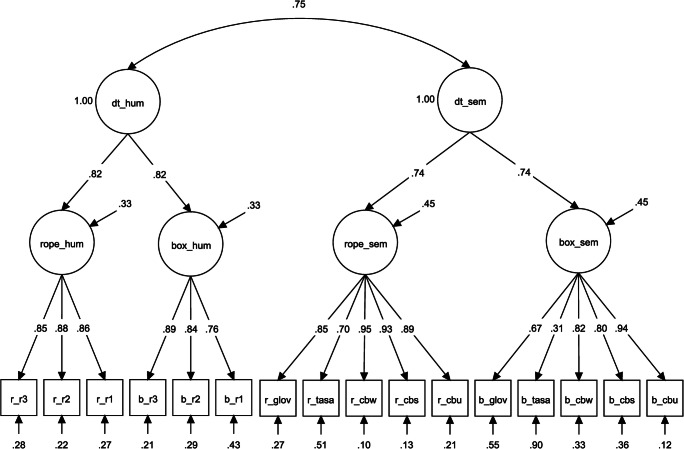
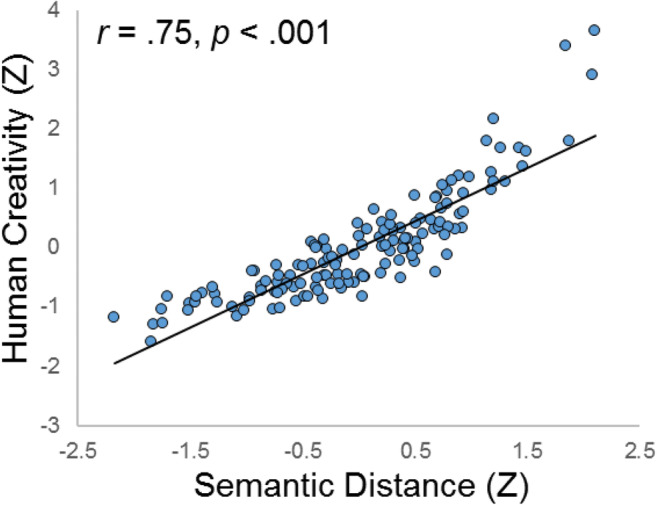
Creativity research requires assessing the quality of ideas and products. In practice, conducting creativity research often involves asking several human raters to judge participants’ responses to creativity tasks, such as judging the novelty of ideas from the alternate uses task (AUT). Although such subjective scoring methods have proved useful, they have two inherent limitations—labor cost (raters typically code thousands of responses) and subjectivity (raters vary on their perceptions and preferences)—raising classic psychometric threats to reliability and validity. We sought to address the limitations of subjective scoring by capitalizing on recent developments in automated scoring of verbal creativity via semantic distance, a computational method that uses natural language processing to quantify the semantic relatedness of texts. In five studies, we compare the top performing semantic models (e.g., GloVe, continuous bag of words) previously shown to have the highest correspondence to human relatedness judgements. We assessed these semantic models in relation to human creativity ratings from a canonical verbal creativity task (AUT; Studies 1–3) and novelty/creativity ratings from two word association tasks (Studies 4–5). We find that a latent semantic distance factor—comprised of the common variance from five semantic models—reliably and strongly predicts human creativity and novelty ratings across a range of creativity tasks. We also replicate an established experimental effect in the creativity literature (i.e., the serial order effect) and show that semantic distance correlates with other creativity measures, demonstrating convergent validity. We provide an open platform to efficiently compute semantic distance, including tutorials and documentation ( https://osf.io/gz4fc/ ).
Overview
The claims and statistics of this paper haven’t been checked yet.
Run the check — free, no account needed. It reads the open-access text and checks the sources it cites.
Integrity signals
Registry
Cites
Statistics
Figures
Verification
Claims the paper makes
The claims and statistics of this paper haven’t been checked yet.
Run the check — free, no account needed. It reads the open-access text and checks the sources it cites.
Claims other papers make about this one
Each is checked against this paper’s own text: does it say what the citing paper says it does?
In the citing paper
“we investigate originality primarily by means of semantic similarity, using a well-performing sentence embedding model [72] whose direct predecessors [70] have been found to agree well with human judgments of originality in creativity research [6, 26].”
From Homogenization Effects of Large Language Models on Human Creative Ideation (2024) · cites this paper as [6]
In the citing paper
“a metric which has been found to agree well with human judgments of semantic similarity [6, 26].”
From Homogenization Effects of Large Language Models on Human Creative Ideation (2024) · cites this paper as [6]
Self-check
Percentages, sums and reported differences re-computed from the paper’s own numbers.
The self-check needs the paper’s full text.
Citations
Cites
(1998) · Cited by 36,049
Glove: Global Vectors for Word Representation
Pennington, J., Socher, R., & Manning, C. (2014) · Proceedings of the 2014 Conference on Empirical Methods in Natural Language Processing (EMNLP) · doi:10.3115/v1/d14-1162 · Cited by 34,071
lavaan : An R Package for Structural Equation Modeling
Rosseel, Y. (2012) · Journal of Statistical Software · doi:10.18637/jss.v048.i02 · Cited by 27,955
Distributed Representations of Words and Phrases and their Compositionality
Mikolov, T., Sutskever, I., Chen, K., Corrado, G., & Dean, J. (2013) · arXiv · doi:10.48550/arxiv.1310.4546 · Cited by 24,533
An introduction to latent semantic analysis
Landauer, T. K., Foltz, P. W., & Laham, D. (1998) · Discourse Processes · doi:10.1080/01638539809545028 · Cited by 4,880
The associative basis of the creative process.
Mednick, S. (1962) · Psychological Review · doi:10.1037/h0048850 · Cited by 4,140
The social psychology of creativity: A componential conceptualization.
Amabile, T. M. (1983) · Journal of Personality and Social Psychology · doi:10.1037/0022-3514.45.2.357 · Cited by 4,034
Thurstone, L. L. (1973) · Springer eBooks · doi:10.1007/978-94-011-6129-9_8 · Cited by 2,126
(2011) · Cited by 2,025
Psychometric Properties of the HEXACO Personality Inventory
Lee, K., & Ashton, M. C. (2004) · Multivariate Behavioral Research · doi:10.1207/s15327906mbr3902_8 · Cited by 1,961
Research works printed but not linked: 2
- Cattell, R. B., & Cattell, A. K. S. (1961/2008). Measuring intelligence with the Culture Fair Tests. Oxford, UK: Hogrefe.
- Cattell, R. B., & Cattell, A. (1973). Measuring intelligence with the culture fair tests. Institute for Personality and Ability Testing. Champaign Ill.: Institute for Personality and Ability Testing.
Cited by
Sorted by citations
Best humans still outperform artificial intelligence in a creative divergent thinking task
Koivisto, M., & Grassini, S. (2023) · Scientific Reports · doi:10.1038/s41598-023-40858-3 · Cited by 247
Associative thinking at the core of creativity
Beaty, R. E., & Kenett, Y. N. (2023) · Trends in Cognitive Sciences · doi:10.1016/j.tics.2023.04.004 · Cited by 272
Self-citationOrganisciak, P., Acar, S., Dumas, D., & Berthiaume, K. (2023) · Thinking Skills and Creativity · doi:10.1016/j.tsc.2023.101356 · Cited by 202
Creativity and artificial intelligence—a student perspective
Marrone, R., Taddeo, V., & Hill, G. (2022) · Journal of Intelligence · doi:10.3390/jintelligence10030065 · Cited by 208
Naming unrelated words predicts creativity
Olson, J. A., Nahas, J., Chmoulevitch, D., Cropper, S. J., & Webb, M. E. (2021) · Proceedings of the National Academy of Sciences · doi:10.1073/pnas.2022340118 · Cited by 182
Metadata
- Authors
- Beaty, R. E., & Johnson, D. R.
- Affiliations
- Pennsylvania State University (US)
- Washington and Lee University (US)
- Corresponding author
- Beaty, Roger E.
- Johnson, Dan R.
- Venue
- Behavior Research Methods
- Published
- 2020-08-31
- Volume
- 53
- Issue
- 2
- Pages
- 757-780
- ISSN
- 1554-351X (ISSN-L)
- 1554-3528
- PMC
- PMC8062332
- OpenAlex
- W3081924543
- Cited by
- 341
- References
- 96
- Citations by year
- 2026: 57 · 2025: 66 · 2024: 79 · 2023: 58 · 2022: 54 · 2021: 23 · 2020: 4
- FWCI
- 33.62
- Type
- journal article
- Language
- en
- Open access
- hybrid
- doi.org
- Locations
- Behavior Research Methods (publishedVersion, cc-by)
- PubMed Central (publishedVersion, cc-by)
- PubMed (publishedVersion)
- PsyArXiv (OSF Preprints) (submittedVersion, cc-by)
- PsyArXiv (OSF Preprints) (submittedVersion)
- Funders
- National Science Foundation (1920653)
- Topics
- Social Sciences › Psychology › Experimental and Cognitive Psychology › Creativity in Education and Neuroscience
- Physical Sciences › Computer Science › Artificial Intelligence › Topic Modeling
- Social Sciences › General Social Sciences › Computational and Text Analysis Methods
- Keywords
- creativity assessment, semantic distance, alternative uses task, word association task, automated grading, semantic relatedness, gloves, CBOW, serial order effects, convergent validity, open platform
- MeSH terms
- Creativity, Humans, Psychometrics, Semantics, Reproducibility of Results
About these checks
Registry, retraction, Cites and statistics results are computed, not judged, with one exception: a printed reference that no index lists is read once by a model before it counts as a citation error. Claims are extracted by a model and kept only when their quote appears verbatim in the text; each cited source is then checked, with a model’s help, for whether it says what the claim relies on. Those verdicts can be wrong — read the claim’s quote and the cited source before relying on one.
Statistics and arithmetic are recomputed, not judged.
Confidence bands are shown only for fields calibrated on our annotated test set. None is calibrated yet, so no band is shown.
What counts as a claim ›How we measure confidence ›How we check this ›
Are you an author, or do you see a problem with this page? Request a review
