

The DOI matches its Crossref record; 95 of the 96 references it cites were found in a registry or an index.
Automating creativity assessment with SemDis: An open platform for computing semantic distance
Open accessAbstract
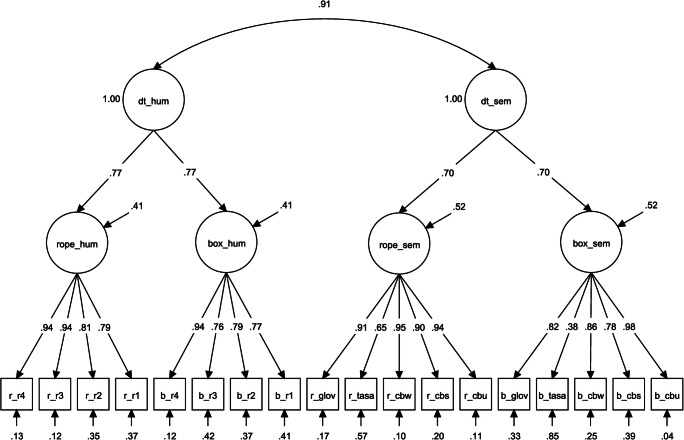
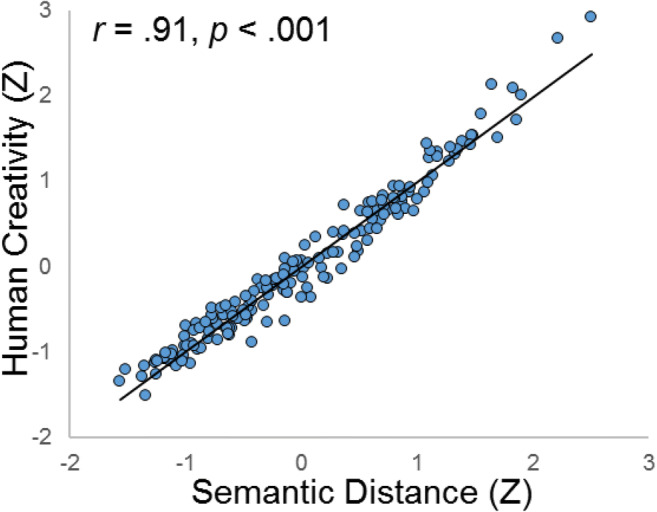
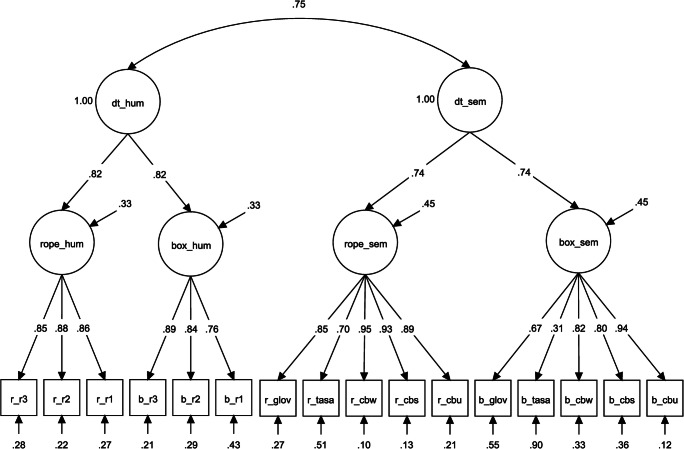
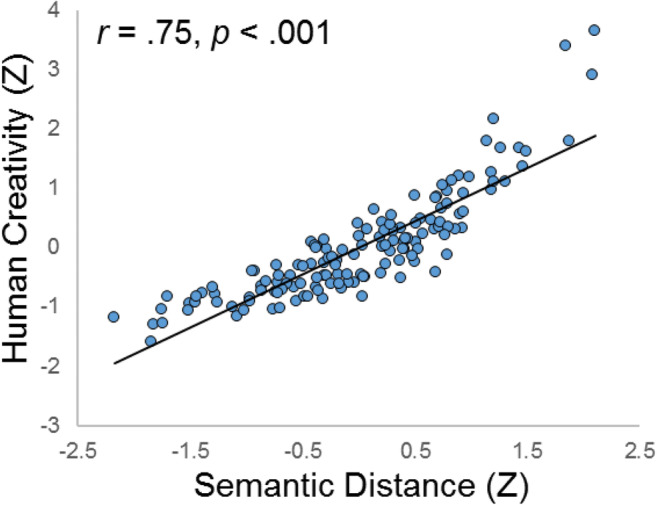
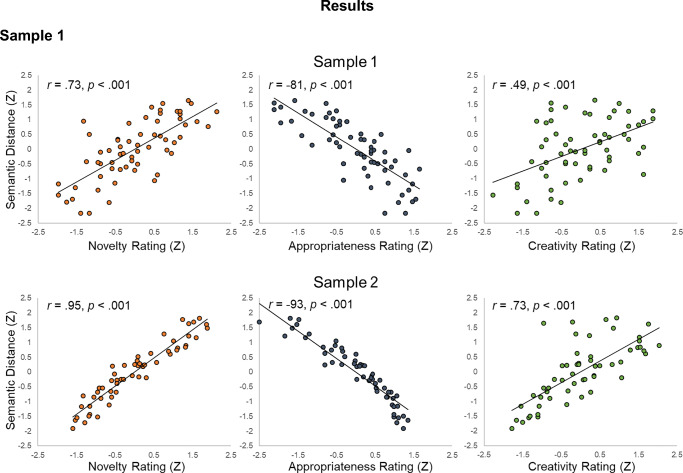
Creativity research requires assessing the quality of ideas and products. In practice, conducting creativity research often involves asking several human raters to judge participants’ responses to creativity tasks, such as judging the novelty of ideas from the alternate uses task (AUT). Although such subjective scoring methods have proved useful, they have two inherent limitations—labor cost (raters typically code thousands of responses) and subjectivity (raters vary on their perceptions and preferences)—raising classic psychometric threats to reliability and validity. We sought to address the limitations of subjective scoring by capitalizing on recent developments in automated scoring of verbal creativity via semantic distance, a computational method that uses natural language processing to quantify the semantic relatedness of texts. In five studies, we compare the top performing semantic models (e.g., GloVe, continuous bag of words) previously shown to have the highest correspondence to human relatedness judgements. We assessed these semantic models in relation to human creativity ratings from a canonical verbal creativity task (AUT; Studies 1–3) and novelty/creativity ratings from two word association tasks (Studies 4–5). We find that a latent semantic distance factor—comprised of the common variance from five semantic models—reliably and strongly predicts human creativity and novelty ratings across a range of creativity tasks. We also replicate an established experimental effect in the creativity literature (i.e., the serial order effect) and show that semantic distance correlates with other creativity measures, demonstrating convergent validity. We provide an open platform to efficiently compute semantic distance, including tutorials and documentation ( https://osf.io/gz4fc/ ).
Overview
The claims and statistics of this paper haven’t been checked yet.
Run the check — free, no account needed. It reads the open-access text and checks the sources it cites.
Integrity signals
Registry
Cites
Statistics
Figures
Verification
Claims the paper makes
The claims and statistics of this paper haven’t been checked yet.
Run the check — free, no account needed. It reads the open-access text and checks the sources it cites.
Claims other papers make about this one
Each is checked against this paper’s own text: does it say what the citing paper says it does?
In the citing paper
“we investigate originality primarily by means of semantic similarity, using a well-performing sentence embedding model [72] whose direct predecessors [70] have been found to agree well with human judgments of originality in creativity research [6, 26].”
From Homogenization Effects of Large Language Models on Human Creative Ideation (2024) · cites this paper as [6]
In the citing paper
“a metric which has been found to agree well with human judgments of semantic similarity [6, 26].”
From Homogenization Effects of Large Language Models on Human Creative Ideation (2024) · cites this paper as [6]
Self-check
Percentages, sums and reported differences re-computed from the paper’s own numbers.
The self-check needs the paper’s full text.
Citations
Cites
(1998) · Cited by 36,049
Glove: Global Vectors for Word Representation
Pennington, J., Socher, R., & Manning, C. (2014) · Proceedings of the 2014 Conference on Empirical Methods in Natural Language Processing (EMNLP) · doi:10.3115/v1/d14-1162 · Cited by 34,071
lavaan : An R Package for Structural Equation Modeling
Rosseel, Y. (2012) · Journal of Statistical Software · doi:10.18637/jss.v048.i02 · Cited by 27,955
Distributed Representations of Words and Phrases and their Compositionality
Mikolov, T., Sutskever, I., Chen, K., Corrado, G., & Dean, J. (2013) · arXiv · doi:10.48550/arxiv.1310.4546 · Cited by 24,533
An introduction to latent semantic analysis
Landauer, T. K., Foltz, P. W., & Laham, D. (1998) · Discourse Processes · doi:10.1080/01638539809545028 · Cited by 4,880
The associative basis of the creative process.
Mednick, S. (1962) · Psychological Review · doi:10.1037/h0048850 · Cited by 4,140
The social psychology of creativity: A componential conceptualization.
Amabile, T. M. (1983) · Journal of Personality and Social Psychology · doi:10.1037/0022-3514.45.2.357 · Cited by 4,034
Thurstone, L. L. (1973) · Springer eBooks · doi:10.1007/978-94-011-6129-9_8 · Cited by 2,126
(2011) · Cited by 2,025
Psychometric Properties of the HEXACO Personality Inventory
Lee, K., & Ashton, M. C. (2004) · Multivariate Behavioral Research · doi:10.1207/s15327906mbr3902_8 · Cited by 1,961
Baroni, M., Dinu, G., & Kruszewski, G. (2014) · Proceedings of the conference - Association for Computational Linguistics. Meeting · doi:10.3115/v1/p14-1023 · Cited by 1,439
Reliability, Validity, and Factor Structure of the Creative Achievement Questionnaire
Carson, S., Peterson, J. B., & Higgins, D. M. (2005) · Creativity Research Journal · doi:10.1207/s15326934crj1701_4 · Cited by 1,024
Composition in Distributional Models of Semantics
Mitchell, J., & Lapata, M. (2010) · Cognitive Science · doi:10.1111/j.1551-6709.2010.01106.x · Cited by 968
Silvia, P. J., Winterstein, B. P., Willse, J. T., Barona, C. M., Cram, J. T., Hess, K. I., Martinez, J. L., & Richard, C. A. (2008) · Psychology of Aesthetics, Creativity, and the Arts · doi:10.1037/1931-3896.2.2.68 · Cited by 912
Understanding The New Statistics
Cumming, G. (2013) · Routledge eBooks · doi:10.4324/9780203807002 · Cited by 878
Robust prediction of individual creative ability from brain functional connectivity
Beaty, R. E., Kenett, Y. N., Christensen, A. P., Rosenberg, M. D., Benedek, M., Chen, Q., Fink, A., Qiu, J., Kwapil, T. R., Kane, M. J., et al. (2018) · Proceedings of the National Academy of Sciences · doi:10.1073/pnas.1713532115 · Cited by 835
Self-citationBenedek, M., Jauk, E., Sommer, M., Arendasy, M., & Neubauer, A. C. (2014) · Intelligence · doi:10.1016/j.intell.2014.05.007 · Cited by 743
The NEO–PI–3: A More Readable Revised NEO Personality Inventory
McCrae, R. R., Costa, P. T., & Martin, T. (2005) · Journal of Personality Assessment · doi:10.1207/s15327752jpa8403_05 · Cited by 701
Vector-based Models of Semantic Composition
Mitchell, J., & Lapata, M. (2008) · Edinburgh Research Explorer (University of Edinburgh) · Cited by 680
Beaty, R. E., & Silvia, P. J. (2012) · Psychology of Aesthetics, Creativity, and the Arts · doi:10.1037/a0029171 · Cited by 551
Self-citationPredictive Validity of the Torrance Tests of Creative Thinking*
TORRANCE, E. P. (1972) · The Journal of Creative Behavior · doi:10.1002/j.2162-6057.1972.tb00936.x · Cited by 516
Mandera, P., Keuleers, E., & Brysbaert, M. (2016) · Journal of Memory and Language · doi:10.1016/j.jml.2016.04.001 · Cited by 460
Creative mindsets: Measurement, correlates, consequences.
Karwowski, M. (2013) · Psychology of Aesthetics Creativity and the Arts · doi:10.1037/a0034898 · Cited by 449
The roles of associative and executive processes in creative cognition
Beaty, R. E., Silvia, P. J., Nusbaum, E. C., Jauk, E., & Benedek, M. (2014) · Memory & Cognition · doi:10.3758/s13421-014-0428-8 · Cited by 448
Self-citationRunco, M. A., Millar, G. W., Acar, S., & Cramond, B. L. (2010) · Creativity Research Journal · doi:10.1080/10400419.2010.523393 · Cited by 397
Investigating the structure of semantic networks in low and high creative persons
Kenett, Y. N., Anaki, D., & Faust, M. (2014) · Frontiers in Human Neuroscience · doi:10.3389/fnhum.2014.00407 · Cited by 392
Assessing creativity with self-report scales: A review and empirical evaluation.
Silvia, P. J., Wigert, B. G., Reiter‐Palmon, R., & Kaufman, J. C. (2011) · Psychology of Aesthetics Creativity and the Arts · doi:10.1037/a0024071 · Cited by 392
Is the proof in the pudding? Reanalyses of Torrance׳s (1958 to present) longitudinal data
Plucker, J. A. (1999) · Creativity Research Journal · doi:10.1207/s15326934crj1202_3 · Cited by 390
The road to creative achievement: a latent variable model of ability and personality predictors
Jauk, E., Benedek, M., & Neubauer, A. C. (2014) · European Journal of Personality · doi:10.1002/per.1941 · Cited by 375
Scoring divergent thinking tests: A review and systematic framework.
Reiter-Palmon, R., Forthmann, B., & Barbot, B. (2019) · Psychology of Aesthetics, Creativity, and the Arts · doi:10.1037/aca0000227 · Cited by 367
Günther, F., Rinaldi, L., & Marelli, M. (2019) · Perspectives on Psychological Science · doi:10.1177/1745691619861372 · Cited by 354
Zeng, L., Proctor, R. W., & Salvendy, G. (2011) · Creativity Research Journal · doi:10.1080/10400419.2011.545713 · Cited by 350
Are creative ideas novel and useful?
Diedrich, J., Benedek, M., Jauk, E., & Neubauer, A. C. (2015) · Psychology of Aesthetics, Creativity, and the Arts · doi:10.1037/a0038688 · Cited by 314
Making creative metaphors: The importance of fluid intelligence for creative thought
Silvia, P. J., & Beaty, R. E. (2012) · Intelligence · doi:10.1016/j.intell.2012.02.005 · Cited by 278
Self-citationA Semantic Network Cartography of the Creative Mind
Kenett, Y. N., & Faust, M. (2019) · Trends in Cognitive Sciences · doi:10.1016/j.tics.2019.01.007 · Cited by 276
Harrington, D. M. (1975) · Journal of Personality · doi:10.1111/j.1467-6494.1975.tb00715.x · Cited by 268
Relations of creative responses to working time and instructions
Christensen, P. R., Guilford, J. P., & Wilson, R. C. (1957) · Journal of Experimental Psychology · doi:10.1037/h0045461 · Cited by 263
Nusbaum, E. C., Silvia, P. J., & Beaty, R. E. (2014) · Psychology of Aesthetics Creativity and the Arts · doi:10.1037/a0036549 · Cited by 261
Self-citationDivergent thinking: New methods, recent research, and extended theory.
Acar, S., & Runco, M. A. (2019) · Psychology of Aesthetics Creativity and the Arts · doi:10.1037/aca0000231 · Cited by 248
Flexibility of thought in high creative individuals represented by percolation analysis
Kenett, Y. N., Levy, O., Kenett, D. Y., Stanley, E., Faust, M., & Havlin, S. (2018) · Proceedings of the National Academy of Sciences · doi:10.1073/pnas.1717362115 · Cited by 242
Torrance, E. P. (1981) · Gifted Child Quarterly · doi:10.1177/001698628102500203 · Cited by 239
Benedek, M., Mühlmann, C., Jauk, E., & Neubauer, A. C. (2013) · Psychology of Aesthetics Creativity and the Arts · doi:10.1037/a0033644 · Cited by 238
Assessment of real-life creativity: The Inventory of Creative Activities and Achievements (ICAA).
Diedrich, J., Jauk, E., Silvia, P. J., Gredlein, J. M., Neubauer, A. C., & Benedek, M. (2017) · Psychology of Aesthetics Creativity and the Arts · doi:10.1037/aca0000137 · Cited by 233
Metaphorically speaking: cognitive abilities and the production of figurative language
Beaty, R. E., & Silvia, P. J. (2013) · Memory & Cognition · doi:10.3758/s13421-012-0258-5 · Cited by 216
Self-citationThe generality-specificity of creativity: Exploring the structure of creative potential with EPoC
Barbot, B., Besançon, M., & Lubart, T. (2016) · Learning and Individual Differences · doi:10.1016/j.lindif.2016.06.005 · Cited by 212
Beaty, R. E., Christensen, A. P., Benedek, M., Silvia, P. J., & Schacter, D. L. (2017) · NeuroImage · doi:10.1016/j.neuroimage.2017.01.012 · Cited by 208
Self-citationAssessing Associative Distance Among Ideas Elicited by Tests of Divergent Thinking
Acar, S., & Runco, M. A. (2014) · Creativity Research Journal · doi:10.1080/10400419.2014.901095 · Cited by 203
Kaufman, J. C., Lee, J., Baer, J., & Lee, S. (2007) · Thinking Skills and Creativity · doi:10.1016/j.tsc.2007.04.002 · Cited by 194
“Forward flow”: A new measure to quantify free thought and predict creativity.
Gray, K. J., Anderson, S., Chen, E. E., Kelly, J., Christian, M. S., Patrick, J., Huang, L., Kenett, Y. N., & Lewis, K. (2019) · American Psychologist · doi:10.1037/amp0000391 · Cited by 189
Understanding Fluency and Originality: A latent variable perspective
Dumas, D., & Dunbar, K. N. (2014) · Thinking Skills and Creativity · doi:10.1016/j.tsc.2014.09.003 · Cited by 188
What can quantitative measures of semantic distance tell us about creativity?
Kenett, Y. N. (2018) · Current Opinion in Behavioral Sciences · doi:10.1016/j.cobeha.2018.08.010 · Cited by 181
Proceedings of the 38th Annual Conference of the Cognitive Science Society, CogSci 2016
Räsänen, O. J., Nagamine, T., & Mesgarani, N. (2016) · Cited by 175
LSAfun - An R package for computations based on Latent Semantic Analysis
Günther, F., Dudschig, C., & Kaup, B. (2014) · Behavior Research Methods · doi:10.3758/s13428-014-0529-0 · Cited by 174
Cseh, G. M., & Jeffries, K. K. (2019) · Psychology of Aesthetics Creativity and the Arts · doi:10.1037/aca0000220 · Cited by 171
Thin slices of creativity: Using single-word utterances to assess creative cognition
Prabhakaran, R., Green, A. E., & Gray, J. R. (2013) · Behavior Research Methods · doi:10.3758/s13428-013-0401-7 · Cited by 167
The semantic distance task: Quantifying semantic distance with semantic network path length.
Kenett, Y. N., Levi, E., Anaki, D., & Faust, M. (2017) · Journal of Experimental Psychology Learning Memory and Cognition · doi:10.1037/xlm0000391 · Cited by 165
Mouchiroud, C., & Lubart, T. (2001) · The Journal of Genetic Psychology · doi:10.1080/00221320109597491 · Cited by 160
Dumas, D., Organisciak, P., & Doherty, M. (2021) · Psychology of Aesthetics, Creativity, and the Arts · doi:10.1037/aca0000319 · Cited by 158 · cited 18×
“Regarding creativity, the five semantic spaces showed comparable but variable correlations with creativity ratings, with the highest correlations found for GloVe ( r = .61) and cbowukwac ( r = .55).”
BackgroundMethodResultInfluentialThe Dynamics of Creative Ideation: Introducing a New Assessment Paradigm
Barbot, B. (2018) · Frontiers in Psychology · doi:10.3389/fpsyg.2018.02529 · Cited by 138
The be-creative effect in divergent thinking: The interplay of instruction and object frequency
Forthmann, B., Gerwig, A., Holling, H., Çelik, P., Storme, M., & Lubart, T. (2016) · Intelligence · doi:10.1016/j.intell.2016.03.005 · Cited by 137
Hass, R. W. (2016) · Memory & Cognition · doi:10.3758/s13421-016-0659-y · Cited by 135
Creativity assessment in psychological research: (Re)setting the standards.
Barbot, B., Hass, R. W., & Reiter‐Palmon, R. (2019) · Psychology of Aesthetics Creativity and the Arts · doi:10.1037/aca0000233 · Cited by 134
Semantic search during divergent thinking
Hass, R. W. (2017) · Cognition · doi:10.1016/j.cognition.2017.05.039 · Cited by 132
Said‐Metwaly, S., Fernández‐Castilla, B., Kyndt, E., & Noortgate, W. V. D. (2019) · Psychology of Aesthetics Creativity and the Arts · doi:10.1037/aca0000244 · Cited by 130
Acar, S., Runco, M. A., & Park, H. (2019) · Psychology of Aesthetics Creativity and the Arts · doi:10.1037/aca0000256 · Cited by 129
Christensen, A. P., & Kenett, Y. N. (2021) · Psychological Methods · doi:10.1037/met0000463 · Cited by 129
Green, A. E. (2016) · Current Directions in Psychological Science · doi:10.1177/0963721415618485 · Cited by 114
Scoring divergent thinking tests by computer with a semantics-based algorithm
Beketayev, K., & Runco, M. A. (2016) · Europe’s Journal of Psychology · doi:10.5964/ejop.v12i2.1127 · Cited by 106
Remotely Close Associations: Openness to Experience and Semantic Memory Structure
Christensen, A. P., Kenett, Y. N., Cotter, K. N., Beaty, R. E., & Silvia, P. J. (2018) · European Journal of Personality · doi:10.1002/per.2157 · Cited by 106
Self-citationSemantic distance: An automated measure of creativity that is novel and appropriate.
Heinen, D. J. P., & Johnson, D. R. (2017) · Psychology of Aesthetics Creativity and the Arts · doi:10.1037/aca0000125 · Cited by 101
Self-citationA psychometric investigation of everyday creativity.
Batey (2009) · Europe PMC (PubMed Central) · Cited by 100
Application of Latent Semantic Analysis to Divergent Thinking is Biased by Elaboration
Forthmann, B., Oyebade, O., Ojo, A., Günther, F., & Holling, H. (2018) · The Journal of Creative Behavior · doi:10.1002/jocb.240 · Cited by 92
Typing Speed as a Confounding Variable and the Measurement of Quality in Divergent Thinking
Forthmann, B., Holling, H., Çelik, P., Storme, M., & Lubart, T. (2017) · Creativity Research Journal · doi:10.1080/10400419.2017.1360059 · Cited by 86
Forthmann, B., Holling, H., Zandi, N., Gerwig, A., Çelik, P., Storme, M., & Lubart, T. (2016) · Thinking Skills and Creativity · doi:10.1016/j.tsc.2016.12.005 · Cited by 84
Age-related differences in mind-wandering in daily life.
Maillet, D., Beaty, R. E., Jordano, M. L., Touron, D. R., Adnan, A., Silvia, P. J., Kwapil, T. R., Turner, G. R., Spreng, R. N., & Kane, M. J. (2018) · Psychology and Aging · doi:10.1037/pag0000260 · Cited by 84
Self-citationHow Creativity Happens in the Brain
Dietrich, A. (2015) · Palgrave Macmillan UK eBooks · doi:10.1057/9781137501806 · Cited by 79
Adnan, A., Beaty, R. E., Silvia, P. J., Spreng, R. N., & Turner, G. R. (2018) · Neurobiology of Aging · doi:10.1016/j.neurobiolaging.2018.11.004 · Cited by 76
Self-citationStructure at every scale: A semantic network account of the similarities between unrelated concepts.
Deyne, S. D., Navarro, D., Perfors, A., & Storms, G. (2016) · Journal of Experimental Psychology General · doi:10.1037/xge0000192 · Cited by 73
Use or Consequences: Probing the Cognitive Difference Between Two Measures of Divergent Thinking
Hass, R. W., & Beaty, R. E. (2018) · Frontiers in Psychology · doi:10.3389/fpsyg.2018.02327 · Cited by 72
Self-citationThe neglect of idea diversity in creative idea generation and evaluation.
Johnson, D. R., Cuthbert, A. S., & Tynan, M. E. (2019) · Psychology of Aesthetics Creativity and the Arts · doi:10.1037/aca0000235 · Cited by 69
Self-citationOld or New? Evaluating the Old/New Scoring Method for Divergent Thinking Tasks
Silvia, P. J., Nusbaum, E. C., & Beaty, R. E. (2015) · The Journal of Creative Behavior · doi:10.1002/jocb.101 · Cited by 68
Self-citationZedelius, C. M., Mills, C., & Schooler, J. W. (2018) · Behavior Research Methods · doi:10.3758/s13428-018-1137-1 · Cited by 67
Forthmann, B., Paek, S. H., Dumas, D., Barbot, B., & Holling, H. (2019) · British Journal of Educational Psychology · doi:10.1111/bjep.12325 · Cited by 66
SNAFU: The Semantic Network and Fluency Utility
Zemla, J. C., Cao, K., Mueller, K. D., & Austerweil, J. L. (2020) · Behavior Research Methods · doi:10.3758/s13428-019-01343-w · Cited by 64
Creativity Evaluation through Latent Semantic Analysis
Dunbar, K. N., & Forster, E. (2009) · eScholarship (California Digital Library) · Cited by 62
Objectively Scoring Divergent Thinking Tests for Originality: A Re-Analysis and Extension
Dumas, D., & Runco, M. A. (2018) · Creativity Research Journal · doi:10.1080/10400419.2018.1544601 · Cited by 43
A psychometric investigation of everyday creativity
Batey, M. D. (2007) · OpenGrey (Institut de l'Information Scientifique et Technique) · Cited by 43
On the Dependability and Feasibility of Layperson Ratings of Divergent Thinking
Hass, R. W., Rivera, M., & Silvia, P. J. (2018) · Frontiers in Psychology · doi:10.3389/fpsyg.2018.01343 · Cited by 41
A Semantic Network Approach to the Creativity Quotient (CQ)
Bossomaier, T. R. J., Harré, M., Knittel, A., & Snyder, A. W. (2009) · Creativity Research Journal · doi:10.1080/10400410802633517 · Cited by 40
Latency as a predictor of originality in divergent thinking
Acar, S., Alabbasi, A. M. A., Runco, M. A., & Beketayev, K. (2019) · Thinking Skills and Creativity · doi:10.1016/j.tsc.2019.100574 · Cited by 39
Wilken, A., Forthmann, B., & Holling, H. (2019) · The Journal of Creative Behavior · doi:10.1002/jocb.392 · Cited by 31
Beaty, R. E., Kenett, Y. N., Hass, R. W., & Schacter, D. L. (2019) · doi:10.31234/osf.io/pfz2g · Cited by 31
Self-citationAutomated scoring of originality using semantic representations
Harbinson, J. I., & Haarman, H. J. T. M. (2014) · eScholarship (California Digital Library) · Cited by 27
Christensen, A. P., & Kenett, Y. N. (2019) · doi:10.17605/osf.io/hqxtc · Cited by 20
S., C. E. (1938) · The Mathematical Gazette · doi:10.2307/3607923 · Cited by 5
Research works printed but not linked: 2
- Cattell, R. B., & Cattell, A. K. S. (1961/2008). Measuring intelligence with the Culture Fair Tests. Oxford, UK: Hogrefe.
- Cattell, R. B., & Cattell, A. (1973). Measuring intelligence with the culture fair tests. Institute for Personality and Ability Testing. Champaign Ill.: Institute for Personality and Ability Testing.
Cited by
Sorted by citations
Best humans still outperform artificial intelligence in a creative divergent thinking task
Koivisto, M., & Grassini, S. (2023) · Scientific Reports · doi:10.1038/s41598-023-40858-3 · Cited by 247
Associative thinking at the core of creativity
Beaty, R. E., & Kenett, Y. N. (2023) · Trends in Cognitive Sciences · doi:10.1016/j.tics.2023.04.004 · Cited by 272
Self-citationOrganisciak, P., Acar, S., Dumas, D., & Berthiaume, K. (2023) · Thinking Skills and Creativity · doi:10.1016/j.tsc.2023.101356 · Cited by 202
Creativity and artificial intelligence—a student perspective
Marrone, R., Taddeo, V., & Hill, G. (2022) · Journal of Intelligence · doi:10.3390/jintelligence10030065 · Cited by 208
Naming unrelated words predicts creativity
Olson, J. A., Nahas, J., Chmoulevitch, D., Cropper, S. J., & Webb, M. E. (2021) · Proceedings of the National Academy of Sciences · doi:10.1073/pnas.2022340118 · Cited by 182
Metadata
- Authors
- Beaty, R. E., & Johnson, D. R.
- Affiliations
- Pennsylvania State University (US)
- Washington and Lee University (US)
- Corresponding author
- Beaty, Roger E.
- Johnson, Dan R.
- Venue
- Behavior Research Methods
- Published
- 2020-08-31
- Volume
- 53
- Issue
- 2
- Pages
- 757-780
- ISSN
- 1554-351X (ISSN-L)
- 1554-3528
- PMC
- PMC8062332
- OpenAlex
- W3081924543
- Cited by
- 341
- References
- 96
- Citations by year
- 2026: 57 · 2025: 66 · 2024: 79 · 2023: 58 · 2022: 54 · 2021: 23 · 2020: 4
- FWCI
- 33.62
- Type
- journal article
- Language
- en
- Open access
- hybrid
- doi.org
- Locations
- Behavior Research Methods (publishedVersion, cc-by)
- PubMed Central (publishedVersion, cc-by)
- PubMed (publishedVersion)
- PsyArXiv (OSF Preprints) (submittedVersion, cc-by)
- PsyArXiv (OSF Preprints) (submittedVersion)
- Funders
- National Science Foundation (1920653)
- Topics
- Social Sciences › Psychology › Experimental and Cognitive Psychology › Creativity in Education and Neuroscience
- Physical Sciences › Computer Science › Artificial Intelligence › Topic Modeling
- Social Sciences › General Social Sciences › Computational and Text Analysis Methods
- Keywords
- creativity assessment, semantic distance, alternative uses task, word association task, automated grading, semantic relatedness, gloves, CBOW, serial order effects, convergent validity, open platform
- MeSH terms
- Creativity, Humans, Psychometrics, Semantics, Reproducibility of Results
About these checks
Registry, retraction, Cites and statistics results are computed, not judged, with one exception: a printed reference that no index lists is read once by a model before it counts as a citation error. Claims are extracted by a model and kept only when their quote appears verbatim in the text; each cited source is then checked, with a model’s help, for whether it says what the claim relies on. Those verdicts can be wrong — read the claim’s quote and the cited source before relying on one.
Statistics and arithmetic are recomputed, not judged.
Confidence bands are shown only for fields calibrated on our annotated test set. None is calibrated yet, so no band is shown.
What counts as a claim ›How we measure confidence ›How we check this ›
Are you an author, or do you see a problem with this page? Request a review
