The DOI matches its Crossref record; 255 of the 255 references it cites were found in a registry or an index.
From lithium to sodium: cell chemistry of room temperature sodium–air and sodium–sulfur batteries
Open accessAbstract
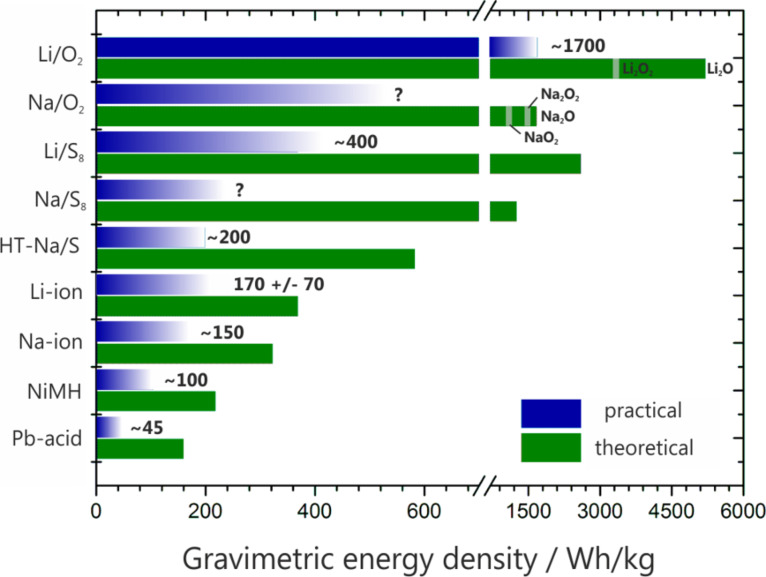
Research devoted to room temperature lithium-sulfur (Li/S8) and lithium-oxygen (Li/O2) batteries has significantly increased over the past ten years. The race to develop such cell systems is mainly motivated by the very high theoretical energy density and the abundance of sulfur and oxygen. The cell chemistry, however, is complex, and progress toward practical device development remains hampered by some fundamental key issues, which are currently being tackled by numerous approaches. Quite surprisingly, not much is known about the analogous sodium-based battery systems, although the already commercialized, high-temperature Na/S8 and Na/NiCl2 batteries suggest that a rechargeable battery based on sodium is feasible on a large scale. Moreover, the natural abundance of sodium is an attractive benefit for the development of batteries based on low cost components. This review provides a summary of the state-of-the-art knowledge on lithium-sulfur and lithium-oxygen batteries and a direct comparison with the analogous sodium systems. The general properties, major benefits and challenges, recent strategies for performance improvements and general guidelines for further development are summarized and critically discussed. In general, the substitution of lithium for sodium has a strong impact on the overall properties of the cell reaction and differences in ion transport, phase stability, electrode potential, energy density, etc. can be thus expected. Whether these differences will benefit a more reversible cell chemistry is still an open question, but some of the first reports on room temperature Na/S8 and Na/O2 cells already show some exciting differences as compared to the established Li/S8 and Li/O2 systems.
Overview
The claims and statistics of this paper haven’t been checked yet.
Run the check — free, no account needed. It reads the open-access text and checks the sources it cites.
Integrity signals
Registry
Cites
Statistics
Figures
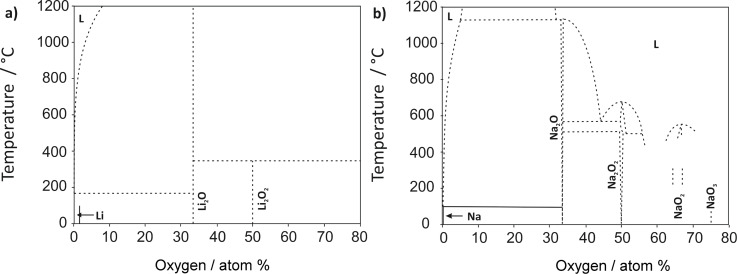
![Figure 3 (a) The Li–O phase diagram. (b) The Na–O phase diagram. Figure redrawn based on [18] and [19].](/paper-figures/c1911b3ad3d243e7b4ea9f9cbf290693/from-lithium-to-sodium-cell-chemistry-of-room-temperature-sodiumair-and-figure-3.jpg)

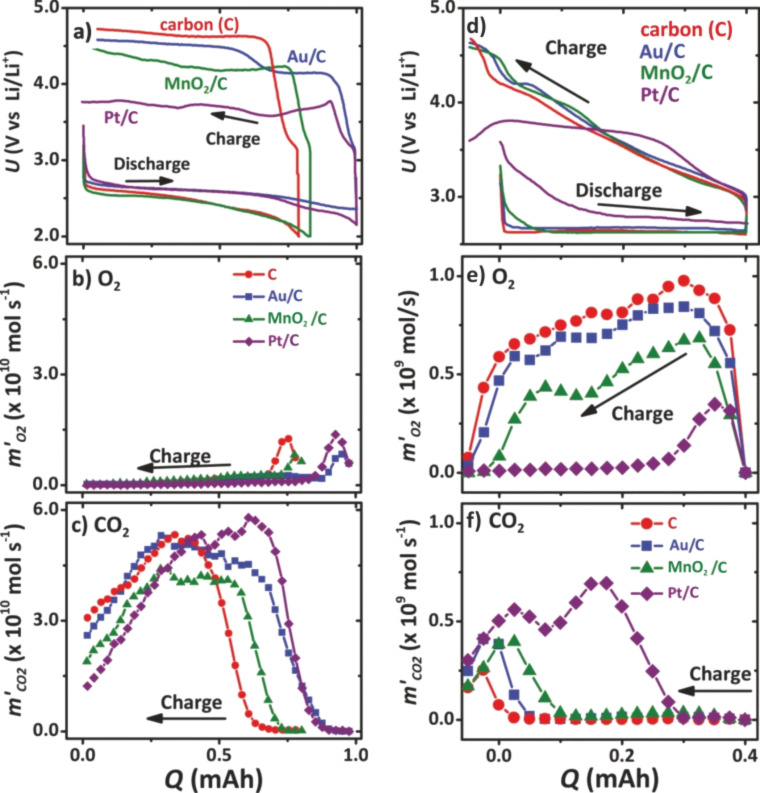
![Figure 5 DEMS analysis of Li/O2 cells with different electrolyte compositions, namely a mixture of propylene carbonate and dimethoxyethane, PC:DME, (a–c) and pure dimethoxyethane, DME, (d–f). Furthermore, gold, platinum and manganese dioxide were tested as heterogeneous catalysts. (a) and (d) show the galvanostatic cycling characteristics. (b) and (d) show the desired oxygen (O2) evolution during charging, and (c) and (f) show the corresponding carbon dioxide (CO2) evolution measured. Figure adapted with permission from [42], copyright 2011 American Chemical Society.](/paper-figures/d68bd533900e445db7712bbdf4d2ad95/from-lithium-to-sodium-cell-chemistry-of-room-temperature-sodiumair-and-figure-5.jpg)
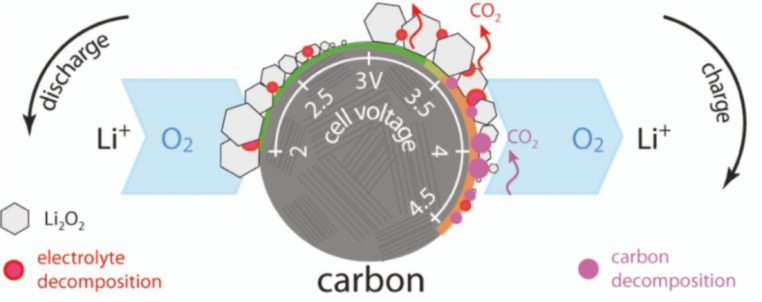
![Figure 6 Sketch by Thotiyl et al. illustrating their findings on the oxidation of the carbon electrode. At discharge at potentials below 3 V, mostly Li2O2 is electrochemically formed and accompanied by electrolyte decomposition. During recharge at potentials between 3.0 and 3.5 V, CO2 evolution is mainly related to electrolyte decomposition. Lastly, at potentials higher than 3.5 V, oxidation of the carbon electrode takes place. Figure adapted with permission from [83], copyright 2012 American Chemical Society.](/paper-figures/a2c2be9da0b54059bac71cd67aa6457b/from-lithium-to-sodium-cell-chemistry-of-room-temperature-sodiumair-and-figure-6.jpg)

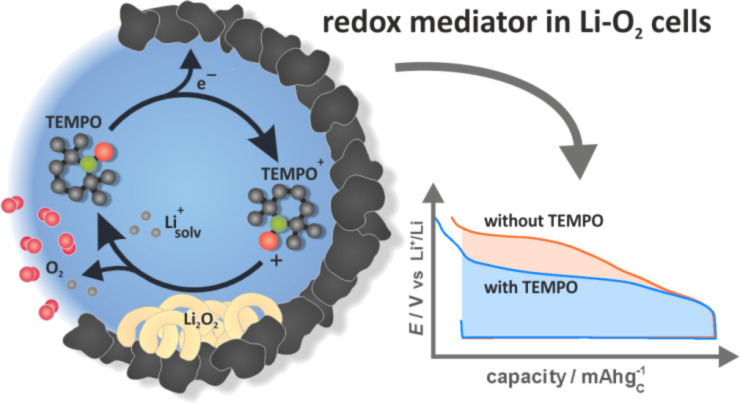
![Figure 8 Illustration of TEMPO as a redox mediator (RM) in an Li/O2 cell reversibly catalyzing the Li2O2 oxidation. Figure adapted with permission from [99], copyright 2014 American Chemical Society.](/paper-figures/27e6a845b1a240ee9fb1ac5235e6e259/from-lithium-to-sodium-cell-chemistry-of-room-temperature-sodiumair-and-figure-8.jpg)

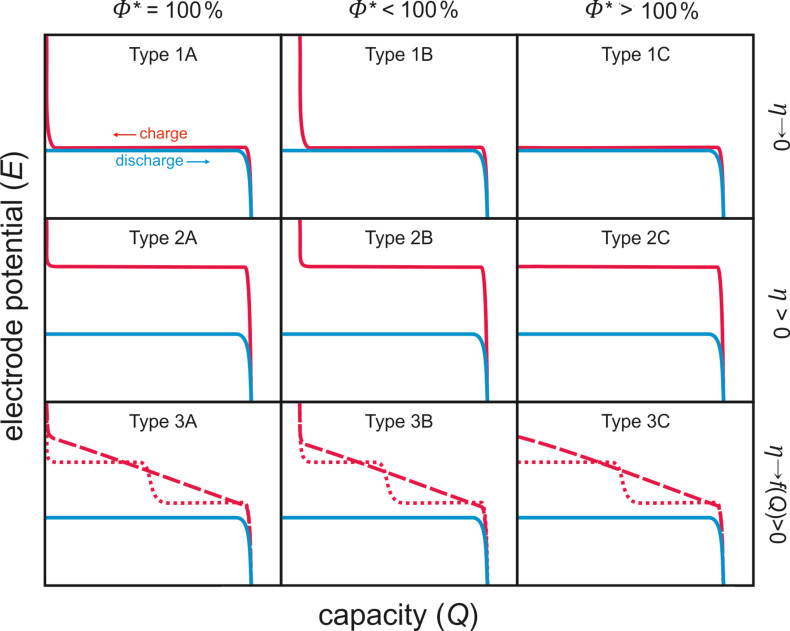
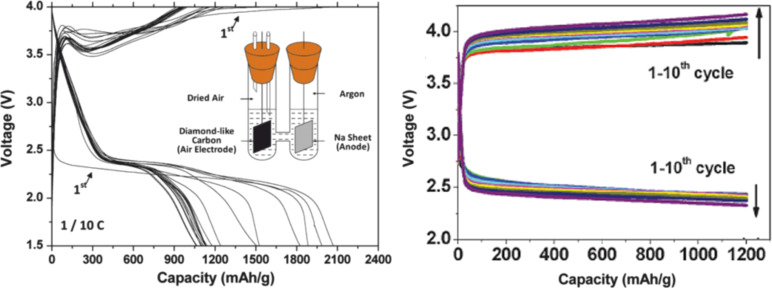
![Figure 10 Sketch of the first room temperature sodium–oxygen cell and its discharge and charge potentials during the first ten cycles (left), Figure adapted with permission from [101], copyright 2012 Elsevier B.V. The voltage profile can be classified as Type 2C. Voltage profile of a sodium–oxygen cell with graphene nanosheets as cathode and NaPF6 in DME as electrolyte (Type 2C) (right). The discharge product was identified as sodium peroxide. Figure adapted with permission from [103], copyright 2013 The Royal Society of Chemistry.](/paper-figures/f50bdbe3a6264d18bcd2e55cf09ec759/from-lithium-to-sodium-cell-chemistry-of-room-temperature-sodiumair-and-figure-10.jpg)
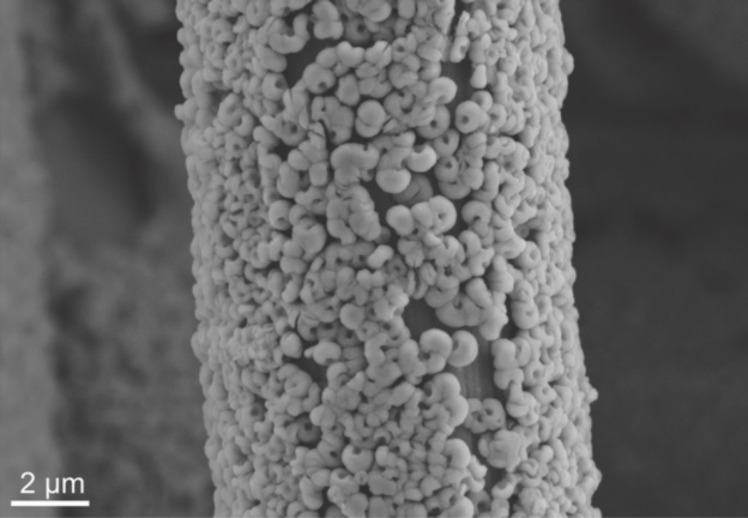
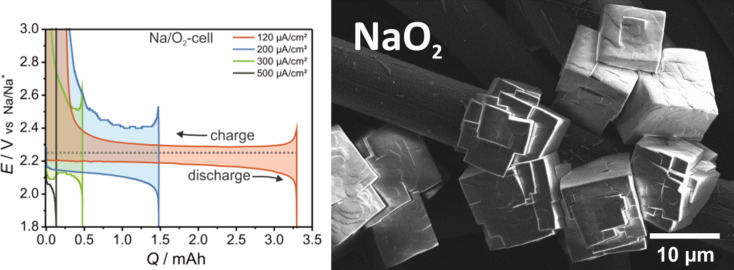
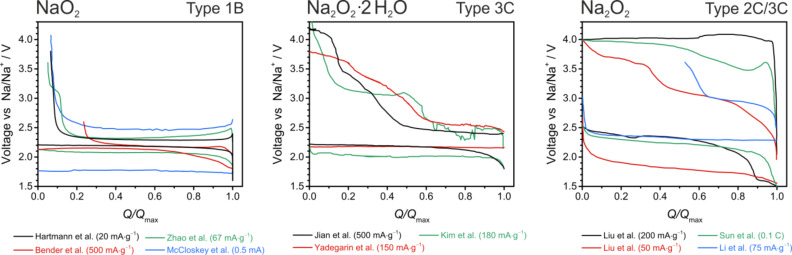
![Figure 11 Discharge/charge curves (Type 1B) of a sodium–oxygen battery with NaO2 as discharge product. The main differences compared to Li/O2 cells are that only small overpotentials are observed and that the crystallite size of the discharge product is much larger (see SEM image on the right) [109].](/paper-figures/68a977999d0d4508a47eab40e066c348/from-lithium-to-sodium-cell-chemistry-of-room-temperature-sodiumair-and-figure-11.jpg)
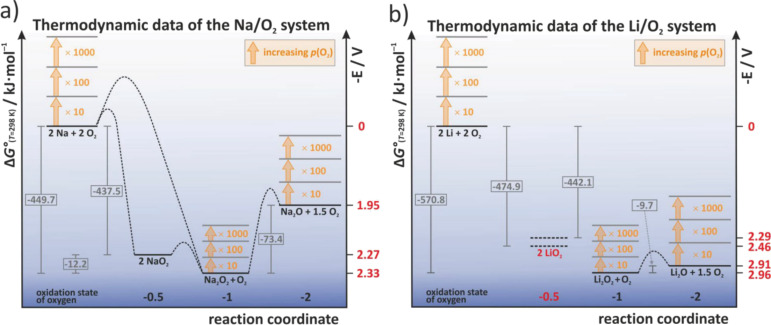
![Figure 12 The thermodynamic landscape of (a) sodium– and (b) lithium–oxygen cells. All values are calculated for the reaction 2A + 2O2 → A2Oy + (2–y/2)O2, where y = 1,2,4. Figure adapted with permission from [27], copyright 2014 Wiley-VCH.](/paper-figures/7387a86e3d6f45f78fe21b7c01938962/from-lithium-to-sodium-cell-chemistry-of-room-temperature-sodiumair-and-figure-12.jpg)
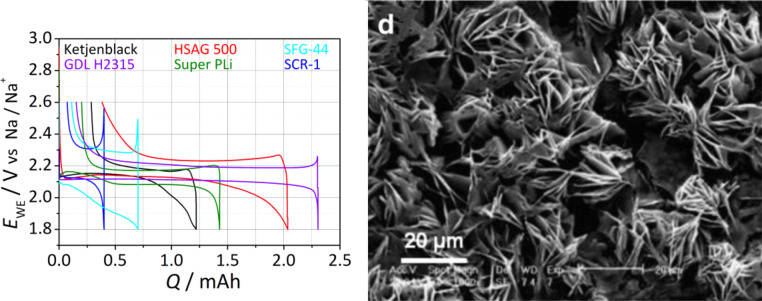
![Figure 13 Voltage hysteresis of different carbon materials for the cathode of a sodium oxygen cell (left), figure adapted with permission from [27], copyright 2014 Wiley-VCH. SEM image of the oxygen electrode of a Na/O2 cell after discharge with Na2O2 and Na2CO3 as discharge product (right), figure adapted with permission from [105], copyright 2014 Elsevier.](/paper-figures/b7f2870d57344e16a023846d027f517c/from-lithium-to-sodium-cell-chemistry-of-room-temperature-sodiumair-and-figure-13.jpg)
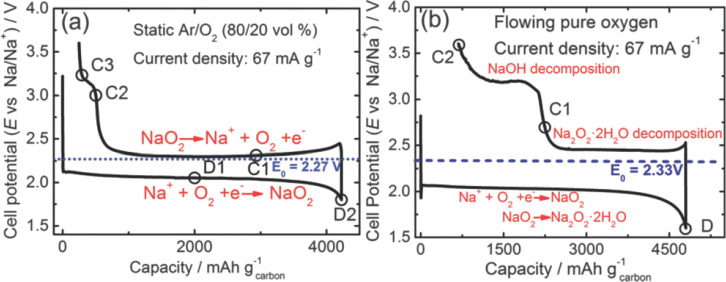
![Figure 14 Voltage profiles of Na/O2 cells under static gas atmosphere and flowing gas atmosphere (Type 1B/3B). Figure adapted with permission from [111], copyright 2014 The Royal Society of Chemistry.](/paper-figures/e39ca2de16d042df90a0ec4127b411f5/from-lithium-to-sodium-cell-chemistry-of-room-temperature-sodiumair-and-figure-14.jpg)

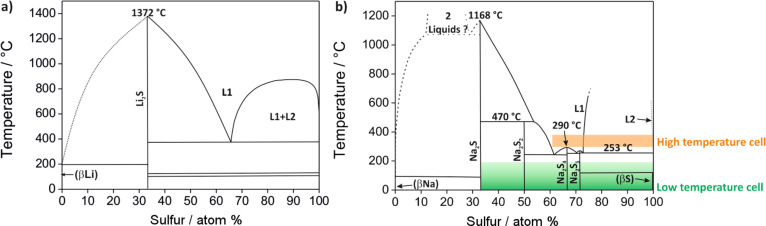
![Figure 16 (a) The Li–S phase diagram. (b) The Na–S phase diagram. Redrawn from references [129–130]. The Na–S phase diagram also depicts the operating window of the commercialized high temperature cell and alternative cell concepts operating at low temperature – including room temperature – that are on the research level.](/paper-figures/11034c6baf9c427dbf65268b651f64b7/from-lithium-to-sodium-cell-chemistry-of-room-temperature-sodiumair-and-figure-16.jpg)
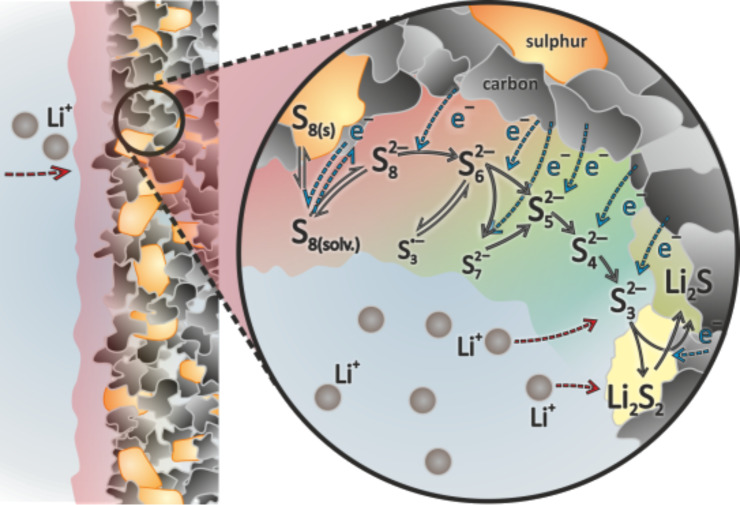
![Figure 17 Schematic illustration of the reduction processes at the negative electrode during discharge of a Li/S8 battery. Reduction of sulfur S8 proceeds over several soluble polysulfide intermediates (Li2Sx) before the final precipitation of solid phases, Li2S and eventually Li2S2 occurs. The cell discharge can be also followed by UV–vis spectroscopy, as different polysulfides give rise to different coloration. Illustration adapted from [124].](/paper-figures/6a184d636d874eed90f03c1d3291388c/from-lithium-to-sodium-cell-chemistry-of-room-temperature-sodiumair-and-figure-17.jpg)
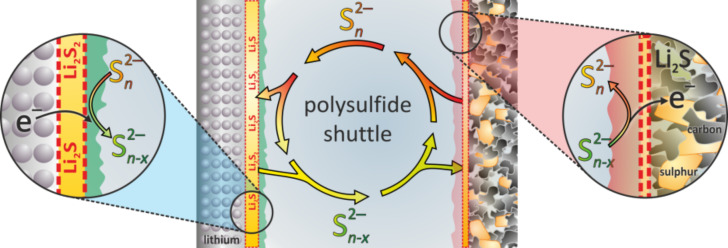
![Figure 18 Schematic illustration of the polysulfide shuttle mechanism after Mikhaylik and Akridge [123]. Long polysulfides diffuse towards the lithium electrode where they are reduced to shorter polysulfides. Subsequently, these shorter polysulfides diffuse back to the positive electrode where they are oxidized. As a result, a cyclic process (“shuttle mechanism”) develops that corresponds to a chemical shortcut of the cell. Illustration adapted from [124].](/paper-figures/212c3773e839409aa1fd6885236760b0/from-lithium-to-sodium-cell-chemistry-of-room-temperature-sodiumair-and-figure-18.jpg)

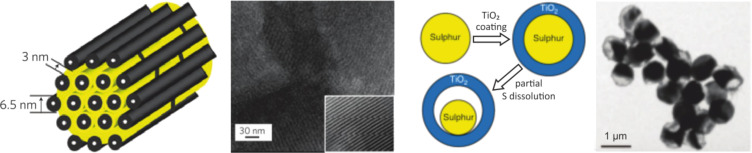
![Figure 20 Schematic diagram of the interconnected pore structure of mesoporous CMK-3 impregnated with sulfur (left). TEM image of the impregnated and the pristine (small inset) CMK-3. Figure adapted with permission from [178], copyright 2009 Macmillan Publishers Ltd. Process of formation of S–TiO2 yolk–shell structures via core–shell formation and partial dissolution of sulfur (right) [180]. TEM image of the yolk–shell structure with nanoparticles of 800 nm size and shell thickness of 15 nm. Figure adapted with permission from [180], copyright 2013 Macmillan Publishers Ltd.](/paper-figures/ef78b92cd45c4d4eaa82a8e76168e6ed/from-lithium-to-sodium-cell-chemistry-of-room-temperature-sodiumair-and-figure-20.jpg)
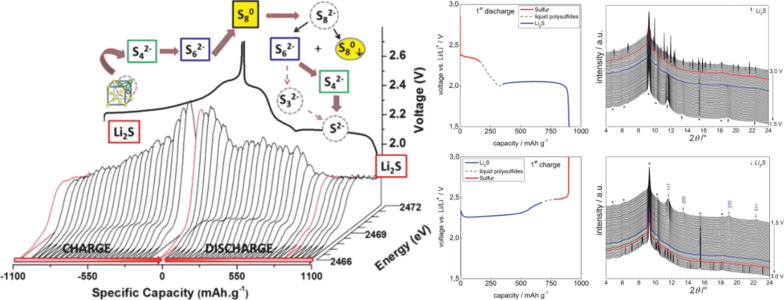
![Figure 21 Operando X-ray absorption near-edge spectroscopy (XANES) measurements (left) during first charge and second discharge at 10C rate. The sulfur species denoted on top represent the proposed charge and discharge mechanism based on the measurements. Figure adapted with permission from [241], copyright 2013 American Chemical Society. In situ XRD patterns (right) during discharge and charge at 20C rate with corresponding voltage profiles (left). The * indicates packaging contribution to the patterns, red and blue lines indicate crystalline phases of sulfur and Li2S, respectively. Figure adapted with permission from [127], copyright 2013 The Royal Society of Chemistry.](/paper-figures/1924dce3a347459caff2086b9ac4f3bd/from-lithium-to-sodium-cell-chemistry-of-room-temperature-sodiumair-and-figure-21.jpg)
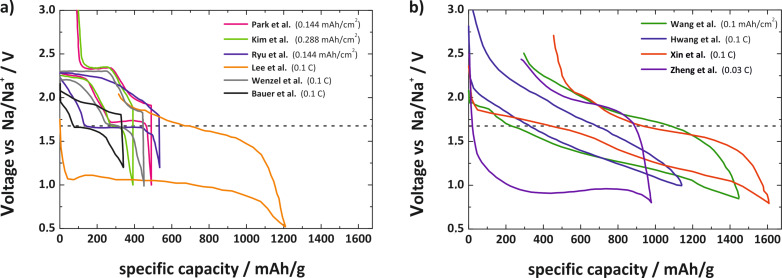
![Figure 22 Literature timeline of research papers on room temperature Na/S8 batteries (ranked after date of acceptance). Experimental studies: all journal publications in which full discharge–charge capacity profiles were shown for at least one complete cycle. The paper by Yu et al. [253] describes a related concept based on a catholyte.](/paper-figures/f9f646449ee949e8a4babe29599d4bb8/from-lithium-to-sodium-cell-chemistry-of-room-temperature-sodiumair-and-figure-22.jpg)
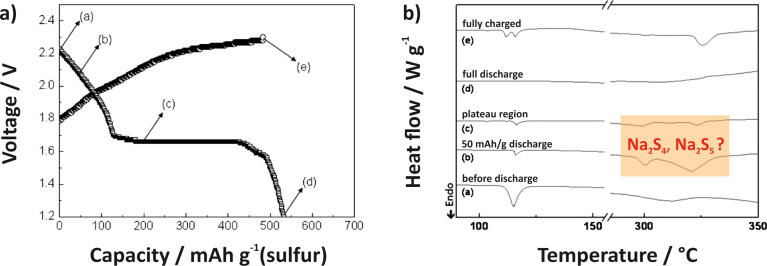
![Figure 23 (a) First discharge–charge curve of a Na/S8 battery with liquid electrolyte at room temperature and analysis points of sulfur electrode such as (a) pristine, (b) discharged to 50 mAh/g sulfur in sloping region, (c) discharged to 200 mAh/g sulfur in plateau region, (d) fully discharged to 1.2 V and (e) fully charged to 2.3 V. (b) DSC curves of the sulfur electrode with various cut-off voltage conditions as shown in (a). Figure adapted with permission from [257], copyright 2011 Elsevier.](/paper-figures/7b6007eefe5d477eb6b518781b1843ce/from-lithium-to-sodium-cell-chemistry-of-room-temperature-sodiumair-and-figure-23.jpg)
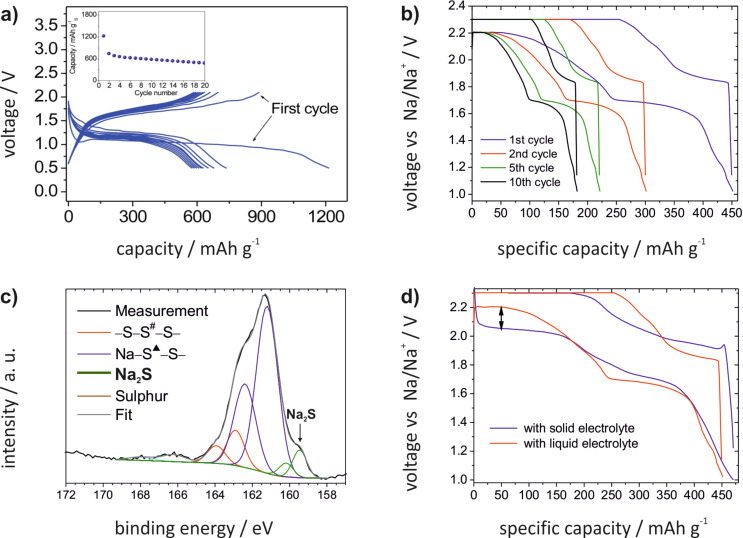
![Figure 24 (a) Voltage profiles a of Na/S8 cells with a TEGDME-based electrolyte and a nanostructured carbon/sulfur composite as cathode. Figure adapted with permission from [258], copyright 2013 The Royal Society of Chemistry. (b) Voltage profiles of a Na/S8 cell with DOL:DME-based electrolyte and a cathode based on commercial materials. (c) XPS spectra of the sulfur electrode after discharge. (d) Comparison ov voltage profiles recorded at a rate of 10C for Na/S8 cells with or without solid electrolyte. Figure adapted with permission from [259], copyright 2013 Elsevier.](/paper-figures/c27647a851d646a49144e5731dcdc702/from-lithium-to-sodium-cell-chemistry-of-room-temperature-sodiumair-and-figure-24.jpg)
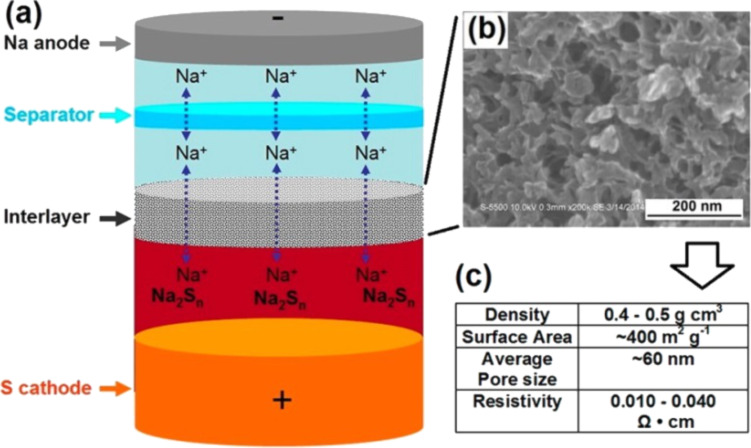
![Figure 25 Room temperature sodium–sulfur battery based on shallow cycling between sulfur and soluble long chain polysulfides. An additional interlayer is used to reduce diffusion of polysulfides towards the sodium anode. Figure adapted with permission from [253], copyright 2014 American Chemical Society.](/paper-figures/568fa53ed6b5453585990a13560bda46/from-lithium-to-sodium-cell-chemistry-of-room-temperature-sodiumair-and-figure-25.jpg)

Verification
Claims the paper makes
The claims and statistics of this paper haven’t been checked yet.
Run the check — free, no account needed. It reads the open-access text and checks the sources it cites.
Claims other papers make about this one
Each is checked against this paper’s own text: does it say what the citing paper says it does?
In the citing paper
“The company BASF created a Sodium-air battery with an energy density of 4.5 kWh/L [106].”
From A Review on Electric Vehicles: Technologies and Challenges (2021) · cites this paper as [106]
Self-check
Percentages, sums and reported differences re-computed from the paper’s own numbers.
The self-check needs the paper’s full text.
Citations
Cites
Nonaqueous Liquid Electrolytes for Lithium-Based Rechargeable Batteries
Xu, K. (2004) · Chemical Reviews · doi:10.1021/cr030203g · Cited by 7,653
Challenges in the development of advanced Li-ion batteries: a review
Etacheri, V., Marom, R., Elazari, R., Salitra, G., & Aurbach, D. (2011) · Energy & Environmental Science · doi:10.1039/c1ee01598b · Cited by 6,776
A highly ordered nanostructured carbon–sulphur cathode for lithium–sulphur batteries
Ji, X., Lee, K. T., & Nazar, L. F. (2009) · Nature Materials · doi:10.1038/nmat2460 · Cited by 5,989
A lithium superionic conductor
Kamaya, N., Homma, K., Yamakawa, Y., Hirayama, M., Kanno, R., Yonemura, M., Kamiyama, T., Kato, Y., Hama, S., Kawamoto, K., et al. (2011) · Nature Materials · doi:10.1038/nmat3066 · Cited by 5,061
Rechargeable Lithium–Sulfur Batteries
Manthiram, A., Fu, Y., Chung, S., Zu, C., & Su, Y. (2014) · Chemical Reviews · doi:10.1021/cr500062v · Cited by 4,710
Slater, M. D., Kim, D., Lee, E., & Johnson, C. S. (2012) · Advanced Functional Materials · doi:10.1002/adfm.201200691 · Cited by 4,529
Na-ion batteries, recent advances and present challenges to become low cost energy storage systems
Palomares, V., Serras, P., Villaluenga, I., Hueso, K. B., Carretero‐González, J., & Rojo, T. (2012) · Energy & Environmental Science · doi:10.1039/c2ee02781j · Cited by 3,571
Kim, S., Seo, D., Ma, X., Ceder, G., & Kang, K. (2012) · Advanced Energy Materials · doi:10.1002/aenm.201200026 · Cited by 3,393
Room-temperature stationary sodium-ion batteries for large-scale electric energy storage
Pan, H., Hu, Y., & Chen, L. (2013) · Energy & Environmental Science · doi:10.1039/c3ee40847g · Cited by 3,326
Lithium–Sulfur Batteries: Electrochemistry, Materials, and Prospects
Yin, Y., Xin, S., Guo, Y., & Wan, L. (2013) · Angewandte Chemie International Edition · doi:10.1002/anie.201304762 · Cited by 2,720
Research works printed but not linked: 4
- Aetukuri, 2014, arXiv [Condensed Matter - Materials Sciences], 1406.3335
- Doughty, 2011, Linden’s Handbook of Batteries
- Greenwood, 1997, Chemistry of the Elements
- 10.1007/s10008-014-2427-x · DOI
Cited by
Sorted by citations
A Review on Electric Vehicles: Technologies and Challenges
Sanguesa, J. A., Torres-Sanz, V., Garrido, P., Martinez, F. J., & Marquez-Barja, J. M. (2021) · Smart Cities · doi:10.3390/smartcities4010022 · Cited by 1,367
Metadata
- Authors
- Adelhelm, P., Hartmann, P., Bender, C. L., Busche, M., Eufinger, C., & Janek, J.
- Affiliations
- Justus-Liebig-Universität Gießen (DE)
- Corresponding author
- Adelhelm, Philipp
- Venue
- Beilstein Journal of Nanotechnology
- Publisher
- Beilstein Institut
- Published
- 2015-04-23
- Volume
- 6
- Pages
- 1016-1055
- ISSN
- 2190-4286 (ISSN-L)
- PMC
- PMC4419580
- OpenAlex
- W2004683913
- Cited by
- 478
- References
- 255
- Citations by year
- 2026: 26 · 2025: 31 · 2024: 40 · 2023: 34 · 2022: 41 · 2021: 43 · 2020: 59 · 2019: 57 · 2018: 50 · 2017: 46 · 2016: 41 · 2015: 10
- FWCI
- 3.44
- Type
- journal article
- Language
- en
- Open access
- diamond
- doi.org
- Licence
- Locations
- Beilstein Journal of Nanotechnology (publishedVersion, cc-by)
- PubMed Central (publishedVersion, cc-by)
- Repository KITopen (Karlsruhe Institute of Technology) (publishedVersion, other-oa)
- PubMed (publishedVersion)
- DOAJ (DOAJ: Directory of Open Access Journals) (submittedVersion, cc-by-sa)
- KITopen (other-oa)
- Topics
- Physical Sciences › Engineering › Electrical and Electronic Engineering › Advanced Battery Materials and Technologies
- Physical Sciences › Engineering › Electrical and Electronic Engineering › Advancements in Battery Materials
- Physical Sciences › Materials Science › Materials Chemistry › Thermal Expansion and Ionic Conductivity
- Keywords
- sodium-sulfur batteries, sodium-oxygen batteries, lithium-sulfur batteries, lithium-oxygen batteries, room-temperature batteries, cell chemistry, ion transport, phase stability, electrode potential, energy density, rechargeable batteries
About these checks
Registry, retraction, Cites and statistics results are computed, not judged, with one exception: a printed reference that no index lists is read once by a model before it counts as a citation error. Claims are extracted by a model and kept only when their quote appears verbatim in the text; each cited source is then checked, with a model’s help, for whether it says what the claim relies on. Those verdicts can be wrong — read the claim’s quote and the cited source before relying on one.
Statistics and arithmetic are recomputed, not judged.
Confidence bands are shown only for fields calibrated on our annotated test set. None is calibrated yet, so no band is shown.
What counts as a claim ›How we measure confidence ›How we check this ›
Are you an author, or do you see a problem with this page? Request a review