

The DOI matches its Crossref record; 74 of the 74 references it cites were found in a registry or an index.
Comparing Tip of the Red Giant Branch Distance Scales: An Independent Reduction of the Carnegie-Chicago Hubble Program and the Value of the Hubble Constant
Open accessAbstract
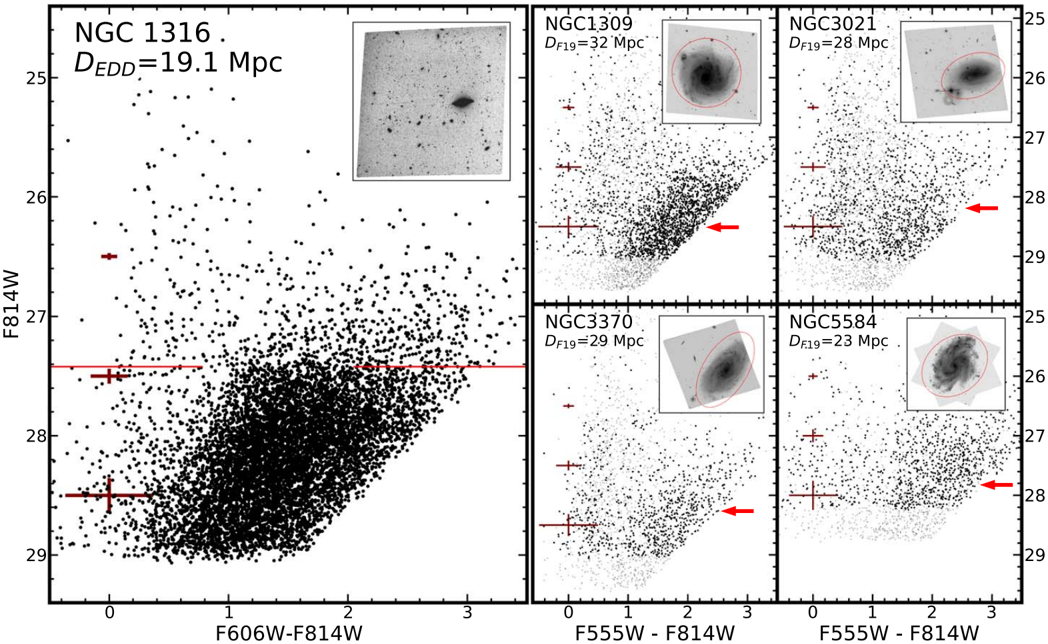
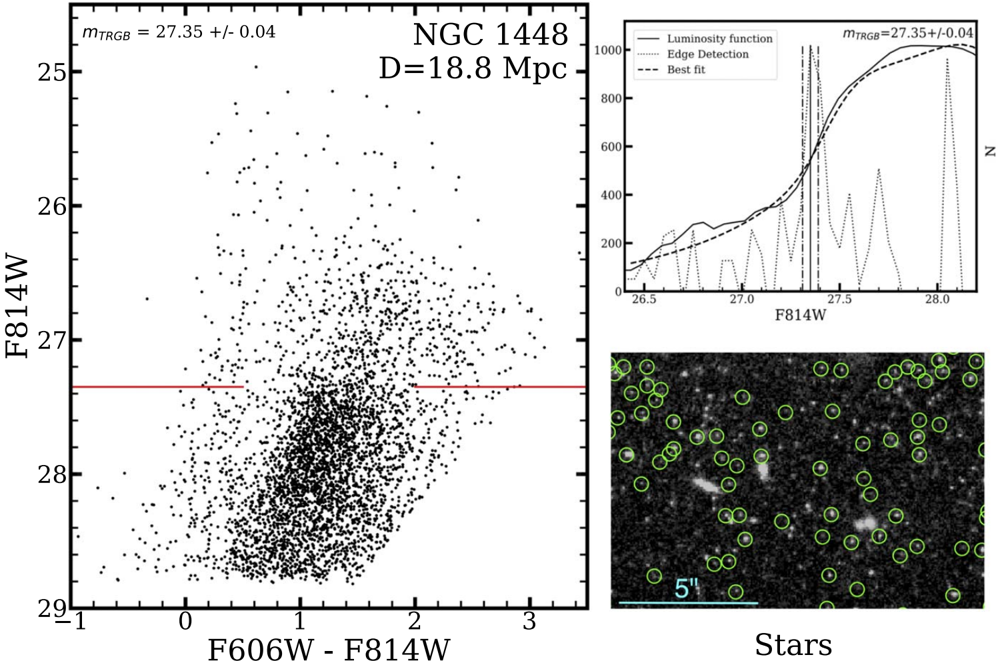
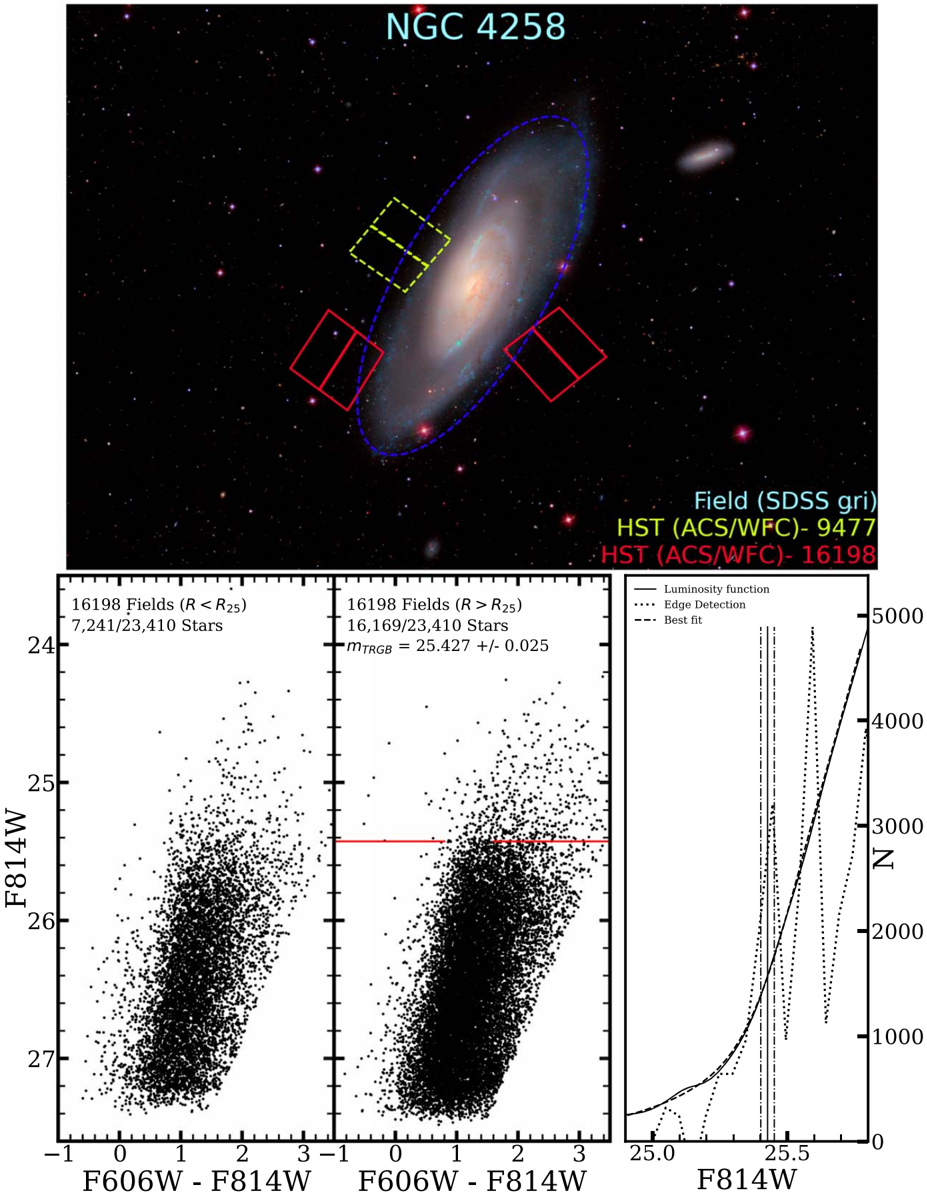
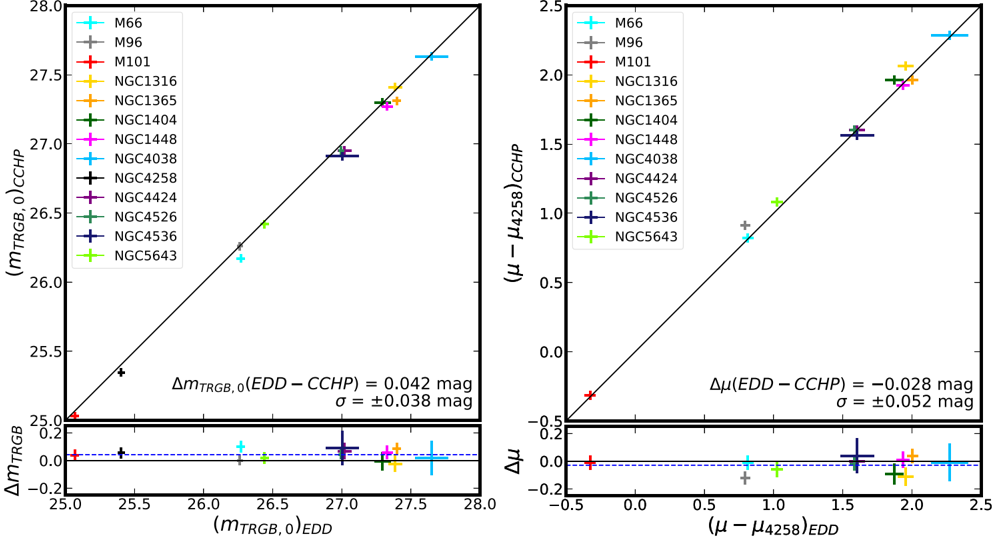
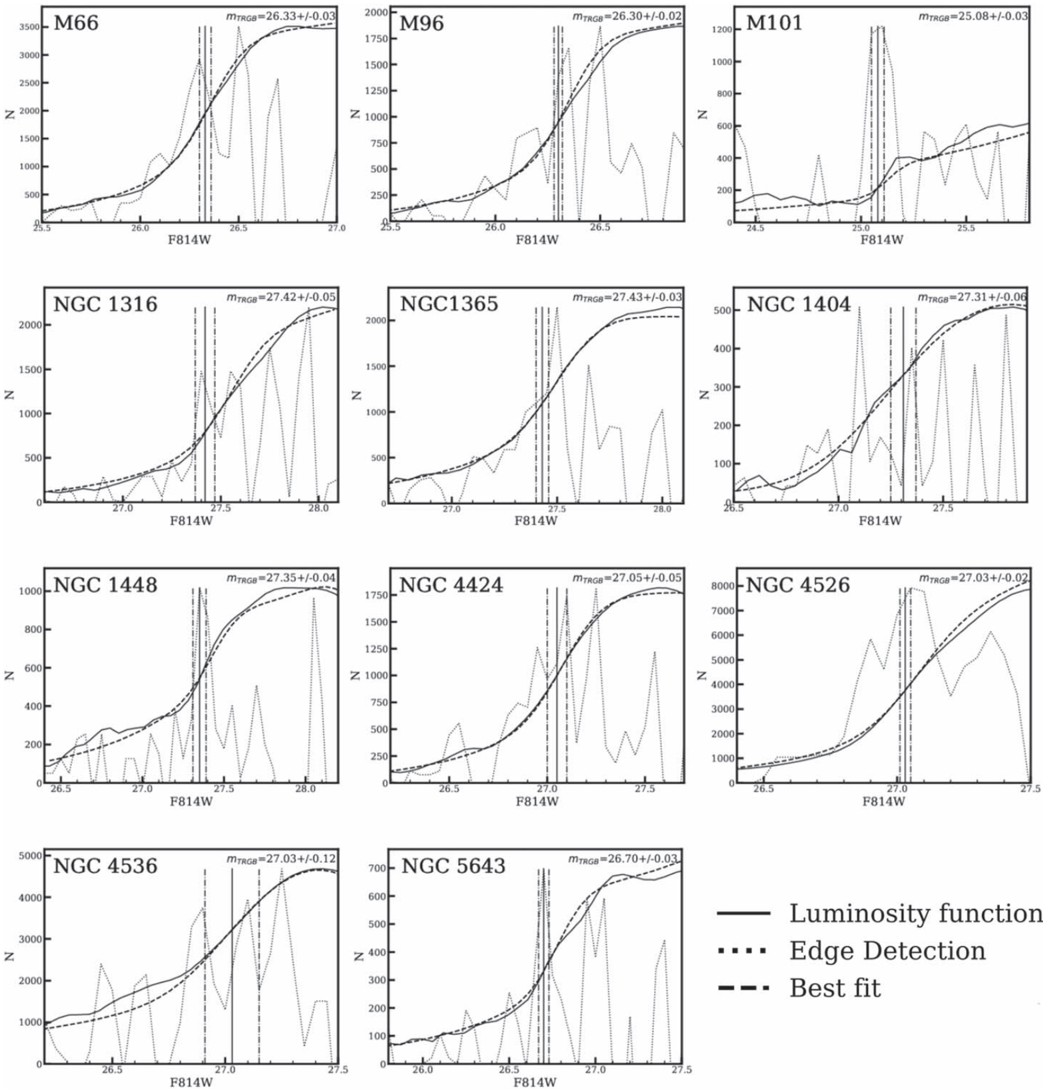
Abstract The tip of the red giant branch has been used to measure distances to 500 nearby galaxies with the Hubble Space Telescope (HST) which are available in the Color–Magnitude Diagrams and Tip of the Red Giant Branch (CMDs/TRGB) catalog on the Extragalactic Distance Database (EDD). Our established methods are employed to perform an independent reduction of the targets presented by the Carnegie-Chicago Hubble Program (CCHP) in the series of papers culminating in Freedman (2021). Our distinct methodology involves modeling the observed luminosity function of red giant branch and asymptotic giant branch stars, which differs from the edge-detection algorithms employed by the CCHP. We find excellent agreement between distances for 11 hosts with new imaging, all at D < 20 Mpc. However, we are unable to measure the TRGB for four hosts that use archival data designed to measure distances with Cepheids, all at D > 23 Mpc. With two new HST observations taken in the halo of the megamaser host NGC 4258, the first with the same ACS F606W and F814W filters and state of the electronics used for SN Ia hosts, we then calibrate our TRGB distance scale to the geometric megamaser distance. Using our TRGB distances, we find a value of the Hubble Constant of H 0 = 71.5 ± 1.8 km s−1 Mpc−1 when using either the Pantheon or Carnegie Supernova Project (CSP) samples of supernovae. In the future, the James Webb Space Telescope will extend measurements of the TRGB to additional hosts of SN Ia and surface-brightness fluctuation measurements for separate paths to H 0.
Overview
The claims and statistics of this paper haven’t been checked yet.
Run the check — free, no account needed. It reads the open-access text and checks the sources it cites.
Integrity signals
Registry
Cites
Statistics
Figures
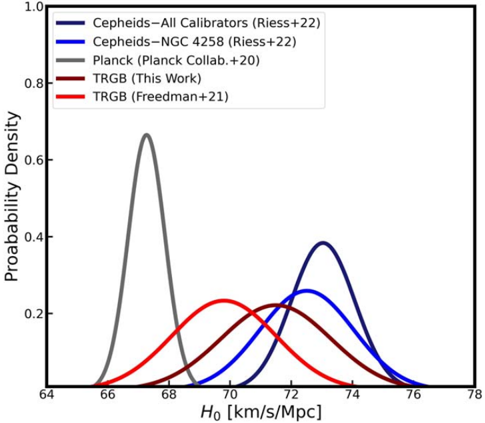
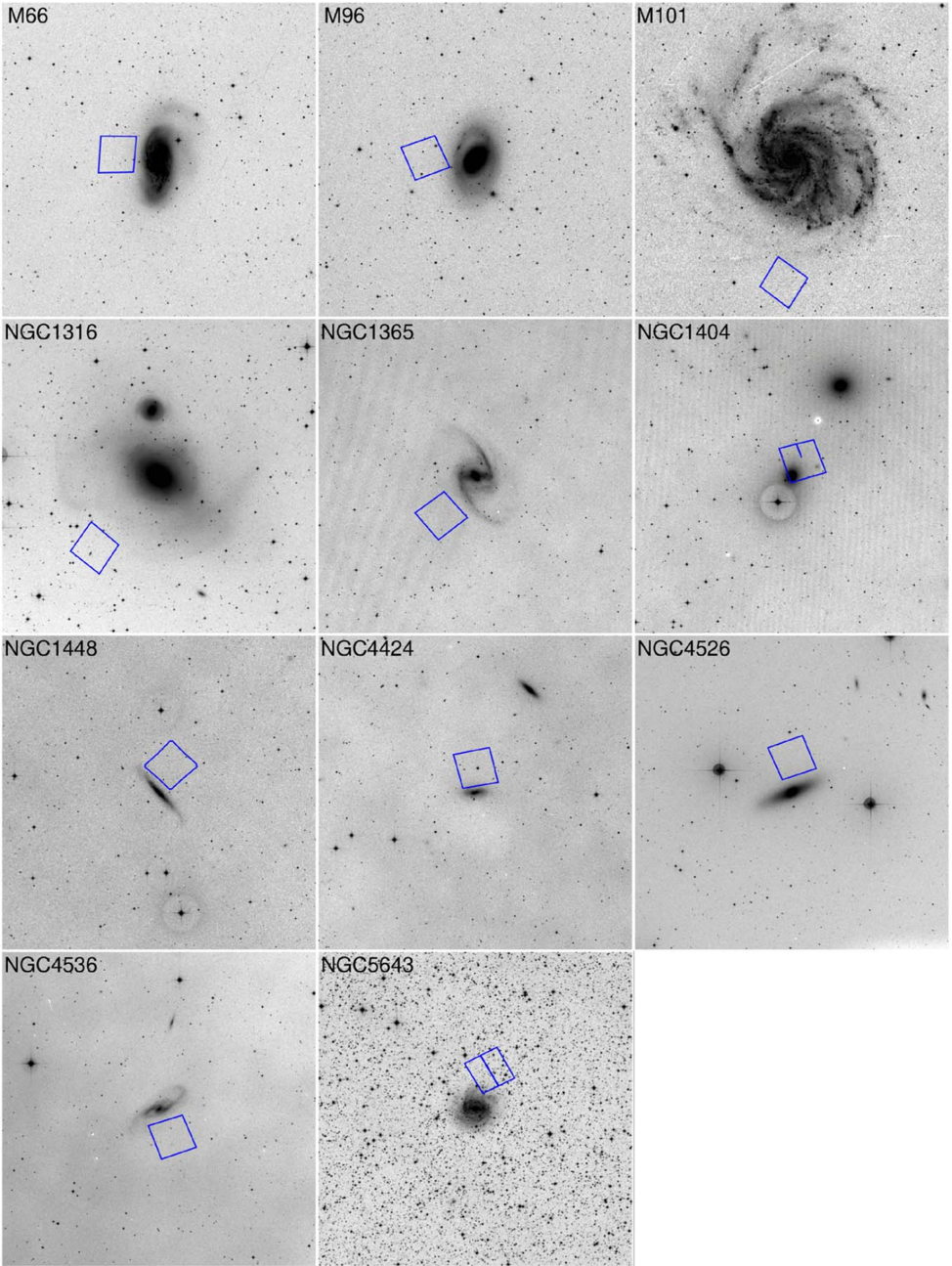
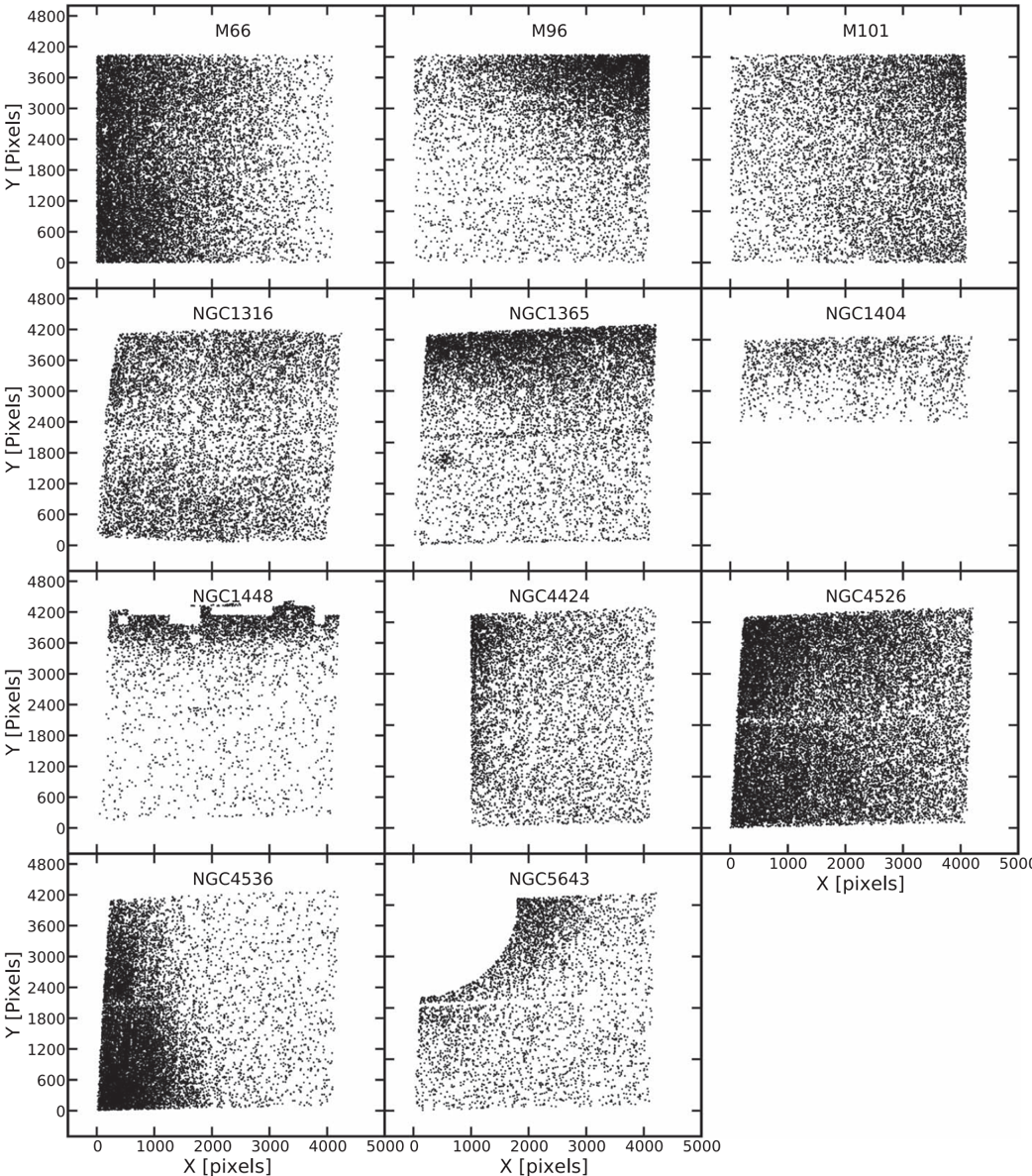
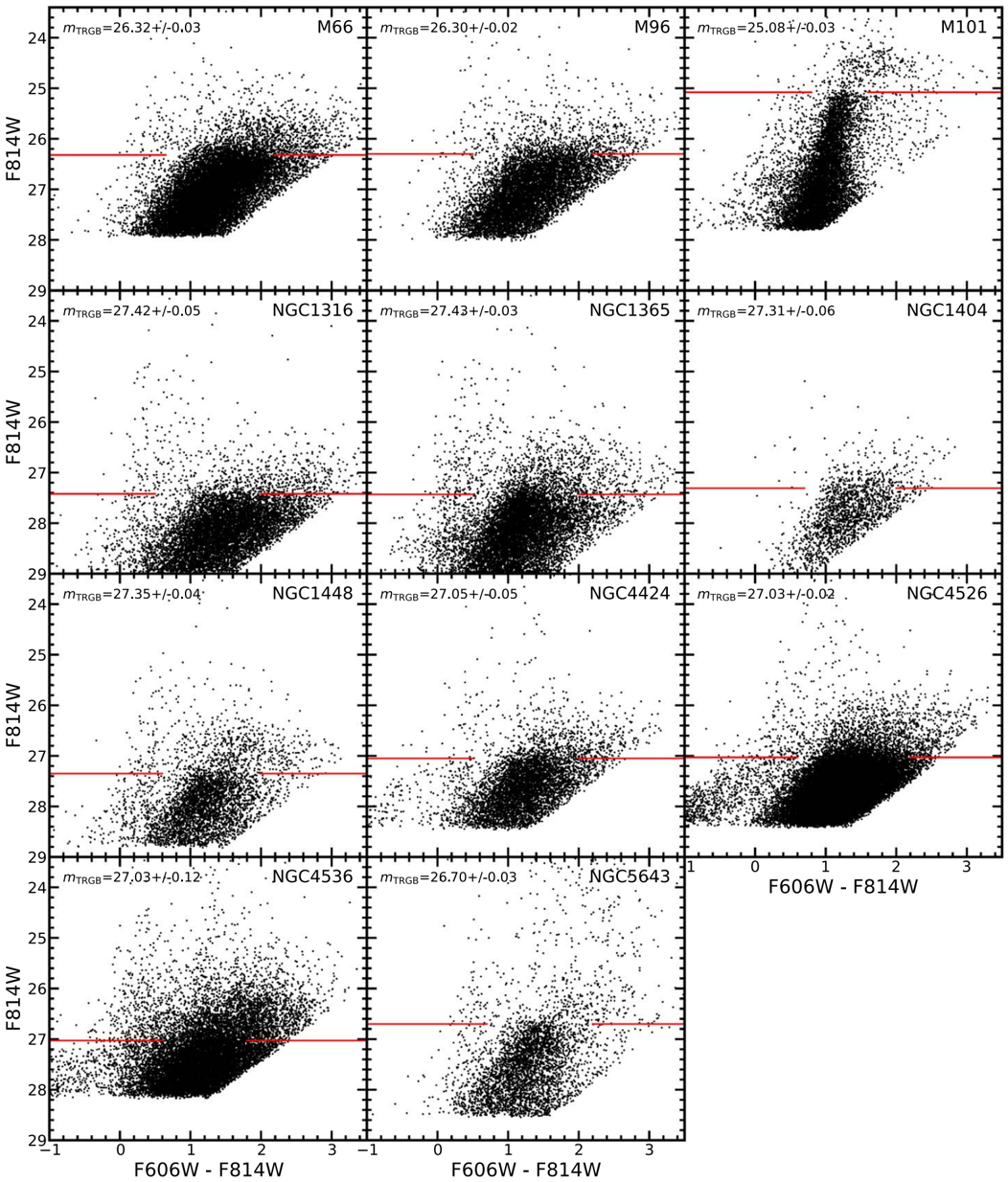
Verification
Claims the paper makes
The claims and statistics of this paper haven’t been checked yet.
Run the check — free, no account needed. It reads the open-access text and checks the sources it cites.
Claims other papers make about this one
Each is checked against this paper’s own text: does it say what the citing paper says it does?
The cited source says what the claim attributes to it.
In the citing paper
“the new independent reanalysis of the targets presented by the Carnegie-Chicago Hubble Program (CCHP) performed in [36] that is shifted more in agreement with the SH0ES value.”
From Challenges of the Standard Cosmological Model (2022) · cites this paper as [36]
Self-check
Percentages, sums and reported differences re-computed from the paper’s own numbers.
The self-check needs the paper’s full text.
Citations
Cites
Planck 2018 results: VI. Cosmological parameters
Planck Collaboration, Aghanim, N., Akrami, Y., Ashdown, M., Aumont, J., Baccigalupi, C., Ballardini, M., Banday, A. J., Barreiro, R. B., Bartolo, N., et al. (2020) · Astronomy & Astrophysics · doi:10.1051/0004-6361/201833910 · Cited by 14,258
The Sloan Digital Sky Survey: Technical Summary
York, D., Adelman, J., Anderson, J., Anderson, S., Annis, J., Bahcall, N., Bakken, J., Barkhouser, R., Bastian, S., Berman, E., et al. (2000) · The Astronomical Journal · doi:10.1086/301513 · Cited by 8,368
MEASURING REDDENING WITH SLOAN DIGITAL SKY SURVEY STELLAR SPECTRA AND RECALIBRATING SFD
Schlafly, E., & Finkbeiner, D. (2010) · The Astrophysical Journal · doi:10.1088/0004-637x/737/2/103 · Cited by 3,969
DAOPHOT: A COMPUTER PROGRAM FOR CROWDED-FIELD STELLAR PHOTOMETRY
Stetson, P. (1987) · Publications of the Astronomical Society of the Pacific · doi:10.1086/131977 · Cited by 3,909
Scolnic, D. M., Jones, D. O., Rest, A., Pan, Y. C., Chornock, R., Foley, R. J., Huber, M. E., Kessler, R., Narayan, G., Riess, A. G., et al. (2018) · The Astrophysical Journal · doi:10.3847/1538-4357/aab9bb · Cited by 2,700
Self-citationRiess, A. G., Yuan, W., Macri, L. M., Scolnic, D., Brout, D., Casertano, S., Jones, D. O., Murakami, Y., Anand, G. S., Breuval, L., et al. (2022) · The Astrophysical Journal Letters · doi:10.3847/2041-8213/ac5c5b · Cited by 2,380
Self-citationA 2.4% DETERMINATION OF THE LOCAL VALUE OF THE HUBBLE CONSTANT *
Riess, A. G., Macri, L. M., Hoffmann, S. L., Scolnic, D., Casertano, S., Filippenko, A. V., Tucker, B. E., Reid, M. J., Jones, D. O., Silverman, J. M., et al. (2016) · The Astrophysical Journal · doi:10.3847/0004-637x/826/1/56 · Cited by 2,250
Self-citationIn the realm of the Hubble tension—a review of solutions *
Di Valentino, E., Mena, O., Pan, S., Visinelli, L., Yang, W., Melchiorri, A., Mota, D. F., Riess, A. G., & Silk, J. (2021) · Classical and Quantum Gravity · doi:10.1088/1361-6382/ac086d · Cited by 2,065
Self-citationA 2.4% Determination of the Local Value of the Hubble Constant
Riess, A. G., Macri, L. M., Hoffmann, S., et al. (2016) · OakTrust (Texas A&M University Libraries) · doi:10.48550/arxiv.1604.01424 · Cited by 1,691
Self-citationWFPC2 Stellar Photometry with HSTphot
Dolphin, A. E. (2000) · Publications of the Astronomical Society of the Pacific · doi:10.1086/316630 · Cited by 1,012
Cited by
Sorted by citations
Items 101–109 of 109
The impact of systematic effects on the cosmic distance ladder
Petreca, A. T. (2024) · doi:10.11606/d.43.2024.tde-29022024-122517 · Cited by 1
Early Galaxy Formation and the Hubble Constant Tension
McGaugh, S. (2023) · doi:10.59350/tcypx-cjr90
Li, S., & Beaton, R. L. (2024) · Springer Series in Astrophysics and Cosmology · doi:10.1007/978-981-99-0177-7_8
Machine learning the tip of the red giant branch
Dennis, M. T., & Sakstein, J. (2025) · Physical review. D/Physical review. D. · doi:10.1103/n2sv-9mpd
Smith, M. L., Alsakka, A., & Öztaş, A. M. (2025) · IntechOpen eBooks · doi:10.5772/intechopen.1012636
Grupa, J., Taubenberger, S., Suyu, S. H., Sluse, D., Huber, S., & Vogl, C. (2026) · Astronomy and Astrophysics · doi:10.1051/0004-6361/202555795
Distance-ladder Measurements of the Hubble Constant: Recent Progress, Systematics, and Prospect
Chen, X., & Wang, S. M. (2026) · Research in Astronomy and Astrophysics · doi:10.1088/1674-4527/ae842e
Metadata
- Authors
- Anand, G. S., Tully, R. B., Rizzi, L., Riess, A. G., & Yuan, W.
- Affiliations
- University of Hawaiʻi at Mānoa (US)
- W.M. Keck Observatory (US)
- Space Telescope Science Institute (US)
- Johns Hopkins University (US)
- Corresponding author
- Anand, Gagandeep S.
- Venue
- The Astrophysical Journal
- Publisher
- American Astronomical Society
- Published
- 2022-06-01
- Volume
- 932
- Issue
- 1
- Pages
- 15
- ISSN
- 0004-637X (ISSN-L)
- 1538-4357
- OpenAlex
- W3187894162
- Cited by
- 109
- References
- 72
- Citations by year
- 2026: 16 · 2025: 23 · 2024: 27 · 2023: 22 · 2022: 18
- FWCI
- 9.00
- Type
- journal article
- Language
- en
- Open access
- gold
- doi.org
- Licence
- Locations
- The Astrophysical Journal (publishedVersion, cc-by)
- arXiv (Cornell University) (submittedVersion)
- arXiv (Cornell University)
- Funders
- HST (SNAP-15922)
- Topics
- Physical Sciences › Physics and Astronomy › Astronomy and Astrophysics › Cosmology and Gravitation Theories
- Physical Sciences › Physics and Astronomy › Astronomy and Astrophysics › Stellar, planetary, and galactic studies
- Physical Sciences › Physics and Astronomy › Astronomy and Astrophysics › Galaxies: Formation, Evolution, Phenomena
- Keywords
- tip of the red giant branch, Hubble constant, asymptotic giant branch stars, Type Ia supernovae, Pantheon sample, Carnegie Supernova Project, surface brightness fluctuations, Hubble Space Telescope imaging
About these checks
Registry, retraction, Cites and statistics results are computed, not judged, with one exception: a printed reference that no index lists is read once by a model before it counts as a citation error. Claims are extracted by a model and kept only when their quote appears verbatim in the text; each cited source is then checked, with a model’s help, for whether it says what the claim relies on. Those verdicts can be wrong — read the claim’s quote and the cited source before relying on one.
Statistics and arithmetic are recomputed, not judged.
Confidence bands are shown only for fields calibrated on our annotated test set. None is calibrated yet, so no band is shown.
What counts as a claim ›How we measure confidence ›How we check this ›
Are you an author, or do you see a problem with this page? Request a review
