

Overview of the JWST Advanced Deep Extragalactic Survey (JADES)
Open accessThe DOI matches its Crossref record; 147 of the 147 references it cites were found in a registry or an index; none of the 83 sources its claims cite is checked for support yet.
Abstract
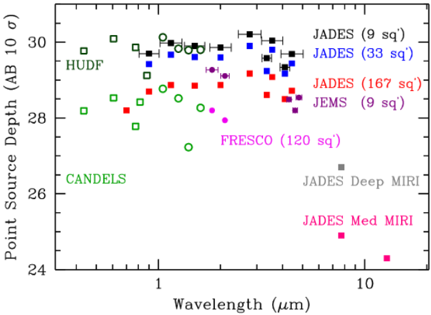
We present an overview of the James Webb Space Telescope (JWST) Advanced Deep Extragalactic Survey (JADES), an ambitious program of infrared imaging and spectroscopy in the GOODS-S and GOODS-N deep fields, designed to study galaxy evolution from high redshift to cosmic noon. JADES uses about 770 hr of Cycle 1 guaranteed time largely from the Near-Infrared Camera (NIRCam) and Near-Infrared Spectrograph (NIRSpec) instrument teams. In GOODS-S, in and around the Hubble Ultra Deep Field and Chandra Deep Field South, JADES produces a deep imaging region of ∼42 arcmin 2 with over 100 hr of exposure time spread over nine NIRCam filters, including two medium-band filters. This is extended at medium depth in GOODS-S and GOODS-N with NIRCam imaging of ∼167 arcmin 2 , averaging 25 hr of exposure over 8–10 filters. In both fields, we conduct extensive NIRSpec multiobject spectroscopy, including two deep pointings of 55 hr exposure time, 14 medium pointings of ∼12 hr, and 15 shallower pointings of ∼4 hr, targeting over 5000 Hubble Space Telescope– and JWST-detected faint sources with five low-, medium-, and high-resolution dispersers covering 0.6–5.3 μ m. Finally, JADES extends redward via coordinated parallels with the JWST Mid-Infrared Instrument, featuring ∼10 arcmin 2 with 43 hr of exposure at 7.7 μ m and thrice that area with 1.4–6.8 hr of exposure at 12.8 and 15 μ m. For nearly 30 yr, the GOODS-S and GOODS-N fields have been developed as the premier deep fields on the sky; JADES is now providing a compelling start on JWST's legacy in these fields.
Overview
CoChat Summary
TL;DR
JADES is a JWST Cycle 1 GTO survey in GOODS-S and GOODS-N using about 770 hr plus coordinated parallels to combine deep NIRCam imaging, NIRSpec multiobject spectroscopy, and MIRI parallels. It is designed to study galaxy evolution from high redshift to cosmic noon and has already spectroscopically confirmed galaxies at z > 10.
Key findings
- JADES is described as the largest program operating in JWST Cycle 1, with roughly 770 hr of guaranteed time split between NIRCam and NIRSpec GTO and a supplementary MIRI-US contribution.
- NIRCam imaging includes a GOODS-S Deep region of ∼42 arcmin² with over 100 hr exposure over nine filters including two medium-band filters, plus Medium imaging of ∼167 arcmin² averaging 25 hr over 8–10 filters. The conclusions report 545 open-shutter hr of dual-band NIRCam imaging and 240 open-shutter hr of MIRI imaging covering about 210 arcmin² in 12 distinct bands.
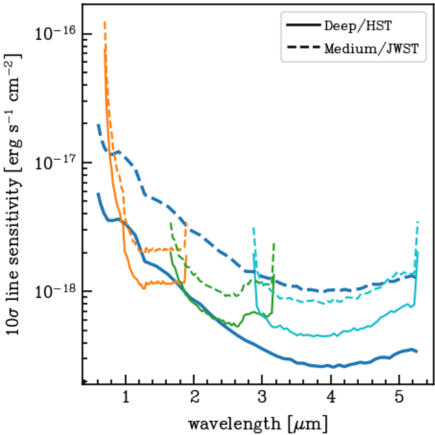
- NIRSpec MOS targets over 5000 HST- and JWST-detected faint sources with two deep 55 hr pointings, 14 medium pointings of ∼12 hr, and 15 shallower pointings of ∼4 hr, using five low-, medium-, and high-resolution dispersers covering 0.6–5.3 μm; the conclusions report 339 open-shutter hr of NIRSpec MOS.
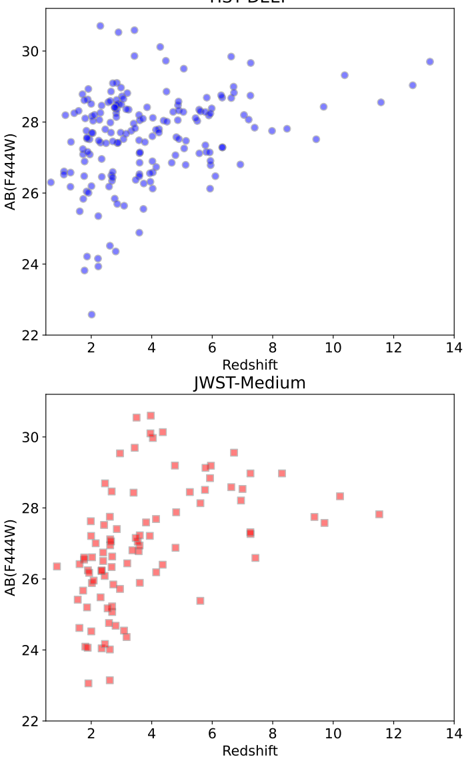
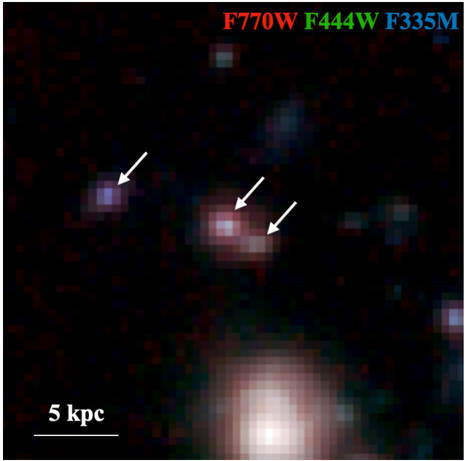
- MIRI parallels provide ∼10 arcmin² with 43 hr at 7.7 μm and thrice that area with 1.4–6.8 hr at 12.8 and 15 μm; the deep MIRI F770W 10σ point-source sensitivity is 27.5 AB. Deep/HST NIRSpec confirmed two galaxies at z = 12.6 and 13.2.
Methods
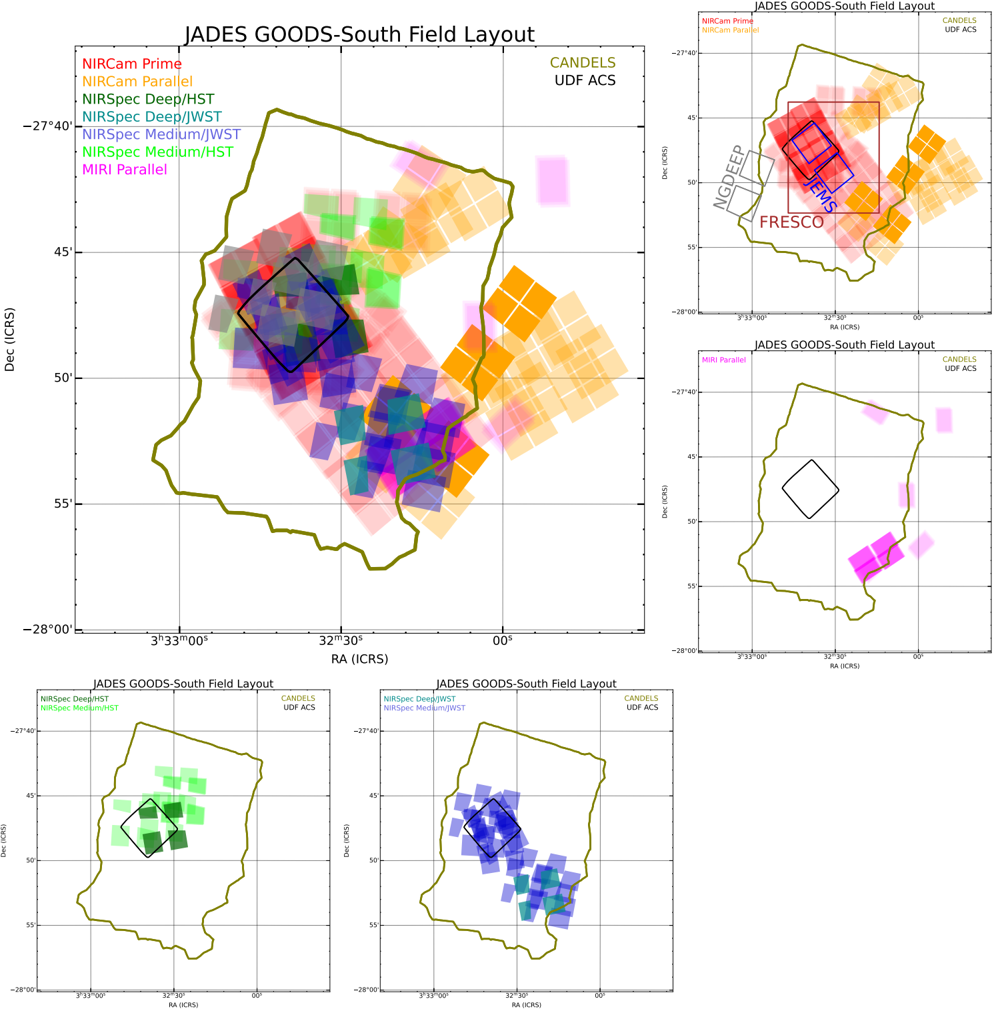
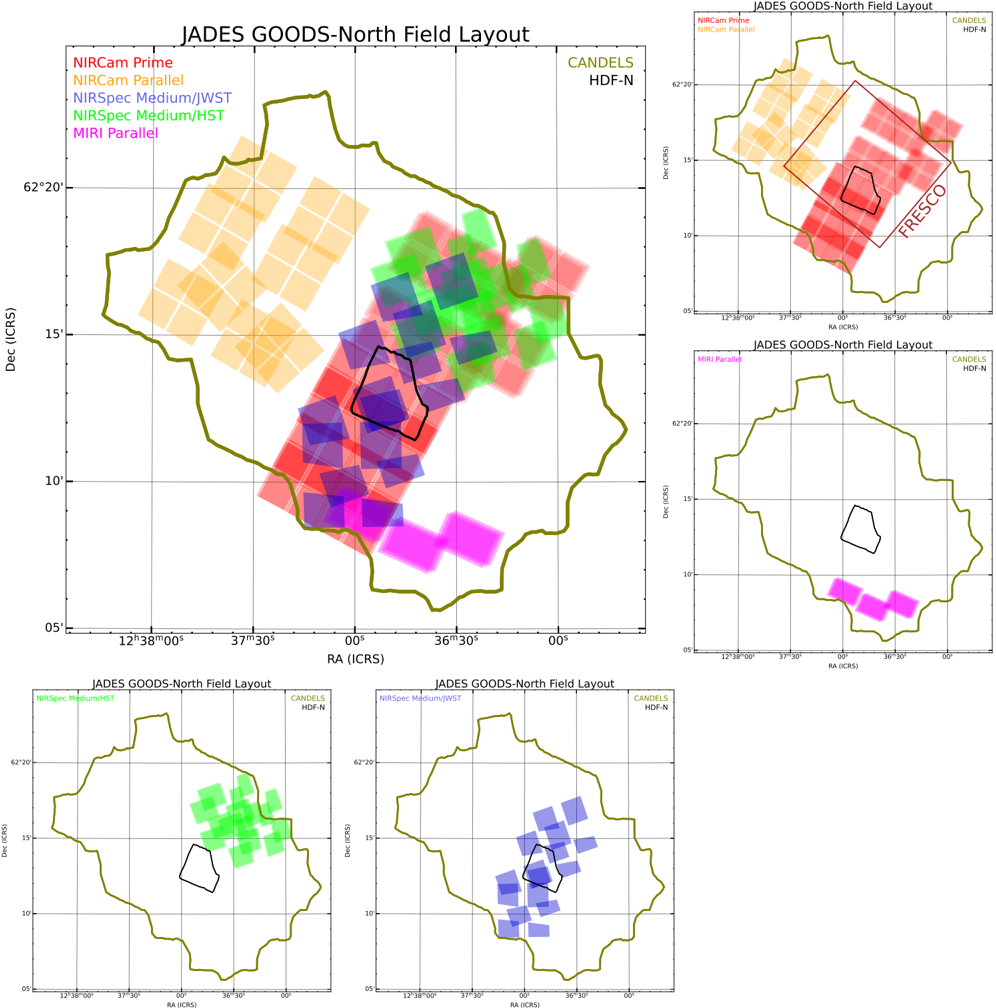
- Design: a two-layer “wedding cake” survey in GOODS-S and GOODS-N, with NIRCam Deep Prime, Medium Prime, Deep Parallel, and Medium Parallel imaging; NIRSpec MOS tiers Deep/HST, Deep/JWST, Medium/HST, and Medium/JWST; and MIRI Deep and Medium parallels.
- Sample and targeting: NIRSpec targets are selected from HST and/or JWST imaging and prioritized largely by redshift and flux. JADES typically supplies at least 200 targets per arcmin², yielding about 150 assigned targets on prism designs, an average assignment rate of only 9%.
- Analysis: this is an overview/descriptive paper of survey design and executed observations. Depths are estimated with the JWST Exposure Time Calculator and independently from blank-sky aperture variance; preparation used eMPT, JAGUAR simulations, and data challenges.
Limitations
- Stated in the paper: JADES was designed for one year but over-scheduling spread it over 18 months; instrument problems, guide-star failures, NIRSpec MSA shorts/glows, NIRCam persistence, wisps, and lost data affected parts of the program. The paper states NIRCam persistence effects on photometry have not yet been considered, and MIRI had minor background-subtraction, dither-step, and astrometry issues.
- Stated in the paper: NIRCam Deep Parallel dithering is set by the NIRSpec MSA and not tuned to the NIRCam pixel scale, and the SW chip gaps are not filled; Medium Parallel also does not cover SW chip gaps, and some targets can only be placed on one or two subpointings.
- Evident from the text: this overview does not present final science results or full data-release analyses, and many data-quality caveats remain to be modeled or mitigated. The paper also notes that two fields mitigate but do not eliminate cosmic-variance concerns, since even more fields would better address them.
Model-written summary. Check it against the paper before relying on it.
Integrity signals
Registry
Cites
Statistics
Figures
Verification
Claims the paper makes
0 Valid · 17 Not valid · 43 Not checked · 144 Own results and interpretations
A result the paper reports from its own data — it cites no other source for it, so there is none to check. The quote shows it is in the paper.
In the paper
“At about 770 hr of observing time plus coordinated parallels, JADES is the largest program operating in JWST Cycle 1”
§ Overview of the JWST Advanced Deep Extragalactic Survey (JADES) > 1. Introduction
plain- Asserted: passes — The authors put it forward as true.
- Checkable: passes — It can be checked against evidence.
- Load-bearing: unclear — It is unclear whether the paper’s conclusions depend on it.
- Based: passes — The paper gives a reason why it holds.
A result the paper reports from its own data — it cites no other source for it, so there is none to check. The quote shows it is in the paper.
In the paper
“Of course, these regions do also incur persistence from brighter sources in our own observations.”
- Also stated in: § 4.6. Data Quality Caveats · plain
“For instance, in 1181 observation 2, there is a bright star in the bad portion of A3 that creates a recurrent glow in all six dither locations.”
- Also stated in: § 4.6. Data Quality Caveats · plain
“And 1286 observation 8 contains the persistent glow of a bright star in observation 6.”
§ Overview of the JWST Advanced Deep Extragalactic Survey (JADES) > 4.6. Data Quality Caveats
plainstates a cause- Asserted: passes — The authors put it forward as true.
- Checkable: passes — It can be checked against evidence.
- Load-bearing: unclear — It is unclear whether the paper’s conclusions depend on it.
- Based: passes — The paper gives a reason why it holds.
- Also stated in: § 4.6. Data Quality Caveats · plain
A result the paper states — it cites no source for it, so there is none to check. The quote shows it is in the paper.
In the paper
“Between these two, we note that F182M and F210M are available for a notable portion of JADES.”
§ Overview of the JWST Advanced Deep Extragalactic Survey (JADES) > 3.4. Other Overlapping JWST Data
plain- Asserted: passes — The authors put it forward as true.
- Checkable: passes — It can be checked against evidence.
- Load-bearing: unclear — It is unclear whether the paper’s conclusions depend on it.
- Based: passes — The paper gives a reason why it holds.
None of the sources cited for this claim have been checked yet.
In the paper
“JADES includes mediumband filters in the NIRCam long-wave channel that can help identify and distinguish high-z candidates from dusty, strong emission-line sources at lower redshifts”
§ Overview of the JWST Advanced Deep Extragalactic Survey (JADES) > 2.1. Motivations
What the sources say
- Not checked yetcites P. Arrabal Haro et al. 2023 matched to “Confirmation and refutation of very luminous galaxies in the early Universe” (2023) source
- Not checked yetcites S. Fujimoto et al. 2023
- Not checked yetcites J. A. Zavala et al. 2023
plainstates a possible cause- Asserted: passes — The authors put it forward as true.
- Checkable: passes — It can be checked against evidence.
- Load-bearing: passes — The paper’s conclusions depend on it.
- Based: passes — The paper gives a reason why it holds.
A result the paper states — it cites no source for it, so there is none to check. The quote shows it is in the paper.
In the paper
“our program is providing large training samples for the photometric redshift methods that supply redshifts for the rest of the imaging sample.”
§ Overview of the JWST Advanced Deep Extragalactic Survey (JADES) > 2.2. Opportunities of a Combined Imaging and Spectroscopy Program
plainstates a cause- Asserted: passes — The authors put it forward as true.
- Checkable: passes — It can be checked against evidence.
- Load-bearing: passes — The paper’s conclusions depend on it.
- Based: passes — The paper gives a reason why it holds.
52 more claims
Create a free account to see all 204 claims and to verify the 83 references still open.
- Probably not a substantial claim. 66
- It may state two separate claims as one. 117
- The quote only partly states this claim. 1
Self-check
Percentages, sums and reported differences re-computed from the paper’s own numbers.
Each contradiction between two passages listed here was confirmed by an independent check.
Rated minor: it would not touch a result — a value no result rests on, a p-value that stays on the same side of the significance level, or a conflict that is clerical, resolved elsewhere in the paper, or outside its own findings.
In the paper
§ Overview of the JWST Advanced Deep Extragalactic Survey (JADES) > 4.5. Comments on Filter Selection
“We chose F182M and F300W as the most sensitive in each of these wide bands.”
§ Overview of the JWST Advanced Deep Extragalactic Survey (JADES) > 4.5. Comments on Filter Selection
“By adding F300M, F182M, and F162M, we provide a single medium-band filter in each of F277W, F200W, and F150W.”
Rated minor: it would not touch a result — a value no result rests on, a p-value that stays on the same side of the significance level, or a conflict that is clerical, resolved elsewhere in the paper, or outside its own findings.
In the paper
§ Overview of the JWST Advanced Deep Extragalactic Survey (JADES) > 5.6. NIRSpec Medium/HST Spectroscopy
“For a fifth target set (configuration 5, the first half of observation 26), the grating exposures are unaffected but the prism exposures were flooded by the short.”
§ Overview of the JWST Advanced Deep Extragalactic Survey (JADES) > 5.6. NIRSpec Medium/HST Spectroscopy
“These are MSA configurations 2, 4, 6, and 10, which are the second half of observations 25, 26, 27, and 29, respectively.”
Citations
Cites
Planck 2018 results: VI. Cosmological parameters
Planck Collaboration, Aghanim, N., Akrami, Y., Ashdown, M., Aumont, J., Baccigalupi, C., Ballardini, M., Banday, A. J., Barreiro, R. B., Bartolo, N., et al. (2020) · Astronomy & Astrophysics · doi:10.1051/0004-6361/201833910 · Cited by 14,258
Gaia Data Release 2: Summary of the contents and survey properties
Gaia Collaboration, Brown, A. G. A., Vallenari, A., Prusti, T., de Bruijne, J. H. J., Babusiaux, C., Bailer-Jones, C. A. L., Biermann, M., Evans, D. W., Eyer, L., et al. (2018) · Astronomy & Astrophysics · doi:10.1051/0004-6361/201833051 · Cited by 8,442
Gaia Collaboration, Prusti, T., de Bruijne, J. H. J., Brown, A. G. A., Vallenari, A., Babusiaux, C., Bailer-Jones, C. A. L., Bastian, U., Biermann, M., Evans, D. W., et al. (2016) · Astronomy & Astrophysics · doi:10.1051/0004-6361/201629272 · Cited by 6,946
CANDELS: THE COSMIC ASSEMBLY NEAR-INFRARED DEEP EXTRAGALACTIC LEGACY SURVEY
Grogin, N. A., Kocevski, D. D., Faber, S. M., Ferguson, H. C., Koekemoer, A. M., Riess, A. G., Acquaviva, V., Alexander, D. M., Almaini, O., Ashby, M. L. N., et al. (2011) · The Astrophysical Journal Supplement Series · doi:10.1088/0067-0049/197/2/35 · Cited by 2,133 · cited 10×
“Two of the NIRCam prime pointings did not have MIRI or NIR-Spec parallels that would fall on NIRCam imaging or GOODS; we opted to use MIRI, to be partnered with HST CANDELS imaging and perhaps future NIRCam data.”
InfluentialSelf-citationKoekemoer, A. M., Faber, S. M., Ferguson, H. C., Grogin, N. A., Kocevski, D. D., Koo, D. C., Lai, K., Lotz, J. M., Lucas, R. A., McGrath, E. J., et al. (2011) · The Astrophysical Journal Supplement Series · doi:10.1088/0067-0049/197/2/36 · Cited by 2,052 · cited 2×
“The DC2 sample used a combination of the CANDELS (Grogin et al. 2011; Koekemoer et al. 2011) catalog with S´ersic parameters estimated by van der Wel et al. (2012) and objects from JAGUAR, which also provides S´ersic parameters.”
Self-citationOverview of the DESI Legacy Imaging Surveys
Dey, A., Schlegel, D. J., Lang, D., Blum, R., Burleigh, K., Fan, X., Findlay, J. R., Finkbeiner, D., Herrera, D., Juneau, S., et al. (2019) · The Astronomical Journal · doi:10.3847/1538-3881/ab089d · Cited by 1,865 · cited 1×
“To browse the sky, we developed FitsMap (Hausen & Robertson 2022), inspired in part by the Legacy Survey viewer led by D. Lang (Dey et al. 2019).”
Self-citationThe Great Observatories Origins Deep Survey: Initial Results from Optical and Near-Infrared Imaging
Giavalisco, M., Ferguson, H. C., Koekemoer, A. M., Dickinson, M., Alexander, D. M., Bauer, F. E., Bergeron, J., Biagetti, C., Brandt, W. N., Casertano, S., et al. (2004) · The Astrophysical Journal · doi:10.1086/379232 · Cited by 1,678 · cited 2×
“…field and that of the Chandra Deep Field South (Giacconi et al. 2002) were broadened out to form the Great Observa-tories Origins Deep Survey (GOODS Giavalisco et al. 2004), utilizing the new opportunities of the HST Advanced Camera for Surveys (ACS) and Spitzer infrared telescope to partner with…”
The Hubble Deep Field: Observations, Data Reduction, and Galaxy Photometry
Williams, R. E., Blacker, B., Dickinson, M., Dixon, W. V. D., Ferguson, H. C., Fruchter, A. S., Giavalisco, M., Gilliland, R. L., Heyer, I., Katsanis, R., et al. (1996) · The Astronomical Journal · doi:10.1086/118105 · Cited by 1,076 · cited 1×
“It boldly unveiled the high-redshift Universe in a single multi-color blank-field image (Williams et al. 1996; Ferguson et al. 2000).”
Beckwith, S. V. W., Stiavelli, M., Koekemoer, A. M., Caldwell, J. A. R., Ferguson, H. C., Hook, R., Lucas, R. A., Bergeron, L. E., Corbin, M., Jogee, S., et al. (2006) · The Astronomical Journal · doi:10.1086/507302 · Cited by 884 · cited 2×
“Soon after, the Hubble Ultra Deep Field (HUDF) was sited in the heart of GOODS-S (Beckwith et al. 2006).”
The ALADIN interactive sky atlas: A reference tool for identification of astronomical sources
Bonnarel, F., Fernique, P., Bienaymé, O., Egret, D., Genova, F., Louys, M., Ochsenbein, F., Wenger, M., & Bartlett, J. G. (2000) · Astronomy and Astrophysics Supplement Series · doi:10.1051/aas:2000331 · Cited by 819
Research works printed but not linked: 1
- Giardino, G., Ferruit, P., & Chevallard, J. 2019, ASPC, 523, 645
Cited by
JADES: The diverse population of infant black holes at 4 < z < 11: Merging, tiny, poor, but mighty
Maiolino, R., Scholtz, J., Curtis-Lake, E., Carniani, S., Baker, W., de Graaff, A., Tacchella, S., Übler, H., D’Eugenio, F., Witstok, J., et al. (2024) · Astronomy & Astrophysics · doi:10.1051/0004-6361/202347640 · Cited by 373
Self-citationBunker, A. J., Cameron, A. J., Curtis-Lake, E., Jakobsen, P., Carniani, S., Curti, M., Witstok, J., Maiolino, R., D’Eugenio, F., Looser, T. J., et al. (2024) · Astronomy and Astrophysics · doi:10.1051/0004-6361/202347094 · Cited by 369
Self-citationDonnan, C. T., McLure, R. J., Dunlop, J. S., McLeod, D. J., Magee, D. K., Arellano-Córdova, K. Z., Barrufet, L., Begley, R., Bowler, R. A. A., Carnall, A. C., et al. (2024) · Monthly Notices of the Royal Astronomical Society · doi:10.1093/mnras/stae2037 · Cited by 363
A small and vigorous black hole in the early Universe
Maiolino, R., Scholtz, J., Witstok, J., Carniani, S., D’Eugenio, F., de Graaff, A., Übler, H., Tacchella, S., Curtis-Lake, E., Arribas, S., et al. (2024) · Nature · doi:10.1038/s41586-024-07052-5 · Cited by 345
“The data presented in this paper are part of the JADES survey 38 and, specifically, obtained through programme ID 1181 (principal investigator D. Eisenstein).”
MethodSelf-citationMaiolino, R., Risaliti, G., Signorini, M., Trefoloni, B., Juodžbalis, I., Scholtz, J., Übler, H., D’Eugenio, F., Carniani, S., Fabian, A. C., et al. (2025) · Monthly Notices of the Royal Astronomical Society · doi:10.1093/mnras/staf359 · Cited by 336
Self-citation
Metadata
- Authors
- Eisenstein, D. J., Willott, C., Alberts, S., Arribas, S., Bonaventura, N., Bunker, A. J., Cameron, A. J., Carniani, S., Charlot, S., Curtis-Lake, E., D’Eugenio, F., Ferruit, P., Giardino, G., Hainline, K., Hausen, R., Jakobsen, P., Johnson, B. D., Maiolino, R., Rauscher, B. J., Rieke, M., Rieke, G., Rix, H.-W., Robertson, B., Stark, D. P., Tacchella, S., Williams, C. C., Willmer, C. N. A., Baker, W. M., Baum, S., Bhatawdekar, R., Boyett, K., Chen, Z., Chevallard, J., Circosta, C., Curti, M., Danhaive, A. L., DeCoursey, C., Endsley, R., de Graaff, A., Dressler, A., Egami, E., Helton, J. M., Hviding, R. E., Ji, Z., Jones, G. C., Kumari, N., Lützgendorf, N., Laseter, I., Looser, T. J., Lyu, J., Maseda, M. V., Nelson, E., Parlanti, E., Perna, M., Puskás, D., Rawle, T., Rodríguez Del Pino, B., Rujopakarn, W., Sandles, L., Saxena, A., Scholtz, J., Sharpe, K., Shivaei, I., Silcock, M. S., Simmonds, C., Skarbinski, M., Smit, R., Stone, M., Suess, K. A., Sun, F., Tang, M., Topping, M. W., Übler, H., Villanueva, N. C., Wallace, I. E. B., Whitler, L., Witstok, J., & Woodrum, C.
- Affiliations
- Center for Astrophysics Harvard & Smithsonian (US)
- Herzberg Institute of Astrophysics (CA)
- University of Arizona (US)
- Centro de Astrobiología (ES)
- University of Copenhagen (DK)
- University of Oxford (GB)
- Scuola Normale Superiore (IT)
- Centre National de la Recherche Scientifique (FR)
- University of Hertfordshire (GB)
- University of Cambridge (GB)
- European Space Agency (FR)
- Johns Hopkins University (US)
- Goddard Space Flight Center (US)
- Max Planck Institute for Astronomy (DE)
- University of California, Santa Cruz (US)
- NSF NOIRLab (US)
- University of Manitoba (CA)
- The University of Melbourne (AU)
- European Space Astronomy Centre (ES)
- European Southern Observatory (DE)
- The University of Texas at Austin (US)
- Carnegie Institution for Science (US)
- Space Telescope Science Institute (US)
- University of Wisconsin–Madison (US)
- University of Colorado Boulder (US)
- Chulalongkorn University (TH)
- Liverpool John Moores University (GB)
- ORCID
- Eisenstein, Daniel J.
- Willott, Chris
- Alberts, Stacey
- Arribas, Santiago
- Bonaventura, Nina
- Bunker, Andrew J.
- Cameron, Alex J.
- Carniani, Stefano
- Charlot, Stephane
- Curtis-Lake, Emma
- D’Eugenio, Francesco
- Ferruit, Pierre
- Giardino, Giovanna
- Hainline, Kevin
- Hausen, Ryan
- Jakobsen, Peter
- Johnson, Benjamin D.
- Maiolino, Roberto
- Rauscher, Bernard J.
- Rieke, Marcia
- Rieke, George
- Rix, Hans-Walter
- Robertson, Brant
- Stark, Daniel P.
- Tacchella, Sandro
- Williams, Christina C.
- Willmer, Christopher N. A.
- Baker, William M.
- Baum, Stefi
- Bhatawdekar, Rachana
- Boyett, Kristan
- Chen, Zuyi
- Chevallard, Jacopo
- Circosta, Chiara
- Curti, Mirko
- Danhaive, A. Lola
- DeCoursey, Christa
- Endsley, Ryan
- de Graaff, Anna
- Dressler, Alan
- Egami, Eiichi
- Helton, Jakob M.
- Hviding, Raphael E.
- Ji, Zhiyuan
- Jones, Gareth C.
- Kumari, Nimisha
- Lützgendorf, Nora
- Laseter, Isaac
- Looser, Tobias J.
- Lyu, Jianwei
- Maseda, Michael V.
- Nelson, Erica
- Parlanti, Eleonora
- Perna, Michele
- Puskás, Dávid
- Rawle, Tim
- Rodríguez Del Pino, Bruno
- Rujopakarn, Wiphu
- Sandles, Lester
- Saxena, Aayush
- Scholtz, Jan
- Sharpe, Katherine
- Shivaei, Irene
- Silcock, Maddie S.
- Simmonds, Charlotte
- Skarbinski, Maya
- Smit, Renske
- Stone, Meredith
- Suess, Katherine A.
- Sun, Fengwu
- Tang, Mengtao
- Topping, Michael W.
- Übler, Hannah
- Villanueva, Natalia C.
- Wallace, Imaan E. B.
- Whitler, Lily
- Witstok, Joris
- Woodrum, Charity
- Venue
- The Astrophysical Journal Supplement Series
- Publisher
- American Astronomical Society
- Published
- 2026-02-11
- Volume
- 283
- Issue
- 1
- Pages
- 6
- ISSN
- 0067-0049 (ISSN-L)
- 1538-4365
- OpenAlex
- W7128536805
- Cited by
- 754
- References
- 145
- Citations by year
- 2026: 357
- FWCI
- 210.84
- Type
- journal article
- Language
- en
- Open access
- gold
- doi.org
- Licence
- cc-by
- creativecommons.org/licenses/by/4.0/ (vor)
- iopscience.iop.org/info/page/text-and-data-mining (tdm)
- Locations
- The Astrophysical Journal Supplement Series (publishedVersion, cc-by)
- Oxford University Research Archive (ORA) (University of Oxford) (publishedVersion)
- Research at the University of Copenhagen (University of Copenhagen) (publishedVersion, cc-by)
- arXiv (submittedVersion, cc-by)
- Liverpool John Moores University (submittedVersion, cc-by)
- University of Hertfordshire Research Archive (University of Hertfordshire) (submittedVersion, cc-by)
- HAL (submittedVersion, cc-by)
- DOAJ (DOAJ: Directory of Open Access Journals) (submittedVersion)
- Apollo (University of Cambridge) (submittedVersion)
- Funders
- NASA ∣ NASA Headquarters (NAS5-02105)
- EC ∣ Horizon Europe ∣ Excellent Science ∣ HORIZON EUROPE European Research Council (789056, 695671)
- Topics
- Physical Sciences › Physics and Astronomy › Astronomy and Astrophysics › Galaxies: Formation, Evolution, Phenomena
- Physical Sciences › Physics and Astronomy › Instrumentation › Astronomy and Astrophysical Research
- Physical Sciences › Physics and Astronomy › Astronomy and Astrophysics › Stellar, planetary, and galactic studies
- Keywords
- JADES, James Webb Space Telescope, GOODS-S, GOODS-N, galaxy evolution, high-redshift galaxies, cosmic noon, Hubble Ultra Deep Field, Chandra Deep Field South
About these checks
Registry, retraction, Cites and statistics results are computed, not judged, with one exception: a printed reference that no index lists is read once by a model before it counts as a citation error. Claims are extracted by a model and kept only when their quote appears verbatim in the text; each cited source is then checked, with a model’s help, for whether it says what the claim relies on. Those verdicts can be wrong — read the claim’s quote and the cited source before relying on one.
A language model drew the claims from the paper on 2026-11-28, under version 3 of the claim definition (model deepseek-v4.1-flash, prompt extract-v3).
A second model labelled each claim on 2026-11-28 (model jev-1.13-20260917, definition revision gold-guideline-v0.2).
Statistics and arithmetic are recomputed, not judged.
Confidence bands are shown only for fields calibrated on our annotated test set. None is calibrated yet, so no band is shown.
What counts as a claim ›How we measure confidence ›How we check this ›
Are you an author, or do you see a problem with this page? Request a review
How to cite
Cite CoChat for the checks on this page, and the paper for its own findings.
- This page
- CoChat. (2026). Citation check: Overview of the JWST Advanced Deep Extragalactic Survey (JADES). https://app.cochat.ai/papers/10.3847/1538-4365/ae3163
- The paper
- Eisenstein, D. J., Willott, C., Alberts, S., Arribas, S., Bonaventura, N., Bunker, A. J., Cameron, A. J., Carniani, S., Charlot, S., Curtis-Lake, E., D’Eugenio, F., Ferruit, P., Giardino, G., Hainline, K., Hausen, R., Jakobsen, P., Johnson, B. D., Maiolino, R., Rauscher, B. J., . . . Woodrum, C. (2026). Overview of the JWST Advanced Deep Extragalactic Survey (JADES). The Astrophysical Journal Supplement Series. https://doi.org/10.3847/1538-4365/ae3163
Data sources
Bibliographic data: Semantic Scholar, OpenAlex, Crossref.
Contains information from the Semantic Scholar Academic Graph Datasets, made available under the ODC Attribution License (ODC-BY 1.0).
Semantic Scholar’s data is described in: Kinney, R., et al. (2023). The Semantic Scholar Open Data Platform. arXiv:2301.10140.
