

Overview of the JWST Advanced Deep Extragalactic Survey (JADES)
Open accessThe DOI matches its Crossref record; 147 of the 147 references it cites were found in a registry or an index; none of the 83 sources its claims cite is checked for support yet.
Abstract
We present an overview of the James Webb Space Telescope (JWST) Advanced Deep Extragalactic Survey (JADES), an ambitious program of infrared imaging and spectroscopy in the GOODS-S and GOODS-N deep fields, designed to study galaxy evolution from high redshift to cosmic noon. JADES uses about 770 hr of Cycle 1 guaranteed time largely from the Near-Infrared Camera (NIRCam) and Near-Infrared Spectrograph (NIRSpec) instrument teams. In GOODS-S, in and around the Hubble Ultra Deep Field and Chandra Deep Field South, JADES produces a deep imaging region of ∼42 arcmin 2 with over 100 hr of exposure time spread over nine NIRCam filters, including two medium-band filters. This is extended at medium depth in GOODS-S and GOODS-N with NIRCam imaging of ∼167 arcmin 2 , averaging 25 hr of exposure over 8–10 filters. In both fields, we conduct extensive NIRSpec multiobject spectroscopy, including two deep pointings of 55 hr exposure time, 14 medium pointings of ∼12 hr, and 15 shallower pointings of ∼4 hr, targeting over 5000 Hubble Space Telescope– and JWST-detected faint sources with five low-, medium-, and high-resolution dispersers covering 0.6–5.3 μ m. Finally, JADES extends redward via coordinated parallels with the JWST Mid-Infrared Instrument, featuring ∼10 arcmin 2 with 43 hr of exposure at 7.7 μ m and thrice that area with 1.4–6.8 hr of exposure at 12.8 and 15 μ m. For nearly 30 yr, the GOODS-S and GOODS-N fields have been developed as the premier deep fields on the sky; JADES is now providing a compelling start on JWST's legacy in these fields.
Overview
CoChat Summary
TL;DR
JADES is a JWST Cycle 1 GTO survey in GOODS-S and GOODS-N using about 770 hr plus coordinated parallels to combine deep NIRCam imaging, NIRSpec multiobject spectroscopy, and MIRI parallels. It is designed to study galaxy evolution from high redshift to cosmic noon and has already spectroscopically confirmed galaxies at z > 10.
Key findings
- JADES is described as the largest program operating in JWST Cycle 1, with roughly 770 hr of guaranteed time split between NIRCam and NIRSpec GTO and a supplementary MIRI-US contribution.
- NIRCam imaging includes a GOODS-S Deep region of ∼42 arcmin² with over 100 hr exposure over nine filters including two medium-band filters, plus Medium imaging of ∼167 arcmin² averaging 25 hr over 8–10 filters. The conclusions report 545 open-shutter hr of dual-band NIRCam imaging and 240 open-shutter hr of MIRI imaging covering about 210 arcmin² in 12 distinct bands.
- NIRSpec MOS targets over 5000 HST- and JWST-detected faint sources with two deep 55 hr pointings, 14 medium pointings of ∼12 hr, and 15 shallower pointings of ∼4 hr, using five low-, medium-, and high-resolution dispersers covering 0.6–5.3 μm; the conclusions report 339 open-shutter hr of NIRSpec MOS.
- MIRI parallels provide ∼10 arcmin² with 43 hr at 7.7 μm and thrice that area with 1.4–6.8 hr at 12.8 and 15 μm; the deep MIRI F770W 10σ point-source sensitivity is 27.5 AB. Deep/HST NIRSpec confirmed two galaxies at z = 12.6 and 13.2.
Methods
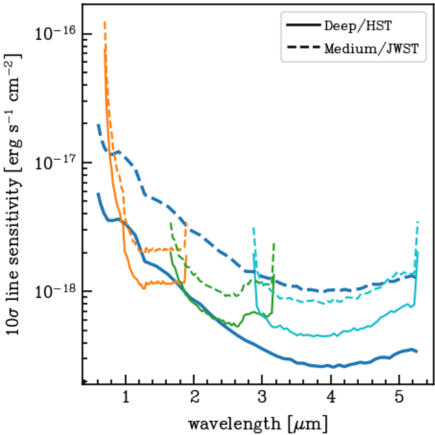
- Design: a two-layer “wedding cake” survey in GOODS-S and GOODS-N, with NIRCam Deep Prime, Medium Prime, Deep Parallel, and Medium Parallel imaging; NIRSpec MOS tiers Deep/HST, Deep/JWST, Medium/HST, and Medium/JWST; and MIRI Deep and Medium parallels.
- Sample and targeting: NIRSpec targets are selected from HST and/or JWST imaging and prioritized largely by redshift and flux. JADES typically supplies at least 200 targets per arcmin², yielding about 150 assigned targets on prism designs, an average assignment rate of only 9%.
- Analysis: this is an overview/descriptive paper of survey design and executed observations. Depths are estimated with the JWST Exposure Time Calculator and independently from blank-sky aperture variance; preparation used eMPT, JAGUAR simulations, and data challenges.
Limitations
- Stated in the paper: JADES was designed for one year but over-scheduling spread it over 18 months; instrument problems, guide-star failures, NIRSpec MSA shorts/glows, NIRCam persistence, wisps, and lost data affected parts of the program. The paper states NIRCam persistence effects on photometry have not yet been considered, and MIRI had minor background-subtraction, dither-step, and astrometry issues.
- Stated in the paper: NIRCam Deep Parallel dithering is set by the NIRSpec MSA and not tuned to the NIRCam pixel scale, and the SW chip gaps are not filled; Medium Parallel also does not cover SW chip gaps, and some targets can only be placed on one or two subpointings.
- Evident from the text: this overview does not present final science results or full data-release analyses, and many data-quality caveats remain to be modeled or mitigated. The paper also notes that two fields mitigate but do not eliminate cosmic-variance concerns, since even more fields would better address them.
Model-written summary. Check it against the paper before relying on it.
Integrity signals
Registry
Cites
Statistics
Figures
Verification
Claims the paper makes
0 Valid · 17 Not valid · 43 Not checked · 144 Own results and interpretations
A result the paper reports from its own data — it cites no other source for it, so there is none to check. The quote shows it is in the paper.
In the paper
“At about 770 hr of observing time plus coordinated parallels, JADES is the largest program operating in JWST Cycle 1”
§ Overview of the JWST Advanced Deep Extragalactic Survey (JADES) > 1. Introduction
plain- Asserted: passes — The authors put it forward as true.
- Checkable: passes — It can be checked against evidence.
- Load-bearing: unclear — It is unclear whether the paper’s conclusions depend on it.
- Based: passes — The paper gives a reason why it holds.
A result the paper reports from its own data — it cites no other source for it, so there is none to check. The quote shows it is in the paper.
In the paper
“Of course, these regions do also incur persistence from brighter sources in our own observations.”
- Also stated in: § 4.6. Data Quality Caveats · plain
“For instance, in 1181 observation 2, there is a bright star in the bad portion of A3 that creates a recurrent glow in all six dither locations.”
- Also stated in: § 4.6. Data Quality Caveats · plain
“And 1286 observation 8 contains the persistent glow of a bright star in observation 6.”
§ Overview of the JWST Advanced Deep Extragalactic Survey (JADES) > 4.6. Data Quality Caveats
plainstates a cause- Asserted: passes — The authors put it forward as true.
- Checkable: passes — It can be checked against evidence.
- Load-bearing: unclear — It is unclear whether the paper’s conclusions depend on it.
- Based: passes — The paper gives a reason why it holds.
- Also stated in: § 4.6. Data Quality Caveats · plain
A result the paper states — it cites no source for it, so there is none to check. The quote shows it is in the paper.
In the paper
“Between these two, we note that F182M and F210M are available for a notable portion of JADES.”
§ Overview of the JWST Advanced Deep Extragalactic Survey (JADES) > 3.4. Other Overlapping JWST Data
plain- Asserted: passes — The authors put it forward as true.
- Checkable: passes — It can be checked against evidence.
- Load-bearing: unclear — It is unclear whether the paper’s conclusions depend on it.
- Based: passes — The paper gives a reason why it holds.
None of the sources cited for this claim have been checked yet.
In the paper
“JADES includes mediumband filters in the NIRCam long-wave channel that can help identify and distinguish high-z candidates from dusty, strong emission-line sources at lower redshifts”
§ Overview of the JWST Advanced Deep Extragalactic Survey (JADES) > 2.1. Motivations
What the sources say
- Not checked yetcites P. Arrabal Haro et al. 2023 matched to “Confirmation and refutation of very luminous galaxies in the early Universe” (2023) source
- Not checked yetcites S. Fujimoto et al. 2023
- Not checked yetcites J. A. Zavala et al. 2023
plainstates a possible cause- Asserted: passes — The authors put it forward as true.
- Checkable: passes — It can be checked against evidence.
- Load-bearing: passes — The paper’s conclusions depend on it.
- Based: passes — The paper gives a reason why it holds.
A result the paper states — it cites no source for it, so there is none to check. The quote shows it is in the paper.
In the paper
“our program is providing large training samples for the photometric redshift methods that supply redshifts for the rest of the imaging sample.”
§ Overview of the JWST Advanced Deep Extragalactic Survey (JADES) > 2.2. Opportunities of a Combined Imaging and Spectroscopy Program
plainstates a cause- Asserted: passes — The authors put it forward as true.
- Checkable: passes — It can be checked against evidence.
- Load-bearing: passes — The paper’s conclusions depend on it.
- Based: passes — The paper gives a reason why it holds.
52 more claims
Create a free account to see all 204 claims and to verify the 83 references still open.
- Probably not a substantial claim. 66
- It may state two separate claims as one. 117
- The quote only partly states this claim. 1
Self-check
Percentages, sums and reported differences re-computed from the paper’s own numbers.
Each contradiction between two passages listed here was confirmed by an independent check.
Rated minor: it would not touch a result — a value no result rests on, a p-value that stays on the same side of the significance level, or a conflict that is clerical, resolved elsewhere in the paper, or outside its own findings.
In the paper
§ Overview of the JWST Advanced Deep Extragalactic Survey (JADES) > 4.5. Comments on Filter Selection
“We chose F182M and F300W as the most sensitive in each of these wide bands.”
§ Overview of the JWST Advanced Deep Extragalactic Survey (JADES) > 4.5. Comments on Filter Selection
“By adding F300M, F182M, and F162M, we provide a single medium-band filter in each of F277W, F200W, and F150W.”
Rated minor: it would not touch a result — a value no result rests on, a p-value that stays on the same side of the significance level, or a conflict that is clerical, resolved elsewhere in the paper, or outside its own findings.
In the paper
§ Overview of the JWST Advanced Deep Extragalactic Survey (JADES) > 5.6. NIRSpec Medium/HST Spectroscopy
“For a fifth target set (configuration 5, the first half of observation 26), the grating exposures are unaffected but the prism exposures were flooded by the short.”
§ Overview of the JWST Advanced Deep Extragalactic Survey (JADES) > 5.6. NIRSpec Medium/HST Spectroscopy
“These are MSA configurations 2, 4, 6, and 10, which are the second half of observations 25, 26, 27, and 29, respectively.”
Citations
Cites
Planck 2018 results: VI. Cosmological parameters
Planck Collaboration, Aghanim, N., Akrami, Y., Ashdown, M., Aumont, J., Baccigalupi, C., Ballardini, M., Banday, A. J., Barreiro, R. B., Bartolo, N., et al. (2020) · Astronomy & Astrophysics · doi:10.1051/0004-6361/201833910 · Cited by 14,258
Gaia Data Release 2: Summary of the contents and survey properties
Gaia Collaboration, Brown, A. G. A., Vallenari, A., Prusti, T., de Bruijne, J. H. J., Babusiaux, C., Bailer-Jones, C. A. L., Biermann, M., Evans, D. W., Eyer, L., et al. (2018) · Astronomy & Astrophysics · doi:10.1051/0004-6361/201833051 · Cited by 8,442
Gaia Collaboration, Prusti, T., de Bruijne, J. H. J., Brown, A. G. A., Vallenari, A., Babusiaux, C., Bailer-Jones, C. A. L., Bastian, U., Biermann, M., Evans, D. W., et al. (2016) · Astronomy & Astrophysics · doi:10.1051/0004-6361/201629272 · Cited by 6,946
CANDELS: THE COSMIC ASSEMBLY NEAR-INFRARED DEEP EXTRAGALACTIC LEGACY SURVEY
Grogin, N. A., Kocevski, D. D., Faber, S. M., Ferguson, H. C., Koekemoer, A. M., Riess, A. G., Acquaviva, V., Alexander, D. M., Almaini, O., Ashby, M. L. N., et al. (2011) · The Astrophysical Journal Supplement Series · doi:10.1088/0067-0049/197/2/35 · Cited by 2,133 · cited 10×
“Two of the NIRCam prime pointings did not have MIRI or NIR-Spec parallels that would fall on NIRCam imaging or GOODS; we opted to use MIRI, to be partnered with HST CANDELS imaging and perhaps future NIRCam data.”
InfluentialSelf-citationKoekemoer, A. M., Faber, S. M., Ferguson, H. C., Grogin, N. A., Kocevski, D. D., Koo, D. C., Lai, K., Lotz, J. M., Lucas, R. A., McGrath, E. J., et al. (2011) · The Astrophysical Journal Supplement Series · doi:10.1088/0067-0049/197/2/36 · Cited by 2,052 · cited 2×
“The DC2 sample used a combination of the CANDELS (Grogin et al. 2011; Koekemoer et al. 2011) catalog with S´ersic parameters estimated by van der Wel et al. (2012) and objects from JAGUAR, which also provides S´ersic parameters.”
Self-citationOverview of the DESI Legacy Imaging Surveys
Dey, A., Schlegel, D. J., Lang, D., Blum, R., Burleigh, K., Fan, X., Findlay, J. R., Finkbeiner, D., Herrera, D., Juneau, S., et al. (2019) · The Astronomical Journal · doi:10.3847/1538-3881/ab089d · Cited by 1,865 · cited 1×
“To browse the sky, we developed FitsMap (Hausen & Robertson 2022), inspired in part by the Legacy Survey viewer led by D. Lang (Dey et al. 2019).”
Self-citationThe Great Observatories Origins Deep Survey: Initial Results from Optical and Near-Infrared Imaging
Giavalisco, M., Ferguson, H. C., Koekemoer, A. M., Dickinson, M., Alexander, D. M., Bauer, F. E., Bergeron, J., Biagetti, C., Brandt, W. N., Casertano, S., et al. (2004) · The Astrophysical Journal · doi:10.1086/379232 · Cited by 1,678 · cited 2×
“…field and that of the Chandra Deep Field South (Giacconi et al. 2002) were broadened out to form the Great Observa-tories Origins Deep Survey (GOODS Giavalisco et al. 2004), utilizing the new opportunities of the HST Advanced Camera for Surveys (ACS) and Spitzer infrared telescope to partner with…”
The Hubble Deep Field: Observations, Data Reduction, and Galaxy Photometry
Williams, R. E., Blacker, B., Dickinson, M., Dixon, W. V. D., Ferguson, H. C., Fruchter, A. S., Giavalisco, M., Gilliland, R. L., Heyer, I., Katsanis, R., et al. (1996) · The Astronomical Journal · doi:10.1086/118105 · Cited by 1,076 · cited 1×
“It boldly unveiled the high-redshift Universe in a single multi-color blank-field image (Williams et al. 1996; Ferguson et al. 2000).”
Beckwith, S. V. W., Stiavelli, M., Koekemoer, A. M., Caldwell, J. A. R., Ferguson, H. C., Hook, R., Lucas, R. A., Bergeron, L. E., Corbin, M., Jogee, S., et al. (2006) · The Astronomical Journal · doi:10.1086/507302 · Cited by 884 · cited 2×
“Soon after, the Hubble Ultra Deep Field (HUDF) was sited in the heart of GOODS-S (Beckwith et al. 2006).”
The ALADIN interactive sky atlas: A reference tool for identification of astronomical sources
Bonnarel, F., Fernique, P., Bienaymé, O., Egret, D., Genova, F., Louys, M., Ochsenbein, F., Wenger, M., & Bartlett, J. G. (2000) · Astronomy and Astrophysics Supplement Series · doi:10.1051/aas:2000331 · Cited by 819
The Science Performance of JWST as Characterized in Commissioning
Rigby, J. R., Perrin, M. D., McElwain, M. W., Kimble, R. A., Friedman, S. D., Lallo, M., Doyon, R., Feinberg, L. D., Ferruit, P., Glasse, A. C. H., et al. (2023) · Publications of the Astronomical Society of the Pacific · doi:10.1088/1538-3873/acb293 · Cited by 704 · cited 1×
“Designed to push the redshift frontier and bring the early growth of galaxies into clear focus, the telescope is performing at, or even better than, expectations (Rigby et al. 2023).”
Self-citationChandra Deep Field South: The 1 Ms Catalog
Giacconi, R., Zirm, A., Wang, J., Rosati, P., Nonino, M., Tozzi, P., Gilli, R., Mainieri, V., Hasinger, G., Kewley, L. J., et al. (2002) · The Astrophysical Journal Supplement Series · doi:10.1086/338927 · Cited by 701 · cited 4×
“We note that while the MIRI fields are not on the UDF itself, they do fall near the center of the Chandra Deep Field South.”
InfluentialBunker, A. J., Saxena, A., Cameron, A. J., Willott, C. J., Curtis-Lake, E., Jakobsen, P., Carniani, S., Smit, R., Maiolino, R., Witstok, J., et al. (2023) · Astronomy and Astrophysics · doi:10.1051/0004-6361/202346159 · Cited by 684 · cited 13×
“One sees that the JADES imaging is comparable in depth in the deepest HUDF data, which covered only a single HST pointing.”
InfluentialSelf-citationJakobsen, P., Ferruit, P., Alves de Oliveira, C., Arribas, S., Bagnasco, G., Barho, R., Beck, T. L., Birkmann, S., Böker, T., Bunker, A. J., et al. (2022) · Astronomy & Astrophysics · doi:10.1051/0004-6361/202142663 · Cited by 669 · cited 1×
“…ultraviolet spectral properties have been accessible, JWST enables for the first time, via its instruments NIRCam (Rieke et al. 2023b), NIRSpec (Jakobsen et al. 2022; Ferruit et al. 2022), NIRISS (Doyon et al. 2023) and MIRI (Wright et al. 2023), photometry and spectroscopy extending from…”
Self-citationA REMARKABLY LUMINOUS GALAXY AT Z = 11.1 MEASURED WITH HUBBLE SPACE TELESCOPE GRISM SPECTROSCOPY
Oesch, P. A., Brammer, G., van Dokkum, P., Illingworth, G. D., Bouwens, R. J., Labbé, I., Franx, M., Momcheva, I. G., Ashby, M. L. N., Fazio, G. G., et al. (2016) · The Astrophysical Journal · doi:10.3847/0004-637x/819/2/129 · Cited by 581
Self-citationA population of red candidate massive galaxies ~600 Myr after the Big Bang
Labbé, I., van Dokkum, P., Nelson, E., Bezanson, R., Suess, K. A., Leja, J., Brammer, G., Whitaker, K., Mathews, E., Stefanon, M., et al. (2023) · Nature · doi:10.1038/s41586-023-05786-2 · Cited by 578
Self-citationPerformance of NIRCam on JWST in Flight
Rieke, M. J., Kelly, D., Misselt, K. A., Stansberry, J., Boyer, M. L., Beatty, T. G., Egami, E., Florian, M., Greene, T. P., Hainline, K., et al. (2023) · Publications of the Astronomical Society of the Pacific · doi:10.1088/1538-3873/acac53 · Cited by 551 · cited 4×
“The first release of JADES data, focusing on year 1 Deep NIRCam imaging and NIRSpec multi-object spectroscopy on the HUDF, is presented in Bunker et al. (2023a) and Rieke et al. (2023a) and available at https://archive.stsci.edu/hlsp/jades and http: //jades.idies.jhu.edu/.”
InfluentialSelf-citationSTRUCTURAL PARAMETERS OF GALAXIES IN CANDELS
van der Wel, A., Bell, E. F., Häussler, B., McGrath, E. J., Chang, Y.-Y., Guo, Y., McIntosh, D. H., Rix, H.-W., Barden, M., Cheung, E., et al. (2012) · The Astrophysical Journal Supplement Series · doi:10.1088/0067-0049/203/2/24 · Cited by 540 · cited 1×
“The DC2 sample used a combination of the CANDELS (Grogin et al. 2011; Koekemoer et al. 2011) catalog with S´ersic parameters estimated by van der Wel et al. (2012) and objects from JAGUAR, which also provides S´ersic parameters.”
Self-citationMatthee, J., Naidu, R. P., Brammer, G., Chisholm, J., Eilers, A.-C., Goulding, A., Greene, J., Kashino, D., Labbe, I., Lilly, S. J., et al. (2024) · The Astrophysical Journal · doi:10.3847/1538-4357/ad2345 · Cited by 540
Self-citationEllis, R. S., McLure, R. J., Dunlop, J. S., Robertson, B. E., Ono, Y., Schenker, M. A., Koekemoer, A., Bowler, R. A. A., Ouchi, M., Rogers, A. B., et al. (2013) · The Astrophysical Journal · doi:10.1088/2041-8205/763/1/l7 · Cited by 512
Self-citationThe James Webb Space Telescope Mission
Gardner, J. P., Mather, J. C., Abbott, R., Abell, J. S., Abernathy, M., Abney, F. E., Abraham, J. G., Abraham, R., Abul-Huda, Y. M., Acton, S., et al. (2023) · Publications of the Astronomical Society of the Pacific · doi:10.1088/1538-3873/acd1b5 · Cited by 503 · cited 1×
“Exploiting this telescope are ambitious multi-purpose instruments (Gardner et al. 2023) that give us dozens of selectable filters, exquisite slit-less, integral-field or multi-object spectroscopy (MOS) and multiple coronagraphs.”
Self-citationNakajima, K., Ouchi, M., Isobe, Y., Harikane, Y., Zhang, Y., Ono, Y., Umeda, H., & Oguri, M. (2023) · The Astrophysical Journal Supplement Series · doi:10.3847/1538-4365/acd556 · Cited by 498 · cited 1×
“…star formation rate in the rest-UV, stellar mass in the rest-optical, and metallicity from nebular lines we can explore whether the fundamental metallicity and mass-metallicity relations are already in place after only ∼ 1 billion years of cosmic history (Curti et al. 2023; Nakajima et al. 2023).”
Harikane, Y., Zhang, Y., Nakajima, K., Ouchi, M., Isobe, Y., Ono, Y., Hatano, S., Xu, Y., & Umeda, H. (2023) · The Astrophysical Journal · doi:10.3847/1538-4357/ad029e · Cited by 492 · cited 1×
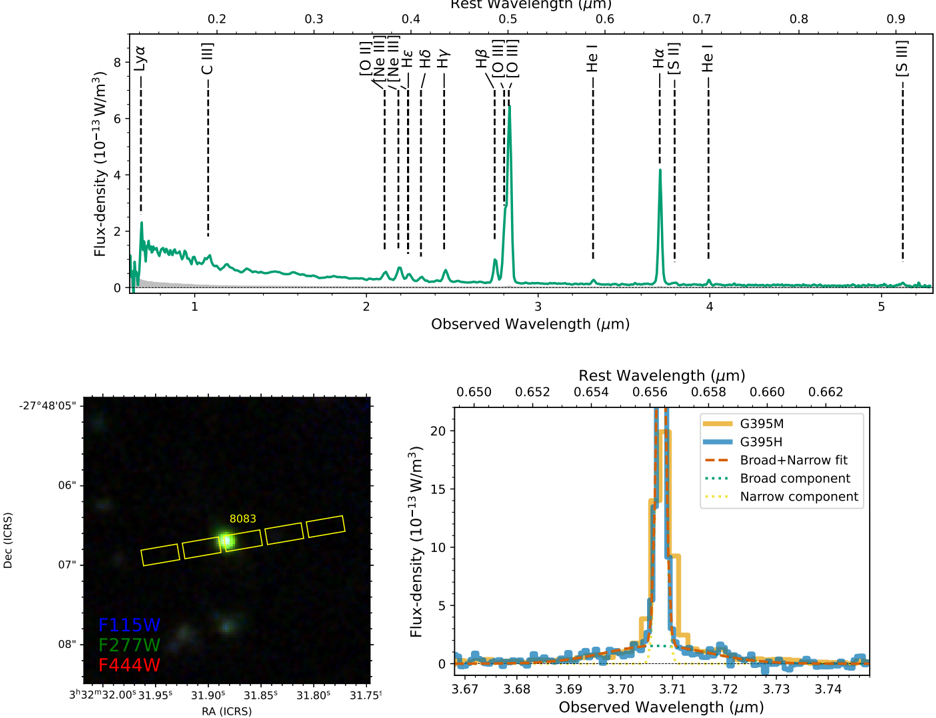
“…pointlike morphology (particularly in the redder bands, e.g. Labbe et al. 2022; Furtak et al. 2022), broad wings of Balmer emission lines (e.g. Figure 2) and highly-ionized narrow lines (Kocevski et al. 2023; Harikane et al. 2023; Maiolino et al. 2023; Scholtz et al. 2023; Larson et al. 2023).”
Stark, D. P., Ellis, R. S., Chiu, K., Ouchi, M., & Bunker, A. (2010) · Monthly Notices of the Royal Astronomical Society · doi:10.1111/j.1365-2966.2010.17227.x · Cited by 443 · cited 1×
“…that show (or not) Lyman-α emission, can track how the increased IGM neutrality at earlier times extinguishes observed line emission in progressively more of the sources (Stark et al. 2010; Fontana et al. 2010; Pentericci et al. 2014; Mason et al. 2018; Ouchi et al. 2020; Jones et al. 2023).”
Self-citationDonnan, C. T., McLeod, D. J., Dunlop, J. S., McLure, R. J., Carnall, A. C., Begley, R., Cullen, F., Hamadouche, M. L., Bowler, R. A. A., Magee, D., et al. (2022) · Monthly Notices of the Royal Astronomical Society · doi:10.1093/mnras/stac3472 · Cited by 433
Modelling and interpreting spectral energy distributions of galaxies with beagle
Chevallard, J., & Charlot, S. (2016) · Monthly Notices of the Royal Astronomical Society · doi:10.1093/mnras/stw1756 · Cited by 418 · cited 1×
“A key utility of JAGUAR includes both mock SEDs and full-resolution spectra, which we generated using BEAGLE (Chevallard & Charlot 2016) based on self-consistent models of stellar radiation and its transfer through the interstellar and intergalactic medium.”
Self-citationKocevski, D. D., Onoue, M., Inayoshi, K., Trump, J. R., Arrabal Haro, P., Grazian, A., Dickinson, M., Finkelstein, S. L., Kartaltepe, J. S., Hirschmann, M., et al. (2023) · The Astrophysical Journal Letters · doi:10.3847/2041-8213/ace5a0 · Cited by 415 · cited 1×
“…pointlike morphology (particularly in the redder bands, e.g. Labbe et al. 2022; Furtak et al. 2022), broad wings of Balmer emission lines (e.g. Figure 2) and highly-ionized narrow lines (Kocevski et al. 2023; Harikane et al. 2023; Maiolino et al. 2023; Scholtz et al. 2023; Larson et al. 2023).”
Spectroscopic confirmation of four metal-poor galaxies at z = 10.3–13.2
Curtis-Lake, E., Carniani, S., Cameron, A., Charlot, S., Jakobsen, P., Maiolino, R., Bunker, A., Witstok, J., Smit, R., Chevallard, J., et al. (2023) · Nature Astronomy · doi:10.1038/s41550-023-01918-w · Cited by 413 · cited 4×
“Two of the additional target galaxies with photometric redshifts from the NIR-Cam imaging (Robertson et al. 2023a) were spectroscopically confirmed in Deep/HST to lie at the highest red-shifts known of 12.6 and 13.2 (Curtis-Lake et al. 2023).”
InfluentialSelf-citationThe Mid-infrared Instrument for JWST and Its In-flight Performance
Wright, G. S., Rieke, G. H., Glasse, A. C. H., Ressler, M. E., García-Marín, M., Aguilar, J., Alberts, S. L., Álvarez-Márquez, J., Argyriou, I., Banks, K., et al. (2023) · Publications of the Astronomical Society of the Pacific · doi:10.1088/1538-3873/acbe66 · Cited by 409 · cited 1×
“…for the first time, via its instruments NIRCam (Rieke et al. 2023b), NIRSpec (Jakobsen et al. 2022; Ferruit et al. 2022), NIRISS (Doyon et al. 2023) and MIRI (Wright et al. 2023), photometry and spectroscopy extending from blueward of the Lyman break to redward of the Balmer/4000˚A break region.”
Self-citationA deep ALMA image of the Hubble Ultra Deep Field
Dunlop, J. S., McLure, R. J., Biggs, A. D., Geach, J. E., Michałowski, M. J., Ivison, R. J., Rujopakarn, W., van Kampen, E., Kirkpatrick, A., Pope, A., et al. (2017) · Monthly Notices of the Royal Astronomical Society · doi:10.1093/mnras/stw3088 · Cited by 380
Self-citationRieke, M. J., Robertson, B. E., Tacchella, S., Hainline, K., Johnson, B. D., Hausen, R., Ji, Z., Willmer, C. N. A., Eisenstein, D. J., Puskás, D., et al. (2023) · The Astrophysical Journal Supplement Series · doi:10.3847/1538-4365/acf44d · Cited by 380 · cited 4×
“The first release of JADES data, focusing on year 1 Deep NIRCam imaging and NIRSpec multi-object spectroscopy on the HUDF, is presented in Bunker et al. (2023a) and Rieke et al. (2023a) and available at https://archive.stsci.edu/hlsp/jades and http: //jades.idies.jhu.edu/.”
InfluentialSelf-citationCLASH: THREE STRONGLY LENSED IMAGES OF A CANDIDATE z≈ 11 GALAXY
Coe, D., Zitrin, A., Carrasco, M., Shu, X., Zheng, W., Postman, M., Bradley, L., Koekemoer, A., Bouwens, R., Broadhurst, T., et al. (2013) · The Astrophysical Journal · doi:10.1088/0004-637x/762/1/32 · Cited by 374
JADES: The diverse population of infant black holes at 4 < z < 11: Merging, tiny, poor, but mighty
Maiolino, R., Scholtz, J., Curtis-Lake, E., Carniani, S., Baker, W., de Graaff, A., Tacchella, S., Übler, H., D’Eugenio, F., Witstok, J., et al. (2024) · Astronomy & Astrophysics · doi:10.1051/0004-6361/202347640 · Cited by 373
Self-citationBunker, A. J., Cameron, A. J., Curtis-Lake, E., Jakobsen, P., Carniani, S., Curti, M., Witstok, J., Maiolino, R., D’Eugenio, F., Looser, T. J., et al. (2024) · Astronomy and Astrophysics · doi:10.1051/0004-6361/202347094 · Cited by 369
Self-citationMason, C. A., Treu, T., Dijkstra, M., Mesinger, A., Trenti, M., Pentericci, L., de Barros, S., & Vanzella, E. (2018) · The Astrophysical Journal · doi:10.3847/1538-4357/aab0a7 · Cited by 366 · cited 1×
“…that show (or not) Lyman-α emission, can track how the increased IGM neutrality at earlier times extinguishes observed line emission in progressively more of the sources (Stark et al. 2010; Fontana et al. 2010; Pentericci et al. 2014; Mason et al. 2018; Ouchi et al. 2020; Jones et al. 2023).”
Larson, R. L., Finkelstein, S. L., Kocevski, D. D., Hutchison, T. A., Trump, J. R., Arrabal Haro, P., Bromm, V., Cleri, N. J., Dickinson, M., Fujimoto, S., et al. (2023) · The Astrophysical Journal Letters · doi:10.3847/2041-8213/ace619 · Cited by 363 · cited 1×
“…pointlike morphology (particularly in the redder bands, e.g. Labbe et al. 2022; Furtak et al. 2022), broad wings of Balmer emission lines (e.g. Figure 2) and highly-ionized narrow lines (Kocevski et al. 2023; Harikane et al. 2023; Maiolino et al. 2023; Scholtz et al. 2023; Larson et al. 2023).”
Self-citationRobertson, B. E. (2022) · Annual Review of Astronomy and Astrophysics · doi:10.1146/annurev-astro-120221-044656 · Cited by 360 · cited 3×
“This corresponds to the wavelength of the Lyman-α transition at redshifts of 4.8 to 7.2, bridging the epoch of the end of cosmic reionization (Robertson 2022).”
InfluentialSelf-citationBrammer, G., Strait, V., Matharu, J., & Momcheva, I. G. (2018) · Zenodo (CERN European Organization for Nuclear Research) · doi:10.5281/zenodo.1146904 · Cited by 357
DISCOVERY OF z ∼ 8 GALAXIES IN THE HUBBLE ULTRA DEEP FIELD FROM ULTRA-DEEP WFC3/IR OBSERVATIONS
Bouwens, R. J., Illingworth, G. D., Oesch, P. A., Stiavelli, M., van Dokkum, P., Trenti, M., Magee, D., Labbé, I., Franx, M., Carollo, C. M., et al. (2010) · The Astrophysical Journal · doi:10.1088/2041-8205/709/2/l133 · Cited by 350
A small and vigorous black hole in the early Universe
Maiolino, R., Scholtz, J., Witstok, J., Carniani, S., D’Eugenio, F., de Graaff, A., Übler, H., Tacchella, S., Curtis-Lake, E., Arribas, S., et al. (2024) · Nature · doi:10.1038/s41586-024-07052-5 · Cited by 345
Self-citationIllingworth, G. D., Magee, D. K., Oesch, P. A., Bouwens, R. J., Labbé, I., Stiavelli, M., van Dokkum, P. G., Franx, M., Trenti, M., Carollo, C. M., et al. (2013) · The Astrophysical Journal Supplement Series · doi:10.1088/0067-0049/209/1/6 · Cited by 332 · cited 1×
“The GOODS (Giavalisco et al. 2004), CAN-DELS (Grogin et al. 2011; Koekemoer et al. 2011), and UDF (Beckwith et al. 2006; Ellis et al. 2013; Illingworth et al. 2013) data have been reduced and released as components of the Hubble Legacy Fields (HLF Illingworth et al. 2016; Whitaker et al. 2019a).”
NEW OBSERVATIONS OF z ∼ 7 GALAXIES: EVIDENCE FOR A PATCHY REIONIZATION
Pentericci, L., Vanzella, E., Fontana, A., Castellano, M., Treu, T., Mesinger, A., Dijkstra, M., Grazian, A., Bradač, M., Conselice, C. J., et al. (2014) · The Astrophysical Journal · doi:10.1088/0004-637x/793/2/113 · Cited by 324
Self-citationTheChandraDeep Field–South Survey: 2 Ms Source Catalogs
Luo, B., Bauer, F. E., Brandt, W. N., Alexander, D. M., Lehmer, B. D., Schneider, D. P., Brusa, M., Comastri, A., Fabian, A. C., Finoguenov, A., et al. (2008) · The Astrophysical Journal Supplement Series · doi:10.1086/591248 · Cited by 317 · cited 1×
“…(Giacconi et al. 2002) were broadened out to form the Great Observa-tories Origins Deep Survey (GOODS Giavalisco et al. 2004), utilizing the new opportunities of the HST Advanced Camera for Surveys (ACS) and Spitzer infrared telescope to partner with deep Chandra X-ray imaging (Luo et al. 2008).”
Zackrisson, E., Rydberg, C.-E., Schaerer, D., Östlin, G., & Tuli, M. (2011) · The Astrophysical Journal · doi:10.1088/0004-637x/740/1/13 · Cited by 315
Quasars and the Intergalactic Medium at Cosmic Dawn
Fan, X., Bañados, E., & Simcoe, R. A. (2023) · Annual Review of Astronomy and Astrophysics · doi:10.1146/annurev-astro-052920-102455 · Cited by 304
The JADES Origins Field: A New JWST Deep Field in the JADES Second NIRCam Data Release
Eisenstein, D. J., Johnson, B. D., Robertson, B. E., Tacchella, S., Hainline, K., Jakobsen, P., Maiolino, R., Bonaventura, N., Bunker, A. J., Cameron, A. J., et al. (2025) · The Astrophysical Journal Supplement Series · doi:10.3847/1538-4365/ae1137 · Cited by 297
Self-citationD’Eugenio, F., Cameron, A. J., Scholtz, J., Carniani, S., Willott, C. J., Curtis-Lake, E., Bunker, A. J., Parlanti, E., Maiolino, R., Willmer, C. N. A., et al. (2025) · The Astrophysical Journal Supplement Series · doi:10.3847/1538-4365/ada148 · Cited by 286
Self-citationCurti, M., D’Eugenio, F., Carniani, S., Maiolino, R., Sandles, L., Witstok, J., Baker, W. M., Bennett, J. S., Piotrowska, J. M., Tacchella, S., et al. (2022) · Monthly Notices of the Royal Astronomical Society · doi:10.1093/mnras/stac2737 · Cited by 282
Self-citationIdentification and properties of intense star-forming galaxies at redshifts z > 10
Robertson, B. E., Tacchella, S., Johnson, B. D., Hainline, K., Whitler, L., Eisenstein, D. J., Endsley, R., Rieke, M., Stark, D. P., Alberts, S., et al. (2023) · Nature Astronomy · doi:10.1038/s41550-023-01921-1 · Cited by 282 · cited 3×
“Two of the additional target galaxies with photometric redshifts from the NIR-Cam imaging (Robertson et al. 2023a) were spectroscopically confirmed in Deep/HST to lie at the highest red-shifts known of 12.6 and 13.2 (Curtis-Lake et al. 2023).”
InfluentialSelf-citationGOODS-ALMA: 1.1 mm galaxy survey
Franco, M., Elbaz, D., Béthermin, M., Magnelli, B., Schreiber, C., Ciesla, L., Dickinson, M., Nagar, N. M., Silverman, J. D., Daddi, E., et al. (2018) · Astronomy and Astrophysics · doi:10.1051/0004-6361/201832928 · Cited by 273 · cited 1×
“GOODS-South, home of the Chandra Deep Field South and the Hubble Ultra Deep Field as well as very deep ALMA (Walter et al. 2016; Dunlop et al. 2017; Franco et al. 2018; Hatsukade et al. 2018) and JVLA data (Rujopakarn et al. 2016; Alberts et al. 2020), is the preeminent deep field on the sky.”
Self-citationJADES: A large population of obscured, narrow-line active galactic nuclei at high redshift
Scholtz, J., Maiolino, R., D’Eugenio, F., Curtis-Lake, E., Carniani, S., Charlot, S., Curti, M., Silcock, M. S., Arribas, S., Baker, W., et al. (2025) · Astronomy and Astrophysics · doi:10.1051/0004-6361/202348804 · Cited by 268
Self-citationFerruit, P., Jakobsen, P., Giardino, G., Rawle, T., de Oliveira, C. A., Arribas, S., Beck, T. L., Birkmann, S. M., Böker, T., Bunker, A. J., et al. (2022) · Astronomy and Astrophysics · doi:10.1051/0004-6361/202142673 · Cited by 263 · cited 1×
“…properties have been accessible, JWST enables for the first time, via its instruments NIRCam (Rieke et al. 2023b), NIRSpec (Jakobsen et al. 2022; Ferruit et al. 2022), NIRISS (Doyon et al. 2023) and MIRI (Wright et al. 2023), photometry and spectroscopy extending from blueward of the Lyman…”
Self-citationCEERS Epoch 1 NIRCam Imaging: Reduction Methods and Simulations Enabling Early JWST Science Results
Bagley, M. B., Finkelstein, S. L., Koekemoer, A. M., Ferguson, H. C., Arrabal Haro, P., Dickinson, M., Kartaltepe, J. S., Papovich, C., Pérez-González, P. G., Pirzkal, N., et al. (2023) · The Astrophysical Journal Letters · doi:10.3847/2041-8213/acbb08 · Cited by 262 · cited 19×
“We note that while the MIRI fields are not on the UDF itself, they do fall near the center of the Chandra Deep Field South.”
InfluentialSelf-citationde Graaff, A., Rix, H., Carniani, S., Suess, K. A., Charlot, S., Curtis-Lake, E., Arribas, S., Baker, W. M., Boyett, K., Bunker, A. J., et al. (2024) · Astronomy and Astrophysics · doi:10.1051/0004-6361/202347755 · Cited by 261
Self-citationSpectroscopic confirmation of two luminous galaxies at a redshift of 14
Carniani, S., Hainline, K., D’Eugenio, F., Eisenstein, D. J., Jakobsen, P., Witstok, J., Johnson, B. D., Chevallard, J., Maiolino, R., Helton, J. M., et al. (2024) · Nature · doi:10.1038/s41586-024-07860-9 · Cited by 260
Self-citationEndsley, R., Stark, D. P., Whitler, L., Topping, M. W., Johnson, B. D., Robertson, B. E., Tacchella, S., Alberts, S. L., Baker, W. M., Bhatawdekar, R., et al. (2024) · Monthly Notices of the Royal Astronomical Society · doi:10.1093/mnras/stae1857 · Cited by 252
Self-citationIn-orbit Performance of the Near-infrared Spectrograph NIRSpec on the James Webb Space Telescope
Böker, T., Beck, T. L., Birkmann, S. M., Giardino, G., Keyes, C. D., Kumari, N., Muzerolle, J. C., Rawle, T., Zeidler, P., Abul-Huda, Y. M., et al. (2023) · Publications of the Astronomical Society of the Pacific · doi:10.1088/1538-3873/acb846 · Cited by 252 · cited 1×
“Not all shutters function properly with 22 failed open that always disperse light onto the detector and 17.5% of the unvignetted shutters that are permanently closed (B¨oker et al. 2023).”
InfluentialSelf-citationConfirmation and refutation of very luminous galaxies in the early Universe
Arrabal Haro, P., Dickinson, M., Finkelstein, S. L., Kartaltepe, J. S., Donnan, C. T., Burgarella, D., Carnall, A. C., Cullen, F., Dunlop, J. S., Fernández, V., et al. (2023) · Nature · doi:10.1038/s41586-023-06521-7 · Cited by 236 · cited 1×
“JADES includes medium-band filters in the NIRCam long wave channel that can help identify and distinguish high-z candidates from dusty, strong emission line sources at lower redshifts e.g. Zavala et al. 2023; Fujimoto et al. 2022; Arrabal Haro et al. 2023).”
A surprising abundance of massive quiescent galaxies at 3 < z < 5 in the first data from JWST CEERS
Carnall, A. C., McLeod, D. J., McLure, R. J., Dunlop, J. S., Begley, R., Cullen, F., Donnan, C. T., Hamadouche, M. L., Jewell, S. M., Jones, E. W., et al. (2023) · Monthly Notices of the Royal Astronomical Society · doi:10.1093/mnras/stad369 · Cited by 234 · cited 2×
“…but higher resolution spectroscopy enables more detailed constraints on SFH and abundances at z > 3 − 4, an era that prior to JWST was prohibitive or impossible to study, but critical to our understand-5 ing of why and how galaxies stop forming stars (Carnall et al. 2023; Nanayakkara et al. 2022).”
ALMA SPECTROSCOPIC SURVEY IN THE HUBBLE ULTRA DEEP FIELD: SURVEY DESCRIPTION
Walter, F., Decarli, R., Aravena, M., Carilli, C., Bouwens, R., Cunha, E. D., Daddi, E., Ivison, R. J., Riechers, D., Smail, I., et al. (2016) · The Astrophysical Journal · doi:10.3847/1538-4357/833/1/67 · Cited by 232 · cited 3×
“ALMA has revealed that such hidden galaxies likely contribute significantly to the cosmic star formation rate density at 3 < z < 8 (e.g. Williams et al. 2019; Fudamoto et al. 2021; Algera et al. 2023), and early JWST data is supporting this finding (Barrufet et al. 2023).”
Self-citationKashino, D., Lilly, S. J., Matthee, J., Eilers, A., Mackenzie, R., Bordoloi, R., & Simcoe, R. A. (2023) · The Astrophysical Journal · doi:10.3847/1538-4357/acc588 · Cited by 229
The JWST FRESCO survey: legacy NIRCam/grism spectroscopy and imaging in the two GOODS fields
Oesch, P. A., Brammer, G., Naidu, R. P., Bouwens, R. J., Chisholm, J., Illingworth, G. D., Matthee, J., Nelson, E., Qin, Y., Reddy, N., et al. (2023) · Monthly Notices of the Royal Astronomical Society · doi:10.1093/mnras/stad2411 · Cited by 224 · cited 1×
“The First Reionization Epoch Spectroscopic Complete program (FRESCO, PI: Oesch, Program 1895, Oesch et al. 2023) conducted NIRCam F444W slitless spectroscopy (2 hr depth), paired with F182M and F210M medium-band imaging (1 hr each).”
Self-citationThe Cosmos in Its Infancy: JADES Galaxy Candidates at z > 8 in GOODS-S and GOODS-N
Hainline, K., Johnson, B. D., Robertson, B. E., Tacchella, S., Helton, J. M., Sun, F., Eisenstein, D. J., Simmonds, C., Topping, M. W., Whitler, L., et al. (2024) · The Astrophysical Journal · doi:10.3847/1538-4357/ad1ee4 · Cited by 221
Self-citationCEERS Key Paper. III. The Diversity of Galaxy Structure and Morphology at z = 3–9 with JWST
Kartaltepe, J. S., Rose, C., Vanderhoof, B. N., McGrath, E. J., Costantin, L., Cox, I. G., Yung, L. Y. A., Kocevski, D. D., Wuyts, S., Ferguson, H. C., et al. (2023) · The Astrophysical Journal Letters · doi:10.3847/2041-8213/acad01 · Cited by 212 · cited 1×
“JWST is revealing the emergence of morphological structures at z > 2 through superb infrared imaging (Robertson et al. 2023b; Kartaltepe et al. 2023; Ferreira et al. 2022a,b; Jacobs et al. 2023; Huertas-Company et al. 2023; Magnelli et al. 2023; Baker et al. 2023).”
Self-citationObservations of the Lyman-α Universe
Ouchi, M., Ono, Y., & Shibuya, T. (2020) · Annual Review of Astronomy and Astrophysics · doi:10.1146/annurev-astro-032620-021859 · Cited by 207 · cited 1×
“…that show (or not) Lyman-α emission, can track how the increased IGM neutrality at earlier times extinguishes observed line emission in progressively more of the sources (Stark et al. 2010; Fontana et al. 2010; Pentericci et al. 2014; Mason et al. 2018; Ouchi et al. 2020; Jones et al. 2023).”
JWST UNCOVER: Extremely Red and Compact Object at z phot ≃ 7.6 Triply Imaged by A2744
Furtak, L. J., Zitrin, A., Plat, A., Fujimoto, S., Wang, B., Nelson, E. J., Labbé, I., Bezanson, R., Brammer, G., van Dokkum, P., et al. (2023) · The Astrophysical Journal · doi:10.3847/1538-4357/acdc9d · Cited by 205
Self-citationEndsley, R., Stark, D. P., Whitler, L., Topping, M. W., Chen, Z., Plat, A., Chisholm, J., & Charlot, S. (2023) · Monthly Notices of the Royal Astronomical Society · doi:10.1093/mnras/stad1919 · Cited by 203 · cited 2×
“…the transmission of Lyman-α with photometric or spectroscopic measurements of environment can provide further insight into the topology of ionized bubbles during this epoch (Tang et al. 2023; Witstok et al. 2023a; Endsley et al. 2023; Jung et al. 2023; Lu et al. 2023; Whitler et al. 2023b).”
Self-citationThe JWST Hubble Sequence: The Rest-frame Optical Evolution of Galaxy Structure at 1.5 < z < 6.5
Ferreira, L., Conselice, C. J., Sazonova, E., Ferrari, F., Caruana, J., Tohill, C.-B., Lucatelli, G., Adams, N., Irodotou, D., Marshall, M. A., et al. (2023) · The Astrophysical Journal · doi:10.3847/1538-4357/acec76 · Cited by 197
The Hubble Legacy Field GOODS-S Photometric Catalog
Whitaker, K. E., Ashas, M., Illingworth, G. D., Magee, D. K., Leja, J., Oesch, P. A., van Dokkum, P., Mowla, L., Bouwens, R., Franx, M., et al. (2019) · The Astrophysical Journal Supplement Series · doi:10.3847/1538-4365/ab3853 · Cited by 197 · cited 2×
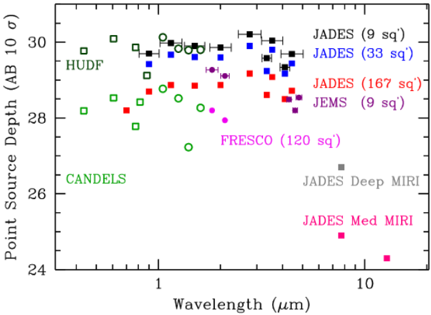
“In Figure 7, we show a visualization of the estimated depth of the JADES, JEMS, and FRESCO NIRCam and JADES MIRI imaging, along with the estimates for HST ACS and WFC3 imaging (Whitaker et al. 2019b) in the HUDF and CANDELS fields that JADES overlaps.”
Tang, M., Stark, D. P., Chen, Z., Mason, C., Topping, M., Endsley, R., Senchyna, P., Plat, A., Lu, T.-Y., Whitler, L., et al. (2023) · Monthly Notices of the Royal Astronomical Society · doi:10.1093/mnras/stad2763 · Cited by 186 · cited 3×
“…the transmission of Lyman-α with photometric or spectroscopic measurements of environment can provide further insight into the topology of ionized bubbles during this epoch (Tang et al. 2023; Witstok et al. 2023a; Endsley et al. 2023; Jung et al. 2023; Lu et al. 2023; Whitler et al. 2023b).”
Self-citationJWST NIRSpec Spectroscopy of the Triply Lensed z = 10.17 Galaxy MACS0647–JD
Hsiao, T. Y.-Y., Abdurrouf, Coe, D., Larson, R. L., Jung, I., Mingozzi, M., Dayal, P., Kumari, N., Kokorev, V., Vikaeus, A., et al. (2024) · The Astrophysical Journal · doi:10.3847/1538-4357/ad5da8 · Cited by 186
Self-citationCameron, A. J., Saxena, A., Bunker, A. J., D’Eugenio, F., Carniani, S., Maiolino, R., Curtis-Lake, E., Ferruit, P., Jakobsen, P., Arribas, S., et al. (2023) · Astronomy & Astrophysics · doi:10.1051/0004-6361/202346107 · Cited by 183 · cited 5×
“Unlike all other previous studies of high-redshift (i.e., z > 3) galaxy populations where only rest-frame ultraviolet spectral properties have been accessible, JWST enables for the first time, via its instruments NIRCam (Rieke et al. 2023b), NIRSpec (Jakobsen et al. 2022; Ferruit et al. 2022), NIRISS (Doyon et al. 202…”
InfluentialSelf-citationFerreira, L., Adams, N., Conselice, C. J., Sazonova, E., Austin, D., Caruana, J., Ferrari, F., Verma, A., Trussler, J., Broadhurst, T. J., et al. (2022) · The Astrophysical Journal Letters · doi:10.3847/2041-8213/ac947c · Cited by 182 · cited 1×
“JWST is revealing the emergence of morphological structures at z > 2 through superb infrared imaging (Robertson et al. 2023b; Kartaltepe et al. 2023; Ferreira et al. 2022a,b; Jacobs et al. 2023; Huertas-Company et al. 2023; Magnelli et al. 2023; Baker et al. 2023).”
Morishita, T., Roberts-Borsani, G. W., Treu, T., Brammer, G., Mason, C. A., Trenti, M., Vulcani, B., Wang, X., Acebrón, A., Bahé, Y. M., et al. (2023) · The Astrophysical Journal Letters · doi:10.3847/2041-8213/acb99e · Cited by 181 · cited 1×
“…to identify physically-associated galaxies in the early universe rather than just projected overdensities (Kashino et al. 2022; Helton et al. 2023; Morishita et al. 2023) and enable us to distinguish between how central and satellite galaxies evolve further back in time than has previously been…”
Self-citationJEMS: A Deep Medium-band Imaging Survey in the Hubble Ultra Deep Field with JWST NIRCam and NIRISS
Williams, C. C., Tacchella, S., Maseda, M. V., Robertson, B. E., Johnson, B. D., Willott, C. J., Eisenstein, D. J., Willmer, C. N. A., Ji, Z., Hainline, K. N., et al. (2023) · The Astrophysical Journal Supplement Series · doi:10.3847/1538-4365/acf130 · Cited by 179 · cited 2×
“The JWST Extragalactic Medium-band Survey (JEMS; PIs: Williams, Tacchella, & Maseda; Program 1963, Williams et al. 2023) observed one pointing on the UDF in F182M, F210M, F430M, F460M, and F480M, with 4–8 hrs/filter.”
Self-citationFontana, A., Vanzella, E., Pentericci, L., Castellano, M., Giavalisco, M., Grazian, A., Boutsia, K., Cristiani, S., Dickinson, M., Giallongo, E., et al. (2010) · The Astrophysical Journal Letters · doi:10.1088/2041-8205/725/2/l205 · Cited by 178
Self-citationTacchella, S., Eisenstein, D. J., Hainline, K., Johnson, B. D., Baker, W. M., Helton, J. M., Robertson, B., Suess, K. A., Chen, Z., Nelson, E., et al. (2023) · The Astrophysical Journal · doi:10.3847/1538-4357/acdbc6 · Cited by 176 · cited 2×
“Already the data set has yielded many candidates at red-shifts above 8 (Hainline et al. 2023) and provided spectroscopic confirmation of 5 galaxies at z > 10 (Robert-son et al. 2023a; Curtis-Lake et al. 2023; Tacchella et al. 2023; Bunker et al. 2023b).”
Self-citationWilliams, C. C., Curtis-Lake, E., Hainline, K. N., Chevallard, J., Robertson, B. E., Charlot, S., Endsley, R., Stark, D. P., Willmer, C. N. A., Alberts, S., et al. (2018) · The Astrophysical Journal Supplement Series · doi:10.3847/1538-4365/aabcbb · Cited by 171 · cited 1×
“To this end, we developed JAGUAR, a novel phenomenological model of galaxy evolution out to z ∼ 15 (JAdes ex-traGalactic Ultradeep Artificial Realizations; Williams et al. 2018) 4 , incorporating known galaxy abundances, flux, color, and morphology relations across redshift.”
Self-citationWitnessing the onset of reionization through Lyman-α emission at redshift 13
Witstok, J., Jakobsen, P., Maiolino, R., Helton, J. M., Johnson, B. D., Robertson, B. E., Tacchella, S., Cameron, A. J., Smit, R., Bunker, A. J., et al. (2025) · Nature · doi:10.1038/s41586-025-08779-5 · Cited by 169
Self-citationDusty Starbursts Masquerading as Ultra-high Redshift Galaxies in JWST CEERS Observations
Zavala, J. A., Buat, V., Casey, C. M., Finkelstein, S. L., Burgarella, D., Bagley, M. B., Ciesla, L., Daddi, E., Dickinson, M., Ferguson, H. C., et al. (2023) · The Astrophysical Journal Letters · doi:10.3847/2041-8213/acacfe · Cited by 169 · cited 1×
“JADES includes medium-band filters in the NIRCam long wave channel that can help identify and distinguish high-z candidates from dusty, strong emission line sources at lower redshifts e.g. Zavala et al. 2023; Fujimoto et al. 2022; Arrabal Haro et al. 2023).”
Self-citationMatthee, J., Mackenzie, R., Simcoe, R. A., Kashino, D., Lilly, S. J., Bordoloi, R., & Eilers, A.-C. (2023) · The Astrophysical Journal · doi:10.3847/1538-4357/acc846 · Cited by 166
Carbonaceous dust grains seen in the first billion years of cosmic time
Witstok, J., Shivaei, I., Smit, R., Maiolino, R., Carniani, S., Curtis-Lake, E., Ferruit, P., Arribas, S., Bunker, A. J., Cameron, A. J., et al. (2023) · Nature · doi:10.1038/s41586-023-06413-w · Cited by 164 · cited 3×
“…the transmission of Lyman-α with photometric or spectroscopic measurements of environment can provide further insight into the topology of ionized bubbles during this epoch (Tang et al. 2023; Witstok et al. 2023a; Endsley et al. 2023; Jung et al. 2023; Lu et al. 2023; Whitler et al. 2023b).”
Self-citationNormal, dust-obscured galaxies in the epoch of reionization
Fudamoto, Y., Oesch, P. A., Schouws, S., Stefanon, M., Smit, R., Bouwens, R. J., Bowler, R. A. A., Endsley, R., Gonzalez, V., Inami, H., et al. (2021) · Nature · doi:10.1038/s41586-021-03846-z · Cited by 163 · cited 1×
“ALMA has revealed that such hidden galaxies likely contribute significantly to the cosmic star formation rate density at 3 < z < 8 (e.g. Williams et al. 2019; Fudamoto et al. 2021; Algera et al. 2023), and early JWST data is supporting this finding (Barrufet et al. 2023).”
Self-citationBouwens, R., Illingworth, G., Oesch, P., Stefanon, M., Naidu, R., van Leeuwen, I., & Magee, D. (2023) · Monthly Notices of the Royal Astronomical Society · doi:10.1093/mnras/stad1014 · Cited by 150 · cited 1×
“…constrains the evolving rest-frame UV galaxy luminosity density and provides information on the hardness of the ionizing continuum and the escape fraction of Lyman continuum photons (Simmonds et al. 2023; Mascia et al. 2023; Endsley et al. 2022; Don-nan et al. 2023; Bouwens et al. 2023).”
The ALMA REBELS survey: the dust-obscured cosmic star formation rate density at redshift 7
Algera, H., Inami, H., Oesch, P. A., Sommovigo, L., Bouwens, R. J., Topping, M. W., Schouws, S., Stefanon, M., Stark, D. P., Aravena, M., et al. (2022) · Monthly Notices of the Royal Astronomical Society · doi:10.1093/mnras/stac3195 · Cited by 143
Self-citationA recently quenched galaxy 700 million years after the Big Bang
Looser, T. J., D’Eugenio, F., Maiolino, R., Witstok, J., Sandles, L., Curtis-Lake, E., Chevallard, J., Tacchella, S., Johnson, B. D., Baker, W. M., et al. (2024) · Nature · doi:10.1038/s41586-024-07227-0 · Cited by 142
Self-citationFerguson, H. C., Dickinson, M., & Williams, R. E. (2000) · Annual Review of Astronomy and Astrophysics · doi:10.1146/annurev.astro.38.1.667 · Cited by 141 · cited 1×
“It boldly unveiled the high-redshift Universe in a single multi-color blank-field image (Williams et al. 1996; Ferguson et al. 2000).”
Doyon, R., Willott, C. J., Hutchings, J. B., Sivaramakrishnan, A., Albert, L., Lafreniére, D., Rowlands, N., Vila, M. B., Martel, A. R., LaMassa, S. M., et al. (2023) · Publications of the Astronomical Society of the Pacific · doi:10.1088/1538-3873/acd41b · Cited by 140 · cited 4×
“…JWST enables for the first time, via its instruments NIRCam (Rieke et al. 2023b), NIRSpec (Jakobsen et al. 2022; Ferruit et al. 2022), NIRISS (Doyon et al. 2023) and MIRI (Wright et al. 2023), photometry and spectroscopy extending from blueward of the Lyman break to redward of the…”
InfluentialSelf-citationVLA AND ALMA IMAGING OF INTENSE GALAXY-WIDE STAR FORMATION IN z ∼ 2 GALAXIES
Rujopakarn, W., Dunlop, J. S., Rieke, G. H., Ivison, R. J., Cibinel, A., Nyland, K., Jagannathan, P., Silverman, J. D., Alexander, D. M., Biggs, A. D., et al. (2016) · The Astrophysical Journal · doi:10.3847/0004-637x/833/1/12 · Cited by 139
Self-citationCEERS Key Paper. IV. A Triality in the Nature of HST-dark Galaxies
Pérez-González, P. G., Barro, G., Annunziatella, M., Costantin, L., García-Argumánez, Á., McGrath, E. J., Mérida, R. M., Zavala, J. A., Arrabal Haro, P., Bagley, M. B., et al. (2023) · The Astrophysical Journal Letters · doi:10.3847/2041-8213/acb3a5 · Cited by 139 · cited 1×
“The stellar SEDs and morphologies of dust obscured galaxies at z > 3 can now be characterized in detail for the first time (G´omez-Guijarro et al. 2023; Nelson et al. 2022; P´erez-Gonz´alez et al. 2023).”
Self-citationJWST/NIRSpec Balmer-line Measurements of Star Formation and Dust Attenuation at z ∼ 3–6
Shapley, A. E., Sanders, R. L., Reddy, N. A., Topping, M. W., & Brammer, G. (2023) · The Astrophysical Journal · doi:10.3847/1538-4357/acea5a · Cited by 136 · cited 1×
“…NIRCam photometry and multi-line NIRSpec spectroscopy offers the opportunity to tackle these issues through SED-fitting and through line diagnostics such as the Paschen and Balmer decrements and 2200˚A bump (e.g., Witstok et al. 2023b; Shapley et al. 2023; Reddy et al. 2023b; Sandles et al. 2023).”
Self-citationExcitation and Ionization Properties of Star-forming Galaxies at z = 2.0–9.3 with JWST/NIRSpec
Sanders, R. L., Shapley, A. E., Topping, M. W., Reddy, N. A., & Brammer, G. B. (2023) · The Astrophysical Journal · doi:10.3847/1538-4357/acedad · Cited by 123 · cited 2×
“…insights into the ionization state of the star-forming ISM in these systems; NIRSpec allows to apply these diagnostics in an entirely new redshift regime (e.g., Cameron et al. 2023; Sanders et al. 2023; Reddy et al. 2023a), connecting them with the properties of the exciting stellar populations.”
Self-citationUnveiling the nature of infrared bright, optically dark galaxies with early JWST data
Barrufet, L., Oesch, P. A., Weibel, A., Brammer, G., Bezanson, R., Bouwens, R., Fudamoto, Y., Gonzalez, V, Gottumukkala, R., Illingworth, G., et al. (2023) · Monthly Notices of the Royal Astronomical Society · doi:10.1093/mnras/stad947 · Cited by 119 · cited 1×
“ALMA has revealed that such hidden galaxies likely contribute significantly to the cosmic star formation rate density at 3 < z < 8 (e.g. Williams et al. 2019; Fudamoto et al. 2021; Algera et al. 2023), and early JWST data is supporting this finding (Barrufet et al. 2023).”
Self-citationDiscovery of a Dark, Massive, ALMA-only Galaxy at z ∼ 5–6 in a Tiny 3 mm Survey
Williams, C. C., Labbe, I., Spilker, J. S., Stefanon, M., Leja, J., Whitaker, K. E., Bezanson, R., Narayanan, D., Oesch, P. A., & Weiner, B. J. (2019) · The Astrophysical Journal · doi:10.3847/1538-4357/ab44aa · Cited by 118 · cited 1×
“ALMA has revealed that such hidden galaxies likely contribute significantly to the cosmic star formation rate density at 3 < z < 8 (e.g. Williams et al. 2019; Fudamoto et al. 2021; Algera et al. 2023), and early JWST data is supporting this finding (Barrufet et al. 2023).”
Self-citationReddy, N. A., Topping, M. W., Sanders, R. L., Shapley, A. E., & Brammer, G. (2023) · The Astrophysical Journal · doi:10.3847/1538-4357/acd754 · Cited by 116 · cited 3×
“…insights into the ionization state of the star-forming ISM in these systems; NIRSpec allows to apply these diagnostics in an entirely new redshift regime (e.g., Cameron et al. 2023; Sanders et al. 2023; Reddy et al. 2023a), connecting them with the properties of the exciting stellar populations.”
Self-citationClosing in on the sources of cosmic reionization: First results from the GLASS-JWST program
Mascia, S., Pentericci, L., Calabrò, A., Treu, T., Santini, P., Yang, L., Napolitano, L., Roberts-Borsani, G. W., Bergamini, P., Grillo, C., et al. (2023) · Astronomy and Astrophysics · doi:10.1051/0004-6361/202345866 · Cited by 116 · cited 1×
“…constrains the evolving rest-frame UV galaxy luminosity density and provides information on the hardness of the ionizing continuum and the escape fraction of Lyman continuum photons (Simmonds et al. 2023; Mascia et al. 2023; Endsley et al. 2022; Don-nan et al. 2023; Bouwens et al. 2023).”
Self-citationHatsukade, B., Kohno, K., Yamaguchi, Y., Umehata, H., Ao, Y., Aretxaga, I., Caputi, K. I., Dunlop, J. S., Egami, E., Espada, D., et al. (2018) · Publications of the Astronomical Society of Japan · doi:10.1093/pasj/psy104 · Cited by 113 · cited 1×
“GOODS-South, home of the Chandra Deep Field South and the Hubble Ultra Deep Field as well as very deep ALMA (Walter et al. 2016; Dunlop et al. 2017; Franco et al. 2018; Hatsukade et al. 2018) and JVLA data (Rujopakarn et al. 2016; Alberts et al. 2020), is the preeminent deep field on the sky.”
Self-citationSMILES Initial Data Release: Unveiling the Obscured Universe with MIRI Multiband Imaging
Alberts, S. L., Lyu, J., Shivaei, I., Rieke, G. H., Pérez‐González, P. G., Bonaventura, N., Zhu, Y., Helton, J. M., Ji, Z., Morrison, J. E., et al. (2024) · The Astrophysical Journal · doi:10.3847/1538-4357/ad7396 · Cited by 111
Self-citationIllingworth, G. D., Magee, D. K., Bouwens, R. J., Oesch, P. A., Labbé, I., van Dokkum, P., Whitaker, K. E., Holden, B. P., Franx, M., & González, V. (2016) · arXiv · doi:10.48550/arxiv.1606.00841 · Cited by 109
Saxena, A., Robertson, B. E., Bunker, A. J., Endsley, R., Cameron, A. J., Charlot, S., Simmonds, C., Tacchella, S., Witstok, J., Willott, C. J., et al. (2023) · Astronomy and Astrophysics · doi:10.1051/0004-6361/202346245 · Cited by 109 · cited 1×
“The spectra reveal the imprint of reionization through variations in Lyman α emission (Saxena et al. 2023; Witstok et al. 2023a) and signatures of the Gunn-Peterson damping wing (Curtis-Lake et al. 2023).”
Self-citationGalaxy morphology from z ∼ 6 through the lens of JWST
Iyer, K. G., Angeloudi, E., Bagley, M. B., Finkelstein, S. L., Kartaltepe, J. S., McGrath, E. J., Sarmiento, R., Vega-Ferrero, J., Haro, P. A., Behroozi, P., et al. (2024) · Astronomy and Astrophysics · doi:10.1051/0004-6361/202346800 · Cited by 106
Whitler, L., Endsley, R., Stark, D. P., Topping, M. W., Chen, Z., & Charlot, S. (2022) · Monthly Notices of the Royal Astronomical Society · doi:10.1093/mnras/stac3535 · Cited by 106
Self-citationMorpheus Reveals Distant Disk Galaxy Morphologies with JWST: The First AI/ML Analysis of JWST Images
Robertson, B. E., Tacchella, S., Johnson, B. D., Hausen, R., Alabi, A., Boyett, K., Bunker, A. J., Carniani, S., Egami, E., Eisenstein, D. J., et al. (2023) · The Astrophysical Journal Letters · doi:10.3847/2041-8213/aca086 · Cited by 104 · cited 3×
“Two of the additional target galaxies with photometric redshifts from the NIR-Cam imaging (Robertson et al. 2023a) were spectroscopically confirmed in Deep/HST to lie at the highest red-shifts known of 12.6 and 13.2 (Curtis-Lake et al. 2023).”
InfluentialSelf-citationSuess, K. A., Bezanson, R., Nelson, E. J., Setton, D. J., Price, S. H., van Dokkum, P., Brammer, G., Labbé, I., Leja, J., Miller, T. B., et al. (2022) · The Astrophysical Journal Letters · doi:10.3847/2041-8213/ac8e06 · Cited by 102
Self-citationTwo Massive, Compact, and Dust-obscured Candidate z ≃ 8 Galaxies Discovered by JWST
Akins, H. B., Casey, C. M., Allen, N., Bagley, M. B., Dickinson, M., Finkelstein, S. L., Franco, M., Harish, S., Arrabal Haro, P., Ilbert, O., et al. (2023) · The Astrophysical Journal · doi:10.3847/1538-4357/acef21 · Cited by 99 · cited 1×
“JWST is indicating that massive galaxies have non-negligible dust content at high-redshift, pointing to efficient production mechanisms even out to z ∼ 8 (McKinney et al. 2023; Akins et al. 2023).”
Self-citationWitstok, J., Smit, R., Saxena, A., Jones, G. C., Helton, J. M., Sun, F., Maiolino, R., Kumari, N., Stark, D. P., Bunker, A. J., et al. (2024) · Astronomy and Astrophysics · doi:10.1051/0004-6361/202347176 · Cited by 99
Self-citationNanayakkara, T., Glazebrook, K., Jacobs, C., Kawinwanichakij, L., Schreiber, C., Brammer, G., Esdaile, J., Kacprzak, G. G., Labbé, I., Lagos, C. D. P., et al. (2024) · Scientific Reports · doi:10.1038/s41598-024-52585-4 · Cited by 98
JWST Reveals a Population of Ultrared, Flattened Galaxies at 2 ≲ z ≲ 6 Previously Missed by HST
Nelson, E. J., Suess, K. A., Bezanson, R., Price, S. H., van Dokkum, P., Leja, J., Wang 王, B. 冰., Whitaker, K. E., Labbé, I., Barrufet, L., et al. (2023) · The Astrophysical Journal Letters · doi:10.3847/2041-8213/acc1e1 · Cited by 95
Self-citationQuiescent or dusty? Unveiling the nature of extremely red galaxies at z > 3
Barrufet, L., Oesch, P. A., Marques-Chaves, R., Arellano-Córdova, K. Z., Baggen, J. F. W., Carnall, A. C., Cullen, F., Dunlop, J. S., Gottumukkala, R., Fudamoto, Y., et al. (2025) · Monthly Notices of the Royal Astronomical Society · doi:10.1093/mnras/staf013 · Cited by 94
The ionizing photon production efficiency at z ∼ 6 for Lyman-alpha emitters using JEMS and MUSE
Simmonds, C., Tacchella, S., Maseda, M. V., Williams, C. C., Baker, W. M., Witten, C., Johnson, B. D., Robertson, B. E., Saxena, A., Sun, F., et al. (2023) · Monthly Notices of the Royal Astronomical Society · doi:10.1093/mnras/stad1749 · Cited by 94 · cited 1×
“…constrains the evolving rest-frame UV galaxy luminosity density and provides information on the hardness of the ionizing continuum and the escape fraction of Lyman continuum photons (Simmonds et al. 2023; Mascia et al. 2023; Endsley et al. 2022; Don-nan et al. 2023; Bouwens et al. 2023).”
Self-citationHelton, J. M., Sun, F., Woodrum, C., Hainline, K., Willmer, C. N. A., Rieke, G. H., Rieke, M. J., Tacchella, S., Robertson, B. E., Johnson, B. D., et al. (2024) · The Astrophysical Journal · doi:10.3847/1538-4357/ad0da7 · Cited by 91
Self-citationAn Extremely Compact, Low-mass Galaxy on its Way to Quiescence at z = 5.2
Strait, V., Brammer, G., Muzzin, A., Desprez, G., Asada, Y., Abraham, R., Bradač, M., Iyer, K. G., Martis, N., Mowla, L., et al. (2023) · The Astrophysical Journal Letters · doi:10.3847/2041-8213/acd457 · Cited by 91 · cited 1×
“The importance of burstiness in the evolution of galaxies is now becoming clear with several examples of z > 5 galaxies undergoing ‘mini-quenching’ episodes (Looser et al. 2023b; Strait et al. 2023).”
Self-citationFrom Clusters to Proto-Clusters: The Infrared Perspective on Environmental Galaxy Evolution
Alberts, S., & Noble, A. (2022) · Universe · doi:10.3390/universe8110554 · Cited by 90 · cited 1×
“The key epochs of stellar growth and the subsequent quenching in groups and (proto-)clusters likely often occur in a dust-obscured phase (see Alberts & Noble 2022, for a review), necessitating rest-frame near-and mid-infrared observations that are robust against extinction and directly probe…”
Self-citationKokorev, V., Brammer, G., Fujimoto, S., Kohno, K., Magdis, G., Valentino, F. M., Toft, S., Oesch, P. A., Davidzon, I., Bauer, F. E., et al. (2022) · The Astrophysical Journal Supplement Series · doi:10.3847/1538-4365/ac9909 · Cited by 88 · cited 1×
“We also utilize astrometric registration to Gaia performed by G. Brammer (private communication) using the methods of Kokorev et al. (2022) and grizli 1 .”
Self-citationCEERS: Diversity of Lyα Emitters during the Epoch of Reionization
Jung, I., Finkelstein, S. L., Haro, P. A., Dickinson, M., Ferguson, H. C., Hutchison, T. A., Kartaltepe, J. S., Larson, R. L., Simons, R. C., Papovich, C., et al. (2024) · The Astrophysical Journal · doi:10.3847/1538-4357/ad3913 · Cited by 81
Ji, Z., Williams, C. C., Tacchella, S., Suess, K. A., Baker, W. M., Alberts, S. L., Bunker, A. J., Johnson, B. D., Robertson, B. E., Sun, F., et al. (2024) · The Astrophysical Journal · doi:10.3847/1538-4357/ad6e7f · Cited by 80
Self-citationA core in a star-forming disc as evidence of inside-out growth in the early Universe
Baker, W. M., Tacchella, S., Johnson, B. D., Nelson, E. J., Suess, K. A., D’Eugenio, F., Curti, M., de Graaff, A., Ji, Z., Maiolino, R., et al. (2024) · Nature Astronomy · doi:10.1038/s41550-024-02384-8 · Cited by 80
Self-citationPaschen-line Constraints on Dust Attenuation and Star Formation at z ∼ 1–3 with JWST/NIRSpec
Reddy, N. A., Topping, M. W., Sanders, R. L., Shapley, A. E., & Brammer, G. (2023) · The Astrophysical Journal · doi:10.3847/1538-4357/acc869 · Cited by 79 · cited 3×
“…insights into the ionization state of the star-forming ISM in these systems; NIRSpec allows to apply these diagnostics in an entirely new redshift regime (e.g., Cameron et al. 2023; Sanders et al. 2023; Reddy et al. 2023a), connecting them with the properties of the exciting stellar populations.”
Self-citationSun, F., Helton, J. M., Egami, E., Hainline, K., Rieke, G. H., Willmer, C. N. A., Eisenstein, D. J., Johnson, B. D., Rieke, M. J., Robertson, B. E., et al. (2024) · The Astrophysical Journal · doi:10.3847/1538-4357/ad07e3 · Cited by 78
Self-citationThe reionizing bubble size distribution around galaxies
Lu, T.-Y., Mason, C. A., Hutter, A., Mesinger, A., Qin, Y., Stark, D. P., & Endsley, R. (2024) · Monthly Notices of the Royal Astronomical Society · doi:10.1093/mnras/stae266 · Cited by 77
Self-citationJones, G. C., Bunker, A. J., Saxena, A., Witstok, J., Stark, D. P., Arribas, S., Baker, W. M., Bhatawdekar, R., Bowler, R. A. A., Boyett, K., et al. (2024) · Astronomy and Astrophysics · doi:10.1051/0004-6361/202347099 · Cited by 76
Self-citationFujimoto, S., Finkelstein, S. L., Burgarella, D., Carilli, C. L., Buat, V., Casey, C. M., Ciesla, L., Tacchella, S., Zavala, J. A., Brammer, G., et al. (2023) · The Astrophysical Journal · doi:10.3847/1538-4357/aceb67 · Cited by 73
Self-citationThe PANORAMIC Survey: Pure Parallel Wide Area Legacy Imaging with JWST/NIRCam
Williams, C. C., Oesch, P. A., Weibel, A., Brammer, G., Cloonan, A. P., Whitaker, K. E., Barrufet, L., Bezanson, R., Bowler, R. A. A., Dayal, P., et al. (2025) · The Astrophysical Journal · doi:10.3847/1538-4357/ad97bc · Cited by 71
Self-citationMontage: An Astronomical Image Mosaicking Toolkit
Jacob, J., Katz, D. S., Berriman, G. B., Good, J., Laity, A. C., Deelman, E., Kesselman, C., Singh, G., Su, M.-H., Prince, T. A., et al. (2010) · Astrophysics Source Code Library · Cited by 70
Whitler, L., Stark, D. P., Endsley, R., Chen, Z., Mason, C. A., Topping, M. W., & Charlot, S. (2024) · Monthly Notices of the Royal Astronomical Society · doi:10.1093/mnras/stae516 · Cited by 67
Self-citationJacobs, C., Glazebrook, K., Calabrò, A., Treu, T., Nanayakkara, T., Jones, T. A., Merlin, E., Abraham, R. G., Stevens, A. R. H., Vulcani, B., et al. (2023) · The Astrophysical Journal Letters · doi:10.3847/2041-8213/accd6d · Cited by 65 · cited 1×
“JWST is revealing the emergence of morphological structures at z > 2 through superb infrared imaging (Robertson et al. 2023b; Kartaltepe et al. 2023; Ferreira et al. 2022a,b; Jacobs et al. 2023; Huertas-Company et al. 2023; Magnelli et al. 2023; Baker et al. 2023).”
Self-citationJADES: Balmer decrement measurements at redshifts 4 < z < 7
Sandles, L., D’Eugenio, F., Maiolino, R., Looser, T. J., Arribas, S., Baker, W. M., Bonaventura, N., Bunker, A. J., Cameron, A. J., Carniani, S., et al. (2024) · Astronomy and Astrophysics · doi:10.1051/0004-6361/202347119 · Cited by 60
Self-citationBEACON: JWST NIRCam Pure-parallel Imaging Survey. I. Survey Design and Initial Results
Morishita, T., Mason, C. A., Kreilgaard, K. C., Trenti, M., Treu, T., Vulcani, B., Zhang, Y., Abdurrouf, Alavi, A., Atek, H., et al. (2025) · The Astrophysical Journal · doi:10.3847/1538-4357/adbbdc · Cited by 58
Self-citationA model-based approach to the spatial and spectral calibration of NIRSpec onboard JWST
Dorner, B., Giardino, G., Ferruit, P., de Oliveira, C. A., Birkmann, S. M., Böker, T., Marchi, G. D., Gnata, X., Köhler, J., Sirianni, M., et al. (2016) · Astronomy and Astrophysics · doi:10.1051/0004-6361/201628263 · Cited by 56 · cited 2×
“To build and validate these tools pre-launch required creation of detailed codes to simulate instrument data: Guitarra 2 for NIR-Cam and the NIRSpec Instrument Performance Simulator (IPS; Dorner et al. 2016).”
Self-citationÖstlin, G., Pérez‐González, P. G., Melinder, J., Gillman, S., Iani, E., Costantin, L., Boogaard, L., Rinaldi, P., Colina, L., Nørgaard-Nielsen, H. U., et al. (2025) · Astronomy and Astrophysics · doi:10.1051/0004-6361/202451723 · Cited by 54
Chevallard, J., Curtis-Lake, E., Charlot, S., Ferruit, P., Giardino, G., Franx, M., Maseda, M. V., Amorín, R., Arribas, S., Bunker, A. J., et al. (2018) · Monthly Notices of the Royal Astronomical Society · doi:10.1093/mnras/sty2426 · Cited by 45 · cited 1×
“For NIRSpec, mock target lists were used to build MSA designs with the eMPT code (Bonaventura et al. 2023), and simulated spectra (Chevallard et al. 2018) were run through reduction and extraction to develop tools for redshift and line flux estimation (Giardino et al. 2019).”
Self-citationWithers, S., Muzzin, A., Ravindranath, S., Sarrouh, G. T. E., Abraham, R., Asada, Y., Bradač, M., Brammer, G., Desprez, G., Iyer, K., et al. (2023) · The Astrophysical Journal Letters · doi:10.3847/2041-8213/ad01c0 · Cited by 42 · cited 1×
“NIRCam imaging in medium and wide filters can measure these breaks and strong lines, and given enough filters can differentiate between the two (Endsley et al. 2022; Williams et al. 2023; Withers et al. 2023).”
Self-citationThe JADES Transient Survey: Discovery and Classification of Supernovae in the JADES Deep Field
DeCoursey, C., Egami, E., Pierel, J. D. R., Sun, F., Rest, A., Coulter, D. A., Engesser, M., Siebert, M. R., Hainline, K. N., Johnson, B. D., et al. (2025) · The Astrophysical Journal · doi:10.3847/1538-4357/ad8fab · Cited by 42
Self-citationJWST CEERS probes the role of stellar mass and morphology in obscuring galaxies
Gómez-Guijarro, C., Magnelli, B., Elbaz, D., Wuyts, S., Daddi, E., Le Bail, A., Giavalisco, M., Dickinson, M., Pérez-González, P. G., Arrabal Haro, P., et al. (2023) · Astronomy & Astrophysics · doi:10.1051/0004-6361/202346673 · Cited by 41 · cited 1×
“The stellar SEDs and morphologies of dust obscured galaxies at z > 3 can now be characterized in detail for the first time (G´omez-Guijarro et al. 2023; Nelson et al. 2022; P´erez-Gonz´alez et al. 2023).”
Self-citationCompleting the Census of AGN in GOODS-S/HUDF: New Ultradeep Radio Imaging and Predictions for JWST
Alberts, S. L., Rujopakarn, W., Rieke, G. H., Jagannathan, P., & Nyland, K. (2020) · The Astrophysical Journal · doi:10.3847/1538-4357/abb1a0 · Cited by 39 · cited 1×
“GOODS-South, home of the Chandra Deep Field South and the Hubble Ultra Deep Field as well as very deep ALMA (Walter et al. 2016; Dunlop et al. 2017; Franco et al. 2018; Hatsukade et al. 2018) and JVLA data (Rujopakarn et al. 2016; Alberts et al. 2020), is the preeminent deep field on the sky.”
Self-citationFinding High-redshift Galaxies with JWST
Steinhardt, C. L., Jespersen, C. K., & Linzer, N. B. (2021) · The Astrophysical Journal · doi:10.3847/1538-4357/ac2a2f · Cited by 37 · cited 1×
“On the scale of one NIRCam or NIRSpec MOS pointing, this can cause the fluctuations in the number of objects, particularly those from the most massive halos, to vary substantially (Steinhardt et al. 2021).”
A NIRCam-dark Galaxy Detected with the MIRI/F1000W Filter in the MIDIS/JADES Hubble Ultra Deep Field
Pérez‐González, P. G., Rinaldi, P., Caputi, K. I., Álvarez-Márquez, J., Annunziatella, M., Langeroodi, D., Moutard, T., Boogaard, L., Iani, E., Melinder, J., et al. (2024) · The Astrophysical Journal Letters · doi:10.3847/2041-8213/ad517b · Cited by 36
Bonaventura, N., Jakobsen, P., Ferruit, P., Arribas, S., & Giardino, G. (2023) · Astronomy and Astrophysics · doi:10.1051/0004-6361/202245403 · Cited by 34 · cited 6×
“After this process determines which shut-ters were to be opened, the final optimal pointings and matching MSA masks were imported into the standard APT/MPT workflow for further execution.”
InfluentialSelf-citationDressler, A. M., Vulcani, B., Treu, T., Rieke, M. J., Burns, C. R., Calabrò, A., Bonchi, A., Castellano, M., Fontana, A., Leethochawalit, N., et al. (2023) · The Astrophysical Journal Letters · doi:10.3847/2041-8213/ac9ebb · Cited by 33 · cited 3×
“Stellar masses measured at z ∼ 10 allow us to infer a bulk star formation rate to z ≳ 12 (given the minimum ∼ 100 Myr timescale typically required for the development of strong rest-frame optical breaks; Whitler et al. 2023a; Dressler et al. 2023).”
Self-citationMagnelli, B., Gómez-Guijarro, C., Elbaz, D., Daddi, E., Papovich, C., Shen, L., Haro, P. A., Bagley, M. B., Bell, E. F., Buat, V., et al. (2023) · Astronomy and Astrophysics · doi:10.1051/0004-6361/202347052 · Cited by 32 · cited 1×
“JWST is revealing the emergence of morphological structures at z > 2 through superb infrared imaging (Robertson et al. 2023b; Kartaltepe et al. 2023; Ferreira et al. 2022a,b; Jacobs et al. 2023; Huertas-Company et al. 2023; Magnelli et al. 2023; Baker et al. 2023).”
Self-citationThe in-flight noise performance of the JWST/NIRSpec detector system
Birkmann, S. M., Giardino, G., Sirianni, M., Ferruit, P., Rauscher, B., de Oliveira, C. A., Böker, T., Kumari, N., Lützgendorf, N., Manjavacas, E., et al. (2022) · Space Telescopes and Instrumentation: Optical, Infrared, and Millimeter Wave · doi:10.1117/12.2629545 · Cited by 30 · cited 3×
“The NIRSpec MOS observations have been processed by using a pipeline developed by the ESA NIRSpec Science Operations Team and the NIRSpec GTO Team.”
InfluentialSelf-citationIn-flight performance of the NIRSpec micro shutter array
Rawle, T., Giardino, G., Franz, D. E., Rapp, R., Plate, M. T., Zincke, C., Abul-Huda, Y. M., de Oliveira, C. A., Bechtold, K., Beck, T. L., et al. (2022) · Space Telescopes and Instrumentation: Optical, Infrared, and Millimeter Wave · doi:10.1117/12.2629231 · Cited by 26 · cited 3×
“By inspecting the count rate maps before background subtraction, we noticed that some shutters dedicated to the targets did not open (Rawle et al. 2022).”
InfluentialSelf-citationFitsMap: A simple, lightweight tool for displaying interactive astronomical image and catalog data
Hausen, R., & Robertson, B. E. (2022) · Astronomy and Computing · doi:10.1016/j.ascom.2022.100586 · Cited by 25 · cited 2×
“To browse the sky, we developed FitsMap (Hausen & Robertson 2022), inspired in part by the Legacy Survey viewer led by D. Lang (Dey et al. 2019).”
Self-citationA Near-infrared-faint, Far-infrared-luminous Dusty Galaxy at z ∼ 5 in COSMOS-Web
McKinney, J., Manning, S. M., Cooper, O. R., Long, A. S., Akins, H., Casey, C. M., Faisst, A. L., Franco, M., Hayward, C. C., Lambrides, E., et al. (2023) · The Astrophysical Journal · doi:10.3847/1538-4357/acf614 · Cited by 20 · cited 1×
“JWST is indicating that massive galaxies have non-negligible dust content at high-redshift, pointing to efficient production mechanisms even out to z ∼ 8 (McKinney et al. 2023; Akins et al. 2023).”
Self-citationHelton, J. M., Alberts, S. L., Rieke, G. H., Hainline, K., Ji, Z., Rieke, M. J., Johnson, B. D., Robertson, B. E., Tacchella, S., Whitler, L., et al. (2026) · The Astrophysical Journal · doi:10.3847/1538-4357/ae5dcd · Cited by 10
Self-citationBrammer, G. (2023) · Zenodo · doi:10.5281/zenodo.7963066
Helton, J. M., Alberts, S., Rieke, G. H., Hainline, K. N., Ji, Z., Rieke, M. J., Johnson, B. D., Robertson, B., Tacchella, S., Whitler, L., et al. (2025) · arXiv · doi:10.48550/arxiv.2506.02099
Self-citation
Research works printed but not linked: 1
- Giardino, G., Ferruit, P., & Chevallard, J. 2019, ASPC, 523, 645
Cited by
JADES: The diverse population of infant black holes at 4 < z < 11: Merging, tiny, poor, but mighty
Maiolino, R., Scholtz, J., Curtis-Lake, E., Carniani, S., Baker, W., de Graaff, A., Tacchella, S., Übler, H., D’Eugenio, F., Witstok, J., et al. (2024) · Astronomy & Astrophysics · doi:10.1051/0004-6361/202347640 · Cited by 373
Self-citationBunker, A. J., Cameron, A. J., Curtis-Lake, E., Jakobsen, P., Carniani, S., Curti, M., Witstok, J., Maiolino, R., D’Eugenio, F., Looser, T. J., et al. (2024) · Astronomy and Astrophysics · doi:10.1051/0004-6361/202347094 · Cited by 369
Self-citationDonnan, C. T., McLure, R. J., Dunlop, J. S., McLeod, D. J., Magee, D. K., Arellano-Córdova, K. Z., Barrufet, L., Begley, R., Bowler, R. A. A., Carnall, A. C., et al. (2024) · Monthly Notices of the Royal Astronomical Society · doi:10.1093/mnras/stae2037 · Cited by 363
A small and vigorous black hole in the early Universe
Maiolino, R., Scholtz, J., Witstok, J., Carniani, S., D’Eugenio, F., de Graaff, A., Übler, H., Tacchella, S., Curtis-Lake, E., Arribas, S., et al. (2024) · Nature · doi:10.1038/s41586-024-07052-5 · Cited by 345
“The data presented in this paper are part of the JADES survey 38 and, specifically, obtained through programme ID 1181 (principal investigator D. Eisenstein).”
MethodSelf-citationMaiolino, R., Risaliti, G., Signorini, M., Trefoloni, B., Juodžbalis, I., Scholtz, J., Übler, H., D’Eugenio, F., Carniani, S., Fabian, A. C., et al. (2025) · Monthly Notices of the Royal Astronomical Society · doi:10.1093/mnras/staf359 · Cited by 336
Self-citation
Metadata
- Authors
- Eisenstein, D. J., Willott, C., Alberts, S., Arribas, S., Bonaventura, N., Bunker, A. J., Cameron, A. J., Carniani, S., Charlot, S., Curtis-Lake, E., D’Eugenio, F., Ferruit, P., Giardino, G., Hainline, K., Hausen, R., Jakobsen, P., Johnson, B. D., Maiolino, R., Rauscher, B. J., Rieke, M., Rieke, G., Rix, H.-W., Robertson, B., Stark, D. P., Tacchella, S., Williams, C. C., Willmer, C. N. A., Baker, W. M., Baum, S., Bhatawdekar, R., Boyett, K., Chen, Z., Chevallard, J., Circosta, C., Curti, M., Danhaive, A. L., DeCoursey, C., Endsley, R., de Graaff, A., Dressler, A., Egami, E., Helton, J. M., Hviding, R. E., Ji, Z., Jones, G. C., Kumari, N., Lützgendorf, N., Laseter, I., Looser, T. J., Lyu, J., Maseda, M. V., Nelson, E., Parlanti, E., Perna, M., Puskás, D., Rawle, T., Rodríguez Del Pino, B., Rujopakarn, W., Sandles, L., Saxena, A., Scholtz, J., Sharpe, K., Shivaei, I., Silcock, M. S., Simmonds, C., Skarbinski, M., Smit, R., Stone, M., Suess, K. A., Sun, F., Tang, M., Topping, M. W., Übler, H., Villanueva, N. C., Wallace, I. E. B., Whitler, L., Witstok, J., & Woodrum, C.
- Affiliations
- Center for Astrophysics Harvard & Smithsonian (US)
- Herzberg Institute of Astrophysics (CA)
- University of Arizona (US)
- Centro de Astrobiología (ES)
- University of Copenhagen (DK)
- University of Oxford (GB)
- Scuola Normale Superiore (IT)
- Centre National de la Recherche Scientifique (FR)
- University of Hertfordshire (GB)
- University of Cambridge (GB)
- European Space Agency (FR)
- Johns Hopkins University (US)
- Goddard Space Flight Center (US)
- Max Planck Institute for Astronomy (DE)
- University of California, Santa Cruz (US)
- NSF NOIRLab (US)
- University of Manitoba (CA)
- The University of Melbourne (AU)
- European Space Astronomy Centre (ES)
- European Southern Observatory (DE)
- The University of Texas at Austin (US)
- Carnegie Institution for Science (US)
- Space Telescope Science Institute (US)
- University of Wisconsin–Madison (US)
- University of Colorado Boulder (US)
- Chulalongkorn University (TH)
- Liverpool John Moores University (GB)
- ORCID
- Eisenstein, Daniel J.
- Willott, Chris
- Alberts, Stacey
- Arribas, Santiago
- Bonaventura, Nina
- Bunker, Andrew J.
- Cameron, Alex J.
- Carniani, Stefano
- Charlot, Stephane
- Curtis-Lake, Emma
- D’Eugenio, Francesco
- Ferruit, Pierre
- Giardino, Giovanna
- Hainline, Kevin
- Hausen, Ryan
- Jakobsen, Peter
- Johnson, Benjamin D.
- Maiolino, Roberto
- Rauscher, Bernard J.
- Rieke, Marcia
- Rieke, George
- Rix, Hans-Walter
- Robertson, Brant
- Stark, Daniel P.
- Tacchella, Sandro
- Williams, Christina C.
- Willmer, Christopher N. A.
- Baker, William M.
- Baum, Stefi
- Bhatawdekar, Rachana
- Boyett, Kristan
- Chen, Zuyi
- Chevallard, Jacopo
- Circosta, Chiara
- Curti, Mirko
- Danhaive, A. Lola
- DeCoursey, Christa
- Endsley, Ryan
- de Graaff, Anna
- Dressler, Alan
- Egami, Eiichi
- Helton, Jakob M.
- Hviding, Raphael E.
- Ji, Zhiyuan
- Jones, Gareth C.
- Kumari, Nimisha
- Lützgendorf, Nora
- Laseter, Isaac
- Looser, Tobias J.
- Lyu, Jianwei
- Maseda, Michael V.
- Nelson, Erica
- Parlanti, Eleonora
- Perna, Michele
- Puskás, Dávid
- Rawle, Tim
- Rodríguez Del Pino, Bruno
- Rujopakarn, Wiphu
- Sandles, Lester
- Saxena, Aayush
- Scholtz, Jan
- Sharpe, Katherine
- Shivaei, Irene
- Silcock, Maddie S.
- Simmonds, Charlotte
- Skarbinski, Maya
- Smit, Renske
- Stone, Meredith
- Suess, Katherine A.
- Sun, Fengwu
- Tang, Mengtao
- Topping, Michael W.
- Übler, Hannah
- Villanueva, Natalia C.
- Wallace, Imaan E. B.
- Whitler, Lily
- Witstok, Joris
- Woodrum, Charity
- Venue
- The Astrophysical Journal Supplement Series
- Publisher
- American Astronomical Society
- Published
- 2026-02-11
- Volume
- 283
- Issue
- 1
- Pages
- 6
- ISSN
- 0067-0049 (ISSN-L)
- 1538-4365
- OpenAlex
- W7128536805
- Cited by
- 754
- References
- 145
- Citations by year
- 2026: 357
- FWCI
- 210.84
- Type
- journal article
- Language
- en
- Open access
- gold
- doi.org
- Licence
- cc-by
- creativecommons.org/licenses/by/4.0/ (vor)
- iopscience.iop.org/info/page/text-and-data-mining (tdm)
- Locations
- The Astrophysical Journal Supplement Series (publishedVersion, cc-by)
- Oxford University Research Archive (ORA) (University of Oxford) (publishedVersion)
- Research at the University of Copenhagen (University of Copenhagen) (publishedVersion, cc-by)
- arXiv (submittedVersion, cc-by)
- Liverpool John Moores University (submittedVersion, cc-by)
- University of Hertfordshire Research Archive (University of Hertfordshire) (submittedVersion, cc-by)
- HAL (submittedVersion, cc-by)
- DOAJ (DOAJ: Directory of Open Access Journals) (submittedVersion)
- Apollo (University of Cambridge) (submittedVersion)
- Funders
- NASA ∣ NASA Headquarters (NAS5-02105)
- EC ∣ Horizon Europe ∣ Excellent Science ∣ HORIZON EUROPE European Research Council (789056, 695671)
- Topics
- Physical Sciences › Physics and Astronomy › Astronomy and Astrophysics › Galaxies: Formation, Evolution, Phenomena
- Physical Sciences › Physics and Astronomy › Instrumentation › Astronomy and Astrophysical Research
- Physical Sciences › Physics and Astronomy › Astronomy and Astrophysics › Stellar, planetary, and galactic studies
- Keywords
- JADES, James Webb Space Telescope, GOODS-S, GOODS-N, galaxy evolution, high-redshift galaxies, cosmic noon, Hubble Ultra Deep Field, Chandra Deep Field South
About these checks
Registry, retraction, Cites and statistics results are computed, not judged, with one exception: a printed reference that no index lists is read once by a model before it counts as a citation error. Claims are extracted by a model and kept only when their quote appears verbatim in the text; each cited source is then checked, with a model’s help, for whether it says what the claim relies on. Those verdicts can be wrong — read the claim’s quote and the cited source before relying on one.
A language model drew the claims from the paper on 2026-11-28, under version 3 of the claim definition (model deepseek-v4.1-flash, prompt extract-v3).
A second model labelled each claim on 2026-11-28 (model jev-1.13-20260917, definition revision gold-guideline-v0.2).
Statistics and arithmetic are recomputed, not judged.
Confidence bands are shown only for fields calibrated on our annotated test set. None is calibrated yet, so no band is shown.
What counts as a claim ›How we measure confidence ›How we check this ›
Are you an author, or do you see a problem with this page? Request a review
Data sources
Bibliographic data: Semantic Scholar, OpenAlex, Crossref.
Contains information from the Semantic Scholar Academic Graph Datasets, made available under the ODC Attribution License (ODC-BY 1.0).
Semantic Scholar’s data is described in: Kinney, R., et al. (2023). The Semantic Scholar Open Data Platform. arXiv:2301.10140.
