

Overview of the JWST Advanced Deep Extragalactic Survey (JADES)
Open accessThe DOI matches its Crossref record; 147 of the 147 references it cites were found in a registry or an index; none of the 83 sources its claims cite is checked for support yet.
Abstract
We present an overview of the James Webb Space Telescope (JWST) Advanced Deep Extragalactic Survey (JADES), an ambitious program of infrared imaging and spectroscopy in the GOODS-S and GOODS-N deep fields, designed to study galaxy evolution from high redshift to cosmic noon. JADES uses about 770 hr of Cycle 1 guaranteed time largely from the Near-Infrared Camera (NIRCam) and Near-Infrared Spectrograph (NIRSpec) instrument teams. In GOODS-S, in and around the Hubble Ultra Deep Field and Chandra Deep Field South, JADES produces a deep imaging region of ∼42 arcmin 2 with over 100 hr of exposure time spread over nine NIRCam filters, including two medium-band filters. This is extended at medium depth in GOODS-S and GOODS-N with NIRCam imaging of ∼167 arcmin 2 , averaging 25 hr of exposure over 8–10 filters. In both fields, we conduct extensive NIRSpec multiobject spectroscopy, including two deep pointings of 55 hr exposure time, 14 medium pointings of ∼12 hr, and 15 shallower pointings of ∼4 hr, targeting over 5000 Hubble Space Telescope– and JWST-detected faint sources with five low-, medium-, and high-resolution dispersers covering 0.6–5.3 μ m. Finally, JADES extends redward via coordinated parallels with the JWST Mid-Infrared Instrument, featuring ∼10 arcmin 2 with 43 hr of exposure at 7.7 μ m and thrice that area with 1.4–6.8 hr of exposure at 12.8 and 15 μ m. For nearly 30 yr, the GOODS-S and GOODS-N fields have been developed as the premier deep fields on the sky; JADES is now providing a compelling start on JWST's legacy in these fields.
Overview
CoChat Summary
TL;DR
JADES is a JWST Cycle 1 GTO survey in GOODS-S and GOODS-N using about 770 hr plus coordinated parallels to combine deep NIRCam imaging, NIRSpec multiobject spectroscopy, and MIRI parallels. It is designed to study galaxy evolution from high redshift to cosmic noon and has already spectroscopically confirmed galaxies at z > 10.
Key findings
- JADES is described as the largest program operating in JWST Cycle 1, with roughly 770 hr of guaranteed time split between NIRCam and NIRSpec GTO and a supplementary MIRI-US contribution.
- NIRCam imaging includes a GOODS-S Deep region of ∼42 arcmin² with over 100 hr exposure over nine filters including two medium-band filters, plus Medium imaging of ∼167 arcmin² averaging 25 hr over 8–10 filters. The conclusions report 545 open-shutter hr of dual-band NIRCam imaging and 240 open-shutter hr of MIRI imaging covering about 210 arcmin² in 12 distinct bands.
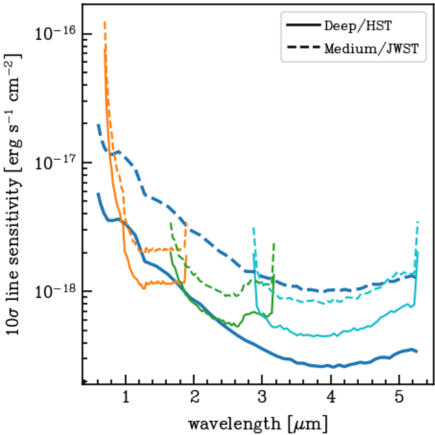
- NIRSpec MOS targets over 5000 HST- and JWST-detected faint sources with two deep 55 hr pointings, 14 medium pointings of ∼12 hr, and 15 shallower pointings of ∼4 hr, using five low-, medium-, and high-resolution dispersers covering 0.6–5.3 μm; the conclusions report 339 open-shutter hr of NIRSpec MOS.
- MIRI parallels provide ∼10 arcmin² with 43 hr at 7.7 μm and thrice that area with 1.4–6.8 hr at 12.8 and 15 μm; the deep MIRI F770W 10σ point-source sensitivity is 27.5 AB. Deep/HST NIRSpec confirmed two galaxies at z = 12.6 and 13.2.
Methods
- Design: a two-layer “wedding cake” survey in GOODS-S and GOODS-N, with NIRCam Deep Prime, Medium Prime, Deep Parallel, and Medium Parallel imaging; NIRSpec MOS tiers Deep/HST, Deep/JWST, Medium/HST, and Medium/JWST; and MIRI Deep and Medium parallels.
- Sample and targeting: NIRSpec targets are selected from HST and/or JWST imaging and prioritized largely by redshift and flux. JADES typically supplies at least 200 targets per arcmin², yielding about 150 assigned targets on prism designs, an average assignment rate of only 9%.
- Analysis: this is an overview/descriptive paper of survey design and executed observations. Depths are estimated with the JWST Exposure Time Calculator and independently from blank-sky aperture variance; preparation used eMPT, JAGUAR simulations, and data challenges.
Limitations
- Stated in the paper: JADES was designed for one year but over-scheduling spread it over 18 months; instrument problems, guide-star failures, NIRSpec MSA shorts/glows, NIRCam persistence, wisps, and lost data affected parts of the program. The paper states NIRCam persistence effects on photometry have not yet been considered, and MIRI had minor background-subtraction, dither-step, and astrometry issues.
- Stated in the paper: NIRCam Deep Parallel dithering is set by the NIRSpec MSA and not tuned to the NIRCam pixel scale, and the SW chip gaps are not filled; Medium Parallel also does not cover SW chip gaps, and some targets can only be placed on one or two subpointings.
- Evident from the text: this overview does not present final science results or full data-release analyses, and many data-quality caveats remain to be modeled or mitigated. The paper also notes that two fields mitigate but do not eliminate cosmic-variance concerns, since even more fields would better address them.
Model-written summary. Check it against the paper before relying on it.
Integrity signals
Registry
Cites
Statistics
Figures
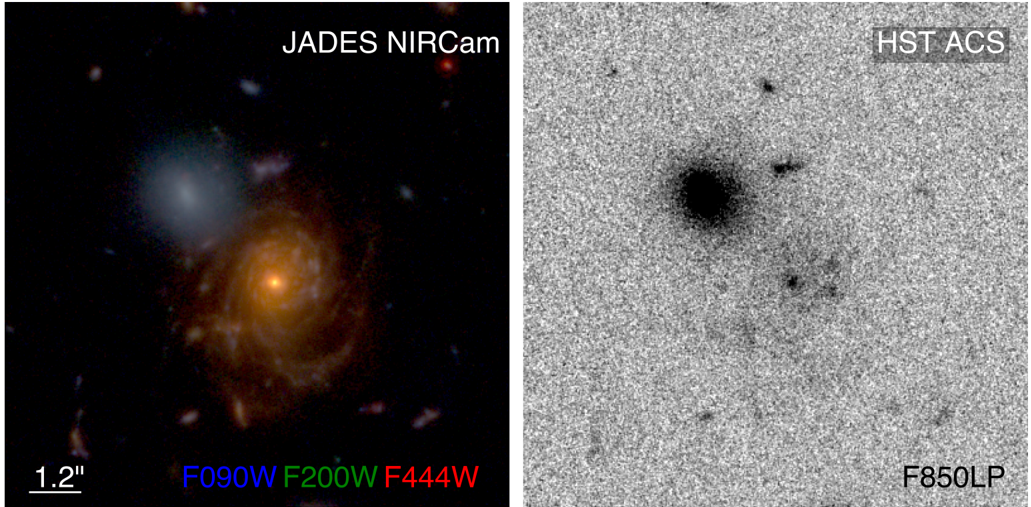
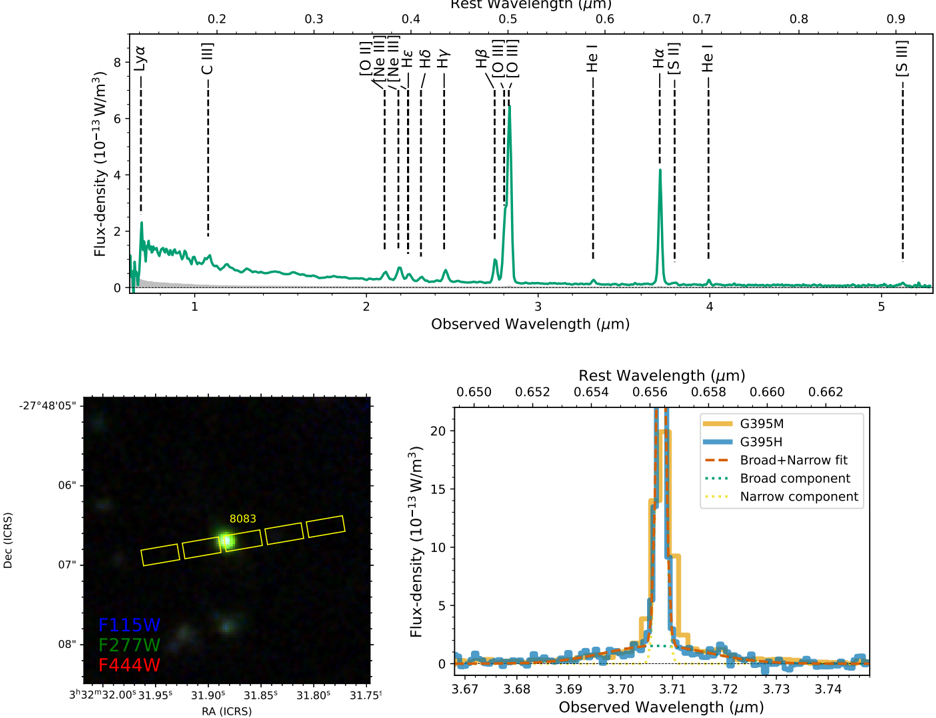
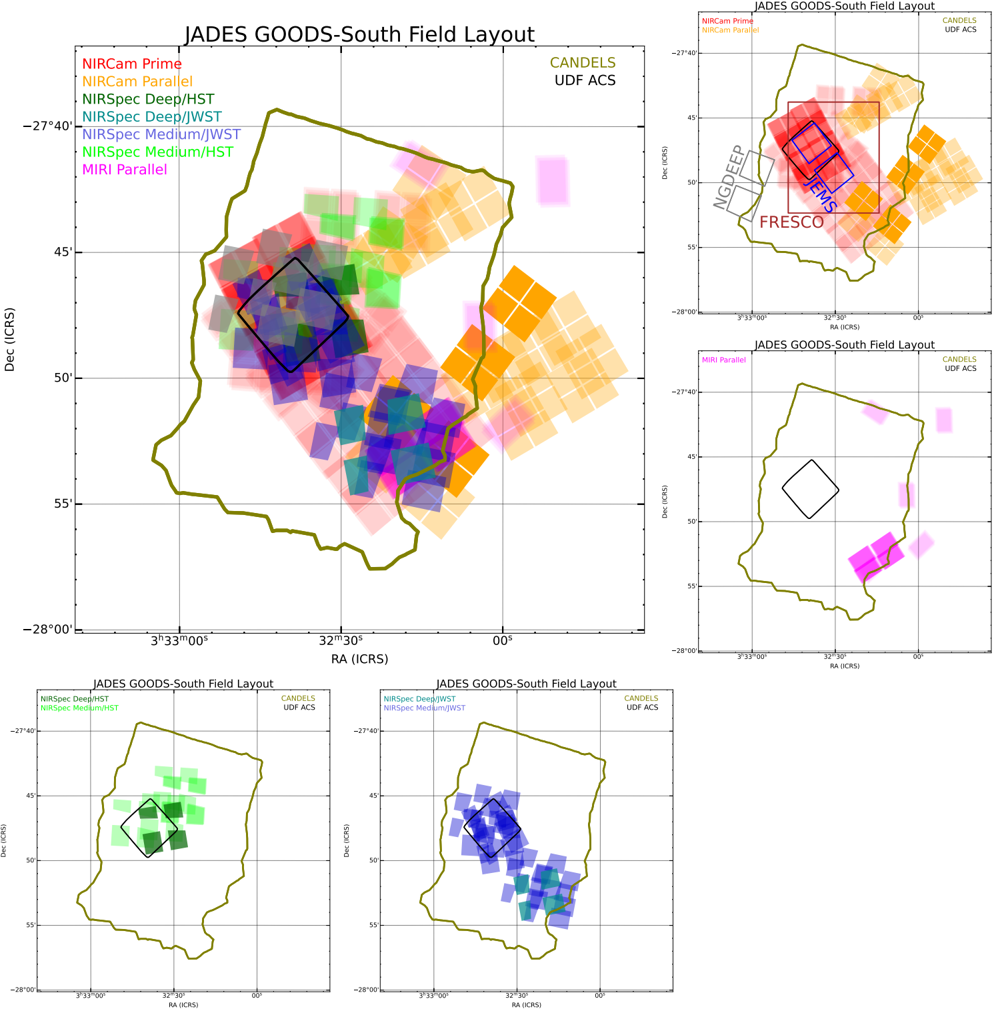
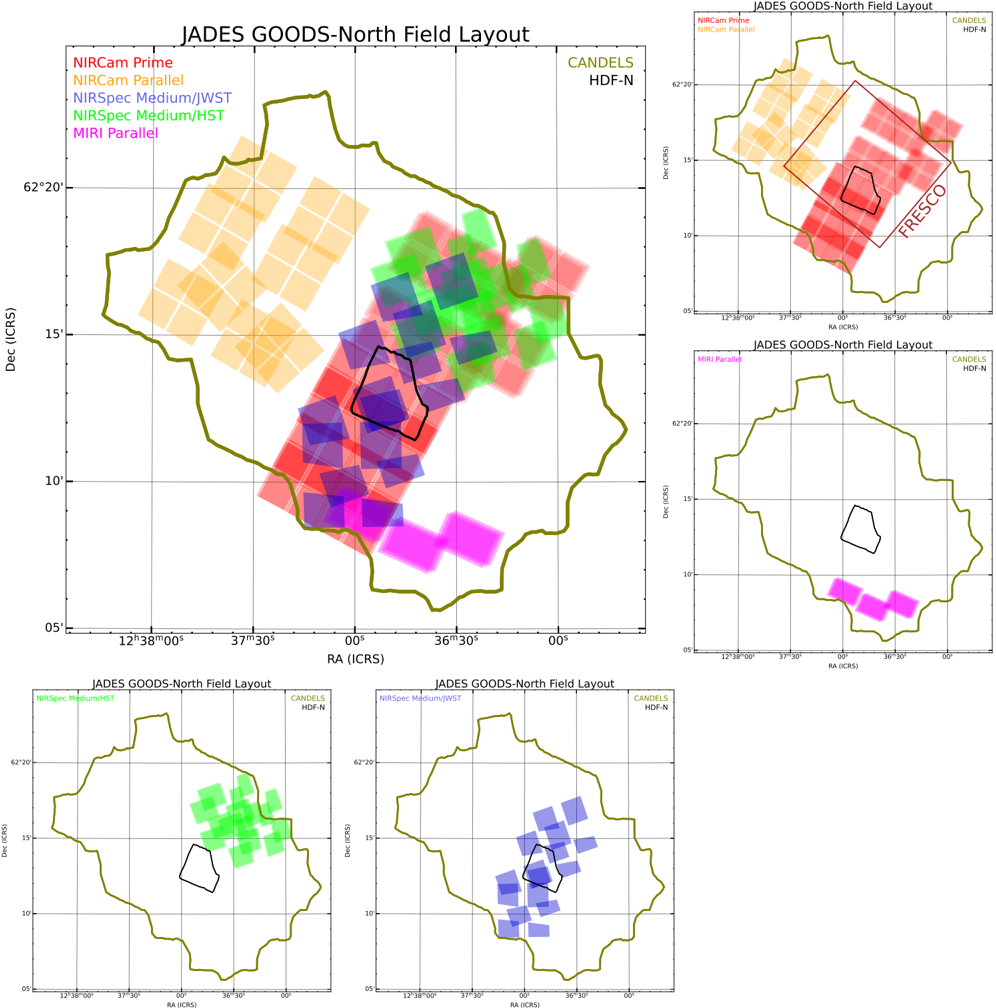
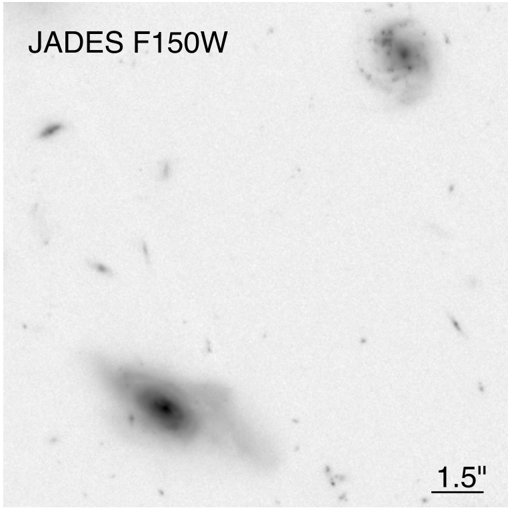
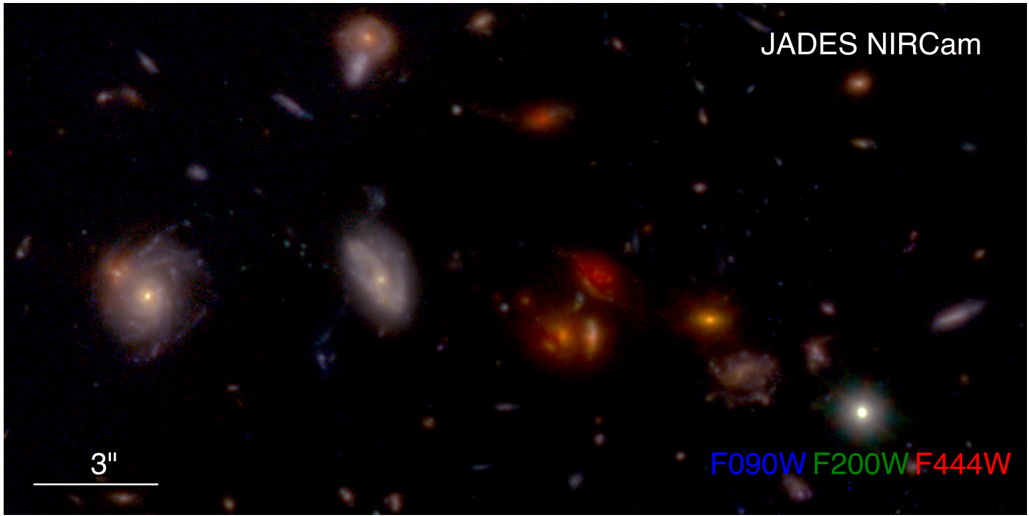
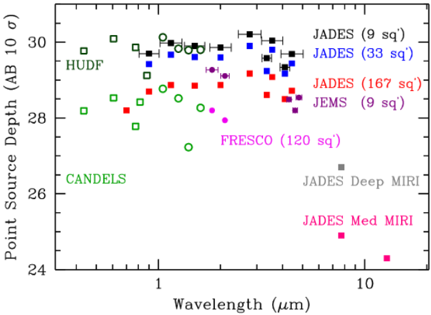
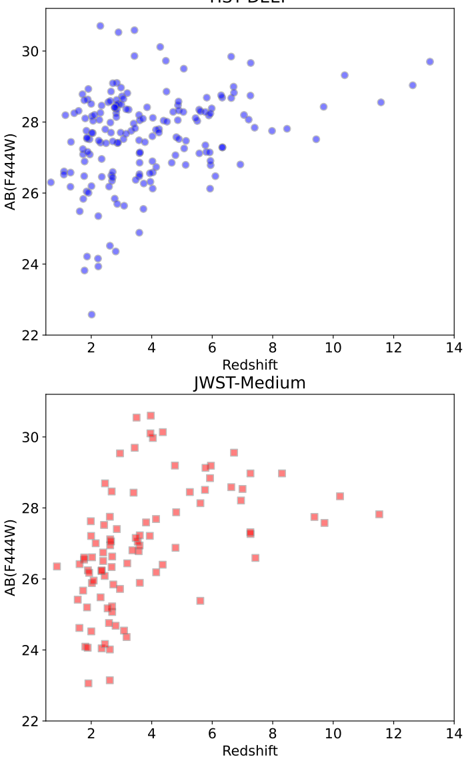
Verification
Claims the paper makes
0 Valid · 17 Not valid · 43 Not checked · 144 Own results and interpretations
A result the paper reports from its own data — it cites no other source for it, so there is none to check. The quote shows it is in the paper.
In the paper
“At about 770 hr of observing time plus coordinated parallels, JADES is the largest program operating in JWST Cycle 1”
§ Overview of the JWST Advanced Deep Extragalactic Survey (JADES) > 1. Introduction
plain- Asserted: passes — The authors put it forward as true.
- Checkable: passes — It can be checked against evidence.
- Load-bearing: unclear — It is unclear whether the paper’s conclusions depend on it.
- Based: passes — The paper gives a reason why it holds.
A result the paper reports from its own data — it cites no other source for it, so there is none to check. The quote shows it is in the paper.
In the paper
“Of course, these regions do also incur persistence from brighter sources in our own observations.”
- Also stated in: § 4.6. Data Quality Caveats · plain
“For instance, in 1181 observation 2, there is a bright star in the bad portion of A3 that creates a recurrent glow in all six dither locations.”
- Also stated in: § 4.6. Data Quality Caveats · plain
“And 1286 observation 8 contains the persistent glow of a bright star in observation 6.”
§ Overview of the JWST Advanced Deep Extragalactic Survey (JADES) > 4.6. Data Quality Caveats
plainstates a cause- Asserted: passes — The authors put it forward as true.
- Checkable: passes — It can be checked against evidence.
- Load-bearing: unclear — It is unclear whether the paper’s conclusions depend on it.
- Based: passes — The paper gives a reason why it holds.
- Also stated in: § 4.6. Data Quality Caveats · plain
A result the paper states — it cites no source for it, so there is none to check. The quote shows it is in the paper.
In the paper
“Between these two, we note that F182M and F210M are available for a notable portion of JADES.”
§ Overview of the JWST Advanced Deep Extragalactic Survey (JADES) > 3.4. Other Overlapping JWST Data
plain- Asserted: passes — The authors put it forward as true.
- Checkable: passes — It can be checked against evidence.
- Load-bearing: unclear — It is unclear whether the paper’s conclusions depend on it.
- Based: passes — The paper gives a reason why it holds.
None of the sources cited for this claim have been checked yet.
In the paper
“JADES includes mediumband filters in the NIRCam long-wave channel that can help identify and distinguish high-z candidates from dusty, strong emission-line sources at lower redshifts”
§ Overview of the JWST Advanced Deep Extragalactic Survey (JADES) > 2.1. Motivations
What the sources say
- Not checked yetcites P. Arrabal Haro et al. 2023 matched to “Confirmation and refutation of very luminous galaxies in the early Universe” (2023) source
- Not checked yetcites S. Fujimoto et al. 2023
- Not checked yetcites J. A. Zavala et al. 2023
plainstates a possible cause- Asserted: passes — The authors put it forward as true.
- Checkable: passes — It can be checked against evidence.
- Load-bearing: passes — The paper’s conclusions depend on it.
- Based: passes — The paper gives a reason why it holds.
A result the paper states — it cites no source for it, so there is none to check. The quote shows it is in the paper.
In the paper
“our program is providing large training samples for the photometric redshift methods that supply redshifts for the rest of the imaging sample.”
§ Overview of the JWST Advanced Deep Extragalactic Survey (JADES) > 2.2. Opportunities of a Combined Imaging and Spectroscopy Program
plainstates a cause- Asserted: passes — The authors put it forward as true.
- Checkable: passes — It can be checked against evidence.
- Load-bearing: passes — The paper’s conclusions depend on it.
- Based: passes — The paper gives a reason why it holds.
52 more claims
Create a free account to see all 204 claims and to verify the 83 references still open.
- Probably not a substantial claim. 66
- It may state two separate claims as one. 117
- The quote only partly states this claim. 1
Self-check
Percentages, sums and reported differences re-computed from the paper’s own numbers.
Each contradiction between two passages listed here was confirmed by an independent check.
Rated minor: it would not touch a result — a value no result rests on, a p-value that stays on the same side of the significance level, or a conflict that is clerical, resolved elsewhere in the paper, or outside its own findings.
In the paper
§ Overview of the JWST Advanced Deep Extragalactic Survey (JADES) > 4.5. Comments on Filter Selection
“We chose F182M and F300W as the most sensitive in each of these wide bands.”
§ Overview of the JWST Advanced Deep Extragalactic Survey (JADES) > 4.5. Comments on Filter Selection
“By adding F300M, F182M, and F162M, we provide a single medium-band filter in each of F277W, F200W, and F150W.”
Rated minor: it would not touch a result — a value no result rests on, a p-value that stays on the same side of the significance level, or a conflict that is clerical, resolved elsewhere in the paper, or outside its own findings.
In the paper
§ Overview of the JWST Advanced Deep Extragalactic Survey (JADES) > 5.6. NIRSpec Medium/HST Spectroscopy
“For a fifth target set (configuration 5, the first half of observation 26), the grating exposures are unaffected but the prism exposures were flooded by the short.”
§ Overview of the JWST Advanced Deep Extragalactic Survey (JADES) > 5.6. NIRSpec Medium/HST Spectroscopy
“These are MSA configurations 2, 4, 6, and 10, which are the second half of observations 25, 26, 27, and 29, respectively.”
Citations
Cites
Planck 2018 results: VI. Cosmological parameters
Planck Collaboration, Aghanim, N., Akrami, Y., Ashdown, M., Aumont, J., Baccigalupi, C., Ballardini, M., Banday, A. J., Barreiro, R. B., Bartolo, N., et al. (2020) · Astronomy & Astrophysics · doi:10.1051/0004-6361/201833910 · Cited by 14,258
Gaia Data Release 2: Summary of the contents and survey properties
Gaia Collaboration, Brown, A. G. A., Vallenari, A., Prusti, T., de Bruijne, J. H. J., Babusiaux, C., Bailer-Jones, C. A. L., Biermann, M., Evans, D. W., Eyer, L., et al. (2018) · Astronomy & Astrophysics · doi:10.1051/0004-6361/201833051 · Cited by 8,442
Gaia Collaboration, Prusti, T., de Bruijne, J. H. J., Brown, A. G. A., Vallenari, A., Babusiaux, C., Bailer-Jones, C. A. L., Bastian, U., Biermann, M., Evans, D. W., et al. (2016) · Astronomy & Astrophysics · doi:10.1051/0004-6361/201629272 · Cited by 6,946
CANDELS: THE COSMIC ASSEMBLY NEAR-INFRARED DEEP EXTRAGALACTIC LEGACY SURVEY
Grogin, N. A., Kocevski, D. D., Faber, S. M., Ferguson, H. C., Koekemoer, A. M., Riess, A. G., Acquaviva, V., Alexander, D. M., Almaini, O., Ashby, M. L. N., et al. (2011) · The Astrophysical Journal Supplement Series · doi:10.1088/0067-0049/197/2/35 · Cited by 2,133 · cited 10×
“Two of the NIRCam prime pointings did not have MIRI or NIR-Spec parallels that would fall on NIRCam imaging or GOODS; we opted to use MIRI, to be partnered with HST CANDELS imaging and perhaps future NIRCam data.”
InfluentialSelf-citationKoekemoer, A. M., Faber, S. M., Ferguson, H. C., Grogin, N. A., Kocevski, D. D., Koo, D. C., Lai, K., Lotz, J. M., Lucas, R. A., McGrath, E. J., et al. (2011) · The Astrophysical Journal Supplement Series · doi:10.1088/0067-0049/197/2/36 · Cited by 2,052 · cited 2×
“The DC2 sample used a combination of the CANDELS (Grogin et al. 2011; Koekemoer et al. 2011) catalog with S´ersic parameters estimated by van der Wel et al. (2012) and objects from JAGUAR, which also provides S´ersic parameters.”
Self-citationOverview of the DESI Legacy Imaging Surveys
Dey, A., Schlegel, D. J., Lang, D., Blum, R., Burleigh, K., Fan, X., Findlay, J. R., Finkbeiner, D., Herrera, D., Juneau, S., et al. (2019) · The Astronomical Journal · doi:10.3847/1538-3881/ab089d · Cited by 1,865 · cited 1×
“To browse the sky, we developed FitsMap (Hausen & Robertson 2022), inspired in part by the Legacy Survey viewer led by D. Lang (Dey et al. 2019).”
Self-citationThe Great Observatories Origins Deep Survey: Initial Results from Optical and Near-Infrared Imaging
Giavalisco, M., Ferguson, H. C., Koekemoer, A. M., Dickinson, M., Alexander, D. M., Bauer, F. E., Bergeron, J., Biagetti, C., Brandt, W. N., Casertano, S., et al. (2004) · The Astrophysical Journal · doi:10.1086/379232 · Cited by 1,678 · cited 2×
“…field and that of the Chandra Deep Field South (Giacconi et al. 2002) were broadened out to form the Great Observa-tories Origins Deep Survey (GOODS Giavalisco et al. 2004), utilizing the new opportunities of the HST Advanced Camera for Surveys (ACS) and Spitzer infrared telescope to partner with…”
The Hubble Deep Field: Observations, Data Reduction, and Galaxy Photometry
Williams, R. E., Blacker, B., Dickinson, M., Dixon, W. V. D., Ferguson, H. C., Fruchter, A. S., Giavalisco, M., Gilliland, R. L., Heyer, I., Katsanis, R., et al. (1996) · The Astronomical Journal · doi:10.1086/118105 · Cited by 1,076 · cited 1×
“It boldly unveiled the high-redshift Universe in a single multi-color blank-field image (Williams et al. 1996; Ferguson et al. 2000).”
Beckwith, S. V. W., Stiavelli, M., Koekemoer, A. M., Caldwell, J. A. R., Ferguson, H. C., Hook, R., Lucas, R. A., Bergeron, L. E., Corbin, M., Jogee, S., et al. (2006) · The Astronomical Journal · doi:10.1086/507302 · Cited by 884 · cited 2×
“Soon after, the Hubble Ultra Deep Field (HUDF) was sited in the heart of GOODS-S (Beckwith et al. 2006).”
The ALADIN interactive sky atlas: A reference tool for identification of astronomical sources
Bonnarel, F., Fernique, P., Bienaymé, O., Egret, D., Genova, F., Louys, M., Ochsenbein, F., Wenger, M., & Bartlett, J. G. (2000) · Astronomy and Astrophysics Supplement Series · doi:10.1051/aas:2000331 · Cited by 819
Research works printed but not linked: 1
- Giardino, G., Ferruit, P., & Chevallard, J. 2019, ASPC, 523, 645
Cited by
Items 501–600 of 754
Accelerated size evolution in the FirstLight simulations from z=14 to z=5
Ceverino, D., Nakazato, Y., Yoshida, N., Klessen, R., Glover, S. C. O., & Costantin, L. (2026) · Astronomy and Astrophysics · doi:10.1051/0004-6361/202659697 · Cited by 6
A Deep ALMA Survey of the Redshift Distribution of Dusty Star-forming Galaxies
McKay, S. J., Barger, A. J., Cowie, L. L., & Bauer, F. E. (2026) · The Astrophysical Journal · doi:10.3847/1538-4357/ae8a4f · Cited by 6
“The JADES catalogs include the Hubble Space Telescope ( HST ) photometry from the Hubble Legacy Field mosaics ( G. Illing-worth et al. 2016; K. E. Whitaker et al. 2019 ) , measured consistently with the JWST photometry ( D. J. Eisenstein et al. 2026 ) .”
Pacucci, F., & Urry, C. M. (2026) · The Astrophysical Journal Letters · doi:10.3847/2041-8213/aeaa52 · Cited by 6
“…compactness and color selection criteria across several deep JWST surveys: we use its sources in CEERS (S. L. Finkelstein et al. 2025), the JADES GOODS-S footprint (D. J. Eisenstein et al. 2026), NGDEEP (M. B. Bagley et al. 2024), and the PRIMER COSMOS and UDS mosaics (J. S. Dunlop et al. 2021).”
Veraldi, E., Vallini, L., Pozzi, F., Esposito, F., Béthermin, M., Boquien, M., Faisst, A. L., Ginolfi, M., Gobat, R., Gruppioni, C., et al. (2024) · Astronomy and Astrophysics · doi:10.1051/0004-6361/202451111 · Cited by 6
The AstroSat UV Deep Field South. II. A Diverse Set of Lyman-continuum Leakers at z ∼ 1
Maulick, S., Saha, K., & Rutkowski, M. J. (2025) · The Astrophysical Journal · doi:10.3847/1538-4357/adc10e · Cited by 6
The IR Compactness of Dusty Galaxies Sets Star Formation and Dust Properties at z ∼ 0–2
McKinney, J., Pope, A., Kirkpatrick, A., Armus, L., Díaz-Santos, T., Gómez-Guijarro, C., Franco, M., Elbaz, D., Hayward, C. C., Inami, H., et al. (2023) · The Astrophysical Journal · doi:10.3847/1538-4357/ace25c · Cited by 6
Sears, H., Chornock, R., Strader, J., Perley, D. A., Blanchard, P. K., Margutti, R., & Tanvir, N. R. (2024) · The Astrophysical Journal · doi:10.3847/1538-4357/ad2e93 · Cited by 6
Spatially resolved metallicity and ionization in the merging system Gz9p3 at z=9.3Preprint
Bik, A., Álvarez-Márquez, J., Gómez, A. C., Colina, L., Pérez‐González, P. G., Östlin, G., Blanco-Prieto, C., Melinder, J., Langeroodi, D., Wright, G. S., et al. (2026) · arXiv · doi:10.48550/arxiv.2604.22460 · Cited by 6
Self-citationThe JADES Transient Survey II: Volumetric Supernova Rates out to z~5Preprint
DeCoursey, C., Vassallo, C., Strolger, L.-G., Pierel, J. D. R., Egami, E., Mattila, S., Rest, A., Coulter, D. A., Bunker, A. J., Cameron, A. J., et al. (2026) · arXiv · doi:10.48550/arxiv.2607.12018 · Cited by 6
Self-citationThe Return to the Einstein Spherical Universe: The Dawning Moment of a New Cosmic SciencePreprint
Wu, B. (. (2025) · Preprints.org · doi:10.20944/preprints202504.0727.v2 · Cited by 5
A Population of Little Red Dot-like Quasars in SDSS*
Casey, Q. O., Hickox, R. C., Cleri, N. J., Cohn, J. H., Alexander, D. M., Durodola, E., Whalen, K. E., Hviding, R. E., & Ananna, T. T. (2026) · The Astrophysical Journal · doi:10.3847/1538-4357/aea419 · Cited by 5
“Specifically, we show JADES-68797/53501/13704/28074 (Eisenstein et al. 2026), RUBIES-uds-40579/31747/47509 (de Graaff et al. 2025a), and UNCOVER-4286/45924 (Bezanson et al. 2024).”
Self-citationSearching for Quiescent Galaxies over $3 < z < 6$ in JWST Surveys Using Manifold LearningPreprint
de la Vega, A., Babcock, M. D., Mobasher, B., Riemann, D. A., Chartab, N., Hemmati, S., Long, A. S., & Sanjaripour, S. (2025) · arXiv · doi:10.48550/arxiv.2501.09066 · Cited by 5
Little red dots: the assembly of early supermassive black holes in the JWST Era
Vaida, D. D., & Farber, R. J. (2026) · Frontiers in Astronomy and Space Sciences · doi:10.3389/fspas.2026.1779045 · Cited by 5
“On the other hand, recent analysis of LRD from the JWST Advanced Deep Extragalactic Survey (JADES; Eisenstein et al., 2023) with NIRCam and MIRI photometry suggest one LRD with a 2% AGN contribution to the luminosity, one completely star-forming, and the rest with 20-70% contributions from AGN…”
Raising the reionization optical depth with inflationary CMB featuresPreprint
Jhaveri, T., Hu, W., & Miranda, V. (2026) · arXiv · doi:10.48550/arxiv.2606.20795 · Cited by 5
Accelerated evolution of galaxy host halo masses during Cosmic Dawn from deep JWST clustering
Dalmasso, N., Ferrami, G., Leethochawalit, N., Ventura, E. M., & Trenti, M. (2026) · Monthly Notices of the Royal Astronomical Society · doi:10.1093/mnras/stag001 · Cited by 5
Performance of photometric template fitting for ultra-high-redshift galaxies
Clausen, T., Steinhardt, C. L., Shao, A., & Kumar, G. S. (2025) · Astronomy and Astrophysics · doi:10.1051/0004-6361/202453247 · Cited by 5
Burnham, E., Wang, B., Leja, J., Gonzales, O., Greene, J. E., Iyer, K. G., Mintz, A., Setton, D. J., Wellons, S., Bezanson, R., et al. (2026) · The Astrophysical Journal · doi:10.3847/1538-4357/ae562d · Cited by 5
Self-citationGuzmán-Ortega, A., Bruzual, G. A., Rodríguez-Gómez, V., & Hernquist, L. (2025) · Monthly Notices of the Royal Astronomical Society · doi:10.1093/mnras/staf1956 · Cited by 5
Toward Reconciling Reionization with JWST: The Role of Bright Galaxies and Strong Feedback
Bera, A., Hassan, S., Feldmann, R., Davé, R., & Finlator, K. (2026) · The Astrophysical Journal · doi:10.3847/1538-4357/ae5e4b · Cited by 5
Sun, H., Wang, T., Xu, K., Elbaz, D., Merlin, E., Cheng, C., Daddi, E., Jin, S., Wang, W.-H., Chen, L., et al. (2026) · The Astrophysical Journal Supplement Series · doi:10.3847/1538-4365/ae69d2 · Cited by 5
“Rieke et al. 2023; D. J. Eisenstein et al. 2026 ) at the bright end.”
Zhang, Y., Ji, Z., Bezanson, R., Williams, C. C., Brammer, G., Cloonan, A. P., de Graaff, A., Greene, J. E., Hirschmann, M., Jespersen, C. K., et al. (2026) · The Astrophysical Journal Letters · doi:10.3847/2041-8213/ae75ac · Cited by 5
Self-citationLittle Red Dot Progenitors from Compact Starbursts: A Natural Path to Early AGN Formation
Liempi, M., Latif, M. A., & Schleicher, D. R. G. (2026) · The Astrophysical Journal · doi:10.3847/1538-4357/ae7710 · Cited by 5
“The emergence of little red dots ( LRDs ) in James Webb Space Telescope ( JWST ) surveys, particularly the JWST Advanced Deep Extragalactic Survey ( D. J. Eisenstein et al. 2025, 2026 ) , has challenged existing paradigms of early galaxy and black hole ( BH ) coevolution.”
Wu, Z., Johnson, B. D., Eisenstein, D. J., Cargile, P. A., Hainline, K., Hausen, R., Rinaldi, P., Robertson, B. E., Tacchella, S., Williams, C. C., et al. (2026) · The Astronomical Journal · doi:10.3847/1538-3881/ae8254 · Cited by 5
Self-citationDanhaive, A. L., & Tacchella, S. (2026) · Monthly Notices of the Royal Astronomical Society · doi:10.1093/mnras/stag1965 · Cited by 5
Self-citationHamed, M., Pérez‐González, P. G., Annunziatella, M., Colina, L., Małek, K., Shivaei, I., Perna, M., Bunker, A. J., Arribas, S., Álvarez-Márquez, J., et al. (2026) · Astronomy and Astrophysics · doi:10.1051/0004-6361/202659082 · Cited by 5
Self-citationCentral Concentration and Escape of Ionizing Photons in Galaxies at the Epoch of Reionization
Lyu, C., Wang, E., Wang, J., Cheng, J., Song, J., Chen, Y., Chen, Z., Yu, H., Ma, C., Wang, J., et al. (2025) · The Astrophysical Journal Letters · doi:10.3847/2041-8213/adf0f9 · Cited by 5
Self-citationEvolution of the star formation rate surface density main sequence
Nadolny, J., Michałowski, M. J., Parente, M., Solar, M., Nowaczyk, P., Ryzhov, O., & Leśniewska, A. (2025) · Astronomy and Astrophysics · doi:10.1051/0004-6361/202452794 · Cited by 5
Metal-polluted Population III galaxies and How to Find ThemPreprint
Rusta, E., Salvadori, S., Gelli, V., Schaerer, D., Alessandro, M., Koutsouridou, I., & Carniani, S. (2025) · arXiv · doi:10.48550/arxiv.2506.17400 · Cited by 5
Self-citationIntense and extended CIII] emission suggests a strong outflow in JADES-GS-z14-0Preprint
Carniani, S., Jakobsen, P., Venturi, G., D’Eugenio, F., Looser, T. J., Witstok, J., Willmer, C. N. A., Ferrara, A., Wu, Z., Arribas, S., et al. (2026) · arXiv · doi:10.48550/arxiv.2604.11899 · Cited by 5
Self-citationStellar feedback SPICEs up [C II] emission in the first galaxiesPreprint
Bhagwat, A., Costa, T., Ciardi, B., & Battaia, F. A. (2026) · arXiv · doi:10.48550/arxiv.2604.18731 · Cited by 5
The progenitors of $z\gtrsim10$ JWST galaxies in the COLIBRE simulationsPreprint
Chaikin, E., Pontzen, A., Frenk, C. S., Schaye, J., Lu, S., Crain, R. A., & Durrant, A. (2026) · arXiv · doi:10.48550/arxiv.2608.19007 · Cited by 5
Bourakadi, K. E., Chakir, H. E., & Khlopov, M. (2024) · Journal of Cosmology and Astroparticle Physics · doi:10.1088/1475-7516/2024/07/018 · Cited by 4
“GN-z11 was initially detected by [120, 121] and subsequently examined in the JWST Advanced Deep Extragalactic Survey [122] using NIRSpec spectroscopy [123] and NIRCam imaging [124].”
An X-ray-emitting protocluster at z ≈ 5.7 reveals rapid structure growth
Bogdán, Á., Schellenberger, G., Li, Q., & Conselice, C. J. (2026) · Nature · doi:10.1038/s41586-025-09973-1 · Cited by 4
“X-ray and Sunyaev– Zel’dovich (SZ) observations have been widely used to identify clusters and protoclusters in the early universe, up to z ≈ 2.5, that are either gravitationally collapsed or in the process of collapsing 11–19 .”
InfluentialZhang, Y., Miller, T. B., Price, S. H., Suess, K. A., Bezanson, R., Setton, D. J., Leja, J., Whitaker, K. E., Greene, J. E., Feldmann, R., et al. (2026) · The Astrophysical Journal Supplement Series · doi:10.3847/1538-4365/ae82f7 · Cited by 4
“Some early JWST surveys target the blank legacy fields (Eisenstein et al. 2026; Finkelstein et al. 2023; Donnan et al. 2024) and obtain wide-area NIRCam (Rieke et al. 2023) broad-band images.”
Self-citationCold Gas Infall onto a Brightest Group Galaxy via a Gas-rich Minor Merger
Zhuang, M.-Y., Shangguan, J., Bian, Y. L., Shen, Y. G., Ho, C. L., Min, D., Li, J., Li, Z., & Jing, W. A. N. G. (2026) · The Astrophysical Journal Letters · doi:10.3847/2041-8213/ae45a9 · Cited by 4
Chen, N., Motohara, K., Spitler, L. R., & Malkan, M. A. (2025) · The Astrophysical Journal · doi:10.3847/1538-4357/adad69 · Cited by 4
Going Wide and Deep with Roman: The z~6-9 UV luminosity function in a Roman Deep FieldPreprint
Bagley, M. B., Finkelstein, S. L., Rhoads, J., Malhotra, S., Yung, L. Y. A., Somerville, R. S., & Papovich, C. (2026) · arXiv · doi:10.48550/arxiv.2603.09828 · Cited by 4
Massive black holes in the first billion years with JWST
Übler, H. (2026) · Nature Astronomy · doi:10.1038/s41550-026-02966-8 · Cited by 4
Self-citationSong, J., Ouchi, M., Kiyota, T., Zhu, C., Kong, X., & Nakazato, Y. (2026) · arXiv · doi:10.48550/arxiv.2605.23049 · Cited by 4
Crotts, K. A., Carter, A. L., Biller, B. A., Booth, M., Bowens-Rubin, R., Bendahan-West, R., Ferrer-Chávez, R., Lawson, K., Lewis, B. L., Marino, S., et al. (2026) · The Astrophysical Journal · doi:10.3847/1538-4357/ae9083 · Cited by 4
UV-to-optical insights into the black hole star model in little red dots
Mérida, R. M., Sawicki, M., Willott, C. J., Gaspar, G., & Iyer, K. G. (2026) · Astronomy and Astrophysics · doi:10.1051/0004-6361/202661390 · Cited by 4
Self-citationDust giant: Extended and clumpy star-formation in a massive dusty galaxy at z = 1.38
Kokorev, V., Jin, S., Gómez-Guijarro, C., Magdis, G., Valentino, F. M., Lee, M., Daddi, E., Liu, D., Sargent, M., Trebitsch, M., et al. (2023) · Astronomy and Astrophysics · doi:10.1051/0004-6361/202346937 · Cited by 4
UV slopes of star-forming galaxies in strong-lensing fields at the epoch of reionisation with JWST
Felicioni, G., Bradač, M., Asada, Y., Martis, N. S., Sarrouh, G. T. E., Desprez, G., Rihtaršič, G., Jagga, N., Harshan, A., Judež, J., et al. (2026) · Astronomy and Astrophysics · doi:10.1051/0004-6361/202659485 · Cited by 4
Self-citationRinaldi, P., Alberts, S. L., Willmer, C. N. A., Carreira, C., Williams, C. C., Noirot, G., Gilbert, C. J. E., Bunker, A. J., Baker, W. M., Barchiesi, L., et al. (2026) · arXiv · doi:10.48550/arxiv.2602.24162 · Cited by 4
Self-citationGillman, S., Ito, K., Valentino, F. M., Brammer, G., Araya-Araya, P., Magdis, G., Dudzevičiūtė, U., Vijayan, A. P., Lee, M., Gullberg, B., et al. (2026) · Astronomy and Astrophysics · doi:10.1051/0004-6361/202659541 · Cited by 4
Euclid: Quick Data Release (Q1) – Photometric studies of known transients
Duffy, C., Cappellaro, E., Botticella, M. T., Hook, I., Poidevin, F., Moriya, T. J., Chrimes, A. A., Petrecca, V., Paterson, K., Goobar, A., et al. (2026) · Astronomy and Astrophysics · doi:10.1051/0004-6361/202554600 · Cited by 4
Hoshi, A., & Yamada, T. (2025) · The Astrophysical Journal · doi:10.3847/1538-4357/adeb6a · Cited by 4
Improved measurements of the age of JWST galaxies at z = 6 − 10
López-Corredoira, M., & Gutiérrez, C. M. (2026) · Monthly Notices of the Royal Astronomical Society · doi:10.1093/mnras/stag089 · Cited by 4
Beyond UV: Rest-frame B -band and Apparent Luminosity Functions of z = 5–9 Galaxies
Leethochawalit, N., Morishita, T., Worrakitpoonpon, T., & Trenti, M. (2026) · The Astrophysical Journal · doi:10.3847/1538-4357/ae374b · Cited by 4
A JWST Pa α Calibration of the Radio Luminosity–Star Formation Rate Relation at z ∼ 1.3
Seymour, N., Hale, C. L., Whittam, I. H., Oesch, P. A., Covelo-Paz, A., Wuyts, S., Afonso, J., Bowler, R. A. A., Grundy, J. A., Jaiswar, R., et al. (2026) · The Astrophysical Journal · doi:10.3847/1538-4357/ae3a7d · Cited by 4
Self-citationPerna, M., Arribas, S., Hamed, M., D’Eugenio, F., Lamperti, I., Bunker, A. J., Carniani, S., Charlot, S., Maiolino, R., Pino, B. R. D., et al. (2026) · Astronomy and Astrophysics · doi:10.1051/0004-6361/202658847 · Cited by 4
Self-citationLiu, F. Y. F., McLeod, D. J., Sutlieff, B. J., Dupuy, T. J., Dunlop, J. S., Chen, X., McLure, R. J., Leung, H.-H., Antonogiannaki, S., Bondestam, C., et al. (2026) · Monthly Notices of the Royal Astronomical Society · doi:10.1093/mnras/stag2055 · Cited by 4
The Hubble parameter of the Local Distance Ladder from dynamical dark energy with no free parameters
van Putten, M. H. P. M. (2024) · Corfu Summer Institute School and Workshops on Elementary Particle Physics and Gravity (CORFU) · doi:10.22323/1.463.0208 · Cited by 4
Model-independent reconstruction of UV luminosity function and reionization epoch
Adak, D., Hazra, D. K., Mitra, S., & Krishak, A. (2024) · Journal of Cosmology and Astroparticle Physics · doi:10.1088/1475-7516/2024/12/010 · Cited by 4
“Recent JWST data suggests an enhanced population of star-forming Galaxies above redshifts z ∼ 9 [83, 84]. luminosity Compared to [56] new data may seem to hint towards a modification to the density evolution model.”
A High-resolution Far-infrared Survey to Probe Black Hole–Galaxy Co-evolution
Bonato, M., Leisawitz, D., de Zotti, G., Sommovigo, L., Shivaei, I., Urry, C. M., Farrah, D., Spencer, L. D., Ricketti, B. V., Rana, H., et al. (2024) · The Astrophysical Journal · doi:10.3847/1538-4357/ad8e36 · Cited by 4
Self-citationOn-orbit Degradation of the JWST/NIRSpec Micro-Shutter Array: Multiplexing and Target AcquisitionPreprint
Jakobsen, P. (2024) · arXiv · doi:10.48550/arxiv.2405.04530 · Cited by 4
Self-citationConstraints on the host galaxy and AGN properties of three z > 6 JWST AGN from NOEMA observationsPreprint
Mazzolari, G., Übler, H., Herrera-Camus, R., Davies, R., Tacconi, L. J., Lutz, D., Schreiber, N. M. F., D’Eugenio, F., Lee, M., Barfety, C., et al. (2026) · arXiv · doi:10.48550/arxiv.2603.29652 · Cited by 4
Self-citationSapori, M., Belli, S., Bugiani, L., Khoram, A. H., Liboni, C., Maheson, G., Brammer, G., Davies, R., Dayal, P., de Graaff, A., et al. (2026) · arXiv · doi:10.48550/arxiv.2607.20606 · Cited by 4
Self-citationReionization driven by the few: the ionizing budget of galaxies at z=5-10 from JWST/NIRSpecPreprint
Giovinazzo, E., Oesch, P. A., Verhamme, A., Meyer, R. A., Witten, C., Chisholm, J., Marques-Chaves, R., & Simmonds, C. (2026) · arXiv · doi:10.48550/arxiv.2607.22834 · Cited by 4
Self-citationHainline, K., Beiler, S. A., Burgasser, A. J., Chen, E. S., Helton, J. M., Leisenring, J., Miles, B., Marley, M. S., Mukherjee, S., Baum, S. A., et al. (2026) · arXiv · doi:10.48550/arxiv.2608.14786 · Cited by 4
Self-citationCosmic Noon Galaxies in the Hubble Ultra Deep Field with MIRI Wide-Field Slitless SpectroscopyPreprint
Kendrew, S., Östlin, G., Colina, L., Rinaldi, P., Álvarez-Márquez, J., Boogaard, L., Melinder, J., Pye, J. P., Alonso‐Herrero, A., Caputi, K. I., et al. (2026) · arXiv · doi:10.48550/arxiv.2609.16239 · Cited by 4
Self-citationConstraining the galaxy-halo connection at $z>10$ using the neighbors of UV-bright galaxiesPreprint
Nikolić, I., & Mason, C. A. (2026) · arXiv · doi:10.48550/arxiv.2609.33817 · Cited by 4
Too many or too bright? Status and perspectives in the study of the UV Luminosity Function at z>10Preprint
Fontana, A., Atek, H., Bromm, V., Bunker, A. J., Castellano, M., Dayal, P., D’Eugenio, F., Elbaz, D., Ferrara, A., Finkelstein, S. L., et al. (2026) · arXiv · doi:10.48550/arxiv.2610.12121 · Cited by 4
Self-citationMOSEL survey: Unwrapping the Epoch of Reionisation through mimic galaxies at Cosmic Noon
Jaiswar, R., Gupta, A., da Cunha, E., Trott, C. M., Harshan, A., Battisti, A. J., & Forrest, B. (2024) · Publications of the Astronomical Society of Australia · doi:10.1017/pasa.2024.37 · Cited by 3
A review of galaxy quenching — Part I: Defining the problem and observational results
Bluck, A. F. L. (2026) · The Astronomy and Astrophysics Review · doi:10.1007/s00159-026-00171-0 · Cited by 3
Williams, L. L. R., Perera, D., Liesenborgs, J., Meena, A. K., Limousin, M., & Ecker, L. R. (2026) · arXiv · doi:10.48550/arxiv.2609.27147 · Cited by 3
Dwarf Galaxies at Cosmic Noon: New JWST Constraints on Satellite Models and Subhalo Tidal Evolution
Wan, J. T., Mansfield, P., Suess, K. A., Wang, Y., Yuan, S., Williams, C. C., & Wechsler, R. H. (2026) · The Astrophysical Journal · doi:10.3847/1538-4357/ae5bba · Cited by 3
Self-citationDiffuse Neutrino Signals from Dark Stars Seeding Supermassive Black Holes
Schwemberger, T., & Takhistov, V. (2025) · The Astrophysical Journal Letters · doi:10.3847/2041-8213/ade5a9 · Cited by 3
Euclid Quick Data Release (Q1): XL. The impact of AGN emission on SED-derived physical properties
Laloux, B., Bongiorno, A., Salvato, M., Allevato, V., Mezcua, M., Roster, W., Zatarain, T. M., Paltani, S., Shirley, R. A., Tarsitano, F., et al. (2026) · Astronomy and Astrophysics · doi:10.1051/0004-6361/202659340 · Cited by 3
JADES: low surface brightness galaxies at 0.4 < z < 0.8 in GOODS-S
Shields, T., Rieke, M. J., Hainline, K., Helton, J. M., Bunker, A. J., Carreira, C., Curtis-Lake, E., Eisenstein, D. J., Johnson, B. D., Rinaldi, P., et al. (2026) · Monthly Notices of the Royal Astronomical Society · doi:10.1093/mnras/stag202 · Cited by 3
Self-citationJiang, Y., Shen, Y., Merz, G., Lin, S., Liu, X., Pan, Z., Zhuang, M., Roster, W., Salvato, M., Siudek, M., et al. (2026) · arXiv · doi:10.48550/arxiv.2604.03182 · Cited by 3
GA-NIFS: The interplay between feedback and star formation at 3 < z < 9 probed by JWST/NIRSpec IFU
Ulivi, L., Perna, M., Arribas, S., Pino, B. R. D., Pérez‐González, P. G., Lamperti, I., Marconcini, C., Übler, H., D’Eugenio, F., Böker, T., et al. (2026) · Astronomy and Astrophysics · doi:10.1051/0004-6361/202661424 · Cited by 3
Self-citationRapid Bulge Assembly in Young Galaxy Disks at Cosmic Dawn
Borgohain, A., & Saha, K. (2026) · The Astrophysical Journal Supplement Series · doi:10.3847/1538-4365/aea15d · Cited by 3
Impact of stellar population models on the estimated physical properties of galaxies
Stoyanova, B., Boquien, M., Santini, P., Tombesi, F., Merlin, E., Bergamini, P., Buat, V., & Burgarella, D. (2026) · Astronomy and Astrophysics · doi:10.1051/0004-6361/202658901 · Cited by 3
Detecting Molecular Hydrogen (H2) Emission at Cosmic Dawn
Johnson, M., Burkhart, B., D’Eugenio, F., Tacchella, S., Maiolino, R., Bialy, S., Bourlot, J. L., Roueff, E., Petit, F. L., Bron, É., et al. (2025) · The Astrophysical Journal · doi:10.3847/1538-4357/ae032d · Cited by 3
Self-citationThe Lyman-α emitter bispectrum as a probe of reionization morphology
Maitra, S., Kulkarni, G., Asthana, S., Bolton, J. S., Haehnelt, M. G., & Keating, L. C. (2025) · Monthly Notices of the Royal Astronomical Society · doi:10.1093/mnras/staf1262 · Cited by 3
Goovaerts, I., Rafelski, M. A., Beckett, A., Oyarzún, G. A., Citro, A., Hasan, F., Nedkova, K., Hawcroft, C., Koekemoer, A. M., Revalski, M., et al. (2026) · The Astrophysical Journal · doi:10.3847/1538-4357/ae75b0 · Cited by 3
Self-citationsagui: SED-based segmentation of multiband Galaxy images – application to JADES in GOODS-South
Souza, R. K., Wille, A., Shenoy, S., Patil, A. A., Krone-Martins, A., Chies-Santos, A. L., Bœhm, C., Rosa, R. R., Pessi, T., Ishida, É. E. O., et al. (2026) · Monthly Notices of the Royal Astronomical Society · doi:10.1093/mnras/stag1062 · Cited by 3
LCEz4-M1: A Lyman Continuum Emitter Candidate at z = 4.444 in the MUSE Hubble Ultra Deep Field
Zhu, S., Zheng, Z.-Y., Bian, F., Yuan, F.-T., Jiang, C., Zhang, X., Lin, R., & Guo, Y. (2026) · The Astrophysical Journal Letters · doi:10.3847/2041-8213/ae75e1 · Cited by 3
“LCEz4-M1 also falls within the footprint of JWST spectroscopic surveys such as the JWST Advanced Deep Extragalactic Survey ( JADES; D. J. Eisenstein et al. 2026 ) and the First Reionization Epoch Spectroscopically Complete Observations ( FRESCO; P. A. Oesch et al. 2023 ) , but has not been targeted…”
Chen, Y.-C., Zakamska, N. L., Vayner, A., Neustadt, J. M. M., Wylezalek, D., Rupke, D. S. N., Veilleux, S., Bertemes, C., Ishikawa, Y., Lau, M. W., et al. (2026) · The Astrophysical Journal · doi:10.3847/1538-4357/ae7c01 · Cited by 3
“With the advent of JWST, studies in deep fields ( S. L. Finkelstein et al. 2023; D. J. Eisenstein et al. 2026 ) have revealed numerous high-redshift SMBH candidates that appear to be overmassive relative to their host galaxies ( Y. Harikane et al. 2023; D. Kocevski et al. 2023; Y. J. E. Greene et…”
Through the fog: A complementary optical galaxy classification scheme for intermediate redshifts
Santos, D. M., Pappalardo, C., Miranda, H., Afonso, J., Matute, I., Carvajal, R., Lobo, C., Lagos, P., Papaderos, P., Paulino-Afonso, A., et al. (2025) · Astronomy and Astrophysics · doi:10.1051/0004-6361/202554528 · Cited by 3
Leonova, E., Naidu, R. P., Oesch, P. A., Brammer, G., Matthee, J., Meyer, R. A., Schaerer, D., & Xiao, M. (2025) · arXiv · doi:10.48550/arxiv.2512.06072 · Cited by 3
Hu, W., Papovich, C., Shen, L., Haro, P. A., Backhaus, B. E., Cleri, N. J., Dickinson, M., Dunlop, J. S., Finkelstein, S. L., Giavalisco, M., et al. (2026) · arXiv · doi:10.48550/arxiv.2605.02539 · Cited by 3
Tracing the Evolution of the Balmer Break from Cosmic Dawn to Cosmic Noon with JWSTPreprint
Kuruvanthodi, A., Schaerer, D., Marques-Chaves, R., Weibel, A., Korber, D., & Charbonnel, C. (2026) · arXiv · doi:10.48550/arxiv.2607.07698 · Cited by 3
Napolitano, L., Pentericci, L., Ferrara, A., Llerena, M., Dickinson, M., Calabrò, A., Finkelstein, S. L., Begley, R., Haro, P. A., Arroyo-Polonio, A., et al. (2026) · arXiv · doi:10.48550/arxiv.2609.00199 · Cited by 3
An Updated Characterization of Luminous Ly α Emitters at the End of Reionization
Ning, Y., Cai, Z., Jiang, L., Li, Q., Yu, S.-Y., Yu, X., & Zheng, Z.-Y. (2026) · The Astrophysical Journal Letters · doi:10.3847/2041-8213/aea091 · Cited by 2
“CDFS-z6lae-021 is covered by the JWST Cycle 1 program ( GO-1210 ) JWST Advanced Deep Extragalactic Survey ( JADES; M. J. Rieke et al. 2023; D. J. Eisenstein et al. 2026 ) .”
Bianchi, M. (2026) · Journal of Applied Mathematics and Physics · doi:10.4236/jamp.2026.147137 · Cited by 2
Kaviraj, S., Bichanga, B., Lazar, I., Watkins, A. E., Martin, G., & Jackson, R. A. (2025) · Monthly Notices of the Royal Astronomical Society · doi:10.1093/mnras/staf716 · Cited by 2
Spiral Arms across Cosmic Time: JWST Measurements of the Pitch Angles of Spiral Galaxies at z < 3.5
Kuhn, V., Guo, Y., Rentschler, S., Castillo, M., Nandi, G., Dugdale, E., & Mitiku, T. (2026) · The Astrophysical Journal · doi:10.3847/1538-4357/ae77fe · Cited by 2
Clumps in spiral galaxies at z ≲ 3: disentangling two spatial modes of star formation
Chugunov, I. V., & Marchuk, A. A. (2026) · Monthly Notices of the Royal Astronomical Society · doi:10.1093/mnras/stag940 · Cited by 2
Is GN-z11 powered by a super-Eddington massive black hole?Preprint
Bhatt, M., Gallerani, S., Ferrara, A., Mazzucchelli, C., D’Odorico, V., Valentini, M., Zana, T., Farina, E. P., & Chakraborty, S. (2024) · arXiv · doi:10.48550/arxiv.2401.13733 · Cited by 2
JWST Predictions for $z > 10$ Galaxies from the Renaissance Simulations -- I: Photometry and SizesPreprint
Hardin, S., Wise, J., & Troutman, E. K. (2026) · arXiv · doi:10.48550/arxiv.2605.30436 · Cited by 2
EPOCHS-DR2 I: Expanded data release and properties of $6.5Preprint
Austin, D., Conselice, C. J., Harvey, T., Adams, N., Quilley, L., D’Silva, J. C. J., Rusakov, V., Li, Q., Westcott, L., Goolsby, C. M., et al. (2026) · arXiv · doi:10.48550/arxiv.2609.24987 · Cited by 2
The Hubble parameter of the Local Distance Ladder from dynamical dark energy with no free parametersPreprint
van Putten, M. H. P. M. (2024) · arXiv · doi:10.48550/arxiv.2408.13121 · Cited by 2
Ragavan, D. C., Sureshkumar, U., Hilton, M., Hughes, J. P., Moodley, K., Mroczkowski, T. K., Partridge, B., Salatino, M., Sifón, C., Vavagiakis, E. M., et al. (2026) · Monthly Notices of the Royal Astronomical Society · doi:10.1093/mnras/stag778 · Cited by 2
BlackTHUNDER Reveals a Massive Filament around a Compact AGN at $z\simeq5.23$Preprint
Tozzi, G., Übler, H., Parlanti, E., Maiolino, R., Pulsoni, C., Somerville, R. S., Curti, M., Mazzolari, G., Barfety, C., Bertola, E., et al. (2026) · arXiv · doi:10.48550/arxiv.2607.05523 · Cited by 2
Self-citationThe Tale of Two Telescopes: How Hubble Uniquely Complements the James Webb Space Telescope: Galaxies
Windhorst, R. A., Summers, J., Carleton, T. M., Cohen, S. H., Croker, K. S., Jansen, R. A., O’Brien, R., Smith, B. M., Conselice, C. J., Diego, J. M., et al. (2025) · doi:10.3847/25c2cfeb.efb61a04 · Cited by 2
Huberty, M., Scarlata, C. M., Hayes, M., Henry, A. L., Berg, D. A., Cammelli, V., Ellis, R. S., Jaskot, A. E., Lin, Y.-H., Mehta, V., et al. (2026) · The Astrophysical Journal · doi:10.3847/1538-4357/ae9a94 · Cited by 2
“…2006; R. J. Bouwens et al. 2010; R. S. Ellis et al. 2013; H. I. Teplitz et al. 2013; M. J. Hayes et al. 2024 ) and both short-wavelength and long-wavelength imaging from the JWST / NIRCam ( D. J. Eisenstein et al. 2026; C. C. Williams et al. 2023 ) and NIRISS ( NGDEEP; M. B. Bagley et al. 2024 ) .”
InfluentialSelf-citationStanghellini, L., Kassin, S. A., Pacifici, C., Morrison, J. E., Dickinson, M., Sukay, E., Mulcahey, C. R., Bergeron, L., Regan, M. W., Willmer, C. N. A., et al. (2026) · The Astrophysical Journal · doi:10.3847/1538-4357/ae5a9f · Cited by 2
Self-citationThe Kormendy Relation in the First Billion Years: Evidence from JWST
Borgohain, A., & Saha, K. (2026) · The Astrophysical Journal Letters · doi:10.3847/2041-8213/ae7e83 · Cited by 2
Metadata
- Authors
- Eisenstein, D. J., Willott, C., Alberts, S., Arribas, S., Bonaventura, N., Bunker, A. J., Cameron, A. J., Carniani, S., Charlot, S., Curtis-Lake, E., D’Eugenio, F., Ferruit, P., Giardino, G., Hainline, K., Hausen, R., Jakobsen, P., Johnson, B. D., Maiolino, R., Rauscher, B. J., Rieke, M., Rieke, G., Rix, H.-W., Robertson, B., Stark, D. P., Tacchella, S., Williams, C. C., Willmer, C. N. A., Baker, W. M., Baum, S., Bhatawdekar, R., Boyett, K., Chen, Z., Chevallard, J., Circosta, C., Curti, M., Danhaive, A. L., DeCoursey, C., Endsley, R., de Graaff, A., Dressler, A., Egami, E., Helton, J. M., Hviding, R. E., Ji, Z., Jones, G. C., Kumari, N., Lützgendorf, N., Laseter, I., Looser, T. J., Lyu, J., Maseda, M. V., Nelson, E., Parlanti, E., Perna, M., Puskás, D., Rawle, T., Rodríguez Del Pino, B., Rujopakarn, W., Sandles, L., Saxena, A., Scholtz, J., Sharpe, K., Shivaei, I., Silcock, M. S., Simmonds, C., Skarbinski, M., Smit, R., Stone, M., Suess, K. A., Sun, F., Tang, M., Topping, M. W., Übler, H., Villanueva, N. C., Wallace, I. E. B., Whitler, L., Witstok, J., & Woodrum, C.
- Affiliations
- Center for Astrophysics Harvard & Smithsonian (US)
- Herzberg Institute of Astrophysics (CA)
- University of Arizona (US)
- Centro de Astrobiología (ES)
- University of Copenhagen (DK)
- University of Oxford (GB)
- Scuola Normale Superiore (IT)
- Centre National de la Recherche Scientifique (FR)
- University of Hertfordshire (GB)
- University of Cambridge (GB)
- European Space Agency (FR)
- Johns Hopkins University (US)
- Goddard Space Flight Center (US)
- Max Planck Institute for Astronomy (DE)
- University of California, Santa Cruz (US)
- NSF NOIRLab (US)
- University of Manitoba (CA)
- The University of Melbourne (AU)
- European Space Astronomy Centre (ES)
- European Southern Observatory (DE)
- The University of Texas at Austin (US)
- Carnegie Institution for Science (US)
- Space Telescope Science Institute (US)
- University of Wisconsin–Madison (US)
- University of Colorado Boulder (US)
- Chulalongkorn University (TH)
- Liverpool John Moores University (GB)
- ORCID
- Eisenstein, Daniel J.
- Willott, Chris
- Alberts, Stacey
- Arribas, Santiago
- Bonaventura, Nina
- Bunker, Andrew J.
- Cameron, Alex J.
- Carniani, Stefano
- Charlot, Stephane
- Curtis-Lake, Emma
- D’Eugenio, Francesco
- Ferruit, Pierre
- Giardino, Giovanna
- Hainline, Kevin
- Hausen, Ryan
- Jakobsen, Peter
- Johnson, Benjamin D.
- Maiolino, Roberto
- Rauscher, Bernard J.
- Rieke, Marcia
- Rieke, George
- Rix, Hans-Walter
- Robertson, Brant
- Stark, Daniel P.
- Tacchella, Sandro
- Williams, Christina C.
- Willmer, Christopher N. A.
- Baker, William M.
- Baum, Stefi
- Bhatawdekar, Rachana
- Boyett, Kristan
- Chen, Zuyi
- Chevallard, Jacopo
- Circosta, Chiara
- Curti, Mirko
- Danhaive, A. Lola
- DeCoursey, Christa
- Endsley, Ryan
- de Graaff, Anna
- Dressler, Alan
- Egami, Eiichi
- Helton, Jakob M.
- Hviding, Raphael E.
- Ji, Zhiyuan
- Jones, Gareth C.
- Kumari, Nimisha
- Lützgendorf, Nora
- Laseter, Isaac
- Looser, Tobias J.
- Lyu, Jianwei
- Maseda, Michael V.
- Nelson, Erica
- Parlanti, Eleonora
- Perna, Michele
- Puskás, Dávid
- Rawle, Tim
- Rodríguez Del Pino, Bruno
- Rujopakarn, Wiphu
- Sandles, Lester
- Saxena, Aayush
- Scholtz, Jan
- Sharpe, Katherine
- Shivaei, Irene
- Silcock, Maddie S.
- Simmonds, Charlotte
- Skarbinski, Maya
- Smit, Renske
- Stone, Meredith
- Suess, Katherine A.
- Sun, Fengwu
- Tang, Mengtao
- Topping, Michael W.
- Übler, Hannah
- Villanueva, Natalia C.
- Wallace, Imaan E. B.
- Whitler, Lily
- Witstok, Joris
- Woodrum, Charity
- Venue
- The Astrophysical Journal Supplement Series
- Publisher
- American Astronomical Society
- Published
- 2026-02-11
- Volume
- 283
- Issue
- 1
- Pages
- 6
- ISSN
- 0067-0049 (ISSN-L)
- 1538-4365
- OpenAlex
- W7128536805
- Cited by
- 754
- References
- 145
- Citations by year
- 2026: 357
- FWCI
- 210.84
- Type
- journal article
- Language
- en
- Open access
- gold
- doi.org
- Licence
- cc-by
- creativecommons.org/licenses/by/4.0/ (vor)
- iopscience.iop.org/info/page/text-and-data-mining (tdm)
- Locations
- The Astrophysical Journal Supplement Series (publishedVersion, cc-by)
- Oxford University Research Archive (ORA) (University of Oxford) (publishedVersion)
- Research at the University of Copenhagen (University of Copenhagen) (publishedVersion, cc-by)
- arXiv (submittedVersion, cc-by)
- Liverpool John Moores University (submittedVersion, cc-by)
- University of Hertfordshire Research Archive (University of Hertfordshire) (submittedVersion, cc-by)
- HAL (submittedVersion, cc-by)
- DOAJ (DOAJ: Directory of Open Access Journals) (submittedVersion)
- Apollo (University of Cambridge) (submittedVersion)
- Funders
- NASA ∣ NASA Headquarters (NAS5-02105)
- EC ∣ Horizon Europe ∣ Excellent Science ∣ HORIZON EUROPE European Research Council (789056, 695671)
- Topics
- Physical Sciences › Physics and Astronomy › Astronomy and Astrophysics › Galaxies: Formation, Evolution, Phenomena
- Physical Sciences › Physics and Astronomy › Instrumentation › Astronomy and Astrophysical Research
- Physical Sciences › Physics and Astronomy › Astronomy and Astrophysics › Stellar, planetary, and galactic studies
- Keywords
- JADES, James Webb Space Telescope, GOODS-S, GOODS-N, galaxy evolution, high-redshift galaxies, cosmic noon, Hubble Ultra Deep Field, Chandra Deep Field South
About these checks
Registry, retraction, Cites and statistics results are computed, not judged, with one exception: a printed reference that no index lists is read once by a model before it counts as a citation error. Claims are extracted by a model and kept only when their quote appears verbatim in the text; each cited source is then checked, with a model’s help, for whether it says what the claim relies on. Those verdicts can be wrong — read the claim’s quote and the cited source before relying on one.
A language model drew the claims from the paper on 2026-11-28, under version 3 of the claim definition (model deepseek-v4.1-flash, prompt extract-v3).
A second model labelled each claim on 2026-11-28 (model jev-1.13-20260917, definition revision gold-guideline-v0.2).
Statistics and arithmetic are recomputed, not judged.
Confidence bands are shown only for fields calibrated on our annotated test set. None is calibrated yet, so no band is shown.
What counts as a claim ›How we measure confidence ›How we check this ›
Are you an author, or do you see a problem with this page? Request a review
Data sources
Bibliographic data: Semantic Scholar, OpenAlex, Crossref.
Contains information from the Semantic Scholar Academic Graph Datasets, made available under the ODC Attribution License (ODC-BY 1.0).
Semantic Scholar’s data is described in: Kinney, R., et al. (2023). The Semantic Scholar Open Data Platform. arXiv:2301.10140.
