

New Constraints on DMS and DMDS in the Atmosphere of K2-18 b from JWST MIRI
Open accessThe DOI matches its Crossref record; 138 of the 138 references it cites were found in a registry or an index; none of the 117 sources its claims cite is checked for support yet.
Abstract
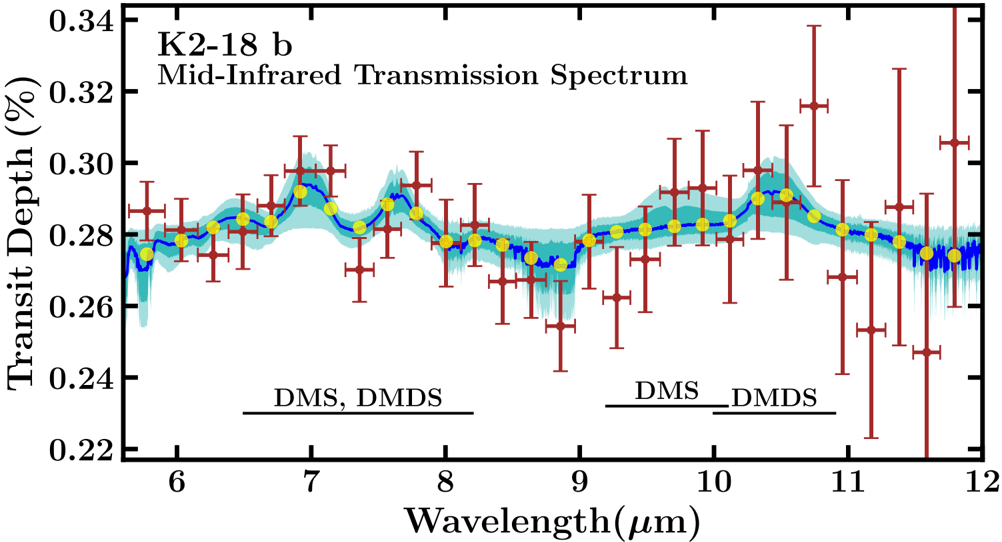
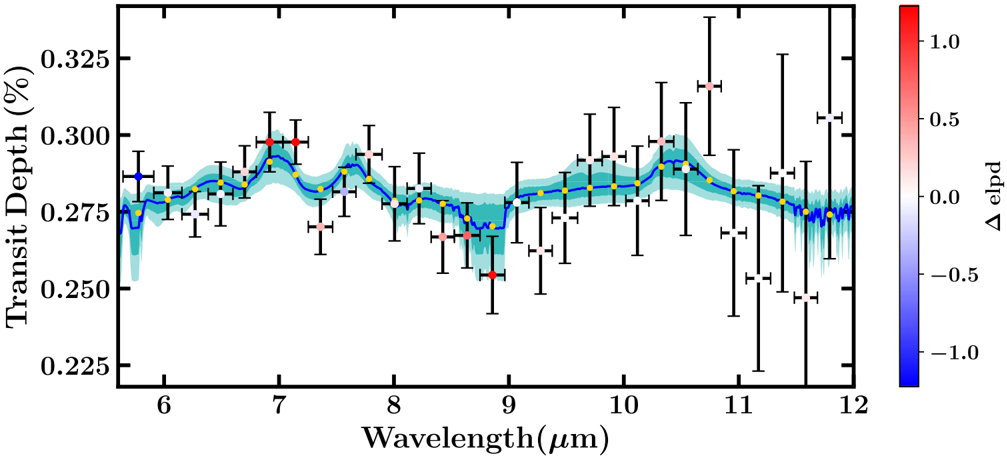
The sub-Neptune frontier has opened a new window into the rich diversity of planetary environments beyond the solar system. The possibility of hycean worlds, with planet-wide oceans and H 2 -rich atmospheres, significantly expands and accelerates the search for habitable environments elsewhere. Recent JWST transmission spectroscopy of the candidate hycean world K2-18 b in the near-infrared led to the first detections of the carbon-bearing molecules CH 4 and CO 2 in its atmosphere, with a composition consistent with predictions for hycean conditions. The observations also provided a tentative hint of dimethyl sulfide (DMS), a possible biosignature gas, but the inference was of low statistical significance. We report a mid-infrared transmission spectrum of K2-18 b obtained using the JWST MIRI LRS instrument in the ∼6–12 μ m range. The spectrum shows distinct features and is inconsistent with a featureless spectrum at 3.4 σ significance compared to our canonical model. We find that the spectrum cannot be explained by most molecules predicted for K2-18 b, with the exception of DMS and dimethyl disulfide (DMDS), also a potential biosignature gas. We report new independent evidence for DMS and/or DMDS in the atmosphere at 3 σ significance, with high abundance (≳10 ppmv) of at least one of the two molecules. More observations are needed to increase the robustness of the findings and resolve the degeneracy between DMS and DMDS. The results also highlight the need for additional experimental and theoretical work to determine accurate cross sections of important biosignature gases and identify potential abiotic sources. We discuss the implications of the present findings for the possibility of biological activity on K2-18 b.
Overview
CoChat Summary
TL;DR
JWST MIRI LRS mid-infrared transmission spectroscopy of K2-18 b shows spectral features best explained by DMS and/or DMDS, with combined evidence at ~3σ and abundances of ~10⁻⁵–10⁻³. The authors interpret this as independent, tentative support for possible biological activity on the candidate hycean world, while stressing degeneracy and the need for more data.
Key findings
- The MIRI spectrum is inconsistent with a featureless spectrum at 3.4σ significance compared to the canonical model; the canonical model is preferred over a flat line at 3.4σ–3.8σ depending on the prior width.
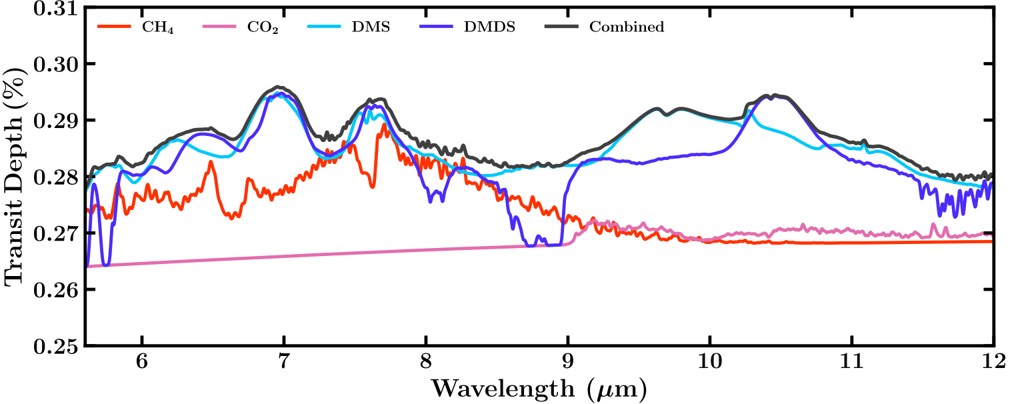
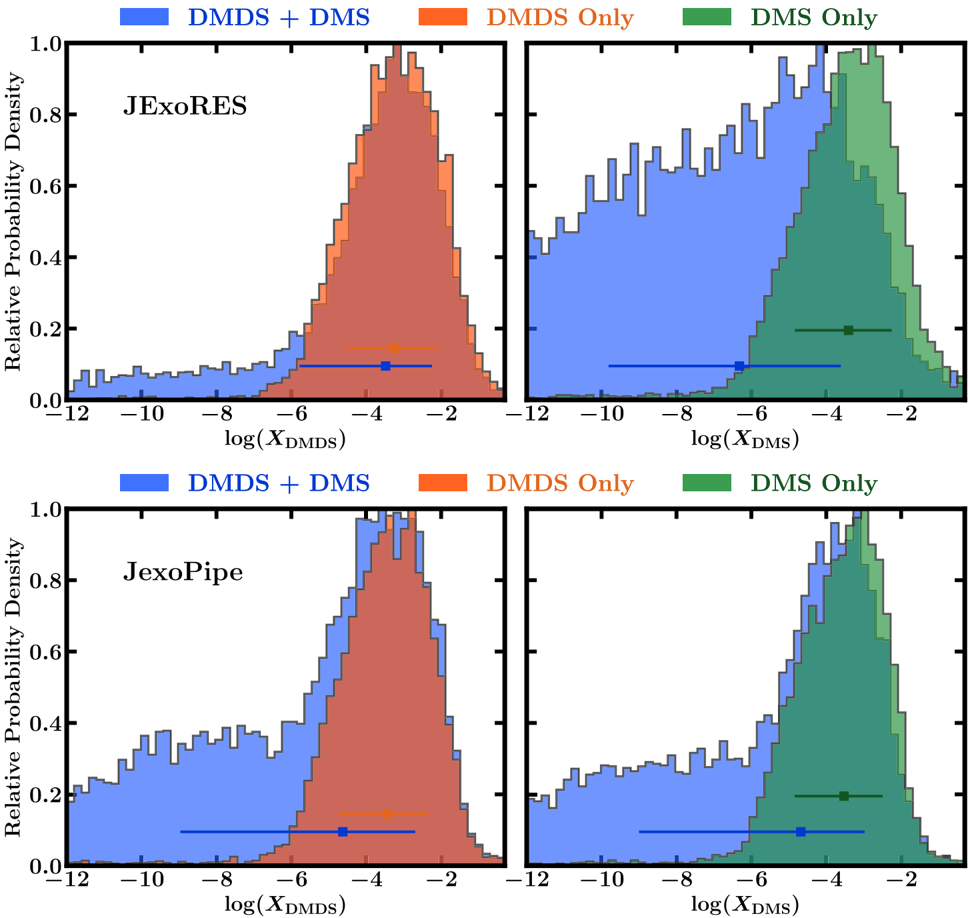
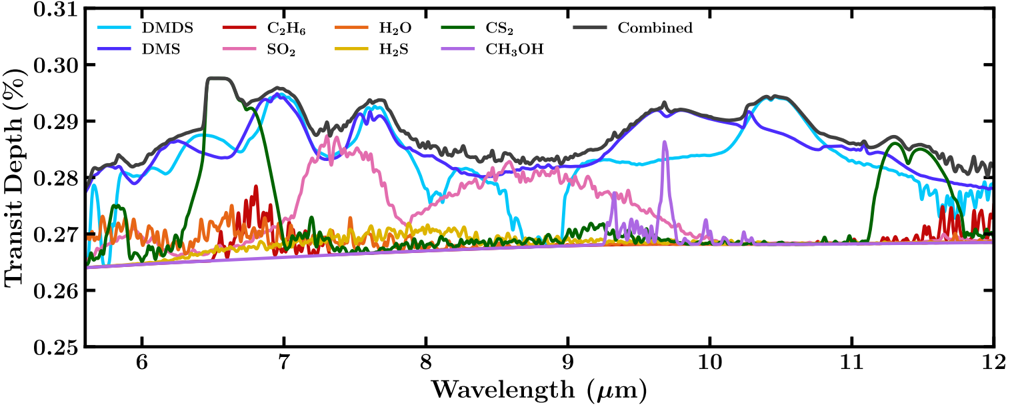
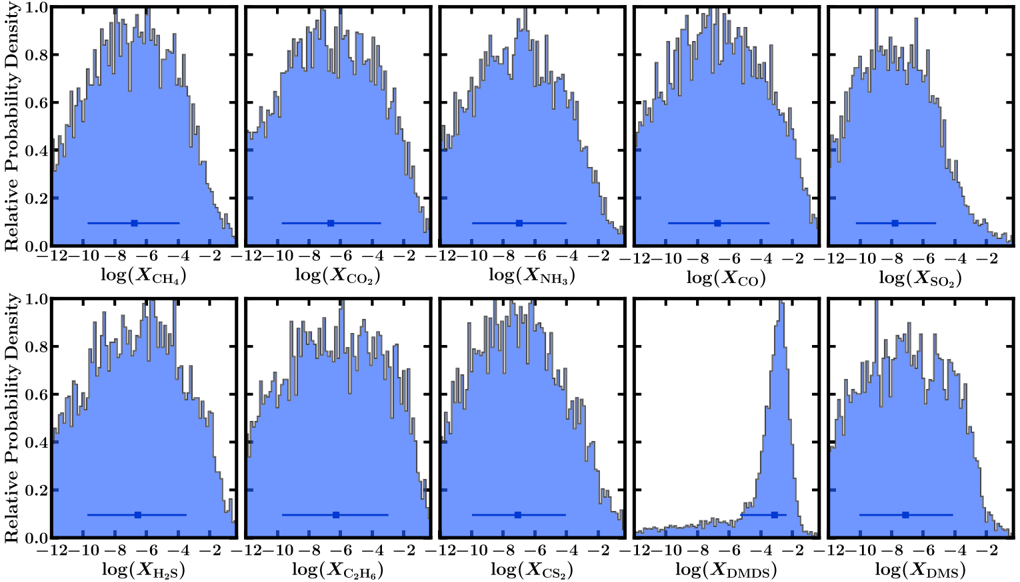
- DMS and/or DMDS are detected at 2.9σ–3.2σ across canonical retrievals: combined DMS+DMDS at 3.2σ, DMS-only at 2.9σ–3.0σ, and DMDS-only at 3.0σ–3.2σ. Retrieved abundances include log X_DMDS = −3.48⁺²·²⁷₋₁.₂₄ when both are included, log X_DMDS = −3.25⁺¹·³⁰₋₁.₁₇ for DMDS-only, and log X_DMS = −3.42⁺¹·⁴⁴₋₁.₁₆ for DMS-only (JExoRES), corresponding to mixing ratios of ~10⁻⁵–10⁻³ and at least one molecule at ~10 ppmv.
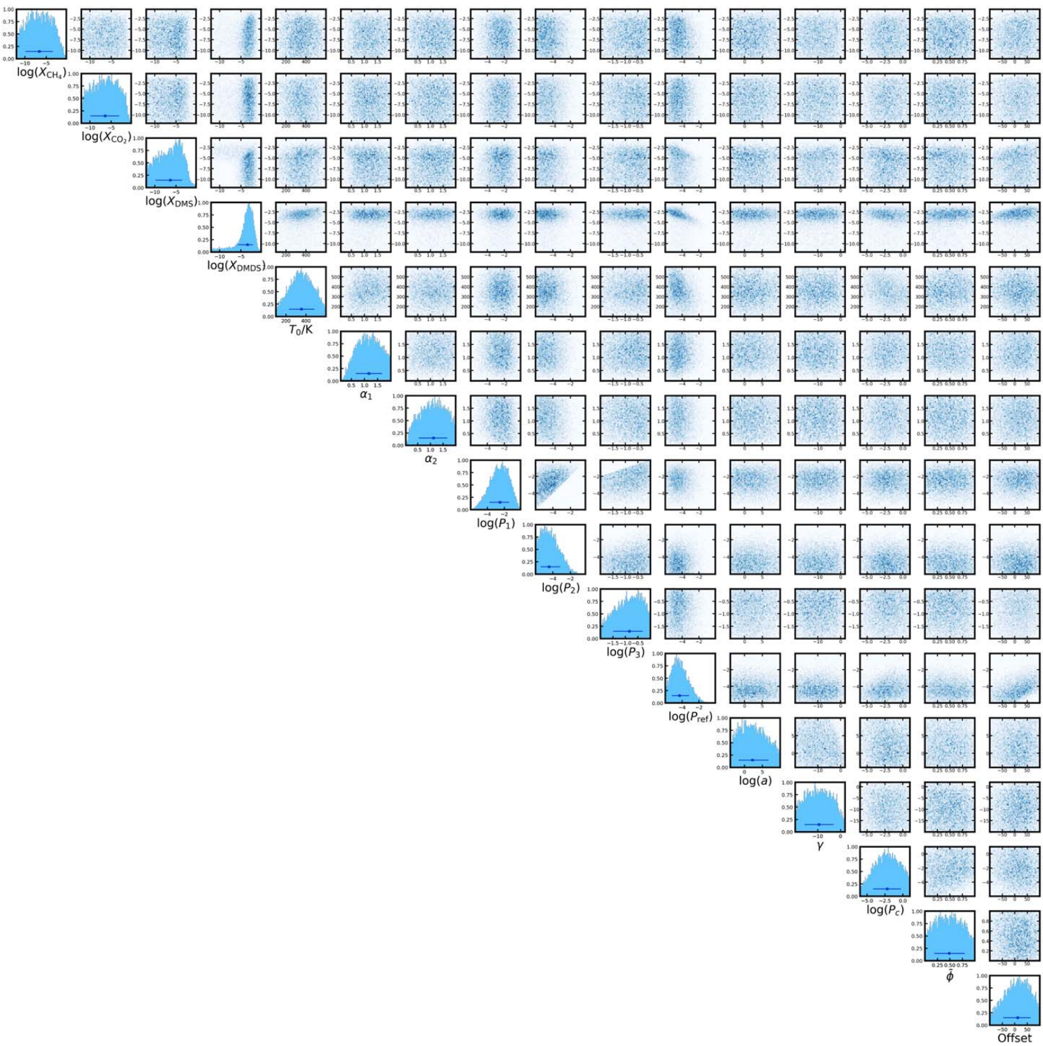
- Of 20 molecules considered, only DMDS and DMS have notable evidence; CH₄ and CO₂ are not detectable in the MIRI band, and their previously reported ~1% abundances are insufficient to explain the data. The photospheric temperature at 1 mbar is weakly constrained to 422⁺¹³³₋₁₄₁ K.
- Leave-one-out analysis indicates the DMS/DMDS detection is driven by multiple data points rather than localized systematics or individual outliers.
Methods
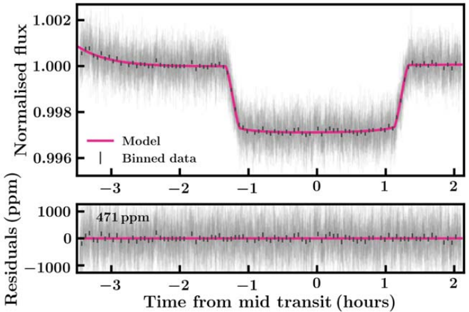
- JWST MIRI LRS slitless prism observations with F560W and FASTR1 were taken on 2024 April 25–26 for 5.85 hr, with 2.68 hr in transit, 5095 integrations, 25 groups per integration, maximum saturation 51%, and average native resolution R ~ 100 over ~5–12 μm.
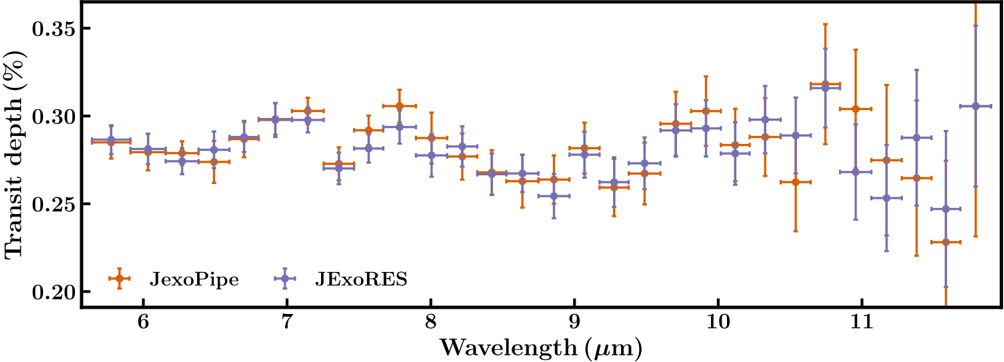
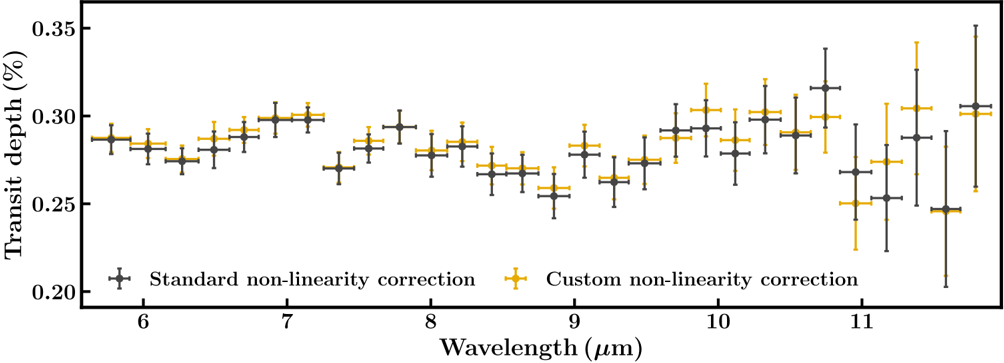
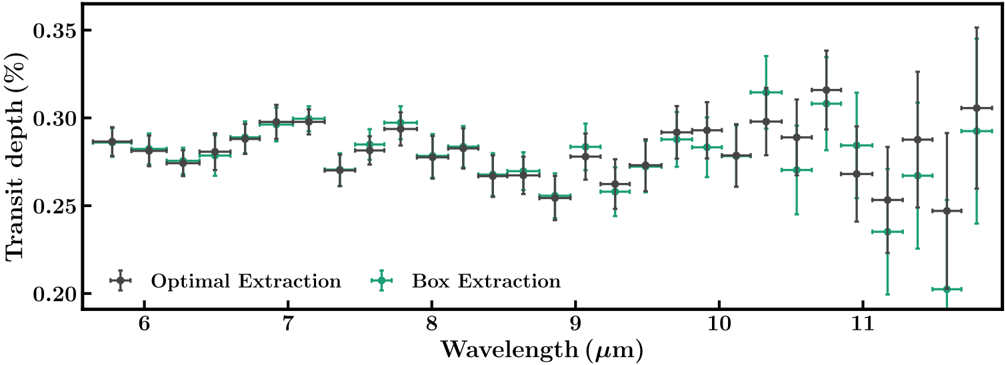
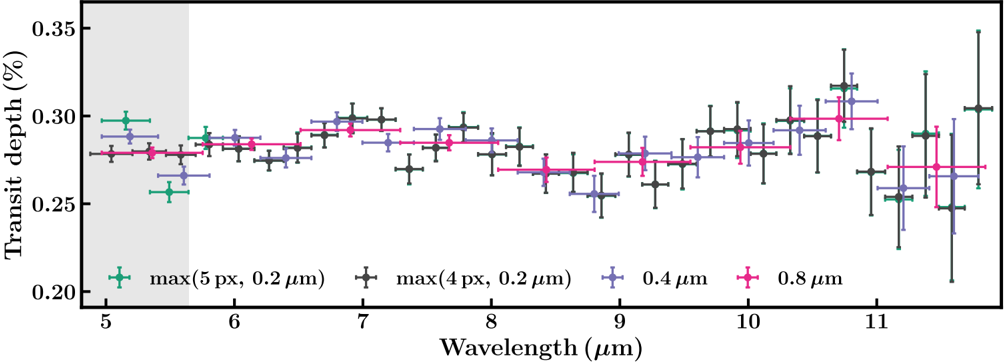
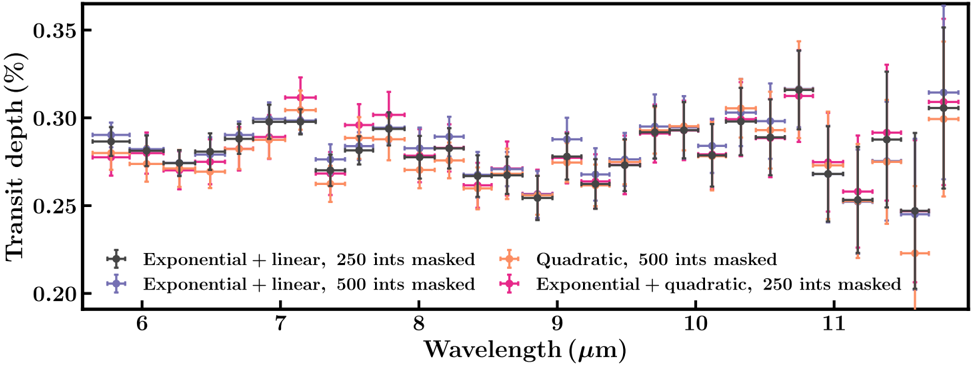
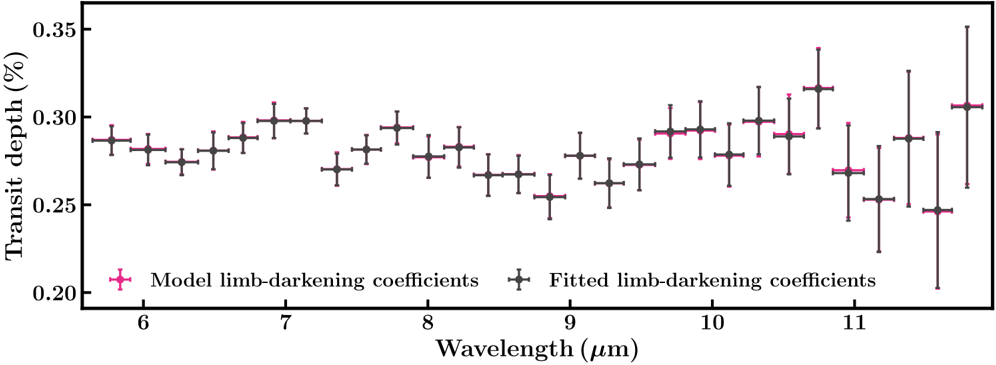
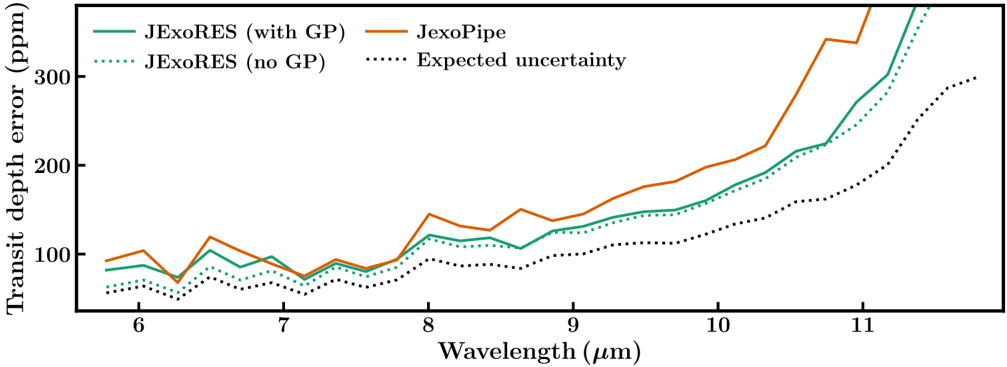
- Two independent reduction pipelines, JExoRES and JexoPipe, produced transmission spectra agreeing within 1σ; white-light curves used 4.8–10 μm, spectral bins were nominally 0.2 μm or 5 pixels, data below 5.6 μm were excluded, and fits included transit models, systematic trends, limb darkening, and correlated-noise treatments.
- Atmospheric retrievals used the AURA/VIRA framework with a plane-parallel hydrostatic terminator, parametric P–T profile, clouds/hazes, H₂–H₂ and H₂–He collision-induced absorption, and up to 20 molecules; the canonical model included DMS, DMDS, CH₄, and CO₂ with 16 free parameters, and Bayesian evidence was computed with MultiNest and checked with UltraNest.
Limitations
- The paper states the combined DMS/DMDS detection significance is ~3σ, at the lower end of robustness, and that DMS and DMDS are strongly degenerate in the MIRI band; more JWST transits (1–3 additional MIRI transits, ~8–24 hr) are needed to reach 4σ–5σ and rule out unaccounted-for instrumental systematics.
- The paper states retrieved abundances and temperatures depend strongly on limited DMS/DMDS cross sections from HITRAN at 1 bar and 298 K with an N₂ broadener, which may differ in an H₂-rich lower-pressure atmosphere; the 20-molecule search may not be exhaustive, and DMDS could condense depending on tropopause temperatures.
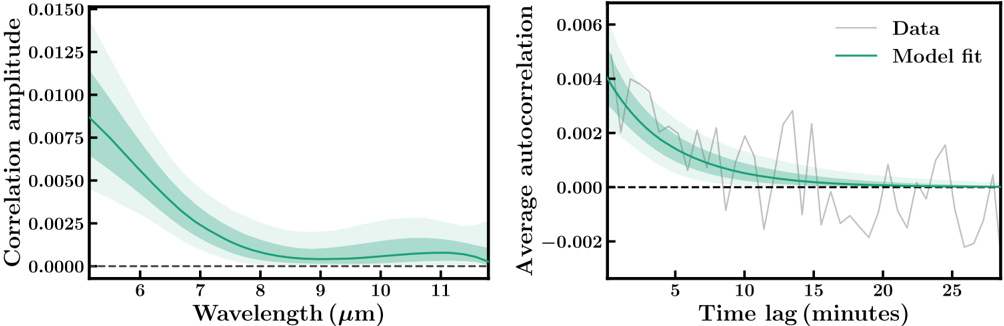
- Evident from the text: no significant constraints are obtained on other molecules or cloud/haze parameters, data below 5.6 μm are excluded due to binning instability, time-correlated noise is present and modeled, and detection significances carry a typical ~0.1σ uncertainty from MultiNest.
Model-written summary. Check it against the paper before relying on it.
Integrity signals
Registry
Cites
Statistics
Figures
Verification
Claims the paper makes
0 Valid · 2 Not valid · 60 Not checked · 165 Own results and interpretations
A result the paper reports from its own data — it cites no other source for it, so there is none to check. The quote shows it is in the paper.
In the paper
“Furthermore, we find evidence for timecorrelated noise on the timescale of minutes, with increasing amplitude toward shorter wavelengths.”
§ New Constraints on DMS and DMDS in the Atmosphere of K2-18 b from JWST MIRI > 2.1. JExoRES Pipeline
plainstates an association- Asserted: passes — The authors put it forward as true.
- Checkable: passes — It can be checked against evidence.
- Load-bearing: passes — The paper’s conclusions depend on it.
- Based: passes — The paper gives a reason why it holds.
A result the paper reports from its own data — it cites no other source for it, so there is none to check. The quote shows it is in the paper.
In the paper
“We find that the spectrum cannot be explained by most molecules predicted for K2-18 b, with the exception of DMS and dimethyl disulfide (DMDS), also a potential biosignature gas.”
§ New Constraints on DMS and DMDS in the Atmosphere of K2-18 b from JWST MIRI > Abstract
plain- Asserted: passes — The authors put it forward as true.
- Checkable: passes — It can be checked against evidence.
- Load-bearing: passes — The paper’s conclusions depend on it.
- Based: passes — The paper gives a reason why it holds.
- Rests on 2 assumptions not shown here.
A result the paper reports from its own data — it cites no other source for it, so there is none to check. The quote shows it is in the paper.
In the paper
“We present a mid-infrared transmission spectrum of K2-18 b with JWST, the first for a habitable-zone exoplanet.”
§ New Constraints on DMS and DMDS in the Atmosphere of K2-18 b from JWST MIRI > 1. Introduction
plainSingle case- Asserted: passes — The authors put it forward as true.
- Checkable: passes — It can be checked against evidence.
- Load-bearing: passes — The paper’s conclusions depend on it.
- Based: passes — The paper gives a reason why it holds.
In the paper
“Additionally, the amplitudes of the observed spectral features, of ∼300-400 ppm, in the present MIRI data are significantly larger compared to the ∼200 ppm amplitudes seen in previous nearinfrared (∼1-5 μm) observations with the NIRISS and NIRSpec instruments (N.Madhusudhan et al. 2023b).”
§ New Constraints on DMS and DMDS in the Atmosphere of K2-18 b from JWST MIRI > 3.2. Atmospheric Constraints
What the sources say
- Not checked yetcites N.Madhusudhan et al. 2023b matched to “Carbon-bearing Molecules in a Possible Hycean Atmosphere” (2023) source
plainstates an association- Asserted: passes — The authors put it forward as true.
- Checkable: passes — It can be checked against evidence.
- Load-bearing: unclear — It is unclear whether the paper’s conclusions depend on it.
- Based: passes — The paper gives a reason why it holds.
A result the paper reports from its own data — it cites no other source for it, so there is none to check. The quote shows it is in the paper.
In the paper
“In retrievals with only one of the two molecules present, the posterior of that molecule shows a single wellconstrained peak with no low-abundance tail.”
§ New Constraints on DMS and DMDS in the Atmosphere of K2-18 b from JWST MIRI > 3.2. Atmospheric Constraints
plain- Asserted: passes — The authors put it forward as true.
- Checkable: passes — It can be checked against evidence.
- Load-bearing: passes — The paper’s conclusions depend on it.
- Based: passes — The paper gives a reason why it holds.
114 more claims
Create a free account to see all 227 claims and to verify the 115 references still open.
- It may state two separate claims as one. 64
- Probably not a substantial claim. 49
- The quote only partly states this claim. 6
Claims other papers make about this one
Each is checked against this paper’s own text: does it say what the citing paper says it does?
In the citing paper
“While the MIRI binning scheme adopted by Madhusudhan et al. (2025) favors the presence of DMS/DMDS in K2-18b”
From K2-18b Does Not Meet The Standards of Evidence For Life (2025) · cites this paper as Madhusudhan et al. (2025)
Citations
Cites
<tt>emcee</tt>: The MCMC Hammer
Foreman-Mackey, D., Hogg, D. W., Lang, D., & Goodman, J. (2013) · Publications of the Astronomical Society of the Pacific · doi:10.1086/670067 · Cited by 12,414 · cited 1×
“We use emcee (Foreman-Mackey et al. 2013) to perform a Markov Chain Monte Carlo parameter estimation of the white light curve, fitting for a transit model with quadratic limb-darkening generated by pylightcurve (Tsiaras et al. 2016) multiplied by a systematic trend consisting of an exponential term…”
The HITRAN2016 molecular spectroscopic database
Gordon, I. E., Rothman, L. S., Hill, C., Kochanov, R. V., Tan, Y., Bernath, P. F., Birk, M., Boudon, V., Campargue, A., Chance, K. V., et al. (2017) · Journal of Quantitative Spectroscopy and Radiative Transfer · doi:10.1016/j.jqsrt.2017.06.038 · Cited by 7,721
(2015) · doi:10.1007/s11222-016-9696-4 · Cited by 5,611
MultiNest: an efficient and robust Bayesian inference tool for cosmology and particle physics
Feroz, F., Hobson, M. P., & Bridges, M. (2009) · Monthly Notices of the Royal Astronomical Society · doi:10.1111/j.1365-2966.2009.14548.x · Cited by 2,958 · cited 4×
“The Bayesian inference and parameter estimation is conducted using the nested sampling algorithm (Skilling 2004) through the MultiNest implementation (Feroz et al. 2009; Buchner et al. 2014).”
InfluentialThe HITRAN2020 molecular spectroscopic database
Gordon, I. E., Rothman, L. S., Hargreaves, R. J., Hashemi, R., Karlovets, E. V., Skinner, F. M., Conway, E. K., Hill, C., Kochanov, R. V., Tan, Y., et al. (2022) · Journal of Quantitative Spectroscopy and Radiative Transfer · doi:10.1016/j.jqsrt.2021.107949 · Cited by 2,600
HITEMP, the high-temperature molecular spectroscopic database
Rothman, L. S., Gordon, I. E., Barber, R. J., Dothe, H., Gamache, R. R., Goldman, A., Perevalov, V. I., Tashkun, S. A., & Tennyson, J. (2010) · Journal of Quantitative Spectroscopy and Radiative Transfer · doi:10.1016/j.jqsrt.2010.05.001 · Cited by 2,285 · cited 1×
“…Gandhi & Madhusudhan (2017) and Gandhi et al. (2020), for CH 4 (Yurchenko & Tennyson 2014), CO 2 (Tashkun et al. 2015), H 2 O (Barber et al. 2006; Rothman et al. 2010), NH 3 (Yurchenko et al. 2011), CO (Li et al. 2015), SO 2 (Underwood et al. 2016), HCN (Barber et al. 2014), H 2 S (Azzam et al.…”
Müller, H. S. P., Schlöder, F., Stutzki, J., & Winnewisser, G. (2005) · Journal of Molecular Structure · doi:10.1016/j.molstruc.2005.01.027 · Cited by 2,003 · cited 1×
“When DMDS is removed from the model a peak in the posterior is found for DMS. (Bouanich et al. 1986; Golebiowski et al. 2014; Müller et al. 2005; Auwera & Fayt 2006; Sung et al. 2009; Toth et al. 2010; Régalia-Jarlot et al. 2002), N 2 O (Daumont et al. 2001) and PH 3 (Gordon et al. 2022).”
The James Webb Space Telescope
Gardner, J. P., Mather, J. C., Clampin, M., Doyon, R., Greenhouse, M. A., Hammel, H. B., Hutchings, J. B., Jakobsen, P., Lilly, S. J., Long, K. S., et al. (2006) · Space Science Reviews · doi:10.1007/s11214-006-8315-7 · Cited by 1,978 · cited 1×
“The discoveries of temperate exoplanets orbiting nearby stars and the advent of the James Webb Space Telescope (JWST; Gardner et al. 2006) are opening the possibility of detecting biosignatures in habitable exo-planets.”
An optimal extraction algorithm for CCD spectroscopy
Horne, K. (1986) · Publications of the Astronomical Society of the Pacific · doi:10.1086/131801 · Cited by 1,923
Buchner, J., Georgakakis, A., Nandra, K., Hsu, L., Rangel, C., Brightman, M., Merloni, A., Salvato, M., Donley, J., & Kocevski, D. (2014) · Astronomy & Astrophysics · doi:10.1051/0004-6361/201322971 · Cited by 1,644 · cited 1×
“The Bayesian inference and parameter estimation is conducted using the nested sampling algorithm (Skilling 2004) through the MultiNest implementation (Feroz et al. 2009; Buchner et al. 2014).”
Research works printed but not linked: 3
- Bushouse, H. 2020, in ASP Conf. Ser. 527, Astronomical Data Analysis Software and Systems XXIX, ed. R. Pizzo et al. (San Francisco, CA: ASP), 583
- Skilling, J. 2004, in AIP Conf. Ser. 735, Bayesian Inference and Maximum Entropy Methods in Science and Engineering: 24th International Workshop on Bayesian Inference and Maximum Entropy Methods in Science and Engineering, ed. R. Fischer, R. Preuss, & U. V. Toussaint (Melville, NY: AIP), 395
- Zahnle, K. 1996, in IAU Colloq. 156: The Collision of Comet Shoemaker- Levy 9 and Jupiter, ed. K. S. Noll, H. A. Weaver, & P. D. Feldman (Cambridge: Cambridge Univ. Press), 183
Cited by
Processes in Microbial Ecology
Kirchman, D. L., & Shade, A. L. (2011) · doi:10.1093/9780197831632.001.0001 · Cited by 184
A Comprehensive Reanalysis of K2-18 b’s JWST NIRISS+NIRSpec Transmission Spectrum
Schmidt, S. P., MacDonald, R. J., Tsai, S., Radica, M., Wang, L., Ahrer, E.-M., Bell, T. J., Fisher, C., Thorngren, D., Wogan, N. F., et al. (2025) · The Astronomical Journal · doi:10.3847/1538-3881/ae019a · Cited by 99
“However, the same is not true when extrapolating the transmission spectrum corresponding to the median retrieved atmospheric properties reported by Madhusudhan et al. (2025) backward to the near-infrared.”
InfluentialBayesian Model Comparison and Significance: Widespread Errors and How to Correct Them
Thorngren, D., Sing, D. K., & Mukherjee, S. (2026) · The Astrophysical Journal Supplement Series · doi:10.3847/1538-4365/ae0e71 · Cited by 63
“Likewise, papers which use the formula to determine non-significance or tentative detections are fine Mikal-Evans et al. (2021 2020), though the detection of an atmosphere containing water were statistically significant in other works (e.g. Benneke et al. 2019; Madhusudhan et al. 2025).”
Sub-Neptunes Are Drier than They Seem: Rethinking the Origins of Water-rich Worlds
Werlen, A., Dorn, C., Burn, R., Schlichting, H. E., Grimm, S. L., & Young, E. (2025) · The Astrophysical Journal Letters · doi:10.3847/2041-8213/adff73 · Cited by 41
“The idea of water-rich ‘Hycean’ exoplanets has gained significant attention following JWST observations of the sub-Neptune K2-18b, which suggests potential biosig-natures (Madhusudhan et al. 2021, 2023, 2025).”
InfluentialBower, D. J., Thompson, M., Hakim, K., Tian, M., & Sossi, P. A. (2025) · The Astrophysical Journal · doi:10.3847/1538-4357/ae1479 · Cited by 33
“Although these transmission spectroscopy measurements probe the upper atmosphere (near 10 − 2 –10 − 4 bar, Benneke et al. 2024; Madhusudhan et al. 2025) and the speciation cannot therefore be directly compared with that predicted in our models, they provide first-order constraints on the chemical…”
Metadata
- Authors
- Madhusudhan, N., Constantinou, S., Holmberg, M., Sarkar, S., Piette, A. A. A., & Moses, J. I.
- Affiliations
- University of Cambridge (GB)
- Space Telescope Science Institute (US)
- Cardiff University (GB)
- University of Birmingham (GB)
- Space Science Institute (US)
- ORCID
- Venue
- The Astrophysical Journal Letters
- Publisher
- American Astronomical Society
- Published
- 2025-04-17
- Volume
- 983
- Issue
- 2
- Pages
- L40
- ISSN
- 2041-8205 (ISSN-L)
- 2041-8213
- OpenAlex
- W4409554365
- Cited by
- 140
- References
- 136
- Citations by year
- 2026: 77 · 2025: 58
- FWCI
- 22.09
- Type
- journal article
- Language
- en
- Open access
- gold
- doi.org
- Licence
- cc-by
- creativecommons.org/licenses/by/4.0/ (vor)
- iopscience.iop.org/info/page/text-and-data-mining (tdm)
- Locations
- The Astrophysical Journal Letters (publishedVersion, cc-by)
- University of Birmingham Research Portal (University of Birmingham) (publishedVersion, cc-by)
- ORCA Online Research @Cardiff (Cardiff University) (acceptedVersion)
- arXiv (submittedVersion, cc-by)
- Apollo (University of Cambridge) (submittedVersion, cc-by)
- DOAJ (DOAJ: Directory of Open Access Journals) (submittedVersion)
- Funders
- UKRI Frontier Research Grant (EP/X025179/1)
- NASA (NAS 5-031)
- Topics
- Physical Sciences › Physics and Astronomy › Astronomy and Astrophysics › Stellar, planetary, and galactic studies
- Physical Sciences › Physics and Astronomy › Astronomy and Astrophysics › Space Science and Extraterrestrial Life
- Physical Sciences › Earth and Planetary Sciences › Space and Planetary Science › Astro and Planetary Science
- Keywords
- K2-18b, dimethyl sulfide, dimethyl disulfide, exoplanet atmospheres, biosignature gases, transmission spectroscopy, sub-Neptunes, JWST MIRI, mid-infrared spectrum, exoplanet habitability
About these checks
Registry, retraction, Cites and statistics results are computed, not judged, with one exception: a printed reference that no index lists is read once by a model before it counts as a citation error. Claims are extracted by a model and kept only when their quote appears verbatim in the text; each cited source is then checked, with a model’s help, for whether it says what the claim relies on. Those verdicts can be wrong — read the claim’s quote and the cited source before relying on one.
A language model drew the claims from the paper on 2026-11-28, under version 3 of the claim definition (model deepseek-v4.1-flash, prompt extract-v3).
A second model labelled each claim on 2026-11-28 (model jev-1.13-20260917, definition revision gold-guideline-v0.2).
Statistics and arithmetic are recomputed, not judged.
Confidence bands are shown only for fields calibrated on our annotated test set. None is calibrated yet, so no band is shown.
What counts as a claim ›How we measure confidence ›How we check this ›
Are you an author, or do you see a problem with this page? Request a review
How to cite
Cite CoChat for the checks on this page, and the paper for its own findings.
- This page
- CoChat. (2026). Citation check: New Constraints on DMS and DMDS in the Atmosphere of K2-18 b from JWST MIRI. https://app.cochat.ai/papers/10.3847/2041-8213/adc1c8
- The paper
- Madhusudhan, N., Constantinou, S., Holmberg, M., Sarkar, S., Piette, A. A. A., & Moses, J. I. (2025). New Constraints on DMS and DMDS in the Atmosphere of K2-18 b from JWST MIRI. The Astrophysical Journal Letters. https://doi.org/10.3847/2041-8213/adc1c8
Data sources
Bibliographic data: Semantic Scholar, OpenAlex, Crossref.
Contains information from the Semantic Scholar Academic Graph Datasets, made available under the ODC Attribution License (ODC-BY 1.0).
Semantic Scholar’s data is described in: Kinney, R., et al. (2023). The Semantic Scholar Open Data Platform. arXiv:2301.10140.
