

The DOI matches its Crossref record; 29 of the 29 references it cites were found in a registry or an index; none of the 38 sources its claims cite is checked for support yet.
Monitoring agroforest plots under the scope of the COMCHA project. 1. Baseline data for the vascular plants and arthropods of "Vale da Fonte Plot" in Pico Island (Azores Archipelago)
Open accessPublished version of a preprint
Abstract
Agroforestry is increasingly promoted as a nature-based solution (NbS) capable of reconciling production with biodiversity conservation, particularly in island landscapes, where endemism and fragmentation heighten conservation stakes. We established a permanent agroforest monitoring plot at Vale da Fonte (Pico Island, Azores) to generate baseline data on vascular plants and terrestrial arthropods and to evaluate whether a structurally complex orchard embedded in native coastal forest can support native and endemic biotas and key ecosystem functions. We used a modified COBRA framework integrating complementary active protocols (nocturnal aerial searching, day/night beating and day sweeping), together with pollinators time transects, pan traps and targeted pest traps. We collected 69 standardised samples (5 plant, 64 arthropod) and made the dataset publicly available in Darwin Core format via the GBIF IPT for long-term use. The botanical survey documented 155 vascular plant species including 12 taxa recorded for the first time for Pico Island. These newly-recorded species are: Centaurium tenuiflorum (Hoffm. & Link) Fritsch subsp. tenuiflorum (Naturalized), Lolium rigidum Gaudin (Naturalised), Malus domestica Borkh (Casual), Mentha spicata L. (Naturalised), Monstera deliciosa Liebm. (Casual), Opuntia ficus-indica (L.) Mill. (Naturalised), Passiflora edulis Sims (Casual), Poa pratensis L. (Casual), Prunus armeniaca L. (Casual), Scrophularia auriculata L. (Casual), Trifolium pratense L. (Naturalised) and Verbena rigida Spreng. (Naturalised). We recorded 169 arthropod taxa from 18 orders and 84 families, comprising 150 identified taxa (56 native non-endemic, 14 endemic, 74 introduced and six of indeterminate status). We also documented a total of 18 first records to Pico Island, one of which is also a new record for the Azores Archipelago, the European paper wasp Polistes dominula (Christ, 1791) (Hymenoptera, Vespidae). In addition, these results highlight the mixed native–exotic character of lowland agroforestry mosaics on oceanic islands and provide a baseline for future monitoring of biosecurity risks, restoration efficacy and ecosystem-service provisioning in insular production landscapes.
Overview
CoChat Summary
Written by AI from the paper’s full text.
TL;DR
This data paper establishes a permanent agroforest monitoring plot at Vale da Fonte, Pico Island (Azores), and provides baseline inventories of vascular plants and terrestrial arthropods using a modified COBRA protocol. It records 155 vascular plant species (12 new to Pico) and 169 arthropod taxa (18 new to Pico, one new to the Azores), highlighting a mixed native–exotic assemblage in lowland agroforestry.
Key findings
- The botanical survey documented 155 vascular plant species in five classes, 34 orders, 73 families and 138 genera; 75 were naturalised, 23 native (including 10 endemics), seven casual introductions and two of uncertain status, with 48 species intentionally planted. Twelve species were first records for Pico Island.
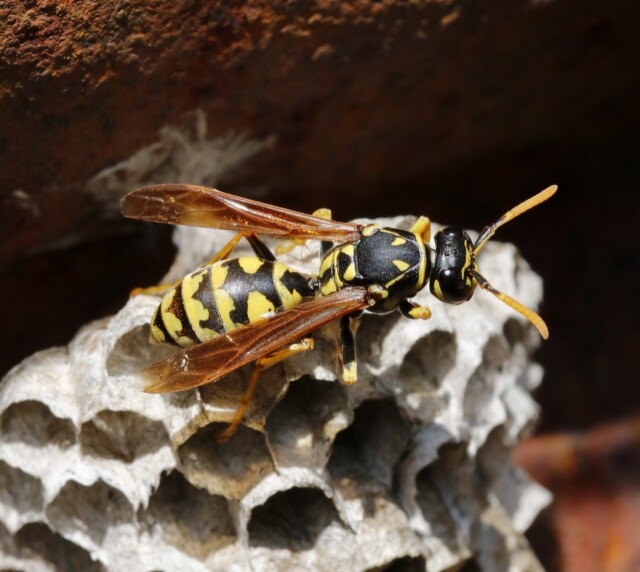
- The arthropod survey recorded 169 taxa from 18 orders, 84 families and 146 genera; 150 taxa were identified to species or subspecies, comprising 14 endemic (9.3%), 56 native non-endemic (37.3%), 74 introduced (49.3%) and six indeterminate (4.0%). There were 18 first records to Pico Island, one of which—*Polistes dominula*—was also a new record for the Azores Archipelago.
- A total of 69 standardised samples were collected (five plant, 64 arthropod). The GBIF Darwin Core Archive contains an event table with 69 records and an occurrence table with 1,285 records.
- The 169 arthropod taxa represent about 18% of Pico’s known fauna (928 taxa before this study; 946 after adding the 18 new island records) and approximately 7% of all arthropod taxa recorded for the Azores (2,420).
Methods
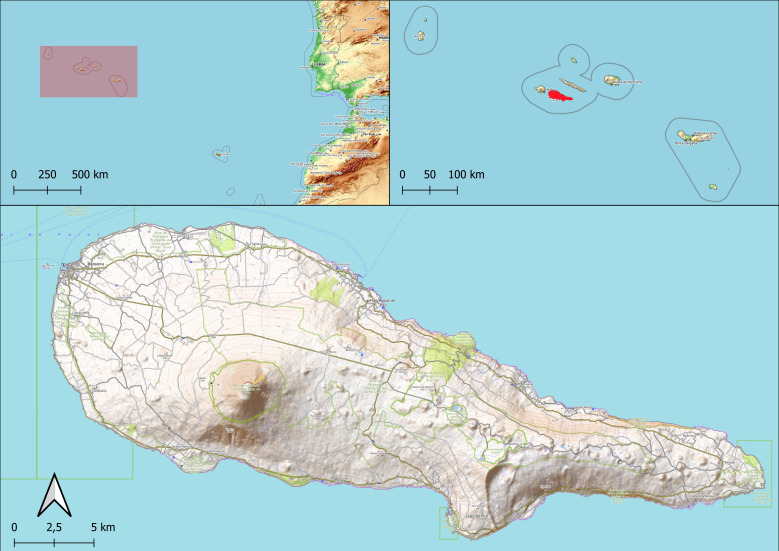
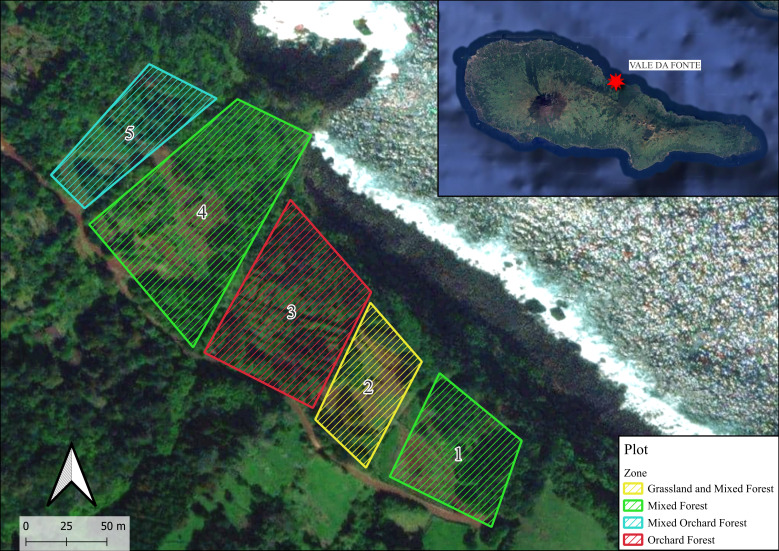
- A permanent agroforest monitoring plot was established at Vale da Fonte, Pico Island, Azores, within a structurally complex orchard embedded in native coastal forest. The study area was divided into five plots at 72–83 m a.s.l.; the principal survey occurred mostly 16–19 June 2025, with trap data extending to 18 August 2025.
- A modified COBRA protocol combined nocturnal active aerial searching, day and night foliage beating, day sweeping, pollinator timed transects, pan traps, and targeted pest traps for *Ceratitis capitata*, thrips and *Cosmopolites sordidus*. Vegetation was assessed with a random-walk botanical survey.
- Specimens were preserved in 96% ethanol, sorted and identified by parataxonomists and taxonomists, and data were standardised to Darwin Core and published via the GBIF IPT. Taxonomic nomenclature and colonisation status follow Borges et al. 2022b.
Limitations
- The paper states no explicit limitations.
- Evident from the text: this is a baseline inventory from a single low-elevation agroforest plot (five subplots) with a short main survey window (mostly 16–19 June 2025), so temporal replication and broader generalisation are limited.
- Evident from the text: no control or comparative statistical analysis is reported, and juvenile arthropods were included in identifications because low Azorean species diversity allows reliable identification, which may still constrain some determinations.
Model-written summary. Check it against the paper before relying on it.
Integrity signals
Registry
Cites
Statistics
Figures
Verification
Claims the paper makes
33 Own result · 13 Sources not found · 11 Own method · 11 Own interpretation · 10 Check pending · 3 No full text of the sources · 1 No basis given
A result the paper reports from its own data — it cites no other source for it, so there is none to check. The quote shows it is in the paper.
In the paper
“seven are casual introductions”
§ Monitoring agroforest plots under the scope of the COMCHA project. 1. Baseline data for the vascular plants and arthropods of "Vale da Fonte Plot" in Pico Island (Azores Archipelago) > Additional information
plain- Asserted: passes — The authors put it forward as true.
- Checkable: passes — It can be checked against evidence.
- Load-bearing: unclear — It is unclear whether the paper’s conclusions depend on it.
- Based: passes — The paper gives a reason why it holds.
A result the paper reports from its own data — it cites no other source for it, so there is none to check. The quote shows it is in the paper.
In the paper
“Of these, 150 taxa (89%) were identified to species or subspecies.”
§ Monitoring agroforest plots under the scope of the COMCHA project. 1. Baseline data for the vascular plants and arthropods of "Vale da Fonte Plot" in Pico Island (Azores Archipelago) > Additional information
plain- Asserted: passes — The authors put it forward as true.
- Checkable: passes — It can be checked against evidence.
- Load-bearing: unclear — It is unclear whether the paper’s conclusions depend on it.
- Based: passes — The paper gives a reason why it holds.
A result the paper reports from its own data — it cites no other source for it, so there is none to check. The quote shows it is in the paper.
In the paper
“These newly-recorded species are: Centaurium tenuiflorum (Hoffm. & Link) Fritsch subsp. tenuiflorum (Naturalized), Lolium rigidum Gaudin (Naturalised), Malus domestica Borkh (Casual), Mentha spicata L. (Naturalised), Monstera deliciosa Liebm. (Casual), Opuntia ficus-indica (L.) Mill. (Naturalised), Passiflora edulis Sims (Casual), Poa pratensis L. (Casual), Prunus armeniaca L. (Casual), Scrophular”
§ Monitoring agroforest plots under the scope of the COMCHA project. 1. Baseline data for the vascular plants and arthropods of "Vale da Fonte Plot" in Pico Island (Azores Archipelago) > Abstract > New information
plain- Asserted: passes — The authors put it forward as true.
- Checkable: passes — It can be checked against evidence.
- Load-bearing: passes — The paper’s conclusions depend on it.
- Based: passes — The paper gives a reason why it holds.
A result the paper reports from its own data — it cites no other source for it, so there is none to check. The quote shows it is in the paper.
In the paper
“We also documented a total of 18 first records to Pico Island, one of which is also a new record for the Azores Archipelago, the European paper wasp Polistes dominula (Christ, 1791) (Hymenoptera, Vespidae).”
§ Monitoring agroforest plots under the scope of the COMCHA project. 1. Baseline data for the vascular plants and arthropods of "Vale da Fonte Plot" in Pico Island (Azores Archipelago) > Abstract > New information
plainSingle case- Asserted: passes — The authors put it forward as true.
- Checkable: passes — It can be checked against evidence.
- Load-bearing: unclear — It is unclear whether the paper’s conclusions depend on it.
- Based: passes — The paper gives a reason why it holds.
A result the paper reports from its own data — it cites no other source for it, so there is none to check. The quote shows it is in the paper.
In the paper
“The 150 identified taxa comprise 14 endemic (9.3%), 56 native non-endemic (37.3%), 74 introduced (49.3%) and six of indeterminate status (4.0%).”
§ Monitoring agroforest plots under the scope of the COMCHA project. 1. Baseline data for the vascular plants and arthropods of "Vale da Fonte Plot" in Pico Island (Azores Archipelago) > Additional information
plain- Asserted: passes — The authors put it forward as true.
- Checkable: passes — It can be checked against evidence.
- Load-bearing: unclear — It is unclear whether the paper’s conclusions depend on it.
- Based: passes — The paper gives a reason why it holds.
- Probably not a substantial claim. 39
- It may state two separate claims as one. 24
Create a free account to see these claims.
Create a free account to see these assumptions.
32 more claims
Create a free account to see all 82 claims and to verify the 15 references still open.
Self-check
Percentages, sums and reported differences re-computed from the paper’s own numbers.
Each contradiction between two passages listed here was confirmed by an independent check.
Rated minor: it would not touch a result — a value no result rests on, a p-value that stays on the same side of the significance level, or a conflict that is clerical, resolved elsewhere in the paper, or outside its own findings.
In the paper
§ Monitoring agroforest plots under the scope of the COMCHA project. 1. Baseline data for the vascular plants and arthropods of "Vale da Fonte Plot" in Pico Island (Azores Archipelago) > Sampling methods > Sampling description
“Pan trapping consisted of placing two sets of pan traps per plot, distanced by ~ 50 m. One set was placed at soil level, while in the other, the traps were levelled at the average flower height.”
§ Monitoring agroforest plots under the scope of the COMCHA project. 1. Baseline data for the vascular plants and arthropods of "Vale da Fonte Plot" in Pico Island (Azores Archipelago) > Sampling methods > Sampling description
“In total, five vertical and four soil-level pan-trap sets were deployed.”
Rated minor: it would not touch a result — a value no result rests on, a p-value that stays on the same side of the significance level, or a conflict that is clerical, resolved elsewhere in the paper, or outside its own findings.
In the paper
§ Monitoring agroforest plots under the scope of the COMCHA project. 1. Baseline data for the vascular plants and arthropods of "Vale da Fonte Plot" in Pico Island (Azores Archipelago) > Project description > Study area description
“between 38°33′57″ and 38°33′44″ N and 28°01′39″ and 28°32′33″ W”
§ Monitoring agroforest plots under the scope of the COMCHA project. 1. Baseline data for the vascular plants and arthropods of "Vale da Fonte Plot" in Pico Island (Azores Archipelago) > Sampling methods > Study extent
“situated at 38.5027707 N, -28.27836457 W”
Citations
Cites
Biodiversity and ecosystem services: A multilayered relationship
Mace, G. M., Norris, K., & Fitter, A. H. (2012) · Trends in Ecology & Evolution · doi:10.1016/j.tree.2011.08.006 · Cited by 1,832
Multifunctional shade-tree management in tropical agroforestry landscapes - a review
Tscharntke, T., Clough, Y., Bhagwat, S., Buchori, D., Faust, H., Hertel, D., Hölscher, D., Juhrbandt, J., Kessler, M., Perfecto, I., et al. (2011) · Journal of Applied Ecology · doi:10.1111/j.1365-2664.2010.01939.x · Cited by 831
Biodiversity and the challenge of pluralism
Pascual, U., Adams, W. M., Díaz, S. M., Lélé, S. M., Mace, G. M., & Turnhout, E. (2021) · Nature Sustainability · doi:10.1038/s41893-021-00694-7 · Cited by 421
Gomes, L. C., Bianchi, F. J. J. A., Cardoso, I. M., Fernandes, R. B. A., Filho, E. I. F., & Schulte, R. P. O. (2020) · Agriculture, Ecosystems & Environment · doi:10.1016/j.agee.2020.106858 · Cited by 224
de Souza, H. N., de Goede, R. G. M., Brussaard, L., Cardoso, I. M., Duarte, E. M. G., Fernandes, R. B. A., Gomes, L. C., & Pulleman, M. (2011) · Agriculture Ecosystems & Environment · doi:10.1016/j.agee.2011.11.007 · Cited by 220
Agroforestry and the achievement of the Millennium Development Goals
Garrity, D. P. (2004) · Agroforestry Systems · doi:10.1023/b:agfo.0000028986.37502.7c · Cited by 168
Building livelihood resilience: what role does agroforestry play?
Quandt, A., Neufeldt, H., & McCabe, J. T. (2018) · Climate and Development · doi:10.1080/17565529.2018.1447903 · Cited by 154
Natural zonal vegetation of the Azores Islands: characterization and potential distribution
Elias, R. B., Gil, A., Silva, L., Fernández‐Palacios, J. M., de Azevedo, E. B., & Reis, F. V. (2016) · Phytocoenologia · doi:10.1127/phyto/2016/0132 · Cited by 133
Borges, P. A. V., Cardoso, P., Kreft, H., Whittaker, R. J., Fattorini, S., Emerson, B. C., Gil, A., Gillespie, R. G., Matthews, T. J., Santos, A. M. C., et al. (2018) · Biodiversity and Conservation · doi:10.1007/s10531-018-1553-7 · Cited by 115
Self-citationA spatial scale assessment of habitat effects on arthropod communities of an oceanic island
Cardoso, P., Aranda, S. C., Lobo, J. M., Dinis, F., Gaspar, C., & Borges, P. A. V. (2009) · Acta Oecologica · doi:10.1016/j.actao.2009.05.005 · Cited by 72
Self-citationAn updated checklist of Azorean arthropods (Arthropoda)
Borges, P. A. V., Lamelas-López, L., Andrade, R., Lhoumeau, S., Vieira, V., Soares, A. O., Borges, I., Boieiro, M., Cardoso, P., Crespo, L. C., et al. (2022) · Biodiversity Data Journal · doi:10.3897/bdj.10.e97682 · Cited by 50
Self-citationMeijer, S. S., Whittaker, R. J., & Borges, P. A. V. (2011) · Journal of Insect Conservation · doi:10.1007/s10841-010-9330-2 · Cited by 42
Self-citationLand Cover Trade‐offs in Small Oceanic Islands: A Temporal Analysis of Pico Island, Azores
Gil, A., Fonseca, C., & Benedicto, J. (2017) · Land Degradation and Development · doi:10.1002/ldr.2770 · Cited by 39
Schmid-Egger, C., van Achterberg, K., Neumeyer, R., Morinière, J., & Schmidt, S. (2017) · ZooKeys · doi:10.3897/zookeys.713.11335 · Cited by 37
Biodiversity Erosion: Causes and Consequences
Borges, P. A. V., Gabriel, R. M. D. A., & Fattorini, S. (2019) · Encyclopedia of the UN sustainable development goals · doi:10.1007/978-3-319-71065-5_78-1 · Cited by 33
Self-citationBryophyte Diversity along an Elevational Gradient on Pico Island (Azores, Portugal)
Coelho, M. C. M., Gabriel, R., Hespanhol, H., Borges, P. A. V., & Ah-Peng, C. (2021) · Diversity · doi:10.3390/d13040162 · Cited by 30
Self-citationImpact of land‐use change on flower‐visiting insect communities on an oceanic island
Picanço, A., Rigal, F., Matthews, T. J., Cardoso, P., & Borges, P. A. V. (2017) · Insect Conservation and Diversity · doi:10.1111/icad.12216 · Cited by 29
Self-citationBorges, P. A. V., Lamelas-López, L., Stüben, P., Ros-Prieto, A., Gabriel, R., Boieiro, M., Tsafack, N., & Ferreira, M. T. (2022) · Biodiversity Data Journal · doi:10.3897/bdj.10.e81410 · Cited by 29
Self-citationThe Role of Small Lowland Patches of Exotic Forests as Refuges of Rare Endemic Azorean Arthropods
Tsafack, N., Fattorini, S., Boieiro, M., Rigal, F., Ros-Prieto, A., Ferreira, M. T., & Borges, P. A. V. (2021) · Diversity · doi:10.3390/d13090443 · Cited by 27
Self-citationHowse, M. W. F., Haywood, J., & Lester, P. J. (2020) · Insects · doi:10.3390/insects11110784 · Cited by 25
Aparício, B. A., Cascalho, J., Cruz, M. J., Borges, P. A. V., Azevedo, E. B., Elias, R. B., & Ascensão, F. (2018) · Journal of Insect Conservation · doi:10.1007/s10841-018-0059-7 · Cited by 15
Self-citationDipter, T. E. F. O. T. (2006) · doi:10.1163/9789004278066_013 · Cited by 14
Monitoring Arthropods in Azorean Agroecosystems: the project AGRO-ECOSERVICES
Borges, P. A. V., Nunes, R., Lamelas-López, L., Pereira, E., Costa, R., Monjardino, P., Lopes, D. H., Soares, A. O., Gil, A., Rigal, F., et al. (2021) · Biodiversity Data Journal · doi:10.3897/bdj.9.e77548 · Cited by 11
Self-citationMarcelino, J., Borges, P., Borges, I., Pereira, E., Santos, V., & Soares, A. (2021) · Biodiversity Data Journal · doi:10.3897/bdj.9.e62157 · Cited by 10
Self-citationTwo alien insect species are new records at the family-level to the Azores archipelago (Portugal)
Boieiro, M., Leite, A., Rego, C., Varga-Szilay, Z., & Borges, P. (2023) · BioInvasions Records · doi:10.3391/bir.2023.12.2.16 · Cited by 7
Self-citationThreats and conservation status of the endemic terrestrial arthropods of the Azores
Oyarzabal, G., Pozsgai, G., Tsafack, N., Cardoso, P., Rigal, F., Boieiro, M., Santos, A. M. C., Amorim, I. R., Malumbres-Olarte, J., Costa, R., et al. (2025) · Biological Conservation · doi:10.1016/j.biocon.2025.111282 · Cited by 7
Self-citationThe effectiveness of agroforestry on agricultural productivity and erosion control in Rwanda
Byiringiro, B., Akshay, U., Kayijuka, C., & Bharti, B. (2023) · REFORESTA · doi:10.21750/refor.17.01.112 · Cited by 5
Silva, L. B., Madeira, P., Pavão, D. C., Elias, R. B., Moura, M., & Silva, L. (2023) · Biodiversity Data Journal · doi:10.3897/bdj.11.e109082 · Cited by 3
Lhoumeau, S., Oyarzabal, G., & Borges, P. A. V. (2025) · Global Ecology and Conservation · doi:10.1016/j.gecco.2025.e03935 · Cited by 2
Self-citation
Research works printed but not linked: 7
- Arechavaleta, 2010, Lista de especies silvestres de Canarias. Hongos, plantas y animales terrestres
- Augère-Granier, 2020, Agroforestry in the European Union, European Parliamentary Research Service (EPRS), PE 651.982.
- Bitsch, 1993, Hyménoptères Sphecidae de l’Europe occidentale. Vol. 1. Faune de France, 79.
- Borges, 2008, A list of the terrestrial fungi, flora and fauna of Madeira and Selvagens archipelagos
- Korneyev, 2001, A key to genera of Palaearctic Platystomatidae (Diptera), with descriptions of a new genus and new species, Entomological Problems, 32, 1
- Lyneborg, 1969, Asteiidae, and Milichiidae (Diptera) collected in Southern Spain with descriptions of six new species, Entomologiske Meddelelser, 37, 27
- Neumeyer, 2019, Vespidae. Fauna Helvetica 6
Cited by
Wallon, S., Domingues, A., Ros-Prieto, A., Lhoumeau, S., Lopes, D., & Borges, P. (2026) · Biodiversity Data Journal · doi:10.3897/bdj.14.e210298
Self-citation
Metadata
- Authors
- Lago, A., Petrone, A., Soares, A., Boieiro, M., Lopes, D., Freitas, T., Lhoumeau, S., Wallon, S., & Borges, P.
- Affiliations
- University of Bologna (IT)
- University of Azores, CE3C—Centre for Ecology, Evolution and Environmental Changes, Azorean Biodiversity Group, CHANGE —Global Change and Sustainability Institute, Faculty of Science and Technology, Rua da Mãe de Deus, 9500-321, Ponta Delgada, São Miguel, Azores, Portugal
- Universidade dos Açores (PT)
- Vale da Fonte, São Roque, Azores, Portugal
- Corresponding author
- Borges, Paulo
- ORCID
- Venue
- Biodiversity Data Journal
- Publisher
- Pensoft Publishers
- Published
- 2026-02-18
- Volume
- 14
- Pages
- e174244-e174244
- ISSN
- 1314-2828 (ISSN-L)
- 1314-2836
- PMC
- PMC12936719
- OpenAlex
- W7130319880
- Cited by
- 1
- References
- 29
- Citations by year
- 2026: 1
- FWCI
- 3.25
- Type
- journal article
- Language
- en
- Open access
- gold
- doi.org
- Licence
- Locations
- Biodiversity Data Journal (publishedVersion, cc-by)
- PubMed (publishedVersion)
- PubMed Central (publishedVersion, cc-by)
- ZooKeys (submittedVersion, other-oa)
- Biodiversity Heritage Library (Smithsonian Institution) (submittedVersion, cc-by)
- Portuguese National Funding Agency for Science, Research and Technology (RCAAP Project by FCT) (submittedVersion, other-oa)
- Funders
- Fundo Regional para a Ciência e Tecnologia
- Biodiversa+
- Fundação para a Ciência e a Tecnologia (UID/00329/2025, 00329)
- Topics
- Life Sciences › Agricultural and Biological Sciences › Forestry › Agroforestry and silvopastoral systems
- Physical Sciences › Environmental Science › Nature and Landscape Conservation › Ecology and Vegetation Dynamics Studies
- Life Sciences › Agricultural and Biological Sciences › Ecology, Evolution, Behavior and Systematics › Plant and animal studies
- Keywords
- agroforestry, nature-based solutions, Pico Island, vascular plants, terrestrial arthropods, endemic species, introduced species, new records, orchards, pollinators, pest monitoring, biodiversity conservation, island ecosystems, Polistes dominula, long-term monitoring plots
About these checks
Registry, retraction, Cites and statistics results are computed, not judged, with one exception: a printed reference that no index lists is read once by a model before it counts as a citation error. Claims are extracted by a model and kept only when their quote appears verbatim in the text; each cited source is then checked, with a model’s help, for whether it says what the claim relies on. Those verdicts can be wrong — read the claim’s quote and the cited source before relying on one.
A language model drew the claims from the paper on 2026-11-12, under version 3 of the claim definition (model deepseek-v4.1-flash, prompt extract-v3).
A second model labelled each claim on 2026-11-12 (model jev-1.13-20260917, definition revision gold-guideline-v0.2).
Statistics and arithmetic are recomputed, not judged.
Confidence bands are shown only for fields calibrated on our annotated test set. None is calibrated yet, so no band is shown.
What counts as a claim ›How we measure confidence ›How we check this ›
Are you an author, or do you see a problem with this page? Request a review
