

The DOI matches its Crossref record; 1 of the 1 references it cites were found in a registry or an index.
Standardised arthropod (Arthropoda) inventory across natural and anthropogenic impacted habitats in the Azores archipelago
Abstract
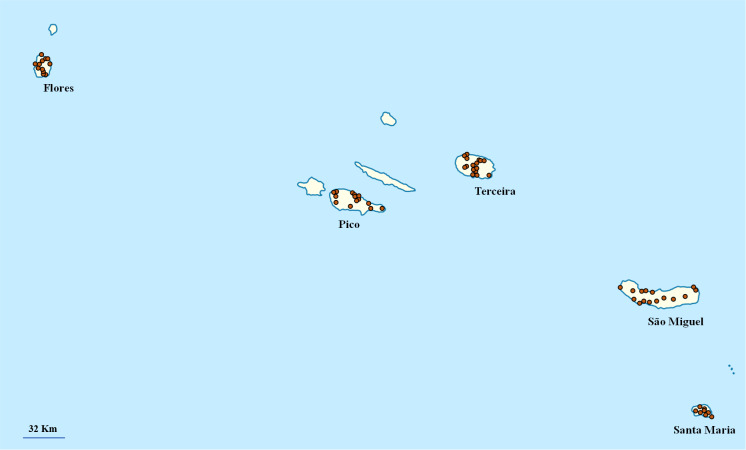
In this paper, we present an extensive checklist of selected arthropods and their distribution in five Islands of the Azores (Santa Maria. São Miguel, Terceira, Flores and Pico). Habitat surveys included five herbaceous and four arboreal habitat types, scaling up from native to anthropogenic managed habitats. We aimed to contribute to the ongoing effort to document the terrestrial biodiversity of the world, in particular the Portuguese archipelago of the Azores, as islands harbour a significant portion of unique terrestrial biodiversity. Selection of Arthropoda groups for the current checklist was based on their known richness and abundance (Arachnida, Collembola, Hemiptera, Neuroptera, Coleoptera, Hymenoptera), in almost all terrestrial ecosystems, as well as their importance in current Integrated Pest Management and alternative Biocontrol protocols at large (i.e. hymenopteran parasitoids and beneficial Coleoptera). In addition, we include the list of Dermaptera, Orthoptera, Psocoptera and Thysanoptera species. These assembled groups represent part of the monitoring programme EDEN Azores (2008-2014), where all Arthropod fauna, at all strata, within nine representative habitats of the abovementioned five Islands of the Azores was recorded. In this study, a total of 116,523 specimens, belonging to 483 species and subspecies of selected groups of arthropods, are reported by order, family and, when possible, genus and species. Hymenopteran, mostly parasitoids, accounted for the most represented taxa across all the monitoring and sampling phase of EDEN Azores (193 species and mophospecies), followed by Coleoptera (95 species); Collembola (89 species); and Araneae (72 species). A total of 37 non-native species are reported for the first time in the Azores. Coleoptera: Asaphidion flavipes (Linnaeus, 1761) (Carabidae); Tachyporus dispar (Paykull, 1789) (Staphylinidae). Hemiptera: Acrosternum heegeri Fieber, 1861 (Pentatomidae). Collembola: Entomobrya regularis Stach, 1963 (Entomobryidae); Lepidocyrtus lusitanicus piezoensis (Simón-Benito, 2007) (Entomobryidae); Jordanathrix articulata (Ellis, 1974) (Sminthuridae); Sminthurinus quadrimaculatus (Ryder, 1879) (Katiannidae); Himalanura sp. (Entomobryidae); Protophorura sp. (Onychiuridae). Hymenoptera, parasitoids: Aphidius colemani Viereck, 1912 (Braconidae); Aphidius ervi Haliday, 1834 (Braconidae); Aphidius matricariae Viereck, 1912 (Braconidae); Aphidius rhopalosiphi Stefani-Perez, 1902 (Braconidae); Aphidius rosae (Haliday, 1834) (Braconidae); Aphidius urticae Haliday, 1834 (Braconidae); Centistidea ectoedemiae Rohwer, 1914 (Braconidae); Meteorus unicolor (Wesmael, 1835) (Braconidae); Meteorus collaris (Spin.) Hal. – Ruschka, Fulmek, 1915 (Braconidae); Orthostigma cratospilum (Thomson, 1895) (Braconidae); Orthostigma latriventris Ratzeburg, 1844 (Braconidae); two other species of Orthostigma sp.; Pseudopezomachus bituberculatus (Marshall, 1905) (Braconidae); Tanycarpa punctata (van Achterberg, 1976) (Braconidae); Gonatopus clavipes (Thunberg, 1827) (Dryinidae). New genera not previously recorded for the Azores include: Pycnetron sp. (Chalcidoidea: Pteromalidae); four species of Aspilota sp. (Braconidae: Alysiinae); four species of Chorebus sp. (Braconidae: Aphidiinae: Alysiinae); Microgaster sp. (Braconidae: Microgastrinae); Homolobus sp. (Braconidae: Homolobinae); Lodbrokia sp. (Braconidae: Alysiinae). These 37 taxa were found in several Islands and five are new species for Flores Island, 10 species are new for Pico Island, 12 species are new for Terceira Island, 19 species are new for S. Miguel Island and five species are new for S. Maria Island. Additional species records for the Islands included: Flores (5 Collembola, 9 Araneae; 2 Hemiptera; 8 Coleoptera, 8 Hymenoptera), Pico (4 Collembola; 7 Araneae; 4 Hemiptera; 11 Coleoptera; 9 Hymenoptera), Terceira (4 Collembola; 1 Araneae; 3 Hymenoptera), S. Miguel (1 Araneae; 2 Coleoptera; 3 Hymenoptera), S. Maria (5 Collembola; 3 Araneae; 2 Hemiptera; 2 Hymenoptera).
Overview
The claims and statistics of this paper haven’t been checked yet.
Run the check — free, no account needed. It reads the open-access text and checks the sources it cites.
Integrity signals
Registry
Cites
Statistics
Figures
Verification
Claims the paper makes
The claims and statistics of this paper haven’t been checked yet.
Run the check — free, no account needed. It reads the open-access text and checks the sources it cites.
Claims other papers make about this one
Each is checked against this paper’s own text: does it say what the citing paper says it does?
In the citing paper
“These mosaics form transitional zones where native and anthropogenic elements interact, potentially supporting refuges or dispersal corridors for endemic species across fragmented landscapes (Cardoso et al. 2009, Marcelino et al. 2021, Tsafack et al. 2021).”
From Monitoring agroforest plots under the scope of the COMCHA project. 1. Baseline data for the vascular plants and arthropods of "Vale da Fonte Plot" in Pico Island (Azores Archipelago) (2026) · cites this paper as Marcelino et al. 2021
Self-check
Percentages, sums and reported differences re-computed from the paper’s own numbers.
The self-check needs the paper’s full text.
Citations
Cites
Biodiversity: The ravages of guns, nets and bulldozers
Maxwell, S. L., Fuller, R. A., Brooks, T. M., & Watson, J. E. M. (2016) · Nature · doi:10.1038/536143a · Cited by 1,979
Research works printed but not linked: 47
- 10.5772/intechopen.74847 · DOI
- Borges, 2008, Insect ecology and conservation
- Borges, 2010, A list of the terrestrial and marine biota from the Azores
- Borges, 2013, New records of exotic spiders and insects to the Azores, and new data on recently introduced species, Arquipelago Life and Marine Sciences, 30, 57
- 10.1007/s10531-018-1553-7 · DOI · Paper page
- 10.1007/978-3-319-71065-5_78-1 · DOI
- 10.1016/B978-0-12-409548-9.11949-9 · DOI
- 10.3389/fmars.2017.00037 · DOI
- 10.1007/s10531-006-9078-x · DOI
- 10.1111/mec.14037 · DOI
- Colwell, 2013, EstimateS: statistical estimation of species richness and shared species from samples. Version 9. User’s Guide and application
- 10.1007/978-94-007-7750-7_17 · DOI
- 10.1127/phyto/2016/0132 · DOI
- 10.1186/s12898-018-0176-x · DOI
- Frutuoso, 1978, Livro sexto das saudades da terra (1589), I
- 10.1038/s41559-019-1079-8 · DOI
- 10.1017/S0954102007000028 · DOI
- 10.1016/B978-0-12-386475-8.00004-6 · DOI
- 10.1038/539141a · DOI
- 10.1002/9781118223208 · DOI
- 10.1007/s00267-004-0211-x · DOI
- 10.1111/j.1365-2656.2006.01048.x · DOI
- Lobo, 2010, Terrestrial arthropods of Macaronesia Biodiversity, Ecology and Evolution
- 10.1111/jzs.12339 · DOI
- 10.15468/38ccb3 · DOI
- Marcelino, 2011, Unobserved diversity in Darwin's appraisal of the Azores. Darwin's mistake and what we are doing to correct it, Açoreana, Suppl. 7, 229
- 10.1007/s10661-012-3019-9 · DOI
- Marcelino, 2016, Distribution and genetic variability of Staphylinidae across a gradient of anthropogenically influenced insular landscapes, Bulletin of Insectology, 69, 117
- 10.1007/s00267-014-0321-z · DOI
- 10.1111/j.1744-7348.2006.00088.x · DOI
- 10.1016/j.ecolind.2005.03.005 · DOI
- 10.1126/science.327.5963.260 · DOI
- 10.1111/icad.12216 · DOI · Paper page
- 10.1016/j.biocon.2007.02.011 · DOI
- 10.1073/pnas.2002548117 · DOI
- 10.1111/ddi.12655 · DOI
- 10.1146/annurev-environ-101718-033245 · DOI
- 10.1016/j.biocon.2019.01.020 · DOI · Paper page
- 10.1007/978-3-319-55236-1_21 · DOI
- 10.1016/j.pedobi.2005.10.005 · DOI
- Thayer, 2005, Handbook of Zoology, IV
- 10.1111/gcb.13272 · DOI · Paper page
- 10.1111/j.1600-0706.2008.17053.x · DOI
- Vandenberg, 2002, American beetles 2, Polyphaga: Scarabaeoidea through Curculionoidea, Volume 2
- 10.1073/pnas.2023989118 · DOI
- 10.1126/science.aam8326 · DOI
- 10.1038/s41467-017-02644-4 · DOI
Cited by
Lago, A., Petrone, A., Soares, A., Boieiro, M., Lopes, D., Freitas, T., Lhoumeau, S., Wallon, S., & Borges, P. (2026) · Biodiversity Data Journal · doi:10.3897/bdj.14.e174244 · Cited by 1
Self-citation
Metadata
- Authors
- Marcelino, J., Borges, P., Borges, I., Pereira, E., Santos, V., & Soares, A.
- ORCID
- Borges, Paulo
- Venue
- Biodiversity Data Journal
- Publisher
- Pensoft Publishers
- Published
- 2021-03-10
- Volume
- 9
- ISSN
- 1314-2828
- 1314-2836
- PMC
- PMC7969584
- Cited by
- 10
- References
- 1
About these checks
Registry, retraction, Cites and statistics results are computed, not judged, with one exception: a printed reference that no index lists is read once by a model before it counts as a citation error. Claims are extracted by a model and kept only when their quote appears verbatim in the text; each cited source is then checked, with a model’s help, for whether it says what the claim relies on. Those verdicts can be wrong — read the claim’s quote and the cited source before relying on one.
Statistics and arithmetic are recomputed, not judged.
Confidence bands are shown only for fields calibrated on our annotated test set. None is calibrated yet, so no band is shown.
What counts as a claim ›How we measure confidence ›How we check this ›
Are you an author, or do you see a problem with this page? Request a review
Data sources
Bibliographic data: Semantic Scholar, OpenAlex, Crossref.
Contains information from the Semantic Scholar Academic Graph Datasets, made available under the ODC Attribution License (ODC-BY 1.0).
Semantic Scholar’s data is described in: Kinney, R., et al. (2023). The Semantic Scholar Open Data Platform. arXiv:2301.10140.
