

Propiedades psicométricas del PHQ-9 (Patient Health Questionnaire) en centros de atención primaria de Chile
Open accessThe DOI matches its Crossref record; 29 of the 29 references it cites were found in a registry or an index.
Abstract
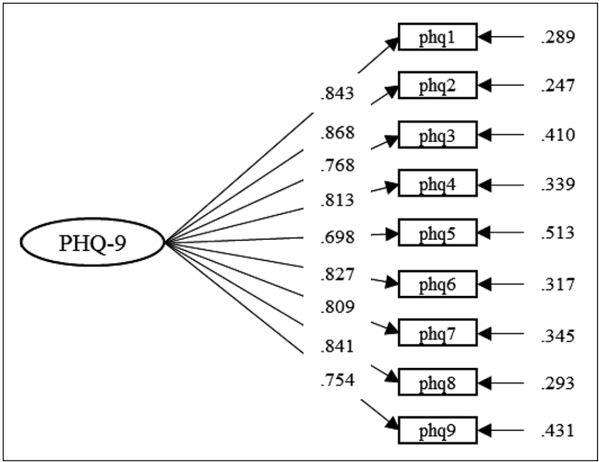
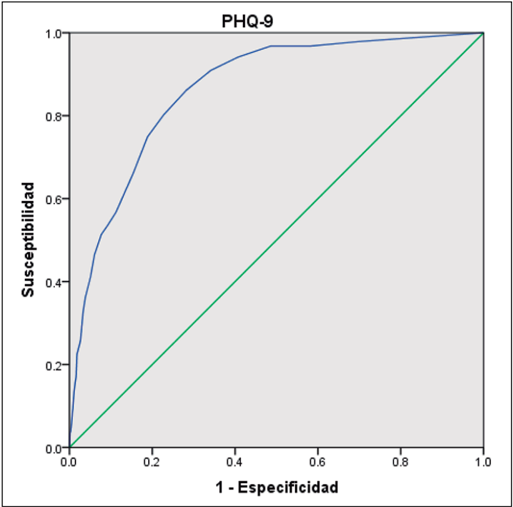
BACKGROUND: Simple and brief questionnaires with adequate psychometric properties are useful for the early detection of depressive disorders. AIM: To analyze the psychometric behavior of the Patient Health Questionnaire (PHQ-9) in Chile. MATERIAL AND METHODS: Data were collected from 1,738 adult patients, consulting in primary health care centers. The values obtained in the PHQ-9 were compared with those of the Composite International Diagnostic Interview (CIDI). RESULTS: The mean score of PHQ-9 was 4.85 ± 5.57. Internal consistency indices were high. McDonald's ω coefficient of was 0.90 and Cronbach alpha 0.89. A confirmatory factor analysis showed a good fit of the one-dimensional model. Using a cutoff score of seven determined with the receiver operating characteristic (ROC) curve, the sensitivity and specificity of the instrument were 0.8 and 0.7, when compared with CIDI diagnoses. CONCLUSIONS: PHQ-9 is a useful instrument for the screening of depressive disorders in primary health care centers in Chile.
Overview
The claims and statistics of this paper haven’t been checked yet.
Free: it reads the open-access text and checks the first 5 claims that cite a source we can check. Create a free account to check every claim.
Integrity signals
Registry
Cites
Statistics
Figures
Verification
Claims the paper makes
The claims and statistics of this paper haven’t been checked yet.
Free: it reads the open-access text and checks the first 5 claims that cite a source we can check. Create a free account to check every claim.
Claims other papers make about this one
Each is checked against this paper’s own text: does it say what the citing paper says it does?
The cited source says what the claim attributes to it.
In the citing paper
“The Spanish version (Diez-Quevedo et al., 2001) has been validated in Chile, showing good psychometric properties (Baader et al., 2012; Saldivia et al., 2019).”
From App-based intervention for reducing depressive symptoms in postpartum women: Protocol for a feasibility randomized controlled trial (2023) · cites this paper as Saldivia et al., 2019
Self-check
Percentages, sums and reported differences re-computed from the paper’s own numbers.
The self-check needs the paper’s full text.
Citations
Cites
Confirmatory factor analysis for applied research
(2007) · Choice Reviews Online · doi:10.5860/choice.44-2769 · Cited by 15,614
Vos, T., Barber, R. M., Bell, B., Bertozzi-Villa, A., Biryukov, S., Bolliger, I., Charlson, F., Davis, A., Degenhardt, L., Dicker, D., et al. (2015) · The Lancet · doi:10.1016/s0140-6736(15)60692-4 · Cited by 6,414
The PHQ-8 as a measure of current depression in the general population
Kroenke, K., Strine, T. W., Spitzer, R. L., Williams, J. B. W., Berry, J. T., & Mokdad, A. H. (2009) · Journal of Affective Disorders · doi:10.1016/j.jad.2008.06.026 · Cited by 5,121
Kroenke, K., Spitzer, R. L., Williams, J. B. W., & Löwe, B. (2010) · General Hospital Psychiatry · doi:10.1016/j.genhosppsych.2010.03.006 · Cited by 4,057
Diagnostic and Statistical Manual of Mental Disorders
Siegel, L. J., & Fletcher‐Janzen, E. (2014) · Encyclopedia of Special Education · doi:10.1002/9781118660584.ese0728 · Cited by 3,423
Haslwanter, T. (2016) · Statistics and Computing · doi:10.1007/978-3-319-28316-6_12 · Cited by 3,094
Robins, L. N. (1988) · Archives of General Psychiatry · doi:10.1001/archpsyc.1988.01800360017003 · Cited by 2,909
Health Measurement Scales: A Practical Guide to Their Development and Use
Vogelzang, J. L. (2015) · Journal of Nutrition Education and Behavior · doi:10.1016/j.jneb.2015.03.007 · Cited by 2,337
Manea, L., Gilbody, S., & McMillan, D. (2012) · Canadian Medical Association Journal · doi:10.1503/cmaj.110829 · Cited by 1,966
Clinical diagnosis of depression in primary care: a meta-analysis
Mitchell, A. J., Vaze, A., & Rao, S. (2009) · The Lancet · doi:10.1016/s0140-6736(09)60879-5 · Cited by 1,251
Ferrari, A. J., Somerville, A. J., Baxter, A. J., Norman, R., Patten, S. B., Vos, T., & Whiteford, H. A. (2013) · Psychological Medicine · doi:10.1017/s0033291712001511 · Cited by 1,230
Gadermann, A., Guhn, M., & Zumbo, B. D. (2020) · PubMed · doi:10.7275/n560-j767 · Cited by 1,200
Smarr, K. L., & Keefer, A. L. (2011) · Arthritis Care & Research · doi:10.1002/acr.20556 · Cited by 971
McGee, S. (2002) · Journal of General Internal Medicine · doi:10.1046/j.1525-1497.2002.10750.x · Cited by 894
Diez-Quevedo, C., Rangil, T., Sanchez-Planell, L., Kroenke, K., & Spitzer, R. L. (2001) · Psychosomatic Medicine · doi:10.1097/00006842-200107000-00021 · Cited by 649
What's under the ROC? An Introduction to Receiver Operating Characteristics Curves
Streiner, D. L., & Cairney, J. (2007) · The Canadian Journal of Psychiatry · doi:10.1177/070674370705200210 · Cited by 527
Araya, R., Rojas, G., Fritsch, R., Gaete, J., Rojas, M., Simon, G., & Peters, T. J. (2003) · The Lancet · doi:10.1016/s0140-6736(03)12825-5 · Cited by 450
Patel, V., Araya, R., Chowdhary, N., King, M., Kirkwood, B., Nayak, S., Simon, G., & Weiss, H. A. (2008) · Psychological Medicine · doi:10.1017/s0033291707002334 · Cited by 364
Mitchell, A. J., & Coyne, J. C. (2007) · PubMed Central · Cited by 354
Lifetime and 12-Month Prevalence of DSM-III-R Disorders in the Chile Psychiatric Prevalence Study
Vicente, B., Kohn, R., Rioseco, P., Saldivia, S., Levav, I., & Torres, S. (2006) · American Journal of Psychiatry · doi:10.1176/ajp.2006.163.8.1362 · Cited by 182
Self-citationPeters, L., & Andrews, G. (1995) · Psychological Medicine · doi:10.1017/s0033291700033237 · Cited by 179
Merz, E. L., Malcarne, V. L., Roesch, S. C., Riley, N., & Sadler, G. R. (2011) · Cultural Diversity & Ethnic Minority Psychology · doi:10.1037/a0023883 · Cited by 173
Validation of the Edinburgh postnatal depression scale (EPDS) in chilean postpartum women
Jadresic, E., Araya, R., & Jara, C. (1995) · Journal of Psychosomatic Obstetrics & Gynecology · doi:10.3109/01674829509024468 · Cited by 166
Araya, R., Wynn, R., & Lewis, G. (1992) · Social Psychiatry and Psychiatric Epidemiology · doi:10.1007/bf00789001 · Cited by 162
Responsiveness of the PHQ-9 to Psychopharmacological Depression Treatment
Löwe, B., Karapanagiotou‐Schenkel, I., Carney, C. P., & Göbel, C. (2005) · Psychosomatics · doi:10.1176/appi.psy.47.1.62 · Cited by 147
Lifetime and 12-Month Prevalence of DSM-III-R Disorders in the Chile Psychiatric Prevalence Study
Vicente, B. (2006) · American Journal of Psychiatry · doi:10.1176/appi.ajp.163.8.1362 · Cited by 58
Self-citationSchantz, K., Reighard, C., Aikens, J. E., Aruquipa, A., Pinto, B., Valverde, H., & Piette, J. D. (2017) · The International Journal of Psychiatry in Medicine · doi:10.1177/0091217417738934 · Cited by 53
Assessing validity of a depression screening instrument in the absence of a gold standard
Gelaye, B., Tadesse, M. G., Williams, M. A., Fann, J. R., Vander Stoep, A., & Andrew Zhou, X.-H. (2014) · Annals of Epidemiology · doi:10.1016/j.annepidem.2014.04.009 · Cited by 37
Sadness Or Depression?: International Perspectives on the Depression Epidemic and Its Meaning
Wakefield, J. C., & Demazeux, S. (2016) · Cited by 21
Research works printed but not linked: 9
- Cano A, Salguero JM, Wood C, Dongil E, Latorre JM. La sepresión en atención primaria: prevalencia, diagnóstico y tratamiento. Papeles del Psicólogo 2012; 33 (1): 2-11.
- Castañón SC, Pinto LJ. Mejorando la pesquisa de depre- sión posparto a través de un instrumento de tamizaje, la escala de depresión posparto de Edimburgo. Rev Med Chile 2008; 136: 851-8.
- Kroenke K, Spitzer RL, Williams JBW. The PHQ-9: Validity of a brief depression severity measure. J Gen Intern Med 2001 (16): 606-13.
- Baader T, Molina JL, Venezian S, Rojas C, Farías R, Fierro-Freixenet C, et al. Validación y utilidad de la encuesta PHQ-9 (Patient Health Questionnaire) en el diagnóstico de depresión en pacientes usuarios de aten- ción primaria en Chile. Rev Chil Neuro Psquiat 2012; 50 (1): 10-22.
- King M, Walker C, Levy G, Bottomley C, Royston P, Weich S, et al. Development and validation of an inter- national risk prediction algorithm for episodes of major depression in general practice attendees: the PredictD study. Arch Gen Psychiatry 2008; 65 (12): 1368-76.
- Saldivia S, Vicente B, Marston L, Melipillán R, Nazareth I, Bellón-Saameño J, et al. Desarrollo y validación de un algoritmo para predecir riesgo de depresión en consul- tantes de atención primaria en Chile. Rev Med Chile 2014; 142: 323-9.
- Vielma M, Vicente B, Rioseco P, Castro N, Torres S. Validación en Chile de la entrevista diagnóstica estan- darizada para estudios epidemiológicos CIDI. Revista de Psiquiatría 1992; 9 (1): 1039-49.
- Muthén LK, Muthén BO. Mplus User's Guide. Eighth Edition. Los Angeles, CA: Muthén & Muthén; 1998- 2017.
- Schantz K, Reighard C, Aikens JE, Aruquipa A, Pinto B, Valverde H, et al. Screening for depression in Andean Latin America: Factor structure and reliability of the CES-D short form and the PHQ-8 among Bolivian public hospital patients. Int J Psychiatry Med 2017; 52 (4-6): 315-27.
Cited by
Huarcaya-Victoria, J., Villarreal-Zegarra, D., Podestà, A., & Luna-Cuadros, M. A. (2022) · International Journal of Mental Health and Addiction · doi:10.1007/s11469-020-00354-5 · Cited by 185
Lamela, D. J. P. D. V., Soreira, C. S. S., Matos, P., & Morais, A. (2020) · Journal of Affective Disorders · doi:10.1016/j.jad.2020.06.066 · Cited by 165
Al-Hawary, S. I. S., & Syasneh, M. S. A. (2020) · Verslas teorija ir praktika · doi:10.3846/btp.2020.11895 · Cited by 153
Herrera, M. S., Elgueta, R., Fernández, M. B., Giacoman, C., Leal, D., Marshall, P., Acuña, M. R., & Bustamante, F. (2021) · BMC Geriatrics · doi:10.1186/s12877-021-02110-3 · Cited by 146
“This questionnaire has been validated in Chile in a sample of adults from primary care centers [30].”
MethodPaz, C., Mascialino, G., Adana-Díaz, L., Rodríguez-Lorenzana, A., Simbaña-Rivera, K., Gómez-Barreno, L., Troya, M., Paez, M. I., Cárdenas, J., Gerstner, R. M., et al. (2020) · PLOS ONE · doi:10.1371/journal.pone.0240008 · Cited by 60
“89) with the original version, was used in the present study [26].”
Method
Metadata
- Authors
- Saldivia, S., Aslan, J., Cova, F., Vicente, B., Inostroza, C., & Rincón, P.
- Affiliations
- University of Concepción (CL)
- Venue
- Revista médica de Chile
- Published
- 2019
- Volume
- 147
- Issue
- 1
- Pages
- 53-60
- ISSN
- 0034-9887 (ISSN-L)
- OpenAlex
- W2918575569
- Cited by
- 99
- References
- 27
- Citations by year
- 2026: 8 · 2025: 20 · 2024: 17 · 2023: 15 · 2022: 19 · 2021: 9 · 2020: 10
- FWCI
- 11.19
- Type
- journal article
- Language
- en
- Open access
- diamond
- doi.org
- Licence
- cc-by
- Locations
- Revista médica de Chile (publishedVersion, cc-by)
- PubMed (publishedVersion)
- LA Referencia (Red Federada de Repositorios Institucionales de Publicaciones Científicas) (publishedVersion, other-oa)
- Americanae (AECID Library) (submittedVersion, cc-by)
- Topics
- Social Sciences › Psychology › Experimental and Cognitive Psychology › Anxiety, Depression, Psychometrics, Treatment, Cognitive Processes
- Social Sciences › Decision Sciences › Management Science and Operations Research › Psychometric Methodologies and Testing
- Health Sciences › Medicine › Psychiatry and Mental health › Mental Health Treatment and Access
- Keywords
- PHQ-9, Patient Health Questionnaire, depression screening, depressive disorders, psychometric properties, primary care, Composite International Diagnostic Interview, internal consistency, diagnostic accuracy
- MeSH terms
- Patient Health Questionnaire, Adolescent, Adult, Aged, Depressive Disorder, Factor Analysis, Statistical, Female, Humans, Male, Middle Aged, Primary Health Care, Psychiatric Status Rating Scales, Psychometrics, Reference Values, Sensitivity and Specificity, Severity of Illness Index, Reproducibility of Results, Young Adult
About these checks
Registry, retraction, Cites and statistics results are computed, not judged, with one exception: a printed reference that no index lists is read once by a model before it counts as a citation error. Claims are extracted by a model and kept only when their quote appears verbatim in the text; each cited source is then checked, with a model’s help, for whether it says what the claim relies on. Those verdicts can be wrong — read the claim’s quote and the cited source before relying on one.
Statistics and arithmetic are recomputed, not judged.
Confidence bands are shown only for fields calibrated on our annotated test set. None is calibrated yet, so no band is shown.
What counts as a claim ›How we measure confidence ›How we check this ›
Are you an author, or do you see a problem with this page? Request a review
Data sources
Bibliographic data: Semantic Scholar, OpenAlex, Crossref.
Contains information from the Semantic Scholar Academic Graph Datasets, made available under the ODC Attribution License (ODC-BY 1.0).
Semantic Scholar’s data is described in: Kinney, R., et al. (2023). The Semantic Scholar Open Data Platform. arXiv:2301.10140.
