

Dietary nitrogen as a limiting nutrient in frugivorous birds
The DOI matches its Crossref record.
Abstract
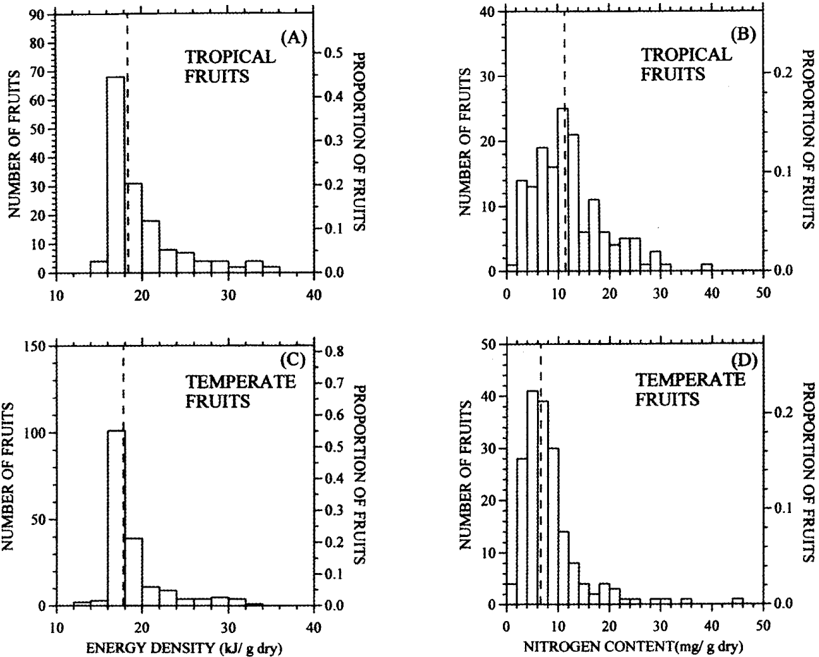
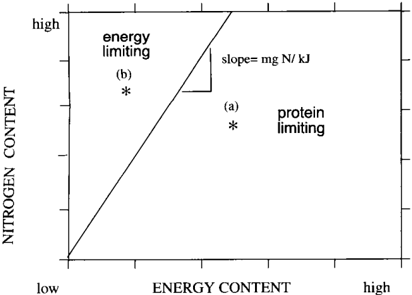
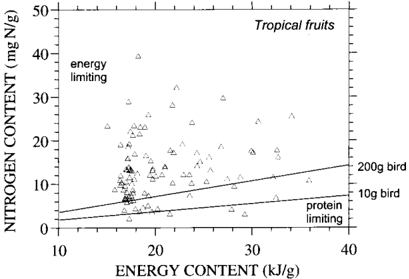
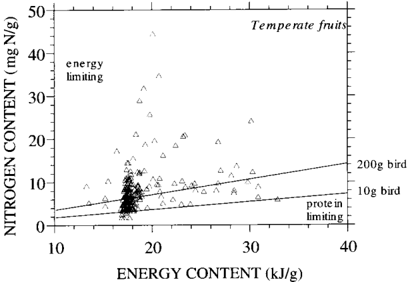
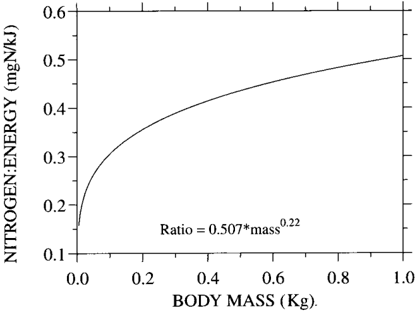
La pulpa de las frutas es considerada un alimento inadecuado para las aves frugivoras debido a su bajo contenido de proteina. Por lo tanto, se espera que los frugivoros minimicen sus perdidas de nitrogeno como una adaptacion a la frugivoria. En esta revision examinamos las propiedades de las frutas y los rasgos fisiologicos de los frugivoros que afectan su capacidad para subsistir en base a una dieta de frutas. La mayoria de las frutas tropicales y templadas parecen contener suficiente nitrogeno para satisfacer los requerimientos de los pajaros, si su ingesta de alimento estuviera ajustada para compensar el gasto energetico. Los requerimientos, sin embargo, dependen del tamano corporal. Las aves mas grandes deberian requerir alimentos con una relacion de nitrogeno a energia mas elevada que las aves pequenas. No obstante, el nitrogeno digerible puede de hecho ser limitante ya que las pulpas de las frutas parecen contener cantidades considerables de nitrogeno no-proteico y una composicion de aminoacidos diferente a la requerida por las aves. Ambas caracteristicas de las frutas conducen a un aumento de las perdidas de nitrogeno en aves frugivoras al consumir dietas naturales. En terminos de sus adaptaciones fisiologicas, esperariamos que los frugivoros posean una elevada capacidad de extraccion de nitrogeno de la dieta y esbozamos la posibilidad de que las bajas perdidas urinarias de nitrogeno de los frugivoros pudieran estar relacionadas con una baja tasa metabolica. La minimizacion de las perdidas endogenas fecales podria ser la adaptacion mas importante de los frugivoros para subsistir con base en dietas pobres en nitrogeno. No es evidente como los frugivoros especializados pueden tener requerimientos de nitrogeno mas bajos que los esperados en comparacion a aves de otros grupos dietarios. Finalmente, sugerimos varios topicos de investigacion que conducirian a mejorar nuestra comprension de las complejas interacciones involucradas en la regulacion de las necesidades proteicas de las aves frugivoras
Overview
The claims and statistics of this paper haven’t been checked yet.
Free: it reads the open-access text and checks the first 5 claims that cite a source we can check. Create a free account to check every claim.
Integrity signals
Registry
Cites
Statistics
Figures
Verification
Claims the paper makes
The claims and statistics of this paper haven’t been checked yet.
Free: it reads the open-access text and checks the first 5 claims that cite a source we can check. Create a free account to check every claim.
Claims other papers make about this one
Each is checked against this paper’s own text: does it say what the citing paper says it does?
The source backs part of the claim, not all of it — or backs it for a different population, condition or comparison.
In the citing paper
“Comparatively low-quality, energy-diluted foods such as fruits have low digestibility (Bosque & Pacheco 2000, Cipollini 2000).”
From Nutritional ecology and digestive response to dietary shift in the large South American fox, Pseudalopex culpaeus (2005) · cites this paper as Bosque & Pacheco 2000
Experimental — accuracy not yet measuredIn the citing paper
“but our test fruit ( S. molle ) had lower nitrogen content and higher energy and lipid contents than average values reported for other species (Landers et al. 1977, Ball & Gologhtly 1992, Bosque & Pacheco 2000).”
From Nutritional ecology and digestive response to dietary shift in the large South American fox, Pseudalopex culpaeus (2005) · cites this paper as Bosque & Pacheco 2000
Self-check
Percentages, sums and reported differences re-computed from the paper’s own numbers.
The self-check needs the paper’s full text.
Citations
Cites
No references could be resolved yet.
Research works printed but not linked: 14
- BANCROFT GT, R BOWMAN & RJ SAWICKI (in press) Rainfall, fruiting phenology, and the nesting season of White- crowned Pigeons in the upper Florida Keys. Auk.
- LEVEY DJ, HA BISSELL & SF O'KEEFE (in press) Conversion of nitrogen to protein and amino acids in wild fruit. Journal of Chemical Ecology.
- MOULD ED & CT ROBBINS (1981) Nitrogen metabolism in Elk. Journal of Wildlife Management 45: 323-334.
- MURPHY ME (1993a) The protein requirement for maintenance in the White-crowned Sparrow, Zonotrichia leucophrys gambellii. Canadian Journal of Zoology 71: 2111-2120.
- MURPHY ME (1993b) The essential amino acid requirements for maintenance in the White- crowned Sparrow, Zonotrichia leucophrys gambellii. Canadian Journal of Zoology 71: 2121-2130.
- ROCA RL (1994) Oilbirds of Venezuela: ecology and conservation. Nuttal Ornithological Club. Cambridge, Massachusetts. x+ 83 pp.
- ROBBINS CT (1993) Wildlife feeding and nutrition. Academic Press, San Diego, California. 352 pp.
- SEDINGER JS (1984) Protein and amino acid composition of tundra vegetation in relation to nutritional requirements of geese. Journal of Wildlife Management 48: 1128-1136.
- SEDINGER JS, RG WHITE, FE MANN, FA BURIS & RA KEDROWSKI (1989) Apparent metabolizability of alfalfa components by yearling Pacific Black Brant. Journal of Wildlife Management 53: 726-734.
- SOURD C & A GAUTIER-HION (1986) Fruit selection by a Forest Guenon. Journal of Animal Ecology 55: 235244.
- WELL S & KS NAIR (1990) Relationship of resting metabolic rate to body composition and protein turnover. American Journal of Physiology 258: E990998.
- WHITE RG, ID HUME & JV NOLAN (1988) Energy expenditure and protein turnover in three species of wallabies (Marsupialia, Macropodidae). Journal of Comparative Physiology 158B: 237- 246.
- WHITE SC (1974) Ecological aspects of growth and nutrition in tropical fruit-eating birds. Ph. Doctoral Dissertation, University of Pennsylvania, USA. xvii+ 145 pp.
- WHITE TCR (1993) The inadequate environment, nitrogen and the abundance of animals. Springer-Verlag. 425 pp.
Cited by
IT TAKES GUTS (AND MORE) TO EAT FRUIT: LESSONS FROM AVIAN NUTRITIONAL ECOLOGY
Levey, D. J., & del Rio, C. M. (2001) · The Auk · doi:10.1642/0004-8038(2001)118[0819:itgamt]2.0.co;2 · Cited by 187
Nutrition of Birds in the Order Psittaciformes: A Review
Koutsos, E. A., Matson, K. D., & Klasing, K. C. (2001) · Journal of Avian Medicine and Surgery · doi:10.1647/1082-6742(2001)015[0257:nobito]2.0.co;2 · Cited by 174
Effects of food stress and density in different life stages on reproduction in a butterfly
Bauerfeind, S. S., & Fischer, K. (2005) · Oikos · doi:10.1111/j.0030-1299.2005.13888.x · Cited by 164
Allocation of larval and adult resources to reproduction in a fruit-feeding butterfly
FISCHER, K., O'BRIEN, D. M., & BOGGS, C. L. (2004) · Functional Ecology · doi:10.1111/j.0269-8463.2004.00892.x · Cited by 115
“Fruit is similar to nectar in being fairly carbohydrate-rich and nitrogen-poor (Bosque & Pacheco 2000).”
Bauerfeind, S. S., & Fischer, K. (2009) · Entomologia Experimentalis et Applicata · doi:10.1111/j.1570-7458.2008.00814.x · Cited by 40
Metadata
- Authors
- CARLOS, B., & PACHECO, M. A.
- Venue
- Revista chilena de historia natural
- Published
- 2000-09
- Volume
- 73
- Issue
- 3
- ISSN
- 0716-078X
- Cited by
- 1
- References
- 0
- Language
- en
About these checks
Registry, retraction, Cites and statistics results are computed, not judged, with one exception: a printed reference that no index lists is read once by a model before it counts as a citation error. Claims are extracted by a model and kept only when their quote appears verbatim in the text; each cited source is then checked, with a model’s help, for whether it says what the claim relies on. Those verdicts can be wrong — read the claim’s quote and the cited source before relying on one.
Statistics and arithmetic are recomputed, not judged.
Confidence bands are shown only for fields calibrated on our annotated test set. None is calibrated yet, so no band is shown.
What counts as a claim ›How we measure confidence ›How we check this ›
Are you an author, or do you see a problem with this page? Request a review
How to cite
Cite CoChat for the checks on this page, and the paper for its own findings.
- This page
- CoChat. (2026). Citation check: Dietary nitrogen as a limiting nutrient in frugivorous birds. https://app.cochat.ai/papers/10.4067/s0716-078x2000000300007
- The paper
- CARLOS, B., & PACHECO, M. A. (2000). Dietary nitrogen as a limiting nutrient in frugivorous birds. Revista chilena de historia natural. https://doi.org/10.4067/s0716-078x2000000300007
Data sources
Bibliographic data: Semantic Scholar, OpenAlex, Crossref.
Contains information from the Semantic Scholar Academic Graph Datasets, made available under the ODC Attribution License (ODC-BY 1.0).
Semantic Scholar’s data is described in: Kinney, R., et al. (2023). The Semantic Scholar Open Data Platform. arXiv:2301.10140.
