

The DOI matches its Crossref record; 55 of the 55 references it cites were found in a registry or an index.
Brown Adipose Tissue as a Regulator of Energy Expenditure and Body Fat in Humans
Open accessAbstract
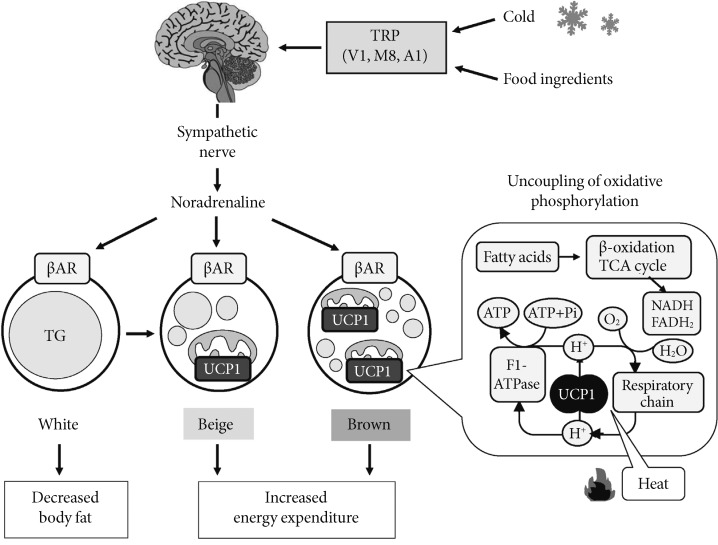
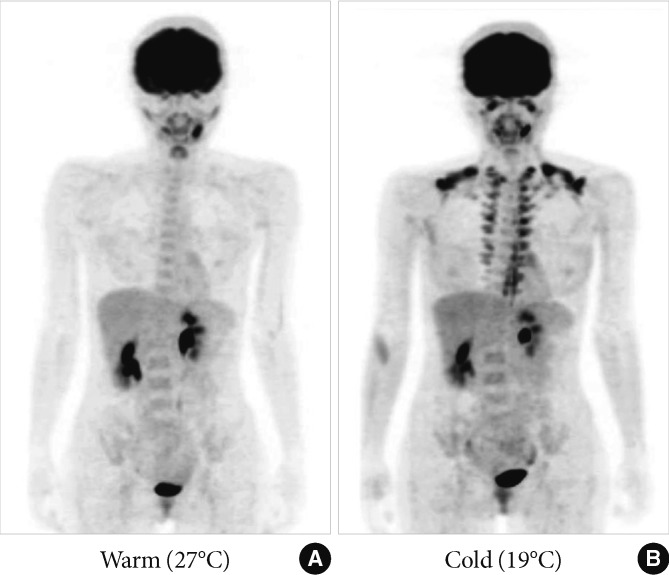
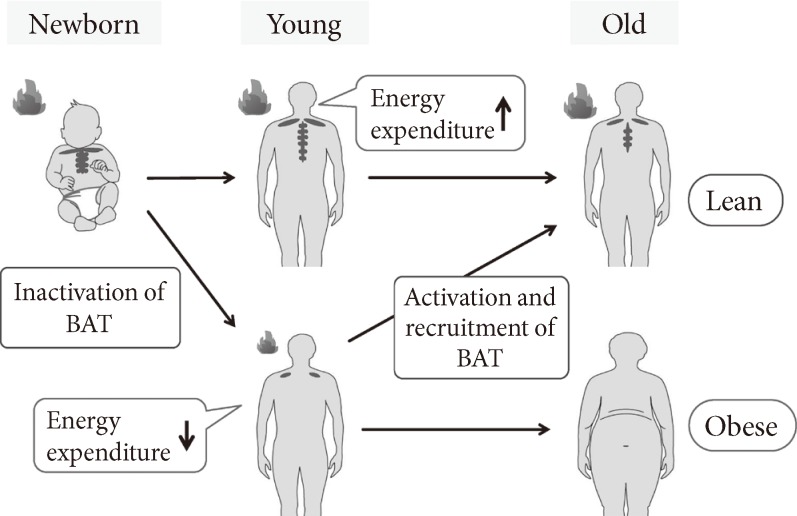
Brown adipose tissue (BAT) is recognized as the major site of sympathetically activated nonshivering thermogenesis during cold exposure and after spontaneous hyperphagia, thereby controling whole-body energy expenditure and body fat. In adult humans, BAT has long been believed to be absent or negligible, but recent studies using fluorodeoxyglucose-positron emission tomography, in combination with computed tomography, demonstrated the existence of metabolically active BAT in healthy adult humans. Human BAT is activated by acute cold exposure, being positively correlated to cold-induced increases in energy expenditure. The metabolic activity of BAT differs among individuals, being lower in older and obese individuals. Thus, BAT is recognized as a regulator of whole-body energy expenditure and body fat in humans as in small rodents, and a hopeful target combating obesity and related disorders. In fact, there are some food ingredients such as capsaicin and capsinoids, which have potential to activate and recruit BAT via activity on the specific receptor, transient receptor potential channels, thereby increasing energy expenditure and decreasing body fat modestly and consistently.
Overview
The claims and statistics of this paper haven’t been checked yet.
Run the check — free, no account needed. It reads the open-access text and checks the sources it cites.
Integrity signals
Registry
Cites
Statistics
Figures
Verification
Claims the paper makes
The claims and statistics of this paper haven’t been checked yet.
Run the check — free, no account needed. It reads the open-access text and checks the sources it cites.
Claims other papers make about this one
Each is checked against this paper’s own text: does it say what the citing paper says it does?
In the citing paper
“It has been demonstrated by several groups that there is a meal‐associated thermogenesis 101, 102, 103.”
From Inter‐organ communication: a gatekeeper for metabolic health (2019) · cites this paper as [103]
Self-check
Percentages, sums and reported differences re-computed from the paper’s own numbers.
The self-check needs the paper’s full text.
Citations
Cites
Brown Adipose Tissue: Function and Physiological Significance
CANNON, B., & NEDERGAARD, J. (2004) · Physiological Reviews · doi:10.1152/physrev.00015.2003 · Cited by 6,433
Identification and Importance of Brown Adipose Tissue in Adult Humans
Cypess, A. M., Lehman, S., Williams, G., Tal, I., Rodman, D., Goldfine, A. B., Kuo, F. C., Palmer, E. L., Tseng, Y.-H., Doria, A., et al. (2009) · New England Journal of Medicine · doi:10.1056/nejmoa0810780 · Cited by 4,399
Cold-Activated Brown Adipose Tissue in Healthy Men
van Marken Lichtenbelt, W. D., Vanhommerig, J. W., Smulders, N. M., Drossaerts, J. M. A. F. L., Kemerink, G. J., Bouvy, N. D., Schrauwen, P., & Teule, G. J. J. (2009) · New England Journal of Medicine · doi:10.1056/nejmoa0808718 · Cited by 3,452
Beige Adipocytes Are a Distinct Type of Thermogenic Fat Cell in Mouse and Human
Wu, J., Boström, P., Sparks, L. M., Li, Y., Choi, J. H., Giang, A.-H., Khandekar, M. J., Virtanen, K. A., Nuutila, P., Schaart, G., et al. (2012) · Cell · doi:10.1016/j.cell.2012.05.016 · Cited by 3,406
Functional Brown Adipose Tissue in Healthy Adults
Virtanen, K. A., Lidell, M. E., Orava, J., Heglind, M., Westergren, R., Niemi, T., Taittonen, M., Laine, J., Savisto, N.-J., Enerbäck, S., et al. (2009) · New England Journal of Medicine · doi:10.1056/nejmoa0808949 · Cited by 3,058
High Incidence of Metabolically Active Brown Adipose Tissue in Healthy Adult Humans
Saito, M., Okamatsu-Ogura, Y., Matsushita, M., Watanabe, K., Yoneshiro, T., Nio-Kobayashi, J., Iwanaga, T., Miyagawa, M., Kameya, T., Nakada, K., et al. (2009) · Diabetes · doi:10.2337/db09-0530 · Cited by 1,848
Self-citationUnexpected evidence for active brown adipose tissue in adult humans
Nedergaard, J., Bengtsson, T., & Cannon, B. (2007) · American Journal of Physiology-Endocrinology and Metabolism · doi:10.1152/ajpendo.00691.2006 · Cited by 1,824
Towards a molecular understanding of adaptive thermogenesis
Lowell, B. B., & Spiegelman, B. M. (2000) · Nature · doi:10.1038/35007527 · Cited by 1,630
Brown adipose tissue activity controls triglyceride clearance
Bartelt, A., Bruns, O. T., Reimer, R., Hohenberg, H., Ittrich, H., Peldschus, K., Kaul, M. G., Tromsdorf, U. I., Weller, H., Waurisch, C., et al. (2011) · Nature Medicine · doi:10.1038/nm.2297 · Cited by 1,608
A role for brown adipose tissue in diet-induced thermogenesis
Rothwell, N. J., & Stock, M. J. (1979) · Nature · doi:10.1038/281031a0 · Cited by 1,606
Research works printed but not linked: 8
- Ricquier, 2000, Biochem J, 345, 161, 10.1042/0264-6021:3450161 · DOI
- Heaton, 1972, J Anat, 112, 35
- Cohade, 2003, J Nucl Med, 44, 170
- Saito, 2007, Int J Obes (Lond), 31, S32
- Yoneshiro, Int J Obes (Lond)
- Vallerand, 1987, Am J Physiol, 253, E179
- Vallerand, 1990, Am J Physiol, 259, R1043
- Shimizu, 1993, Am J Physiol, 264, E890
Cited by
Sorted by citations
Leeners, B., Geary, N., Tobler, P. N., & Asarian, L. (2017) · Human Reproduction Update · doi:10.1093/humupd/dmw045 · Cited by 407
Temperature-Acclimated Brown Adipose Tissue Modulates Insulin Sensitivity in Humans
Lee, P., Smith, S., Linderman, J. D., Courville, A. B., Brychta, R. J., Dieckmann, W., Werner, C., Chen, K. Y., & Celi, F. S. (2014) · Diabetes · doi:10.2337/db14-0513 · Cited by 411
Short-term Cold Acclimation Recruits Brown Adipose Tissue in Obese Humans
Hanssen, M. J. W., van der Lans, A. A. J. J., Brans, B. T., Hoeks, J., Jardon, K. M. C., Schaart, G., Mottaghy, F. M., Schrauwen, P., & Lichtenbelt, W. D. V. M. (2015) · Diabetes · doi:10.2337/db15-1372 · Cited by 302
Pradhan, G., Samson, S. L., & Sun, Y. (2013) · Current Opinion in Clinical Nutrition & Metabolic Care · doi:10.1097/mco.0b013e328365b9be · Cited by 311
Wang, S., Liang, X., Yang, Q., Fu, X., Rogers, C. J., Zhu, M. J., Rodgers, B. D., Jiang, Q., Dodson, M. V., & Du, . (2015) · International Journal of Obesity · doi:10.1038/ijo.2015.23 · Cited by 285
Metadata
- Authors
- Saito, M.
- Affiliations
- Tenshi College (JP)
- Corresponding author
- Saito, Masayuki
- ORCID
- Saito, Masayuki
- Venue
- Diabetes & Metabolism Journal
- Publisher
- Korean Diabetes Association
- Published
- 2013
- Volume
- 37
- Issue
- 1
- Pages
- 22
- ISSN
- 2233-6079 (ISSN-L)
- 2233-6087
- PMC
- PMC3579148
- OpenAlex
- W2168695748
- Cited by
- 146
- References
- 55
- Citations by year
- 2026: 4 · 2025: 10 · 2024: 6 · 2023: 13 · 2022: 10 · 2021: 7 · 2020: 9 · 2019: 10 · 2018: 8 · 2017: 13 · 2016: 14 · 2015: 19 · 2014: 11 · 2013: 12
- FWCI
- 13.00
- Type
- journal article
- Language
- en
- Open access
- gold
- doi.org
- Licence
- Locations
- Diabetes & Metabolism Journal (publishedVersion, cc-by-nc)
- Europe PMC (PubMed Central) (publishedVersion, cc-by-nc)
- PubMed Central (publishedVersion, cc-by-nc)
- PubMed (publishedVersion)
- DOAJ (DOAJ: Directory of Open Access Journals) (submittedVersion, cc-by-sa)
- Funders
- Japan Society for the Promotion of Science (24240092)
- Topics
- Health Sciences › Medicine › Physiology (medical) › Adipose Tissue and Metabolism
- Health Sciences › Medicine › Endocrinology, Diabetes and Metabolism › Adipokines, Inflammation, and Metabolic Diseases
- Life Sciences › Neuroscience › Endocrine and Autonomic Systems › Regulation of Appetite and Obesity
- Keywords
- brown adipose tissue, non-shivering thermogenesis, energy expenditure, fat mass, cold exposure, obesity, capsaicin, capsinoids, TRP channels, aging
About these checks
Registry, retraction, Cites and statistics results are computed, not judged, with one exception: a printed reference that no index lists is read once by a model before it counts as a citation error. Claims are extracted by a model and kept only when their quote appears verbatim in the text; each cited source is then checked, with a model’s help, for whether it says what the claim relies on. Those verdicts can be wrong — read the claim’s quote and the cited source before relying on one.
Statistics and arithmetic are recomputed, not judged.
Confidence bands are shown only for fields calibrated on our annotated test set. None is calibrated yet, so no band is shown.
What counts as a claim ›How we measure confidence ›How we check this ›
Are you an author, or do you see a problem with this page? Request a review
