

Knowledge, attitudes, and help-seeking behaviour for mental illness in a Christian community
Open accessThe DOI matches its Crossref record; 31 of the 31 references it cites were found in a registry or an index; 4 of the 36 sources its claims cite were checked for support.
Abstract
Background: Christian beliefs have a role in conceptualising mental illness, which determines help-seeking behaviour and treatment choices. The topic of mental illness is controversial in many Christian circles and is often avoided because of the beliefs and teachings stemming from the Christian faith. Inadequate and inaccurate knowledge about mental illness and its causes negatively impacts the attitudes towards mental illness, the mentally ill, and ultimately help-seeking behaviour. Aim: This study aimed to explore knowledge, attitudes, and help-seeking behaviour for mental illness in a Christian community. Setting: A descriptive, quantitative cross-sectional survey was conducted, comprising 300 congregants from a Pentecostal Christian charismatic church - Assemblies of God in KwaZulu-Natal. Methods: A socio-demographic tool was used to capture the relevant social, demographic, and religious information. Existing self-administered questionnaires were used to collect information in four areas: Mental Health Knowledge Schedule, the Reported and Intended Behaviour Scale, Community Attitudes Towards Mentally Ill scale and the Dimensions of Religiosity Scale to determine the degree of religiosity. Results: The population studied demonstrates high levels of mental health knowledge and a tolerant attitude towards persons who have mental illness. There is a high preference for professional treatment. Conclusion: The high knowledge in this Christian community is associated with a reduction in stigma and a positive attitude towards mental illness. If mental health awareness is encouraged, it helps to encourage positive help-seeking practices tolerance, and treatment outcomes. Contribution: This study highlights levels of knowledge and its influence on help-seeking practices and stigma in a Christian community.
Overview
CoChat Summary
TL;DR
In a cross-sectional survey of 300 Pentecostal Assemblies of God congregants in KwaZulu-Natal, the study found moderate-to-high mental health knowledge, generally tolerant attitudes, and a preference for professional help-seeking. Higher knowledge was associated with less stigma and more favourable attitudes, while greater religiosity correlated with less favourable attitudes and intended behaviour.
Key findings
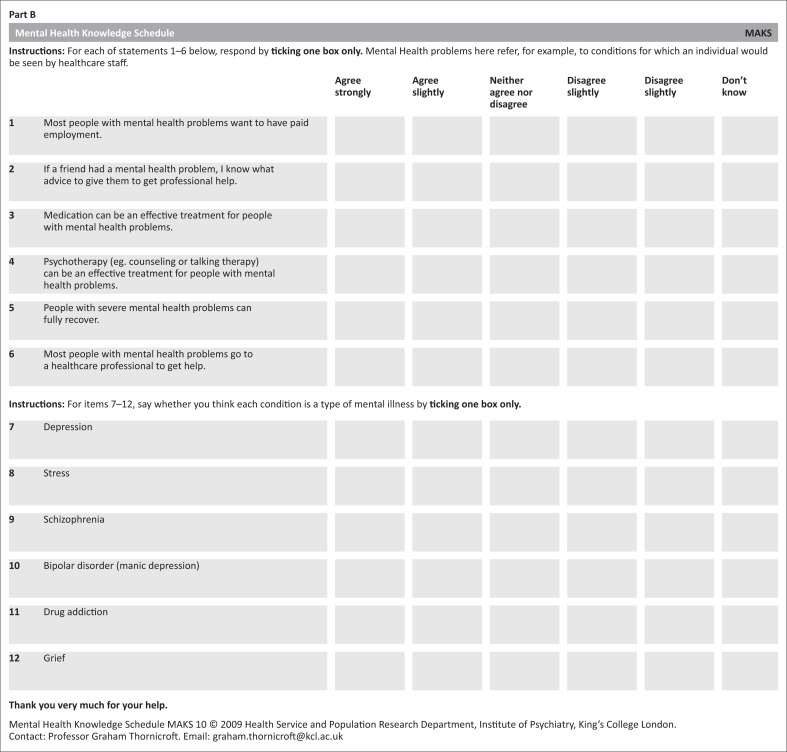
- On the MAKS, 141 (47%) had high mental health knowledge, 110 (37%) moderate, and 49 (16%) low; schizophrenia and bipolar disorder were recognised as mental illness by 76.3% and 71.7%, respectively, while depression and drug addiction were recognised by 61% and 58%.
- On the CAMI, 141 (46.8%) had medium scores and 96 (31.6%) had high/favourable attitudes; males had more favourable attitudes than females (92.0 vs 80.7), and stigma was lowest in ages 31–40 and 41–50 and highest in ages 18–20 (75.9 vs 95.98).
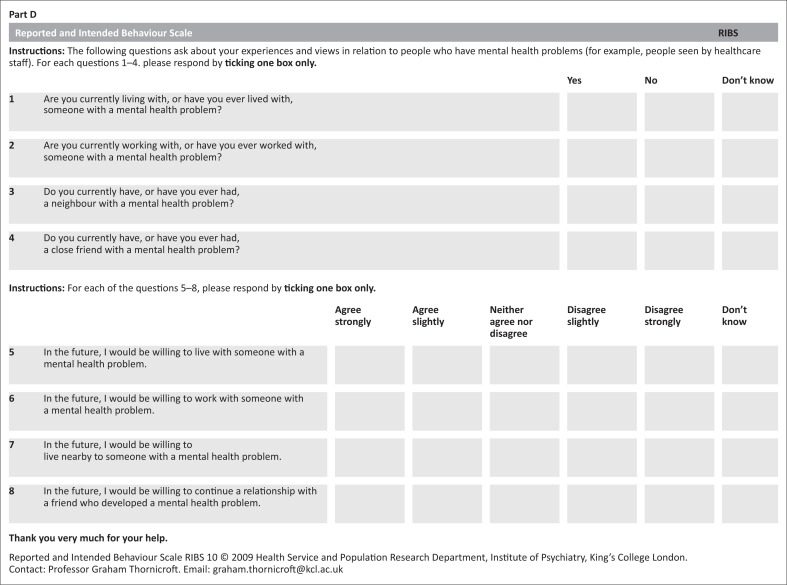
- On the RIBS, 139 (46%) had medium and 95 (31.6%) high past contact with mental illness; intended-behaviour mean was 12.47 (SD 5.78), and CAMI scores were positively correlated with RIBS scores (r = 0.594, p < 0.05).
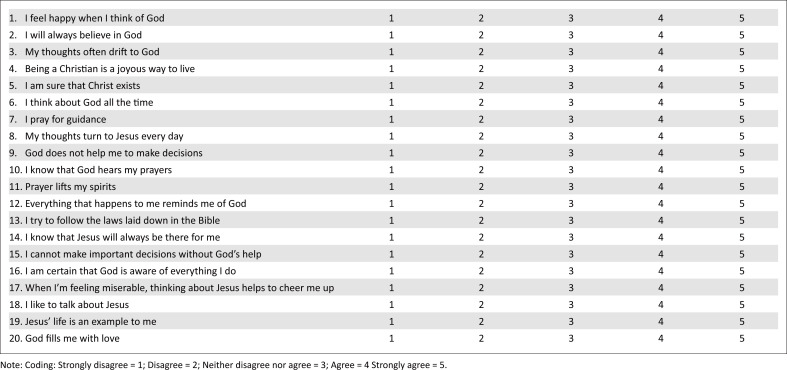
- Help-seeking most commonly named hospital/clinic (108; 36.0%), followed by church pastor (76; 25.3%), Christian professional (62; 20.7%), lay Christian counsellor (46; 15.3%), and traditional healer (7; 2.3%); high religiosity correlated negatively with attitudes (r = -0.203, p < 0.005) and RIBS (r = -0.175, p < 0.005), with no significant correlation with MAKS.
Methods
- Descriptive, quantitative cross-sectional survey of 300 congregants from a Pentecostal Christian charismatic church — Assemblies of God in KwaZulu-Natal; inclusion required age 18+, ability to consent, and English literacy, with only KwaZulu-Natal branches included.
- Data collected via socio-demographic tool and self-administered questionnaires: Mental Health Knowledge Schedule (MAKS), Reported and Intended Behaviour Scale (RIBS), Community Attitudes Towards Mentally Ill scale (CAMI), and Dimensions of Religiosity Scale; survey administered online through Google Forms, WhatsApp, and email.
- Analysis used IBM SPSS version 27 with descriptive statistics, bivariate analysis, and logistic regression; statistical significance set at p < 0.05.
Limitations
- Stated: anonymous self-report questionnaires may not fully represent the Christian population; possible neutral response bias, untruthful reporting, loss of introspective ability, and reporting bias.
- Stated: instruments had not yet been validated in the South African context, and inclusion of only one denominational cluster reduces generalisability; the sample is a small representation of many Christian followers and denominations, so results are explorative rather than conclusive.
- Evident from the text: the cross-sectional design cannot establish causality, and the online, self-selected convenience sample restricted to KwaZulu-Natal branches and English-literate adults may further limit generalisability.
Model-written summary. Check it against the paper before relying on it.
Integrity signals
Registry
Cites
Statistics
Figures
Verification
Claims the paper makes
2 Valid · 0 Not valid · 18 Not checked · 69 Own results and interpretations
None of the sources cited for this claim have been checked yet.
In the paper
“Spirituality has a significant influence on patients’ attitudes and practices contributing to mental illness and recovery.2,3,4”
§ Knowledge, attitudes, and help-seeking behaviour for mental illness in a Christian community > Introduction
What the sources say
- Could not verifycites [2] Henderson C, Evans-Lacko S, Thornicroft G. Mental illness stigma, help seeking, and public health programs. Am J Public Health. 2013; 103(5): 777– 780. 10.2105/AJPH.2012.301056 23488489 PMC3698814 sourceExperimental — accuracy not yet measured
Our full-text copy of Henderson, Evans-Lacko, and Thornicroft (2013) addresses mental illness stigma, help-seeking and public health programs (e.g., the Time to Change campaign analyses in 'IMPACT OF PUBLIC HEALTH PROGRAMS ON HELP SEEKING' and 'DISCRIMINATION, STIGMA, AND MENTAL HEALTH CARE ACCESS'), and never mentions spirituality, religion or faith. Searches for 'spirituality/spiritual', 'religion/faith beliefs' and 'cultural beliefs/explanatory models of recovery' returned only passages on mental health knowledge, public attitudes, ethnic-group differences and treatment-adherence references, none supporting the attributed point. The paper is not truncated, so the absence is not a coverage gap, but nothing in our copy speaks to the claim either way. (LLM, conf=0.70)
- Not checked yetcites [3] Cornah D. The impact of spirituality on mental health: A review of the literature. Mental Health Foundation [homepage on the Internet]. 2006 [cited n.d.]. Available from: https://www.elament.org.uk/self-help-resources/the-mental-health-foundation-the-impact-of-spirituality-a-literature-review/
- Not checked yetcites [4] Saunders SM, Miller ML, Bright MM. Spiritually conscious psychological care. Prof Psychol Res Pract. 2010; 41(5): 355. 10.1037/a0020953 source
Checked before — its earlier verdict is held back until a new check runs.
plainstates a cause- Asserted: passes — The authors put it forward as true.
- Checkable: passes — It can be checked against evidence.
- Load-bearing: passes — The paper’s conclusions depend on it.
- Based: passes — The paper gives a reason why it holds.
- Could not verify
The cited sources support only part of this claim — read each source’s verdict below.
In the paper
“This was the finding of a systematic review on spiritual health by Harold Koenig which showed that, when a person’s distress had progressed beyond a certain severity, spiritual beliefs may not be sufficient to bring about relief.”
§ Knowledge, attitudes, and help-seeking behaviour for mental illness in a Christian community > Introduction
What the sources say
- Partly supportedcites [6] Koening HG. Research on religion, spirituality, and mental health: A review. Can J Psychiatry. 2009; 54(5): 283– 291. 10.1177/070674370905400502 19497160 sourceExperimental — accuracy not yet measured
The Summary and Conclusions section of our copy does support the general point attributed here: 'While some are helped, not all such people are completely relieved of their mental distress or destructive behavioural tendencies,' and it adds that 'especially in the emotionally vulnerable, religious beliefs and doctrines may reinforce neurotic tendencies, enhance fears or guilt.' However, no passage of our copy establishes the specific threshold the claim rests on — that distress must have 'progressed beyond a certain severity' before spiritual beliefs become insufficient; searches for a severity cut-off return only unrelated findings (e.g., symptom severity inversely related to religious indicators in depressed medical inpatients, Depression section) and a caution that benefits 'may not be true in all populations.' Further, this 2009 paper is presented as a narrative review of research on religion, spirituality and mental health (it reports earlier systematic reviews, such as the 68-study religion–suicide review, as separate works), so describing it itself as 'a systematic review' overstates its design. (LLM, conf=0.72)
hedgedstates a possible cause- Asserted: passes — The authors put it forward as true.
- Checkable: passes — It can be checked against evidence.
- Load-bearing: passes — The paper’s conclusions depend on it.
- Based: passes — The paper gives a reason why it holds.
- Partly supported
The cited sources support only part of this claim — read each source’s verdict below.
In the paper
“Religious beliefs are further influenced by ethnicity and culture in predicting attitudes and interpretation of mental illness.7,12”
§ Knowledge, attitudes, and help-seeking behaviour for mental illness in a Christian community > Introduction
What the sources say
- Not checked yetcites [7] Salifu Yendork J, Kpobi L, Sarfo EA. ‘ It’s only “madness” that I know’: Analysis of how mental illness is conceptualized by congregants of selected Charismatic churches in Ghana. Ment Health Religion Cult. 2016; 19(9): 984– 999. 10.1080/13674676.2017.1285877 source
Checked before — its earlier verdict is held back until a new check runs.
- Partly supportedcites [12] Abi Doumit C, Haddad C, Sacre H, et al. Knowledge, attitude and behaviors towards patients with mental illness: Results from a national Lebanese study. PLoS One. 2019; 14(9): e0222172. 10.1371/journal.pone.0222172 31525219 PMC6746362 sourceExperimental — accuracy not yet measured
The Discussion (p. n/a) and Introduction support the culture-and-religion part of the claim: 'the Lebanese society where religion plays an important role, pays special attention to beliefs about sin and causes and treatment of mental illness', and 'The theological view of mentally illness in the Arab culture considers that the illness is related to evil eye or a result from a sin or wrongdoing... a consequence of God punishment'; the Introduction adds 'In Arab countries, symptoms of psychiatric disorders are associated to religious beliefs' and 'socio-cultural, religious and political aspects of the Arab world have an impact on psychiatric care'. However, nothing in our copy makes ethnicity a determinant of religious beliefs or of attitudes: the study's own bivariate/multivariable analyses of CAMI, MAKS and RIBS scores cover gender, age, education, district/residence, knowledge and familiarity only — no ethnic variable. So the 'influenced by ethnicity' element attributed to this source is unsupported. (LLM, conf=0.72)
plainstates an association- Asserted: passes — The authors put it forward as true.
- Checkable: passes — It can be checked against evidence.
- Load-bearing: unclear — It is unclear whether the paper’s conclusions depend on it.
- Based: passes — The paper gives a reason why it holds.
- Not checked yet
None of the sources cited for this claim have been checked yet.
In the paper
“Spirituality and religion play a significant role in mental health.”
§ Knowledge, attitudes, and help-seeking behaviour for mental illness in a Christian community > Introduction
What the sources say
- Could not verifycites [2] Henderson C, Evans-Lacko S, Thornicroft G. Mental illness stigma, help seeking, and public health programs. Am J Public Health. 2013; 103(5): 777– 780. 10.2105/AJPH.2012.301056 23488489 PMC3698814 sourceExperimental — accuracy not yet measured
Our copy of Henderson, Evans-Lacko & Thornicroft (2013) deals only with stigma, discrimination and help-seeking barriers, and with public health programmes such as Time to Change (DISCRIMINATION, STIGMA, AND MENTAL HEALTH CARE ACCESS; IMPACT OF PUBLIC HEALTH PROGRAMS ON HELP SEEKING). Searches for spirituality, religion, faith and religious coping returned no passage in which the paper attributes any role to spirituality or religion in mental health; the nearest content is about ethnic groups and cultural beliefs affecting barriers to care (ref 23-26), which is a different point. Since our copy does not address the claim's point, it can neither support nor contradict it. (LLM, conf=0.68)
- Not checked yetcites [3] Cornah D. The impact of spirituality on mental health: A review of the literature. Mental Health Foundation [homepage on the Internet]. 2006 [cited n.d.]. Available from: https://www.elament.org.uk/self-help-resources/the-mental-health-foundation-the-impact-of-spirituality-a-literature-review/
plainstates an association- Asserted: passes — The authors put it forward as true.
- Checkable: passes — It can be checked against evidence.
- Load-bearing: passes — The paper’s conclusions depend on it.
- Based: passes — The paper gives a reason why it holds.
- Could not verify
A result the paper reports from its own data — it cites no other source for it, so there is none to check. The quote shows it is in the paper.
In the paper
“Furthermore, it was found that individuals who have been practising Christianity for 11–20 years displayed the highest level of knowledge.”
§ Knowledge, attitudes, and help-seeking behaviour for mental illness in a Christian community > Results > Bivariate analysis
plainstates an association- Asserted: passes — The authors put it forward as true.
- Checkable: passes — It can be checked against evidence.
- Load-bearing: unclear — It is unclear whether the paper’s conclusions depend on it.
- Based: passes — The paper gives a reason why it holds.
45 more claims
Create a free account to see all 89 claims and to verify the 30 references still open.
- It may state two separate claims as one. 32
- The quote only partly states this claim. 1
- Probably not a substantial claim. 13
Self-check
Percentages, sums and reported differences re-computed from the paper’s own numbers.
Each contradiction between two passages listed here was confirmed by an independent check.
Rated major: it would touch a result — a value a result rests on, reported and recomputed p-values on opposite sides of the significance level, two passages that conflict with no sign which is right, or a cited work retracted before this paper was published.
In the paper
§ Knowledge, attitudes, and help-seeking behaviour for mental illness in a Christian community > Results > Bivariate analysis
“There was no significant correlation between attitude and age or length of time as a Christian.”
§ Knowledge, attitudes, and help-seeking behaviour for mental illness in a Christian community > Results > Bivariate analysis
“| Duration ofChristian belief(years) | | < 0.001‡ | - | < 0.001‡ | - | < 0.001‡ |”
Rated major: it would touch a result — a value a result rests on, reported and recomputed p-values on opposite sides of the significance level, two passages that conflict with no sign which is right, or a cited work retracted before this paper was published.
In the paper
§ Knowledge, attitudes, and help-seeking behaviour for mental illness in a Christian community > Results > Bivariate analysis
“There was no significant correlation between attitude and age or length of time as a Christian.”
§ Knowledge, attitudes, and help-seeking behaviour for mental illness in a Christian community > Results > Bivariate analysis
“| Age (years) | - | < 0.001‡ | - | < 0.001‡ | - | < 0.001‡ |”
Rated major: it would touch a result — a value a result rests on, reported and recomputed p-values on opposite sides of the significance level, two passages that conflict with no sign which is right, or a cited work retracted before this paper was published.
In the paper
§ Knowledge, attitudes, and help-seeking behaviour for mental illness in a Christian community > Results > Bivariate analysis
“the number of years as a Christian was not predictive of the level of knowledge of mental illness and did not predict attitude significantly (p = < 0.005, r = 0.188)”
§ Knowledge, attitudes, and help-seeking behaviour for mental illness in a Christian community > Research methods and design > Statistical analysis
“Statistical significance was set at p < 0.05.”
Rated minor: it would not touch a result — a value no result rests on, a p-value that stays on the same side of the significance level, or a conflict that is clerical, resolved elsewhere in the paper, or outside its own findings.
In the paper
§ Knowledge, attitudes, and help-seeking behaviour for mental illness in a Christian community > Results > Bivariate analysis
“The highest mean scores were in the 31–40-year age group while the lowest knowledge scores were found in the 50+ age group (43.41 vs 40.64, p < 0.001).”
§ Knowledge, attitudes, and help-seeking behaviour for mental illness in a Christian community > Results > Bivariate analysis
“| 18–20 | 75.9 ± 12.17 | - | 43.41 ± 4.04 | - | 8.99 ± 5.93 | - | | 21–30 | 85.63 ± 16.01 | - | 42.92 ± 5.06 | - | 13.75 ± 5.12 | - | | 31–40 | 95.98 ± 19.27 | - | 45.3 ± 4.61 | - | 14.41 ± 4.94 | - |”
Rated minor: it would not touch a result — a value no result rests on, a p-value that stays on the same side of the significance level, or a conflict that is clerical, resolved elsewhere in the paper, or outside its own findings.
In the paper
§ Knowledge, attitudes, and help-seeking behaviour for mental illness in a Christian community > Discussion > Help seeking attitude
“The majority of participants showed a preference for a hospital in help-seeking.”
§ Knowledge, attitudes, and help-seeking behaviour for mental illness in a Christian community > Results > Socio-demographic characteristics of the participants
“| Who are participants likely to consult? | Hospital or clinic | 108 | 36.0 |”
1 more finding
Create a free account to see every finding of this check.
Citations
Cites
The global burden of mental disorders: An update from the WHO World Mental Health (WMH) surveys
Kessler, R. C., Aguilar-Gaxiola, S., Alonso, J., Chatterji, S., Lee, S., Ormel, J., Üstün, T. B., & Wang, P. S. (2009) · Epidemiologia e Psichiatria Sociale · doi:10.1017/s1121189x00001421 · Cited by 1,895
Research on Religion, Spirituality, and Mental Health: A Review
Koenig, H. G. (2009) · The Canadian Journal of Psychiatry · doi:10.1177/070674370905400502 · Cited by 1,442 · cited 2×
“6,13,14 There are varying approaches to addressing mental health issues among Christians.”
BackgroundMental Illness Stigma, Help Seeking, and Public Health Programs
Henderson, C., Evans-Lacko, S., & Thornicroft, G. (2013) · American Journal of Public Health · doi:10.2105/ajph.2012.301056 · Cited by 959
Scaling Community Attitudes Toward the Mentally Ill
Taylor, S. M., & Dear, M. J. (1981) · Schizophrenia Bulletin · doi:10.1093/schbul/7.2.225 · Cited by 854
Development and psychometric properties of the Mental Health Knowledge Schedule
Evans-Lacko, S., Little, K., Meltzer, H., Rose, D., Rhydderch, D., Henderson, C., & Thornicroft, G. (2010) · The Canadian Journal of Psychiatry · doi:10.1177/070674371005500707 · Cited by 402
Evans-Lacko, S., Rose, D., Little, K., Flach, C., Rhydderch, D., Henderson, C., & Thornicroft, G. (2011) · Epidemiology and Psychiatric Sciences · doi:10.1017/s2045796011000308 · Cited by 363
Community attitudes toward and knowledge of mental illness in South Africa
Hugo, C. J., Boshoff, D. E. L., Traut, A., Zungu-Dirwayi, N., & Stein, D. J. (2003) · Social Psychiatry and Psychiatric Epidemiology · doi:10.1007/s00127-003-0695-3 · Cited by 255
Religious and ethnic group influences on beliefs about mental illness: A qualitative interview study
Cinnirella, M., & Loewenthal, K. M. (1999) · British Journal of Medical Psychology · doi:10.1348/000711299160202 · Cited by 162
Abi Doumit, C., Haddad, C., Sacre, H., Salameh, P., Akel, M., Obeid, S., Akiki, M., Mattar, E., Hilal, N., Hallit, S., et al. (2019) · PLOS ONE · doi:10.1371/journal.pone.0222172 · Cited by 131 · cited 3×
“12,15 This study aimed to explore the knowledge, attitudes, and help-seeking behaviour for mental illness among congregants in a Pentecostal Christian charismatic church in KwaZulu-Natal.”
BackgroundMental Health Literacy Affects Mental Health Attitude: Is There a Gender Difference?
Lee, H. Y., Hwang, J., Ball, J. G., Lee, J., Yu, Y., & Albright, D. L. (2020) · American Journal of Health Behavior · doi:10.5993/ajhb.44.3.1 · Cited by 111
Joseph, S., & DiDuca, D. (2007) · Mental Health, Religion & Culture · doi:10.1080/13674670601050295 · Cited by 73
Okafor, I. P., Oyewale, D. V., Ohazurike, C., & Ogunyemi, A. O. (2022) · African Journal of Primary Health Care & Family Medicine · doi:10.4102/phcfm.v14i1.3547 · Cited by 70
Robinson, E. J., & Henderson, C. (2019) · Psychological Medicine · doi:10.1017/s0033291718003677 · Cited by 58
Religious attributions pertaining to the causes and cures of mental illness.
Hartog, K., & Gow, K. M. (2005) · Mental Health, Religion & Culture · doi:10.1080/13674670412331304339 · Cited by 56
Stress among black women in a South African township: The protective role of religion
Copeland‐Linder, N. (2006) · Journal of Community Psychology · doi:10.1002/jcop.20116 · Cited by 47
Community/hospital indicators in South African public sector mental health services.
Lund, C., & Flisher, A. J. (2003) · PubMed · Cited by 41
Spiritually conscious psychological care
Saunders, S. M., Miller, M. L., & Bright, M. M. (2010) · Professional Psychology: Research and Practice · doi:10.1037/a0020953 · Cited by 40
Evaluation of anti-stigma social marketing campaigns in Ghana and Kenya: Time to Change Global
Potts, L. C., & Henderson, C. (2021) · BMC Public Health · doi:10.1186/s12889-021-10966-8 · Cited by 39
Modern Christian healing of mental illness
(1982) · American Journal of Psychiatry · doi:10.1176/ajp.139.6.728 · Cited by 28
Perceptions of serious mental illness in the local church
Stanford, M. S., & McAlister, K. R. (2008) · Journal of Religion, Disability & Health · doi:10.1080/15228960802160654 · Cited by 27
Baptist senior pastors’ knowledge and perceptions of mental illness
Stanford, M., & Philpott, D. (2011) · Mental Health, Religion & Culture · doi:10.1080/13674670903511135 · Cited by 27
Salifu Yendork, J., Kpobi, L., & Sarfo, E. A. (2016) · Mental Health, Religion & Culture · doi:10.1080/13674676.2017.1285877 · Cited by 26
Birkie, M., & Anbesaw, T. (2021) · BMC Psychiatry · doi:10.1186/s12888-021-03609-0 · Cited by 23
Toward a Theology of Mental Illness
Webb, M. (2012) · Journal of Religion Disability & Health · doi:10.1080/15228967.2012.645608 · Cited by 22
The effects of mental illness on families within faith communities
Rogers, E. B., Stanford, M., & Garland, D. R. (2012) · Mental Health, Religion & Culture · doi:10.1080/13674676.2011.573474 · Cited by 19
Religiousness and help seeking: Individual, congregational, and clergy factors
Lefevor, G. T., Paiz, J. Y., Milburn, H. E., Sheffield, P. E., & Tamez Guerrero, N. A. (2022) · Counselling Psychology Quarterly · doi:10.1080/09515070.2021.1874297 · Cited by 15 · cited 1×
“22,23,24,25 Mental health literacy rather than gender was the strongest predictor of positive mental health knowledge and attitude in a study by Lee et al. 23 Older females, however, had lower levels of knowledge and negative mental health attitude.”
BackgroundHajure, M., Debele, G. R., Gezimu, W., Nigatu, D., Mohammedhussein, M., Mamo, A., Dule, A., Ahmed, M. H., & Jemal, K. (2022) · Frontiers in Psychiatry · doi:10.3389/fpsyt.2022.1018440 · Cited by 15
Religion and help seeking: Theological conservatism and preferences for mental health assistance
Moreno, A. N., Bartkowski, J. P., & Xu, X. (2022) · Religions · doi:10.3390/rel13050415 · Cited by 12
RELIGIOSITY, PERSONAL DISTRESS AND MINOR PSYCHIATRIC MORBIDITY AMONG BLACK STUDENTS IN SOUTH AFRICA
Peltzer, K. (2005) · Social Behavior and Personality An International Journal · doi:10.2224/sbp.2005.33.7.723 · Cited by 7
Psychotherapy with mainline Protestants: Lutheran, Presbyterian, Episcopal/Anglican, and Methodist.
McCullough, M. E., Weaver, A. J., Larson, D. B., & Aay, K. R. (2000) · Handbook of psychotherapy and religious diversity. · doi:10.1037/10347-005 · Cited by 5
Attitudes of the public to mental health: A church congregation
Gray, A. J. (2001) · Mental Health, Religion & Culture · doi:10.1080/13674670010016990 · Cited by 2
Research works printed but not linked: 1
- Cornah D. The impact of spirituality on mental health: A review of the literature. Mental Health Foundation [homepage on the Internet]. 2006 [cited n.d.]. Available from: https://www.elament.org.uk/self-help-resources/the-mental-health-foundation-the-impact-of-spirituality-a-literature-review/
Cited by
Primary Healthcare Nurses: Key Role Players in Early Recognition of Mental Health Issues
Jansen, R., & Morifi, M. G. (2025) · Issues in Mental Health Nursing · doi:10.1080/01612840.2025.2571624 · Cited by 6
Negotiating Faith in Therapy: A Qualitative Study of Christian Clients in Secular Psychotherapy
Lloyd, C. E. M., Reid, G., & Cathcart, J. (2026) · Pastoral Psychology · doi:10.1007/s11089-025-01292-6 · Cited by 5
Kakinda, A. I., Croudace, T. J., Plouffe, R. A., & Amone‐P’Olak, K. (2026) · Cambridge Prisms Global Mental Health · doi:10.1017/gmh.2026.10250 · Cited by 3
Dlamini, Z. T., Poliah, V., & Govender, N. (2025) · South African Journal of Psychiatry · doi:10.4102/sajpsychiatry.v31i0.2399 · Cited by 2
Edosomwan, H. S. (2025) · Spiritual Psychology and Counseling · doi:10.37898/spiritualpc.1544456 · Cited by 1
Metadata
- Authors
- Hlongwane, N., & Juby, V.
- Affiliations
- University of KwaZulu-Natal (ZA)
- Corresponding author
- Hlongwane, Nomthandazo
- Venue
- South African Journal of Psychiatry
- Publisher
- AOSIS
- Published
- 2023-11-07
- Volume
- 29
- Pages
- 2139-2139
- ISSN
- 1608-9685 (ISSN-L)
- 2078-6786
- PMC
- PMC10696576
- OpenAlex
- W4388456911
- Cited by
- 11
- References
- 31
- Citations by year
- 2026: 4 · 2025: 6 · 2024: 1
- FWCI
- 1.78
- Type
- journal article
- Language
- en
- Open access
- gold
- doi.org
- Locations
- South African Journal of Psychiatry (publishedVersion, cc-by)
- PubMed Central (publishedVersion, cc-by)
- PubMed (publishedVersion)
- DOAJ (DOAJ: Directory of Open Access Journals) (submittedVersion, cc-by-sa)
- Topics
- Health Sciences › Medicine › Psychiatry and Mental health › Mental Health Treatment and Access
- Social Sciences › Health › Religion, Spirituality, and Psychology
- Social Sciences › Psychology › Clinical Psychology › Suicide and Self-Harm Studies
- Keywords
- mental illness, help-seeking, mental health knowledge, attitudes toward mental illness, stigma, religiosity, Christian faith, Pentecostal churches, Assemblies of God, church members, mental health awareness
About these checks
Registry, retraction, Cites and statistics results are computed, not judged, with one exception: a printed reference that no index lists is read once by a model before it counts as a citation error. Claims are extracted by a model and kept only when their quote appears verbatim in the text; each cited source is then checked, with a model’s help, for whether it says what the claim relies on. Those verdicts can be wrong — read the claim’s quote and the cited source before relying on one.
The claim verdicts this report counts are experimental: their accuracy is not yet measured.
A language model drew the claims from the paper on 2026-11-14, under version 3 of the claim definition (model deepseek-v4.1-flash, prompt extract-v3).
A second model labelled each claim on 2026-11-14 (model jev-1.13-20260917, definition revision gold-guideline-v0.2).
Cited sources are checked with a language model’s help (qwen3.8-omni-flash).
Statistics and arithmetic are recomputed, not judged.
Confidence bands are shown only for fields calibrated on our annotated test set. None is calibrated yet, so no band is shown.
What counts as a claim ›How we measure confidence ›How we check this ›
Are you an author, or do you see a problem with this page? Request a review
Data sources
Bibliographic data: Semantic Scholar, OpenAlex, Crossref.
Contains information from the Semantic Scholar Academic Graph Datasets, made available under the ODC Attribution License (ODC-BY 1.0).
Semantic Scholar’s data is described in: Kinney, R., et al. (2023). The Semantic Scholar Open Data Platform. arXiv:2301.10140.
