

The DOI matches its Crossref record; 33 of the 33 references it cites were found in a registry or an index.
Analysis of laparoscopic port site complications: A descriptive study
Open accessAbstract
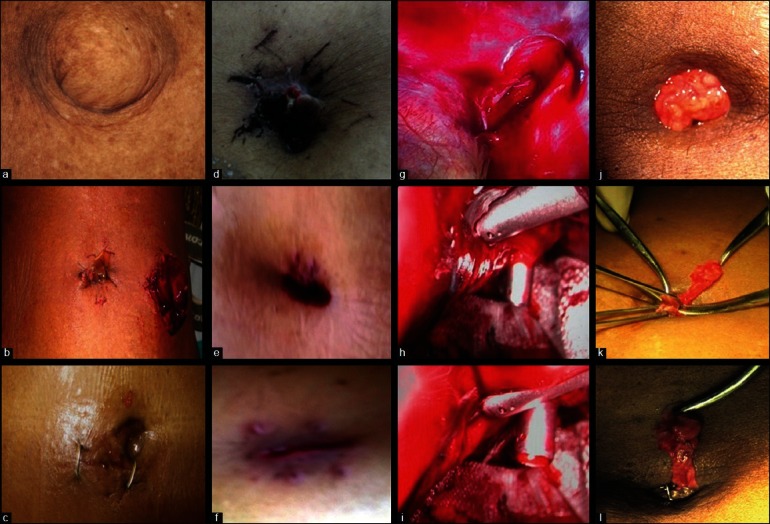
CONTEXT: The rate of port site complications following conventional laparoscopic surgery is about 21 per 100,000 cases. It has shown a proportional rise with increase in the size of the port site incision and trocar. Although rare, complications that occur at the port site include infection, bleeding, and port site hernia. AIMS: To determine the morbidity associated with ports at the site of their insertion in laparoscopic surgery and to identify risk factors for complications. SETTINGS AND DESIGN: Prospective descriptive study. MATERIALS AND METHODS: In the present descriptive study, a total of 570 patients who underwent laparoscopic surgeries for various ailments between August 2009 and July 2011 at our institute were observed for port site complications prospectively and the complications were reviewed. STATISTICAL ANALYSIS USED: Descriptive statistical analysis was carried out in the present study. The statistical software, namely, SPSS 15.0 was used for the analysis of the data. RESULTS: Of the 570 patients undergoing laparoscopic surgery, 17 (3%) had developed complications specifically related to the port site during a minimum follow-up of three months; port site infection (PSI) was the most frequent (n = 10, 1.8%), followed by port site bleeding (n = 4, 0.7%), omentum-related complications (n = 2; 0.35%), and port site metastasis (n = 1, 0.175%). CONCLUSIONS: Laparoscopic surgeries are associated with minimal port site complications. Complications are related to the increased number of ports. Umbilical port involvement is the commonest. Most complications are manageable with minimal morbidity, and can be further minimized with meticulous surgical technique during entry and exit.
Overview
The claims and statistics of this paper haven’t been checked yet.
Run the check — free, no account needed. It reads the open-access text and checks the sources it cites.
Integrity signals
Registry
Cites
Statistics
Figures
Verification
Claims the paper makes
The claims and statistics of this paper haven’t been checked yet.
Run the check — free, no account needed. It reads the open-access text and checks the sources it cites.
Claims other papers make about this one
Each is checked against this paper’s own text: does it say what the citing paper says it does?
In the citing paper
“Following laparoscopic procedures, the most common complications or injuries are gastrointestinal (0.6 per 1,000), genitourinary (0.3 per 1000), vascular (0.1 per 1,000), and momentum (0.4 per 1,000).”
From Insights Into Laparoscopic Port Site Complications: A Comprehensive Review (2024) · cites this paper as [5]
Self-check
Percentages, sums and reported differences re-computed from the paper’s own numbers.
The self-check needs the paper’s full text.
Citations
Cites
Neudecker, J., Sauerland, S., Neugebauer, E., Bergamaschi, R. C., Bonjer, H. J., Cuschieri, A., Fuchs, K., Jacobi, C. A., Jansen, F. W., Koivusalo, A.-M., et al. (2002) · Surgical Endoscopy · doi:10.1007/s00464-001-9166-7 · Cited by 638
Port site metastases after laparoscopic colorectal surgery for cure of malignancy
Wexner, S. D., & Cohen, S. M. (1995) · British journal of surgery · doi:10.1002/bjs.1800820305 · Cited by 568
Complications of laparoscopy: a prospective multicentre observational study
Jansen, F. W., Kapiteyn, K., Trimbos-Kemper, T. C. M., Hermans, J., & Trimbos, J. B. (1997) · BJOG An International Journal of Obstetrics & Gynaecology · doi:10.1111/j.1471-0528.1997.tb11539.x · Cited by 465
Tonouchi, H. (2004) · Archives of Surgery · doi:10.1001/archsurg.139.11.1248 · Cited by 435
Mortality and Complications Associated with Laparoscopic Cholecystectomy
Shea, J. A., Healey, M. J., Berlin, J. A., Clarke, J. R., Malet, P. F., Staroscik, R. N., Schwartz, J. S., & Williams, S. V. (1996) · Annals of Surgery · doi:10.1097/00000658-199611000-00005 · Cited by 428
Incisional hernias after major laparoscopic gynecologic procedures
Kadar, N. R., Reich, H., Liu, C. Y., Manko, G. F., & Gimpelson, R. J. (1993) · American Journal of Obstetrics and Gynecology · doi:10.1016/s0002-9378(11)90787-x · Cited by 388
Ahmad, G., Gent, D. G., Henderson, D., O’Flynn, H., Phillips, K., & Watson, A. (2015) · Cochrane Database of Systematic Reviews · doi:10.1002/14651858.cd006583.pub4 · Cited by 358
Complications of laparoscopy: An inquiry about closed- versus open-entry technique
Jansen, F. W., Kolkman, W., Bakkum, E. A., de Kroon, C. D., Trimbos-Kemper, T. C. M., & Trimbos, J. B. (2004) · American Journal of Obstetrics and Gynecology · doi:10.1016/j.ajog.2003.09.035 · Cited by 268
Mayol, J. M., García‐Aguilar, J., Ortiz‐Oshiro, E., Carmona, J. A. D., & Fernández‐Represa, J. A. (1997) · World Journal of Surgery · doi:10.1007/pl00012281 · Cited by 244
Montz, F. J., Holschneider, C. H., & Munro, M. G. (1995) · International Journal of Gynecology & Obstetrics · doi:10.1016/0020-7292(95)90005-5 · Cited by 231
Research works printed but not linked: 2
- Mc, 1999, Optical versus as an entry technique, Endose, 379
- Mettler, 1999, Laparoscopic entry and its complications, Gynaecol Endose, 383
Cited by
Sorted by citations
Port site infection in laparoscopic surgery: a review of its management
Sasmal, P. K. (2015) · World Journal of Clinical Cases · doi:10.12998/wjcc.v3.i10.864 · Cited by 100
Quan, Y., Huang, A., Ye, M., Xu, M., Zhuang, B., Zhang, P., Yu, B., & Min, Z. (2015) · Gastric Cancer · doi:10.1007/s10120-015-0516-x · Cited by 85
Laparoscopy in trauma: An overview of complications and related topics
Stawicki, S. P., Kindel, T. L., Latchana, N., Swaroop, M., Chaudhry, U. I., Noria, S. F., Choron, R. L., Seamon, M., Lin, M., Mao, M. L., et al. (2015) · International Journal of Critical Illness and Injury Science · doi:10.4103/2229-5151.165004 · Cited by 56
Mercoli, H., Tzedakis, S., D’Urso, A., Nedelcu, M., Memeo, R., Meyer, N., Vix, M., Perretta, S., & Mutter, D. (2016) · Surgical Endoscopy · doi:10.1007/s00464-016-5140-2 · Cited by 52
New trends in colorectal surgery: Single port and natural orifice techniques
Daher, R. (2014) · World Journal of Gastroenterology · doi:10.3748/wjg.v20.i48.18104 · Cited by 31
Metadata
- Authors
- Augustine, A., Karthik, S., Shibumon, M., & Pai, M.
- Affiliations
- Manipal Academy of Higher Education (IN)
- Venue
- Journal of Minimal Access Surgery
- Published
- 2013
- Volume
- 9
- Issue
- 2
- Pages
- 59
- ISSN
- 0972-9941 (ISSN-L)
- PMC
- PMC3673575
- OpenAlex
- W2155582219
- Cited by
- 120
- References
- 33
- Citations by year
- 2026: 6 · 2025: 5 · 2024: 12 · 2023: 5 · 2022: 14 · 2021: 5 · 2020: 2 · 2019: 8 · 2018: 9 · 2017: 12 · 2016: 17 · 2015: 10 · 2014: 13 · 2013: 2
- FWCI
- 13.81
- Type
- journal article
- Language
- en
- Open access
- gold
- doi.org
- Licence
- cc-by-nc-sa
- Locations
- Journal of Minimal Access Surgery (publishedVersion, cc-by-nc-sa)
- Europe PMC (PubMed Central) (publishedVersion, cc-by-nc-sa)
- PubMed Central (publishedVersion, cc-by-nc-sa)
- PubMed (publishedVersion)
- DOAJ (DOAJ: Directory of Open Access Journals) (submittedVersion, cc-by-sa)
- Topics
- Health Sciences › Medicine › Surgery › Minimally Invasive Surgical Techniques
- Health Sciences › Medicine › Surgery › Hernia repair and management
- Health Sciences › Medicine › Surgery › Surgical site infection prevention
- Keywords
- port complications, laparoscopic surgery, port site infection, port site hernia, port-site metastasis, umbilical port, trocar size, risk factors, postoperative morbidity
About these checks
Registry, retraction, Cites and statistics results are computed, not judged, with one exception: a printed reference that no index lists is read once by a model before it counts as a citation error. Claims are extracted by a model and kept only when their quote appears verbatim in the text; each cited source is then checked, with a model’s help, for whether it says what the claim relies on. Those verdicts can be wrong — read the claim’s quote and the cited source before relying on one.
Statistics and arithmetic are recomputed, not judged.
Confidence bands are shown only for fields calibrated on our annotated test set. None is calibrated yet, so no band is shown.
What counts as a claim ›How we measure confidence ›How we check this ›
Are you an author, or do you see a problem with this page? Request a review
