

The DOI matches its Crossref record; 40 of the 40 references it cites were found in a registry or an index; none of the 32 sources its claims cite is checked for support yet.
Anethum graveolens: An Indian traditional medicinal herb and spice
Open accessAbstract
Anethum graveolens L. (dill) has been used in ayurvedic medicines since ancient times and it is a popular herb widely used as a spice and also yields essential oil. It is an aromatic and annual herb of apiaceae family. The Ayurvedic uses of dill seeds are carminative, stomachic and diuretic. There are various volatile components of dill seeds and herb; carvone being the predominant odorant of dill seed and α-phellandrene, limonene, dill ether, myristicin are the most important odorants of dill herb. Other compounds isolated from seeds are coumarins, flavonoids, phenolic acids and steroids. The main purpose of this review is to understand the significance of Anethum graveolens in ayurvedic medicines and non-medicinal purposes and emphasis can also be given to the enhancement of secondary metabolites of this medicinal plant.
Overview
CoChat Summary
TL;DR
This narrative review summarizes the traditional Ayurvedic, culinary, and industrial uses of *Anethum graveolens* L. (dill) alongside its phytochemistry and reported pharmacological activities. It argues that the plant's monoterpenes—particularly carvone and limonene—are commercially valuable and that in vitro tissue culture could enhance their production.
Key findings
- Dill is used in more than 56 Ayurvedic preparations (e.g., Dasmoolarishtam, Dhanwanthararishtam, Saraswatharishtam) and is described in Ayurveda as carminative, stomachic, and diuretic, with uses for colic, abdominal discomfort, and digestion.
- Seventeen volatile compounds have been identified in the plant; dill oil is described as containing 40–60% d-carvone (listed as 23.1%) with d-limonene (45%), plus α-phellandrene, eugenol, anethole, flavonoids, coumarins, triterpenes, and phenolic acids. The fruit yields about 3.5% oil, with specific gravity 0.895–0.915.
- Reported pharmacological effects include antimicrobial activity against *S. aureus*, *E. coli*, *P. aeruginosa*, *S. typhimurium*, *Shigella flexneri*, and *Salmonella typhii*; mucosal protective, antisecretory, and anti-ulcer activity against HCl- and ethanol-induced lesions in mice; antispasmodic relaxant effects on rat ileum; and antihyperlipidemic/antioxidant effects in rats fed a high-fat diet.
- The review notes commercial demand: a survey of four West European countries estimated overall demand for freeze-dried herb at less than 300 tonnes per annum, and anethole at 60 minims is described as a fairly potent vermicide for hookworm.
Methods
- Narrative literature review; no primary experimental data are reported by the authors.
- Synthesizes Ayurvedic, Unani, botanical, ecological, phytochemical, and pharmacological literature, including cited in vitro and in vivo animal studies (mice, rats) and chemical analyses.
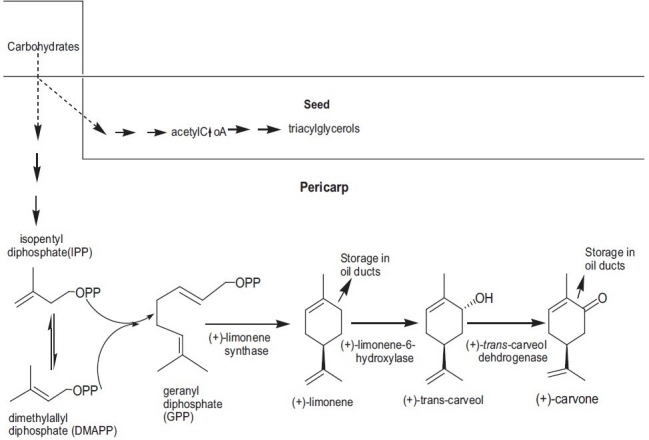
- Includes a phytochemical screening table for seeds, leaves, and roots (tannins, terpenoids, cardiac glycosides, flavonoids) and a table of important compounds, plus a described enzymatic pathway for limonene and carvone synthesis from geranyl diphosphate.
Limitations
- The paper states no formal limitations section; it acknowledges that "very less in vitro research has been performed on this potential plant species" and that several physiological and biochemical parameters remain unknown.
- Evident from the text: this is a non-systematic narrative review with no stated search strategy, inclusion criteria, or quality appraisal, and it reports no original data or quantitative synthesis.
- Evident from the text: many efficacy claims are attributed to cited studies without reporting doses, sample sizes, or effect sizes, and several traditional-use claims (e.g., curing urinary complaints, piles, and mental disorders) are presented without supporting experimental evidence.
Model-written summary. Check it against the paper before relying on it.
Integrity signals
Registry
Cites
Statistics
Figures
Verification
Claims the paper makes
11 Sources not found · 9 No full text of the sources · 8 Not checked yet · 3 Check pending
In the paper
“The phytochemical screening of plant showed that leaves, stems and roots were rich in tannins, terpenoids, cardiac glycosides and flavonoids [Table 1].”
§ Anethum graveolens: An Indian traditional medicinal herb and spice > CONSTITUENTS
What the sources say
- Not checked yetcites [30] Aiyelaagbe, 2009, Plant Sci Res
plain- Asserted: passes — The authors put it forward as true.
- Checkable: passes — It can be checked against evidence.
- Load-bearing: unclear — It is unclear whether the paper’s conclusions depend on it.
- Based: passes — The paper gives a reason why it holds.
In the paper
“Dill fruit hydrochloric extract is a potent relaxant of contractions induced by a variety of spasmogens in rat ileum, so it supports the use of dill fruit in traditional medicine for gastrointestinal disorders.[26]”
§ Anethum graveolens: An Indian traditional medicinal herb and spice > PHARMACOLOGY
What the sources say
- Not checked yetcites [26] Naseri-Gharib, 2007, Int J Pharm
plainstates a cause- Asserted: passes — The authors put it forward as true.
- Checkable: passes — It can be checked against evidence.
- Load-bearing: passes — The paper’s conclusions depend on it.
- Based: passes — The paper gives a reason why it holds.
In the paper
“Seed extracts of A. graveolens L. have significant mucosal protective, antisecretory and anti-ulcer activities against HCl- and ethanol-induced stomach lesions in mice.[23]”
§ Anethum graveolens: An Indian traditional medicinal herb and spice > PHARMACOLOGY
What the sources say
- Check pendingcites [23] Hosseinzadeh, 2002, BMC Pharmacol source
plainstates a cause- Asserted: passes — The authors put it forward as true.
- Checkable: passes — It can be checked against evidence.
- Load-bearing: unclear — It is unclear whether the paper’s conclusions depend on it.
- Based: passes — The paper gives a reason why it holds.
In the paper
“Dill fruit hydrochloric extract is a potent relaxant of contractions induced by a variety of spasmogens in rat ileum, so it supports the use of dill fruit in traditional medicine for gastrointestinal disorders.[26]”
§ Anethum graveolens: An Indian traditional medicinal herb and spice > PHARMACOLOGY
What the sources say
- Not checked yetcites [26] Naseri-Gharib, 2007, Int J Pharm
plainstates a cause- Asserted: passes — The authors put it forward as true.
- Checkable: passes — It can be checked against evidence.
- Load-bearing: passes — The paper’s conclusions depend on it.
- Based: passes — The paper gives a reason why it holds.
In the paper
“This effect may help to prevent peptic ulcer.[2425]”
§ Anethum graveolens: An Indian traditional medicinal herb and spice > PHARMACOLOGY
What the sources say
- Not matchedcites [2425]
Couldn’t be matched to a paper in Crossref, so it can’t be checked.
hedgedstates a possible cause- Asserted: passes — The authors put it forward as true.
- Checkable: passes — It can be checked against evidence.
- Load-bearing: passes — The paper’s conclusions depend on it.
- Based: passes — The paper gives a reason why it holds.
- Not matched
8 more claims
Create a free account to see all 31 claims and to verify the 10 references still open.
- It may state two separate claims as one. 10
- Probably not a substantial claim. 10
Claims other papers make about this one
Each is checked against this paper’s own text: does it say what the citing paper says it does?
In the citing paper
“From the earlier literature, dill is utilized for many purposes, including medicinal or nutritional such as minimization of bad breath, management of digestive disorders, lactation stimulation, lipid-lowering, anti-gastric irritation, antidiabetic, antimicrobial, antioxidant, anticancer, and also known as an anti-inflammatory agent (Jana and Shekhawat, 2010; Ozliman et al., 2021; Peerakam et al.,”
From Induction role of chitosan nanoparticles to Anethum graveolens extract against food-borne bacteria, oxidant, and diabetic activities in vitro (2023) · cites this paper as Jana and Shekhawat, 2010
In the citing paper
“In traditional medicine, dill is generally employed for alleviating colic in infants and flatulence in young children. Additionally, its seed is used in decoction or infusion mode for the treatment of urinary infections, insomnia, hyposecretion of milk, digestive disorders accompanied by meteorism, and gastrointestinal spasms [6,7].”
Self-check
Percentages, sums and reported differences re-computed from the paper’s own numbers.
Each contradiction between two passages listed here was confirmed by an independent check.
Rated minor: it would not touch a result — a value no result rests on, a p-value that stays on the same side of the significance level, or a conflict that is clerical, resolved elsewhere in the paper, or outside its own findings.
In the paper
§ Anethum graveolens: An Indian traditional medicinal herb and spice > CONSTITUENTS
“The phytochemical screening of plant showed that leaves, stems and roots were rich in tannins, terpenoids, cardiac glycosides and flavonoids [Table 1].”
§ Anethum graveolens: An Indian traditional medicinal herb and spice > CONSTITUENTS
“Table: Table 1 Phytochemical analysis of Anethum graveolens L. seeds, leaves and roots”
Rated minor: it would not touch a result — a value no result rests on, a p-value that stays on the same side of the significance level, or a conflict that is clerical, resolved elsewhere in the paper, or outside its own findings.
In the paper
§ Anethum graveolens: An Indian traditional medicinal herb and spice > METABOLITES OF IMPORTANCE
“40 to 60% of d-carvone”
§ Anethum graveolens: An Indian traditional medicinal herb and spice > METABOLITES OF IMPORTANCE
“d-carvone (23.1%)”
Citations
Cites
Indian Medicinal Plants: An Illustrated Dictionary
Khare, C. P. (2007) · Springer eBooks · doi:10.1007/978-0-387-70638-2 · Cited by 10,646
Duke, J. A. (2002) · CRC Press eBooks · doi:10.1201/9781420040463 · Cited by 1,642
DELAQUIS, P. J. (2002) · International Journal of Food Microbiology · doi:10.1016/s0168-1605(01)00734-6 · Cited by 1,059
Fleming, T. C. (1998) · Cited by 774
The illustrated encyclopedia of essential oils
Lawless, J. (1995) · Element eBooks · Cited by 225
Patt, J. M., Hamilton, G. C., & Lashomb, J. H. (1997) · Entomologia Experimentalis et Applicata · doi:10.1046/j.1570-7458.1997.00153.x · Cited by 225
Plantas medicinales: el Dioscórides renovado
Quer, P. F. (1999) · Dialnet (Universidad de la Rioja) · Cited by 215
Phase I and pharmacokinetic study of d -limonene in patients with advanced cancer
Vigushin, D. M., Poon, G. K., Boddy, A., English, J., Halbert, G. W., Pagonis, C., Jarman, M., & Coombes, R. C. (1998) · Cancer Chemotherapy and Pharmacology · doi:10.1007/s002800050793 · Cited by 198
(2004) · doi:10.1007/978-3-642-18659-2 · Cited by 180
Bailer, J., Aichinger, T., Hackl, G., de Hueber, K., & Dachler, M. (2001) · Industrial Crops and Products · doi:10.1016/s0926-6690(01)00088-7 · Cited by 179
Research works printed but not linked: 8
- Ravindran P, Balachandran I. Under utilized medicinal spices II, Spice India. Vol. 17. India: Publisher V K Krishnan Nair; 2005. p. 32-6.
- Warrier PK, Nambiar VPK, Ramakutty C, Indian Medicinal Plants. Vol. 1. Arya Vaidya Sala, Kottakkal Madras, India: Orient Longman Limited; 1994. p. 153-4.
- Kirtikar KP, Basu BD, Mahaskar C. Indian Medicinal Plants. Vol. 2, 2nd ed. Allahabad: International Book Distributors; 1987. p. 1219.
- Mohele, 1985, UV-induced biosynthesis of quercetin 3-o-beta-d-glucuronide in dill Anethum graveolens cell cultures, Phytochem, 183
- Yazdanparast, 2007, Improvement of liver antioxidant status in hypercholesterolamic rats treated with A.graveolens extracts, Pharmacologyonline, 88
- Aiyelaagbe, 2009, Phytochemical screening for active compounds in Mangifera indica leaves from Ibadan, Oyo state, Plant Sci Res, 11
- Sehgal, 1978, Differentiation of shoot buds and embryoids from inflorescence of Anethum graveolens in cultures, Phytomorphol, 291
- Stockigt, 1985, The natural product and enzymes from plant cell culture, Plant Cell Tissue Organ Cult, 97
Cited by
Items 101–200 of 265
Mohammed, F. A., Razvi, S. S., Abdul, W. M., Mohammed, K., Hakeem, K. R., Banaganapalli, B., Shaik, N. A., & Elkady, A. I. (2019) · Springer eBooks · doi:10.1007/978-3-030-04408-4_8 · Cited by 11
Liu, T., Gou, L.-J., Zeng, H. M., Zhou, G., Dong, W.-R., Cui, Y., Cai, Q., & Chen, Y. (2022) · Separations · doi:10.3390/separations9100296 · Cited by 11
Effect of provision of apiaceous flowers associated to foods on the biology of Coleomegilla maculata
D’Ávila, V. D. A., Aguiar-Menezes, E. D. L., Pereira, R. N., Gonçalves-Esteves, V., Mendonça, C. B. F., de Melo, S. J., & dos Santos, T. M. (2017) · Phytoparasitica · doi:10.1007/s12600-017-0616-8 · Cited by 11
Mousavi, S. M., Pizarro, A. B., Akhgarjand, C., Bagheri, A., Persad, E., Karimi, E., Wong, A., & Jayedi, A. (2021) · Critical Reviews in Food Science and Nutrition · doi:10.1080/10408398.2021.1889459 · Cited by 11
Słowik‐Borowiec, M., & Walorczyk, S. (2015) · Food Analytical Methods · doi:10.1007/s12161-015-0333-1 · Cited by 11
Phylogeny of medicinal plants depicts cultural convergence among immigrant groups in New York City
Xavier, C., & Molina, J. (2015) · Journal of Herbal Medicine · doi:10.1016/j.hermed.2015.12.002 · Cited by 10
Anti-mycotic and anti-mycotoxigenic properties of Egyptian dill.
Badr, A. N., Nada, F., Shehata, M. G., & Amra, H. A. (2017) · Journal of Applied Sciences · doi:10.3923/jas.2017.184.195 · Cited by 5
Sierra-Quitian, A. G., Prieto-Rodríguez, J. A., & Patiño-Ladino, O. J. (2025) · International Journal of Molecular Sciences · doi:10.3390/ijms26073407 · Cited by 10
Golmohammadi, R., Sabaghzadeh, F., & Mojadadi, M. (2016) · PubMed Central · Cited by 10
Rafieian‐Kopaei, M., Aleebrahim-Dehkordy, E., Ansaripour, S., & Saberianpour, S. (2018) · Pharmacognosy Reviews/Bioinformatics Trends/Pharmacognosy review · doi:10.4103/phrev.phrev_48_17 · Cited by 10
Antiemetic African Medicinal Spices and Vegetables
Tchatchouang, S., Beng, V. P., & Kuete, V. (2017) · Elsevier eBooks · doi:10.1016/b978-0-12-809286-6.00011-x · Cited by 10
Wang, Y., Liu, P.-Z., Zhang, R., Sun, Y., Xie, Y., Fang, F., Liu, H., Tan, G., Chen, Z.-F., Zhang, J., et al. (2025) · Journal of Advanced Research · doi:10.1016/j.jare.2025.03.024 · Cited by 9
Sharma, H., Yang, H.-W., Sharma, N., & An, S. S. A. (2024) · International Journal of Molecular Sciences · doi:10.3390/ijms25137104 · Cited by 9
Meena, N. K., Meena, R. S., Singh, R. N., VERMA, A. K., Choudhary, S., Singh, B., Meena, R. D., Ravi, Y., & Meena, M. (2022) · Scientific Reports · doi:10.1038/s41598-022-17397-4 · Cited by 9
Benammar, S., Haffas, M., Hamitouche, A.-E., Boudjemaa, A., & Bacharı, K. (2022) · Reaction Kinetics Mechanisms and Catalysis · doi:10.1007/s11144-022-02324-5 · Cited by 9
Akbari, M., Javadnoori, M., Siahpoosh, A., Afshari, P., Haghighi, M. H., & Lake, E. (2015) · Jundishapur Journal of Natural Pharmaceutical Products · doi:10.17795/jjnpp-27876 · Cited by 9
Nguyen, V. T., Nguyen, N. Q., An, T. N. T., Van, N. T., & Anh, N. H. T. (2020) · IOP Conference Series Materials Science and Engineering · doi:10.1088/1757-899x/991/1/012032 · Cited by 9
Božović, D., Gladikostić, N., Ikonić, B., Teslić, N., Sknepnek, A., Mirković, M., Vojvodić, S., Zeković, Z. P., Putnik, P., Kovačević, D. B., et al. (2025) · Food and Bioproducts Processing · doi:10.1016/j.fbp.2025.12.009 · Cited by 8
Anti-Toxoplasma Activities of Some Egyptian Plant Extracts: An In Vitro Study
Elazab, S. T., & Arafa, F. M. (2022) · Acta Parasitologica · doi:10.1007/s11686-022-00633-2 · Cited by 8
Phenotypic diversity of Greek dill (Anethum graveolensL.) landraces
Ninou, E. G., Mylonas, I. G., Tsivelikas, A. L., & Ralli, P. (2017) · Acta Agriculturae Scandinavica Section B - Soil & Plant Science · doi:10.1080/09064710.2016.1276957 · Cited by 8
Nutraceutical Potential of Apiaceae
Aćimović, M. (2017) · Reference series in phytochemistry · doi:10.1007/978-3-319-54528-8_17-1 · Cited by 8
Tarmizi, A. A. A., Wagiran, A., Salleh, F. M., Chua, L. S., Abdullah, F. I., Hasham, R., & Mostafiz, S. B. (2021) · Plants · doi:10.3390/plants10040717 · Cited by 8
Bahrami, F., Pour, F. J., Hassanpour, M., Saki, M., Ebrahimzadeh, F., & Jafaripour, L. (2023) · Multiple Sclerosis and Related Disorders · doi:10.1016/j.msard.2023.105038 · Cited by 7
Sharma, R., Salwan, R., & Sharma, V. (2024) · Vegetos · doi:10.1007/s42535-024-00884-6 · Cited by 7
Brinsi, C., Jedidi, S., Sammari, H., Selmi, H., & Sebaï, H. (2024) · Neurogastroenterology & Motility · doi:10.1111/nmo.14892 · Cited by 7
A review on phyto pharmacological, botanical and marketed formulation studies of Anethum sowa
Singh, S., Khalid, M., Arif, M., & Ahsan, F. (2020) · Oriental Pharmacy and Experimental Medicine · doi:10.1007/s13596-020-00487-x · Cited by 7
Jalili, C., Moradi, S., Mirzababaei, A., Mohammadi, H., Heydarzadeh, F., Miraghajani, M. S., & Lazaridi, A.-V. (2021) · Journal of Herbal Medicine · doi:10.1016/j.hermed.2021.100516 · Cited by 7
Essential oils from Apiaceae family (parsley, lovage, and dill)
CATUNESCU, G. M., Bodea, I. M., DAVID, A. P., Pop, C. R., & Rotar, A. M. (2023) · Elsevier eBooks · doi:10.1016/b978-0-323-91740-7.00015-3 · Cited by 7
Biologically active peptides isolated from dill Anethum graveolens L.
Kulikova, O. G., Maltsev, D. I., Ильина, А. П., Burdina, A. V., Yamskova, V. P., & Yamskov, I. A. (2015) · Applied Biochemistry and Microbiology · doi:10.1134/s0003683815030114 · Cited by 7
Sarhadinejad, Z., Tajadini, H., Tansaz, M., Bahrampour, A., Sarhadynejad, Z., Ansari, M., Sharififar, F., Iranpour, M., & Salari, Z. (2018) · Iranian Red Crescent Medical Journal · doi:10.5812/ircmj.74211 · Cited by 7
Ahl, H. A. H. S., & Omer, E. A. (2016) · International Journal of Pharmacy and Pharmaceutical Sciences · Cited by 7
Ahl, H. A. H. S., & Omer, E. A. (2016) · International Journal of Pharmacy and Pharmaceutical Sciences · Cited by 7
Nehdi, I. A., Abutaha, N., Sbihi, H. M., Tan, C. P., & Al-Resayes, S. I. (2020) · Grasas y Aceites · doi:10.3989/gya.0455191 · Cited by 7
Carvone-Rich Essential Oils and Their Agrobiological Interactions: A Review
Krajewska, A., Azeez, G., Ebadollahi, A., Kalemba, D., & Synowiec, A. (2026) · Molecules · doi:10.3390/molecules31040579 · Cited by 6
Nephroprotective Effect of Anethum Graveolens in a Murine Model of Gentamicin Induced Nephrotoxicity
Srivastava, P., Rashmi Rao, R., Shenoy, P. J., Manjrekar, P., Teerthanath, T. S., & Bhuvaneshwari Bhuvaneshwari, S. (2018) · Journal of Young Pharmacists · doi:10.5530/jyp.2018.10.35 · Cited by 6
Ajarem, J. S., Maodaa, S. N., El‐Serehy, H. A., Altoom, N. G., Allam, A. A., Hernández-Bautista, R., & Mahmoud, A. M. (2021) · Coatings · doi:10.3390/coatings11070838 · Cited by 6
Crithmum maritimum L.—Study on the Histochemical Localization of Essential Oil
Dzhoglova, V., Ivanov, K., Benbassat, N., Georgieva, Y., Ardasheva, R., Karcheva-Bahchevanska, D. P., & Ivanova, S. (2024) · Plants · doi:10.3390/plants13040550 · Cited by 6
Minor Seed Spices: Ajwain, Dill, Celery, and Aniseed
Lal, G., Malhotra, S. K., Lal, S., & Meena, S. (2023) · Springer eBooks · doi:10.1007/978-981-19-3728-6_53 · Cited by 6
Role of Phytochemicals in the Treatment of Ectoparasitic Infections
Palai, S., Kesh, S. S., Awuchi, C. G., Abdulrahman, S. A., & Egbuna, C. (2021) · Wiley eBooks · doi:10.1002/9781119617143.ch20 · Cited by 6
Vikhe, S. R., Dhavane, S. S., & Ghogare, R. D. (2023) · Research Journal of Pharmacy and Technology · doi:10.52711/0974-360x.2023.00543 · Cited by 6
Spice components as modulating agents of P-glycoprotein – An in silico study
Mukhopadhyay, S., Roy, C., & Ghosh, P. (2024) · Indian Journal of Pharmacology · doi:10.4103/ijp.ijp_299_23 · Cited by 6
Alan, Ö., Kanturer, D., Powell, A. A., & İlbi, H. (2022) · Seed Science and Technology · doi:10.15258/sst.2022.50.1.02 · Cited by 6
Metabolomic analysis of bioactive compounds in dill (Anethum graveolens L.) extracts
Thanuma, J., Phetcharaburanin, J., Dokduang, H., Loilome, W., Klanrit, P., Wangwiwatsin, A., & Namwat, N. (2025) · PeerJ · doi:10.7717/peerj.19567 · Cited by 5
Herbal therapies for pain management: a scoping review of the current evidence
Hasan, M. K., Zanzabil, K. Z., Ara, I., Rahman, T., Kieu, A., Östlundh, L., Junaidi, S., & Khan, M. A. (2024) · Phytochemistry Reviews · doi:10.1007/s11101-024-09916-0 · Cited by 5
Belabas, N. E. H., Guemmaz, T., Laroui, H., Douffa, Y., Azzi, N., Barkat, A., Saffidine, K., Zerargui, F., Righi, N., & Baghiani, A. (2025) · Journal of Ethnopharmacology · doi:10.1016/j.jep.2025.120205 · Cited by 5
Common Indian vegetables medicinally acclaimed for retaining health and vigor: a review
Balkrishna, A., Shankar, R., Joshi, R. A., Srivastava, A., Prajapati, U. B., & Saini, N. (2025) · Discover Food · doi:10.1007/s44187-025-00366-x · Cited by 5
Bioactivity and Phytochemical Studies of Seed Extracts of Anethum graveolens Linn.
(2021) · Letters in Applied NanoBioScience · doi:10.33263/lianbs112.35603572 · Cited by 5
Алёна, Т., & Татьяна, Е. (2020) · Журнал здорового питания и диетологии · doi:10.59316/.vi12.71 · Cited by 5
Effectiveness of Anethum Graveolens L. on Antioxidant Status, Thyroid Function and Histopathology
İdiz, C. (2018) · Acta Endocrinologica (Bucharest) · doi:10.4183/aeb.2018.447 · Cited by 5
Sharma, R., Salwan, R., Sharma, M., Sharma, A., & Sharma, V. (2023) · Vegetos · doi:10.1007/s42535-023-00641-1 · Cited by 5
Validated HPTLC Analysis for Estimation of Quercetin in Seeds of Anethum graveolens
Lote, S. B., Agrawal, S. S., Ghune, S., & Gurjar, P. (2023) · International Journal of Pharmaceutical Quality Assurance · doi:10.25258/ijpqa.14.2.05 · Cited by 5
Herbs and Spices - New Perspectives in Human Health and Food Industry
Ivanišová, E. (2024) · IntechOpen eBooks · doi:10.5772/intechopen.1001733 · Cited by 4
Chemical Profile and Bioactivity of Essential Oil Fractions as a Function of Distillation Time
Zheljazkov, V. D., Shiwakoti, S., Jeliazkova, E. A., & Astatkie, T. (2016) · ACS symposium series · doi:10.1021/bk-2016-1218.ch010 · Cited by 4
Kabiraj, A., & Deshmukh, R. (2024) · Current Pharmaceutical Analysis · doi:10.2174/0115734129286029240106123114 · Cited by 4
Siriyong, T., Chanphool, H., Jitjum, S., Laohaprapanon, S., & Voravuthikunchai, S. P. (2025) · Advances in Integrative Medicine · doi:10.1016/j.aimed.2025.01.006 · Cited by 4
Rai, A., Chauhan, B., & Parmar, D. N. (2022) · Research Journal of Pharmacognosy and Phytochemistry · doi:10.52711/0975-4385.2022.00033 · Cited by 4
Shirokova, A. V., Дмитриев, Л. Б., Belopukhov, S. L., Dmitrieva, V. L., Львовна, Д. И., Kharchenko, V. A., Pekhova, O. A., Фёдоровна, М. Е., Tsitsilin, A., Gulevich, A. A., et al. (2023) · International Journal of Molecular Sciences · doi:10.3390/ijms242015137 · Cited by 4
Advances in Dill (Anethum graveolens L.) Molecular Breeding Strategies
Wahba, M. M., Abdein, M. A. E.-H., Alhaithloul, H. A. S., Alghanem, S. M. S., & Elshamy, M. M. (2025) · Advances in plant breeding strategies · doi:10.1007/978-3-031-81838-7_4 · Cited by 3
Prabhat, L. N. U., Jagriti, L. N. U., Kumar, S., & Bansal, A. (2024) · Cureus · doi:10.7759/cureus.54242 · Cited by 3
Anti-implantation and anti-fertility potentials ofAnethum graveolensL. extracts in rats
Monsefi, M., Lohrasbi, P., Abpaikar, Z., & Bakhtiari, S. (2014) · Toxicological & Environmental Chemistry Reviews · doi:10.1080/02772248.2015.1027204 · Cited by 3
Herbs for increasing breast-milk production
Vargová, Z., & Rudá-Kučerová, J. (2017) · Česká a slovenská farmacie · doi:10.36290/csf.2017.031 · Cited by 3
Mohsin, M. M., Hanif, M. A., Ayub, M. A., Bhatti, I. A., & Jilani, M. I. (2019) · Elsevier eBooks · doi:10.1016/b978-0-08-102659-5.00018-5 · Cited by 3
Singh, A., Singh, B., & Navneet (2022) · Elsevier eBooks · doi:10.1016/b978-0-12-824412-8.00017-5 · Cited by 3
EFFECT OF ADDING DIFFERENT LEVELS OF DILL SEEDS TO THE DIET ON PHYSIOLOGICAL TRAITS OF BROILERS
Shnain, W. Z., & Ezzat, H. N. (2022) · Iraqi Journal of Market Research and Consumer Protection · doi:10.28936/jmracpc14.2.2022.(12 · Cited by 3
Dill: Potential Health Benefits
Singletary, K. W. (2023) · Nutrition Today · doi:10.1097/nt.0000000000000604 · Cited by 3
Neamah, W. H., Hasan, F. A., Jasim, F. M., & Hachim, A. J. (2024) · The Open Agriculture Journal · doi:10.2174/0118743315277673231208101854 · Cited by 3
Inala, M. S. R., & Pamidimukkala, K. (2024) · In Silico Pharmacology · doi:10.1007/s40203-024-00192-6 · Cited by 3
Natural Anticarcinogens: The Efficacy of Herbs and Spices
Vikas, B., Sweety, V. K., Anil, S., & Palaniyandi, S. (2024) · IntechOpen eBooks · doi:10.5772/intechopen.1004335 · Cited by 3
Al-Oqail, M. M., Al-Sheddi, E. S., Farshori, N. N., Al-Massarani, S. M., Alsultan, E. N., Ahmad, J., Al-Khedhairy, A. A., & Siddiqui, M. A. (2024) · Journal of King Saud University - Science · doi:10.1016/j.jksus.2024.103390 · Cited by 3
Studying Efficiency Inhibition of Some Medicinal Plant Extracts against Some Fungal
Ali, H. K., Jumaah, A. M., & Hussain, A. S. (2017) · International Journal of Current Microbiology and Applied Sciences · doi:10.20546/ijcmas.2017.601.014 · Cited by 3
Menaga, S., Kripa, K. G., & Sangeetha, R. (2017) · Asian Journal of Pharmaceutical and Clinical Research · doi:10.22159/ajpcr.2017.v10i6.16896 · Cited by 3
Shelepova, O. V., & Хуснетдинова, Т. И. (2017) · chemistry of plant raw material · doi:10.14258/jcprm.2018012020 · Cited by 3
Bipate, M., & Misra, A. K. (2020) · Indian Journal of Dairy Science · doi:10.33785/ijds.2020.v73i02.006 · Cited by 3
Phenolic Content of Dill Seed Extracts as Antifungal Agent against Aspergillus spp
(2021) · Middle East Journal of Agriculture Research · doi:10.36632/mejar/2021.10.4.89 · Cited by 3
Anti-Osteoporotic Potential of Water Extract of Anethum graveolens L. Seeds
Jang, S.-A., Lee, S.-J., Hwang, Y.-H., & Ha, H. (2023) · Nutrients · doi:10.3390/nu15194302 · Cited by 2
Lekhwar, C., Meghwal, M., & Giuffrè, A. M. (2025) · Current Nutrition & Food Science · doi:10.2174/0115734013384523250905053835 · Cited by 2
Athul, T. P., Vijaya Lekshmi, R., Sarangi, N. V., Murali, S. K., Dey, A., Mahajon, B., Pandey, M., Galib, R., Jachak, S. M., Nesari, T. M., et al. (2026) · Annales Pharmaceutiques Françaises · doi:10.1016/j.pharma.2026.01.005 · Cited by 2
Fincan, M., & ÇİFTÇİ, Y. (2021) · GIDA / THE JOURNAL OF FOOD · doi:10.15237/gida.gd21092 · Cited by 2
Shahabi, R., Rostampour, M., Khakpour, B., Tehrani, B. S., & Saadat, F. (2022) · Caspian Journal of Neurological Sciences · doi:10.32598/cjns.8.28.302.1 · Cited by 2
Kulkarni, S. P., & Parwe, S. D. (2024) · JMIR Research Protocols · doi:10.2196/57287 · Cited by 2
Effect and Response of Medicinal Plants to Abiotic Stress
Arman, M. S., Islam, M. R., Azmal, M., Rabbi, M. A., & Ghosh, A. (2024) · Springer eBooks · doi:10.1007/978-981-97-4292-9_20 · Cited by 2
Bioactive metabolites of Anethum graveolens and their applications
Sharma, R., Salwan, R., & Sharma, V. (2025) · Vegetos · doi:10.1007/s42535-025-01196-z · Cited by 2
Gupta, J., Verma, N., Wal, A., Panda, K. C., Yeleti, V. V., Singh, B., Mahajan, S., Kandhari, H., & Wal, P. (2025) · Endocrine Metabolic & Immune Disorders - Drug Targets · doi:10.2174/0118715303327497241214054628 · Cited by 2
Ahmed, M. T., Alrumman, S. A., Kumar, P., & Eid, E. M. (2025) · Scientific Reports · doi:10.1038/s41598-025-97598-9 · Cited by 2
Does Use of Anethum Graveolens Affected Thyroid Hormone Levels and Thyroid Nodules?
Altay, M., Ateş, İ., Efe, F. K., & Karadağ, İ. (2016) · American Journal of Therapeutics · doi:10.1097/mjt.0000000000000511 · Cited by 2
Effect of shatpushpa in female infertility w.s.r to anovulatory factor: a review study
Pandya, S. H., Gujarathi, J. R., & Vyas, J. M. (2017) · Journal of Ayurveda and Holistic Medicine · doi:10.70066/jahm.v5i5.360 · Cited by 2
Musheer, N., Ashraf, S., Choudhary, A., Jamil, A., Kumar, M., & Saeed, S. (2021) · Springer eBooks · doi:10.1007/978-981-16-1350-0_11 · Cited by 2
Role of dietary spices in modulating inflammation and oxidative stress
Oh, E. S., Petersen, K. H., Kris‐Etherton, P. M., & Rogers, C. J. (2021) · Elsevier eBooks · doi:10.1016/b978-0-12-823482-2.00005-4 · Cited by 2
Maria, B. J. (2023) · Pure and Applied Biology · doi:10.19045/bspab.2023.120097 · Cited by 2
Mahendiran, D., Kuppuswamy, A. D., & Viswanathan, S. (2021) · International Journal of Food Science and Biotechnology · doi:10.11648/j.ijfsb.20210604.15 · Cited by 1
TAŞ, S., Erdoğan, A., Gürses, M., & Aktaş, H. M. (2023) · Erzincan Üniversitesi Fen Bilimleri Enstitüsü Dergisi · doi:10.18185/erzifbed.1294606 · Cited by 1
Eating and Healing: Traditional Food as Medicine
Bandekar, S. S., & Namdeo, A. G. (2023) · Springer eBooks · doi:10.1007/978-981-99-7703-1_24 · Cited by 1
Antidiabetic Potential of Apiaceae Family Plants- A Critical Update
Bag, S., Chatterjee, D., Ashique, S., Pal, R., Khatoon, H., & Kumar, S. (2024) · Current Functional Foods · doi:10.2174/0126668629283987240123100449 · Cited by 1
Aswathy, Y. S., Prathibha, C. K. B., Raman, S., Dharmarajan, P., & Anandaraman, P. V. (2024) · Journal of Natural Remedies · doi:10.18311/jnr/2024/35468 · Cited by 1
Hamza, R. K., Hamed, N. N., & Al-Mazirah, H. S. (2024) · Acta Agraria Debreceniensis · doi:10.34101/actaagrar/2/13501 · Cited by 1
Maodaa, S. N., Ajarem, J. S., Alruhaimi, R. S., Allam, A. A., Altoom, N. G., & Mahmoud, A. M. (2025) · Journal of Molecular Histology · doi:10.1007/s10735-025-10457-9 · Cited by 1
Patel, D. R., Metgud, R., Dodamani, S., Nadaf, R., & Patil, A. (2025) · Archives of Razi Institute · doi:10.32592/ari.2025.80.1.225 · Cited by 1
Gajarmal, A. A., Baheti, S., Patekar, R., Mane, S. S., Sagar, R., Mahesh, S., & Rath, S. K. (2025) · Ethnobotany Research and Applications · doi:10.32859/era.31.47.1-35 · Cited by 1
Mehta, V. K., Prasad, R., Srivastava, R., Kumar, S., & Tripathi, R. (2025) · Asian Journal of Research in Chemistry · doi:10.52711/0974-4150.2025.00034 · Cited by 1
Seasonal Variations in Essential Oil of Dill: A Three Months Study
Mirmohammadmakki, F., Gharachorloo, M., Ghavami, M., Abdossi, V., Azizinezhad, R., & Mohammadmakki, S. A. M. (2025) · Journal of Lifestyle and SDGs Review · doi:10.47172/2965-730x.sdgsreview.v5.n08.pe07470 · Cited by 1
Metadata
- Authors
- Shekhawat, G., & Jana, S.
- Affiliations
- Banasthali University (IN)
- Corresponding author
- Shekhawat, GS
- ORCID
- Jana, S
- Venue
- Pharmacognosy Reviews
- Publisher
- Manuscript Technomedia LLP
- Published
- 2010
- Volume
- 4
- Issue
- 8
- Pages
- 179
- ISSN
- 0973-6581 (ISSN-L)
- 0973-7847
- PMC
- PMC3249919
- OpenAlex
- W2159773548
- Cited by
- 269
- References
- 40
- Citations by year
- 2026: 15 · 2025: 28 · 2024: 29 · 2023: 31 · 2022: 29 · 2021: 33 · 2020: 21 · 2019: 11 · 2018: 15 · 2017: 14 · 2016: 16 · 2015: 10 · 2014: 7 · 2013: 6 · 2012: 3
- FWCI
- 3.79
- Type
- journal article
- Language
- en
- Open access
- hybrid
- doi.org
- Licence
- cc-by
- Locations
- Pharmacognosy Reviews/Bioinformatics Trends/Pharmacognosy review (publishedVersion, cc-by)
- PubMed Central (publishedVersion, cc-by-nc-sa)
- Europe PMC (PubMed Central) (publishedVersion, cc-by-nc-sa)
- PubMed (publishedVersion)
- Funders
- University Grants Commission
- Topics
- Life Sciences › Agricultural and Biological Sciences › Plant Science › Plant chemical constituents analysis
- Life Sciences › Agricultural and Biological Sciences › Plant Science › Medicinal Plant Research
- Health Sciences › Medicine › Complementary and alternative medicine › Phytochemicals and Medicinal Plants
- Keywords
- dill, Ayurveda, medicinal plants, spices, essential oils, carvone, coumarins, flavonoids, phenolic acids, secondary metabolites
About these checks
Registry, retraction, Cites and statistics results are computed, not judged, with one exception: a printed reference that no index lists is read once by a model before it counts as a citation error. Claims are extracted by a model and kept only when their quote appears verbatim in the text; each cited source is then checked, with a model’s help, for whether it says what the claim relies on. Those verdicts can be wrong — read the claim’s quote and the cited source before relying on one.
A language model drew the claims from the paper on 2026-11-12, under version 3 of the claim definition (model deepseek-v4.1-flash, prompt extract-v3).
A second model labelled each claim on 2026-11-12 (model jev-1.13-20260917, definition revision gold-guideline-v0.2).
Statistics and arithmetic are recomputed, not judged.
Confidence bands are shown only for fields calibrated on our annotated test set. None is calibrated yet, so no band is shown.
What counts as a claim ›How we measure confidence ›How we check this ›
Are you an author, or do you see a problem with this page? Request a review
Data sources
Bibliographic data: Semantic Scholar, OpenAlex, Crossref.
Contains information from the Semantic Scholar Academic Graph Datasets, made available under the ODC Attribution License (ODC-BY 1.0).
Semantic Scholar’s data is described in: Kinney, R., et al. (2023). The Semantic Scholar Open Data Platform. arXiv:2301.10140.
