

Impact of nutrition education in improving dietary pattern during pregnancy based on pender’s health promotion model: A randomized clinical trial
Open accessThe DOI matches its Crossref record; 32 of the 32 references it cites were found in a registry or an index.
Abstract
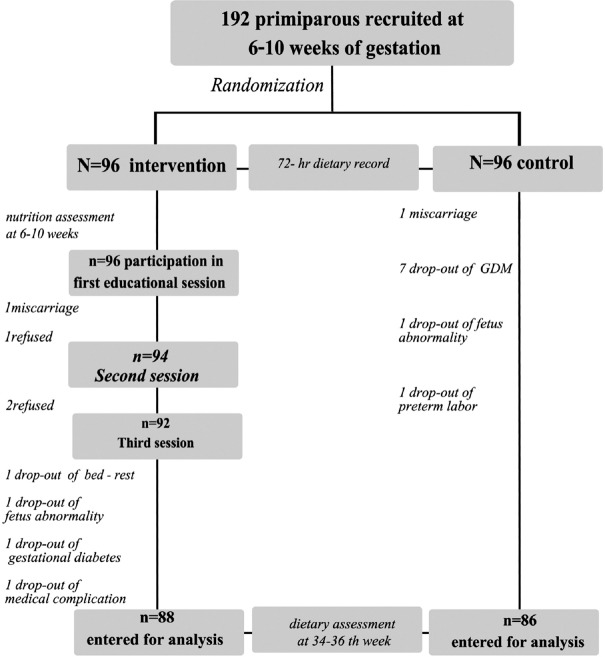
BACKGROUND: Different types of nutrients in adequate amounts are required to meet the increased demands of the mother and the developing fetus. Therefore, we examined the impact of nutrition education on the number of food servings per day. MATERIALS AND METHODS: = 96), and were followed-up until the end of pregnancy. Each woman in the experimental group met the study nutritionist at the time of enrollment and an individualized nutrition plan was developed. In addition, the nutrition education based on Pender's Health Promotion Model (HPM) was designed, including three 45-60 min training sessions in 6-10, 18, and 26 weeks of pregnancy. The participants' usual food intake using a three-day dietary record was assessed at 6-10 weeks and 34-36 weeks of gestation. RESULTS: The mean scores of the perceived benefits, self-efficacy, activity-related affect, interpersonal influences (husband support), and commitment to action increased while the competing demand scores decreased in the interventional group compared with the control group. The mean standard deviation (SD) of food portions from grain [10.40 (1.96) versus 12.70 (1.93) in the control group], vegetable [3.88 (1.33) versus 2.96 (0.91)], fruit [4.02 (0.05) versus 3.95 (0.91)], dairy [2.33 (0.68) versus 2.11 (0.45)], and meat [3.17 (0.68) versus 2.96 (0.67)] were improved in the experimental group. CONCLUSIONS: Pender's HPM for nutrition education is effective based on the compliance of pregnant women to the dietary guideline and the food guide pyramid.
Overview
The claims and statistics of this paper haven’t been checked yet.
Free: it reads the open-access text and checks the first 5 claims that cite a source we can check. Create a free account to check every claim.
Integrity signals
Registry
Cites
Statistics
Figures
Verification
Claims the paper makes
The claims and statistics of this paper haven’t been checked yet.
Free: it reads the open-access text and checks the first 5 claims that cite a source we can check. Create a free account to check every claim.
Claims other papers make about this one
Each is checked against this paper’s own text: does it say what the citing paper says it does?
The source backs part of the claim, not all of it — or backs it for a different population, condition or comparison.
In the citing paper
“Indeed, previous studies have explored the positive effects of nutrition education on healthy and sustainable eating behaviors and lifestyle changes among pregnant women [80,81,82,83,84,85,86].”
From Impact of Mediterranean Diet Adherence During Pregnancy on Preeclampsia, Gestational Diabetes Mellitus, and Excessive Gestational Weight Gain: A Systematic Review of Observational Studies and Randomized Controlled Trials (2025) · cites this paper as [85]
Experimental — accuracy not yet measured
Self-check
Percentages, sums and reported differences re-computed from the paper’s own numbers.
The self-check needs the paper’s full text.
Citations
Cites
Update of the Healthy Eating Index: HEI-2010
Guenther, P. M., Casavale, K. O., Reedy, J., Kirkpatrick, S. I., Hiza, H. A. B., Kuczynski, K. J., Kahle, L. L., & Krebs-Smith, S. M. (2013) · Journal of the Academy of Nutrition and Dietetics · doi:10.1016/j.jand.2012.12.016 · Cited by 1,360 · cited 1×
“[3] Therefore, nutrition education to promote sustainable healthy eating behaviors is a well‐established intervention and the first five components of the healthy eating index during pregnancy are the average daily servings of five food groups.[4,5] Nutrition education was positively associated with a higher intake of…”
BackgroundHealth promotion in nursing practice
Pender, N. J., Murdaugh, C. L., & Parsons, M. A. (1982) · Prentice Hall eBooks · Cited by 1,324
Diet or exercise, or both, for preventing excessive weight gain in pregnancy
Muktabhant, B., Lawrie, T. A., Lumbiganon, P., & Laopaiboon, M. (2015) · Cochrane Database of Systematic Reviews · doi:10.1002/14651858.cd007145.pub3 · Cited by 601 · cited 1×
“Women with weight‐related complications,[12] a history of diabetes (diabetes mellitus type 1 and type 2),[13] mental disease,[14] anemia, urinary tract complications, usage of a special regimen,[15] chronic disease, addiction[16] as well as the women who did not participate in all the classes because of medical or oth…”
BackgroundRisk factors and outcomes of maternal obesity and excessive weight gain during pregnancy
Gaillard, R., Durmuş, B., Hofman, A., Mackenbach, J. P., Steegers, E. A. P., & Jaddoe, V. W. V. (2013) · Obesity · doi:10.1002/oby.20088 · Cited by 490 · cited 1×
“[1,2] On the contrary, women who gain too much weight during pregnancy are at risk of having larger babies and postpartum weight retention.[3] Therefore, nutrition education to promote sustainable healthy eating behaviors is a well‐established intervention and the first five components of the healthy eating index duri…”
BackgroundGuelinckx, I., Devlieger, R., Mullie, P., & Vansant, G. (2010) · The American Journal of Clinical Nutrition · doi:10.3945/ajcn.2009.28166 · Cited by 338 · cited 1×
“[9] Other lifestyle interventions were efficient in developing diet habits among pregnant mothers.[10,11] To our knowledge, the previously performed studies changed the dietary patterns for 2–3 months or in some other aspects, while the pregnant mothers needed to adhere to the food guide pyramid recommendations during…”
ResultRutishauser, I. H. (2005) · Public Health Nutrition · doi:10.1079/phn2005798 · Cited by 307 · cited 1×
“A baseline assessment of the participants’ usual food intake using a three‐day dietary record (including one weekend day) occurred at 6–10 weeks of gestation in the two groups.[18] The food records were analyzed for the mean number of servings of each food group.”
MethodThornton, P. L., Kieffer, E. C., Salabarría-Peña, Y., Odoms-Young, A., Willis, S. K., Kim, H., & Salinas, M. A. (2006) · Maternal and Child Health Journal · doi:10.1007/s10995-005-0025-3 · Cited by 290 · cited 1×
“In addition, Thornton et al.[25] reported that husbands and female relatives were important sources of support for weight and diet among pregnant Latino women.”
BackgroundGirard, A. W., & Olude, O. (2012) · Paediatric and Perinatal Epidemiology · doi:10.1111/j.1365-3016.2012.01278.x · Cited by 278 · cited 1×
“[6] In accordance to the aforementioned study and similar trials about nutrition education, a meta‐analyses concluded that additional research grounded in appropriate theories of behavior change are needed to improve confidence in this field.[7] One of the models used in changing the nutritional behavior is Pender’s H…”
ResultIs price a barrier to eating more fruits and vegetables for low-income families?
Cassady, D., Jetter, K. M., & Culp, J. (2007) · Journal of the American Dietetic Association · doi:10.1016/j.jada.2007.08.015 · Cited by 268 · cited 1×
“We observed a marginal decrease in the baseline value after intervention because some of the items such as gastrointestinal problems require special treatment and some of them (like prices) will be decreased by public policies.[24] Further work is needed to develop the interventions that modify or remove these barrier…”
BackgroundHui, A., Back, L., Ludwig, S., Gardiner, P., Sevenhuysen, G., Dean, H., Sellers, E., McGavock, J., Morris, M., Bruce, S., et al. (2012) · BJOG: An International Journal of Obstetrics & Gynaecology · doi:10.1111/j.1471-0528.2011.03184.x · Cited by 195 · cited 1×
“[9] Other lifestyle interventions were efficient in developing diet habits among pregnant mothers.[10,11] To our knowledge, the previously performed studies changed the dietary patterns for 2–3 months or in some other aspects, while the pregnant mothers needed to adhere to the food guide pyramid recommendations during…”
Result
Cited by
Chen, H.-H., & Hsieh, P. (2021) · International Journal of Environmental Research and Public Health · doi:10.3390/ijerph18199985 · Cited by 122
Dewidar, O., John, J., Baqar, A., Madani, M. T., Saad, A., Riddle, A. Y., Ota, E., Kung’u, J. K., Arabi, M., Raut, M. K., et al. (2023) · Campbell Systematic Reviews · doi:10.1002/cl2.1361 · Cited by 97
Demilew, Y. M., Alene, G. D., & Belachew, T. (2020) · BMC Pediatrics · doi:10.1186/s12887-020-02363-8 · Cited by 33
Jalali, A., Ziapour, A., Ezzati, E., Kazemi, S., & Kazeminia, M. (2024) · American Journal of Health Promotion · doi:10.1177/08901171231224101 · Cited by 19
Lin, C.-H., Liu, C., Huang, C.-C., & Rong, J. (2022) · Geriatrics · doi:10.3390/geriatrics7060125 · Cited by 22
“Pender’s health promotion model has been widely adopted to explore the relationships between health promotion behaviors and quality of life [47,48].”
BackgroundPromoting Oral Health Behavior During Pregnancy: A Randomized Controlled Trial
Bashirian, S., Barati, M., Barati, M., Shirahmadi, S., Khazaei, S., Jenabi, E., & Gholami, L. (2023) · Journal of Research in Health Sciences · doi:10.34172/jrhs.2023.119 · Cited by 13
Enhancing perinatal health patient information through ChatGPT – An accuracy study
de Vries, P. L. M., Baud, D., Baggio, S., Ceulemans, M., Favre, G., Gerbier, E., Legardeur, H., Maisonneuve, É., Pena-Reyes, C., Pomar, L., et al. (2025) · PEC Innovation · doi:10.1016/j.pecinn.2025.100381 · Cited by 16
“However, patient information provided by health care workers is often inadequate due to limited time and resourcess [1,17-21].”
Mitran, A.-M., Gherasim, A., Niță, O., Mihalache, L., Arhire, L. I., Cioancă, O., Gafițanu, D., & Popa, A. D. (2024) · Nutrients · doi:10.3390/nu16030377 · Cited by 14
Shahabi, N. A., Javdan, G., Hosseini, Z., Aghamolaei, T., Ghanbarnejad, A., & Behzad, A. (2024) · BMC Public Health · doi:10.1186/s12889-024-19452-3 · Cited by 21
“Other researchers also reported the effectiveness of intervention based on Pender’s HPM in commitment to the plan of action [36, 46, 51, 57].”
BackgroundMethodResultMardanian, F., Goodarzi-Khoigani, M., Mahmoodabad, S. S. M., Moghadam, M. H. B., Nadjarzadeh, A., Feizi, A., Allameh, Z. S., & Molavi, S. (2021) · Journal of Research in Medical Sciences · doi:10.4103/jrms.jrms_780_20 · Cited by 10
Self-citationRiazi, S., Ghavami, V., Sobhani, S. R., Shoorab, N. J., & Mirzakhani, K. (2024) · BMC Pregnancy and Childbirth · doi:10.1186/s12884-024-06728-0 · Cited by 34
“…the HBM model, has been used as a framework for nutrition education and health behavior changes in various studies, including Sasanfar (2022) [37], Moitra (2021) [39], Mohammadi (2019) [40], Saadat Niya (2018) [41], Baji (2018) [42], Diddana (2017) [43], Ziyai (2017) [28], Khorramabadi (2016)…”
MethodDewidar, O., Saad, A., Baqar, A., John, J. C., Riddle, A. Y., Ota, E., Kung’u, J. K., Arabi, M., Raut, M. K., Klobodu, S. S., et al. (2021) · Campbell Systematic Reviews · doi:10.1002/cl2.1202 · Cited by 9
“While nutrition counselling and education has been shown to be effective among pregnant women in high income countries (Goodarzi ‐ Khoigani et al., 2018), the impact of such interventions on maternal and foetal health outcomes in low ‐ or middle ‐ income countries have not been well examined or…”
BackgroundTabatabai, S. V. A., Esmailinejad, A. S., Sadeghi, R., & Zeidabadi, B. (2022) · Journal of Education and Health Promotion · doi:10.4103/jehp.jehp_183_21 · Cited by 12
“showed that Pender’s HPM‐based nutrition education intervention in improving dietary patterns was associated with perceived benefits, self‐efficacy, behavioral emotions, and interpersonal influences.[31]”
BackgroundSharma, S., Esposito, S., Di Castelnuovo, A., Gialluisi, A., De Domenico, P., de Gaetano, G., Bonaccio, M., & Iacoviello, L. (2025) · Nutrients · doi:10.3390/nu17101723 · Cited by 9
Effectiveness of Integrated Maternal Nutrition Intervention Package on Birth Weight in Rwanda
Habtu, M., Gebremariam, A., Umugwaneza, M., Mochama, M., & Munyanshongore, C. (2022) · Frontiers in Nutrition · doi:10.3389/fnut.2022.874714 · Cited by 11
McKay, F. H., Zinga, J., & van der Pligt, P. (2023) · Nutrition & Dietetics · doi:10.1111/1747-0080.12845 · Cited by 8
Lin, C., Chen, Y., Lee, S., Kuo, C., Lee, M., & Lee, M. (2019) · Taiwanese Journal of Obstetrics and Gynecology · doi:10.1016/j.tjog.2018.11.015 · Cited by 8
Akhtar, A. N., Jamil, R., & Tariq, S. (2020) · ANNALS OF ABBASI SHAHEED HOSPITAL AND KARACHI MEDICAL & DENTAL COLLEGE · doi:10.58397/ashkmdc.v25i01.232 · Cited by 6
Li, Q., & Li, J. (2025) · BMC Pregnancy and Childbirth · doi:10.1186/s12884-025-07876-7 · Cited by 10
“%) reported methods of allocation concealment [12, 13, 18, 25, 27, 29, 30, 61, 62, 67], and 12 studies (32”
InfluentialMotivational Interviewing Screening Tool to Address Pediatric Obesity
Hyde, H., & McPeters, S. (2022) · The Journal for Nurse Practitioners · doi:10.1016/j.nurpra.2021.11.024 · Cited by 5
Mahmoodabad, S. S. M., Molavi, S., Nadjarzadeh, A., Mardanian, F., Riahi, R., Ardian, N., Salehi, K., & Goodarzi-Khoigani, M. (2021) · International Journal of Preventive Medicine · doi:10.4103/ijpvm.ijpvm_37_20 · Cited by 4
“[10] Health care providers medically examined participants and then an intended person described the study aims for them whereas took the written consent, too.”
BackgroundSelf-citationANALISIS PENGETAHUAN GIZI DAN HIDRASI TERHADAP SIKAP DAN PERILAKU IBU DI MASA KEHAMILAN
Mulyani, E. Y., Jus’at, I., Angkasa, D., & Anggiruling, D. O. (2019) · Gizi Indonesia · doi:10.36457/gizindo.v42i2.462 · Cited by 4
“mengonsumsi cairan 12 gelas/hari atau 3L 38 (77,6) 11 (22,4) 35 (68,6) 16 (31,4) 0,37”
BackgroundHidayat, S., Mumpuningtias, E. D., & Andriyani, P. S. (2020) · STOMATOGNATIC - Jurnal Kedokteran Gigi · doi:10.19184/stoma.v17i2.25214 · Cited by 4
Is Health Education among the Decisive Factors for the Diet Quality of Pregnant Women in Poland?
Demuth, A., Ratajczak, J., Czerniak, U., & Antosiak-Cyrak, K. (2023) · Nutrients · doi:10.3390/nu15112627 · Cited by 5
Strahl, M., Wasilewska, E., Chawłowska, E., & Małgorzewicz, S. (2026) · Nutrients · doi:10.3390/nu18142260 · Cited by 2
“The practical importance of nutrition education is also demonstrated by the randomized study by Goodarzi-Khoigani et al., in which an educational intervention based on Pender’s Health Promotion Model improved the diet of pregnant women and their adherence to dietary recommendations [25].”
Goodarzi-Khoigani, M., Ardakani, T. S., Aram, F. A., Khoshhali, M., Mardanian, F., & Ardian, N. (2024) · Journal of Education and Health Promotion · doi:10.4103/jehp.jehp_926_23 · Cited by 3
Self-citationHydration status count for weight gain on pregnancy period
Mulyani, E. Y., Angkasa, D., Stanin, E., & Jus’at, I. (2021) · Nutrition & Food Science · doi:10.1108/nfs-03-2021-0096 · Cited by 1
Heidari, N., Amiri, M., Rajati, F., Mahaki, B., & Rajati, M. (2025) · Frontiers in Public Health · doi:10.3389/fpubh.2025.1496028 · Cited by 3
Lewa, A. F., & Muliani, M. (2022) · Gaceta Médica de Caracas · doi:10.47307/gmc.2022.130.2.13 · Cited by 5
Increasing Patient Adherence to Gestational Weight Gain Goals in Pregnancy
Vining, A. (2020) · IRL - University of Missouri, St. Louis (University of Missouri–St. Louis)
Tonkaboni, N. D., Peyman, N., & Khandehroo, M. (2021) · Journal of Education and Community Health · doi:10.52547/jech.8.1.65
Ekrem, E. C., & Atan, Ş. Ü. (2021) · Bandırma Onyedi Eylül Üniversitesi Sağlık Bilimleri ve Araştırmaları Dergisi · doi:10.46413/boneyusbad.910100
Ain, H., Pandin, M. G. R., & Arief, Y. S. (2022) · medRxiv · doi:10.1101/2022.09.19.22280088
Amiri, M., Heidari, N., Rajati, M., Mahaki, B., & Rajati, F. (2022) · Research Square · doi:10.21203/rs.3.rs-2343454/v1
Peningkatan Pengetahuan Ibu Hamil Tentang Gizi di Desa Gelam Kota Serang
Nurkhayati, E., & Yunarsih, N. (2022) · Indonesia Berdaya · doi:10.47679/ib.2023370
Amiri, M., Heidari, N., Rajati, M., Mahaki, B., & Rajati, F. (2023) · Research Square · doi:10.21203/rs.3.rs-2343454/v2 · Cited by 1
Yasodhadevi, K., Preethi, S. A. E., & Banumathi, S. (2023) · FoodSci Indian Journal of Research in Food Science and Nutrition · doi:10.15613/fijrfn/2023/v10i1/220469
“To increase the impact of nutrition education programmes, it is necessary to highlight the benefits of healthy dietary habits and the consequences of poor dietary intake which will increase the nutritional knowledge of pregnant women 18 .”
BackgroundGustina, N. Z. (2022) · Jurnal Pustaka Keperawatan (Pusat Akses kajian Keperawatan) · doi:10.55382/jurnalpustakakeperawatan.v1i1.174
“, (2018)[20] Dampak Edukasi Gizi dalam Memperbaiki Pola Makan Selama Kehamilan Berdasarkan Model Promosi Kesehatan Pender: Uji Klinis Acak Iranian Journal of Nursing and Midwifery Research Mengetahui berbagai jenis nutrisi dalam jumlah yang cukup diperlukan untuk memenuhi peningkatan kebutuhan ibu dan janin yang sedan…”
BackgroundWilandika, A., & Rachmawati, A. (2024) · Jurnal Manajemen Asuhan Keperawatan · doi:10.33655/mak.v8i1.183 · Cited by 2
Mothers' experiences of pregnancy care: A qualitative study
Alibabaei, M., Moradabadi, M. T., & Sadati, A. K. (2024) · Payesh (Health Monitor) Journal · doi:10.61186/payesh.23.2.245 · Cited by 2
Prenatal nutrition in Iowa: A multi-study qualitative analysis
Feldpausch, G. (2024) · doi:10.31274/td-20240617-119
Prachi, G., Puskuri, J. S., Devi, T. S., Vyjayanthi, S., & Balakrishna, N. (2025) · Research Square · doi:10.21203/rs.3.rs-6445408/v1
Demilew, Y. M., Alene, G. D., & Belachew, T. (2020) · Figshare · doi:10.6084/m9.figshare.13059335
Demilew, Y. M., Alene, G. D., & Belachew, T. (2020) · Figshare · doi:10.6084/m9.figshare.13059329
Demilew, Y. M., Alene, G. D., & Belachew, T. (2020) · Figshare · doi:10.6084/m9.figshare.13059332
Assessing the institutional provision of maternal nutrition services in antenatal clinics in Beijing
Li, Y., Wang, X., Wang, D., Zhang, S., Li, Y., Hu, M., Sun, Y., & Ma, L. (2026) · The Journal of Maternal-Fetal & Neonatal Medicine · doi:10.1080/14767058.2026.2630531
Prabhu, A. V., Shyamala, G., Garg, M., Ravishankar, N., Nayak, B. S., & Karkada, S. R. (2026) · Dialogues in Health · doi:10.1016/j.dialog.2026.100289
“Nutrition education has emerged as an effective, cost-effective intervention for improving dietary behaviours, diversifying food group intake, and mitigating risks associated with nutrient deficiencies [11].”
Maternal nutrition education among midwives and student midwives in Nigeria: a cross-sectional study
Wahab, I. E., & Abayomi, J. C. (2026) · African Journal of Midwifery and Women s Health · doi:10.12968/ajmw.2025.0005
Promotion de l'activité physique chez les femmes enceintes Guadeloupéennes
Ruart, S. (2020) · theses.fr (ABES) · doi:10.70675/9551b647z6fc0z4853za538zaaeff4f50b38
Application and Effectiveness of the Nola Pender Model in Nursing: A Narrative Review
Torres, I. L. R., Rojas, D. M. P., Lastre-Amell, G., & Martínez, S. G. (2026) · Iranian Journal of Nursing and Midwifery Research · doi:10.4103/ijnmr.ijnmr_442_24
“[7] Similarly, another study of a similar nature revealed positive impacts of an educational program on patients undergoing hemodialysis, especially in self‑efficacy behaviors and treatment adherence.”
Influential
Metadata
- Authors
- Mazloomy-Mahmoodabad, S., Goodarzi-Khoigani, M., Baghiani Moghadam, M., Nadjarzadeh, A., Mardanian, F., & Fallahzadeh, H.
- Affiliations
- Shahid Sadoughi University of Medical Sciences and Health Services (IR)
- Isfahan University of Medical Sciences (IR)
- Venue
- Iranian Journal of Nursing and Midwifery Research
- Published
- 2018
- Volume
- 23
- Issue
- 1
- Pages
- 18
- ISSN
- 1735-9066 (ISSN-L)
- PMC
- PMC5769180
- OpenAlex
- W2779702087
- Semantic Scholar
- 695707e3644dd592201a07c5626943815d3e1fe6
- Cited by
- 50
- References
- 32
- Citations by year
- 2026: 5 · 2025: 5 · 2024: 7 · 2023: 7 · 2022: 9 · 2021: 7 · 2020: 8 · 2019: 2
- FWCI
- 3.52
- Type
- journal article
- Language
- en
- Open access
- gold
- doi.org
- Licence
- cc-by-nc-sa
- Locations
- Iranian Journal of Nursing and Midwifery Research (publishedVersion, cc-by-nc-sa)
- PubMed Central (publishedVersion, cc-by-nc-sa)
- PubMed (publishedVersion)
- DOAJ (DOAJ: Directory of Open Access Journals) (submittedVersion)
- Topics
- Health Sciences › Nursing › Nutrition and Dietetics › Nutrition, Health and Food Behavior
- Health Sciences › Medicine › Pediatrics, Perinatology and Child Health › Public Health and Nutrition
- Health Sciences › Medicine › Pediatrics, Perinatology and Child Health › Maternal and Neonatal Healthcare
- Keywords
- nutrition education, pregnancy, dietary habits, Pender's health promotion model, dietary intake, self-efficacy, perceived benefits, husband support, Food Guide Pyramid, dietary guidelines, maternal nutrition
About these checks
Registry, retraction, Cites and statistics results are computed, not judged, with one exception: a printed reference that no index lists is read once by a model before it counts as a citation error. Claims are extracted by a model and kept only when their quote appears verbatim in the text; each cited source is then checked, with a model’s help, for whether it says what the claim relies on. Those verdicts can be wrong — read the claim’s quote and the cited source before relying on one.
Statistics and arithmetic are recomputed, not judged.
Confidence bands are shown only for fields calibrated on our annotated test set. None is calibrated yet, so no band is shown.
What counts as a claim ›How we measure confidence ›How we check this ›
Are you an author, or do you see a problem with this page? Request a review
Data sources
Bibliographic data: Semantic Scholar, OpenAlex, Crossref.
Contains information from the Semantic Scholar Academic Graph Datasets, made available under the ODC Attribution License (ODC-BY 1.0).
Semantic Scholar’s data is described in: Kinney, R., et al. (2023). The Semantic Scholar Open Data Platform. arXiv:2301.10140.
