

The DOI matches its Crossref record; 42 of the 43 references it cites were found in a registry or an index, and 1 are not checked yet.
Relationship between serum lipids and depression: A cross sectional survey among adults in Haryana, India
Open accessAbstract
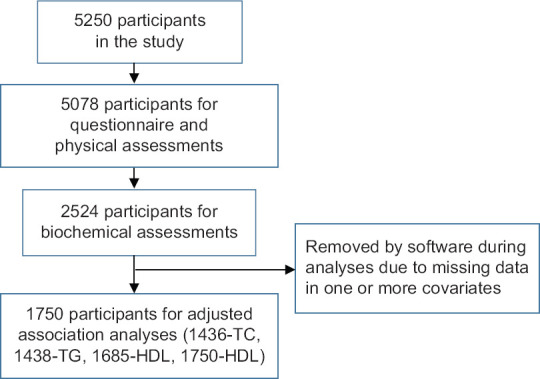
ABSTRACT Introduction: Dyslipidemia and mental illnesses are significant contributors to the global noncommunicable disease burden and studies suggest an association between them. Aim: Using data from a noncommunicable disease risk factor survey conducted in Haryana, India, we undertook a secondary data analysis to examine the association between lipids and depressive symptoms. Methods: The survey involved 5,078 participants and followed the World Health Organisation STEPwise approach to NCD risk factor surveillance approach. Biochemical assessments were undertaken in a subset of participants. Lipid markers were measured using wet chemistry methods. Depressive symptoms were assessed using the Patient Health Questionnaire–9. Descriptive statistics were presented for all variables; logistic regression was used for association analyses. Results: The mean age of the study population was 38 years and 55% of them were females. A majority of the participants belonged to a rural background. The mean total cholesterol was 176 mg/dL and approximately 5% of the participants were found to have moderate to severe depression. The association of total cholesterol (odds ratio [OR] 0.99, P = 0.84), LDL-cholesterol (OR = 1.00, P = 0.19), HDL-cholesterol (OR = 0.99, P = .76), and triglycerides (OR 1.00, P = .12) with depressive symptoms was not significant. Conclusion: This study did not find any association between lipids and depressive symptoms. However, further investigations using prospective designs are warranted to understand this relationship and complex interactions with other mediating factors better.
Overview
The claims and statistics of this paper haven’t been checked yet.
Run the check — free, no account needed. It reads the open-access text and checks the sources it cites.
Integrity signals
Registry
Cites
Statistics
Figures
Verification
Claims the paper makes
The claims and statistics of this paper haven’t been checked yet.
Run the check — free, no account needed. It reads the open-access text and checks the sources it cites.
Claims other papers make about this one
Each is checked against this paper’s own text: does it say what the citing paper says it does?
In the citing paper
“Another research finding was that the level of lipids is not related to depressive symptoms in people [19], and also the association with suicidal behavior or attempts in patients with mental disorders is not clear [20,21].”
Self-check
Percentages, sums and reported differences re-computed from the paper’s own numbers.
The self-check needs the paper’s full text.
Citations
Cites
The PHQ-9: Validity of a brief depression severity measure
Kroenke, K., Spitzer, R. L., & Williams, J. B. W. (2001) · Journal of General Internal Medicine · doi:10.1046/j.1525-1497.2001.016009606.x · Cited by 44,910 · cited 3×
“Although we used the PHQ-9 scale, which is a thoroughly validated and robust tool for the assessment of depressive symptoms worldwide, [26] the responses captured by this screening tool are self-reported and maybe subjective, which may have introduced a bias in our estimates.”
InfluentialGlobal Burden of Disease and the Impact of Mental and Addictive Disorders
Rehm, J., & Shield, K. D. (2019) · Current Psychiatry Reports · doi:10.1007/s11920-019-0997-0 · Cited by 1,388
Depression and cardiac mortality: results from a community-based longitudinal study.
Penninx, B., Beekman, A., Honig, A., Deeg, D., Schoevers, R., van Eijk, J., & van Tilburg, W. V. (2001) · Archives of General Psychiatry · doi:10.1001/archpsyc.58.3.221 · Cited by 983 · cited 1×
“[41,42] Conversely, cardiac events and morbidity have also been shown to be determinants of acute and chronic depressive episodes in individuals.”
State of the art review: depression, stress, anxiety, and cardiovascular disease
Cohen, B. E., Edmondson, D., & Kronish, I. M. (2015) · American Journal of Hypertension · doi:10.1093/ajh/hpv047 · Cited by 955
The burden of non communicable diseases in developing countries
Boutayeb, A., & Boutayeb, S. (2005) · International Journal for Equity in Health · doi:10.1186/1475-9276-4-2 · Cited by 775
Vancampfort, D., Correll, C. U., Galling, B., Probst, M., De Hert, M., Ward, P. B., Rosenbaum, S., Gaughran, F., Lally, J., & Stubbs, B. (2016) · World Psychiatry · doi:10.1002/wps.20309 · Cited by 659 · cited 1×
“16] This has in-turn led to the creation of a five-by-five approach by the UN member states, focused on the inclusion of mental health in strategies to tackle the NCD burden.”
Depressive Symptoms and Risks of Coronary Heart Disease and Mortality in Elderly Americans
Ariyo, A. A., Haan, M. N., Tangen, C. M., Rutledge, J. C., Cushman, M., Dobs, A. S., & Furberg, C. D. (2000) · Circulation · doi:10.1161/01.cir.102.15.1773 · Cited by 556 · cited 1×
“[41,42] Conversely, cardiac events and morbidity have also been shown to be determinants of acute and chronic depressive episodes in individuals.”
Anxiety and new onset of cardiovascular disease: critical review and meta-analysis
Batelaan, N. M., Seldenrijk, A., Bot, M., van Balkom, A. J. L. M., & Penninx, B. W. J. H. (2016) · British Journal of Psychiatry · doi:10.1192/bjp.bp.114.156554 · Cited by 362
Brain membrane lipids in major depression and anxiety disorders
Müller, C. P., Reichel, M., Mühle, C., Rhein, C., Gulbins, E., & Kornhuber, J. (2015) · Biochimica et Biophysica Acta (BBA) - Molecular and Cell Biology of Lipids · doi:10.1016/j.bbalip.2014.12.014 · Cited by 308
Burden of non-communicable disease: Global overview
Habib, S. H., & Saha, S. (2008) · Diabetes & Metabolic Syndrome Clinical Research & Reviews · doi:10.1016/j.dsx.2008.04.005 · Cited by 260
Integrating mental health with other non-communicable diseases
Stein, D. J., Benjet, C., Gureje, O., Lund, C., Scott, K. M., Poznyak, V., & van Ommeren, M. (2019) · BMJ · doi:10.1136/bmj.l295 · Cited by 245
Serum lipid levels and suicidality: a meta-analysis of 65 epidemiological studies
Wu, S., Ding, Y., Wu, F., Xie, G., Hou, J., & Mao, P. (2015) · Journal of Psychiatry and Neuroscience · doi:10.1503/jpn.150079 · Cited by 154 · cited 2×
“[11,12] At the same time, a Mendelian randomization analysis published in 2019 had reported an association between raised triglyceride levels and depression.”
The Associations of Serum Lipids with Vitamin D Status
Wang, Y., Si, S., Liu, J., Wang, Z., Jia, H., Feng, K., Sun, L., & Song, S. (2016) · PLoS ONE · doi:10.1371/journal.pone.0165157 · Cited by 142 · cited 1×
“Research has even suggested a probable effect of Vitamin D levels on serum cholesterol [40] which in turn might be responsible for mediating the relationship between lipids and mental health but the evidence remains equivocal.”
Depression and serum low-density lipoprotein: A systematic review and meta-analysis
Persons, J. E., & Fiedorowicz, J. G. (2016) · Journal of Affective Disorders · doi:10.1016/j.jad.2016.07.033 · Cited by 136 · cited 3×
“[11,12] At the same time, a Mendelian randomization analysis published in 2019 had reported an association between raised triglyceride levels and depression.”
Low cholesterol concentrations and severe depressive symptoms in elderly people
Brown, S. L., Salive, M. E., Harris, T. B., Simonsick, E. M., Guarlnik, J. M., & Kohout, F. J. (1994) · BMJ · doi:10.1136/bmj.308.6940.1328 · Cited by 133
Wysokiński, A., Strzelecki, D., & Kłoszewska, I. (2015) · Diabetes & Metabolic Syndrome: Clinical Research & Reviews · doi:10.1016/j.dsx.2015.04.004 · Cited by 120 · cited 1×
“Studies in the past that have reported associations between depression and mood disorders and impaired lipid profiles have majorly been conducted in either populations that were already suffering from a mental health condition [8,17,18,31,35,36] or among individuals with diabetes or heart failure.”
Longitudinal Relationship of Depressive and Anxiety Symptoms With Dyslipidemia and Abdominal Obesity
Dortland, A. K. B. V. R., Giltay, E. J., van Veen, T., Zitman, F. G., & Penninx, B. W. J. H. (2012) · Psychosomatic Medicine · doi:10.1097/psy.0b013e318274d30f · Cited by 106 · cited 1×
“Third, there is literature on the possibility of a change in lipid levels as a consequence of depression [38] and depression being a risk factor for nonadherence to lipid-lowering drugs, which could in turn lead to dyslipidemia.”
LDL cholesterol relates to depression, its severity, and the prospective course
Wagner, C. J., Musenbichler, C., Böhm, L., Färber, K., Fischer, A.-I., von Nippold, F., Winkelmann, M., Richter-Schmidinger, T., Mühle, C., Kornhuber, J., et al. (2019) · Progress in Neuro-Psychopharmacology and Biological Psychiatry · doi:10.1016/j.pnpbp.2019.01.010 · Cited by 106 · cited 2×
“Studies in the past that have reported associations between depression and mood disorders and impaired lipid profiles have majorly been conducted in either populations that were already suffering from a mental health condition [8,17,18,31,35,36] or among individuals with diabetes or heart failure.”
Segoviano-Mendoza, M. A., la Cruz, M. C.-D., Salas-Pacheco, J. M., Vázquez-Alaníz, F., Llave-León, O. L., Castellanos-Juárez, F. X., Hernández, J. E. M., Barraza-Salas, M., Miranda-Morales, E. G., Arias-Carrión, Ó., et al. (2018) · BMC Psychiatry · doi:10.1186/s12888-018-1596-z · Cited by 83 · cited 2×
“[27] 30] On the other hand, many studies have reported significant associations of both hypolipidemia (low total cholesterol, [17,18,31,32] low LDL-cholesterol, [12,18,32,33] low triglycerides, [18] and low HDL-cholesterol [8,32,34] ) and hyperlipidemia (high total cholesterol, [8,34–36] high…”
Serum lipid profiles in major depression with clinical subtypes, suicide attempts and episodes
Huang, T. (2004) · Journal of Affective Disorders · doi:10.1016/j.jad.2004.11.005 · Cited by 76 · cited 1×
“[27] 30] On the other hand, many studies have reported significant associations of both hypolipidemia (low total cholesterol, [17,18,31,32] low LDL-cholesterol, [12,18,32,33] low triglycerides, [18] and low HDL-cholesterol [8,32,34] ) and hyperlipidemia (high total cholesterol, [8,34–36] high…”
Prospective plasma lipid profiling in individuals with and without depression
Enko, D., Brandmayr, W., Halwachs‐Baumann, G., Schnedl, W. J., Meinitzer, A., & Kriegshäuser, G. (2018) · Lipids in Health and Disease · doi:10.1186/s12944-018-0796-3 · Cited by 74
Ofori‐Asenso, R., Jakhu, A., Curtis, A. J., Zomer, E., Gambhir, M., Korhonen, M. J., Nelson, M. R., Tonkin, A. M., Liew, D., & Zoungas, S. (2018) · The Journals of Gerontology Series A · doi:10.1093/gerona/glx256 · Cited by 71 · cited 1×
“[39] A cross-sectional study cannot ascertain the direction of causality and could thus affect the overall findings.”
So, H., Chau, C. K., Cheng, Y.-Y., & Sham, P. C. (2020) · Psychological Medicine · doi:10.1017/s0033291720000951 · Cited by 70
Thakur, J. S., Jeet, G., Nangia, R., Singh, D. R., Grover, S., Lyngdoh, T., Pal, A., Verma, R. K., Aggarwal, R., Khan, M. H., et al. (2019) · PLoS ONE · doi:10.1371/journal.pone.0208872 · Cited by 68 · cited 2×
“[24] Given that India has a high prevalence of both dyslipidemia and mental disorders and a considerable dearth of studies on the same, we took advantage of data from this surveillance study and used the opportunity to examine the relationship of serum lipids with depressive symptoms and suicidal…”
Depression following Myocardial Infarction: A One Year Longitudinal Study
Travella, J. I., Forrester, A. W., Schultz, S. K., & Robinson, R. G. (1994) · The International Journal of Psychiatry in Medicine · doi:10.2190/u8r0-a61y-akrp-t24v · Cited by 54 · cited 1×
“[43,44] This ambiguity regarding the cause and effect aspect of this relationship has further raised the question of whether cardiovascular and mental health conditions are different complications of a common underlying pathophysiology altogether.”
The relationship between cholesterol levels and depression in the elderly
Ergün, U. G. Ö., Uğuz, Ş., Bozdemir, N., Güzel, R., Burgut, R., Saatçı, E., & Akpınar, E. (2004) · International Journal of Geriatric Psychiatry · doi:10.1002/gps.1078 · Cited by 53
Capuzzi, E., Bartoli, F., Crocamo, C., Malerba, M. R., Clerici, M., & Carrà, G. (2018) · Psychiatry Research · doi:10.1016/j.psychres.2018.10.050 · Cited by 42 · cited 1×
“[27] 30] On the other hand, many studies have reported significant associations of both hypolipidemia (low total cholesterol, [17,18,31,32] low LDL-cholesterol, [12,18,32,33] low triglycerides, [18] and low HDL-cholesterol [8,32,34] ) and hyperlipidemia (high total cholesterol, [8,34–36] high…”
Lipids, lipoprotein distribution and depressive symptoms: the Multi-Ethnic Study of Atherosclerosis
Ong, K. L., Morris, M. J., McClelland, R. L., Maniam, J., Allison, M., & Rye, K.-A. (2016) · Translational Psychiatry · doi:10.1038/tp.2016.232 · Cited by 41 · cited 3×
“[27] 30] On the other hand, many studies have reported significant associations of both hypolipidemia (low total cholesterol, [17,18,31,32] low LDL-cholesterol, [12,18,32,33] low triglycerides, [18] and low HDL-cholesterol [8,32,34] ) and hyperlipidemia (high total cholesterol, [8,34–36] high…”
Endocrine Risk Factors for Cognitive Impairment
Moon, J. H. (2016) · Endocrinology and Metabolism · doi:10.3803/enm.2016.31.2.185 · Cited by 39 · cited 1×
“Changes in membrane lipids have been found to be associated with depression, [5] self-harm behavior, [6] and Alzheimer’s [7] but the relationship is not yet fully understood.”
Melin, E. O., Thulesius, H. O., Hillman, M., Svensson, R., Landin‐Olsson, M., & Thunander, M. (2019) · Lipids in Health and Disease · doi:10.1186/s12944-019-1009-4 · Cited by 37 · cited 2×
“[33,34] Differences in the overall health status and a lack of a substantial number of participants who either had impaired lipids or were diagnosed with depressive symptoms in our study could be a reason for no association between the two variables.”
The Association between Depressive Mood and Cholesterol Levels in Korean Adolescents
Kim, E. J., Hong, J., & Hwang, J. (2019) · Psychiatry Investigation · doi:10.30773/pi.2019.03.24 · Cited by 34 · cited 1×
“…(low total cholesterol, [17,18,31,32] low LDL-cholesterol, [12,18,32,33] low triglycerides, [18] and low HDL-cholesterol [8,32,34] ) and hyperlipidemia (high total cholesterol, [8,34–36] high LDL-cholesterol, [8,37] and high triglycerides [8] ) with an increased risk of depression in adults.”
Mental health and global strategies to reduce NCDs and premature mortality
Pryor, L., Silva, M. A. D., & Melchior, M. (2017) · The Lancet Public Health · doi:10.1016/s2468-2667(17)30140-8 · Cited by 31
Steeds, R. P., Bickerton, D., Smith, M. J., & Muthusamy, R. (2004) · Heart · doi:10.1136/hrt.2003.013904 · Cited by 29 · cited 1×
“[43,44] This ambiguity regarding the cause and effect aspect of this relationship has further raised the question of whether cardiovascular and mental health conditions are different complications of a common underlying pathophysiology altogether.”
Elevated total cholesterol in severely depressed patients: Role in cardiovascular risk?
Das, P. P., Malhotra, S., Chakrabarti, S., & Sharma, S. (2009) · The World Journal of Biological Psychiatry · doi:10.1080/15622970902960889 · Cited by 23
Serum cholesterol and Suicide in first episode psychosis
Shrivastava, A., Johnston, M., Campbell, R., Sousa, A. D., & Shah, N. (2017) · Indian Journal of Psychiatry · doi:10.4103/psychiatry.indianjpsychiatry_185_17 · Cited by 23
Lipid Parameters – Significance in Patients with Endogenous Depression
Kale, A. (2014) · JOURNAL OF CLINICAL AND DIAGNOSTIC RESEARCH · doi:10.7860/jcdr/2014/4059.3911 · Cited by 22 · cited 5×
“[27] 30] On the other hand, many studies have reported significant associations of both hypolipidemia (low total cholesterol, [17,18,31,32] low LDL-cholesterol, [12,18,32,33] low triglycerides, [18] and low HDL-cholesterol [8,32,34] ) and hyperlipidemia (high total cholesterol, [8,34–36] high…”
InfluentialA Controlled Study of Serum Lipid Profiles in Indian Patients with Depressive Episode
Patra, B. N., Khandelwal, S. K., Chadda, R. K., & Ramakrishnan, L. (2014) · Indian Journal of Psychological Medicine · doi:10.4103/0253-7176.130968 · Cited by 21 · cited 3×
“[27] 30] On the other hand, many studies have reported significant associations of both hypolipidemia (low total cholesterol, [17,18,31,32] low LDL-cholesterol, [12,18,32,33] low triglycerides, [18] and low HDL-cholesterol [8,32,34] ) and hyperlipidemia (high total cholesterol, [8,34–36] high…”
Elevated total cholesterol in severely depressed patients: Role in cardiovascular risk?
Das, P. P., Malhotra, S., Chakrabarti, S., & Sharma, S. (2010) · The World Journal of Biological Psychiatry · doi:10.3109/15622970902960889 · Cited by 18 · cited 1×
“A very few observational studies that have been conducted in some parts of the country have reported contradictory results, with some linking depression to low cholesterol [17,18] and others suggesting an association with high cholesterol [19] or no association at all.”
Relationship of Lipids and Lipid-Lowering Medications With Cognitive Function
Ong, K. L., Morris, M. J., McClelland, R. L., Hughes, T. M., Maniam, J., Fitzpatrick, A. L., Martin, S. S., Luchsinger, J. A., Rapp, S. R., Hayden, K. M., et al. (2017) · American Journal of Epidemiology · doi:10.1093/aje/kwx329 · Cited by 15 · cited 1×
“[10] Recent systematic reviews and meta-analyses have reported a probable risk of depression and suicidal behavior among individuals with low LDL-cholesterol and low serum cholesterol.”
Study on Association Between Lipid Profile Values and Psychiatric Disorders
John, S. (2014) · JOURNAL OF CLINICAL AND DIAGNOSTIC RESEARCH · doi:10.7860/jcdr/2014/10383.5301 · Cited by 10 · cited 1×
“[20] Hence, existing research is ambiguous and majorly inadequate for drawing reasonable scientific conclusions.”
Is There a Link Between Cholesterol Level and the Risk of Developing Depression?
Broncel, M., & Serejko-Banaś, K. E. (2016) · Open Medicine Journal · doi:10.2174/1874220301603010352 · Cited by 5
[Association between serum lipid level and depression in patients with chronic heart failure].
Gu, X., Wu, K., Ni, F. Y., Ji, X. C., Wang, J. K., & Pan, S. (2018) · PubMed · doi:10.3760/cma.j.issn.0376-2491.2018.27.009 · Cited by 1 · cited 3×
“…of both hypolipidemia (low total cholesterol, [17,18,31,32] low LDL-cholesterol, [12,18,32,33] low triglycerides, [18] and low HDL-cholesterol [8,32,34] ) and hyperlipidemia (high total cholesterol, [8,34–36] high LDL-cholesterol, [8,37] and high triglycerides [8] ) with an increased risk of…”
(2014) · Institutional Repository University of Antioquia (University of Antioquia) · doi:10.1371/journal.pone
Cited by
Sorted by citations
Liu, Y., Chen, M.-T., He, Y., Chen, M., Liang, J.-R., Jia, F., Huang, Q., Zhou, R., & Hou, C. (2024) · Lipids in Health and Disease · doi:10.1186/s12944-024-02285-9 · Cited by 18
“Studies involving other ethnic groups have yielded conclusions that diverge from those of the present study [67, 68].”
ResultLiu, Z., Sun, L., Sun, F., Zhang, Y., Wang, J., Zhang, Z., Sun, G., Sun, L., Yang, R., Yao, G., et al. (2024) · Heliyon · doi:10.1016/j.heliyon.2024.e30344 · Cited by 17
“Another research finding was that the level of lipids is not related to depressive symptoms in people [19], and also the association with suicidal behavior or attempts in patients with mental disorders is not clear [20,21].”
BackgroundZeng, D., Zheng, Y., Zhao, X.-X., Li, S., Luo, L., Xie, W.-J., Zhang, P., Li, G.-J., He, S., Yu, Y.-M., et al. (2026) · Brain, behavior, and immunity · doi:10.1016/j.bbi.2026.106515 · Cited by 3
Zhang, Z., & Song, Y. (2024) · Medicine · doi:10.1097/md.0000000000038234 · Cited by 3
“[9] In a cross-sectional study of 40,904 Korean adults, it was discovered by scientists that depression symptoms are linked to either low or high levels of LDL-C.”
BackgroundKytikovа, O. Y., Antonyuk, M. V., Novgorodtseva, T. P., & Gvozdenko, T. A. (2024) · Russian Journal of Cardiology · doi:10.15829/1560-4071-2024-5945 · Cited by 3
Metadata
- Authors
- Mulchandani, R., Lyngdoh, T., Nangia, R., Singh, S., Grover, S., & Thakur, J.
- Affiliations
- Post Graduate Institute of Medical Education and Research (IN)
- Indian Council of Medical Research (IN)
- Department of Maharishi Markandeshwar Medical College and Hospital, Kumarhatti, Solan, Himachal Pradesh, India
- Department of Community Medicine and School of Public Heath, Chandigarh, India
- Venue
- Indian Journal of Psychiatry
- Published
- 2023-01
- Volume
- 65
- Issue
- 1
- Pages
- 61-67
- ISSN
- 0019-5545 (ISSN-L)
- 1998-3794
- PMC
- PMC9983447
- OpenAlex
- W4315643351
- Cited by
- 8
- References
- 42
- Citations by year
- 2026: 2 · 2025: 1 · 2024: 5
- FWCI
- 2.14
- Type
- journal article
- Language
- en
- Open access
- diamond
- doi.org
- Licence
- cc-by-nc-sa
- Locations
- Indian Journal of Psychiatry (publishedVersion, cc-by-nc-sa)
- PubMed Central (publishedVersion, cc-by-nc-sa)
- PubMed (publishedVersion)
- DOAJ (DOAJ: Directory of Open Access Journals) (submittedVersion, cc-by-sa)
- Funders
- Postgraduate Institute of Medical Education and Research, Chandigarh
- Topics
- Health Sciences › Medicine › Cardiology and Cardiovascular Medicine › Lipoproteins and Cardiovascular Health
- Health Sciences › Medicine › Psychiatry and Mental health › Mental Health Treatment and Access
- Life Sciences › Neuroscience › Biological Psychiatry › Tryptophan and brain disorders
- Keywords
- serum lipids, depressive symptoms, dyslipidemia, total cholesterol, LDL cholesterol, HDL cholesterol, triglycerides, non-communicable disease risk factors, Haryana
About these checks
Registry, retraction, Cites and statistics results are computed, not judged, with one exception: a printed reference that no index lists is read once by a model before it counts as a citation error. Claims are extracted by a model and kept only when their quote appears verbatim in the text; each cited source is then checked, with a model’s help, for whether it says what the claim relies on. Those verdicts can be wrong — read the claim’s quote and the cited source before relying on one.
Statistics and arithmetic are recomputed, not judged.
Confidence bands are shown only for fields calibrated on our annotated test set. None is calibrated yet, so no band is shown.
What counts as a claim ›How we measure confidence ›How we check this ›
Are you an author, or do you see a problem with this page? Request a review
