

The DOI matches its Crossref record; 47 of the 50 references it cites were found in a registry or an index; 3 of the 12 sources its claims cite were checked for support.
"Doing What Matters in Times of Stress" to Decrease Psychological Distress During COVID-19: A Randomised Controlled Pilot Trial.
Open accessAbstract
Despite the increasing psychological distress during COVID-19, utilisation of face-to-face psychological interventions decreased profoundly. The aim of this study involving two parallel, twoarmed pilot randomised controlled trials was to examine the effectiveness of a guided self-help intervention "Doing What Matters in Times of Stress" (DWM) in decreasing psychological distress in Turkish and Syrian participants. Seventy-four Turkish nationals and 50 Syrian refugee adults with psychological distress were randomly allocated to a DWM group or wait-list control group. The primary outcome measure was the Patient Health Questionnaire 9 postintervention. Secondary outcome measures were the Generalised Anxiety Disorder Scale, posttraumatic stress disorder (PTSD) Checklist for DSM-5, Generalized Self-Efficacy Scale and Acceptance and Action Questionnaire-II postintervention. Although this study was not powered to detect a significant effect for DWM postassessment between DWM and the control group, results showed a significant improvement in depression symptoms among Turkish participants in the DWM group (d=0.46) and in PTSD symptoms among Syrian participants in the DWM group (d= 0.67) from pre- to postintervention assessment. These results indicate the potential of DWM to decrease mental health problems during the pandemic and importance of a fully powered, definitive controlled trial to examine its effectiveness both for the host community and refugees to reduce psychological distress during COVID-19.
Overview
CoChat Summary
TL;DR
This pilot RCT tested WHO’s guided self-help “Doing What Matters in Times of Stress” (DWM) against wait-list control in Turkish and Syrian adults with psychological distress during COVID-19. It found no significant between-group effects on primary or secondary outcomes, but reported within-group improvements in depression among Turkish DWM participants and PTSD among Syrian DWM participants.
Key findings
- Turkish sample: no significant between-group difference on the primary PHQ-9 at postintervention (mean difference 2.40, 95% CI −0.013 to 4.82, P = 0.051, d = 0.55), but a significant time × group interaction (F[1, 65.11] = 4.49, P = 0.038) and a significant within-group depression reduction in DWM (mean difference 1.86, 95% CI 0.03–3.69, P = 0.047, d = 0.46); WLC within-group change was not significant (P = 0.323, d = 0.24).
- Syrian sample: no significant time × group interaction for depressive symptoms (F[1, 33.20] = 1.41, P = 0.244) or significant time/group effects. PTSD symptoms showed a significant time × group interaction (F[1, 33.22] = 6.87, P = 0.013) and significant within-group improvement in DWM (P = 0.005, d = 0.67), but the between-group comparison was not significant (P = 0.133).
- Turkish secondary outcomes: except PTSD, none were significant; a main effect of group on PTSD symptoms was reported (F[1, 69.25] = 4.26, P = 0.043). Syrian secondary outcomes: the paper states none other were significant, though Table 4 reports a significant within-group AAQ-II change for DWM (P = 0.025, d = 0.46).
- No adverse events were reported. Drop-out rates were 31% (Turkish) and 34% (Syrian).
Methods
- Two parallel, two-armed pilot RCTs conducted November 2020–January 2021; Turkish and Syrian adults recruited via social media, with inclusion criteria of age >18, literacy in Turkish or Arabic, and Kessler-10 score >15; Syrians also had to be under temporary protection status. Participants were randomised 1:1 to DWM or wait-list control.
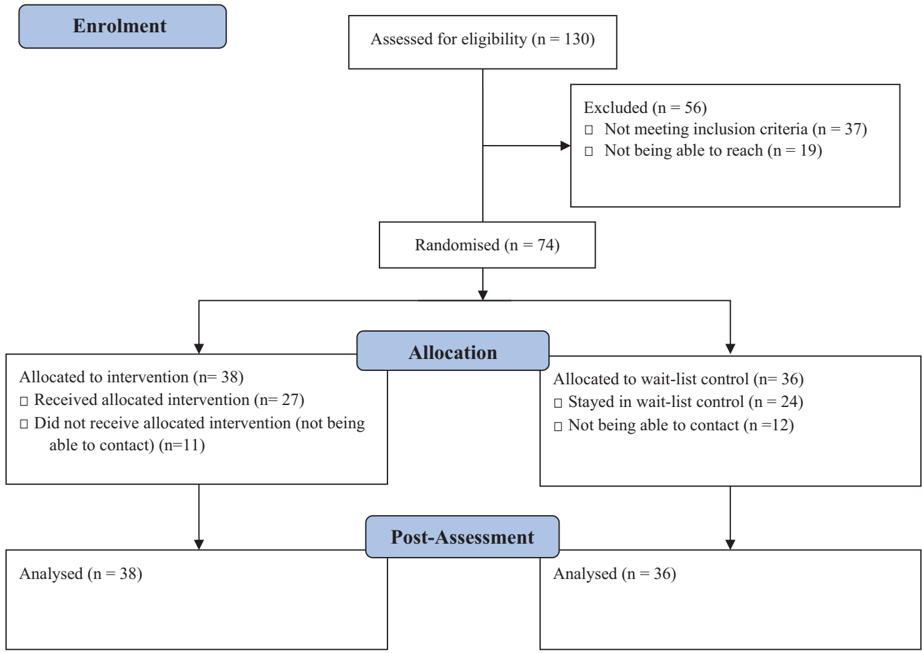
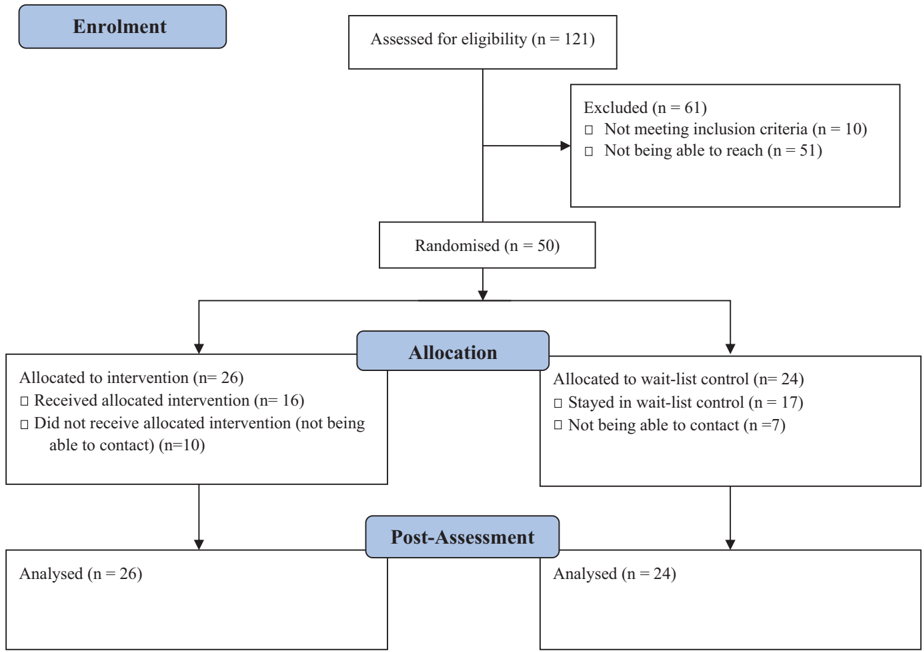
- Turkish sample: 74 eligible (38 DWM, 36 WLC); 51 completed (27 DWM, 24 WLC). Syrian sample: 50 eligible (26 DWM, 24 WLC); 33 completed (16 DWM, 17 WLC). Primary outcome was PHQ-9 postintervention; secondary outcomes were GAD-7, PCL-5 short form, General Self-Efficacy Scale, and AAQ-II.
- Analysis used IBM SPSS 26 with intent-to-treat linear mixed-effects models including fixed effects of group, time, and time × group, plus random subject effect; Cohen d effect sizes were calculated. Power analysis required 64 participants (32 per group) to detect a small-to-medium effect with 80% power at alpha 0.05.
Limitations
- Stated: the study could not reach the predetermined sample size in either sample and was underpowered to detect significant differences on primary and secondary outcome measures. Drop-out rates were 31% and 34%.
- Stated: no Bonferroni adjustment was made for multiple comparisons.
- Evident: two small pilot trials with a short 7-week follow-up, self-report measures, wait-list control, and social-media recruitment; between-group effects were largely non-significant, limiting conclusions about effectiveness.
Model-written summary. Check it against the paper before relying on it.
Integrity signals
Registry
Cites
Statistics
Figures
Verification
Claims the paper makes
3 Valid · 0 Not valid · 5 Not checked · 61 Own results and interpretations
The cited sources support only part of this claim — read each source’s verdict below.
In the paper
“The validated Turkish and Arabic version of the scale showed good psychometric properties (Altun et al., 2019;Easton et al., 2017).”
§ "Doing What Matters in Times of Stress" to Decrease Psychological Distress During COVID-19: A Randomised Controlled Pilot Trial > Psychological Distress Level
What the sources say
- Not checked — no full text of the sourcecites Altun et al., 2019 source
- Partly supportedcites Easton et al., 2017 sourceExperimental — accuracy not yet measured
The Results > Reliability section reports strong internal consistency for the Arabic K10 (Cronbach’s α = 0.88). However, Results > Confirmatory factor analysis reports poor fit for the one-factor K10 model; the two-factor K6 model performed best. The unqualified claim of good psychometric properties for the Arabic K10 therefore overstates the findings. This citation does not need to establish the Turkish version, which has a separate citation. (LLM, conf=0.87)
plain- Asserted: passes — The authors put it forward as true.
- Checkable: passes — It can be checked against evidence.
- Load-bearing: unclear — It is unclear whether the paper’s conclusions depend on it.
- Based: passes — The paper gives a reason why it holds.
A result the paper reports from its own data — it cites no other source for it, so there is none to check. The quote shows it is in the paper.
In the paper
“Between-group comparison was not significant (F[1, 72.66] = 2.31, P = 0.133).”
§ "Doing What Matters in Times of Stress" to Decrease Psychological Distress During COVID-19: A Randomised Controlled Pilot Trial > Secondary Outcomes
plain- Asserted: passes — The authors put it forward as true.
- Checkable: passes — It can be checked against evidence.
- Load-bearing: passes — The paper’s conclusions depend on it.
- Based: passes — The paper gives a reason why it holds.
A result the paper reports from its own data — it cites no other source for it, so there is none to check. The quote shows it is in the paper.
In the paper
“In the Turkish sample, except for PTSD symptoms, none of the impacts on secondary outcomes were significant (see Table 3).”
§ "Doing What Matters in Times of Stress" to Decrease Psychological Distress During COVID-19: A Randomised Controlled Pilot Trial > Secondary Outcomes
plain- Asserted: passes — The authors put it forward as true.
- Checkable: passes — It can be checked against evidence.
- Load-bearing: unclear — It is unclear whether the paper’s conclusions depend on it.
- Based: passes — The paper gives a reason why it holds.
A result the paper reports from its own data — it cites no other source for it, so there is none to check. The quote shows it is in the paper.
In the paper
“These results indicate no significant impact of the intervention on depressive symptoms for this sample.”
§ "Doing What Matters in Times of Stress" to Decrease Psychological Distress During COVID-19: A Randomised Controlled Pilot Trial > Primary Outcomes
hedged- Asserted: passes — The authors put it forward as true.
- Checkable: passes — It can be checked against evidence.
- Load-bearing: unclear — It is unclear whether the paper’s conclusions depend on it.
- Based: passes — The paper gives a reason why it holds.
A result the paper reports from its own data — it cites no other source for it, so there is none to check. The quote shows it is in the paper.
In the paper
“The group comparison at the postintervention narrowly failed to reach significance at the P < 0.05 (F[1, 120.01] = 3.88, P = 0.051).”
§ "Doing What Matters in Times of Stress" to Decrease Psychological Distress During COVID-19: A Randomised Controlled Pilot Trial > Primary Outcomes
plain- Asserted: passes — The authors put it forward as true.
- Checkable: passes — It can be checked against evidence.
- Load-bearing: passes — The paper’s conclusions depend on it.
- Based: passes — The paper gives a reason why it holds.
46 more claims
Create a free account to see all 69 claims and every source verdict.
- Probably not a substantial claim. 7
- It may state two separate claims as one. 14
- The quote only partly states this claim. 2
Statistics that don’t add up
Each reported p-value recomputed from its test statistic and degrees of freedom.
Rated minor: it would not touch a result — a value no result rests on, a p-value that stays on the same side of the significance level, or a conflict that is clerical, resolved elsewhere in the paper, or outside its own findings.
In the paper
“x 2 (3) = 0.833, P = 0.659”
§ "Doing What Matters in Times of Stress" to Decrease Psychological Distress During COVID-19: A Randomised Controlled Pilot Trial > Discussion
Reported p = .659 · recomputed p = .842
Rated minor: it would not touch a result — a value no result rests on, a p-value that stays on the same side of the significance level, or a conflict that is clerical, resolved elsewhere in the paper, or outside its own findings.
In the paper
“t(53) = 1.799, P = 0.712”
§ "Doing What Matters in Times of Stress" to Decrease Psychological Distress During COVID-19: A Randomised Controlled Pilot Trial > Discussion
Reported p = .712 · recomputed p = .078
Rated minor: it would not touch a result — a value no result rests on, a p-value that stays on the same side of the significance level, or a conflict that is clerical, resolved elsewhere in the paper, or outside its own findings.
In the paper
“t(40) = 1.251,P = 0.749”
§ "Doing What Matters in Times of Stress" to Decrease Psychological Distress During COVID-19: A Randomised Controlled Pilot Trial > Discussion
Reported p = .749 · recomputed p = .218
Statistics recomputed
Every reported test result, recomputed from its test statistic and degrees of freedom. A result shows as not adding up only once an independent check has confirmed it.
- Doesn’t add upt(53) = 1.799reported p = .712 · recomputed p = .078
“t(53) = 1.799, p = .712”
- Doesn’t add upχ²(3) = 0.833reported p = .659 · recomputed p = .842
“x 2 (3) = 0.833, p = .659”
- Doesn’t add upt(40) = 1.251reported p = .749 · recomputed p = .218
“t(40) = 1.251,p = .749”
- ConsistentF(1, 65.11) = 4.49reported p = .038 · recomputed p = .038
“F(1, 65.11) = 4.49, p = .038”
- ConsistentF(1, 33.2) = 1.41reported p = .244 · recomputed p = .244
“F(1, 33.20) = 1.41,p = .244”
12 more recomputed tests
Create a free account to see every test the Stats check recomputed.
Self-check
Percentages, sums and reported differences re-computed from the paper’s own numbers.
Each contradiction between two passages listed here was confirmed by an independent check.
Rated minor: it would not touch a result — a value no result rests on, a p-value that stays on the same side of the significance level, or a conflict that is clerical, resolved elsewhere in the paper, or outside its own findings.
In the paper
§ "Doing What Matters in Times of Stress" to Decrease Psychological Distress During COVID-19: A Randomised Controlled Pilot Trial > Secondary Outcomes
“In the Turkish sample, except for PTSD symptoms, none of the impacts on secondary outcomes were significant (see Table 3).”
§ "Doing What Matters in Times of Stress" to Decrease Psychological Distress During COVID-19: A Randomised Controlled Pilot Trial > Discussion
“| DWM | 26.26 (4.30) | 27.97 (4.84) | 1.90 (-0.81-4.61) | 0.168 | 0.39 | 1.70* (0.05-3.35) | 0.044 | 0.37 |”
Rated minor: it would not touch a result — a value no result rests on, a p-value that stays on the same side of the significance level, or a conflict that is clerical, resolved elsewhere in the paper, or outside its own findings.
In the paper
§ "Doing What Matters in Times of Stress" to Decrease Psychological Distress During COVID-19: A Randomised Controlled Pilot Trial > Secondary Outcomes
“None of the other differences in secondary outcomes for Syrian participants (between-or withingroup) were significant (see Table 4).”
§ "Doing What Matters in Times of Stress" to Decrease Psychological Distress During COVID-19: A Randomised Controlled Pilot Trial > Discussion
“| DWM | 32.50 (7.51) | 28.81 (8.40) | 0.96 (-4.98-6.89) | 0.749 | 0.15 | 3.69 † (0.49-6.88) | 0.025 | 0.46 |”
Rated minor: it would not touch a result — a value no result rests on, a p-value that stays on the same side of the significance level, or a conflict that is clerical, resolved elsewhere in the paper, or outside its own findings.
In the paper
“| DWM | 12.35 (5.37) | 10.19 (6.29) | 1.57 (-5.98-2.84) | 0.481 | 0.25 | 2.15 (-0.70-5.01) | 0.134 | 0.37 |”
§ "Doing What Matters in Times of Stress" to Decrease Psychological Distress During COVID-19: A Randomised Controlled Pilot Trial > Discussion
Reported 1.57 · recomputed -1.57
Citations
Cites
Statistical Power Analysis for the Behavioral Sciences
Muller, K. (1989) · Technometrics · doi:10.1080/00401706.1989.10488618 · Cited by 99,167
Statistical power analyses using G∗Power 3.1: tests for correlation and regression analyses
Faul, F., Erdfelder, E., Buchner, A., & Lang, A.-G. (2009) · Behavior Research Methods · doi:10.3758/brm.41.4.1149 · Cited by 37,615
A Brief Measure for Assessing Generalized Anxiety Disorder: The GAD-7
Spitzer, R. L., Kroenke, K., Williams, J. B. W., & Löwe, B. (2006) · Archives of Internal Medicine · doi:10.1001/archinte.166.10.1092 · Cited by 31,765
The Psychological Impact of Quarantine and How to Reduce It: Rapid Review of the Evidence
Brooks, S. K., Webster, R. K., Smith, L. E., Woodland, L., Wessely, S., Greenberg, N., & Rubin, G. J. (2020) · doi:10.2139/ssrn.3532534 · Cited by 16,394
The psychological impact of quarantine and how to reduce it: Rapid review of the evidence
Brooks, S. K., Webster, R. K., Smith, L. E., Woodland, L., Wessely, S., Greenberg, N., & Rubin, G. J. (2020) · The Lancet · doi:10.1016/s0140-6736(20)30460-8 · Cited by 16,378
Correspondence - Tranexamic acid for traumatic brain injury
(2005) · London School of Economics and Political Science Theses Online (London School of Economics and Political Science) · doi:10.1016/s0140-6736 · Cited by 11,894
KESSLER, R. C., ANDREWS, G., COLPE, L. J., HIRIPI, E., MROCZEK, D. K., NORMAND, S.-L. T., WALTERS, E. E., & ZASLAVSKY, A. M. (2002) · Psychological Medicine · doi:10.1017/s0033291702006074 · Cited by 10,327
The PHQ-9: A New Depression Diagnostic and Severity Measure
Kroenke, K., & Spitzer, R. L. (2002) · Psychiatric Annals · doi:10.3928/0048-5713-20020901-06 · Cited by 5,898 · cited 1×
“The primary outcome measure was the Patient Health Questionnaire-9 (Kroenke & Spitzer, 2002).”
Impact of COVID-19 pandemic on mental health in the general population: a systematic review
Xiong, J., Lipsitz, O., Nasri, F., Lui, L. M. W., Gill, H., Phan, L., Chen-Li, D., Iacobucci, M., Ho, R., Majeed, A., et al. (2020) · Journal of Affective Disorders · doi:10.1016/j.jad.2020.08.001 · Cited by 5,204
Bond, F. W., Hayes, S. C., Baer, R. A., Carpenter, K. M., Guenole, N., Orcutt, H. K., Waltz, T., & Zettle, R. D. (2011) · Behavior Therapy · doi:10.1016/j.beth.2011.03.007 · Cited by 3,950 · cited 1×
“Psychological flexibility was assessed using Acceptance and Action Questionnaire-II which includes seven items rated on a seven-point Likert scale (1 = never true, 7 = always true; Bond et al., 2011).”
Research works printed but not linked: 2
- Hemaid, 2016, Psychometric properties of the Palestinian version of the Acceptance and Action Questionnaire-II (AAQ-II) applied in the Gaza strip, International Journal of Psycho-Educational Sciences, 5, 52
- Schwarzer, 1995, Generalized self-efficacy scale., Measures in health psychology: A user’s portfolio. Causal and control beliefs, 35
Cited by
Noha, A.-M. A., Asanov, I., & Buenstorf, G. (2024) · Social Science & Medicine · doi:10.1016/j.socscimed.2024.117442 · Cited by 13
Musotsi, P., Koyiet, P. N., Musimbi, H., Simiyu, K., Chemorei, E., Koskei, P., Evangelidou, S., & Nangukhula, M. (2025) · PLOS Global Public Health · doi:10.1371/journal.pgph.0004712 · Cited by 3
“These findings are consistent with that of Atat-urk et al. (2020) among Turkish nationals and Syrian refugee adults with psychological distress, where DWM resulted in decreased mental health distress [18].”
Metadata
- Authors
- Acarturk, C., Kurt, G., Ilkkursun, Z., Uygun, E., & Karaoglan-Kahilogullari, A.
- Affiliations
- PhD, Department of Psychology, Koc University, Istanbul, Turkey
- PhD, Trauma and Disaster Mental Health, Bilgi University, Istanbul, Turkey
- BA, Department of Psychology, Koc University, Istanbul, Turkey,
- Istanbul Bilgi University (TR)
- MD, WHO Country Office Turkey, Ankara, Turkey
- ORCID
- Uygun, Ersin
- Venue
- Intervention Journal of Mental Health and Psychosocial Support in Conflict Affected Areas
- Published
- 2022-07
- Volume
- 20
- Issue
- 2
- Pages
- 170-178
- ISSN
- 1571-8883 (ISSN-L)
- 1872-1001
- OpenAlex
- W4312691962
- Cited by
- 2
- References
- 50
- Citations by year
- 2025: 1 · 2024: 1
- FWCI
- 0.46
- Type
- journal article
- Language
- en
- Open access
- gold
- doi.org
- Licence
- cc-by-nc-sa
- Locations
- Intervention (publishedVersion, cc-by-nc-sa)
- Digital Collections portal (Koç University) (submittedVersion)
- DOAJ (DOAJ: Directory of Open Access Journals) (submittedVersion, cc-by-sa)
- Funders
- Türkiye Bilimsel ve Teknolojik Araştırma Kurumu (120K440)
- Topics
- Social Sciences › Psychology › Clinical Psychology › COVID-19 and Mental Health
- Social Sciences › Psychology › Applied Psychology › Digital Mental Health Interventions
- Health Sciences › Medicine › Public Health, Environmental and Occupational Health › Maternal Mental Health During Pregnancy and Postpartum
- Keywords
- psychological distress, COVID-19 pandemic, Syrian refugees, depressive symptoms, post-traumatic stress disorder, generalized anxiety disorder, self-efficacy, acceptance and commitment therapy, Turkish adults, refugee mental health
About these checks
Registry, retraction, Cites and statistics results are computed, not judged, with one exception: a printed reference that no index lists is read once by a model before it counts as a citation error. Claims are extracted by a model and kept only when their quote appears verbatim in the text; each cited source is then checked, with a model’s help, for whether it says what the claim relies on. Those verdicts can be wrong — read the claim’s quote and the cited source before relying on one.
The claim verdicts this report counts are experimental: their accuracy is not yet measured.
A language model drew the claims from the paper on 2026-10-11, under version 3 of the claim definition (model deepseek-v4.1-flash, prompt extract-v3).
A second model labelled each claim on 2026-10-11 (model jev-1.13-20260917, definition revision gold-guideline-v0.2).
Cited sources are checked with a language model’s help (gpt-6-sol).
Statistics and arithmetic are recomputed, not judged.
Confidence bands are shown only for fields calibrated on our annotated test set. None is calibrated yet, so no band is shown.
What counts as a claim ›How we measure confidence ›How we check this ›
Are you an author, or do you see a problem with this page? Request a review
How to cite
Cite CoChat for the checks on this page, and the paper for its own findings.
- This page
- CoChat. (2026). Citation check: "Doing What Matters in Times of Stress" to Decrease Psychological Distress During COVID-19: A Randomised Controlled Pilot Trial. https://app.cochat.ai/papers/10.4103/intv.intv_29_21
- The paper
- Acarturk, C., Kurt, G., Ilkkursun, Z., Uygun, E., & Karaoglan-Kahilogullari, A. (2022). "Doing What Matters in Times of Stress" to Decrease Psychological Distress During COVID-19: A Randomised Controlled Pilot Trial. Intervention Journal of Mental Health and Psychosocial Support in Conflict Affected Areas. https://doi.org/10.4103/intv.intv_29_21
Data sources
Bibliographic data: Semantic Scholar, OpenAlex, Crossref.
Contains information from the Semantic Scholar Academic Graph Datasets, made available under the ODC Attribution License (ODC-BY 1.0).
Semantic Scholar’s data is described in: Kinney, R., et al. (2023). The Semantic Scholar Open Data Platform. arXiv:2301.10140.
