

The DOI matches its Crossref record; 17 of the 17 references it cites were found in a registry or an index.
Evaluation of psychometric properties of scales measuring student academic satisfaction: A Systematic review
Open accessAbstract
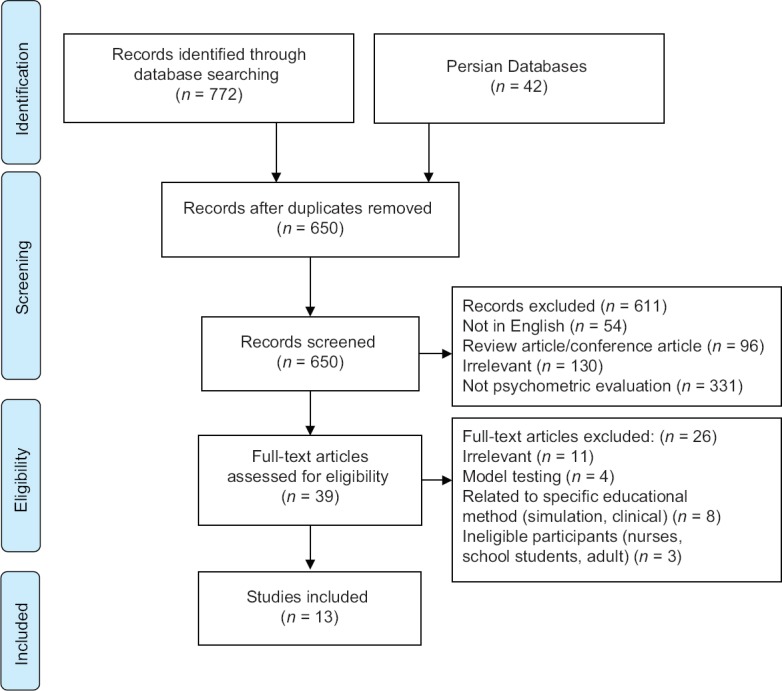
BACKGROUND: Student satisfaction has an impact on student motivation, recruitment of new students, and retention of existing students. Hence, it is important for researchers and academic institutes to assess student academic satisfaction by valid and reliable scales. The aim of this study was to rigorously assess methodological quality and psychometric properties of scales measuring student academic satisfaction. METHODS: In this systematic review, databases including Scopus, PubMed, ProQuest, ScienceDirect, and Web of Science, and two Persian databases were searched using relevant keywords such as academic satisfaction, student satisfaction, university satisfaction, campus satisfaction, academic life experience, validation, and psychometric and factor analysis from 1970 to December 2018. Considering eligibility criteria, studies were selected after titles and abstracts screening. The methodological quality assessment was performed by the COnsensus-based Standards for the selection of health Measurement INstruments (COSMIN) checklist and the Terwee quality criteria. RESULTS: Of 814 retrieved articles, 13 studies were included in the study. Based on the COSMIN checklist, structural validity (84%), content validity (53%), and hypothesis testing (53%) were the most reported properties. One study reported cross-cultural validity, one for criterion validity, and none reported measurement error. CONCLUSION: The results of our study showed that in spite of ≥48 years of development in student satisfaction scales; however, each scale has at least one “poor” psychometric property based on the COSMIN checklist. Quality appraisal of scales is necessary after developing and performing psychometric process.
Overview
The claims and statistics of this paper haven’t been checked yet.
Run the check — free, no account needed. It reads the open-access text and checks the sources it cites.
Integrity signals
Registry
Cites
Statistics
Figures
Verification
Claims the paper makes
The claims and statistics of this paper haven’t been checked yet.
Run the check — free, no account needed. It reads the open-access text and checks the sources it cites.
Claims other papers make about this one
Each is checked against this paper’s own text: does it say what the citing paper says it does?
The cited source says what the claim attributes to it.
In the citing paper
“While the COSMIN tool was originally devised for the medical field, it has since been used in both psychological66,67 and educational research68.”
From A systematic review of AI literacy scales (2024) · cites this paper as [68]
Self-check
Percentages, sums and reported differences re-computed from the paper’s own numbers.
The self-check needs the paper’s full text.
Citations
Cites
Quality criteria were proposed for measurement properties of health status questionnaires
Terwee, C. B., Bot, S. D. M., de Boer, M. R., van der Windt, D. A. W. M., Knol, D. L., Dekker, J., Bouter, L. M., & de Vet, H. C. W. (2007) · Journal of Clinical Epidemiology · doi:10.1016/j.jclinepi.2006.03.012 · Cited by 10,764
Terwee, C. B., Mokkink, L. B., Knol, D. L., Ostelo, R. W. J. G., Bouter, L. M., & de Vet, H. C. W. (2012) · Quality of Life Research · doi:10.1007/s11136-011-9960-1 · Cited by 1,978
Student Satisfaction: An alternative approach to assessing this important concept
Elliott, K. M., & Shin, D. (2002) · Journal of Higher Education Policy and Management · doi:10.1080/1360080022000013518 · Cited by 933
Conceptual Model of Student Satisfaction in Higher Education
Alves, H., & Raposo, M. L. B. (2007) · Total Quality Management & Business Excellence · doi:10.1080/14783360601074315 · Cited by 483
Examining student satisfaction with higher education services
Gruber, T., Fuß, S., Voss, R., & Gläser‐Zikuda, M. (2010) · International Journal of Public Sector Management · doi:10.1108/09513551011022474 · Cited by 441
Relation of Social-Cognitive Factors to Academic Satisfaction in Engineering Students
Lent, R. W., Singley, D. B., Sheu, H., Schmidt, J. A., & Schmidt, L. C. (2007) · Journal of Career Assessment · doi:10.1177/1069072706294518 · Cited by 350
The Measurement and Analysis of College Student Satisfaction
Betz, E. L., Klingensmith, J. E., & Menne, J. W. (1970) · Measurement and Evaluation in Guidance · doi:10.1080/00256307.1970.12022448 · Cited by 85
Validation of the Brief Multidimensional Students' Life Satisfaction Scale Among College Students
Zullig, K. J., Huebner, E. S., Gilman, R., Patton, J., & Murray, K. A. (2005) · American Journal of Health Behavior · doi:10.5993/ajhb.29.3.2 · Cited by 84
Nursing students' satisfaction about their field of study.
Hakim, A. (2014) · PubMed · Cited by 49
Dennison, S., & El‐Masri, M. M. (2012) · Journal of Nursing Measurement · doi:10.1891/1061-3749.20.2.75 · Cited by 41
Research works printed but not linked: 9
- Haghdoost, 2015, Satisfaction of Postgraduate students of Kerman University of medical sciences, Iran, with their training program and campus facilities, Strides Dev Med Educ, 12, 355
- Oliver, 1989, Processing of the satisfaction response in consumption: A suggested framework and research propositions, J Consum Satisf Dissatisfaction Complaining Behav, 2, 1
- Onditi, 2017, Service quality and student satisfaction in higher education institutions: A review of literature, Int J Sci Res Publ, 7, 328
- Noughani, 2015, Correlation between emotional intelligence and educational consent of students of Tehran University of medical students, Tehran Univ Med J, 73, 110
- Mai, 2005, A comparative study between UK and US: The student satisfaction in higher education and its influential factors, J Mark Manag, 21, 859
- Hussain, 2012, Development of the student university satisfaction scale: Reliability and validity, Interdiscip J Contemp Res Bus, 4, 332
- Torkzadeh, 2014, The validation of student's academic satisfaction scale, High Educ Lett, 7, 155
- Chadha, 2017, Measuring international students’ satisfaction with higher education in India: Development & validation of INHedPERF model, Int J Appl Bus Econ Res, 15, 251
- Liu, 2017, Student satisfaction scale development and application for sport management in China, Eurasia J Math Sci Technol Educ, 13, 1429
Cited by
Sorted by citations
A systematic review of AI literacy scales
Lintner, T. (2024) · npj Science of Learning · doi:10.1038/s41539-024-00264-4 · Cited by 292
Metadata
- Authors
- Rahmatpour, P., Sharif Nia, H., & Peyrovi, H.
- Affiliations
- Iran University of Medical Sciences (IR)
- Department of Nursing, School of Nursing and Midwifery Amol, Mazandaran University of Medical Sciences, Sari, Iran
- Corresponding author
- Peyrovi, Hamid
- Venue
- Journal of Education and Health Promotion
- Published
- 2019-12
- Volume
- 8
- Issue
- 1
- Pages
- 256-256
- ISSN
- 2277-9531 (ISSN-L)
- 2319-6440
- PMC
- PMC6967218
- OpenAlex
- W3008233923
- Cited by
- 29
- References
- 17
- Citations by year
- 2026: 2 · 2025: 7 · 2024: 7 · 2023: 8 · 2022: 2 · 2021: 1 · 2020: 2
- FWCI
- 0.36
- Type
- journal article
- Language
- en
- Open access
- gold
- doi.org
- Licence
- cc-by-nc-sa
- Locations
- Journal of Education and Health Promotion (publishedVersion, cc-by-nc-sa)
- PubMed Central (publishedVersion, cc-by-nc-sa)
- PubMed (publishedVersion)
- DOAJ (DOAJ: Directory of Open Access Journals) (submittedVersion, cc-by-sa)
- Topics
- Health Sciences › Nursing › Research and Theory › Health Education and Validation
- Social Sciences › Decision Sciences › Management Science and Operations Research › Psychometric Methodologies and Testing
- Social Sciences › Education › Educational Outcomes and Influences
- Keywords
- psychometric properties, scale validation, structural validity, content validity, measurement error, university students, student retention, student recruitment
About these checks
Registry, retraction, Cites and statistics results are computed, not judged, with one exception: a printed reference that no index lists is read once by a model before it counts as a citation error. Claims are extracted by a model and kept only when their quote appears verbatim in the text; each cited source is then checked, with a model’s help, for whether it says what the claim relies on. Those verdicts can be wrong — read the claim’s quote and the cited source before relying on one.
Statistics and arithmetic are recomputed, not judged.
Confidence bands are shown only for fields calibrated on our annotated test set. None is calibrated yet, so no band is shown.
What counts as a claim ›How we measure confidence ›How we check this ›
Are you an author, or do you see a problem with this page? Request a review
