

The DOI matches its Crossref record; 18 of the 18 references it cites were found in a registry or an index.
Three-Dimensional Automated Volume Calculation (Sonography-Based Automated Volume Count) versus Two-Dimensional Manual Ultrasonography for Follicular Tracking and Oocyte Retrieval in Women Undergoing in vitro Fertilization-Embryo Transfer: A Randomized Controlled Trial
Open accessAbstract
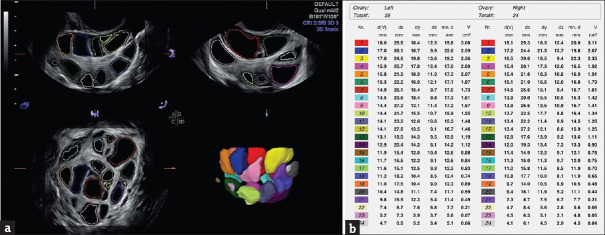
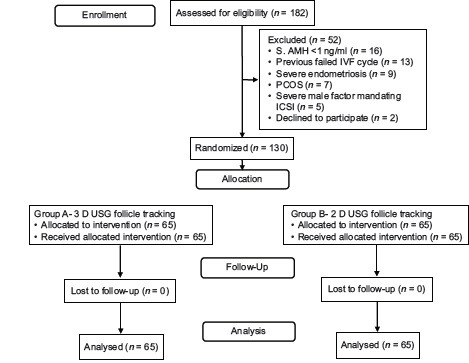
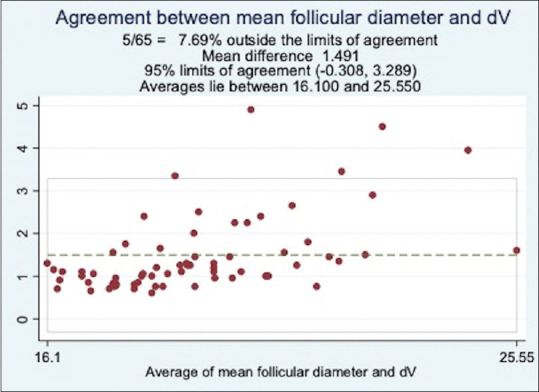
Aim: To compare the oocyte yield using three-dimensional (3D) automated and two-dimensional (2D) ultrasound-based follicle tracking in women undergoing in vitro fertilization-embryo transfer (IVF-ET). Settings and Design: A randomized controlled trial was conducted in the Reproductive Medicine Unit of a teaching medical institute from January 2017 to December 2018. Materials and Methods: A total of 130 patients undergoing IVF-ET were enrolled and randomized into two groups (65 patients in each group). In Group A, follicular tracking during controlled ovarian stimulation (COS) was done using 3D Sonography- based Automated Volume Count (SonoAVC), whereas in Group B, follicular tracking was done by manual ultrasonography (2D USG). The primary outcome measures were the number of oocytes retrieved (the total number and the number of mature oocytes). Secondary outcomes were fertilization rate, cleavage rate, total number of embryos and time taken to perform scans. Other outcome measures were clinical pregnancy rate, miscarriage rate and live birth rate (LBR). Statistical Analysis Used: Chi-square test, Student's t-test, Z-test, Wilcoxon rank-sum test, Bland–Altman's plot. Results: The two groups were comparable with regard to assisted reproductive technology (ART) outcomes. Group B required more time for performing the scan (P < 0.01). Conclusion: Automated SonoAVC ultrasound can be used interchangeably with manual 2D USG for follicle tracking during COS giving comparable ART outcomes with the added advantage of saving time. Our study implies the promising results of applying artificial intelligence in follicular tracking during COS.
Overview
The claims and statistics of this paper haven’t been checked yet.
Run the check — free, no account needed. It reads the open-access text and checks the sources it cites.
Integrity signals
Registry
Cites
Statistics
Figures
Verification
Claims the paper makes
The claims and statistics of this paper haven’t been checked yet.
Run the check — free, no account needed. It reads the open-access text and checks the sources it cites.
Claims other papers make about this one
Each is checked against this paper’s own text: does it say what the citing paper says it does?
The source backs part of the claim, not all of it — or backs it for a different population, condition or comparison.
In the citing paper
“The mentioned limitations included cost-intensified AI-assisted machines and possible reduced image quality in obese patients [223].”
From Evolving the Era of 5D Ultrasound? A Systematic Literature Review on the Applications for Artificial Intelligence Ultrasound Imaging in Obstetrics and Gynecology (2023) · cites this paper as [223]
Experimental — accuracy not yet measuredThe source backs part of the claim, not all of it — or backs it for a different population, condition or comparison.
In the citing paper
“Two included studies, of which one had a prospective, randomized-controlled design, showed increased accuracy of follicle evaluation and reduced examination time by using AI-assisted 2D and 3D US [222,223].”
From Evolving the Era of 5D Ultrasound? A Systematic Literature Review on the Applications for Artificial Intelligence Ultrasound Imaging in Obstetrics and Gynecology (2023) · cites this paper as [223]
Experimental — accuracy not yet measuredThe cited source says what the claim attributes to it.
In the citing paper
“The mentioned limitations included cost-intensified AI-assisted machines and possible reduced image quality in obese patients [223].”
Self-check
Percentages, sums and reported differences re-computed from the paper’s own numbers.
The self-check needs the paper’s full text.
Citations
Cites
Wittmaack, F. M., Kreger, D. O., Blasco, L., Tureck, R. W., Mastroianni, L., & Lessey, B. A. (1994) · Fertility and Sterility · doi:10.1016/s0015-0282(16)57186-6 · Cited by 156
SonoAVC: a novel method of automatic volume calculation
Raine‐Fenning, N. J., Jayaprakasan, K., Clewes, J. S., Joergner, I., Bonaki, S. D., Chamberlain, S., Devlin, L. K., Priddle, H., & Johnson, I. R. (2008) · Ultrasound in Obstetrics and Gynecology · doi:10.1002/uog.5359 · Cited by 121
Ultrasound in the evaluation of normal and induced ovulation
Wallach, E. E., & Ritchie, W. G. M. (1985) · Fertility and Sterility · doi:10.1016/s0015-0282(16)48369-x · Cited by 84
Zaninović, N., Elemento, O., & Rosenwaks, Z. (2019) · Fertility and Sterility · doi:10.1016/j.fertnstert.2019.05.019 · Cited by 56
Automated follicle tracking facilitates standardization and may improve work flow
Raine‐Fenning, N., Jayaprakasan, K., & Clewes, J. S. (2007) · Ultrasound in Obstetrics and Gynecology · doi:10.1002/uog.5222 · Cited by 55
Ata, B., Seyhan, A., Reinblatt, S. L., Shalom‐Paz, E., Krishnamurthy, S., & Tan, S. L. (2010) · Human Reproduction · doi:10.1093/humrep/deq320 · Cited by 51
Automated assessment of ovarian follicles using a novel three-dimensional ultrasound software
Deutch, T. D., Joergner, I., Matson, D. O., Oehninger, S., Bocca, S., Hoenigmann, D., & Abuhamad, A. (2008) · Fertility and Sterility · doi:10.1016/j.fertnstert.2008.08.102 · Cited by 49
Revelli, A., Martiny, G., Piane, L. D., Benedetto, C., Rinaudo, P. F., & Tur-Kaspa, I. (2014) · Reproductive Biology and Endocrinology · doi:10.1186/1477-7827-12-107 · Cited by 49
Raine‐Fenning, N., Deb, S., Jayaprakasan, K., Clewes, J. S., Hopkisson, J. F., & Campbell, B. (2009) · Fertility and Sterility · doi:10.1016/j.fertnstert.2009.02.063 · Cited by 47
Forman, R. G., Robinson, J. N., Yudkin, P., Egan, D. M., Reynolds, K. M., & Barlow, D. H. (1991) · Fertility and Sterility · doi:10.1016/s0015-0282(16)54678-0 · Cited by 45
Cited by
Randomized Clinical Trials of Machine Learning Interventions in Health Care: A Systematic Review
Plana, D., Shung, D. L., Grimshaw, A. A., Saraf, A., Sung, J. J. Y., & Kann, B. H. (2022) · JAMA Network Open · doi:10.1001/jamanetworkopen.2022.33946 · Cited by 236
Hariton, E., Pavlovic, Z. J., Fanton, M., & Jiang, V. S. (2023) · Fertility and Sterility · doi:10.1016/j.fertnstert.2023.05.148 · Cited by 54
Jost, E., Kosian, P., Jimenez Cruz, J., Albarqouni, S., Gembruch, U., Strizek, B., & Recker, F. (2023) · Journal of Clinical Medicine · doi:10.3390/jcm12216833 · Cited by 44
“In total, 11 articles were summarized in this section, including the topics of endometriosis [216,217], premature ovarian failure [218,219], uterine fibroids [220,221], follicle tracking [222,223], and ectopic pregnancies [224,225].”
BackgroundLiang, X., Liang, J., Zeng, F., Lin, Y., Li, Y., Cai, K., Ni, D., & Chen, Z. (2022) · Reproductive BioMedicine Online · doi:10.1016/j.rbmo.2022.07.012 · Cited by 37
Pavlovic, Z. J., Jiang, V. S., & Hariton, E. (2024) · Current Opinion in Obstetrics & Gynecology · doi:10.1097/gco.0000000000000951 · Cited by 25
A review of artificial intelligence applications in in vitro fertilization
Zhang, Q. R., Liang, X., & Chen, Z. (2024) · Journal of Assisted Reproduction and Genetics · doi:10.1007/s10815-024-03284-6 · Cited by 12
Rodríguez-Fuentes, A., Hernández, J., Rouleau, J. P., Martı́n-Vasallo, P., & Palumbo, A. (2024) · Fertility and Sterility · doi:10.1016/j.fertnstert.2024.01.029 · Cited by 5
Lebina, V. A., Shikhalakhova, O. K., Kokhan, A. A., Rashidov, I. Y., Tazhev, K. A., Filippova, A. V., Myshinskaya, E. P., Symolkina, Y. V., Ibuev, Y. I., Mataeva, A. A., et al. (2025) · Obstetrics Gynecology and Reproduction · doi:10.17749/2313-7347/ob.gyn.rep.2025.591 · Cited by 3
Yang, J., Wang, M., Zhou, D., Ye, H., Huang, G., Lian, X., & Zhang, X. (2025) · Journal of Ovarian Research · doi:10.1186/s13048-025-01771-7 · Cited by 2
FollicleFinder: automated three-dimensional segmentation of human ovarian folliclesPreprint
Yamauchi, K. A., Biniasch, M., Franz, L., Gómez, H. F., Geyter, C. D., & Iber, D. (2022) · bioRxiv (Cold Spring Harbor Laboratory) · doi:10.1101/2022.04.08.487638 · Cited by 2
Aydın, G., Ergin, E., Arac, M., Bülbül, M., Çalişkan, E., Hatırnaz, Ş., Dahan, M. H., Malvası, A., & Tinelli, A. (2026) · International Journal of Gynecology & Obstetrics · doi:10.1002/ijgo.71009 · Cited by 1
Preparing the couple for ART: necessary and unnecessary diagnostic tests
Carosso, A. R., Ruffa, A., Evangelisti, B., Mercaldo, N. L., Garolla, A., Foresta, C., Benedetto, C., & Revelli, A. (2023) · Elsevier eBooks · doi:10.1016/b978-0-323-89907-9.00021-1
Three-dimensional follicle measurements: coming soon to a clinic near you?
Hirshfeld‐Cytron, J. (2024) · Fertility and Sterility · doi:10.1016/j.fertnstert.2024.03.025
Artificial Intelligence (AI) in Ovarian Stimulation
Bormann, C. L., & Arkfeld, C. K. (2024) · Elsevier eBooks · doi:10.1016/b978-0-443-21477-6.00228-5
Дмитриевна, Г. Д., Yashchuk, A. G., Gromenko, I. D., & Насырова, С. Ф. (2025) · Vrach · doi:10.29296/25877305-2025-09-02
Kuang, C., Liu, Z., Huang, Y., Xiao, Y., Du, M., & Chen, Z. (2025) · Reproductive BioMedicine Online · doi:10.1016/j.rbmo.2025.105440
Metadata
- Authors
- Malhotra, N., Noor, N., Vignarajan, C., & Vanamail, P.
- Affiliations
- All India Institute of Medical Sciences (IN)
- Corresponding author
- Malhotra, Neena
- Venue
- Journal of Human Reproductive Sciences
- Published
- 2020
- Volume
- 13
- Issue
- 4
- Pages
- 296
- ISSN
- 0974-1208 (ISSN-L)
- PMC
- PMC7879837
- OpenAlex
- W3115070903
- Cited by
- 16
- References
- 18
- Citations by year
- 2026: 1 · 2025: 4 · 2024: 5 · 2023: 3 · 2022: 3
- FWCI
- 1.13
- Type
- journal article
- Language
- en
- Open access
- diamond
- doi.org
- Licence
- cc-by-nc-sa
- Locations
- Journal of Human Reproductive Sciences (publishedVersion, cc-by-nc-sa)
- PubMed Central (publishedVersion, cc-by-nc-sa)
- PubMed (publishedVersion)
- DOAJ (DOAJ: Directory of Open Access Journals) (submittedVersion, cc-by-sa)
- Topics
- Health Sciences › Medicine › Reproductive Medicine › Reproductive Biology and Fertility
- Health Sciences › Medicine › Reproductive Medicine › Reproductive Health and Technologies
- Health Sciences › Medicine › Reproductive Medicine › Ovarian function and disorders
- Keywords
- 3D ultrasound, oocyte retrieval, in vitro fertilization, controlled ovarian stimulation, oocyte yield, artificial intelligence in ultrasound, scan time, live birth rate, assisted reproduction outcomes
About these checks
Registry, retraction, Cites and statistics results are computed, not judged, with one exception: a printed reference that no index lists is read once by a model before it counts as a citation error. Claims are extracted by a model and kept only when their quote appears verbatim in the text; each cited source is then checked, with a model’s help, for whether it says what the claim relies on. Those verdicts can be wrong — read the claim’s quote and the cited source before relying on one.
Statistics and arithmetic are recomputed, not judged.
Confidence bands are shown only for fields calibrated on our annotated test set. None is calibrated yet, so no band is shown.
What counts as a claim ›How we measure confidence ›How we check this ›
Are you an author, or do you see a problem with this page? Request a review
Data sources
Bibliographic data: Semantic Scholar, OpenAlex, Crossref.
Contains information from the Semantic Scholar Academic Graph Datasets, made available under the ODC Attribution License (ODC-BY 1.0).
Semantic Scholar’s data is described in: Kinney, R., et al. (2023). The Semantic Scholar Open Data Platform. arXiv:2301.10140.
