

The DOI matches its Crossref record; 16 of the 17 references it cites were found in a registry or an index.
Prevalence and correlates of cyberchondria among professionals working in the information technology sector in Chennai, India: A cross-sectional study
Open accessAbstract
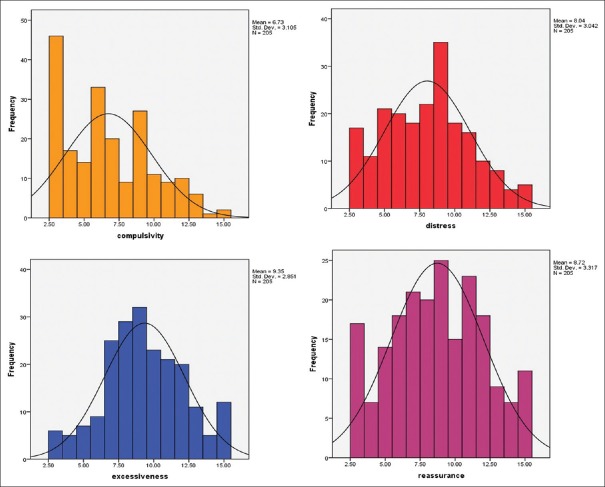
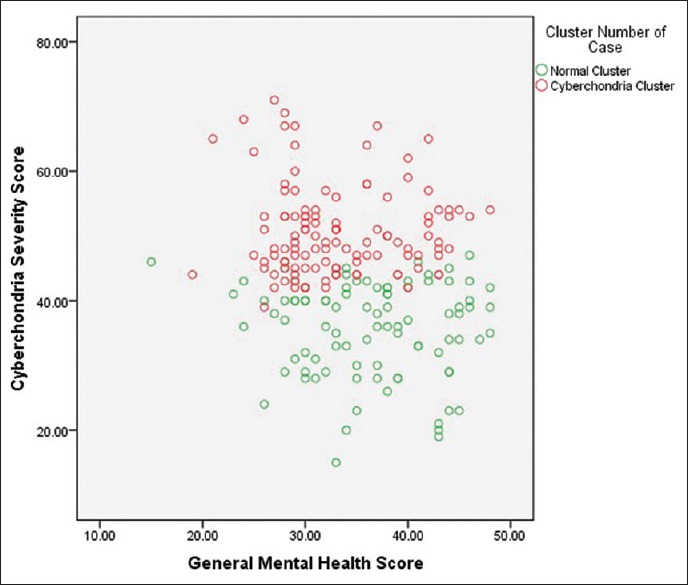
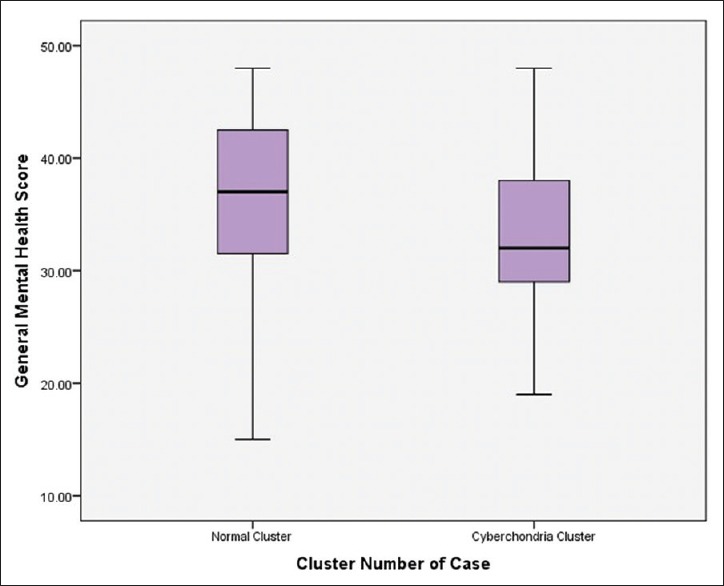
Background: Cyberchondria is the excessive searching of online health information that leads to anxiety and distress. There is scarce information about its prevalence in low and middle-income country settings. Objectives: The objective of the study was to assess the prevalence and factors influencing cyberchondria among employees working in the information technology sector in India. Methods: An emailed questionnaire-based cross-sectional survey was conducted among 205 employees working in various information technology firms in and around Chennai. The data were analyzed using nonhierarchical k-means cluster analysis to group participants with and without cyberchondria on its four subdomains. The association of cyberchondria with general mental health as measured by the General Health Questionnaire 12 was studied using independent sample t-test. Logistic regression analysis was performed to study the association between general mental health and cyberchondria after adjusting for sociodemographic covariates. Results: The prevalence of cyberchondria was 55.6%. The dominant pattern was excessiveness of online searching, requirement of reassurance followed by distress due to health anxiety, and compulsivity. Cyberchondria was negatively associated with general mental health (adj. OR 0.923; 95% CI 0.882-0.967) after adjusting for age, sex, education, and years of service. Conclusions: Cyberchondria is an emerging public mental health problem in India. Since it is associated with poor mental health, measures need to be adopted to evaluate, prevent, and treat it at the population level.
Overview
The claims and statistics of this paper haven’t been checked yet.
Run the check — free, no account needed. It reads the open-access text and checks the sources it cites.
Integrity signals
Registry
Cites
Statistics
Figures
Verification
Claims the paper makes
The claims and statistics of this paper haven’t been checked yet.
Run the check — free, no account needed. It reads the open-access text and checks the sources it cites.
Self-check
Percentages, sums and reported differences re-computed from the paper’s own numbers.
The self-check needs the paper’s full text.
Citations
Cites
Cluster Analysis in Marketing Research: Review and Suggestions for Application
Punj, G., & Stewart, D. W. (1983) · Journal of Marketing Research · doi:10.2307/3151680 · Cited by 2,419
E-mail Survey Response Rates: A Review
Sheehan, K. B. (2006) · Journal of Computer-Mediated Communication · doi:10.1111/j.1083-6101.2001.tb00117.x · Cited by 1,441
Cyberchondria: studies of the escalation of medical concerns in web search
White, R. W., & Horvitz, E. (2009) · ACM Transactions on Information Systems · doi:10.1145/1629096.1629101 · Cited by 546
Cyberchondria: towards a better understanding of excessive health-related internet use
Starcevic, V., & Berle, D. (2013) · Expert Review of Neurotherapeutics · doi:10.1586/ern.12.162 · Cited by 541
The development and initial validation of the cyberchondria severity scale (CSS)
McElroy, E., & Shevlin, M. (2014) · Journal of Anxiety Disorders · doi:10.1016/j.janxdis.2013.12.007 · Cited by 383
Adolescent Health Literacy: The Importance of Credible Sources for Online Health Information
Ghaddar, S. F., Valerio, M. A., Garcia, C. M., & Hansen, L. (2011) · Journal of School Health · doi:10.1111/j.1746-1561.2011.00664.x · Cited by 293
The Cyberchondria Severity Scale (CSS): German Validation and Development of a Short Form
Barke, A., Bleichhardt, G., Rief, W., & Doering, B. K. (2016) · International Journal of Behavioral Medicine · doi:10.1007/s12529-016-9549-8 · Cited by 177
te Poel, F., Baumgartner, S. E., Hartmann, T., & Tanis, M. (2016) · Journal of Anxiety Disorders · doi:10.1016/j.janxdis.2016.07.009 · Cited by 172
Anxiety sensitivity and intolerance of uncertainty as potential risk factors for cyberchondria
Norr, A. M., Albanese, B. J., Oglesby, M. E., Allan, N. P., & Schmidt, N. B. (2015) · Journal of Affective Disorders · doi:10.1016/j.jad.2014.11.023 · Cited by 138
Fergus, T. A., & Russell, L. H. (2016) · Journal of Anxiety Disorders · doi:10.1016/j.janxdis.2016.01.009 · Cited by 116
Research works printed but not linked: 1
- Bhattacharya, 2007, Distress, wellness and organizational role stress among IT professionals: Role of life events and coping resources, J Indian Acad Appl Psychol, 33, 169
Cited by
Sorted by citations
Vismara, M., Caricasole, V., Starcevic, V., Cinosi, E., Dell'Osso, B., Martinotti, G., & Fineberg, N. A. (2020) · Comprehensive Psychiatry · doi:10.1016/j.comppsych.2020.152167 · Cited by 224
“, 2019 [47] IN OA Yes Yes Yes Yes Yes (compromises important everyday”
BackgroundCyberchondria: a systematic review
Zheng, H., Sin, S. J., Kim, H. K., & Theng, Y. (2020) · Internet Research · doi:10.1108/intr-03-2020-0148 · Cited by 83
Unveiling the relationships between cyberchondria and psychopathological symptoms
Arsenakis, S., Chatton, A., Penzenstadler, L. E., Billieux, J., Berle, D., Starčević, V., Viswasam, K., & Khazaal, Y. (2021) · Journal of Psychiatric Research · doi:10.1016/j.jpsychires.2021.09.014 · Cited by 69
Relationship between Health-Anxiety and Cyberchondria: Role of Metacognitive Beliefs
Nadeem, F., Malik, N. I., Atta, M., Ullah, I., Martinotti, G., Pettorruso, M., Vellante, F., Giannantonio, M. D., & Berardis, D. D. (2022) · Journal of Clinical Medicine · doi:10.3390/jcm11092590 · Cited by 60
Fang, S., & Mushtaque, I. (2024) · Psychology Research and Behavior Management · doi:10.2147/prbm.s446448 · Cited by 54
Metadata
- Authors
- Makarla, S., Gopichandran, V, & Tondare, D.
- Corresponding author
- Gopichandran, V
- Venue
- Journal of Postgraduate Medicine
- Published
- 2019
- Volume
- 65
- Issue
- 2
- Pages
- 87-92
- ISSN
- 0022-3859 (ISSN-L)
- PMC
- PMC6515785
- OpenAlex
- W2963554151
- Cited by
- 46
- References
- 17
- Citations by year
- 2026: 6 · 2025: 5 · 2024: 7 · 2023: 8 · 2022: 9 · 2021: 5 · 2020: 6
- FWCI
- 6.81
- Type
- journal article
- Language
- en
- Open access
- diamond
- doi.org
- Locations
- Journal of Postgraduate Medicine (publishedVersion)
- Europe PMC (PubMed Central) (publishedVersion, cc-by-nc-sa)
- PubMed Central (publishedVersion, cc-by-nc-sa)
- PubMed (publishedVersion)
- DOAJ (DOAJ: Directory of Open Access Journals) (submittedVersion, cc-by-sa)
- Topics
- Health Sciences › Health Professions › General Health Professions › Health Literacy and Information Accessibility
- Health Sciences › Medicine › Psychiatry and Mental health › Psychosomatic Disorders and Their Treatments
- Social Sciences › Psychology › Clinical Psychology › COVID-19 and Mental Health
- Keywords
- cyberchondria, prevalence, information technology employees, general mental health, online health information seeking, health anxiety, reassurance seeking, compulsivity, workplace mental health, Chennai
- MeSH terms
- Information Technology, Psychological Distress, Adult, Anxiety, Cross-Sectional Studies, Female, Humans, India, Male, Middle Aged, Surveys and Questionnaires, Prevalence
About these checks
Registry, retraction, Cites and statistics results are computed, not judged, with one exception: a printed reference that no index lists is read once by a model before it counts as a citation error. Claims are extracted by a model and kept only when their quote appears verbatim in the text; each cited source is then checked, with a model’s help, for whether it says what the claim relies on. Those verdicts can be wrong — read the claim’s quote and the cited source before relying on one.
Statistics and arithmetic are recomputed, not judged.
Confidence bands are shown only for fields calibrated on our annotated test set. None is calibrated yet, so no band is shown.
What counts as a claim ›How we measure confidence ›How we check this ›
Are you an author, or do you see a problem with this page? Request a review
